1
Unit 2 语法篇
__________________________________________________________________________________
__________________________________________________________________________________
理解并掌握情态动词can, must, 和have to 的用法
情态动词
can, must 和have to 都是情态动词。情态动词本身有一定的词义,但不能独立作谓语,只能和
动词原形一起构成谓语,表示说话人的语气和态度。
1. can 的用法
can 没有人称和数的变化,其否定形式为can not,可缩写为can’t。can 的过去式是could,用
于一般过去时的句子中。Can 的主要用法:
(1)
表示许可,意为“可以”。例如:
You can do it tomorrow.   你可以明天做。
You can’t go now.  现在你不能走。
(2)
表示请求(对方)许可,意为“能,可以”,一般用于句型“Can I/we…?”,肯定回答
一般为“Yes, you can.”,否定回答一般为“Sorry, you can’t.”。例如:
---Can we leave now?  我们现在可以走了吗?
---Yes, you can.  是的,可以。
(3)
表示能力,意为“能,会”,具体指体力或脑力方面的能力。例如:
I can play basketball.  我会打篮球。
Can you sing well?   你唱歌唱得好吗?
2
2. must 和have to 的用法
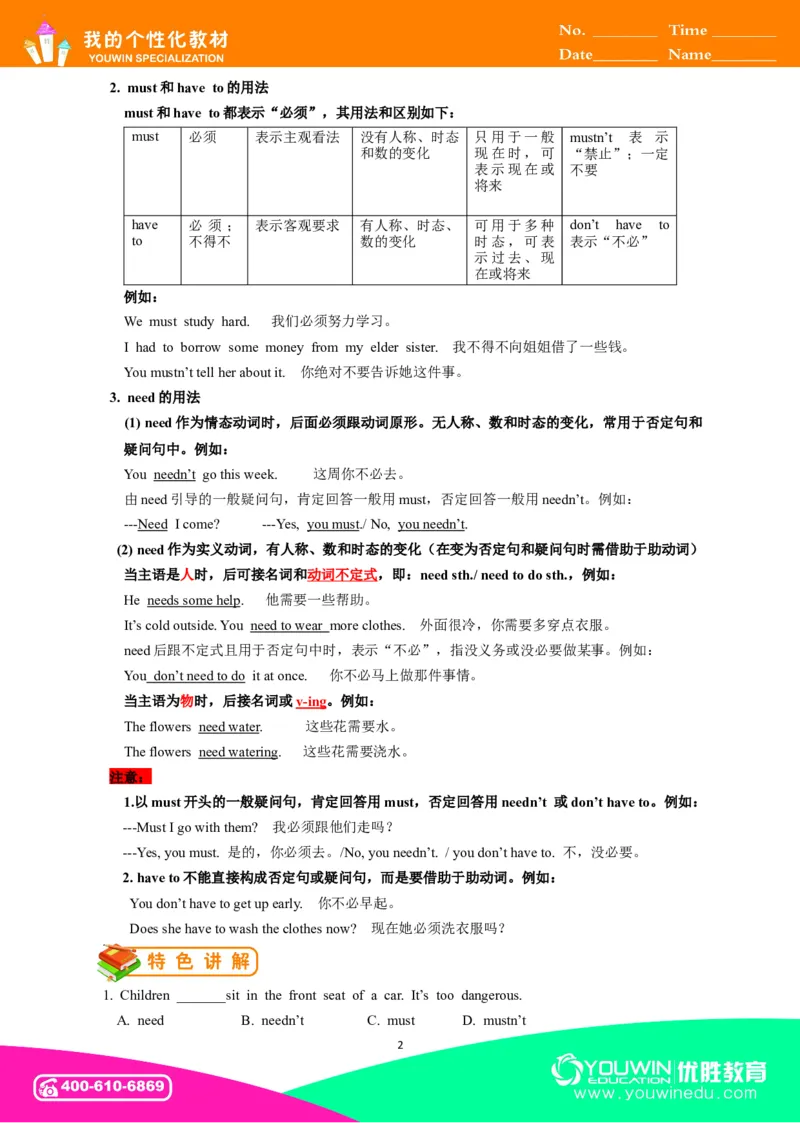
  must 和have to 都表示“必须”,其用法和区别如下:
must
必须
表示主观看法
没有人称、时态
和数的变化
只用于一般
现在时,可
表示现在或
将来
mustn’t
表
示
“禁止”;一定
不要
have
to
必须;
不得不
表示客观要求
有人称、时态、
数的变化
可用于多种
时态,可表
示过去、现
在或将来
don’t have to
表示“不必”
  例如:
  We must study hard.   我们必须努力学习。
  I had to borrow some money from my elder sister.  我不得不向姐姐借了一些钱。
  You mustn’t tell her about it.  你绝对不要告诉她这件事。
3. need 的用法
    (1) need 作为情态动词时,后面必须跟动词原形。无人称、数和时态的变化,常用于否定句和
疑问句中。例如:
You needn’t go this week.     这周你不必去。
由need 引导的一般疑问句,肯定回答一般用must,否定回答一般用needn’t。例如:
---Need I come?      ---Yes, you must./ No, you needn’t.
(2) need 作为实义动词,有人称、数和时态的变化(在变为否定句和疑问句时需借助于助动词)
当主语是人时,后可接名词和动词不定式,即:need sth./ need to do sth.,例如:
He needs some help.   他需要一些帮助。
It’s cold outside. You need to wear more clothes.  外面很冷,你需要多穿点衣服。
need 后跟不定式且用于否定句中时,表示“不必”,指没义务或没必要做某事。例如:
You don’t need to do it at once.   你不必马上做那件事情。
当主语为物时,后接名词或v-ing。例如:
The flowers need water.      这些花需要水。
The flowers need watering.   这些花需要浇水。
注意:
    1.以must 开头的一般疑问句,肯定回答用must,否定回答用needn’t 或don’t have to。例如:
---Must I go with them?  我必须跟他们走吗?
---Yes, you must. 是的,你必须去。/No, you needn’t. / you don’t have to. 不,没必要。
2. have to 不能直接构成否定句或疑问句,而是要借助于助动词。例如:
 You don’t have to get up early.  你不必早起。
 Does she have to wash the clothes now?  现在她必须洗衣服吗?
1. Children _______sit in the front seat of a car. It’s too dangerous.
   A. need           B. needn’t         C. must
    D. mustn’t
3
2. I ________follow you. Would you please repeat it?
   A. can’t           B. don’t          C. needn’t      D. mustn’t
3. We________pay to get into the concert. It’s free.
   A. can’t           B. mustn’t        C. might not    D. don’t have to
4. ---_______you come with me to Lang Lang’s piano concert this evening?
---I’d love to, but I have to study for my math test.
   A. Should             B. May             C. Must           D. Can
5. ---Excuse me, may I keep the book a little longer?
---Sorry. You _____ return it today.
          A. must              B. mustn’t             C. can           D. can’t
        6. ---Look, someone left a book.
          ---Oh, yeah…This book_______be Kitty’s. Only she likes to read this kind of books.
A. can            B. must           C. may        D. might
 7. ---Do we have to finish our homework this afternoon?
---Yes, you_______.
A. must           B. can            C. may        D. need
 8. ---Mr. Wang, can I finish my homework tomorrow?
---Sorry, you_________.
A. can’t           B. don’t          C. needn’t      D. won’t
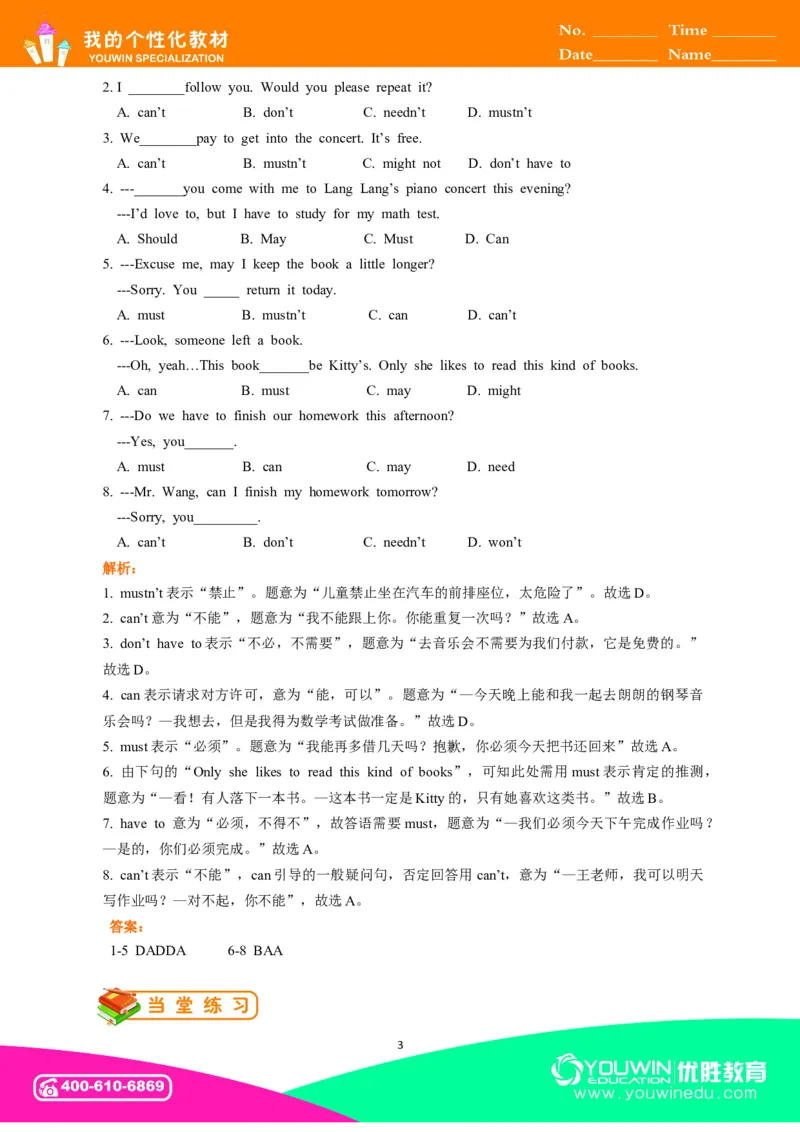
        解析:
1. mustn’t 表示“禁止”。题意为“儿童禁止坐在汽车的前排座位,太危险了”。故选D。
2. can’t 意为“不能”,题意为“我不能跟上你。你能重复一次吗?”故选A。
3. don’t have to 表示“不必,不需要”,题意为“去音乐会不需要为我们付款,它是免费的。”
故选D。
4. can 表示请求对方许可,意为“能,可以”。题意为“—今天晚上能和我一起去朗朗的钢琴音
乐会吗?—我想去,但是我得为数学考试做准备。”故选D。
5. must 表示“必须”。题意为“我能再多借几天吗?抱歉,你必须今天把书还回来”故选A。
6. 由下句的“Only she likes to read this kind of books”,可知此处需用must 表示肯定的推测,
题意为“—看!有人落下一本书。—这本书一定是Kitty 的,只有她喜欢这类书。”故选B。
7. have to 意为“必须,不得不”,故答语需要must,题意为“—我们必须今天下午完成作业吗?
—是的,你们必须完成。”故选A。
8. can’t 表示“不能”,can 引导的一般疑问句,否定回答用can’t,意为“—王老师,我可以明天
写作业吗?—对不起,你不能”,故选A。
答案:
1-5 DADDA      6-8 BAA
4
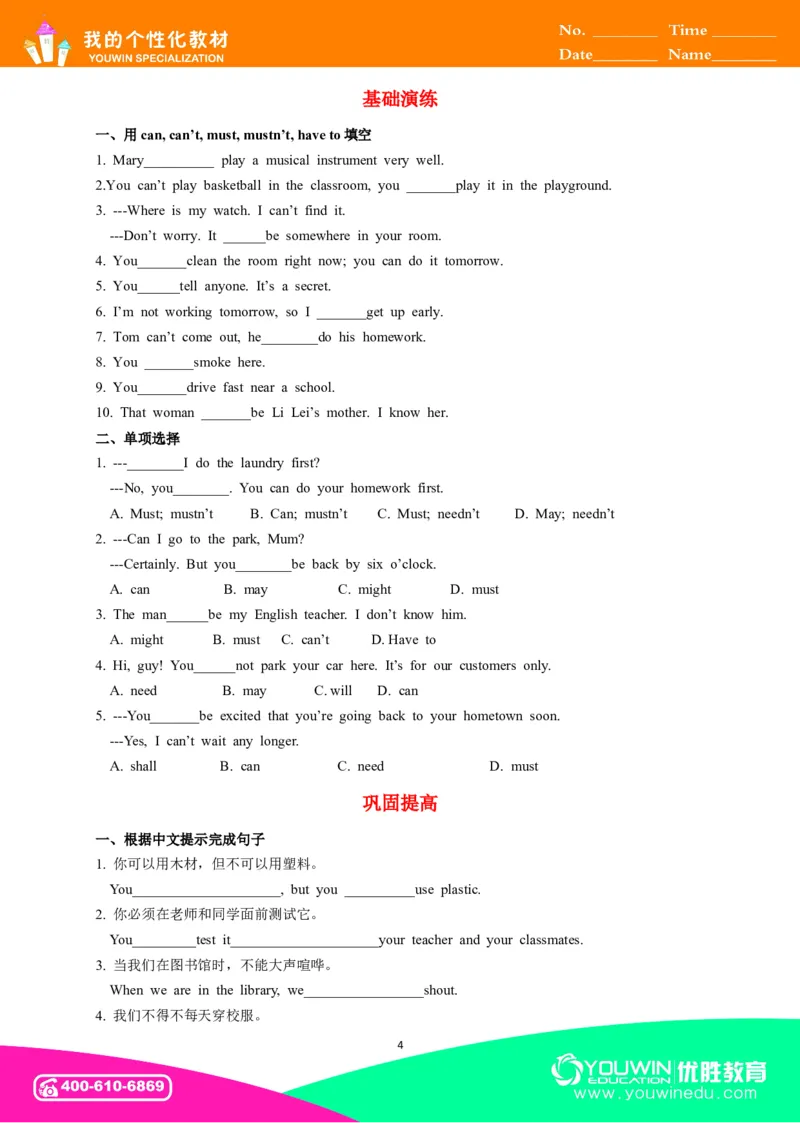
基础演练
一、用can, can’t, must, mustn’t, have to 填空
1. Mary__________ play a musical instrument very well.
2.You can’t play basketball in the classroom, you _______play it in the playground.
3. ---Where is my watch. I can’t find it.
---Don’t worry. It ______be somewhere in your room.
4. You_______clean the room right now; you can do it tomorrow.
5. You______tell anyone. It’s a secret.
6. I’m not working tomorrow, so I _______get up early.
7. Tom can’t come out, he________do his homework.
8. You _______smoke here.
9. You_______drive fast near a school.
10. That woman _______be Li Lei’s mother. I know her.
二、单项选择
1. ---________I do the laundry first?
  ---No, you________. You can do your homework first.
A. Must; mustn’t
  B. Can; mustn’t    C. Must; needn’t     D. May; needn’t
2. ---Can I go to the park, Mum?
  ---Certainly. But you________be back by six o’clock.
  A. can                B. may               C. might             D. must
3. The man______be my English teacher. I don’t know him.
A. might       B. must   C. can’t      D. Have to
4. Hi, guy! You______not park your car here. It’s for our customers only.
A. need
  B. may
   C. will
D. can
5. ---You_______be excited that you’re going back to your hometown soon.
  ---Yes, I can’t wait any longer.
A. shall         B. can           C. need               D. must
巩固提高
一、根据中文提示完成句子
1. 你可以用木材,但不可以用塑料。
  You_____________________, but you __________use plastic.
2. 你必须在老师和同学面前测试它。
  You_________test it_____________________your teacher and your classmates.
3. 当我们在图书馆时,不能大声喧哗。
  When we are in the library, we_________________shout.
4. 我们不得不每天穿校服。
5
  We ______________________ school uniforms every day.
5. 你必须现在回家吗?
  ________you______________now?
6. 你现在不必做作业,你可以明天做。
  You ________________ do your homework now, you__________do it tomorrow.
7. 我们不可以那样跟老师说话。
  We_________________________our teacher like that.
8. 你可以借我的书,但必须按时归还。
  You __________________my book, but you______________it _____________.
9. 你认为学生可以在课堂上睡觉吗?
  Do you think students_______________________________________________?
10. 你可以用木材、纸张,但一定不要用其他的东西。
   You________use_______and_______, but you _______use _______________.
二、翻译
1. 我哥哥花了两周教我弹吉他。
____________________________________________________________________
2.我们通常晚饭后散步。
____________________________________________________________________
3. 孩子们一个接一个地下了公交车。
____________________________________________________________________
4. 我认为Tony 不会讲汉语。
____________________________________________________________________
5. 准时是很重要的。
____________________________________________________________________
答案
基础演练
一、用can, can’t, must, mustn’t, have to 填空
1. can          2. can      3. must     4. Don’t have to    5. mustn’t
6. don’t have to  7. has to    8. can’t     9. mustn’t         10. must
二、单项选择
1-5 CDCDD
巩固提高
一、根据中文提示完成句子
1. can use wood; can’t
2. must; in front of
3.mustn’t
4. have to
5. Must; go home
6
6. don’t have to; can
7. mustn’t speak to
8. borrow; must; on time
9. can sleep in class
10. can; wood; paper; can’t; other things
二、翻译
1. It took my brother two weeks to teach me to play the guitar.
2. We usually take a walk after supper.
3. The children got off the bus one by one.
4. I don’t think Tony can speak Chinese.
5. It is important to be on time.
一、单项选择
1. People__________always be careful with fire, or it can be dangerous.
  A. can             B. needn’t         C. must         D. shouldn’t
2. It rained heavily, so we_______ stay at home watching TV.
  A. could           B. had to           C. must        D. have to
3. Reading everyday can make you_________.
  A. became a superstar                  B. getting clever
C. to have fun                        D. feel good
4. ---Listen! Someone is singing in the next room. Is it Jane?
  ---No, it ______be her. She is at school now.
A. may not         B. mustn’t         C. can’t         D. won’t
5. ______nice the ice cream looks! I can’t wait to taste it.
  A. How a          B. How           C. What a        D. What
6. Look! They are still working on ___________the problem.
  A. solve           B. solved          C. solving        D. to solve
7. The story of Yu Gong is________. I’m ____________in it.
A. interesting; interesting             B. interest; interesting
C. interesting; interested               D. interest; interested
8. They didn’t go to bed________they finished their homework.
A. until           B. after            C. when          D. as soon as
9. According to the new traffic law, everyone in a car_______wear the seat belt.
A. can            B. may            C. must           D. will
10. Our teacher often asks us________questions in groups.
A. discuss         B. to discuss        C. discussing      D. discussed
二、完形填空
7
The Read family comes to a new big city, but Mrs. Read’s son, Bob, is not happy. He
doesn’t have anyone to play with. “Don’t

 1

 !” says his mother, “You will soon make
friends here.”
One morning, there is a
  2
  at the door. Bob’s mother, Mrs. Read, opens it. There stands a
woman with brown hair. It is Mrs. Miller. She comes to borrow some
  3
  . She wants to
  4
cakes. Mrs. Read gives her two. In the afternoon, there is another knock at the door. Mrs. Read
opens it and sees a boy  5

 there. “My name is Jack Miller,” he says, “My mother sends
you this cake and the two eggs.” “Well, thank you, Jack.” Says Mrs. Read, “
  6
  and meet
my son Bob.”
Look! Bob and Jack are having cake and milk. They are playing football. Now they are
  7
! Jack says, “I’m glad you live next door.” Bob says, “I must thank your mother for coming to
8

 eggs.” Jack laughs and tells Bob, “My mother doesn’t want the two eggs, but she wants to
make friends
  9
  your mother.” Bob says, “That’s a funny way to make friends. It’s a (n)
10

  way, too. It can work!”
Only if you’re willing to make friends can you always find some ways.
1. A. worry
      B. frighten       C. excite       D. interest
2. A. shout
      B. cry
       C. knock     D. bark
3. A. cakes
      B. desks
       C. milk
 D. eggs
4. A. cook          B. pay
           C. ask
     D. make
5. A. lifting
      B. sitting
       C. standing
 D. lying
6. A. Come in
      B. Go away
       C. Get out
     D. Turn around
7. A. classmates
  B. enemies       C. friends     D. brothers
8. A. lend
          B. borrow         C. give
     D. take
9. A. into
          B. to
           C. after        D. with
10. A. easy         B. difficult       C. foolish     D. bad
答案
一、单项选择 1-5 CBDCB    6-10 CCACB
二、完形填空1-5 ACDDC    6-10 ACBDA
_________________________________________________________________________________
_________________________________________________________________________________
一、单项选择
1. There is______ wrong with this computer. It doesn’t work.
8
A. something               B. anything                 C. everything                D. nothing
2. ---______ you help me mend the radio?     ---Yes, I can.
A. May                     B. Might                       C. Must                      D. Can
3. ---Which colour do you like _______, blue or green?    ---Blue.
A. good                      B. better                     C. best                       D. the best
4. Tom is a good boy and he writes _________ in his class.
A. careful                  B. the most careful         C. carefully                 D. the most carefully
5. ---Is Mike at home?     ---No. He_______ with his brother.
A. swims                 B. was swimming          C. is swimming            D. swam
 (附:单选1-5,  2014-2015 北京市东城区(南片)八年级上学期期末考试英语试卷)
二、阅读理解
A
Studying in groups is becoming more and more popular in class. It has many advantages. For example,
we can not only save time but also encourage each other when we study in groups.
I still remember when I was in Grade 8, my physics was very poor. I had a really hard time with it.
Once in class, the teachers asked us to discuss it with each other, but I was very shy, I could not do it like
what they told me. My physics teacher encouraged me to face others and talk with someone else bravely.
Then I studied with some classmates together. When I did not understand any questions, they could give me
some advice, I could quickly find out the ways to deal with the problems. After that, I felt very relaxed and
asked my classmates a lot of questions about physics. I did not feel stressed out at all. At last, I finished my
homework by myself for the first time. How excited I was!
Because of studying in groups, I am not worried about physics any more. With my classmates’ help, I
get more confidence. It also gives me more chances to improve myself in many ways. So let’s study
more in groups.
1. ______was poor for the writer in Grade 8.
A. English          B. Physics            C. Maths       D. Geography
2. Why could the author not do it like what they told her?
  A. Because she was very shy.                  B. Because she was afraid.
  C. Because she could not know how to do it.    D. Because she could not know what to do
3. The underlined word “poor” in the passage means________.
  A. 穷的            B. 差的              C. 稀少的      D. 可怜的
4. Which of the following is WRONG in this article?
  A. I felt relaxed after studying in groups.
   B. We can save time and encourage each other when studying in groups.
  C. I was excited because I could finish my homework alone at last.
  D. I am still worrying about physics because of studying with my classmates.
5. What is the best title of the article?
  A. To study in groups                     B. To do homework in groups
9
  C. To study alone                        D. To do homework alone
B
Summer Camps for Children
ZEM, Education Language Summer Camp
Ages: 8-14
You can come to this 2-week camp to learn Spanish in a good environment. There you can take
part in lots of activities, such as camping, swimming and mountain-biking with Spanish children.
Anglia Summer School
Ages: 8-19
Our summer school is something special. You can learn about stage work, such as acting, singing
and dancing. As well as improving these skills you will also be able to learn about teamwork.
Science Camp
Ages: 4-14
Our camp provides the chance for children to make discoveries. It is not only for fun but also
educational. This camp has many activities in areas such as chemistry, nature, and technology.
You can also do plenty of exciting science experiments here.
A Rock Star Camp
Ages: 8-16
This camp is perfect for creating superstars. We are ready to discover and train musical children
who want to become superstars.
6. How many days does the Language Summer Camp last?
A. 7 days
    B. 10 days       C. 14 days        D.15 days
7. Which of the following cannot you learn in Anglia Summer School?
A. Acting        B. Singing       C. Dancing
D. Camping
8. Peter is very interested in animals. Which summer camp do you think he should take part in?
A. A Rock Star Camp
            B. Anglia Summer School
C. Science Camp
            D. ZEM, Education Language Summer Camp
9. If you are fifteen years old this year, how many summer camps can you take part in?
A. One
        B. Two          C. Three         D. Four
10. Where can you probably read this passage?
A. In a book about children’s education
B. On poster about summer activities for children
C. In a magazine about superstars
D. On a website about schools for children
C
When I was seven years old, my family made me an ant farm. First, we put clean sand in a thin glass
box. Then we waited for the ants to arrive.
After the ants were in the glass farm, they started to make tunnels (隧道). I was amazed that each one
knew exactly what to do. Each had its own job.
On the fifth day a tragedy happened. I put my face so close to the glass farm that I knocked it over.
All the tunnels fell down. Although the ants remained alive after their earthquake, one by one they
began to die. I was scared as I watched them give up building their tunnels to carry the bodies to a corner of
10
the farm.
My mother said that the ants were dying of sadness. They simply could not stand that their tunnels
were gone.
Although much time has passed, I still think of that ant farm. Mom had hoped it would teach me about
the natural world, but it taught me much more.
Over the years, I came to realize the importance of teamwork .Working together, the ants were able to
make an amazing world for themselves. I also learned that they should be admired for their hard word.
But there was an even larger lesson that I did not realize until recently: adversity is a natural part of
life, and must be accepted .Unlike the ants ,we cannot give up when we are sad .We have to realize that if a
tunnel is gone, we must building another.
Giving up, I say, is not a good choice.
11. The writer’s family made him an ant farm when he was_________.
A. seven years old                 B. seventeen years old
C. seventy years old                D. six years old
12. After the writer knocked over the glass farm, the ants_________.
A. remained alive at first, but then they began to die one by one
B. were died at once
  C. were all right all the time
  D. were run away
13. Which statement is TRUE according to the passage?
  A. The writer broke the glass box because it made his face dirty.
B. The ants died one by one because the tunnels were destroyed.

C. Unlike people, teamwork is not so important for the ants.
D. Giving up is a good way when we meet trouble.
14. The underlined word “teamwork” in the passage means________.
  A. 小组工作     B. 团队合作     C. 辛勤劳作    D. 不停工作
15. What did the writer come to realize a few years later?
  A. Working together is useless.
      B. Teamwork is important.

C. He can’t accept adversity.      D. Working alone is amazing.
答案
一、单项选择   1-5 ADBDC
二、阅读理解   (A) 1-5 BABDA
(B) 6-10 CDCBB
(C) 11-15 AABBB
11
课程顾问签字:                        教学主管签字: