1
Module 4
______________________________________________________________________________
______________________________________________________________________________
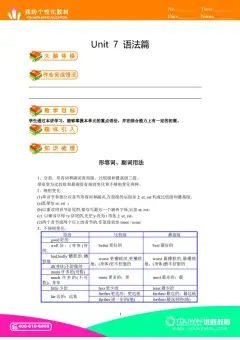
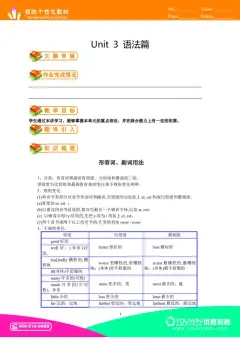
一般将来时:will+do
一般将来时:will+do
表示将来发生的动作或存在的状态,其结构是will+动词原形,常与表示将来的时间状语连用,如
tomorrow,next...,in a few days,in+一段时间,in+将来的年份等。如:
Will you be back in two days?
你将在两天之后回来吗?
They will leave for Shanghai next week.
他们下周将去上海。
当主语是I 或we 时,疑问句中一般使用shall,表示征求对方意见。如?
Where shall we meet tomorrow?
明天我们在哪里见面?
will 表示的是一般将来时,本身没有人称和数的变化。下面将will 的句式总结如下:
        肯定
         否定
     一般疑问
        回答
2
I
will
have
many
books.
I will not (won’t)have
many books.
Will
I
have
many
books?
Yes,I will.
No,I won’t.
You will write a book.
You will not (won’t)
write a book.
Will you write a book?
Yes,you will.
No,you won’t.
He\She will fly kites.
He\She will not (won’t)
fly kites.
Will he\she fly kites?
Yes,he\she will.
No,he\she won’t.
It will happen.
It
will
not
(won’t)
happen.
Will it happen?
Yes,it will.
No,it won’t.
We will win.
We will not (won’t)
win.
Will we win?
Yes,we will.
No,we won’t.
They will clean the
room.
They
will
not
(won’t)clean the room.
Will they clean the
room?
Yes,they will.
No,they won’t.
There will be a party.
There will not (won’t)
be a party.
Will there be a party?
Yes,there will.
No,there won’t.
即:肯定句是:主语+will +动词原形
否定句是:主语+will not (won’t)+动词原形
一般疑问句是:Will +主语+动词原形?
1. Mary__________to the party next weekend.
A.goes
B.will go
C.went
D.has gone
答案:B
解析:本题考查动词时态。由next weekend 可知要用一般将来时。故答案为B。
2. Steven’s parents

      him off at the airport tomorrow.
A.will see
B.saw
C.see
D.has seen
答案:A
解析:本题考查动词时态。由tomorrow 可知要用一般将来时。故答案为A。
3. I


   the film if I am free next Sunday.
A.sees
B.saw
C.will see
D.has seen
答案:C
解析:本题考查一般将来时。If 引导的条件状语从句,当主句是一般将来时的时候,从句用一般现
在时表示将来,即“主将从现”,故选C。
4. Everyone


  a small and light computer in the future.
3
A.had
B.will have
C.has
D.is having
答案:B
解析:本题考查一般经来时。根据in the future“在将来”可知要用一般将来时,故选择B。
5. I


  30 years old in 2040.
A.will be
B.am
   C.was
D.were
答案:A
解析:本题考查一般将来时。根据in+2040,将来的年份可知选择A。
基础演练
单项选择:
1.There


  a heavy rain in Beijing tomorrow.
A. is               B.will be             C.was               D.is going to have
2. —When _______ the Browns leave here?
—Tomorrow morning.
A. Will
B.do
C. does
D. are
3. In a few years’ time, there ________ thousands of trees in my hometown.
A. will have
    B. will be
    C. are have
D. have
4. There will ______ a new library in our school.
A. are
    B. have
    C. be
    D. has
5. —Will there be schools in the future?
—No, there______.
A. isn’t
    B. won’t be           C. won’t
    D. will be not
答案:BABCB

巩固提高
完成句子:
1.将来会有学校吗?
__________there be schools in the__________?
4
2.老师将不再用粉笔在黑板上写字。
The teachers__________ __________on a blackboard with__________.
3.将来的生活会是什么样子?
__________ will life __________ __________ in the future?
4.今天晚上会有暴雨。
There__________ __________ heavy rain in the evening.
5.--学校在未来会有所不同吗?
--是的,它们会。
--Will schools__________ __________ in the future?
--Yes,__________ __________.
答案
1.will ,future
2.won’t write,chalk
3.what ,be like
4.will be
5.be different, they will
单项选择:
1. There _________ three new films in the cinema next month.
A are going to be
B is going to be
C are
        D is
2. ---Will there be more trees in the future ?
 ---________. Because people will plant more and more trees.
A No, there won’t
B Yes, there are
C No, there aren’t
D Yes, there will
3. --______ you _________ free tomorrow ? ---No, I ______ free the day after tomorrow.
A Are; going to ; will
B Are ; going to be ; will
C Are ; going to; will be
D Are; going to be; will be
4. Hurry up ! The train ______in two minutes
A will go
B go
C goes
D went
5
5. Robots ________ the housework in the future
A will help doing
B help to do
C do
D will help to do
句型转化:
1.We’ll send our homework to our teacher by email.(改为同义句)
We__________ __________ __________ send our homework to our teacher by email.
2.Will everyone study at home?(作否定回答)
No,__________ __________.
3.I think that everyone will use computers.(改为否定句)
I__________ __________ that everyone__________ __________ computers.
4.She will visit The Great Wall.(改为一般疑问句)
__________ __________ __________The Great Wall?
5.Everyone is using paper,pens and pencils.(改为一般将来时)
Everyone __________ __________paper,pens and pencils.
完形填空
  A little boy wanted to meet God(上帝), so he started his trip with some cakes and orange juice. On
his way he saw an old woman
  1
  in the park. The boy sat down next to her. The old lady looked
  2
  ,
so he gave her a cake. She
  3
  it thankfully and smiled at him. Her smile was so pretty that the boy
wanted to see it    4

 , so he gave her a bottle of orange juice. Once again she smiled at him. The boy was
very happy! They sat there all afternoon eating and smiling, but they never said a word. As it grew dark, the
boy got up to leave.   5

 he left, he gave her a kiss. She gave him her    6

 smile ever.
When the boy    7

 home, his mother saw the look of joy    8      his face. She asked him, “    9      made
you so happy? ”He answered, “I had lunch with God. She’d got the most beautiful smile. ”The old woman
also returned to her home
  10

  . Her son asked, “Mother, why are you so happy? ”She answered, “I ate
cakes in the park with God. You know, he’s much younger than I expected(想象). ”[来源:
1. A. sat
B. to sit
C. sitting
D. sits
2.A. tired
B. thirsty
C. angry
D. hungry
3.A. pushed
B. answered
C. gave
D. received
4.A. again
B. once
C. too
D. very
5.A. Until
B. Since
C. After
D. Before
6
6.A. biggest
B. the biggest
C. bigger
D. big
7.A. arrived in
    B. returns
C. got
D. got to
8.A. on
B. at
C. with
D. in
9.A. Why
B. What
C. Where
D. Which
10A. happier
    B. happiness
    C. happy
D. happily
答案:
单项选择   ADDAD
句型转换
1.are going to
2.they won’t
3.don’t think,will use
4.Will she visit
5.will use
完形填空: 1--5CDDAD  6--10ACABD
______________________________________________________________________________
______________________________________________________________________________
西城区期末
1.一Whose exam paper is it?
    一It _________ be Li Lei’s.He always forgets to write his name on it.
A.can’t
B.can
C.mustn’t
D.must
2.You can’t go out and play __________ you’ve done your homework.
A.when
B.since
C.while
    D.until
3.—_________ he is only 8 years old,he knows more about science than his father.
A.but
B.Though
C.so
D.because
4.—I remember __________ you somewhere.
    —Yes.We met in Shanghai two years ago.
A.to meet
B.meeting
C.met
D.meet
7
5.一What’s the article about?
—It tells us __________ about nature.
    A.something interesting
B.interesting something
C.anything interesting
D.interesting anything
答案:ADBBA
单项选择:
1.Will students ________ to school every day in the future?
A.goes
B.go
C.gone
D.going
2.It's very kind ________ you to give me so much help.
A.for
B.by
C.of
D.with
3.Can you pass me ________? I can't reach it.
A.chalk
B.a chalk
C.some chalks
D.a piece of chalk
4.There ________ a basketball match on TV tomorrow evening.
A.will be
B.was
C.is
D.will have
5.Planes will be very large so ________ will be very cheap.
A.fly
B.flying
C.to fly
D.flies
6.This bed is too hard. I feel very ________ in it.
A.warm
B.interesting
C.comfortable
D.uncomfortable
7.We ________ going to buy a new car.
A.will
B.are
C.can
D.be
8.— Will ________ any schools in fifty years?
— It's hard to say. Maybe students will study at home.
A.there are
B.there be
C.these are
D.they are
9.The teachers won't write on a blackboard ________ chalk.
A.for
B.by
C.of
D.with
10.I often use ENGLISH-CHINESE DICTIONARY ________ look up new words.
A.to
B.of
C.by
D.for
11.Machines will do the ________ jobs in factories and farms, so no one will do heavy work.
A.interesting
B.fun
C.dull
D.cool
8
12.We'll ________ some milk for coffee.
A.heats
B.heat
C.to heat
D.heating
13.There will ________ lots of free time in the future.
A.have
B.be
C.has
D.is
14.Machines will do heavy work instead ________ people.
A.in
B.of
C.for
D.to
15.Laptops are usually small, ________ they aren't heavy.
A.but
B.so
C.then
D.or
完形填空
O·Henry was a pen name used by an American      1   of short stories. His     2    name was
William Sydney Porter. He was     3    in North Carolina in 1862.     4    a young boy, he lived an
exciting life. He did not go to school for very long, but he tried to teach     5    everything he needed to
know.
When he was about 20 years old, O· Henry went to Texas. There he tried different     6   . He first
worked on newspaper, and then had a job in a     7   .When some money went missing from the bank,
O·Henry was believed to have stolen(偷) it. Because of that, he was     8    to prison(监狱).     9
the three years in prison, he learned to write short stories.
People liked his stories, because they were     10    to understand and they would finish with a
sudden change in the end, to the readers’ surprise.
1. A. clerk
   B. teacher
C. writer
D. doctor
2. A. pen
   B. old
    C. first
D. real
3. A. bore
       B. born
C. bored
D. boring
4. A. to
   B. for
    C. as
D. because
5. A. myself
   B. himself
C. yourself
D. itself
6. A. food
   B. clothes
C. work
D. jobs
7. A. newspaper
   B. hospital
    C. school
D. bank
8. A. send
   B. sent
C. sending
D. to send
9. A. on
   B. for
    C. in
    D. during
10. A. hard
   B. difficult
    C. easy
D. creative
阅读理解
9
    If someone asks you to draw a picture of a robot ,how would it look? Like a person? That's what
most people think about in their minds. But real robots look different.
Some robots have TV cameras for eyes. Some have special parts that help them touch. Many
have computer brains. How robots look depends on(取决于)the job they have to do. Some can
even change their parts so they can do different jobs.
Robots can do boring jobs. They can do dangerous jobs. They can do messy jobs,such as spray(喷
洒)painting. They can do jobs no person could do,such as picking up hot metal.
Robots don't get bored. They don't get tired. They don't mind getting dirty.
Some people think robots will take jobs away from people. But that doesn't have to happen. After
all,people are in charge of(掌管)robots. People must remember that robots are good at some things
and humans are good at others. Robots can do dull jobs so people can do better ones.
1. Some robots have TV cameras to _________.
A. look
  B. touch
C. listen
D. think
2. Paragraph 3 is mainly about ___________ .
A. why robots do boring jobs
B. what robots look like
C. how robots do heavy work
D. what robots can do
3. The writer writes this passage to ___________.
A. help readers to think like robots
B. tell a story about famous robots
C. make readers work harder than before
D. give readers information about robots
单项选择:1--5   BCDAB  6--10  DBBDA   11--15   CBBBB
完形填空:1--5   CDBCB  6--10  DDBDC
阅读理解:ADD
课程顾问签字:                        教学主管签字: