1
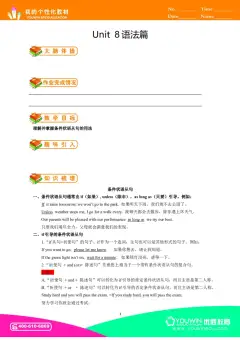
Unit10 语法篇

__________________________________________________________________________________
__________________________________________________________________________________
1.熟练掌握现在进行时的疑问句式的用法
2.熟练掌握一般现在时和现在进行时的区别
现在进行时(II)
1. 现在进行时的疑问句式
(1) 一般疑问句式:Be+主语+v-ing 形式?
回答:Yes, 主语+be/No, 主语+be 的否定形式.
—Is your brother watching TV?  你爸爸正在看电视吗?
—Yes, he is/No, he isn’t.   是的,他在看。/不,他没在看。
(2) 特殊疑问句式:疑问词+be+主语+V-ing 形式?
 What is your sister doing? 你妹妹在做什么?
2. 一般现在时与现在进行时的区别
(1) 一般现在时表示现在的状态,或是主语具备的性格或能力,或陈述客观真理;而现在进行
时表示现在或现阶段正在进行的动作。
(2) 结构不同
一般现在时:主语+be+其他;主语+实义动词+其他;主语+情态动词+动词原形+其他
现在进行时:主语+be+V-ing 形式+其他
(3) 时间状语不同
一般现在时:usually, often, sometimes, always, every day, once a month 等。
现在进行时:now, at the moment, these days 等。
(4) 英语中有些动词如hear, know, like, love, want, have(拥有)等不可用于现在进行时,但可用
于一般现在时。
(5)现在进行时有时可代替一般现在时,表示说话人的某种情绪,使句子具有强烈的感情色彩,
2
常与always(总是), forever(永远)等连用。
You are always forgetting the important thing.  你总是把重要的事情忘掉。
单项选择
1.(北京中考改编)---May I speak to the headmaster(和校长通话)?
---He


  a meeting(会) now. Can I take a message?
A. is having
B. had
C. has
D. will have
2. ---Are you making a lantern?
---


 . I'm helping my mother in the kitchen.
A. Yes, I am
B. No, I don't
C. No, I'm not
D. Yes, I do
3.---Where are your friends?
---


  in the playground.
A. They're playing
B. Yes, they're playing
C. No, they aren't playing
D. They play
4. They

  computer games in the evening because they do their homework.
A. are playing
B. aren't playing
C. don't play
D. play
5.

  people in Moscow going to work at the moment?
A. Do
B. Is
C. Are
D. Can
6.---


 ?
---They are having science lessons in the lab.
A. Are the students having science lesson
B. What are the students doing
C. What do students do in the science lab
D. Can the students have science lessons
7.---Who is in the office?
---Mr. Green. He       a report.
A. is writeing
B. is writing
C. writing
D. wrote
8.---Is Lingling's grandmother cooking the meal?
---No, she       .
A. is
B. isn’t
C. are

D. aren’t
解析及答案:
1. 找关键词法。由now 可知本句时态应为现在进行时,故选A。
2. 现在进行时的一般疑问句用be 动词来提问,就用be 动词来回答;通过答语的下半句判定是否定
回答,故选C。
3. 特殊疑问句不用Yes 或No 来回答;用现在进行时态提问应用现在进行时态回答,故选A。
4. 通过后半句动词do 可判定上文也用一般现在时,根据句意用否定形式。故选C。
5. 由going 和at the moment 可知应用助动词be;people 为集合名词,故选C。
3
6. 由答语用现在进行时可知问句也应用现在进行时来提问,由答语没用Yes 或No 作答,可知问句
是特殊疑问句。故选B。
7. 由对话的情景可知,此处应使用现在进行时,即is writing,故选B。
8. 前面用了No,后面也应使用否定形式,she 是第三人称单数形式,故选B。
基础演练
一、适当形式填空(单句适当形式)
1. He often

   (go) shopping on Sundays.
2. We always

   (have) a good time on Children's Day.
3. He

   (not like) learning English.
4. It's a Chinese lesson. The students

   (write) in the classroom.
5. ---

    Danny and Jenny

    (run) now?
--- No, they aren't.
6. Listen! The bird

   (sing) in the tree.
7. --- It's nine o'clock. What

    Xu Mei

    (do)?
--- She

   (learn) English.
8. Spring Festival

   (finish) at Lantern Festival.
答案:
1. goes
2. have
3. doesn't like
4. are writing
5. Are, running
6. is singing
7. is, doing; is learning
8. finishes
二、适当形式填空(补全对话)
A: Are you busy, Jenny?
B: Yes, I 1.

   (send) an email. I always 2.

   (send) an email to my friend Lily.
A: What are you doing, Mum?
C: I 3.

   (cut) up the tomatoes in the kitchen.
A: Then, 4.

   (be) my father there?
C: No, he 5.

   (wash) his car in the garden.
答案:
1. am sending
2. send
3. am cutting
4. Is
5. is washing
巩固提高
三、按要求转换句型
1. Wu Na is watching a football match now. (改为一般疑问句并作否定回答)


    Wu Na

    a football match now?
4


   , she

   .
2. He's cooking the meal in the kitchen. (对划线部分提问)


    he

    in the kitchen?
3. Grandpa often makes red lanterns. (改为现在进行时)
Grandpa


    red lanterns.
4. The girls are singing in the hall. (改为一般疑问句, 并作肯定回答)


    the girls

    in the hall?
Yes,


   .
5. Everyone is playing happily(高兴地). (改为同义句)
Everyone is

    a good

   .
6. My brothers are watching TV. (改为否定句)
My brothers


    TV.
7. Does he surf the Internet at home every day? (用at the moment 改写句子)


    he

    the Internet at home at the moment?
答案:
1. Is, watching; No, isn't
2. What is, doing
3. is making
4. Are, singing; they are
5. having, time
6. aren't watching
7. Is, surfing
一、单项选择
1. Li Ming's father is

    work now.

A.
 at
B.
 for
C.
 to
D.
 with
2. ---

    at the moment?
--- They're having breakfast.

A.
 What do his brothers do
B.
 Where are his brothers

C.
 What are his brothers doing
D.
 How are his brothers
3. The Great Wall is great. Lots of people

    it every year.

A.
 are visiting
B.
 look
C.
 visit
D.
 are looking
4. His family go to Hainan every year on

    same day.

A.
 a
B.
 an
C.
 the
D.
 /
5. --- Hello! Can I speak to (和……通话) Tony?
---

   .

A.
 I'm Tony
B.
 My name is Tony

C.
 This is Tony
D.
 It's me
5
6. --- Would you like

    football with us?
--- Sure. I like

    football very much.

A.
 to play; playing
B.
 playing; play

C.
 to play; to playing
D.
 playing; to play
7. Look! All the students are busy. They are

    the final exam (期末测试).

A.
 looking for
B.
 getting ready for

C.
 asking for
D.
 leaving for
8. Father Christmas always

    the children presents.

A.
 give
B.
 gives
C.
 is giving
D.
 giving
9. Don't talk here. The baby

   .

A.
 sleep
B.
 is sleeping
C.
 are sleeping
D.
 sleeping
10.

    the students

    to music at the moment?

A.
 Do; listen
B.
 Does; listen

C.
 Are; listening
D.
 Are; listen
答案:1-5 ACCCC
6-10 ABBBC
二、完形填空
    Spring Festival is the Chinese New Year's Day. It usually comes

 1

    January or February.
Everyone in China

 2

    Spring Festival very much. When Spring Festival

 3

   , Li Hong
usually

 4

    his parents clean their house and

 5

    some shopping and other housework. On
that

 6

    everyone in China eats dumplings, New Year's cakes and other good

 7

   . Li Hong
likes New Year's cakes. But Wang Hai says dumplings are

 8

    favourite food. The Chinese people


 9

    the New Year's cakes and dumplings in their houses. How

 10


    they are!
1.
A.
 after
B.
 on
C.
 in
D.
 by
2.
A.
 has
B.
 like
C.
 remembers
D.
 likes
3.
A.
 goes
B.
 comes
C.
 reaches
D.
 hears
4.
A.
 helps
B.
 makes
C.
 gets
D.
 takes
5.
A.
 buys
B.
 does
C.
 goes
D.
 carries
6.
A.
 morning
B.
 evening
C.
 day
D.
 afternoon
7.
A.
 food
B.
 drinks
C.
 vegetable
D.
 fruit
8.
A.
 he
B.
 his
C.
 him
D.
 she
9.
A.
 find out
B.
 buy
C.
 eat
D.
 sell
10.
A.
 happy
B.
 happily
C.
 lovely
D.
 great
答案:1-5 CDBAB
6-10 CABCA
 _________________________________________________________________________________
 _________________________________________________________________________________
一、阅读理解
6
A
    On New Year's Eve, people in Italy(意大利) throw out (扔掉) all the old things, so there are chairs,
beds, clothes and plates in the streets. In Spain(西班牙), the New Year comes more quietly. In the evening
people come together to the streets. Each holds a bag of grapes(葡萄). When twelve o'clock comes, people
start eating the grapes.
    In Japan(日本), people eat noodles on New Year's Eve. This food is said to bring long life(长寿).
Early the next morning, some families climb Mount Fuji. There they watch the first sunrise(日出) of the
New Year.
1. This story is about New Year's Eve in

   .

A.
 Italy
B.
 Spain

C.
 Japan
D.
 all of the above (以上所有的)
2. People in Spain welcome New Year by

    after twelve.

A.
 eating grapes
B.
 eating noodles

C.
 throwing the old things
D.
 watching the sunrise
3. People in both Spain and Japan

    to welcome the New Year.

A.
 throw things away
B.
 get together

C.
 eat some food
D.
 climb a mountain
4. The Japanese climb Mount Fuji to

   .

A.
 look at the stars
B.
 look for New Year's wishes

C.
 see the sun coming up
D.
 have a break
5. The people in

    hope to get long life from their New Year's food.

A.
 Japan
B.
 China
C.
 Spain
D.
 Italy
B
    Thanksgiving Day is an American national(国家的) holiday. It usually lasts(持续) four days.
Americans celebrate it on the fourth(第四) Thursday of November each year. It's a time for people to give
thanks to God(上帝), and it's also a time for family members to get together.
    Thanksgiving Day is like a warm family meeting. On the eve of Thanksgiving Day, members of the
family will drive and even fly home. The next day, they sit around the table, enjoying a traditional dinner
together. A turkey(火鸡), sweet potatoes and a pudding are always ready for the Thanksgiving dinner.
    Thanksgiving Day is also a day for students to give thanks to parents and teachers who give them help
and who love them very much.
6. Thanksgiving Day is a(n)

   .

A.
 French national day
B.
 English national day

C.
 Chinese national day
D.
 American national day
7. How long (多久) does Thanksgiving Day usually last in America?

A.
 For three days.
B.
 For four days.

C.
 For five days.
D.
 For six days.
7
8. Thanksgiving Day is on

    every year.

A.
 the second Tuesday of November

B.
 the third Tuesday of November

C.
 the fourth Thursday of December

D.
 the fourth Thursday of November
9. People have

    on Thanksgiving Day.

A.
 a turkey and a pudding
B.
 sweet potatoes

C.
 both A and B
D.
 noodles
10. Which of the following sentences is TRUE?

A.
 Thanksgiving Day is a time for people to give thanks to God and those who give them
help.

B.
 Thanksgiving Day usually lasts five days.

C.
 Thanksgiving Day usually falls on the third Thursday of November.

D.
 Members of the family often enjoy a traditional dinner on the eve of Thanksgiving Day.
C(辽宁鞍山市2014 年期末试题)
All around the world, people drink tea. But tea does not mean the same thing to everyone. In different
countries people have very different ideas about drinking tea.
In China, for example, tea is always served when people get together. The Chinese drink it at any time
of the day at homes or in teahouses. They prefer their tea plain, with nothing else in it.
Tea is also important in Japan. The Japanese have a special way of serving tea called a tea ceremony
(仪式). It is very old and full of meaning. Everything must be done in a special way in the ceremony.
There is even a special room for it in Japanese homes.
Another tea-drinking country is England. In England, the late afternoon is “teatime”. Almost everyone
has a cup of tea then. The English usually make tea in a teapot and drink it with milk and sugar. They also
eat cakes, cookies and little sandwiches at teatime.
  In the United States people drink tea mostly for breakfast or after meals. Americans usually use tea bags to
make their tea. Tea bags are faster and easier than making tea in teapots. In summer, many Americans drink
cold tea — “iced tea”. Sometimes they drink iced tea from cans, like soda.2
阅读短文,选择正确答案。
11. Iced tea is popular _______.
  A. in winter
 B. for breakfast
C. in England
  D. in the USA
12. The English like to _______.
  A. drink their tea plain
   B. eat cakes and cookies with their tea
  C. have tea with dinner
D. drink their tea in a special room
13. The Chinese drink tea _______.
  A. in a special ceremony
B. only in teahouses
  C. when they get together
D. for breakfast
14. Tea is popular _______.
  A. in Asian countries
B. only in English-speaking countries2
  C. only in the USA
D. all around the world
8
15. The passage is about _______.
  A. Chinese tea
B. different ways of drinking tea
  C. the teatime in England
D. why tea is important
D(天津滨海新区塘沽教育中心2013 年期末试题)
A child’s room is not only a bedroom. You can see computers, mobile phones, televisions, DVD
players, Playstation, and other 21st-century toys. Britain’s 8 to 16-year-olds have bedroom possessions(财
产) about £ 3,300.
But they don’t just have hi-tech toys( 高科技玩具). A child’s room also has expensive clothes,
sunglasses, watches, and sports equipment(装备) 40% of children have a room that is a home office, mini
cinema, and sports hall 90% have a TV, and 70% have a DVD player. 60% have a CD player, iPod, or MP3
player. 25% have their own computers.
With so much to do in their bedrooms, it is no surprise(惊奇) that children spend more time there than
anywhere else in the house. One girl spends so long on her mobile phone in her room that her parents have
to text her to speak to her. Another child goes into his room as soon as he gets home form school and plays
on his Playstation until bedtime.
Children’s bedrooms are their kingdoms(王国). Some families hardly do anything all together. People
eat different meals at different times, and watch different TV programmes in different rooms.
16. ___________ of children can work, watch movies and exercise in their rooms.
  A. 70%              B. 60%
 C. 40%            D. 90%
17. Children spend more time in their rooms because ______________.
  A. they can do what they like
 B. they have much homework
  C. they are tired after school
 D. they don’t like their parents
18. Parents and children __________ together at home.
  A. often eat dinner                            B. usually watch TV
  C. sometimes play games
 D. hardly do anything
答案:一、阅读理解
1-5 DACCA
6-10 DBDCA
11-15 DBCDB
16-18 CAD
课程顾问签字:                        教学主管签字: