1
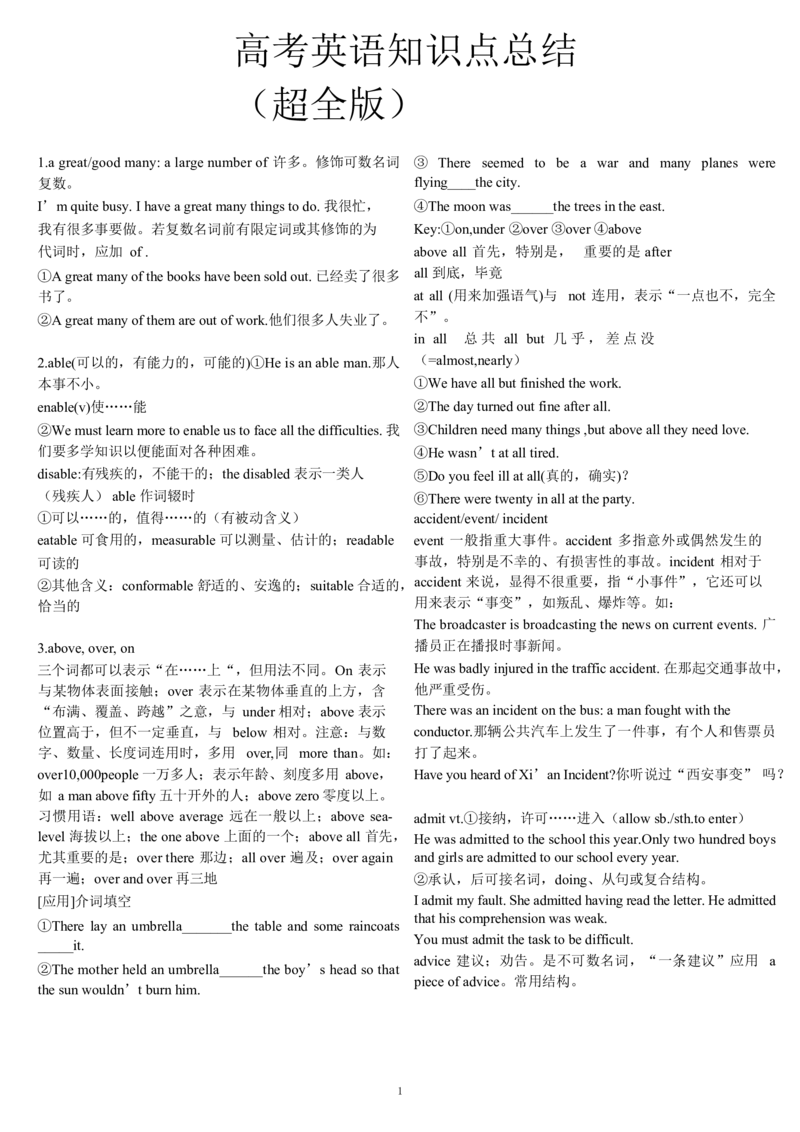
高考英语知识点总结
(超全版)

1.a great/good many: a large number of 许多。修饰可数名词
复数。
I’m quite busy. I have a great many things to do. 我很忙,
我有很多事要做。若复数名词前有限定词或其修饰的为
代词时,应加 of .
①A great many of the books have been sold out. 已经卖了很多
书了。
②A great many of them are out of work.他们很多人失业了。

2.able(可以的,有能力的,可能的)①He is an able man.那人
本事不小。
enable(v)使……能
②We must learn more to enable us to face all the difficulties. 我
们要多学知识以便能面对各种困难。
disable:有残疾的,不能干的;the disabled 表示一类人
(残疾人) able 作词辍时
①可以……的,值得……的(有被动含义)
eatable 可食用的,measurable 可以测量、估计的;readable
可读的
②其他含义:conformable 舒适的、安逸的;suitable 合适的,
恰当的

3.above, over, on
三个词都可以表示“在……上“,但用法不同。On 表示
与某物体表面接触;over 表示在某物体垂直的上方,含
“布满、覆盖、跨越”之意,与 under 相对;above 表示
位置高于,但不一定垂直,与 below 相对。注意:与数
字、数量、长度词连用时,多用 over,同 more than。如:
over10,000people 一万多人;表示年龄、刻度多用 above,
如 a man above fifty 五十开外的人;above zero 零度以上。
习惯用语:well above average 远在一般以上;above sea-
level 海拔以上;the one above 上面的一个;above all 首先,
尤其重要的是;over there 那边;all over 遍及;over again
再一遍;over and over 再三地
[应用]介词填空
①There lay an umbrella_______the table and some raincoats
_____it.
②The mother held an umbrella______the boy’s head so that
the sun wouldn’t burn him.
③ There seemed to be a war and many planes were
flying____the city.
④The moon was______the trees in the east.
Key:①on,under ②over ③over ④above
above all 首先,特别是, 重要的是 after
all 到底,毕竟
at all (用来加强语气)与 not 连用,表示“一点也不,完全
不”。
in all  总共 all but 几乎,差点没
(=almost,nearly)
①We have all but finished the work.
②The day turned out fine after all.
③Children need many things ,but above all they need love.
④He wasn’t at all tired.
⑤Do you feel ill at all(真的,确实)?
⑥There were twenty in all at the party.
accident/event/ incident
event 一般指重大事件。accident 多指意外或偶然发生的
事故,特别是不幸的、有损害性的事故。incident 相对于
accident 来说,显得不很重要,指“小事件”,它还可以
用来表示“事变”,如叛乱、爆炸等。如:
The broadcaster is broadcasting the news on current events. 广
播员正在播报时事新闻。
He was badly injured in the traffic accident. 在那起交通事故中,
他严重受伤。
There was an incident on the bus: a man fought with the
conductor.那辆公共汽车上发生了一件事,有个人和售票员
打了起来。
Have you heard of Xi’an Incident?你听说过“西安事变” 吗?

admit vt.①接纳,许可……进入(allow sb./sth.to enter)
He was admitted to the school this year.Only two hundred boys
and girls are admitted to our school every year.
②承认,后可接名词,doing、从句或复合结构。
I admit my fault. She admitted having read the letter. He admitted
that his comprehension was weak.
You must admit the task to be difficult.
advice 建议;劝告。是不可数名词,“一条建议”应用 a
piece of advice。常用结构。

2
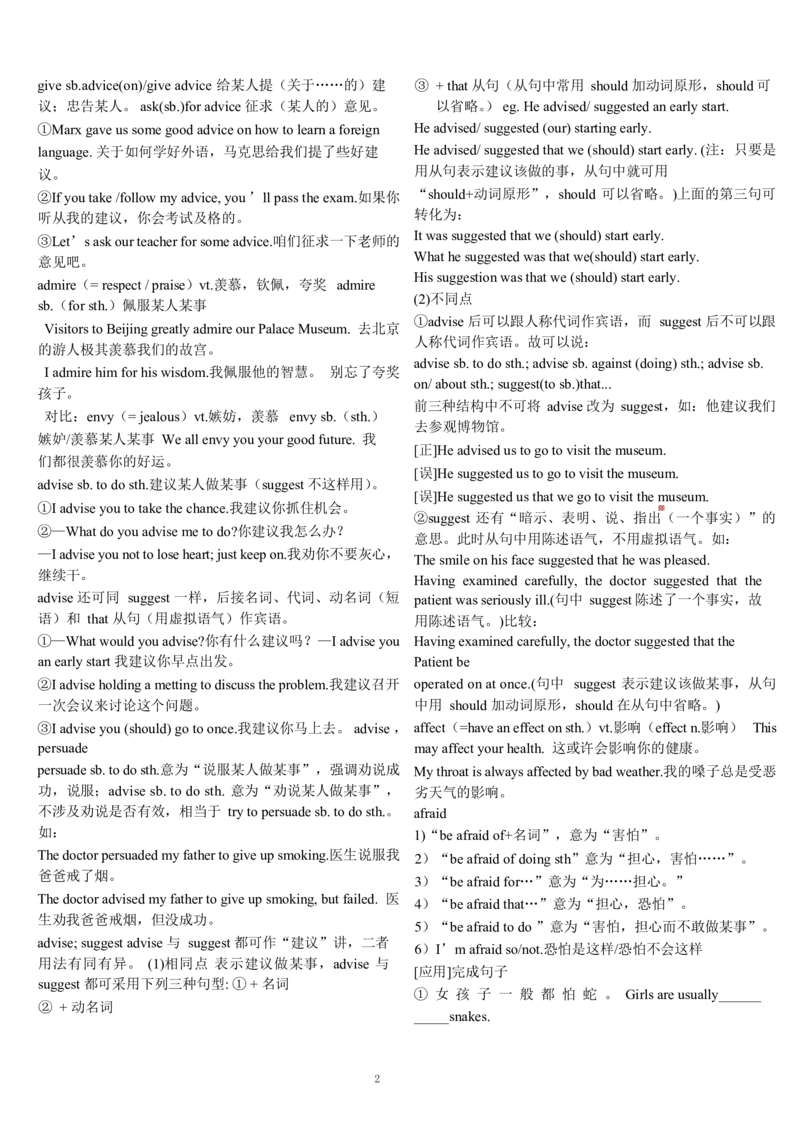
give sb.advice(on)/give advice 给某人提(关于……的)建
议;忠告某人。 ask(sb.)for advice 征求(某人的)意见。
①Marx gave us some good advice on how to learn a foreign
language. 关于如何学好外语,马克思给我们提了些好建
议。
②If you take /follow my advice, you ’ll pass the exam.如果你
听从我的建议,你会考试及格的。
③Let’s ask our teacher for some advice.咱们征求一下老师的
意见吧。
admire(= respect / praise)vt.羡慕,钦佩,夸奖   admire
sb.(for sth.)佩服某人某事
  Visitors to Beijing greatly admire our Palace Museum.  去北京
的游人极其羡慕我们的故宫。
  I admire him for his wisdom.我佩服他的智慧。  别忘了夸奖
孩子。
  对比:envy(= jealous)vt.嫉妨,羡慕   envy sb.(sth.)
嫉妒/羡慕某人某事  We all envy you your good future.  我
们都很羡慕你的好运。
advise sb. to do sth.建议某人做某事(suggest 不这样用)。
①I advise you to take the chance.我建议你抓住机会。
②—What do you advise me to do?你建议我怎么办?
—I advise you not to lose heart; just keep on.我劝你不要灰心,
继续干。
advise 还可同 suggest 一样,后接名词、代词、动名词(短
语)和 that 从句(用虚拟语气)作宾语。
①—What would you advise?你有什么建议吗?—I advise you
an early start 我建议你早点出发。
②I advise holding a metting to discuss the problem.我建议召开
一次会议来讨论这个问题。
③I advise you (should) go to once.我建议你马上去。 advise ,
persuade
persuade sb. to do sth.意为“说服某人做某事”,强调劝说成
功,说服;advise sb. to do sth. 意为“劝说某人做某事”,
不涉及劝说是否有效,相当于 try to persuade sb. to do sth.。
如:
The doctor persuaded my father to give up smoking.医生说服我
爸爸戒了烟。
The doctor advised my father to give up smoking, but failed. 医
生劝我爸爸戒烟,但没成功。
advise; suggest advise 与 suggest 都可作“建议”讲,二者
用法有同有异。 (1)相同点 表示建议做某事,advise 与
suggest 都可采用下列三种句型: ① + 名词
② + 动名词
③ + that 从句(从句中常用 should 加动词原形,should 可
以省略。) eg. He advised/ suggested an early start.
He advised/ suggested (our) starting early.
He advised/ suggested that we (should) start early. (注:只要是
用从句表示建议该做的事,从句中就可用
“should+动词原形”,should 可以省略。)上面的第三句可
转化为:
It was suggested that we (should) start early.
What he suggested was that we(should) start early.
His suggestion was that we (should) start early.
(2)不同点
①advise 后可以跟人称代词作宾语,而 suggest 后不可以跟
人称代词作宾语。故可以说:
advise sb. to do sth.; advise sb. against (doing) sth.; advise sb.
on/ about sth.; suggest(to sb.)that...
前三种结构中不可将 advise 改为 suggest,如:他建议我们
去参观博物馆。
[正]He advised us to go to visit the museum.
[误]He suggested us to go to visit the museum.
[误]He suggested us that we go to visit the museum.
②suggest 还有“暗示、表明、说、指出(一个事实)”的
意思。此时从句中用陈述语气,不用虚拟语气。如:
The smile on his face suggested that he was pleased.
Having examined carefully, the doctor suggested that the
patient was seriously ill.(句中 suggest 陈述了一个事实,故
用陈述语气。)比较:
Having examined carefully, the doctor suggested that the
Patient be
operated on at once.(句中 suggest 表示建议该做某事,从句
中用 should 加动词原形,should 在从句中省略。)
affect(=have an effect on sth.)vt.影响(effect n.影响)   This
may affect your health.  这或许会影响你的健康。
My throat is always affected by bad weather.我的嗓子总是受恶
劣天气的影响。
afraid
1)“be afraid of+名词”,意为“害怕”。
2) “be afraid of doing sth”意为“担心,害怕……”。
3) “be afraid for…”意为“为……担心。”
4) “be afraid that…”意为“担心,恐怕”。
5) “be afraid to do ”意为“害怕,担心而不敢做某事”。
6) I’m afraid so/not.恐怕是这样/恐怕不会这样
[应用]完成句子
① 女 孩 子 一 般 都 怕 蛇 。 Girls are usually______
_____snakes.

3
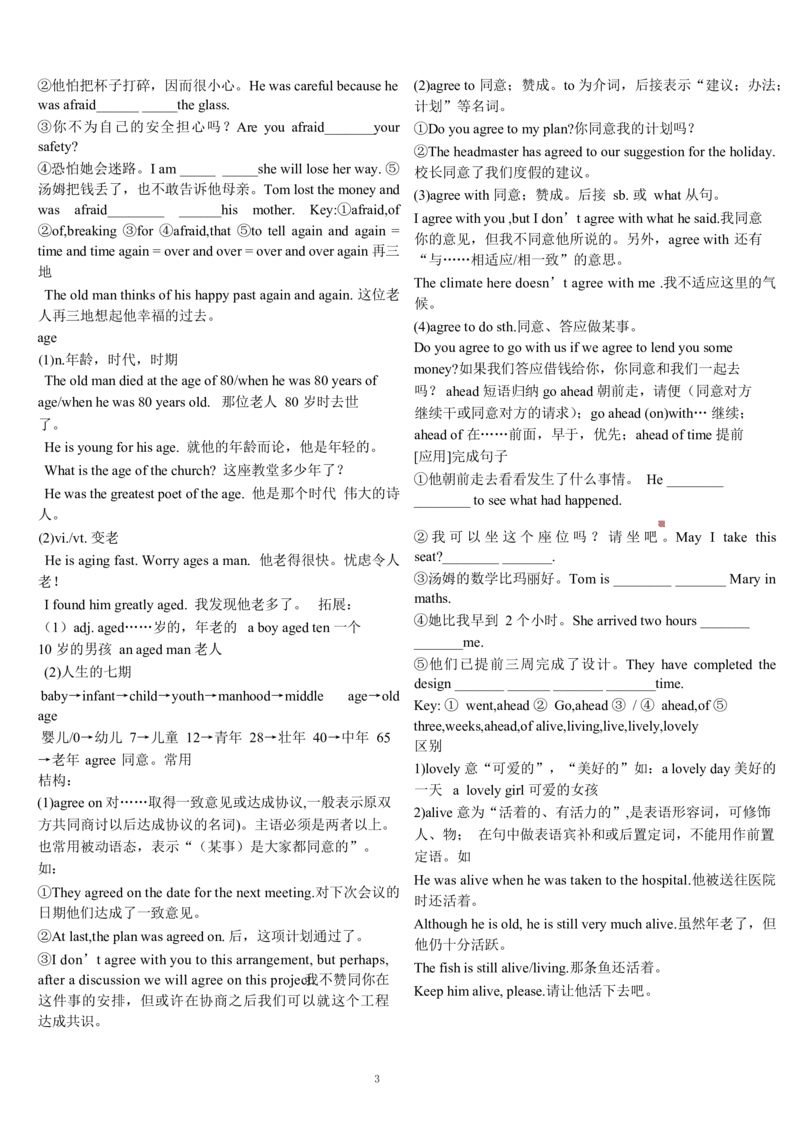
②他怕把杯子打碎,因而很小心。He was careful because he
was afraid______ _____the glass.
③你不为自己的安全担心吗?Are you afraid_______your
safety?
④恐怕她会迷路。I am _____  _____she will lose her way. ⑤
汤姆把钱丢了,也不敢告诉他母亲。Tom lost the money and
was afraid________ ______his mother. Key:①afraid,of
②of,breaking ③for ④afraid,that ⑤to tell again and again =
time and time again = over and over = over and over again 再三
地
  The old man thinks of his happy past again and again. 这位老
人再三地想起他幸福的过去。
age
(1)n.年龄,时代,时期
  The old man died at the age of 80/when he was 80 years of
age/when he was 80 years old.   那位老人 80 岁时去世
了。
  He is young for his age.  就他的年龄而论,他是年轻的。
  What is the age of the church?  这座教堂多少年了?
  He was the greatest poet of the age.  他是那个时代 伟大的诗
人。
(2)vi./vt. 变老
  He is aging fast. Worry ages a man.  他老得很快。忧虑令人
老!
  I found him greatly aged.  我发现他老多了。   拓展:
(1)adj. aged……岁的,年老的   a boy aged ten 一个
10 岁的男孩  an aged man 老人
  (2)人生的七期
 baby→infant→child→youth→manhood→middle
age→old
age
 婴儿/0→幼儿 7→儿童 12→青年 28→壮年 40→中年 65
→老年 agree 同意。常用
桔构:
(1)agree on 对……取得一致意见或达成协议,一般表示原双
方共同商讨以后达成协议的名词)。主语必须是两者以上。
也常用被动语态,表示“(某事)是大家都同意的”。
如:
①They agreed on the date for the next meeting.对下次会议的
日期他们达成了一致意见。
②At last,the plan was agreed on. 后,这项计划通过了。
③I don’t agree with you to this arrangement, but perhaps,
after a discussion we will agree on this project.我不赞同你在
这件事的安排,但或许在协商之后我们可以就这个工程
达成共识。
(2)agree to 同意;赞成。to 为介词,后接表示“建议;办法;
计划”等名词。
①Do you agree to my plan?你同意我的计划吗?
②The headmaster has agreed to our suggestion for the holiday.
校长同意了我们度假的建议。
(3)agree with 同意;赞成。后接 sb. 或 what 从句。
I agree with you ,but I don’t agree with what he said.我同意
你的意见,但我不同意他所说的。另外,agree with 还有
“与……相适应/相一致”的意思。
The climate here doesn’t agree with me .我不适应这里的气
候。
(4)agree to do sth.同意、答应做某事。
Do you agree to go with us if we agree to lend you some
money?如果我们答应借钱给你,你同意和我们一起去
吗? ahead 短语归纳 go ahead 朝前走,请便(同意对方
继续干或同意对方的请求);go ahead (on)with… 继续;
ahead of 在……前面,早于,优先;ahead of time 提前
[应用]完成句子
①他朝前走去看看发生了什么事情。 He ________
________ to see what had happened.

②我可以坐这个座位吗?请坐吧。May I take this
seat?________ _______.
③汤姆的数学比玛丽好。Tom is ________ _______ Mary in
maths.
④她比我早到 2 个小时。She arrived two hours _______
_______me.
⑤他们已提前三周完成了设计。They have completed the
design _______ ______ _______ _______time.
Key: ① went,ahead ② Go,ahead ③ / ④ ahead,of ⑤
three,weeks,ahead,of alive,living,live,lively,lovely
区别
1)lovely 意“可爱的”,“美好的”如:a lovely day 美好的
一天   a  lovely girl 可爱的女孩
2)alive 意为“活着的、有活力的”,是表语形容词,可修饰
人、物;  在句中做表语宾补和或后置定词,不能用作前置
定语。如
He was alive when he was taken to the hospital.他被送往医院
时还活着。
Although he is old, he is still very much alive.虽然年老了,但
他仍十分活跃。
The fish is still alive/living.那条鱼还活着。
Keep him alive, please.请让他活下去吧。

4
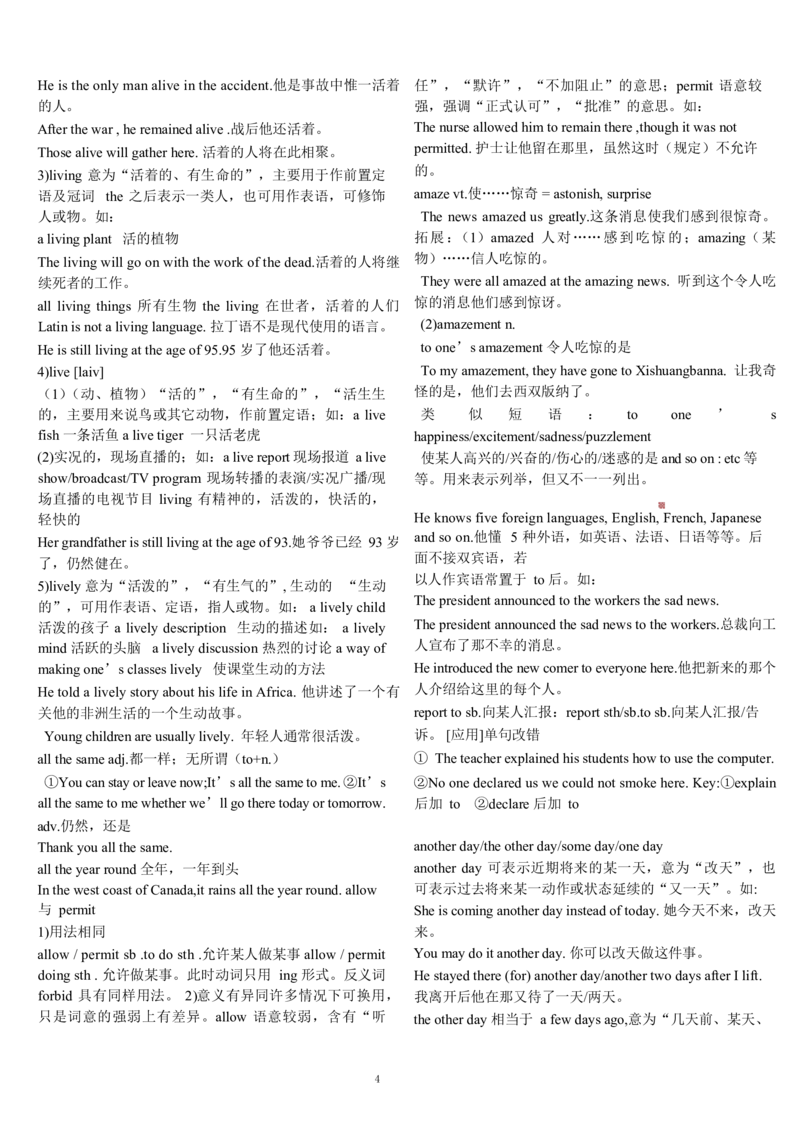
He is the only man alive in the accident.他是事故中惟一活着
的人。
After the war , he remained alive .战后他还活着。
Those alive will gather here. 活着的人将在此相聚。
3)living 意为“活着的、有生命的”,主要用于作前置定
语及冠词 the 之后表示一类人,也可用作表语,可修饰
人或物。如:
a living plant   活的植物
The living will go on with the work of the dead.活着的人将继
续死者的工作。
all living things 所有生物 the living 在世者,活着的人们
Latin is not a living language. 拉丁语不是现代使用的语言。
He is still living at the age of 95.95 岁了他还活着。
4)live [laiv]
(1)(动、植物)“活的”,“有生命的”,“活生生
的,主要用来说鸟或其它动物,作前置定语;如:a live
fish 一条活鱼 a live tiger  一只活老虎
(2)实况的,现场直播的;如:a live report 现场报道 a live
show/broadcast/TV program 现场转播的表演/实况广播/现
场直播的电视节目 living 有精神的,活泼的,快活的,
轻快的
Her grandfather is still living at the age of 93.她爷爷已经 93 岁
了,仍然健在。
5)lively 意为“活泼的”,“有生气的”, 生动的   “生动
的”,可用作表语、定语,指人或物。如: a lively child
活泼的孩子 a lively description  生动的描述如: a lively
mind 活跃的头脑   a lively discussion 热烈的讨论 a way of
making one’s classes lively   使课堂生动的方法
He told a lively story about his life in Africa. 他讲述了一个有
关他的非洲生活的一个生动故事。
  Young children are usually lively.  年轻人通常很活泼。
all the same adj.都一样;无所谓(to+n.)
  ①You can stay or leave now;It’s all the same to me. ②It’s
all the same to me whether we’ll go there today or tomorrow.
adv.仍然,还是
Thank you all the same.
all the year round 全年,一年到头
In the west coast of Canada,it rains all the year round. allow
与 permit
1)用法相同
allow / permit sb .to do sth .允许某人做某事 allow / permit
doing sth . 允许做某事。此时动词只用 ing 形式。反义词
forbid 具有同样用法。 2)意义有异同许多情况下可换用,
只是词意的强弱上有差异。allow 语意较弱,含有“听
任”,“默许”,“不加阻止”的意思;permit 语意较
强,强调“正式认可”,“批准”的意思。如:
The nurse allowed him to remain there ,though it was not
permitted. 护士让他留在那里,虽然这时(规定)不允许
的。
amaze vt.使……惊奇 = astonish, surprise
  The news amazed us greatly.这条消息使我们感到很惊奇。
拓展:(1)amazed 人对……感到吃惊的;amazing(某
物)……信人吃惊的。
  They were all amazed at the amazing news.  听到这个令人吃
惊的消息他们感到惊讶。
  (2)amazement n.
  to one’s amazement 令人吃惊的是
  To my amazement, they have gone to Xishuangbanna.  让我奇
怪的是,他们去西双版纳了。
  类
似
短
语
:
to
one
’
s
happiness/excitement/sadness/puzzlement
  使某人高兴的/兴奋的/伤心的/迷惑的是 and so on : etc 等
等。用来表示列举,但又不一一列出。

He knows five foreign languages, English, French, Japanese
and so on.他懂 5 种外语,如英语、法语、日语等等。后
面不接双宾语,若
以人作宾语常置于 to 后。如:
The president announced to the workers the sad news.
The president announced the sad news to the workers.总裁向工
人宣布了那不幸的消息。
He introduced the new comer to everyone here.他把新来的那个
人介绍给这里的每个人。
report to sb.向某人汇报:report sth/sb.to sb.向某人汇报/告
诉。 [应用]单句改错
① The teacher explained his students how to use the computer.
②No one declared us we could not smoke here. Key:①explain
后加 to    ②declare 后加 to

another day/the other day/some day/one day
another day 可表示近期将来的某一天,意为“改天”,也
可表示过去将来某一动作或状态延续的“又一天”。如:
She is coming another day instead of today. 她今天不来,改天
来。
You may do it another day. 你可以改天做这件事。
He stayed there (for) another day/another two days after I lift.
我离开后他在那又待了一天/两天。
the other day 相当于 a few days ago,意为“几天前、某天、

5
那天、不久前”,句中用一般过去时。如:
I met her in the street the other day.几天前我在街上碰见过她。
I bought the watch the other day.这手表我是几天前买的。
some day 指将来“总有一天、有朝一日、终将、(日后)
某一天”,谓语动词用一般将来时.如:
Your wishes will come true some day.总有一天你的愿望会实
现的。
Some day you’ll have to pay for what you have done. 总有一天
你要为你的行为而付出代价的。
one day 可以表示“(过去)某一天”,谓语动词常用一
般过去式;也可表示“(将来)某一天”,这时可与
some day 互相代替,谓语常用一般将来时。如:
One day I went to see my first teacher ,but he happened to be out.
有一天,我去看我的启蒙老师,可碰巧他出去了。
He will understand the teacher one day/some day.将来有一天,
他会理解老师的。
anxious, eager
两个词均有“渴望,急于”之意。anxious 着重指焦急、
着急或担心;而 eager 着重指对成功的期望或进取的热情。
两者都多用作表语,其主语通常是人,不能以无生命的事
物作主语。对比:
He is eager to join the army.他渴望参军。
He is anxious to know whether he has been chosen. 他急于知道
是否被选上了。
常用搭配:
①be anxious to do sth.渴望急切地做某事;be anxious for 渴
望(了解、得到);
be anxious about 担心,对……感到不安
②be eager to do sth.急切地想做某事; be
eager for (about, after)渴望,渴求, be
eager for your help 渴望得到你的帮助; be
eager about peace 渴望和平
①学生们都急切地想知道考试结果。
The students ________ ________ ________ ________ the
results ofthe examination.
②那个小男孩渴望得到一台新录音机。The little boy was
________ ________a new recorder.
③我很担心我儿子的健康。I’m ________ ________my son’
s health.
④他殷切希望女儿的成功。He is __________ _________ his
daughter’s success.
Key:①are, anxious(eager),to ,know②anxious(eager),for③
anxious, about④eager, for(about, after) apologize for doing
sth.
apologize 是不及物动词,意为“道歉”,其表达式为
“apologize to sb.for sth.”。如:
You must apologize to your sister for being so rude.它的名词
形式是 apology, 复数形式是 apologizes. make one’s
apologies to sb. for sth.= make an apology to sb.
for sth.如:
He make his apologies to me for coming late. appear
As a result, it appered to scientists on earth that the stars had
moved.因此,地球上的科学家看来,恒星好像是移动了。
句型:It appears/seems(to sb.) +that—clause.看来/似乎是……
①It appears to me that something is wrong.我看好像有点不大
对头。
②It appears that he will the prize.看来他会得笑。
appear;seem;look
appear, seem, look 都有“看起来
似……”之
意,但其暗含意思和用法又各有不
同。从意义上
讲:
(1)appear 强调外表给人的印象,有时含实质上并非如此的
意思,如:
He appears to know more than he really does。他看起来好像
懂得很多。(其实懂得没有那么多)
(2)seem 暗示有一定根据的判断,这种判断往往接近事实,
如:
His health seems to be better.他的健康状况似乎有所好转。
(3)look 着重由视觉得出的印象,如:
He doesn’t look his age.他看起来比实际年龄年轻(或老成)。
从用法上讲:
seem 和 appear 后可加
(to + be)+表语(adj.或 n.或 prep.)
+to v.
It + ~ +(that)从句如:
He seems/appears(to be)very sad today.=It seems that he is
very sad today.
It seems like years since I saw you last time.
He seems a kind doctor.(=It seems that he is a kind doctor.)
He seems/appears to have caught a cold.=It seems/appears that
he has caught a cold.
look 当“看起来似乎…和 as if 从句。如:
He looks strong.
She looks like her mother.
高考直通车整理

6
It looks as if we are going to miss the train.…”讲时,可接形
容词、过去分词、名词、介词短语
area; district
(1)
area 表示“地区、区域”,是普通用词,暗示一
个较大的,可能是没有清楚界限的地区,不能用来指行政
上的地理单位。如:
The old man lives in a mountain area.这位老人生活在山东。
This is a less developed area.这是个欠发达地区。
Most of the large land areas are connected.多数大块陆地是相
连的。
(2)
district 表示“区、地区、区域”,指为行政管理
或选举之目的所分的区。在同一城市,各种性质不同的区
域也
叫 district。如:
Where is the District of Columbia?哥伦比亚特区在什么地方?
The old man used to work in the jin-Cha-Ji Military District. 那
位老人曾经在晋察冀军区工作。
The northeast part of the city is the residential district.这城市的
东北部是住宅区。
Arm take…in one’s
arms
该结构意为“拥抱”。如:
He went into classroom, taking some books in his arms.
As a child….:As/When he was a child…,小的时候,该句型
中的 as 为连词,意为“在……的时候”,引导时间状语
从句。当从句与主句主语一致,且从句谓语为 be 时,可
将从句主语及 be 省略。
①Even as(he was)a student,Professor Smith showed great
interest in maths.甚至上学的时候,史密斯教授对数学就很
感兴趣。
②As(he was)a boy,he liked playing table tennis with the grown-
ups.小时候,他就喜欢和大人们打乒乓球。 as a result 作为
结果,结果(发生某情况),可置于句首,也可置于句末
She got up very early. As a result, she was able to catch the early
bus.她起得很早,因此她赶上了早班车。
He has won the game. He is in high spirits as a result. 他赢了比
赛,所以他精神高昂。
He runs every day .As a result , he has lost weight . 他每天跑步,
结果他减肥了。
as a result of 作为……的结果,as a result of……的结果是
As a result of exercise , he has built up his health.
 The flight was delayed as a result of typhoon.该次班机因台风
而延误
result in = lead to 导致,造成……结果,如:
Hard work results in success.努力终归成功。(= Success
results from hard work.成功来自努力) Hard work results in
success. 勤奋才会成功。
result from 由……产生的结果,如:
Success results from hard work. 成功来自勤奋。
His illness resulted from overwork.  他的病起因于操劳过渡。
as…as
as many as 和……一样多/多达;as much as 和……一样多
/多达(注意:many 指可数的量,much 指不可数词的量);
as high as 和……一样高/高达;as thick as 和……一样厚/
厚达;as long as 一样长/长达;as deep as 一样深/深达;as
early as 一样早/早在……时候,如:
We have as many books as they.我们的书和他们的一样多。
/The great fire burned down as many as twenty buildings.大火
烧毁的大楼多达 20 座。
[应用]汉译英
①新桥与旧桥一样长。/这种鱼可长到长达 15 英尺。
②这座山和远处的另一座一样高。/这座山高达 4000 米。

Key:①The new bridge is as long as the old one./The kind of fish
can grow as long as 15 feet.
② This mountain is as high as another one in the
distance./This mountain is as high as 4,000 metres. as…as
possible:as…as one can 尽可能地……. ①I’ll come back
as soon as possible.我尽可能地……
②Get up as early as possible tomorrow morning. 明天早晨尽量
早起。
as...as...用法小结
(1)...as+形容词(副词)原级+as...;not as/so+形容词(副
词)原级+as...
Their factory is as large as ours.他们的工厂和我们的一样大。
I study as hard as you.我和你一样用功学习。
He doesn’t get up as/ so early as his parents.他不像他父母那
样早起床。
(2)……倍数 +  as + 形容词(副词)原级+as...
Line AB is 3 times as long as Line CD.=Line AB is twice longer
than/3 times the length of Line CD.线段 AB 是线段
CD 长的 3 倍。
(3)as + 形容词 + a/an + 单数可数名词 + as; as + 形容词+
复数名词 + as
She is as good many records as possible.我们需要尽量多的唱
片。
There is as much sugar in it as eight pieces of sugar.其中的含糖
量相当于八块方糖。

7
I have’t got as much money as I thought.我没有原来想象的
那么多钱。
(5) as much/ many as 多达……,……那么多
On Sports Day, during the relay race, you will use most of all,
perhaps as much as 650 calories an hour.在运动会上,进行接
力赛跑时,你消耗的能量 多,可能每小时多达 650 卡。
As many as 700 different languages are spoken in Africa.非洲有
多达 700 种不同的语言。
He didn’t catch as many as he’d hoped.他没有捉住预想的
那么多。
(6) as...as possible; as... as one can
 The teacher should write the words on the blackboard as
carefully as he can. =The teacher should write the words on
the blackboard as carefully as possible.老师在黑板上应尽可
能仔细地把字写好。
Please be as friendly as possible to your friends.=Please be as
friendly as you can.请对你的朋友尽可能友好。
(7) as...as + 年代数字/名词
As early as 1950 I knew him.早在 1950 年我就认识他了。
He walked as far as the post office.他步行到邮局。
(8) as/so far as I know
As/ So for as I know, he will be away from home for 3 months.
就我所知,他将要离家 3 个月。
(9) as soon as—……就……
Please let us know as soon as you arrive in Bejing.一到北京,
请通知我们一声。
(10)as well as 和;也;还有
He gave me money as well as advice.他除了给我忠告外,还
给我钱。
He studies French as well as English.他不但学习英语,而且学
习法语。
(11)as/so long as 只要;如果
You may use that dictionary as long as you take care of it.只要
你好好保存,你可以用那本词典。
as a matter of fact=in fact 事实上、实际上……
It seems easy,but as a matter of fact,it’ll take us a long time to
work it out. 这道题貌似简单,实际上要解出的话很费时
间。区别下列用法
1)as(so)far as 和……一样远,远至(原级比较或表示距离);
就……来讲
2)as(so)long as 和……一样长(原级比较);只要(引导条
件
状语从句)
3) as well as 和……一样好;既……也……(连接并列成分)
4) as good as 和……一样好;事实上(作状语)
[应用]完成句子
①他们实际上已经答应帮助我们了。They have ________
_______ ______ promised to help us.
②油漆后的这辆自行车和新的一样。Painted, this bike is
_______ _____ ______ a new one.
③小李英语说得和汉语一样好。 Xiao Li speaks
English______ ______ _____ she speaks Chinese.
④他和他的父母对我都很好。 He _______ ______
______his parents is kind to me.
⑤晚饭后我们一直到走山脚下。 After supper we
walked______ _____ ______the foot of the hill.
⑥就我所知,他将离开两个月。______ ______ ______I
know, he’ll be away for two months.
⑦只要努力,你一定会成功。 ________ ________
_______you work hard, you’ll succeed in time.
⑧这座新建的桥据说和旧的一样长。This newly – built
bridge is said to be _____ ____  ___the old one.

Key:①②as good as;③④as well as ⑤as far as    ⑥As, far,as
⑦As/so,long,as ⑧as,long,as
as if 可用 as though 替换,在此引导表语从句,另外它们也
可引导状语从句,从句既可用陈述语气,也可用虚拟语
气。如:
①It looks as if /though it’s going to rain.(陈述语气)
②You look as if you’d seen a ghost.(虚拟语气) as
is the case with = as with ……就和……的情况一样
  As is the case with his mother, he is fond of music.  跟母亲一
样,他喜欢音乐。
  As with human, animals also love their babies.  同人一样,动
物也爱它们的幼仔。
as good as
as good as 作为固定词组意为“几乎一样”,“实际上等
于”,作为同级比较结构,意为“和……一样好”。如:
①He is as good at English as me.②My bike is as good as yours.
…as it is
该固定词组表达意思是“就以(现在)这个样
子,”“根据现在的情况”。如:He decided to buy the
house as it is.
as long as/so long as 只要
  (1)引导条件状语从句
  You may borrow the book as / so long as you keep it clean.  只
要你不把书弄脏,你就可以借。

8
You will succeed so long as you work hard.  只要你努力就会成
功。
  As long as you study hard, you’ll make great progress. 只要
你努力学习,你就会取得很大进步。
  (2)和……一样长
  This rope is as long as that one.这条绳子和那条一样长。
  This bridge isn’t so/as long as that one.这座桥和那座不一样
长。
  (3)长达……(表时间)
  The old couple have been living in the small town as long as
50 years.   这对老夫妇已在这个小城镇里住了长达 50 年。
as well/ as well as
as well 表示“也”,是副词短语,用作状语,通常放在句
末,也可放在主语之后,相当于 too,但一般无标点符号与
句子隔开.as well as 通常看作一个复合并列连词,连接两个
成分相同的词、短语或句子,表示“既……又……,不
但……而且……”当它连接两个主语时,谓语动词的人称
和数要与第一个主语保持一致。如:
The children learn to read, write and they play games as well. 孩
子们学习读书写字,他们也做游戏。
With television,we can see a picture as well as hear sound.利用
电视,我们既能听到声音,又能看到图像.
Tom,as well as his parents,likes pop music.汤姆以及他的父母
都喜欢流行音乐。
as;which 引导定语从句异同 as, which 都能引导限制性
或非限制性的定语从句。 (1)在引导限制性定语从句
时;
①which 从句修饰的先行词是名词(词组),which 可与 that
换用,作宾语时可省去。如:
Then grow some tomatoes in one box which has plant food in
the soil and some in another box which doesn’t. But the
studios(which)he started are still busy today, producing more
and more interesting films.
②as 从句的先行词是 the same/such 或被 the same/such 修
饰;as 可作主、宾、表语,一律不可省略。如:Many of
the sports were the same as they are now.(as 作表语)
He uses the same map as I (use).他和我用的是同一份地图。
(as 作宾语)
Such as beautiful park as is being built was designed by two
young engineers.正在建造的如此漂亮的公园是由两个年轻
的工程师设计的。(as 作主语)
The printed newspaper was not such as the chief editor had
expected. 印好的报纸并非如主编原来所期望的那样。(as
作宾语)
(2)在引导非限制性定语从句时,as,which 都可作主、宾、
表语,都不可省去。
①which 从句补充说明先行词的用途、性质、状态、特征等。
如:
At present,the biggest nature park for milu deer in China is in
the Nanhaizi Milu Park,which is about 20 kilometres south of
Beijing.(位置)
China Daily has plenty of advertisements, which help to cut the
costs of making the newspaper.(用途)
One of Charile Chaplin’s most famous films was“The Gold
Rush”,which was made in 1925.(时间)
Now, however,the maters of this great lake,which is also the
World’s deepest(over 1,740 metres),have been dirtied by
waste  from a chemical factory.(特征)
②which 从句还可表示说话人的看法,也可对主句作意义
上的补充;which=and it/ this/ that/ they;which 代表的是先
行词、主句或主句的一部分;which 从句只能放在先行词
或主句后。如:
He said she could speak 4 foreign languages, which(=and
it)is not true.他说她会四门外语,这是不可能的。(说话人看
法,which 代表宾语从句部分)
比较: He said she could speak 4 foreign languages,
which(=and that)surprised every one of us.他说她会四门外
语,这使我们每个人都很惊讶。(补充主句,which 代表
主句)
Leaves are turning yellow, which means autumn is coming.  树
叶正在变黄,这意味着秋天就要来了。 ③as 也可代表先
行词、主句或主句一部分。但 as 有“正如”的意义,其
从句可放在主句前或后,如:
The Nanjing Changjiang River Bridge,as we all know, was
compl-
eted in 1969.我们都知道南京长江大桥,它建成于一九六九
年。(as 代表先行词)
To shut your eyes to facts, as many of you do, is foolish.(如)
你们许多人(所做的那样)对事实视而不见是愚蠢的。
(as 代表主语部分)
  As we know, the earth is round.  我们知道,地球是圆的。
ask for 要求,请求 ask sb.for sth.向(某人)
请求 (要求)……
She asked for some advice on how to learn English well. at
表示速度、价格、利率
at a high/low price 以高价/;低价;at 40 miles an hour 以每小
时 40 英里的速度;at a high/low speed 以高速/慢速;at an
ordinary speed 以普通速度;at full/top speed 以全速/高速;
at a speed of 以……速度。

9
[应用]完成句子
①公司决定以较低的价格将这批电视卖掉。
The company decided to sell the TV sets _   __ _   __ __   _        。
②火车正以每小时 150 英里的速度前进。
The train was running ______ _____ ______ _______150 miles
an hour .
Key:①at, a, low, price②at,a, speed,of
“at+名词”表示“在进行,从事”
at work 在工作;at table 在吃饭;at play 在做游戏;at sea 出
海;at university/college 在上学;at night school 在上夜校; at
dinner/table 在吃饭;at peace 处于和平状态;at war 在交战,
在打仗
[应用]完成句子。
①别人在工作,不要吵闹。Don’t make any noise while
others are ______ ________.
②孩子们在游戏,而他们的父母正在吃饭。
The children were ______ ________ while their parents
were_______ _______. Key:①at, work②at,play,at,dinner at
last, in the end, finally 三者均有“ 后、终于”的含义。
finally 常用于动词之前,表示人们长期以来期待的某事后
实现了,也可指一系列事物或论点的顺序。例如:
After putting it off three times,we finally managed to have a
holiday in Greece.经过三次延期之后,我们终于在希腊度了一
次假。
They talked about it for hours.Finally,they decided not to go. 他
们谈论了几个小时, 后决定不去。
at last 有时可与 finally 互换,但往往用于一番拖延或曲折
之后,语气更强烈。例如:
When at last they found him, he was almost dead.当人们终找到
他时,他已经奄奄一息了。
James has passed his exams at last.詹姆斯终于通过了考试。
in the end 指经过许多变化、困难的捉摸不定的情况之后,
某事才发生。例如:
We made five different plans for our holiday, but in the end
we had a summer camp again.我们制订了五种不同的度假方
案,但 后我们还是选定了再来一次夏令营活动。
at (the) least 至少; 少。反义词组为 at (the)most 至多;多。
—Mr Smith looks older than his real age.In fact,he is at
(the)most 40 years old.史密斯先生很显老,实际上他 多 40
岁。
—Oh, really?I thought he was 50 years old at (the)least.噢,真
的吗?我以为他至少 50 岁了。 at the beginning of 在……
初(开头),可指时间与空间。
如:
at the beginning of term 在学期开始 at the beginning of the
book 在那本书的开头 at the beginning 单独用时间 at first,
也可说 in the beginning.
比较:at the end of 在……末(尽头)      at the end 在末尾处
in the end 终,同 at last       in the middle of 在…… 中期
from beginning to end 从头至尾 at
the doctor’s
该结构为介词+名词所有格,意为“在诊所”。所有格-’s
后一般接名词,如 her mother’s bike ,但有时这个名词可
省略,主要表现在以下两个方面: ①指一个企业,机构,
教堂,学校,医院,家庭,理发店,店铺时。如:
She is at the hairdresser’s.
②为了避免重复,省略-’s 后的名词。如:
I have read some of Shaw’s plays,but none of Shakespeare’s.
at the last moment 在 后关头 at the moment 此刻;正在那
时 for a moment 片刻;一会儿 for the moment 目前,暂时
in a moment 立刻,马上 at the top of 在……的顶部,上方
at the top of a mountain 在山顶
She is (at)the top of her class in French.
at the top of one’s voice 高声地,尖声地
at war
该介宾词组意思是“处于战争或交战状态”。在句中常作
表语。如:
The U.S.A.and Iraq are at war again.
at, with, through 表原因
三个介词都可表示原因,at 表示听到或看到的原因;with
表示人体外部的原因;through 强调自身的原因。如:be
sad at the news 听了这个消息而悲伤;be frightened at the
sight 看了那个情景而害怕;jump up with joy 高兴地跳了
起来;turn red with anger 气得脸红;shake with cold/fear
冻得/害怕得发抖;with pleasure 高兴地;with pride 骄傲
地;with satisfaction 满意地;make the mistake through his
carelessness 由于粗心而出错;be put into prison through no
fault of his own 没有任何罪过被关进监狱。
[应用]汉译英 ①听到这个消息,全国人民处于悲哀之中。
②孩子们高兴地跳了起来。
③由于大意他犯了这个错误。
Key:①At the news, the whole country was in deep sorrow.
②The children jumped up with joy.
③He made the mistake through his carelessness.
at work; out of work; after work
这三个以 work 为中心词的介词短语,在意思和用法上均不
相同。
(1)at work 表示“在工作、在上班”,作表语或状语。例如:

10
They are both at work today.今天他们俩都在上班。
His father had an accident at work last week.上周的父亲在工作
时出了事故。
(2)out of work 表示“失业”,是介词短语,相当于 lost
one’ s job 或 be unemployed。例如:
If you don’t work hard, you’ll be out of work.如果你不好好
工作就会失业。
You’ll be out of work if you keep coming late.如果你老是迟
到,你会失业的。
(3)after work 表示“下班后”,作时间状语。例如:
What do you usually do after work?下班后你经常干什么?
I visited Mr Liu after work yesterday.昨天下班后我看望过刘
先生。
attempt
(1)n.尝试;企图。
①He made an attempt to learn to ski.他尝试着学滑雪。
②He failed in attempt at climbing up the mountain.他企图爬上
这座山,却失败了。
(2)vt.尝试;企图。
①She attempted to learn Japanese.她试图学习日语。
②The prisoner attempted an escape.那犯人企图逃走。
12.keep out of = keep sth.(sb.)out of 不使入内;不牵涉进去。
①Warm clothing will keep the cold out.保暖的衣服可御寒。
②Keep out of their quarrels.不要参与他们争吵。
attention  短语 pay attention to sth.  注意某事
draw one’s attention(to sth.)  引起某人的注意
be worth one’s attention  值得某人注意 bring
one’s attention to sth.  叫某人注意某事
average 短语归纳
average 可用作名词,表示“平均数,一般水平”,也可作
形容词,表示“平均的”。如:
the average of the pay 平均工资;above/below the average 平
均以上/以下;
the average age of the girls 姑娘的平均年龄; the
average temperature 平均气温;
on(an,the)average 平均起来
[应用]完成句子
①这个厂的工人平均每月收入 700 元。____ ______,one
worker in this factory gets 700 yuan
every month.
②他的功课一般以上。He is_________ _________ in his
lessons.
Key: ①On, average    ②above, average   awake,wake
①awake 用作及物或不及物动词,表示“叫醒,唤醒;醒
来”;而 wake 表示相同意义时,必须与 up 连用,对比:
The noise awoke me./The noise woke me up. 嗓音把我闹醒。
She usually awakes at six in the morning./She usually wakes up
at six in the morning.她通常早上 6 点醒。
注意:awake 不与 up 连用;wake up 的宾语是人称代词时
必须置于两个词之间。误:wake up him 正:wake him up
②awake 还可用作形容词,只用作表语或后置定语,不能
用作前置定语。其反义词是 asleep.如:
Is he awake or asleep?他睡着了还是醒着?
Anyone awake heard the sound.任何醒着
的人都听到了那
个声音。
注意:wide/fully awake 完全醒着;sound/fast/deeply
asleep 熟睡 [应用]完成句子
①他醒来时,他母亲在他的旁边。When he_______,his
mother was beside him.
②我彻夜未眠,一直在考虑这个问题。 I have
lain_______all night thinking of the problem.
③他突然醒了,好象有人叫他的名字。He ______
_______suddenly,as if someone had called his name.
④她睡着的时候谁也叫不醒他。No one can_______
_______ ________when she is asleep.
Key:①awoke ②awake ③woke up ④wake,her,up
battle, war, fight, struggle
war 指战争的总体;battle 指 war 中的战斗或战役;fight
指具体的人与人之间或动物之间的争斗;struggle 指长时
间、激烈的争斗,多指肉体、精神上的战斗。对比:
We have had two world wars in this century.本世纪已有两次世
界大战。
They were wounded in the battle.他们在战斗中受了伤。
We have started a fight against pollution. 我们已开始了一场消
除污染的斗争。
His life was a hard struggle with sickness.他一生跟疾病作了艰
苦的斗争。
[应用]英译汉
①in time of war           ②be at war
③declare war on…         ④fight a battle
⑤give/offer battle        ⑥have a hand-to-hand fight
Key:①战时      ②交战,在打仗
③对……宣战      ④打一仗 挑战 ⑤肉搏战伴随
状语可用现在分词也可用过去分词
He put a finger in his mouth, tasted it and smiled, looking rather
pleased. 本句有三个并列谓语,looking 部分为伴随状语。

11
例题  1)He held up his finger ,_______ a face and nodded his
head.A.making     B. made
答案:B.此题有 and ,需连接并列结构,所填词的形式应
与前后保持一致。
2) He sat there in silence, _______sad and doing nothing.A.
looking                     B. looked
答案:A.此题 and 之后 ing 形式,其前面也应该用 ing 形
式,而不能与前面的 sat 并列。
②What are you angry about?你生什么气?
③He was angry at being kept waiting for so long.让他等了这么
久,他很生气。
be certain…; be sure
be uncertain about 意思是“对……不确定(没把握)”
uncertain 的词根是 certain,意思是“确信的,有把握的”,
常用于以下结构:
(1)be certain(sure) to do sth.“肯定会做……”(表示某事将
要发生)。如:
He is certain(sure) to come next Sunday.
(2)be certain(sure) of/ about sth.“确信、有把握”(表示某个
人的思想状态)。如:
We are certain/ sure of victory.
(3)名词从句作主语时,一般多用 certain.
B. satisfied
答案:B.伴随状语可用现在分词也可用过去分词,此处
表示“感到满意”的一种状态,而 satisfying 表示令人满
意的,此时的 satisfied 是过去分词,而不是过去式。 be
about to do sth. 正要、即将做某事。是将来时的一种表达
方式,表示 近的将来。
①I was about to go to bed when he called. 我正要去睡觉,这
时他打来了电话。
②When I saw Tom, he was about to get on the bus.我看到汤
姆,他正要上汽车。注意:be about to 通常不用于带有具
体时间状语的句子,但可用 be going to 表示。
①Hurry up! They are about to start.快点!他们就要走了。
②Hurry up! They are going to start at 10 o’clock.快点!10
点钟他们就要走了。
be ahead of
该词组有两层意思,一是“优于”,“超过”;二是
“比…… 早”,“在……的前面”。如:
He is well ahead of all the other students in English.
be angry with sb.生某人的气。 be angry at/about
sth.因某事而生气。
①Don’t be angry with me for my being late?不要因为我迟
到而生我的气。
be familiar with 的主语是有生命的事,意为“某人对人、
事熟悉”;be familiar to 的主语是无生命的事物,意为
“某人/事为某人所熟悉”,对比:He is very familiar with
the names of plants in English.他很熟悉植物的英语名称。
Suzhou and Hangzhou are familiar to many foreigners.苏州和
杭州为许多外国人所熟悉。
I’m not familiar with European history./European history is
not familiar to me.我对欧洲历史不太熟悉。注意:be
familiar with/to   还表示“精通、通晓”
如:French is as familiar to him as English.他对法语就象对
英语一样精通。
[应用] 一句多译①这些事实是每个学生都熟悉的。②她精
通 4 种语言。
Key:①These facts are familiar to every schoolboy./Every
shoolboy is familiar with these facts.
②She is familiar with four languages./Four languages are
familiar to her.
be filled with = be full of 充满,装满  如:
The bottle is filled with water .瓶子里装满了水。
注意:Filled with courage , he went into the cave .此处 filled
表示“充满了的”指处于一种状态。
比较:be crowded with 挤满的,与 be filled with 有所不同。
如:
The room is crowded with guests.房间里挤满了客人。此外,
fill 作为动词可用其主动形式,亦可构成另外短语。
如:
Fill the bottle with sand .把瓶子装满沙子。
3)He  sat  there  in  silence  ,______  nothing.A.doing       It is certain that he will come.
B.did
be different from 与……不同
答案:A.此题才是在逗号之后,需要伴随状误。
  Your idea is different from mine.  你的想法和我的不同。
4)He set out early, ________ there on time .A.arriving         对比:           make sb./ sth. different from 使某人/某物不同
B. and arrived
于……
答案:B.此题两种选项从形式看都有可能,但根据意思看,
  Her special accent makes her different from others.  她特
“到达”并不伴随“出发”的动作,而是明显地有先有后。  殊的口音使她与众不同。
5)He made a smile, _____ with the result.  A. satisfying      be familiar with,be familiar to

12
Fill in the blanks .填空。
be full of…→be filled with…充满…
①The classroom was full of students.教室里挤满了学生。
②Her eyes were full of tears.她眼泪汪汪的。
be likely to 易于……;有可能的.  后跟动词不定式,往往
用在一时的情形。
I shall be likely to catch cold if I go out tonight without my
overcoat.如果今晚不穿大衣出去,我会感冒的。
  Is that magazine likely to interest you?  那本杂志对你有吸引
力吗?
be of…结构小结
(1)be of + 表示年龄(age)、大小(size)、颜色(color)、
重量(weight)、高度(height)、价格(price)、意见
(opinion)、形状(shape)、种类(kind)和方法(way)
等名词,说明主语的特征,of 表示“具有”之意,有时可
省去。例如:
They are both of middle height.他俩都是中等个儿。
When I was of your age, I was a teacher.当我是你这个年龄时,
我当老师了。
These flowers are of different colors.这些花朵颜色不同。
Tom is of a different way of thinking. 汤姆的思维方式与别人
不同。
注意:此结构中,如果 of 后面的名词前有不定冠词 a/an,
则 a/an=the same.例如:
The two boys are of an/the same age.这两个男孩同龄。
These bottles are of a/the same size.这些瓶子大小一样。
(2)be of + 物质名词,表示主语是由某材料制成或某成分
构成,相当于 be made of, be built of 或 be made up of 等。
例如:
The necklace is(made)of glass.这项链是玻璃制的。
The bridge is (built)of stone.这桥是由石头构筑的。
Our class is (made up)of over 50 students. 我班有 50 多个学
生。
(3)be of + 抽象名词(如 value, importance,use, help 等),
of 表示“具有、具备”等意思,of 不能省,这一结构相
当于 be+该抽象名词相应的形容词。例如:
They are of great help/ very helpful to learners of English.他们
对英语学习者来说是很有帮助的。
In fact, sports and games can be of great value/very valuable.
事实上体育运动是很有价值的。
The book is of no use/useless to us.这书对我们无用。
It is of great importance/very important to study English.学习
英语很重要。
因此,根据上述(1),(2)点可以看出,课文句中第一个 be of
结构表示“具有”,第二个 be of(承前省去 be)表示
“由…… 制成的”。全句汉语意思为:“硬币的大小、
重量、形状可能各不相同,并由不同的金属制成。”
be on
on 表明所处的状态,意为“为…工作,在……服务”可
用 be a member of, work for, belong to 替换。
I’m on the school team.我属于校队。
She is on Times newspaper.她在时代报社工作。
[应用]完成句子,上下句同意
① Which
team
do  you  belong  to  ?Which
team______you_____?
②She is a member of the city team.She______ ______ the city
team.
Key: ①are,on ②is, on be out; put out
be out 指“(灯、火)熄灭”,强调状态。 put  out 意为
“熄灭、扑灭” ,强调动作。如:
Is the fire out ?
Office workers tried to put out the fire, but it was impossible to
control it.
be remembered as…作为……而被人们怀念
He will always be remembered as a national hero.
be seated
意为“坐下”(=sit down),是正式用语,而 sit down 是
非正式用语。如:Please be seated, ladies and gentlemen.
be up to
to 是介词,后接名词、代词或动名词。这一短语有以下几
个常用意思:
(1)从事于、忙于,有时含有“密谋干坏事”之意。如:
What is he up to now?他现在在干什么?
He is up to no good.他没干好事。
(2)由……负责,常用 It 作主语。如:
It’s up to you to decide whether to go or not.是去还是不去
由你决定。
It’s up to us to give them all the help we can.我们理应尽力
帮助他们。
(3)胜任、适于。如:
He is not up to his work.他不胜任他的工作。
(4)直到、以至。如:
up to now 直到现在

13
Between the hours of midnight and 6 a.m.,the hurricane
crossed the southeast corner of England with winds of up to
160km/h.从午夜时分到清晨 6 点之间,飓风横扫英格兰的
东南角,风速高达每小时 160 公里。 because;because of
二者均表示“因为”,区别是:
because 是从属连词引导原因状语从句;而 because of 是
一个合成介词,其后接名词、代词、动名词或 what 从
句组成介词短语。如:
I went back not because of the rain,but because I was tired.我
回去不是因为下雨,而是因为我累了。
Her face turned red because of what he said.他的话使她脸红
了。
become experienced at 对…… 有经验
experienced adj.有经验的,老练的
be experienced in
He’s very experienced in money matters.
experience n.经验,体验(in(of)/doing)
My father has ten year’s experience in teaching.
beeline n.两地之间的直线;捷径(指蜜蜂采蜜后径直飞向
蜂房,这条路叫 beeline)
(1)
make a beeline for sb./sp.走近路;走直路;向……
直行
  As soon as the meeting was over, he made a beeline for the
pub.会议一结束,他就直接上了酒吧。
  If you want to catch up with them, you’d better make a
beeline for them.   如果你想赶上他们,你 好抄近路去。
(2)
in a beeline 成直线地,笔直地
  The pupils went to the museum in a beeline.  孩子们直接走
向博物馆。
believe in(=trust/trust in)信赖;信任;信仰   Tom is
honest. I believe in him.  汤姆很诚实,我信赖他。
  He doesn’t believe in anybody in the world.  在这个世界上,
他不相信任何人。
  We believe in socialism.  我们信仰社会主义。
①We believe in Marxism.
②You can believe in him.
③We believe in our government.   对比:
believe sb.相信某人的话是真的。
I believe what he said this time though he often tells lies.尽管
他经常撒谎,可这次我相信他的话是真的。
belong to 属于
  无被动结构,也不用进行时态。下列单词和词组也无被
动形式:appear, disappear, happen, take place, break out 等。
The house belongs to him.这所房子归他所有。The book
belongs to my deskmate.这本书是我同位的。
besides
作为副词,意思是“还有,而且”(moreover),常放在
句首。如:
I don ‘t want to go out for a walk. Besides, I’m feeling tired.
beyond,prep.
(场所)在(向)……的一边,越过……,(程度)超
出;(时间),超过(Δ 常用于否定句);除……之
外,……以外。
①Go about 200 metres beyond the house and you will find the
hotel on the left.
②I want to buy a bag beyond these clothes. blow
    ①用作动词,表示“吹风,刮风”。如:
blow hard(strongly)风刮得很大;blow away the leaves 吹走
树叶;blow down(over)trees 把树刮倒;blow in much dust
吹进灰尘;blow off one’s hat 吹掉帽子;blow out the
candle 吹灭蜡烛;blow open(风吹)开;blow up 爆炸
②用作名词,表示“打击,一击”。如:be a great blow
to sb.对某人是个巨大的打击;give sb.a heavy blow on the
head 重重地打某人的头。
【应用】完成句子
①他妻子之死对他是一大打击。His wife’s death was
_______ _________ ________ ______him.
②我那顶帽子被风吹掉了。I _______my hat __________
___________.
③风刮得厉害,门吹开了。The wind was ________
__________ and the door ________.
④战士们把敌人的大桥炸毁了。The soldiers __________
__________the enemy’s bridge.
Key:①a ,great, blow, to     ②had, blown, off③blowing, hard,
blew, open   ④blew, up block
    ①用作名词,意为“块;街区;阻塞。”如:
a block of ice/stone/wood 一大块冰/石头/木头;two blocks
两个街区;a block in traffic/a traffic block 交通堵塞。
②用作动词,表示“阻塞,阻拦”。如:
be blocked by the heavy snow 被大雪堵塞,block the entrance
堵塞入口;Block!(路标)此路不通!
【应用】完成句子
①道路被人群挤得水泄不通。 The road_______
_______with crowds of people.
②那家旅馆同这里隔着两条街。The hotel is __________

14
_________ __________.
③他们用石块将洞口堵住。They ________ (up)the entrance
to the cave with big rocks. ④有人在妨碍我们实施计划。
Someone is _________our plan.
Key:①was, blocked   ②two, blocks,away③blocked  ④
blocking
倍数的表示法
1) …times as…as“……是……的几倍”;
Asia is four times as large as Europe.亚洲的大小是欧洲的 4
倍。
2) …times +形容词/副词比较级+that:
The new building is four times higher than the old one.新楼比
旧楼高 4 倍。
3) …times+the size/height/length/depth+of…
The earth is 49 times the size of the moon.地球是月亮大小
的 49 倍。
The ball is twice the width of our classroom.舞厅是我们教室
宽度的 2 倍。
4) …times+what 从句:
The production now is three times what it was ten years ago. 现
在的生产是 10 年前的 3 倍。
[应用]选择正确答案
①After the new technique was introduced,the factory
produced_____tractors in 1988 as the year before.(MET’90)
A.as twice many   B.as many twiceC.twice as many
D.twice many as
②The population of China is_____than that of America.
A.larger five times  B.five times larger  C.five times as
D.as five times
Key:①C  ②B begin(…)with…从……开始(…)
①Knowledge begins with practice.知识来自实践。
②Let’s begin(this unit) with the words and expressions.咱们
从单词和短语开始学(这个单元)。
besides/except/but
besides 用作介词时,表示“除……以外还有”之意,即
所除去的东西要包括在内。用作副词时,表示“此外,
而且” except 表了“除……之外”所除去的东西不包
括在内。 but 只能用在 no,all,nobody,anything,anywhere
等词之后。如:Besides knowing some Greek,she was
fluent in Italian. 她除了懂些希腊语之外,意大利语也
说得很流利。
Do you play other games besides tennis?除网球之外,你还
进行其他的运动吗?
It wasn’t a good hotel;besides,it was very expensive.这不是
一家好旅馆,况且房价也很贵。
Harrison had thought of everything except the weather.哈利森
什么事情都考虑到了,惟独没有考虑到天气。
Under the soil there is nothing except/but sand.土壤下面只有
沙子。
比较级 + and + 比较级
more and more countries 越来越多的国家;fewer and fewer
students 越来越少的学生;less and less time 越来越少的时
间;more and more beautiful 越来越漂亮;get thinner and
thinner 变得越来越瘦;fly higher and higher 飞得越来越高;
run more and more slowly 跑得越来越慢,become stronger
and stronger 越来越强大;
[应用]汉译英 ①越来越多的人认识到学好一门外语的重要
性。
②飞机飞得越来越高直到看不见了。
Key:
①More and more people realize the importance of learning a
foreigh language well.
②The plane flew higher and higher until it was out of sight.

表示“大约”
about,around,some,or so 均可来表示“大约”。前三个词通
常放在被修饰成分之前,而 or so 多置于其后。如:
about one hundred students 大约 100 名学生;
at around eight o’cloch 在大约八点钟; some
twenty years ago 大约二十年前;
[应用]一句多用:这件设备重 10 吨左右。
Key:This piece of equipment weighs some 10 tons.
    This piece of equipment weighs 10 tons or so.
    This piece of equipment weighs about (around)10 tons. 表示
“决心、决定做”的几个用法
1)decide to do 决定做
We decided to put off the trip to the U.S.我们决定推迟美国之
行。
2)make a decision to do :
He has made a decision to buy a new computer.他已决定买一
台新电脑。
3)make up one’s mind to do
The doctor made up his mind to go abroad for further education.
那位医生决定出国深造。
4)determine to do
We have determined to get the work done before National

15
Day.我们已决定国庆节前完成这项工作。
5)be determined to do
He is determined to give up smoking.他决心戒烟。
6)decide that……(从句中动词用 should + 动词原形)
We decided that we should widen the road.我们决定拓宽这条
路。
[应用]一句多译:这位年轻科学家决心继续自己的研究。
Key:
The young scientist was determined to go on with his
research./He determined to go on with his research./He
decided that he should go on with his research./He made up
his mind to go on with his research./He made a decision to
go on with his research./He decided to go on with his
research.
表示“宁愿、想要某人做某事”
下列句型均可表示“宁愿、想让某人作某事”:would
like sb.to do sth.;would prefer sb.to do sth.;like sb.to do
sth;want sb.to do sth.;would rather that sb.did sth.
对比:would like/love to do sth.喜欢、宁愿做某事;prefer
to do sth.宁愿做;would rather do sth.宁愿做;would
like/love not to do sth.不想做;would rather not do sth.宁愿
不做……; prefer not to do sth.不想做;would rather do
sth.than do sth. 宁愿做某事而不做某事;p11refer to do
sth.rather than do sth.宁愿做某事而不做某事。 [应用]①一
句多译我想让我儿子学医。②选择正确的答案
Little Jim should love_______to the theatre this evening.
(MET’92)
表示“没必要做某事”的 4 种 句型
    ①There be no need(for sb.) to do sth.
②It be not necessary(for sb.)to do sth.
③主语+don’t/ doesn’t/ didn’t have to do sth.
④主语+needn’t+动词原形
[应用]一句多译:我们没有必要再等了。
Key:There is no need for us to wait.
    It’s not necessary for us to wait.
    We don’t have to wait.
    We need not wait.
表示“祝愿”的几种句型
    ①名词短语(+to you):Happy birthday to you! 祝你生日
快乐。
Best wishes for Teachers’Day.祝教师节愉快。
②All the best.祝万事如意。
All the best with your family.祝全家好。
All the best in your study/business.祝你学习/事业顺利。
③主语+wish+sb.+名词/形容词
I wish you happy.我祝你幸福。
We wish you greater progres.我们祝你取得更大进步。
④I hope+that 从句:
D.taking Key:
I would like my son to study medicine./I’d love my son to  study
medicine,/ I would rather that my son studied medicine./ I like
my son to study medicine./I want my son to study medicine./I
would rather that my son studied medicine.
②A
表示态度、语气的短语归纳
generally speaking 一般说来;strictly speaking 严格说来;
honestly speaking 诚实地说来;personally speaking 就我个
人而言;exactly speaking 准确地说来。to tell you the truth
说实话;to be honest 老实说;believe it or not 信不信由
你; judging from his appearance 从他的相貌来说
[应用]完成句子
①严格说来,加拿大英语和美国英语并不完全一样。
_____
____,Canadian English is not just the same as  American
English.
②老实说我不赞同你的想法。_______ _______ ________,I
can’t agree to your idea.
③一般地说,青年人喜欢流行音乐。___________,young
people enjoy pop music.
Key: ① Strictly,speaking ② To,be,honest ③ Generally,
speaking
起很高兴。
⑤部分祈使句也可表祝愿:
Remember me to your family.代我向你全家问好。
Send best wishes to him.向他问好。
break 小结
break 一词常用搭配有:(1)break out(战争、火
灾、争吵、瘟疫等)爆发
A big fire broke out in the city last week.
(2)break away from 脱离
A carriage(车厢)broke away from the train.
(3)break the law 违反法律
A.to be taken          B.to take  C.being taken          I hope you’ll enjoy being with us.我们希望你和我们在一

16
Who breaks the law will be punished by the law.
(4)break in  破门而入;打断
He broke in to say that he was not interested in what I was
talking about.
(5)break down 损坏;中断
Her fridge has broken down for a long time.
(6)break off 打断;结束;暂停
They were arguing(争论)but broke off when someone came into
the room.
(7)break into 闯入;侵入
Thieves broke into my house when I was out.
break off 该短语动词的意思是“中断说话”,“暂时停
止”。如:
He broke off in the middle of a sentence. break
sth.off/break off sth. with sb.
前者意为“(使)折断”,后者意为“与某人突然断绝
(关系)”。如:
The mast broke off /was broken off when the ship was moving.
break out(战争、火灾、疾病、瘟疫等的)爆发
①The American Civil War broke out in 1861.
②Fire broke out in the neighbour last night.
break out in (into)…忽然(做出)……
break out in laughter 突然放声大笑
break in (强盗等)强行闯入 break into
闯入;打碎(打破)成…… break up
分开,分割 bring 短语归纳
bring down(风)刮倒,降低(降落);bring up 养大,呕吐;
bring about 带来,引起;bring along 捎来,带来,bring
back 归还;bring out 拿出;bring in 赚(钱),带进,传
入; bring on 端上(饭菜),引起(火灾),使……成长;
[应用]副词填空
①He felt terribly ill and brought ______ what he ate.
②Surely the new railway will bring __ many changes in this
less developed area.
③ Next time you come to China, be sure to bring
______your friends.
④All the library books must be brought_______ before June20.
⑤Selling newspapers brings ______ enough money for my
schooling.
⑥Enough water can bring the rice _______ . Key:
①up ②about ③along ④back ⑤in ⑥on
bring/take/fetch(get)/carry
①bring 向着说话人的地方“带来;拿来”。
②take 由说话人的地方“带走;拿去”。 ③fetch(get)由说
话人的地方“去拿来、带来”,指往返双程。
④carry“携带;搬运;运送”,无方向性。 bring
in   把……拿进来;收获;赚入……;获利
They bring in one million dollars a year from their new company.
broadcast vt.;vi.广播;播放。过去式和过去分词均为
broadcast。
①The BBC broadcasts every day.BBC 每天都广播。
②The news was broadcast on the radio.这个消息是收音机里
播送的。
burst into tears
该动宾短语,理解的重点是不及物动词 burst 的意思及其
分词或副词连用的结构形式和意思。
burst 是及物动词或不及物动词,意为“(使)爆破”,
“胀破”。如:
①He put too much air into the balloon and it burst. ②The
funny joke made the children burst their sides with laughing.
burst 由原意引伸出表示空发性的动作,意为“突然发
生”, “突然发作”。常构成一些短语,如: burst into
tears/laughter(突然大哭/大笑) burst into song(突然唱起歌
来) burst into angry speech(大发雷庭) burst into
bloom(开花)
burst into view/sight(景象,奇观的)
突
然出现 burst into the room(闯入房间) burst
out/forth laughing(捧腹大笑) burst out/forth
crying(突然大哭)如:On hearing the sad
news, she burst into tears. Busy be busy doing
sth.
该结构意为“忙于做某事”。应注意的是 be busy 后只
能接动词-ing 形式,不能接动词不定式 to do,相同结构
的形容词还有 worth。如:
①He is busy writing his composition.
②She keeps busy working on a new novel these weeks.
③This book is well worth seeing.
but prep. 除…之外。与 except 同义,除了的部分与其他
部分不在一个范围内,不具有一致性。except 适用场合
较多,but 主要用于带有 nothing/nobody/no one/all 等不
定代词的句子。
①No one except/but you was late.除你之外没有迟到。(你
迟到了)
②We all went to see a film yesterday evening except/but you.
除你之外作天晚上我们都去看电影了。(你没去)
③That window is open except in winter .除冬天外那窗户一
直开着。(冬天不开)另外,but 后可接不不定式。如果

17
句子前面有实义动词 do 及其变化形式时,不定式不带
to; 否则不定式带 to .
①I did nothing yesterday evening but watch TV.昨天晚上除看
电视外我什么也没干。
②He had no choice but to leave.他只得离开。注意:
besides 也是介词,意为“除……之外(还有)”。除了
的部分和其他部分在同一个范围内,具有一致性。
①We all went to see a film yesterday evening besides you.
除你之外昨天晚上我们也都去看电影了。(你和我们都
去了)
②Who is going there with Tom besides you? 除你之外还有谁
和汤姆一起去?
but for
该短语介词意为“要不是……”,后接名词(=without
+ n.),but for…短语相当于一个虚拟条件句,因此,句
中谓语动词用虚拟语气。如:
The boy would have drowned but for your help.
如果接的是句子,but for 要换用成 but that… 如:
 He would have helped us but that he was short of money at
the time.(= if it had not been the fact that he was…)
Buy
“我的金项链花了 2500 元”有多种译法:


by prep. 乘……。用来表示方式,其后的名词为单数,且
不加冠词。
例
如

by
bike/bus/
car
/taxi/train//road/railway/land/boat/ship/ water/
sea/ plane/air 但:“步行”用 on foot.
注意:若表示交通工具的名词前有限定词,则将 by 改作
in 或 on.
in one’s/the car/ bus/plane etc.  on the bike by
name
该介宾词组的意思是“名叫……”;“凭名字”。如:
①He met a man, John by name.
②I knew him only by name.
by one’s first marriage 通过或由于某人的第一次婚姻   介
词by 有许多含义,在此处意为“通过”,相当于through。
  He left by the first train.   他乘第一次列车离开了。
The electricity supply is operated by a switch.供电由一个开关
控制。
by the age of/at the age of,by 到……时为止。表示的是一段
时间,句子通常用完成时态。
at 在……时候。表示的是具体时间点,句子通常用一般时
态。
①By the age of ten,he had learned to play the piano.10 岁的时
候,他就学会了弹钢琴。
②He was very clever.and at the age of 15 he went to college.
他非常聪明,15 岁时上大学了。
③By the end of this term,we’ll have learned 2000 English
words.到本学期末,我们将学会 2000 个英语单词。
④At the end of this term,we’ll hold an English party.在本学
期末,我们将举行一次英语晚会.
call 短语
动词.call 所构成的短语很多,现将在中学课上的常出现的
由 call 所构成短语的意义和用法列出。
(1)call at 指短期访问某地:顺便去某处。
We called at the park when we stayed in the city. 我们在那个
城市时顺便去了那个公园。
(2)call on 的意思“正式拜访某人”;
此外,它还有
“号召” 之意。如:
They called on the famous scientist.他们拜访了那个著名科学
家。
The Party calls on us to learn from Comrade Lei Feng.党号召
我们向雷锋同志学习。
(3)call to“大声呼唤、招呼、呼求”。如:
They called to us for help. 他们向我们呼求援助。
(4)call for 可作“要求、需要、提倡”,还可作“邀约”解。
如:
This is a problem that calls for immediate solution.这是个要求
立即解决的问题。
I’ll call for you then and we go there together.到时我来叫你,
我们一起去哪儿。
(5)call in 有“召来、召请、召进”之意。
You’d better call in a doctor.你 好请一位医生来。 (6)此
外,call back 有“叫回来、收回”之意;call off 有“叫出
去、叫走”之意;call after 可作“追在后面叫喊”和“以
某人的名字命名”之意。
can/may/must 表推测的用法 can, may, must 等都可用于表
推测,但它们的含义和用法不同。 must 语气 肯定,指
“一定、必定”,只用于肯定句中。
“must+动词原形”表示对现在情况的推测;“must + have
+ done ”表示对过去情况的推测。如:

18
Mum must be cooking supper now.妈妈现在一定在做晚饭。
He must have finished his work.他一定完成他的工作了。
May/might 表示“或许,可能”。如:
Tom may go abroad next year.汤姆明年可能要出国。
She might have finished the work.她可能已完成这项工作了。
He can’t know the answer.他不可能知道这个答案。
can/could 表示“可能,会”,我用于否定和疑问句中。如:
Could she he at home?她可能在家吗?
can,表示一时的情况,意为“有时侯会……”。
can 的这种用法,只用在肯定句中。如:
Children are lovely, but they can be tiring.
 Training by yourself in a game can be highly dangerous. carry
短语归纳
carry away 拿走,带走;carry on(with)one’s work 继续工
作;carry on a struggle/fight 开展斗争;carry on a big
business 经 营 大 生 意 ; carry  out  a
plan/order/promise/instructions/one
’ s
duty/an
experiment/advices/tests 执行计划/执行命令/履行诺言/执行
指示/履行职责/做实验/按建议办/进行试验;be carried up
into space 被发射升空。
[应用]介、副词填空
①It’s often easier to make plans than it is to carry them______.
②Let’s stop here. We’ll carry________ the conversation
tomorrow.
③Carry the baby _______. It’s dangerous here.
④Rising costs made it hard to carry ________ the business.
⑤They decided to carry ________ though the weather was bad.
Key:①out ②on ③away ④on ⑤on carry out
搬出;进行,实行,执行
    ①Would you please carry the chairs out?
The plan should be carried out at once.
  It was important to carry out the work quickly.赶快进行这些
工作是重要的。
  He did not carry out his promise to us.  对我们他没有实现他
的诺言。
  用 out 构成的短语:look out 向外看,小心 work out 算出
来,实行。
  leave out 遗漏,忽视  take/bring out 拿出来 thinking
out 想出  hold out 伸出,支持,抵抗到底 case 用法小
结
(1)名词 case 的词意
①意为“情形、情况”。
If that’s the case, you’ll have to work much harder.如果是
那种情形的话,你将不得不更加努力地工作。
②意为“病例、案例”。
There were seven cases of cholera.有 7 起霍乱的病例。
The civil case will be heard in court next week. 这一案件将于
下星期审理。
③意为“箱、盒、容器”。
John bought a case of beer.约翰买了一箱啤酒。
(2)由 case 构成的短语
①in case 意为“因为可能发生某事、以防万一”,是介
词短语,在句中作状语,常可置于句尾;也可用做连词,
后跟 that 从句(that 常省略),表示条件或目的,从句谓
语习惯用 should+动词原形(should 常省略)或陈述语气。
It may rain—you’d better take an umbrella(just)in case(it
does).可能下雨——你 好带把雨伞,以防万一。
In case(=If)he arrives before I get back, please ask him to
wait. 如果他在我回来之前到,请让他等一下。
He doesn’t dare to leave the house in case(that)he should be
recognized.他不敢出门,生怕被认出来。 ②in that case
意为“ 既然那样、假若是那样的
话” ,用来
承接上文。
In that case, you wouldn’t have a pan on fire. You’d have
a house on fire!要是那样,你就不光使锅着火,你还会
把房子烧起来。
You don’t like the job? In that case why don’t you leave?
你不喜欢这份工作?那你怎么不辞掉呢?
He may be late. In that case we ought to wait for him.他可能迟
到,因此我们应该等他。
③in any case 意为“无论如何、总之”。
We have to help him to pay the debt in case.我们无论如何要
帮他还债。
④in no case 意为“在任何情形下决不、无论如何都不”,
用于句首时句子要进行部分倒装。
In no case shall I forget the expression on her face.我决不会忘
记她脸上的表情。
⑤in case of sth.意为“若发生某事、如果、假如”,是短
语介词,后接名词、代词、 -ing 形式作宾语。
In case of fire, ring the alarm bell.遇火警时立即按警铃。
In case of rain(=In case it rains),they can’t go.要是下雨,
他们就走不了了。
In case of his being absent, we’ll put off the meeting till next
week.如果他缺席,我们就会把会议推迟到下周。
⑥in the case of 意为“至于、就……来说”,是短语介词。

19
In the case of your debt, I’ll pay it off for you.至于你的欠款,
我会替你还清的。
catch fire; on fire
catch fire 意为“着火”,表示动作。on fire 意为“着火、
在燃烧”,表示状态。如:
Suddenly a pan of oil catches fire.
Soon the whole floor was on fire and it was impossible for
people on the floors above to escape. cause n.(大家为之奋
斗的)事业
  Helping the poor is a worthy cause.  帮助穷人是一项有价值
的事业。
  World peace is the cause he works for.  世界和平是他为之奋
斗的事业。


cause v.导致,引起
1) 接名词:cause an accident/trouble/death/a fire/a serious
illness/damage 引起事故/惹麻烦/导致死亡/引起大火/导
致重病/造成损害
2) 接双宾语:cause sb.pain/trouble/damage 给某人带来痛
苦/麻烦/损害
3) 接复合宾语:cuase sb. to do sth 使某人做某事
The sound caused me to jump back.  那声音吓得我向后退。
[应用]完成句子
①什么使她改变了计划?
What _______ _______ ______ _______her plan?
②地震使所有的楼房倒塌了。
The earthquake ________ all the buildings ________ _______.
Key:①caused,her,to,change ②cuased,to,fall certain
某(些),仅作形容词用法。
①He didn’t come for a certain reason.
②A certain person called on me yesterday.
③She will do it on certain conditions.
some 也可以作此意讲,但前面无冠词
①He is living at some place in East Africa. ②I’ve
read that story before in some book of other.
chance
    1)用于短语: give sb.a chance
给某人一次机会; have a chance
to do sth.有机会做; miss a
chance 错过机会; lose a chance
失去机会;
2)用于句型:
The chance is that…/ The chances are that…表示“有可
能……”(句型中的 The 和 That 可省略)。如:
The chance is (that)she’s already heard the news. 可能她已听
到那则消息了。
Chances are that the new machine will arrive tomorrow. 新机
器可能明天到。
3)后接 of 或 that 从句表示“可能性”。如:
He has no chance of winning the match.他不可能赢得这次比
赛。
There is a chance that I will see him.我有可能见到他。
[应用]一句多译:那里有可能藏着蛇。
The chances are that there is a snake over there.
There is a chance of a snake hiding there. There
is a chance that a snake is over there.
change one’s mind 该动宾词组意为“改变主意”,其中
mind 常用单数形式。如:
If one always change one’s mind, he succeeds in nothing. check
out 清点;结账;核实;检查;开票提款
  Ask him to check the information out for us.请他为我们核实
一下信息。
  We’d better check the whole room out
in case it has
been bugged .   我们 好检查一下整个
房间以免有
蛀虫。
  The trainees checked out all right.   这些培训学员完全合格。
She checked out 6000 dollars.她提款 6000 美元。 come
true 成为现实、实现表示变化过程的系动词有:
become,get,turn,而 be 表状态区别:①He
became(get,turned)angry when hearing the news.
听到那消息他生气了。(从不……到生气)
②He was angry, because he heard some bad news. 他生气是因
为听到不好的消息。
常用的单位量词
a piece of diary 一则日记;a sheet of paper 一张纸;a suit
of clothes 一套服装;an article of clothing 一件衣服;a
crowd
of people 一群人;a basin of water 一盆水;a block of wood
一块木头;a cake of soap 一块肥皂;a bottle of ink 一瓶墨
水;a grain of sand 一粒沙子;a group of tall trees 一片高
树;a team of players 一队运动员;a copy of China Youth
一分《中国青年》;a drop of oil 一滴油;a loaf of bread 一
块面包;a pack of cigarettes 一包烟;a pair of socks 一双短
袜; a tin of beer 一罐啤酒;a set of equipment 一套设备;
a bucket of water 一桶水;a couple of eggs 两个鸡蛋;a pile
of old books 一堆旧书;a bowl of rice 一碗米饭;a handful

20
of sand 一把(少量的)沙注意:上述单位量词本身具有
复数形式,亦可被具体数字修饰,句中的谓语多用复数
形式。
[应用]汉译英
①搬家时成堆的旧书被卖掉。 ②三条重要新闻刊登在头版。
Key:①Piles of old books were sold when we moved. ②Three
pieces of important news were printed in the front page.
常用合成形容词构成形式;
(1) adj+n.+ed:cold-blooded 冷血的 middle-aged 中年的
simple-minded 头脑简单的,纯朴的
  The white-haired girl was named Xi’er.   那个白毛女叫喜儿。
  The milddle-aged woman is warm-hearted and is always
willing to help others.
  那位中年妇女是个热心肠,总是乐意助人
(2) n. +pres.p.(现在分词):English-speaking 说英语的
man-eating 吃人的
(3) n. + adj:snow-white 雪白的 world-famous 世界闻名的
  (4)num. (数词) +n.+ed : four-legged 四条腿的
nine-storeyed 九层的
(5) n.+ past p.(过去分词):man-made 人造的
(6) adj.+ pres. p.:good-looking 好看的   (7) adv. + past.
P. :well-known 著名的 chief/ main 两者都有“主要
的”、“首要的”之意,但有区别。 chief 主要用于
人,表示“为首的,有 高地位或权力的”。 main 一
般说明事与物,可指某些具体的或抽象的东西。如:
He is the chief policeman. 他是警长。
This is our main teaching building. 这是我们的主教学楼。
clear
    (1)用作形容词,表示“清楚的,明白的”。如:
in a clear voice 以清楚的声音; be clear about sth.对……清
楚,明白; be clear to sb.对某人来说很清楚; make
one’s meaning clear 说明自己的意思;注意两个句型:
A:make it clear that…声明,说明;B.It’ s (was)clear
that…很明显(清楚)……。
(2)用作动词,表示“清除,清理,使干净”。如:
clear one’s room/a table/a street/the desk
整理房间/收拾桌子/清扫大街/整理书桌;
clear away the dishes/waste 把餐碟收走/把垃圾清除
(3)clear up 的三个意义:
A.表示“清理,收拾,解决”。如:
The dustmen were busy clearing up the snow on the road. 清洁
工正在清除路上的积雪。
This book has cleared up many problems for me. 这本书给我
解决了许多难题。
B.表示“(天气)转晴”。如:
It’s snowing now, but I think it will clear up soon. 现在正在
下雨,但是我想天气很快会晴的。 C.表示“露出喜悦
的心情”。如:
Her face cleared up as she read the letter. 她看信的时候面露
喜色。
[应用]完成句子
①她对下一步干什么十分清楚。
She is _________ _________what to do next.
②很清楚敌人是不会放弃他们的计划的。
________ _______ _______that the enemy wouldn’t give
up their plan.
③他明确表示他要离职。
He _________ _________ ________that
he would leave
office.
④在离开办公室以前,请把你的桌子整理一下。
_________ ________your desk before you leave the office.
Key:①clear,about        ②It, is, clear  ③make , it clear
④Clear,up
clear up(天气)放晴,使明了,收拾整理,解决,了结
  The sky cleared up just after the rain.  雨过天晴。
  Don’t expect me to clear up after you.  别期望我在你后面
收拾东西。(收拾不要的东西)
  The police haven’t cleared up the murder case.  警察还没查
清那件谋杀案。
  His face cleared up as she heard the news.(引申义)  听到这个
消息她脸上露出喜悦之情。
  对比:clean up 打扫干净,整理,获利,赚钱
  The students cleaned up the classroom after class.(打扫干净)
下课后学生们打扫教室。
cloth; clothes; dress cloth 指做衣服等用的“衣料、布”。
一般作不可数名词。如:
I put a piece of wet cloth around my face and lay on the floor
for about two hours.
注:用于表达特殊用途的布,如“桌布、抹布”等时,
cloth 用做可数名词。如:
He washed a table cloth just now.
clothes 意为“衣服”,总是以复数形式出现,泛指身上
穿的各部分衣着,包括上衣、裤子、内衣、背心等。
如:Look at these clothes. They are on Mrs Green’s clothes
line.
注意:

21
(1)“一件衣服”不可说 a clothes, 应说 an article of
clothing;“一套衣服”可说 a suit(set) of clothes.
(2)clothes 前不可直接用数词修饰,如不可说 three clothes.
(3)clothes 前可用 these, those, the, many, few 修饰,口语中
可用 much, little 修饰。
(4)chothes 作主语时,谓语动词只能用复数形式。 dress
可用于可数和不可数名词,用于可数名词时,常指妇女、
儿童服装、内衣或外衣等公共场合穿的衣服。用于不可
数名词时,统指“ 衣服” 。该词可作动词,意为
“给…… 穿衣”。如:
What colour is Mrs Green’s dress? He
could not wash himself or get dressed.
combine; connect; join; unite 此组动词意为“联合、连接”。
combine 意为“结合、联合”,指为了某一目的而把两事
物结合在一起。如:
We must combine theory with practice.我们必须把理论和实
践联系起来。
He combines botany with chemistry.他把植物学和化学联系
起来了。
connect“连接”,指用东西把两事物连接在一起,或两事
物直接相连,二者仍保持原状。
The two cities are connected by a railway. 两座城市由铁路相
连。
He connected the gas stove with gas pipe.他把煤气和接在煤
气炉上。
join 意为“连接”,指以线、绳、桥等把两物或两地连接
在一起,和 connect 意思相近,也可指两物互相紧密相接。
如:
We had better join the island to the mainland with a steel bridge.
我们 好建一座钢筋桥把这个岛与大陆连接起来。
Where does this stream join the Changjiang River?这条河和
长江在哪里会合? unite 意为“联合”,指两种以上的事
物结合为一体,有合二为一的意味,强调结合后的统一
性。
The two companies will unite into one.这两家公司将合并成
一家。
The whole family united to help him.全家齐心协力帮助他。
come about: happen 产生;发生。相当于不及物动词,和
happen, take place 一样无被动语态。 ①How did this
accident come about ?这事故怎么发生的?
②I don’t know how the quarrel came about.我不知道怎么发
生的争吵。
come across=meet with(meet…by chance/accident)无意中碰
到,找到,想到
  Perhaps I shall come across him somewhere in the park.   也
许我会在公园的某个地方遇到他。
  He came suddenly across an idea.   他突然有了一个好主意。
come down 下来,流传下来,倒塌,没落,病倒,减价
  The song comes down to us from the 10th century.(流传
下来)   这首歌是从 10 世纪流传到我们这一代的。
  The roof of the house came down during the night.   我听说计
算机要降价。
come out
come out 是本单元需要掌握的一个重点词语,现在我们对
它们的用法作一比较全面的了解。
(1)come out(= be published)出来;出版
I’ll let you have a copy of my book as soon as it comes out. 我
的书一出版我就送你一本。
(2)come out (= to bloom)长出;发芽;开花;(使)开花;

(使)繁盛
Spring comes, the trees turn green and flowers come out.春天
来了,树变绿了,花儿开了。
(3)come out (= to appear)出现;出来
Ever since then, the bat comes out only at night.从那时起,蝙
幅只在晚上出来。
(4)come out(= to win…)获得(名次)
I came out first in the examination.我考试得了第一名。
(5)come out(= to become known)传出,公之于众;(秘密)
泄露
The truth will come out some day.总有一天会真相大白的。
(6)come out (= to be seen, as in a photograph)(在相片等中)
显示;被看见
Mary always comes out well in photos.玛丽总是很上相。
(7)come out (= to be developed)冲印;冲洗
The boss said that the photos had been come out for a long time.
老板说照片已经冲印出来很久了。
(8)come out (= to be removed; disappear)去掉;消失
Would you please help me to make the ink in my shirt come
out?你能帮我把衬衣上的墨水渍去掉吗?
(9)come out (to be on strike; to refuse to work)罢工
The workers came out for a pay raise.工人们为增加工资而罢
工。
(10)come out (= to end in the stated way)后来发现;结果是
The answer to the question came out wrong.这个问题的答案
后来发现是错误的。
(11)come out (= to express clearly)(意思)表达清楚

22
The meaning of his speech did not come out well.他讲话的意
思不很清楚。
(12)come out (= to be counted)算出来;总计
The total expense(花费)comes out at 5000 yuan.总开支达
五千元。
come to light 发现,暴露(= be discovered / exposed /found
out / be brought to light)
  Much more new evidence has come to light(has been
discovered/has been exposed/has been brought to light),so the
judges have to sentence the man to death.   新的证据不断被发
现,所以法官们不得不判这个人死刑。
  When the old woman died, it came to light that she was
actually very rich.   老太婆死后,人们才发现她其实很富
有。 common adj.共同的;一般的;公共的
A great interest in music was common to them.他们对音乐都
有共同的强列的兴趣。
The common people in those days suffered a lot.当时一般民众
生活都很苦。
We work for the common good.我们为了公共利益而工作。
common ,ordinary 二者都有“普通的,平常的”的意思,
但侧重点不同。 ordinary 侧重表示“外表平凡,平平常
常”;而 common 指“普遍存在,经常碰到”。对比:
in ordinary dress 穿着平常的衣服; in an ordinary way 以
通常的方式; an ordinary – looking man 相貌平常的人;
an ordinary event 平常的一件事; common excuse 常用的
借口; common knowledge 常识;common people 普通
人,老百姓; have a bathroom in common 合用洗澡间。
[应用]完成句子
①那是一首普通的舞曲。It was a piece of______dance music.
②这种天气在南方是很常见的。This sort of weather is quite
_________in the south.
③这弟兄两个没有什么共同之处。These two brothers have
nothing ________ _________.
Key:①ordinary ②common ③in common communicate
v.  (1)vt.传达,传送,传染
  communicate information/feelings/news…to sb.把信息、感
情、消息……传递/传达给某人
  I’ll communicate the news to you directly.  我会直接把消息
传达给你。
  (2)vi.通讯,通话   communicate with sb.(by)
用……与某人联络/沟通
  We communicate with each other by telephone/letter.  我们用
电话/信件彼此沟通。
  拓展:communication n.[u]通讯[c]消息 pl.通讯系统
  Radio
and  television  are  important  means
of
communication.  收音机和电视机是信息交流的重要工具。
  Communications satellite helps the human a lot in many ways .
通讯卫星在很多方面对人类有很大的帮助。
complete, finish
二个词都有“完成”之意,但 complete 更突出使一切完
备、没有欠缺、多指完成工程、设计等。而 finish 是一
般用语。常用短语有:complete the work 完成工作;
complete the new railway 修完铁路;complete one’s
collection of stamps 完备集邮; finish one ’ s
homework/middle school/writing the article 完成作业/中学
毕业/写完文章。注意:complete 还可用作形容词,意为
“完全的,彻底的、完成了的”。completely 是副词,
“ 完全地、彻底地” 。如: a complete
sentence/strange/success/failure 完整的
句子/完全陌
生/完全成功/彻底的失败。This job is completely new to
me.这项工作对我来说是完全陌生的。
[应用]单句改错
①You have to finish to read the whole passage in five minutes.
②Professor Smith has been complete successful in working out
the problem.
Key:①改 to read 为 reading,因为 finish 后只能接动名词。
②改
complete 为
completely。
congratulate v.  祝贺,庆贺
  常用短语:congratulate sb. on / upon sth. / doing sth.为某事
向某人祝贺
  congratulate oneself that… 因…… 而自己庆幸
congratulations 常用于祝贺语,后可接 on,也可单独用。
  I’d like to congratulate you on your success.   对你的成功我
表示祝贺。
  I’d like to offer my congratulations on your success.  对你的
成功我表示祝贺。
  You really should congratulate yourself on your appearance.
(= You really should congratulate that you are so handsome.)
你真该为自己的外表而庆幸。   对比:celebrate sth.庆贺
某事
  We’ll celebrate the New Year with a dance party.  我们将举
行跳舞晚会以庆贺新年。
  拓展:in celebration of… 庆祝……  hold a celebration 举行
庆祝(会)
congratulate, congratulations
高考直通车整理

23
    ①congratulate 是动词,作“祝贺、庆祝”解时,必须
以被祝贺的人作宾语,构成:congratulate sb. on
sth./doing sth.表示“祝贺某人……”。另外:
congratulate oneself 表示“庆幸,感到幸运”。如:
We congratulated him on his success/his having succeeded. 我
们祝贺他的成功。
I congratulated myself on having escaped unhurt. 我因自己幸
免于难而感到幸运。
 ②congratulation 是名词,多用作复数形式。注意下列用法:
Congratulations!(单独使用)祝贺你!
Congratulations on your success 对你的成功我表示祝贺。
Congratulations to everybody!祝贺大家!
Please accept my congratulations on your birthday. 请接受我
对你的生日祝贺。
[应用]选择正确答案
We offered him our congratulations       him passing the college
entrance exams.(MET’93)
A. at         B. on       C. for      D. of
connect 连接,把……联系起来
  (1)vt. The road connects London and Edinburgh.   这条路把
伦敦和爱丁堡连在一起。
  The two cities are connected by a canal.   这两座城市由运河
连在一起。
  A good student must connect what he reads with and what he
sees around him.   一个好学生必须把他所读的与所见的联系
起来。
  (2)be connected with 与……有关系;与……有亲戚关系
  She is connected with the Smiths.   她与史密斯家有亲戚关
系。
  对比:join…to…
  Every family is joined to the world by Internet.
每个家庭由网络与世界联系在一起。 connect
vt.; vi.连接;联系。
①He connected the two speakers to (with)the recorder.他把两
个喇叭同录音机相连。
②Many people connect China with the Great Wall.许多人把
中国与长城联系在一起。 consider 用法小结
consider 是个很常用的动词,其意义不同,句型结构也不
同。我们在学习中要特别注意。(1)作“仔细考虑、深思
熟虑”解,consider 可作不及物动词或及物动词。
作及动词时,后可接名词、代词、动名词作宾语,不能接
动词不定式,但可以接疑问词+不定式,相当于宾语从句。
例如:
Consider carefully before you decide.你要慎重考虑后再做决
定。
They considered your suggestion.他们仔细考虑了你的建议。
He is considering studying abroad.他在考虑出国留学。
We are considering how to help them.我们在考虑如何帮助他
们。
(2)作“将……视为、认为、以为”解。
①可用 consider+名词+(to be)名词(形容词)或
consider+ 名词+as+名词(形容词)结构,但当不定式为行
为动词时,不能省略,不可用于进行时。这样用时相当于
that 引导宾语从句。例如:
He considers himself(to be)clever(=as clever).=He considers
that he is clever.他认为自己很聪明。
I consider him(to be)my closest friend(as my closest
friend).=I consider(that)he is my closest friend.我把他视为
我 亲密的朋友。

He is considered to have invented the first computer. 他被认为
是 早发明计算机的人。
②还可用于 consider+it(形式宾语)+形容词+不定式结构。
例如:
I consider it wrong for students to smoke.我认为学生抽烟是
不对的。
consider 的用法:①You should consider the question.你应该
考虑这个问题。
②跟从句
He began to consider when he would get married 他开始考虑
什么时侯结婚的事情。
③跟疑问词 + to do sth.
He is considering how to get there in time.他正想怎么能及时
赶到那儿。
④跟动名词
Who considers answering the question?谁正在考虑回答这
个问题? ⑤为……着
想
He always considers others before himself 他常先为别人着想。
⑥名词为:consideration(不可数) take sth.
into consideration 把……考虑在内
If you want to go on holidays in Beijing,you should take the
cost into consideration. 如果想到北京去度假,你应该考
虑费用问题。
content
(1)n.内容;目录

24
He always reads the contents of a book first of all.他读书总是
先从目录看起。
(2)adj.满足的;甘心的
Are you content with your work?你对你的工作满意吗?
(3)vt.使(某人)满足。
The little boy contented himself with a new toy.那男孩有了新
玩具就满足了。
continue  v.继续


They rain continued for three days.雨连续了 3 天。
They continued their game after lunch. 他们午饭后继续比赛。
He continued writing /to write late into the night. 他继续写作
到深夜。
The weather continued cold.天气持续寒冷。
cover 盖上;掩盖;占据(时间)(空间),走过(路程);
采访。
①My mother covered the baby with a blanket.
②She tried to cover the fact that she had been to the place.
③I’m covering the accident. create;
invent; discover
三者含义相近,但用法不同:
(1)
create“创造、创作”,指产生出新的东西,其
对象往往是精神上的,如艺术、文学作品中的人物及新的
科学领域等。例如:
Shakespeare created many famous characters.莎士比亚创造了
许多有名的人物。
(2)
invent“发明”,指创造出原来自然界不存在的
东西,如工具、方法、手段、灯泡、汽车、电视、合成材
料等。例如:
who invented the telephone?谁发明了电话? He invented a
new teaching method.他发明了一种的教学方法。
(3)
discover 指“发现或找到”某种自然界本来已存
在,但以前未被人类发现或认识的事物,如发现元素、
电、煤、石油、铁等矿藏以及新星、星系或科学真理等。
例如:
I discovered an unopened letter in the drawer.我在抽屉里发现
了一封未拆的信。
crowd
crowd 可用作名词,表示“人群,群”;用作动词,表示
“群集,拥挤”。如:
a crowd of children 一群孩子;crowds of books 成堆的书;
a cheering crowd 欢呼的人群;crowd into 挤进;crowd in
拥入;crowd round 围在……的周围;a crowded city/train
拥挤的城市/火车;be crowded with 挤满、塞满 [应用]汉
译英 ①很多村民从大门拥入,院子里很挤。
②大厅里挤满了学生。
Key:①Many villagers crowded in through the gate and the yard
was crowded.
②The hall was crowded with students.
cut 短语归纳 1)用作动词:
get one’s hair cut 理发;cut a loaf of bread in two 把一块
面包一切为二;cut a figure in stone 雕刻石像;cut the
price 降价;cut the article 删节文章;cut down trees 伐树;
cut down on smoking 减少吸烟;cut in 插嘴,插入,cut
in with a few words 插嘴讲几句话;cut off a corner 切掉一
角;cut off electricity 切断电源;cut off three sentences 删
去三个句子;cut out 切掉,删掉;cut out the last part of the
play 把剧本的 后一部分删掉;cut…open 切开。
2) 用作名词:the cuts on one’s arms 臂上的伤口:make big
cuts 削减,降价
[应用]介、副词填空
①Big cuts have been made____the prices of medicine.
②The strong wind cut_____the electricity of the whole city.
③The chairman spoke so fast that nobody could cut____.
④All the trees were cut_____.They will have to answer for their
foolish action
Key:①in ②off ③in ④down
date back to / date from
  追溯到(某个时期),起始于(某个时期),从……时候
就存在
  The tower dates back to 1173.   这座塔起始于
1173 年。
  The old church dates from the first century A.d.   这座古老的
教堂起始于公元 1 世纪。
  My interest in stamp collecting dates from my schooldays.   从
学生时代起,我对集邮就开始感兴趣。
day by day 一天天地 day after day 日
复一日,一天又一天
    ①Day by day he seems to grow a little stronger.
②I have to do this work day after day.
deal with,do with
    1)二者都可表示“对付,应付,处理,安排”,但
deal 是不及物动词,可与 how 连用;而 do 是及物动
词,只与 what 连用表示上述意义,不能单独使用。对

25
比:We don’ t know what to do with the waste
materials./We don’t know how to deal with the waste
materials. 我们不知道怎样处理这此废料。
What’s the best way of dealing with thieves? 对付小偷
好的办法是什么?
(此句中的 deal with 不可替换成 do with) 2)deal with
还可表示“论述,涉及到;与……相处”等意义,而 do
with 无此用法。如:
The books dealing with Asian problems sell well in colleges. 论
述亚洲问题的书在大学里很畅销。
That man is easy to deal with.这个人容易相处。
[应用]完成句子
①你是怎么处理这类事情的?
_________did you deal with matters of this sort?
What did you ________ _________matters of this sort?
②我们要处理的棘手事太多了。
There are too many difficulties for us to _________ ______.
Key:①How/ do,with  ②deal, with delight  to one’s delight
该词组意为“使某人高兴”,还可以表达为“to the delight
of sb.”。
能这样表达的还有 to one’s joy,to one’s surprise,to one’
s sorrow 等。如:
To my shame, I completely forgot our date.
demand
①当可数名词“要求”用
We refused his unreasonable demands.我们拒绝了他的无理要
求。
②当不可数名词用
There is a great demand for typists but(a)poor demand for clerks.
打字员很抢手但是办公室职员几乎没人需要。 ③当动词用:
demand+名词、代词、从句或 to do sth.如:
They demanded the right to do things they like. 他们要求有做
自己喜欢做的事情的权力。
The lady demanded to see our headmaster.那个女士要求见校
长。
He demanded that we (should)try to finish our work on time. 他
要求我们按时完工。
宾语从句用虚拟语气形式,主+should+动原……
④demand 问
“How old are you?”he demanded.
他问我“你多大啦?” depend on(=rely on)依靠;依赖;
以……而定;取决于……。如:
①Whether you will succeed or not depends on how hard you
work.你是否成功得看你努力的程度。
②I don’t want to depend on my parents any longer.我不想
再依赖父母了。 destroy  t.毁坏;破坏;毁灭。
①Don’t destroy the box .It may be useful.不要弄坏这个盒
子,可能还有用。
②The whole building was badly desdtroyed by the fire.整幢
楼房都被大火严重烧毁了。 determine v.
(1)决心、决定,其后可接动词不定式、从句或 on 引导
的短语。如:
We determined to get the work done before October 1.我们决
定在“十一”之前完成这项工作。
She determined to go that very afternoon.
Have you determined where you’re going to spend the
summer vocaion?你决定在哪儿过暑假了吗?
They determined on an early start.他们决定早动身。
week.他决定下
He has determined on going home next
周回家。
(2)使……决意,后接不定式或介词短语作宾补。如:
What determined you to accept the invitation?什么原因使你
接受这个请帖?
The situation determined him against further delay.形势使他决
定不再拖延。
(3)be determined(to do sth.)下定决心;有决心,后接不
定式或从句。如:
He was determined to study English well.他下决心把英语学
好。
I was determined not to follow their advice.
We were determined that we should never allow such things to
happen again.我们决定绝不允许这类事情再次发生。
(注意从句运动用 should + 动词原形)]
determine to do sth.决定(心)做……
I left him,determined never to set foot in that house again.
devote…to…把……献给,把……用在
      devote oneself to…致力于,献身于       be
devoted to…专心致志于,献身于,忠于
①Mary devotes too much time to eating.
②He has devoted his whole life to benefiting mankind.
③He devoted himself entirely to music.
④He was still devoted to the study of chemistry.
⑤He is very devoted to his wife.
die out 熄灭;绝种;逐渐消失。如:
①The fire died out .火灭了。
②That talkative man’s voice died out.那个健谈的人的声音
渐渐地听不见了。

26
2.the + 形容词(分词)表示一类人的用法。常见的短语有:
the old(young; rich; poor; learned; living…).如:
The living should carry out what the dead unfinished. 活着的
人(后人)应该把前人未竞事业进行到底。
3.no more than①(=noly)仅仅,不过。②两者都不。如:
①What can I do, I’m no more than a citizen. 我能怎么样,
我只不过是个平民百姓。
②Tom is no cleverer than Jack.汤姆和杰克都不聪明。但是:
not more than 表示 A 不如 B(……)或不超过。
如;
①My English is not better than yours. 我的英语不如你的好。
②I think you are not more than twenty years old. 我想你不满
二十岁吧。
diet; food
两者都可作“食物”解。diet 指的是习惯上吃的食物或规
定要吃的食物,特指维持健康的定量或定质的食物,如病
人的疗养饮食。food 是一般用语。凡能吃喝的具有营养的
东西都可称 food.例如:
The Chinese diet is considered to be the healthiest in the world 。
中国的饮食被认是世界上 健康的饮食。
Proper diet and exercise are both important to health.适当的饮
食和锻炼对健康都很重要。
He is on a special diet to lose weight.他服用特别饮食以减肥。
The doctor put him on a liquid diet after operation.手术之后医
生规定他吃流食。
They eat different kinds of food which change into energy.他们
吃的各种各样的食物都转化成能量。
His food includes eggs, vegetables, fruit and some soft drinks.
他的食物包括鸡蛋、蔬菜、水果和一些软饮料。 dip into
蘸进;随便翻阅;稍稍研究
  I haven’t read that book properly. I’ve only dipped into it.   我
没有好好读那本书,仅随便翻阅一下。
  I’ve only dipped into politics.   我对政治研究不深。
discover
discover sth.发现某物;discover oneself 暴露自己的身份;
discover sb. doing sth.发现某人在做某事;discover sb./sth.to
be…发现某人(物)……;discover + that 从句发现……
常用搭配:discover one’s mistake/an island/the truth 发现
自己的错误/一座岛/事实的真相 [应用]完成句子
①我们发现他是一位出色的舞蹈家。
We ____her _____ ____ a good dancer./We _____ that_____
____a good dancer.
②有人发现她在偷东西。
Someone
______  ______
______
things./Someone
discovered
that
______
______stealing things.
Key: ① discovered , to, be/discovered, she, was ②
discovered,her,stealing/she,was
distance n.距离;远处


When they finish their talk, the two may be quite a distance
from the place where they were standing.当谈话结束时,两
个人离他们原来站的地方可能有相当一段距离了。
The waterfall can be heard at a distance of two miles. 在两英里
外就能听到这瀑布声。
Hills are blue in the distance.远处的山呈蓝色。
The lion looks dangerous, so I decide to keep a distance away
from it.狮子看起来很危险,所以我决定离它远点儿。
What’s the distance between Beijing and Shanghai? 北京到上
海之间的距离是多少?
disturb,interrupt
disturb 有“打扰,扰乱,使(人)心神不宁”之意。如:
disturb the sleeping child/one’s plan/the piblic peace 打扰睡
觉的孩子/打乱计划/扰乱社会治安;be mentally
disturbed 精神上受到影响;be disturbed about 对……感到
不妥。
对比:interrupt 有“打断,打扰”之意,侧重打断。如:
Don’t interrupt me while I’m busy.我忙的时候不要打扰我。
[应用]完成句子
①她获悉母亲得急病后感到心神不安。
She  was________  ________  her  mother’s
sudden
illness./She
was________  _______hear  of  her  mother’s  sudden
illness./She was________ ________ the news of her
mother’s sudden illness.
②不要打断那位演讲者,他讲完再问你的问题。
Don’t _________ the speaker;ask your question after the
meeting.
Key:①disturbed, about/disturbed,to/disturbed, by
②interrupt do all sb.can to do sth.:do what sb.can to do sth.
尽某人的所能做某事 all 后面为 that 所引导的定语从句,
that 在从句中作宾语已被省略;can 后面为避免重复省略
了 do;后面的 to do sth. 为不定式(短语)作目的状语。
all(that)sb.can(do)相当于宾语从句 what sb.can(do)。
①I’ll do all I can to help you.我将尽力帮助你。
②He did all he could to improve his spoken English. 他尽了
大努力来提高英语口语水平。

27
Do give her my regards.请一定代我她问好。
助动词 do 及其变化形式可在肯定句中用来强调动词,意
为“务必;一定;的确;真的”,加强了句子的语气。
①Do be careful! 一定要小心
② I do like you.我真的喜欢你。
③She does work very hard.她学习确实很努力。 ④—
Why didn’t you tell him?你为什么不告诉他? —I did
tell him.我告诉他了。
do sb. a favour 或 do a favour for sb.给某人帮个忙,如果有
to do sth.则常用。
do sb.the favour to do sth.如:
①I wonder if you can do me a favour?我不知道你能不能帮
我个忙?(没有说干何事)
②Please do me the favour to open the door, I want to go out. 麻
烦你给我开一下门,我要出去。
do up 收拾(东西)。整理、梳装打扮、系(扣)好……
①He was so hurried that he did up his buttons wrongly. 他太着
急了以致于扣错了纽扣。
②She spent a long time doing up her hair.她花了很长时间把
头盘起来。
Do you think so?
①“so”用于避免重复前面所说过的内容,等于代替肯定
的 名 词 性 从 句 , 可 与
believe,do,expect,fear,guess,hope,say,speak,suppose, think
等及 It appear…,It seems 和 I’m afraid 连用。
“Will they go to see him?”
“I believe so.(?I believe[that]they will go to see him.)”
②表示否定时,用 not 代替 so,但在 believe,suppose,think
等动词之后,如 I don’t think(believe,suppose)so 等,通常
仍可与 so 连用。 ③不能和表示确信、疑问的词语连用。
I doubt about it.(√)
I doubt so.(×)
do walking 步行。“do + 动名词”结构表示“干某事,有
较灵活的译法。
do  reading( 读 书 )/washing( 洗 衣 服 )/cooking( 做
饭)/shopping(买东西)/cleaning(打扫除)等。
Do what I told you to .
Don’t be late again.
Make sure the door is shut. 让对方做或不做某事时 dozens
of 几十;许多。
①She bought dozens of dresses.她买了许多衣服。
②I’ve borrowed dozens of books for my daughter.我为女儿
借了许多书。
doubt v.& n.怀疑,不相信
n.
              of…对……(抱)怀疑或悲观(态度)       doubt
从句在否定句及疑问句中多跟 that              引起的从
句,在肯定句中多跟              whether(if)引起的从句。
    ①I doubt the truth of this report.
②They have never doubted of success.
③I don’t doubt that you are honest.
④Can you doubt that he will win?
⑤I  doubt if that was what he wanted.

该词作名词时有以下短语
beyond(all)doubt 毫无疑问;in doubt 怀疑,犹豫,不肯定;
no doubt 肯定地,想必;without doubt 毫无疑问,一定地
①The truth of the story is beyond doubt.
②I was in doubt about what to do.
③No doubt I learned a lot from that lecture.
④Without doubt these theories were all wrong.
dream vi.做梦,迫切希望
  As he slept, he dreamed a dream.  他睡觉时做了一个梦。
  W e dream of peace.我们梦想和平。
  拓展:dream a pleasant/sweet/horrible dream 做好梦/甜
梦/噩梦
  live a happy/quiet/hard/normal life 过幸福/平静/艰苦/正常的
生活
  die a glorious death 死得光荣
Do you dream at night?你晚上做梦吗?
dream of……多用于否定句中,“做梦也没想到,从未想
到过”
I never dream of getting so much money. 我从未幻想过得到
这么多钱。
Dream+从句
We never dreamed that the film was so long.
我们怎么也没想到这部电影这么长。
dream of 迫切希望、渴望。
People all over the world are dreaming of peace. 全世界人民
都渴望和平。
dreamy(adj.)模糊的,梦幻般的
I don’t believe your dreamy words.我不信你的梦语。
动词 + about
read about 读到有关的内容;know about 了解;learn
about 得知有关……;hear about 听说过;forget about 忘
记有关……;talk about 谈论;argue about 争论;chat
about 闲谈;tell about 讲述有关……;think about 考虑;

28
write about 写有关的……;joke about 拿……开玩笑;
worry about 为……担心。 [应用]汉译英 ①我已在报纸上
读到了有关这次事故的情况。
②这件事我几乎忘了。
Key:①I’ve read about the accident in the newspaper.
②I almost forget about this matter.
动词+at
动词+at, 其中的 at 多表示“目标,方向”。如:
shout at 朝……喊;laugh at 嘲笑;throw at 朝……扔;
shoot at 朝……射击;point at 指着;aim at 瞄准;call at 拜
访; stare at 盯着;glance at 一瞥;take a look at 看一眼;
pull at 拉,扯;arrive at 到达;come at 朝……起来;tear
at 撕,扯
[应用]完成句子
①别对那孩子大声嚷嚷,你吓坏她了。
Don’t ________ ________ the girl. You frightened her.
②他被朋友们嘲笑了。
He _________ _________ _________ by his friends.
Key:①shout, at       ②was, laughed, at
动词不定式的省略为了避免重复,我们常常把作宾语、宾
补和谓语动词的一部分的不定式省略,只保留动词不定式
的符号 to。现将常见省略不定式的几种情况通过实例加
以简析,供大家参考:
(1)—How about coming to my house?
—I’d love to if it doesn’t give you so much trouble.
在 hope, like, love, promise, want, wish 等词后作宾语的不定
式常省略。再如:
You may go if you want to.
She can get a job if she hopes to.
—How about going hunting with me tomorrow?
—I’d like to, but I have no time.
(2)Don’t close the window until I ask you to. 在 allow,
ask, tell 等词后作宾语补足语的不定式常省略。再如:
Don’t touch the light unless your mother allows you to.
Don’t plant potatoes until the peasant tells you to. (3)He
didn’t want to hand in his composition, but he had to.
在 be able to, be going to, have to, need to, enough to, used
to 等后的不定式需省略。再如:
I don’t sing much, now, but I used to a lot.
If you don’t want to say anything at the meeting, you don’t need
to.
She didn’t go out last night, because she was afraid to.
在 afraid, glad, happy, pleased, sorry 等词后作状语的不定
式常省略。再如:—Will you go with me to see the film
tonight? —I’ll be glad to. 动词 + off 短语 fly off 飞走;go
off 离开;take off 脱下,起飞;run off 跑开;fall off 掉
下;turn off 关上;get off 下来;drive off 驶离;hurry off
匆忙离开;keep off 离开,勿靠近;pay off 还清(债)
put off 推迟;send off 驱逐;set off 出发,动身;throw
off 扔掉,匆忙脱衣;ring off 挂断电话;
[应用]完成句子
①此处很危险,让孩子们离开。

It’s dangerous here.______ ______ the children.
②火车刚到,一大群人正在下车。
The train has just come in, with crowds of people_____
______it.
Key:①keep ,off ②getting, off
动词 + up go up(物价等)上涨,上升;build(up)one’s
health 使身体强壮;turn up 出席,到场,开大音量;
divide up 分配;分给;set up 建立;come up 走近,发芽;
pick up 拾起,用车接,收听(节目);send up 发射;get
up 起床;grow up 长大;look up 仰望,查阅;eat up 吃光;
drink up 喝光;use up 用光;stay/sit up 熬夜;give up 放
弃;take up 占空间,从事,开始干;keep up 保持,继续;
put up 举起,建起;hang up 挂起来;hold up 举起;join
up 连接起来;rise up 奋起反抗;move up 向前移动;lift
up 扶起;do up 包,捆;hurry up 赶快;call up 打电话;
break up 拆散,破裂;make up 组成,化妆,编造;bring up
抚养大;dress up 打扮;add up 加起来;warm up 变暖,
热身。
[应用]完成句子
①物价在天天上涨。
Prices are_____ _____ day after day.
②衣服常常挂在火炉附近。
The clothes are often_______ ______ near a fire.
③妈妈的把孩子扶起来,领走了。
The mother_____ the baby______ and took him away.
④他到乡下呆了一段时间,身体好了起来。
He went and stayed in the countryside for a period of time and
_____ ______ ______ _______.
Key: ①going, up②hung, up③lifted, up④built, up, his, health
drop 用法归纳
drop 可用作名词“滴”;用作不及物动词“掉下,滴下”;
用作及物动词“使掉(滴)下”。如:
a drop of blood 一滴血;drop by rop/in drops 一滴一滴地;
drop from the tree 从树上掉下来;drop to the ground 落在地
上;drop the letter into the mailbox 把信投进信箱;drop a
handkerchief/stone 掉下手帕/石头  习语:drop in 顺便拜访;

29
drop in on sb.顺便走访某人; drop in at his school 顺便拜访
他的学校。
[应用]完成句子
①我看见一个苹果从树上掉下来。
I saw an apple______ _______ the tree.
②他们这样做是搬起石头咂自己的脚。
In doing so they are lifting a rock to _______ ________on
their feet.
③你路过的话,千万要来。
Do _______ _______ if you happen to be passing.
Key:
①drop,from    ②drop, it     ③drop, in   due to , be
due to
be due(to)有“应付给,应到的,预期的”之意,多用作表
语,to 不定式符号;而 due to 表示“由于,起因于”时,
to 是介词,相当于 because of。如:
The train is due to arrive at 12.火车应于 12 点到。
When is the ship due?船预定何时到?
The accident was due to careless driving 车祸是粗心驾车引起
的。
[应用]完成句子
①那项计划由于资金不足而失败。
The program failed ________ _________lack of money.
②希尔先生预定明天演讲两次。
Mr Hill_________ _________ ________ lecture twice
tomorrow.
Key:①due,to    ②is ,due, to earn  v.
赚;得到
①earn  n.    ②earn sb. sth    ③earn one’s living He earns
$10,000 a year.他一年赚 10,000 英镑。
His honesty earned him great respect.他因诚实而博得人们的
尊敬。
She earned her living by singing in a nightclub.她靠在夜总会
唱歌谋生。
earn, gain, win ,get
四个词均有“得到”之意,但 earn 指经过艰苦努力所得到
的报偿,意为“赚得”;gain 指作出很大努力而“获得”,
所得东西常有一定价值;get 是普通词,指不一定需要努
力就能“得到”;win 意为“赢得”,含有取胜一方具有
优越条件而能克服障碍之意。这四个词有时可通用。
[应用]英译汉
①earn much money/a prize/one’s living
② gain a victory/experience/the first prize/ten dollars/a
living/success/the battle/a doctor’s degree
③get one’s help/full marks
Key: ①挣得很多钱/获奖/谋生
②获胜/取得经验/获得一等奖/赚 10 美元/谋生/获得成功/
赢得战斗/获博士学位
③得到某人的帮助/得满分
earn one’s living,make one’s living 谋生,挣钱过活。
The professor earns his living by teaching at a language
school. eat up 吃光;吃掉。
He was so hungry that he ate up all the cakes and none was
left.他太饿了,把所有的蛋糕都吃完了,一点也没剩。
类似的短语还有:drink up 喝光;喝净。/burn up 烧完;
烧掉。/use up 用完;用尽。/clean up 打扫干净。
effect
have effect on 对……有影响,相当于 affect:
It has had such a bad effect on him. effort
短语归纳
make the greatest effort 做 大努力;make great efforts 尽
大努力;make a special effort 作出特殊努力;make an
effort to do sth.努力做某事;make every effort to help you
尽力帮助你;make one last effort 作 后的努力;make no
effort 不努力;spare no efforts to do sth.不遗余力去做某
事;with(an)effort 艰难地;without effort 轻而易举地;in
an effort 努力。
[应用]完成句子
①他身体很强壮,可以轻易地提起那个重箱子。
He is strong enough to lift the heavy box _________.
②我们会不遗余力地阻止他们采取这一步骤。
We will ________ _______ _______to prevent them from
takingthis  step.
③他艰难地游泳,为的是救出那个孩子。
He swam with difficulty________ _________ _______
________
save
the boy.
④我不会努力去帮助这样的人。
I’ll ________ _________ _______ to help such a person.
Key:①without,effout    ②spare, to ,efforts
③in, an, effort, to    ④make, no, efforts
make efforts to do sth.努力(尽力)干……
make an effort (at)尽力,努力…… spare no
effort 不遗余力
I made every effort to get it (at getting it)
end up 结果,结束
  He started as an employee and ended up as head of the firm.
他以职员开始而 后成为公司的主管。
  The party ended up with a song.   晚会以一首歌曲结束。

30
  If you continue to drive so carelessly, you’ll end up in
hospital.   如果你继续这样不小心开车,你会进医院的。
对比:end 指完结或终止,为意义 单纯的用语; close 指
把已开始的事物像关闭似的加以结束; finish 尤指 后的
修饰工作,或把已经做的加以完成; complete 指把不完美
的各点或有缺陷的部分加以补充完成。
Let’s end the discussion.
The meeting was closed by the chairman’s speech.
Try to finish your homework before 9 o’clock.
Have you completed your new programme? escape(1)vi.逃
走;vt.逃避
  The soldier managed to escape by running into the woods.   那
个士兵进树林逃掉了。
  You were lucky enough to escape punishment / being
punished.   你很幸运逃脱了惩罚。
  (2)n.[c]逃脱,逃亡   have a narrow escape 九
死一生,死里逃生
exam; exmination; test; quiz
examination 通常只指正式的“考试”,如期末考试、入学
考试等。exam 是 examination 的缩写,常用于口语,多为
学生使用。test 为“小考”成“考查”,quiz 为“测验”, 特
指事先无准备,随时进行的测验,也可指(广播节目中的)
一般知识测验、问答比赛、猜谜等。例如:
He did very well in the entrance examination. 他在入学考试中
成绩很好。
There’s going to be a physics test this afternoon.今天下午将
进行物理考试。
The teacher gave us a five-minute quiz.老师对我们进行了一
次五分钟的小测验。
example; pattern;model pattern“型、式样、图样”可指供
模仿的某物原型或精心设计出的图样或模型,也可指榜
样。如:
Can you use the sentence pattern?他会用这个句型吗? She
is a pattern for us.她是我们学习的典范。
model“模型、模范”,指供模仿或值得信效的人或物。
如:
Have you seen his model ship?你看见过他的船模吗?
example “例子、榜样”,主要指人及其行为和活动被他人
信效。如:
Example is better than precept.身教重于言教。
except; besides; except for+名词/except that+句子用法区别。
except 相当于 but,表示“除了……以外(不包括在内)”,
常与all, nobody,everything,everybody, nowhere 等表示整
体概念的词连用。besides 相当于 apart from,表示
“除…… 以外(尚有)”之义。except for.../except
that ...表示“除了……”之意,引述一个相反的原因或
细节,因而部分地修正了句中的主要意思。如:Your
article is well written except for some grammar mistakes.你
的文章写得好,只是有几处语法错误。
excuse, pardon,forgive
excuse“原谅,宽恕”,语气较轻,指对轻微的冒犯、
失礼等的原谅;pardon 用于正式场合时意为“赦免”,
也有 “原谅,对不起”之意,语气 重;forgive 指免除
某人犯错误或违法承担的后果,或不追究其应受责备的
行为。三个词都常与 for 连用,表示“原谅某人……”。
[应用]汉译英
①请原谅我迟到了。
②我永远不会原谅你昨天晚上说过的话。
Key:①Please excuse we for being late.
②The court pardoned the man who had broken the law for a
certain reason.
③I’ll never orgive you for what you said to me last night.
expect, wait
二者均有“等待”之意,但有不同。expect 侧重心理状
态,因而可译为“期待,期盼”, 是及物动词;而
wait 指行动,有“不干别的事专门等”之意,是不及物
动词。对比:
They are busy with prepartions, expecting the foreign guests. 他
们忙着准准备,期待着外宾的到来。
Holding little flags, the children are waiting for the foreign
guests.孩子们手拿小旗,在等待外宾的到来。
[应用]完成句子
①她很久没有儿子的消息了,因而期待着他的电话。
She hasn’t heard from her son for a long time, so she
_______ telephones
from him.
②他正等着要和你说句话。
He ________ ________ to have a word with you.
Key:①expects   ②is ,waiting
expert   n.专家,能手  adj.精通的 ①an
expert on … 一名……方面的专家
②be expert at/in doing sth.  于……很内行 an
expert on computer science  计算机方面的专家
She’s expert at/in looking after babies.
她对于照料婴儿很内行。 explain t.
说明;解释;讲解。
①He explained why he was late.他说明了迟到的原因。
②Please explain this exercise to me . 请把这个练习给我讲一
讲。

31
express one’s satisfaction with 对……表示满意
be satisfied with 对……感到满意
The officials expressed their satisfaction with the preparation
for the exhibition.
fall 短语归纳
fall from a tree 从树上掉下来;fall off a table 从桌子上落下;
fall out of bed 从床上跌下来;fall asleep 入睡;fall ill 病倒;
fall behind 落后;fall in love with sb.爱上某人;fall to pieces
倒塌,垮台,崩溃,解体;fall into the water 跌进水中;
fall down 倒下;fall onto the ground 掉(倒)在地上; have
many falls 跌下许多跤;in the fall 在秋季。
[应用]完成句子
①那个孩子从墙上掉下来伤着了右腿。
The boy____ ____the wall and hurt his right leg.
②他不想在学习上落后于别人。
He didn’t want to _____ ____others in his studies.
Key:①fell,off ②fall,behind fall ill 生病,得病
①Tom is absent,for he has fallen ill.
②John was caught in the storm and he fell ill.
fall over 意为“跌倒”,“跌跤”。如:
When he was skating, he fell over some times.
fall to pieces
该短语意为“垮台”,“崩溃”,“倒塌”,“解体”。
如:
①Most buildings fell to pieces in the earthquake in this city.
②Most organizations fell to pieces after political reform. far
below + n.
该词组意为“远远低于”,“比……低得多”,其中 far
是副词,用以加强语气。如:
The production of this factory was far below the normal level
last year.
far from:不仅仅,远不是(跟动名词、形容词、名词或代
词)。如:
①Far being slow, they are actually fast enough. 他们一点也不
慢,相反非常迅速。
②It’s far from perpect.它还很不完美。
另外:由 far 引出的短语
①go far(物)经用、时间长
This food can’t go far.这些东西不够吃。
②so far:到目前为止、到…程度(地步)
I can only tell you so far.我只能给你说到这一步。
③as far as 就……而言、从……来看、尽……所能、只
要……、一直查到某地
As far as I know, he will not come.据我所知,他不会来啦。
You should stick to your opinion as far as it is reasonable.只要
你有理,就应该坚持。
We walked as far as the church. 我们一直走到教堂跟前。
feed vt. 喂养;以……为。常用结构:
feed…with/on sth . feed sth . to
①She feeds her baby with /on cow’s milk./she feeds cow’ s
milk to her baby.她用牛奶喂孩子。
  ②I feed my cat with/on fish./I feed fish to my cat .我用鱼喂
猫。
  另外:feed (vi.)on 相当于 live on , 意为“以……为主食”。
  Sheep feed mainly on grass.羊以草为主食。
fight against;fight for
feed…on…以……饲养(动物)
feed on(动物)以……为食
feed…to…喂(动物)……当饲
料。
feed a dog on meat
                      以肉饲养狗
feed meet to a dog
Cows feed on hay during winter. feel
like…想(做某事);愿意。
I feel like going to a museum.我想去博物馆。
I feel like a drink. Have you got any beer?我想喝点东西,你
俩有啤酒吗?
fight with,fight against 意为“为反对……而战、与……作斗
争”,against 后面接的是反对的对象,如:
They are fighting against their enemy.他们在与敌人作战。
Political leaders fought against slavery.政治领导们为了反
对奴隶制度而斗争。 fight for 意为“为争取……而斗
争、因为……而打架”。如:
Two dogs fight for a bone,and a third runs away with it.两只狗
为抢一块骨头而打架,另一只狗把骨头叼走了。
fight with 意为“同……(一起并肩)作战、与……作战”,
它含有两重意思,试比较:
They fought with the Italian in the last war.他们在 后的这次
战争中是与意大利人作战。
They fought with the Italian against France in that war.在那次
战争中,他们和意大利联合作战反对法国。
figure;  shape;form  这组名词都有“形状”的意思。
shape 着重指人或物等的比较具体的整个外形,不太正式;
form 指有实体结构和看得见的某种特殊形状或是抽象的形
式;figure 指物时,侧重指轮廊,指人时,着重指姿态。
如:

32
Coins may be of different sizes,weights, shapes, and of diff-
erent metals. 硬币可能大小、轻重、形状不同,铸造的金
属也可能不一样。
The shape of Italy is like a leg.意大利国的形状像一条腿。
Change  these  sentences  into  the  Present
Perfect
Passive,putting the verbs into the correct forms.用动词的正确
形式将下面的句子变成现在完成时的被动语态 。
Ice,snow and steam are forms of water.冰、雪、蒸气是水的
几种形态。
You can see the tall stone figures and visit the temples of the
gods.你可以看到那些高大的石雕像,参观那些神殿。这
组名词也可当动词用,shape 意为“使什么东西具有某
种具体的外形”,常有“塑造”等具体意义;form 指通
过协商、组织等形成某种习惯、计划或组织等,一般相
当于“形成”;figure 通常指象征某事物。
find
  (1)vt.发现,发觉
  She found a wallet lying on the ground.   她发现地上有个钱
包。
  We found her still asleep.   我们发现她还在睡觉。
  He found her left behind.   他发现她被落在后面。
  (2)n.发现,发现物(尤指贵重或悦人的)
  I made a great find in a second-hand bookshop yesterday.
昨天在旧书店里我有重大发现。   对比:find 多指偶然
发现,碰见;后可接名词、复合结构或从句。find out
指通过观察、探索而发现事实的真相、真情,通过调查
找出原因,或发现秘密、错误等;一般接名词、代词或
从句。discover 指发现客观事物的存在,发现已存在而
不为人知的事情;多用于好的事物。
  Have you found the book you have been looking for?   你一直
找的书找到了吗?
  Have you found out why he was late?
  你弄清他为什么迟到吗?
  Columbus discovered America.   哥伦布发现了美洲。
find one’s way(to)找到;设法找到去……的路
  Can you find your way to the post office?  你能找到去邮局
的路吗?
  Rivers find their way to the sea.  条条江河通大海。
  拓展:make one’s way 非常困难地前进
feel one’s way 摸索着前进   force / fight
one’s way 突破……而前进   push one’s
way 排开……而前进 fine adj./adv./n./v.
  (1)adj.美好的,天气晴朗的,(身体)好的,细的
  It’s fine today.今天天气很晴朗。
  What a fine view it is!多么美丽的风景!
  —How are you?
—你好吗?
—Fine, thank you.
—很好,谢谢!(不可用于否定句及疑问句)
First there was a fine rain but then it rained heavily. 开始是毛
毛细雨,接着就下大了
(2)adv.很好
Everything went fine.一切顺利
(3)[c]罚金 a traffic violation fine 违反交通规则罚款
(4)v.处罚金
If you make such a mistake again, you’ll get fined. 如果你再犯
这样的错误,你就会挨罚。
短语:fine and 非常,极(强调后面所接的形容词)
one fine day/morning 有朝一日
first of all 指按时间,顺序等处于第一位的,如:
例:First of all let me say how glad I’m to be here.首先我要
说我来到这儿是多么高兴。
I’m interested in coins ,but first of all I’m a stamp collector.
我对硬币感兴趣,但我首先是个集邮的。
比较:first 与 at first
first 译为“首先/,是从动作的先后角度来考虑的。”如:
Before we go , I must first change my clothes .走之前我得先
换衣服。
at first 意为“起初/,含有后来不这样了的意思。”如:
At first I didn’t like him ,but now I do .起初我不喜欢他,但
现在喜欢了。
for the first time 意为“第一次”。如:
It was there that they met for the first time .正是在那儿他
们第一次见了面。 fit
①be fit for 适合于
This job is fit for you.这份工作适合你干。
②主语+be + fit + to do sth.如:
Nobody is fit to take his place.没有合适的人接替他。
③(物,衣物之类)+fit+sb.表示衣帽之类适合某人,合身。
The shirt does not fit me well.这件衬衫不太合我的身。
fix  vt.安排;修理;准备;安装;固定


33
We have fixed the time and date of the party. 我们已经确定了
聚会的日期和具体时间。
Something has gone wrong with my tape-recorder. I must have
it fixed. 我的录音机坏了,我得请人修一下。
Mother decided to fix them something to eat. 母亲决定给他们
准备点吃的。
It’s not polite to fix your eyes on others. 盯着别人看是不礼貌
的。
It is necessary for a child to form the habit of fixing his attention
on/ upon what he is doing. 孩子养成专心做事情的习惯是很
有必要的。
fix a date 确定日期 fix
a time 确定时间 fix a
place 确定场所 fix vt.
决定,确定 fix+n./wh-
/to do sth.
My uncle is fixing to set up a company.
fix up vt.搭起、安装,修理,安排(住宿等),提供,
We must fix the house up before we move into it.
Flash in a flash
该介宾词组意为“转眼间”,“突然间”,“瞬间。”如:
In a flash. I realized where we had met before.
fly
  (1)vt.飞跃 +地点或距离作宾语:驾驶(飞机);(用飞机)
运送;放(风筝)
  fly the Atlantic / the English Channe/ a distance of 2000
km
  飞跃大西洋/英吉利海峡/2000 公里的距离
  Supplies of food have been flown to the refugees.   补给的粮
食空运给那些难民。
  The children are flying their kites.   孩子们在放风筝。
(2)vi.飞,飞行,飞跑
  Time flies like an arrow. 光阴似箭。
  The little girl flew to her grandmother.   这女孩向她奶奶飞
跑过去。
(3)n.苍蝇   butter(奶油)+fly(苍蝇)=butterfly(蝴蝶)
dragon(龙)+fly(苍蝇)=dragonfly(蜻蜓)   fire
(火)+fly(苍蝇)= firefly(萤火虫)(=lighting-bug,
美语) follow  t.
(1)跟随;跟着。
We followed the professor into the lab . 我们跟着教授走进了
实验室。
(2)听懂;理解。
Would you please say it again? I can’t follow you. 请再说一
遍好吗?我没听懂。
4. know about/of : have information concerning 听说(关
于……的事情);知道;了解。
Know vt. : have in mind as the result of experience or because
one has learned 认识,知道。
①I don’t know the writer , but I know about him.我不认识那
位作家,但我听说过他。
②I know him ,but I don’t know about him. 我认识他,但我
并不了解他。
for a start/to start with 首先,第一点
  You have no right to be here, to start with.   首先,你无权在
此。
  It won’t work:for a start, we don’t have so much
money and secondly we cannot get the permission. 那不
行,首先我们没那么多钱,其次我们不能被批准。
for example / such as
for emample 用来举例说明,例子通常是一个。它可放在
所举例子的前面,也可放在后面;such as 用来列举事物,
只能放在所列举的事物的前面。另外,只列举有代表性的
事物,并不全部列出。如:
Some students are often late for school, Li Ling ,for emample .
有些学生上学经常迟到,例如李玲。
He can speak several foreign languages, such as English,
Janpanese,
German and so on.他会说好几种外语,比如英语、日语、
德语等。
forbid(forbade,
forbidden)
①forbid sb.to do sth.如:
My mother forbids me to keep in touch with that boy.我妈不让
我与那个男孩交往。
②forbid(one’s)doing sth.如:
The law strictly forbids individual’s running business in some
fields.法律严禁私人从事某些经营活动。
③常用被动形式
Smoking is forbidden here.这儿不许抽烟。
④表示“使……不可能,使……无法……”
The bad weather forbids a spring outing.坏天气使我们无法
春游。否定转移
I/We think, believe,suppose, imagine 接宾语从句时,通常
否定主句谓语;但变反意问句时,却必须和从句的人称、
谓语保持一致,而且要考虑主句中有无 not。如:I
don’t think

34
she is right,isn’t?/I believe that they will win the match, won’
t they?
[应用]汉译英 ①我猜今天夜里不会有雨。
②我们认为美国不会赞同我们的和平计划。
Key:
①I don’t suppose there will be rain this night. ②We
don’t think America will agree to our peace plan.
form
in the form of 以……的形式呈现,prep.take the form of
以……形式呈现,vt.
The cookies are all in the form of stars.
?The cookies all take the form of stars. free
adj.
(1)空闲的;有空的。
Are you free tomorrow?明天你有空吗?
(2)免费的;无偿的。
①Do you enjoy free medical care ?你享受免费医疗吗?
②—Why are you so happy?你怎么那么高兴? —
Because I got two free ticket. 我免费弄到两张票。
(3)自由的。
①The birds in the cage wish to be free.笼中之鸟盼望自由。
②You are free to say anything you want to at the meeting . 会
上你可以畅所欲言。
freeze,freezing,frozen
freeze 是动词“结冰,凝固”;freezing 可用作名词“冰
点”,用作形容词“冰冷的”,用作副词“极冷地”;
frozen 既是 freeze 的过去分词形式,也可用作形容词,
表示“冷冻的”。对比:
Water freezes below freezing. 冰点以下时水结冰。
It was freezing cold that morning.那天早晨非常地冷。
The roads are frozen in places.路上多处结冰。
[应用]英译汉
①above/over freezing
②freezing weather
③be frozen to death
④give sb. a freezing cold
⑤freezing machine
⑥frozen meat
⑦I’m frozen,so I can’t write ⑧I’m
freezing,so I’ve to put on a heavy coat.
Key:
①零度以上                ②很冷的天气
③被冻死                  ④冷冷地看某人一眼

⑤制冷机               ⑥冻肉
⑦我冻坏了,不能写东西了。⑧我觉得冷极了,我得穿
件厚大衣 frighten
用作动词,frighten 表示“吓唬、使惊恐” 。如:
frighten the birds away 把鸟吓跑;be frightened by 被……
吓坏;be frightened of sb./sth.害怕某人/物;be firghtened
at 因……而受到惊吓;be frightened off away 被吓跑了;
be
frightened to dath 被吓死;frighten sb.into(doing) sth.吓得某
人做某事。
辨析:frightened, frightening:前者表示“感到恐惧、害怕”,
后者表示“令人惧怕”。对比:
frightened children 吓坏了孩子;
frightening voice 令人恐惧的声音;
her frightened look 她那恐惧的样子(自己内心害怕所显露
出的表情)。
her frightening look 她那可怕的样子(其样子使别人害怕)
[应用]完成句子
①那可怕的声音使我非常恐惧.
The _______ voice made me very ________.
②他吓得那个老太太签署了那份文件。
He _______ the old lady _______ ________ the paper.
③她看到蛇吓坏了。
She________ ____________ the sight of a snake.
④你怕老虎吗?
Are you __________ ________ tigers?
Key:①frightening , frightened     ②frightened, into, signing
③was, frightened, at      ④frightened, of “复合名词”变复数
的几种形式
(1)由 man 和 woman 构成的复合名词变复数时,两个成分
都要变。如:
a man doctor→men doctors 男医生 a
woman driver→women drivers 女司机
(2)由“名词+名词”以及“动名词+名词”构成的复合名
词,把复数词尾放在一个名词上。如:
police officers 警官          boy-friends 男朋友 match-
boxes 火柴盒          flower shops 花店 frying pans 平
底锅
(3)由“名词+副词”构成的复合名词,把复数词尾放在名
词上。如:
passers-by 过路人              lookers-on 旁观者
(4)由“家庭成员+in-law”构成的复合名词,复数形式放在
第一个成分上。如:

35
fathers-in-law(岳父)           sisters-in-law(嫂嫂)  sons-in-
law(女婿)
(5)复合名词中没有名词时,把复数词尾放在 后一个词上。
如:
go-betweens 中间人,媒人         grown-ups 成年人
game,race, match
三个词都有“比赛”之意。game 通常指“游戏、比赛”,
其复数形式往往指大型运动会。race 多指赛跑,赛马、赛
车、赛船等运动。match 指竞技比赛。 [应用]英译汉
①play games
②play a game of basketball
③the Asian Games ④horse
race.
⑤a 1,500-metre race
⑥run a race
⑦have a volleyball match
⑧watch a match
Key:①做游戏,比赛 ②进行一次篮球比赛 ③亚运会 ④
赛马 ⑤一千五百米赛跑 ⑥赛跑 ⑦举行排球比赛 ⑧观看
比赛
get a general idea of 对……了解大意(大概情况)
  Read the chapter quickly to get a general idea.   快速阅读这
一章,了解大意。
  I have a general idea of that town.
  我对那个镇子的大概情况有所了解 get
in touch with sb.; keep in touch with sb.
这两个相似动词短语的区别是:前者是表示动作性的,作
“和(与)某人进行接触”解,如:
Finally Hank and his friend gave each other their addresses and
promised to get in touch again with each other when they
both returned to the States.后,汉克和他的朋友互换了地址,
并且保证回美国后和对方联系。
而后者表示状态,作“和(与)某人保持着联系”解。如:
Some students keep in touch with me all the time.一些学生一
直和我保持着联系。
get sb. / sth. doing 使某人/某物开始活跃或使某物开始工作
  Let me try now, I will get the car going
  现在让我试试,我会把汽车发动起来。
  拓展:get sb. to do sth. = have sb. do sth.让/使某人做某
事   get sth. done = have sth. done 请人做某事   I’ll get
him to do the job.我会让他做这项工作。
  When did you get your hair cut?   你什么时候理的发?感
叹句表达方式感叹句表示说话时的惊讶、喜悦、赞赏和
愤怒等情绪。大多数感叹句是由 what 和 how 引导,其
句型结构为
“What(或 How)+感叹部分+主语+谓语!”。也有少量其
他形式的感叹句,现一并归纳如下:
(1)What 引导的感叹句
What 用做定语,修饰名词,其引导的感叹句句型结构为:
①What+a(an)+可数名词单数+主语+谓语!如:
What an orphan he is!他是个多么可怜的孤儿啊!
②What+a (an)+形容词+可数名词单数+主语+谓语!如:
What a beautiful voice she has!她的声音多美啊!
③What+形容词+可数名词复数+主语+谓语!如:
What kind doctors they are!他们是多好的医生啊!
④What+形容词+不可数名词+主语+谓语!如:
What good news it is!
(2)How 引起的感叹句
How 用做状语,修饰形容词、副词和动词,其引导的感
叹句句型结构为: ①How+形容词+主语+谓语!
How clever you are!
②How+副词+主语+谓语!
How well she dances!
③How +形容词+a(an)+可数名词单数+主语+谓语!如:
How good a student he is!
④How+主语+谓语!如:
How the teachers worked!教师们工作多么努力啊!
⑤How+many(few)+可数名词的复数+主语+谓语!如:
How many books you have read!
⑥How much(little)+不可数名词+主语+谓语!如:
How little money the coat cost!
(3)“What+a(an)+形容词+可数名词单数+主语+谓语!”句
型可转换为“How+形容词+a(an)+可数名词单数+主语+谓
语!”句型。如;
What a clever boy he is!
How clever a boy he is!
(4)感叹句常将主语和谓语动词省略,以“What+名词!”
或“How+形容词!”的形式构成。如:
What a fine student!
What mountains!
How wonderful!
How brave!
(5)其他形式的感叹句有时候,可不用 what 和 how 来表
示感叹,而用陈述句、疑问句、祈使句,甚至一个词或词
组来表示感叹。如:
She is such a nice girl!她是一个多好的姑娘啊!(陈述句)
Who do you think you are!你算老几!(疑问句)

36
“Stop the train! Stop the train!”(祈使句)
Wonderful!(一个词)
Happy New Year!(词组)
get through 接通电话;完成;通过
I can’t get through. The line’s busy.我没能接通电话。占线
了。
get through the work/the exams/the book 完成工作/通过考
试/看完这本书打电话的其他交际用语:
Can you ring up …?你能给……打电话吗?
I can’t get through.我没能接通(电话) The
line is busy.(电话)占线。
I’ll try again later.一会儿我再试试。
Could I speak to… please?我找……接电话。
This is … speaking .我是…… Hold on,
Please.请等一等。 Can I take a message?我
可以捎个口信吗?
Could you ask … to ring me back, please? 你让……给我回个
电话好吗?
I’ll ask …… to call you. 我要让……给你打个电话。
They are talking on /over the phone. 他们在通电话。
You are wanted on the phone.有电话找你。
She answered the phone.她接了电话。 give
构成的短语
①give away 送给人、分发、泄露、暴露
Let’s give away our dog.我们把狗送人吧。
②give back:送还、恢复(健康)
Living here has given me back my health.在这住使我恢复了
健康。
③give in 交进来,让步、妥协、投降
The boy gave in the money he picked up. 那小孩把捡到的钱
上交了。
In the end,they gave in.终,他们屈服了。
④give off 散发出
The gas gave off an unpleasant smell.那种气体发出难闻的气
味。
⑤give out 用完、耗尽、没有了。
Money gave out.钱用完了。
⑥give up 放弃、不再做、把……献给……
My father has given up smoking.我爸“戒烟了。”
He has given up his life to teaching. 他一生都献给了教育事
业。
Don’t give up,try again.别泄气,再试一次。
give birth to 生……;造成……的原因。

    ①She gave birth to a baby last week.
②His illness gave birth to his absence.
Give my regards/ best wishes/love to sb. 向人问好时 give
off,放出(光、烟、气味等)、散发, give out,放出,发
出(声音,光线,气味等),(食物、燃料、力量等)用
尽、筋疲力尽。
①These red roses give off a sweet smell.
②This device gives out flashes of light in the fog.
③Both my strength and money gave out.
go bad 变坏类似的:go
wrong,go mad,etc. go 通常表
示不好的变化。
Alice’s face went red with anger.
My husband’s hair is going gray.
“go+doing”表示“去干某事”,多指从事与体育、娱乐
有关的活动。
go fishing  去钓鱼       go riding 去骑马 go
boating 去划船       go climbing 去登山 go
swimming 去游泳     go shooting 去射击 go
walking 去散步       go hunting 去打猎 go
shopping 去买东西     go cycling 去骑车 go
dancing 去跳舞   go camping 去露营
“go+doing”还可以表示从事某种职业。
go farming 务农     go nursing 当护士 go on
doing , go on to do , go on with
1) go on doing sth .指继续做同一件事。如:
After a short rest , they went on working . 短暂休息之后,他
们继续工作。
go on with sth . 指继续同一件事,此时 with 后能接名词,
代词,不能跟 ing 形式。如:After a short rest ,they went on
with the work . 短暂休息之年,他们继续那项工作。 go on
to do sth . 指接着做另外一件事。如:
After finishing the words , they went on to go over the text. 结
束单词后,他们接着通课文。 2) 类似意义的说法。
continue doing/ to do = go on doing;
go ahead with = go on with ,隐含有付出努力之意 keep on
doing ① = go on doing  ②指不顾困难,反对或警告而坚持
做某事。如:He kept on smoking after the doctor told him to
stop .医生告诉他停止后,他还是继续抽烟。 go through 浏
览;经历;历经
  He went through several houses, but haven’t bought one yet.
他看了好几套房子,但一套还没买。

37
  The country has gone through too many wars.这个国家已经
历了太多的战争。
  The plan must go through several stages.
这个计划必须经历几个过程。   拓展:go
through with 完成
  He hasn’t gone through with his composition yet.  他还没
写完作文。 go with 与……相配;适合。
I’d like a pair of shoes to go with my trousers.我想要一双和
我的裤子相配的鞋。
go/do without
该短语表示“没有……将就着也行”。Without 既是介词
也是副词,亦即带不带宾语都行。 [应用]完成句子
①他没钱买电视,只能过着没有电视的日子。
He had no money for a TV set,so he had to _______
_______ ______.
②我们没有地图也行。
We have no map but we can ________ ________
Key:①go,without,it ②do,without had better (not)
do sth.好(不要)做某事。
用来委婉地提出建议或劝告.had 通用于各种人称和数的形
式.。
①You’d better give up smoking.It dose no good to your health.
你 好把烟戒掉,吸烟对健康没好处。
②she had better not come this evening .今晚她 好不要来。
hand down(=pass down)相传、传给意思是“(从上代)传
下来(给后代)”。
In poor families,clothes may be handed down from one child to
the next.
hand back 把……归还……;hand in 面交,提出;hand on
传阅,依次传递;hand out 分发;hand over 移交。
happen 句型归纳
    (1)happen to do sth.(主语常为“人”),意为“碰巧。恰
好”。to 后可用不定式的一般式 to do,完成式 to have
done 进行式 to be doing 如:
You happened to be out when I came to your house. 我到你家
时,你正好出去了。
She happened to have just finished reading the book. 碰巧她刚
刚读完那本书。
The two salesmen happened to be quarrelling when the
manager entered. 经理进去时两个售货员碰巧在吵架。
(2)It(so)happen that…“(如此)碰巧,恰好”。如:
It happens that he is a teacher of English. 恰好他是位英语老
师。

It so happened that he was going that way
too. 如此碰巧的是他也往那边走。注意:
句型 1)和 2)可互换,如:
I happened to have no money with me./It happened that I
had no money with me. 我碰巧身上没带钱。
(3)happen to sb./sth. “某人/物出事,发生了……情况”。
如:What has happened to your hand?你的手怎么了?
Be careful not to let anything happen to that child. 小心别让那
个孩子出任何事。
[应用]选择正确答案
①—We haven’t heard from Jane for a long time.(MET’91)
—What do you suppose __________to her?
A.was happening                B.to happen
C.has happened                 D.having happened ②They
happened to _______for Tianjin when we got there.(MET’)
A.leave     B.have left      C.leaving      D.had left ③If anything
__________you,let me know.
A.is happened to              B.is happening C.happens on
D.happens to
Key:①C ②B ③D
have a right to do sth.有权做某事
right:①当名词用,可有复数形式如:human rights 人权;
但是当方向(右边)讲时,不可数,turn to the right 向右
转
②当形容词:a.右面的、向右的、政治上右倾的;b.对的、
正确的、合适、恰当、正当;c.对头、没事了。如:
He didn’t feel quite right.他感觉不太舒服。
Your advice is right 你的建议是对的。
Which is the right answer?哪个答案正确?
③当副词用,向右
Don’t forget to turn right when you meet a bookstore.看到那
家书店别忘了向右转。
The crowd divided right and left. 人群走散了(各奔西
东)。 have/find + difficulty/trouble + (in)doing sth ./
with sth.
There be + difficulty/trouble + (in) doing sth./with sth.做某事
有困难/麻烦;在……方面有困难/麻烦。
其中的 difficulty 和 trouble 为不可数名词;doing 前的介词
in 可省略。
① I have some difficulty(in)pronouncing some English
words.有些英语单词我发音有困难。
② Everyone in the town knew him; so we had no
difficulty(in) finding his house。镇上所有的人都认识他,
所有我们毫不费力就找到了他的家。

38
③The boy had little difficulty with maths.这孩子学数学没困
难。
④There was much difficulty (in) finding him.好不容易才找
到他。 have mercy on/upon sb.
该短语意为“宽恕(或可怜)某人”,类似的词组还有
show mercy to sb.。
He always has mercy on the poor. at the mercy of …任
由……摆布,在……的掌握中。
如:They were lost at sea,at the mercy of the winds and the
waves.
have no choice but to do sth.
该结构意为“别无选择的干……” 如:
You have no choice but to obey me. have
on,have…on
have on 表示“穿着,戴着”,有 have on sth.或 have
sth.,on 结构,强调状态,无进行时,但有动词—ing 短语
形式。 have…on 表示“有事,有约(会)”。对比:
On Children’s Day,children always have on their new clothes.
儿童节那天孩子们总是穿着新衣服。
I’ve nothing on tomorrow.Let’s go together. 明天我没事,
咱们一起去吧。误:In fact the king was having nothing on.
正:In fact the king had nothing on.事实上国王什么也没
穿。正:The king having nothing on walked in the front.一丝
不挂的国王走在 前面。
[应用]汉译英
①He has something on this evening.I’ve to go without him.
②He has his uniform on this evening.
have something(nothing,much,little)to do with 与……有(没
有,有很大,有一点)关系。
①I have nothing to do with that young man.
②His job has something to do with telephones.
③This has little to do with what we are talking about.
④Do you have anything to do with that club? He sends
his regards/best wishes/love to you. 带人问好时也可
用:Please remember me to your parents.
head vi.向……前进,朝某方面行进。后面接 for,forward
的介词短语,或表示方向的副词 east,eastward 等。head
south 向南行
①Where are we heading?
②Those ships are heading for HongKong. hear
vt,;vi.
(1)听见、听到(声音)。

①Listen!I heard somebody knocking at the door.听!我听到
有人敲门。
②Old Granny can’t hear very well.老奶奶听觉不好了。
(2)hear that(宾从)听说某事
①I heard that he had come back.我听说他回来了。
②I heard that we were going to Qingdao for a holiday.Is that
true?听说我们要去青岛度假,是真的吗?
(3)hear of  听说;获悉。
①I have heard of him,though I don’t know him.尽管我不认
识他,但我听说过他。
②They have never heard of American country music.他们从没
听说过美国的乡村音乐。
③They have never heard American country music。他们从没
听过美国的乡村音乐。
(4)hear from sb.收到某人的来信。
—Have you heard from Peter recently?近收到彼得的信
了吗?
—No,I haven’t heard from him for three months.没有。我已
3 个月没收到他的信了。
heart 短语归纳
lose heart 失去信心;lose one’s heart to sb./sth.爱上某人/ 事;
give heart to sb.鼓励某人;give one’s heart sb./sth.爱上某人
/事;put one’s heart into 一心扑在某事上;heart and soul
全心全意地;have a kind heart 有一幅好心肠;break one’ s
heart 使某人伤心;learn…by heart 记住,背诵;with a
heavy/light heart 心情沉重地/轻松愉快地
[应用]完成句子
①这个队一场比赛未赢,结果灰心了。
The team had won no game and it ________ ________. ②我们
很奇怪她怎么爱上一个外国老头。
We wonder why she ________ _________ ________
_______an  old
foreigner.
③世上无难事,只怕有心人。
Nothing is too difficult in the world if you _______ _______
________ _______it.
④全心全意地为人民服务是一个党员的义务。
It’s the duty of a Party member to serve the people
________
_________ _________ __________.
Key: ① lost,heart ② lost,her,heart,to ③ put,your,heart,into ④
heart,and,soul
help oneself to“自行取用(食物等),随意使用”
Help yourself to more cakes.

39
help to do sth.
该动宾结构意为“有助于干某事”,且不定式符号 to 可
以
省略,即构成 help do sth.的表达形式。如:
①This book helps to understand this question.
②Exercises help build up. hold
短语归纳
hold one’s hand 抓住某人的手;hold me by the arm 抓住
我的胳臂;hold one’s breath 屏住气;hold back one’s
tears  忍住泪水;hold a meeting 开会;hold 100 passengers
容纳 100 名乘客;hold a position 守住阵地;hold back 阻
止; hold one’s head high 昂首,趾高气扬;hold up the
wounded part 抬高受伤的部位; hold it tight 抓紧;hold
everything in secret 对一切都保密;catch/get/take hold of a
rope 抓住绳子;hold a child in one’s arms 怀抱孩子;
hold a final examination 举行期末考试
[应用]介、副词填空
①Nothing can hold______the wheel of the history.
②I held her _____ the hand and tried to follow her.
③He was saved by taking hold______ the big stick.
④Please hold______ your hand if you have any questions to
ask.
Key: ①back ②by ③of ④up
How do you do ? 初次见面打招呼  答语为 How do you do ?
也可用 Nice /Glad/Pleased to meet you.熟人见面打招呼
How are you?随便一些可用 Hello, Hi. How do (did )you
find…?(你觉得/认为……怎么样?)是征求对方对某人、
某事的看法或意见的用语。回答时在 find 后要跟复合宾
语。
    How did you find the dishes?
    (I found them)Tasteless.
    How do you find Peter Gray?
    I found him dishonest.
How long have you had it?你买了多久了?
瞬 时 动 词
come/go/leave/start/arrive/buy/die/join/borrow/marry 等不
能与表示一段时间的状语连用。如 how long, for 和
since 所表示的时间。 ①他去世三年了。不能说:He has
died for 3 years.
而应说:He has been dead for 3 years/He died 3 years ago.
It is 3 years since he died.
②他参军多久了?
不能说:How long has he joined the army?
而应说:How long has he been in the army?/How long has
he been a soldier?/How long is it since he joined the army?
how long/how soon/how far/how often
(1)how long 多久。表示一段时间,句中的动词应是延续性
的。是对 for 或 since 等所表示的时间状语的提问。
—How long have you lived here ?你在这里住多久了? ①—
For three years.3 年了。
②—Since 1997.从 1997 年至今。
③—Since I graduated from college.从大学毕业至今。
(2)how soon (将来)多久;(过)多久(以后)。是对 in 所
表示的时间状语的提问。
—How soon can you finish the work?多久你能完成这工作?
—In three hours. 3 小时后。
(3)how far 多远。用来提问距离。
—How far is your hometown from here?你家乡离这里多远?
—Twenty kilometres.20 公里。
(4)how often(每隔)多久;多经常。用来提问频度。
—How often do you usually go home?你多久回家一次?
—Twice a month. 一个月两次。 how to do sth.是由“疑问
副词+动词不定式”构成的复合结构,在句中可作表语。
How to deal with it hasn’t been decided.
My question is how to feed so many people. however adv. 然
而;但是。表示转折,起承上启下的作用。本身具有相
对的独立性,通常逗号与句子其他部分隔开。
①He likes singing. He can’t sing very well, however. 他喜欢
唱歌,然而唱不好。
②He didn’t agree with me ; however, he said nothing.他不同
意我的看法,但他什么也没说。
human(being)[c]人,与动物等对比的人(the human 人类)
 A human being tells the machine what to do, when to do and
how to do.  人让机器做什么、什么时候做和怎样做。
 In the story human beings were replaced by robots.  在这个故
事里,人类被机器人所代替。
hurt,wound 二者都有“受伤”之意,但含义有所不同。
Wound 指外伤,如枪伤、刀伤、剑伤等,尤指战争、战斗
中受伤。而 hurt 既指肉体上的也指精神上的伤害,含强
烈疼痛意味。如:
be badly wounded in the battle 战斗中受重伤; wound sb.to
death 使某人受伤致死; hurt one’s back 摔伤了后背;
hurt one’s feeling 伤害某人的感情;be hurt by his words
被他的话所伤害。注意:A.wound 可用作名词:
have a wound in the chest 胸部受伤; receive a serious
wound 受重伤;the wounded 伤员。
B.hurt 还可用作不及物动词,表示“疼痛难受”对比:

40
The girl fell off her bike. She hurt one of her legs hurts. 姑娘从
自行车上掉下来,有一条腿疼得厉害。
[应用]完成句子
①这位战士头部受了伤.
The soldier ______ ______ _____in his head./The soldier
______
_______in the head./The soldier head ______ ______.
②他们说我的那些话使我很伤心。
I was rather__________by what they said about me.
③我右腿疼。
My right foot ________.
④他的伤似乎是很重。
It seemed that he _________badly_________.
Key:①received,a, would/was, wounded/was wounded
②hurt ③hurts ④was, hurt/wounded
I must be off now.     I must go now .    I must be leaving now.
表示自己要走时
I think it would be a good idea to(do sth.)
“我想,干某事是个好主意”(是委婉地提出建议的交际
英语)。
A:I’m afraid I’m putting on weight.
B:I think it would be a good idea to keep on doing moning
exercises.
idea  n.  主意,想法
①have an idea       ②have the idea of doing
③have an idea that/wh-从句
He thought and thought, and then he had an idea. 他想啊想,
终于有了一个主意。
She had the idea of discussing the problem with her husband.
她有一个与丈夫商讨此事的办法。
I have an idea that he will lose. 我认为他会输的。
Do you have any idea where he has gone? 你知道他到哪儿去
了吗?
if 与 unless 的异同 1)通常
unless 等于 if not 如:
I won’t go unless he comes .= I won’t go if the doesn’t come .
2)在下面的句子中不可做此替换。如:
I’ll be surprised if he doesn’t have an accident .他要是不出
事故,我倒会感到奇怪了。
unless 不能用于“由于未发生 B 而产生 A”的句子,再如:
I’ll be quite glad if she doesn’t come
this evening.要
是他今晚不来,我才高兴呢。
mix  .混合 mixture n. 混合物 Water and oil
will not mix .油和水不相溶合。
Mix black with white 混淆黑白。注意:下面句子中
mix 的形式。
A rain is falling ,mixed with snow .雨夹着雪在下着。
I’m sorry(that)…很抱歉……。是自认为表现欠妥或做事
失误时的道歉用语,其后的从句说明道歉的内容和原因。
①I’m sorry I can’t answer the question.对不起我不会回答
这个问题。
②I’m sorry that I broke your glass.很抱歉我把你的杯子
打破了。 imagine
1)接名词、代词:You can’t imagine the life on the island.
你无法想象岛上的生活。
2) 接动名词:She never imagined her going abroad for
further education.她从没设想过会出国深造。
3) 接从句:You can’t imagine how worried I was those
days. 你想象不到那几天我是多么焦虑啊。
4) 接复合宾语:The boy imagined himself to be a hero. 这
男孩把自己想象成了英雄。
[应用] 选择正确答案
I can hardly imagine Peter ______across the Atlantic Ocean in
five days.(MET’91)
A.sail      B.to sail       C.sailing       D.to have
sailed
Key:C
improve
1)用作及物动词,意为“改善,使更好,增进,提高”。
如:
improve one’s English/the living conditions/one’s method
of study/oneself in maths 提高英语水平/改善居住条件/改进
学习方法/提高教学水平。 2)用作不及物动词,意为“变
得更好,增加。”如:
After two days’ rest his health is improving. 经过两天的休息,
他的健康状况在好转。
3) 用作名词: improvement of soil 土壤改良; make
improvement in 在某方面作出改进
[应用]一句多译
①他的中文水平在不断提高。 ②这篇文章你
好有所改进。
Key: ① His Chinese is improving./He is improving his Chinese.
②You’d better improve your article./You’d better make
improvement in your article. in prep. 在……之后。用于“将
来一段时间之后”。
① Your birthday is in two weeks’ time .你的生日还有两
周。

41
② I’ll finish the work in 3 days/in 3 days’ time. 这两项
工作我 3 天后完成。注意:“将来具体时间之后”用
after。
① I’ll be back in 3 days.3 天后我回来. ② I’ll be
back after the New year. 新年后我回来。 in a word
总之=in one word
  In a word, I don’t trust him.   总这,我不信任他。
  Tom is brave, careful and calm. In a word, he is admirable.
汤姆既勇敢、细心又镇静。总之,他很令人羡慕。 in
charge of    prep.担任……,管理……,负责
in the charge of a person?in a person’s charge 由(某人)
照料(管理) take charge of 担任……,接管。
My father is in charge of this company. in
common, in general, in particular,in short
(1)in common(with)与……有共同处、(和……)一样。
如:
They have nothing in common with one another.他们相互毫无
共同之处。
(2)in general 大体上、通常、一般说来。如:
In general boys like sports more than girls.一般说来,男孩比
女孩更喜欢运动。
(3)in particular= particularly 特别、尤其。如:
I noticed his eyes in particular, because they were very big. 我
特别注意到他的眼晴,因为那双眼晴很大。
(4)in short 简单地说,总之。如:
The man, in short,is not to be trusted.总之,那个人是不何信
任的。
in debt(to)欠债,欠人情 out
of debt 还清负债,没欠债
get(run,fall)into debt,vi.借债,负债
pay off the debt 还清债务
She was always in debt when she was out of work.
In 1860,Abraham Lincoln was elected president….1860 年林
肯被选为总统。
president/chairman/head/captain/director/mornitor 等表示
头衔、职位的名词,在用作同位语、补语或表语时,前
面通常不加冠词。
in future;in the future; for the future
in future 意思是“从今以后”。例如:
In
future,be
careful
with
your
pronunciation.
今后要注意你的发音。
Such a bad habit must be got rid of in future.今后成长须改掉
这样的坏习惯。
in the furture 意思是“将来、今后的日期”,但 不一定就
是从今立即开始,而是将来的时间。例如:
No one can know what will happen in the future.没有人知道将
来会发生什么事。
My sister wants to be actress in the future.我妹妹将来想当演
员。
for the future 的意思是“就未来而论、今后”,作“今后”
解时可与 in future 替换使用。例如:
What are your plans for the future when you grow up? 你长大
以后对你的未来有什么打算?
For the future, we’ll  have to depend on ourselves.今后我们
得依靠自己。 in honour of sb.(sth.) 为了纪念或表示敬意而
举行某活动。
①A memorial meeting was held in his honour.
②It is only a dance in honour of my birthday.

in+名词+of
in praise of 为……颂扬、歌颂;in honour of 为纪念,为
了向某人表示敬意;in memory of 为了怀念;in favour of
赞同,支持;in place of 代替;in charge of 负责;in
search of 寻找;in need of 需要。注意:上述短语多用作
表语、状语或定语。
[应用]完成句子,句意不变
①This is a book which sings high praise for pioneers.
This is a book ________ ________ ________ pioneers.
②They startd off at once to look for the missing girl.
They started off at once________ ______ _______the missing
girl.
③We all agree to your plan.
We are all ______ ________ ______your plan.
④We usr plastics instead of wood or metal.
We use plastics_______ ________ ________ wood or metal.
Key:①in, praise, of            ②in, search, of
③in, favour, of            ④in, place, of
in one’s opinion 在某人看来,依照某人的看法,也可以说:
in one’s personal opinion
例:have a good /high opinion of sb . = think / speak
well/highly of sb. 对某人评价高,看法不好。
in one’s will 在某人的遗嘱中
  will 作为名词使用时意为“遗嘱”“意志力”或“强烈的
愿望”。
  Her death is god’s will, I suppose.   她的逝世是上帝的旨意,
我估计。

42
His strong will enables him to refuse all the worldly pleaseres.
他的强烈愿望使他可以拒绝世间所有的乐趣。
  Where there is a will, there is a way.   有志者,事竟成。
in other words 换句话说
  In other words, they failed to pass the exam.   换句话说,他
们考试没有及格。
  He became, in other words, a great hero. 也就
是说,他成了一位大英雄。 in place/out of
place 在原处;在合适的位置。
①You should keep everything in place.(=in order) 你应该把所
有的东西都放好。
②What you said is somewhat out of place. 你的话有些离谱了。
in the 1950s:in the 1950’s 20 世纪 50 年代。介词也可用
during。
early/late in the 1990s:in the early/late 1990’s。 20 世纪 90
年代早期/晚期。
in the hope of
该短语表示“期待,抱有……的希望”,后接名词、代词
或动名词,可替换成:in the hope that 从句或hoping to…。
对比:
They got up very early in the hope of catching the first bus. 他
们起得很早,希望能赶上头班车。
注意:have the hope of…/There be hope of…有希望对比:
She has the hope of success.她有成功的希望。
There is still hope of persuading him to change his
mind. 还有希望说服他改变主意。 [应用]一句多
译:他到那里去,希望买一些新鲜鱼。
He went there in the hope of buying some fresh fish./He  Went
there in the hope that he could buy some fresh fish./He went
there hoping to buy some fresh fish.
in the last few years.
该短语意为“ 近几年”,常和现在完成时连用,表示
以前某时开始一直延续至说话时的动作或状态。in 可被
during 或 over 替换。常用的还有:during the past ten
days 过去的 10 天里;over the last 5 months 过去的 5 个
月里; in the past few weeks 过去的几周里如:
We’ve learned quite a lot of English over the past three years.
三年来我们学了不少英语。

[应用]单句改错
①Many factories were built in the last ten years in my
hometown.
②Both my father and mother have been busy since the past few
weeks.
Key:①改 were 为 have been
②改 since 为 for/in/over in the past sixty years 在过去的
60 年里(常与现在完成时连用)
Great changes have taken place in the past few years. in
time 及时(=not later than),终究(=sooner or later)
  I hope you will arrive in time for the meeting . 我希望你及时
到会。
Work hard and you will succeed in time. 努力工作那么
终你将成功。
Increase v.& n.(使……)增长/加
Travel can increase our knowledge of the world.旅行能加深我
们对世界的了解。
The number of students in this school has increased to 3,000. 这
个学校的学生人数已增加到 3000 人。
The population of the area increased by 5% last year.这个地
区的人口去年增加了 5%。 an increase in production/
number/population.
生产/数量/人口增加 information: news 新闻;消息。为不
可数名词,如果表示
“几条消息”,应用 piece
①The news is true.这条消息是真的。
②a piece of news 一条新闻;一则消息。two pieces of news
两条新闻;两则消息。several pieces of news 几条新闻;几
则消息。
insist on doing sth.坚持做……
suggest doing sth.建议做…… enjoy
doing sth.喜欢做……
类似的 admit,appreciate,avoid,consider,delay,deny,detest.dis -
like,endure,escape,excuse,face,feellike,finish,forgive,give
up,can’t help,imagine, leave off,mention,mind,miss,postp
-hone,practise,put off, resist,risk,can’t understand,und
-erstand,mean(意味着)
以上这些动词只能接动名词作宾语,不能接动词不定式作
宾语。在介词之间,也只能用动名词作宾语。
Look
forward
to,object
to
,be
used
to,in
addition
to,prefer…to,according to,stick to,etc.
insist 表示“坚持要求(某人或主语本身)干某事。”;
suggest 表示“ 建议” ,以及 order, demand, request,
advise…,这些动词后的宾语从句常用虚拟语气形式。即
主语+(should)+动词原形+……,should 常可省略。如:
He insisted that he(should)be sent to the poorest place to work。
他坚持要求派他去 贫穷的地方工作。
instead of

43
instead of 是短语介词,意思是“代替、而不”,后接名词、
代词、动名词,有时接动词原形、不定式、形容词等。如:
I’ll take that book instead of this one.我要那本书不要这一
本。
Instead of putting it off till the next day, he started working right
away. 他立即开始工作,不把它拖到明天。
You should give him advice instead of money. 你应给他忠告
而不是金钱。
A word of encouragement might have made me respect
instead of hating him.一句鼓励的话当可时可能使我尊敬他
而不是恨他。
Things are now better instead of worse.目前情况是好转而不
是恶化。
We made the trip by train instead of by car.我们是乘火车旅行
的,不是乘汽车。
instead of, instead, in place of, take the place of  He
went to attend the meeting instead of me .
I was ill so he went to attend the meeting instead .
注意:instead 可用于句首,表示“相反的”。如:
She never studies .Instead, she plays tennis all day .她从不学
习。相反地,她整天打网球。
in place of很多时候可与instead of换用,但更强调“取代”
之意。如:
He isn’t fit for the job, so I’ll do it in place of him.他胜任不
了这项工作,我要代他做。
take the place of 是动词短词,在句中做谓语,如:
Tractors have taken the place of horses .拖拉机已经取代了马。
注意:instead of 后可接 ing 形式,介词短语等。如:
 He came by bus instead of by train.他是乘汽车来的而不是乘
火车。
He wanted to go to a film instead of staying at home.他想去看
电影而不是呆在家里。
Isn’t it easier to stay in the same place ?留在原地难道不
更舒服一些吗?否定疑问句用来表示对某事感到惊讶,含
批评意味。相当于汉语的“难道不/莫非……?”
① Don’t you know my address?难道你不知道我的地址吗?
②Can’t you speak English?你难道不会说英语吗?
Isn’t it happy to live with us ?莫非和我们生活在一起不
快乐?
It 句型:主语+动词+it+形容词或名词+不定式短语此句型
中,it 作形式宾语,常用于句型中的动词有 find,feel,
think, consider, make 等。Einstein.who was a Jew, found it
impossible to continue living in Germany.
爱因斯坦是一个犹太人,他发现他不可能在德国继续生活
下去了。
①I found it quite pleasant to work with him.我发现和他一起
工作很愉快。
②He feels it his duty to help others.他感到帮助别人是他的责
任。
It is hoped that…      人们希望……
It said that …    据说……
It is believed that…     人们相信
It is reported that…     据报道……
It is hoped that our team will win the game.人们希望我们的队
赢得比赛。
It is said that the strange old man is a great artist.据说那个怪老
头是一位艺术大师。
It is believed that before writing was developed, people in
China used to keep records by putting a number of stones
together.人们认为,在出现书写以前,中国人常把石块放
在一起来记事。
It is reported in the papers that the president of the U.S.A
will arrive next Monday.据报纸报道美国总统下星期一抵达。

It is/was + adj. +  for/of sb.+ to do sth.某人做某事是…….
该句的 It 为形式主语,真正的主语是后面的不定式
(短语),for/of sb.是不定式的逻辑主语。能用于该句型
的形容词常有:(1)important/ unimportant/ necessary/
possible/ impossible/ hard/ difficult/ easy/ useful/ usual/
unusual 等。这些形容词的后面常用 for 来表示不定式的
逻辑主语。
①It’s important(for you)to learn English well.(你们)学好英
语很重要。
②It’s not easy for them to finish the work within three hours.
对他们来说 3 小时内完成这项工作很难。
(2)right/ wrong/ clever/ foolish/ stupid/ nice/ kind/ rude/
polite/ impolite 等。这些形容词的后面常用 of 介词短语表
示不定式的逻辑主语。
①It’s kind of you to help us.你们帮助我们真是太好了。
②It’s impolite of a person to interrupt people while they are
talking.打断别人谈话的人是不礼貌的。
It takes sb. some time to do sth .做某事花某人时间。其中的
It 是形式主语。代替后面的不定式(短语)。
①It will take us a whole week to travel through the forest. 穿过
这片森林得用我们一整周时间。

44
②It took them 3 days to finish the work.干完这项工作用了他
们 3 天时间。
It’s time for sth . 该是做……的时候  如: It’s
time for lunch .该吃午饭了。
It’s time (for sb) to do sth . 如: It’s time (for
us )to go to school.(我们)该上学了。也可用如下说
法:
The time has come for lunch.
The time has come for us to go to school.
注意:在It’s time ……句式中time 前可加 high, about 等
修饰词,用法不变。其后跟 that 从句时要用虚拟语气。
如:
It’s (high)time we got up.
It’s about time (that) he knew the truth.
大约是他知道真相的时候了。(that 可省略)接不定式和动
名词意义不同的词
1)remember doing/having done 记得曾做过某事 remember
to do 记住去做某事  对比:
Do you remember meeting me at a party last year?
Please remember to write to your parents when you get there.
2)regret doing/having done 后悔做了(或没做)某事/regret
to do 遗憾地去做某事  对比:
I regret telling her the truth.
I regret to say that you are completely wrong.
3)try to do 尽力去做/try doing  试着去做对比:She
tried to learn it by heart.
She tried adding more salt to the soup.
4)forget doing 忘记曾经做过/forget to do 忘记去做对比:I
forget reading about it in a magazine.
Don’t forget to shut off the gas when you finish cooking.
5)stop doing 停止做/stop to do 停止某一动作去作另一动
作(说明停止的目的)对比:They didn’t
start until it stopped raining .
We stopped to see what was going on.
6)mean doing 意味着/mean to do 打算,意图做
对比:Missing the train means waiting for an hour.
I meant to come, but a friend of mine went to see me .
7)want doing 需要(物作主语,动名词主动表示被动)
/want to do  想做(人作主语)
对比:The wall wants painting. I want to paint the wall myself.
join,join in, take part in ,attend
1)join 表示“加入党派,组织、社团、俱乐部”等。
如:join the Party/Youth League/army/club/organization 入党
/入团/参军/加入俱乐部/加入组织。Would yo join us(in)
singing?和我们一起唱歌吧!
His brother joined the army a year ago. 他哥哥一年前参军
了。 Join 还可表示“来(去)和某人呆在一起,把……
连在一起”
I will join you in a few minutes.我一会就过来。
Please join the two ends of the rope together.把绳子两头接起
来。
2)join in 表示“参加正在进行的活动”。如 :join in a game
/discussion/conversation/walk/talk 参加游戏/讨论/谈话/一
起散步/一起讨论。亦可说:join sb. in (doing)sth.表示
“加入某人一起做某事”。
3)take part in 表示“参加会议、活动”,侧重说明主语参
加并发挥一定作用,part 前若有修饰语,要用不定冠词。
如:take (an active)part in a party/school activities/physical
labour(积极)参加聚会/学校活动/体力劳动。
4)attend 表示“出席、参加会议、仪式、婚礼、葬礼、
典礼、上课、上学、听报告”。如:attend a  meeting/a
sports meeting/a concer/a show/school/a lecture 参加会议/
运动会/ 出席音乐会/出席展览会/上学/听演讲。
[应用]完成句子
①我哥哥参军 2 年了。
It’s two years since my brother_______the army.
②我的朋友和我一起祝你生日快乐。
All my friends_______ ________ ________ wishing you a
happy birthday.
③今晚有一个聚会,你参加吗?
There will be a party this evening. Are you going to_______
______ _______ it?
④迈克没有参加莉莉的婚礼。
Mike didn’t ______ Lily’s wedding.
Key:①joined ②join,me,in③take,part,in ④attend keep
doing sth.连续、持续地做某事。
①They kept sitting there for several hours.他们在那里连续坐
了好几个小时。
②He kept asking silly questions.他不住地问些愚蠢的问题。
keep ;store; save 三个词都有“存”的含义。 store 是及物动
词,“储藏、储存”的意思,一般强调在一个空间范围内
的保管和收藏。如:
We had to store all this while we were away. 我们不在家时,
得把所有的一切都收藏起来。如:
After harvest we store the grain.收割后我们把粮食存起来。
save 既可以是及物动词也可以是不及物动词,可指货币的
储蓄。如:

45
He was out of work, he had saved no money before.他失业了,
以前也没有攒下钱。
They are saving for a house.他们正在存钱买房。
keep 也有“保存”的意思,与 store 比较,它并不强调特
定的地点和场所,是由“保留”的意思引申而来的。如:
I have kept the old letters all the time.我一直把这些旧信保存
了下来。
Will you keep the papers for me?你能为我保存这些论文吗?
keep off 短语动词。意为“远离”、“制止”、“使避
开”、“不让接近”。如:
A board stands by the house on which were written “keep off”.
At night they made a fire to keep wild animals off.
keep one’s word
该动宾词组意为“守信”,“遵守诺言”。词组里
word 不能用复数形式 words.同义词组为“keep a
promise”,反义词组为“break one’s word”。如:
Once you promise someone to do something,you should keep
your word.
keep sb.healthy 使……保持健康 keep,n.“使维持(某种
状态)”后可接 adj.(ving,p.p,adv.) 等作宾补。
①I was so tired that I could hardly keep myself awake.
②I’m sorry to have kept you waiting so long.
③Keep your mouth shut and your eyes open.
④They kept us out.
⑤Once a cold kept him in bed for three days. keep
up
该短语动词有以下现象,分述如下:
①keep sth.up 使不低落,遵守
如:Even if we fail we should keep up our spirits.
②keep sb.up 使晚睡
如:It’s wrong to keep the children up so late.
③keep up with sb.赶上,不落后,保持联系如:I
still keep up with my college classmates far away. 我
仍与远方的大学同学保持着联系。
Knee   go down on one’s knees 双膝
跪地 go down on one knee 单膝跪地
如:①The son went down on his knees,
begging his
father for  mercy.
②Some football players celebrate their“goal”by going
down  on one knee. knock into
该短语意为“把……敲人” ,也可意译为“撞着某人/ 某
物”如:
①The wall is so hard I can’t knock nails into it.
②He was reading while he eas walking and knocked into a
tree. lack
lack 可用作及物或不及物动词,还可用作不可数名词,有
“缺乏,缺少”之意。如:
lack money/courage 缺钱/ 缺少勇气;lack(in) experience/
courage 缺少经验/勇气;have no lack of...不缺乏;for
lack of…因为缺乏。对比:
He is lacking in courage./He lacks courage.他缺少勇气。
The plants died for lack of water. 因为缺水植物枯死了。
[应用]完成句子
①她经验不足,无法获得这项工作。
She________ ______ ______to get the job.
②他们不缺钱,而缺技术工作。
They______ ______ _______ of money but_______skilled
workers.
Key: ①lacked,the,experience ②have,no,lack,lack
lately; recently 两者均可表示“近来、 近”,
但用法不同。
recently 是书面语,常被 quite,just,but, very,only 等词所修
饰,以加强语气。主要用于肯定句中。如:
He’s only recently begun billogy. 他只是 近才开始学生物。
I didn’t know it until quite recently.我一直到 近才知道。
Lately 常用于口语,指与现在有联系的一段时间,常见于
否定句或疑问句中。如:
I haven’t seen him lately.我近来没有看到他。
lay the table, lay breakfast
两个动词短语均可作“摆好桌子”解,但各自的确切含意
不同:lay the table 单纯指“摆桌子(准备吃饭)”,可用
于早、中、晚三餐的任何一餐的场合,如:
I only laid the table.我只是摆好了餐桌(准备吃饭)。而
“lay breakfast”则很明确地表示“摆桌子(吃早餐)”。
如:
I have laid lunch.我已经摆好午餐的桌子了。
He has laid supper.他已把晚餐的桌子摆好了。 leave sth. to
sb.(在死后)将……留给某人;请某人负责某事
  His aunt left all her property to him after her death.  他姑姑死
后将所有财产都留给他了。
  I’ll leave it to you to buy the tickets.我委托你负责买票。
lend to 引导;引起,造成,导致。
①Labour leads to happiness.劳动使人幸福。
②Where does this road lead to?这条路通向哪里?
His carelessness led to his failre.他的粗心导致失败。

46
  Too much work or too little rest often leads to illness.过度工
作或很少休息经常导致疾病。
Difference of opinion led to a heated argument.意见分歧导致
了激烈的争论。
lecture, speech, talk, repot
lecture 多指学术方面的“演讲,报告”;而 speech 指在
公众面前做的经过准备的较正式的“演说,发言”;talk
是一般性的“讲话,谈话”,report 指正式的“报告,报
道,汇报”。
[应用]英译汉
①give a lecture         ②attend a lecture
③make a speech          ④give a talk
⑤receive a report       ⑥make a report
⑦send in a report       ⑧a school report
key:①作演讲 ②出席演讲会 ③发表演说 ④发表讲话
⑤收到报告⑥作报告 ⑦呈交报告 ⑧成绩报告单
lie—lied—lied—lying lie—lay—lain—lying lay—
laid—laid—laying 分析:(1)lie—lied—lied—lying
意思是“说谎”。例:I have never lied in my life.
Obviously he was lying.
(2)lie—lay—lain—lying 意思是:“躺、平放、卧”“位
于”。例:The children lay on the grass, looking at the
beautiful sky.
The look is lying on the desk.
(3)lay—laid—laid—laying
意思是“放置”“产(卵)”“下(蛋)”,lay 是原形
动词。例:She laid the baby gently down on the bed.
The hen laid an egg yesterday.
注意:①lying 既是“说谎”的现在分词,又是“躺、位于”
的现在分词。
②lay 既是“放置、产卵”“下蛋”的原形动词,又是
“躺、位于”的过去式。
lie in
短语动词 lie in 意为“在于”。如:
The way out lies in the development of education. like
用法小结
(1)like 用做动词(及物)通常表示一般的“喜欢”,为
口语用词,词意没有 love 感情强烈,反义词为 hate。
①like + n.(pron.)
Does Li Ming like bananas?李明喜欢吃香蕉吗?
Do you like it?你喜欢它吗?
②like + v.-ing(动名词)
Do you like working in China?你喜欢在中国工作吗?
③like + to + v.(不定式)
I like to keep busy.我喜欢生活得紧张。
④would like(=would love)后接名词、代词或不定式,多用
于有礼貌地提出要求,意为“想要、愿意”。
Would you like something to drink?你想喝点什么吗?
I’d like two sweaters for my daughter.我要给我女儿买两件
运动衫。
Would you like to come?你愿意来吗?
⑤How do you like...?(=What do you think of...?)此句型用
于询问对方对某人(物)的看法,意为“你觉得 ……怎
么样?”
How do you like China?你觉得中国怎么样?
 (2)like 用做介词,意为“像……一样”,反义词为 unlike。
 ①like 后接名词、代词或动名词作宾语。
Don’t throw it like that .别那样扔它。
They’re round,like the moon.它们是圆的,像月亮一样。
Walking on the moon is just like flying . 在月球上行走就像飞
一样。
②look like 意为“看起来像……一样”。
It looks like a chicken.它看起来像一只鸡。
③feel like+v-ing 意为“想……”。
I had a little,but I don’t feel like eating.我吃了一点,可我不
想吃。
④What’s the weather like...?(=How’s the weather like...?)
此句型用来询问天气情况,意为“……天气怎么样?”。
What’s the weather like in Australia now?现在澳大利亚天气
情况怎么样?
It’s (just)like sb. to do sth.
该句意思是“某人(恰恰)就是……这个样子”,表示赞
扬或不满;若用否定式,则表示怀疑。如:
It is just like her to think of others before thinking of herself.
like crazy 这是一个固定词组,口语用语,意为“疯狂
地”,“拼命地”。如:
In order to finish his work on time, he worked like crazy.
crazy 是个形容词,意为“狂热的”,“醉心的”,与
about 连用。如:
Most youths are crazy about famous stars.
live by it 赖……为生;以……为生(Δ 不可用于被动语态)
Live by(one’s)pen 以笔耕为生 live out 活着,熬过 live
through(it)活过,度过……而不死 (Δ 不可用于被动语
态)
The patient will not live through the night.
l ive…life 过着……生活 live a
hard life 过着艰苦的生活 live a

47
happy life 过着愉快的生活 live a
quiet life 过着安静的生活 live a
miserable life 过着悲惨的生活
Einstein lived the rest of his life quietly in the USA.爱因斯坦
在美国安静地度过了他的余生。
The working people are living a happy life now.劳动人民过
着幸福的生活。由 look 构成的短语:
look back upon/on 回顾,回想过去
  I like to look back upon my high-school days.  我喜欢回忆我
高中时的岁月。
  Perhaps some day it will be pleasant to look back upon
these days.  或许将来有一天回忆起这些日子很令人愉快。
look as if /as though 看起来好像   look around 环视四周
look after 照顾;照看    look out 当心   look behind 回头看
look through 浏览   look down 向下看    look up 向上看;查
寻   look into 调查;研究 look at,stare at,glance at
look at 指把眼睛转向目标,译成“看,看着”;stare at 表
示由于吃惊、害怕或深思而张大眼睛看,译成“盯着,注
视,凝视”,glance at 指“匆匆一看,一瞥”。对比:
She stared at the footprint,full of fear. 她两眼盯着脚印,满心
恐惧。
I’d like to look at your photo. 我想看看你的照片。
The middle-aged woman glanced at her watch and hurried
off. 那位中年妇女匆匆看了一下表就离开了。
注意搭配:stare straight at 直直地盯着;stare into space 凝
视着空中;stare sb.in the face 盯着某人的脸看;stare
sb.up and down.上下打量某人;glance over(through)a
letter 匆匆阅读一封信;glance round a room 匆匆环视房
间;at a glance 一看就……;give/take a  glance at 对……
匆匆一看。 [应用]完成句子

①她凝视远方,在思考着
She was ________ ________the distance,thinking.
②她羞涩地从她的扇子后面看了他一眼。
She ______shyly______him form behind her
fan. Key:①staring,into  ②glanced,at look
forward to sth.(doing sth.)渴望、企盼……
①They are looking forward to getting news of him. 他们渴望
听到有关他的消息。
②We should look forward,and don’t give up. 我们应该向前
看(乐观一些)不能放弃。
lose one’s sight(way; life; work;reason)分别表示:失明;迷
路;牺牲;失业;失去理智等。如:
His son lost his life in the fighting.他儿子在战斗中牺牲了。
Love be in love
with sb.
该短语意为“爱上某人”,其中的 be 可用 fall 替换,即
fall in love with sb.也意为“爱上某人”。如:
Henry was/fell in love with Mary.
make love to sb .向某人示爱
make a promise
该动词短语意为“允诺”,其中的 promise 为名词,与它
搭配的词组还有 keep one’s promise(守信)等。如:
He’s always making promises and then breaking them.
Promise 也可是动词(vt.& vi.)意为“允诺”,“答应”。
所用动词句型为:
promise to do sth(不定式作宾语)
promise sb. to do sth.(后接双宾语)
promise (sb)that – clause
(that-clause 为宾语从句)
如:①He promises me to buy a bike for my birthday gift.
②He promises me that he will buy a bike for my birthday gift.
make……do sth.使……做某事。做补语的不定式不带 to,
但在被动语态中则带 to,即:be made to do sth.
The landlord made him work 12 hours a day.地主让他一天干
12 个小时的活。
被动式:He was made to work 12 hours a day(by the landlord).
与 make 意义相近的词还有 let/have/get,但 get 的使用结构
为:get…to do sth.
How can we get the trees to grow quicker?我们怎么能让树长
快点呢? make fun of 取笑;嘲笑。
①It’s wrong to make fun of the blind.取笑盲人是不对的。
②It’s bad manners to make fun of a person who is in trouble.
拿困境中的人开玩笑是不礼貌的。
make sure 弄肯定,设法做到,确保,安排妥,务必,后接
宾语从句。如:
He made sure that he had enough food for the journey.他设法
为旅行备足了食物。Make sure(that)you pick the child up at
five.
Please make sure the house is locked.务必确保房门已锁上。
make sure 后还可接 of 或 about ,指“弄清,搞明”如:
Have you made sure of the time of the train?你搞清楚火车的
时间了吗?
We’ve made sure of our seats for the movie. 比
较:be sure of sth. /be sure that……确信……
be sure to do sth .一定……,必然…… be sure
of doing sth.对做某事有把握  如:

48
I’m sure of his success. = I’m sure that he’ll succeed.我确
信他会成功。
He is sure to succeed .他一定会成功的。(说话人的判断)
He is sure of succeeding in the exam.他对考试成功是有把握
的。
注意:It’s certain that he’ll win.此时不能用 It’s sure
that ……
make…to one’s own measure“依照某人的尺寸做……”
如:
This coat is made to you own measure,I’m sure it will fit you
nicely.这件大衣是你订做的,我想肯定很合身。
to 当介词用,“依照、按照”如:
She is dancing to the music.她在随音乐节拍跳舞。
make up 编(造);构成;化妆 make up 组成,构成。还有
“化妆、打扮;编造(故事等),弥补” 之意 The
government is made up of ten members. She made up a story to
avoid being examined.
It’s a lie. He made up the story. 这是谎言,都是他编造出来
的。
Ten doctors made up a medical team.十名医生组成了一支医
疗队。
Although she doesn’t make up, she looks beautiful.尽管不化
妆,她依然美丽。
make use of
该短语动词意为“利用”,其中 use 前可被 good,the best,
much,little no 修饰。如:
You must make good use of any opportunities you have of
practi- sing English.
以 use 为核心,组成的词组有:
in use 在使用中;out of use(目前)不使
用 come
into use 开始被使用;go out of use 不
再使用。
manage    vt.经营;设法;对付


She managed the house very well.她把家管理得很好。
We managed to finish the work ahead of time. 我们设法提前
完成了任务。
I shan’t be able to manage without help. 没有人帮助,我无法
办到。
[辨析] manage to do sth. /try to do sth.
manage to do sth.强调已达到目的或出现了结果,含“成
功” 之意。try to do sth.意为“试图或尽力做某事”,多
表示一种企图或决心,而不表示一定成功。如:
we’ve managed to make up for the lost time. 我们设法把失去
的时间补了回来。
He tried to pass the examination,but failed. 他努力想通过考试,
但没成功。
manage to do/try to do
manage to do sth. 意为“设法完成或做到某事”,含有成功
之意。
 He managed to organize a live concert. = He succeeded in
organizing a live concert. 他设法组织了一次现场直播的音
乐会。
try to do sth.意为“试图做,尽力做某事”,是否成功,并
不肯定。
He tried to work it out, but he failed.他努力想把它算出来,
但没成功。
marry


She married very early/well.她结婚很早/她嫁得很好。
Jane iis going to marry John.简就要嫁给约翰了。
—Is she married?她结婚了吗?
—Yes, she has been married for five years.是的,她已经结婚
五年了。
 She was married to a doctor.她和一个医生结了婚。
He married his son to a rich lady.他为独生子娶了个有钱的女
子。
masses of…
该词组意为“大量的”,与 lots of 相同,后接可数名词
或不可数名词。如:They saved masses of money by
improving technology. a mass of…意为“一大堆……”,
“一大片……”。 “情态动词 may/might +完成时”的结
构,有以下用法: ①may/might + have + 过去分词表示推
测过去某动作“可能”发生了。如:
I can’t find my sunglasses, I may/might have left them at the
restaurant yesterday.
一般来说,may 和 might 两者意思上没什么区别,只是
may 比 might 表示的可能性大些。如:
He may have heard of it from Jack.
He might have heard of it from Jack.
在下列情况下,may 和 might 用法有区别:句子的主要动
词是现在时,间接引语中用 may/might; 句子的主要动词
是过去时,间接引语中只用 might.如:
He says that she may/might have misunderstood him.
He said that she might have misunderstood him.

49
②might + have + 过去分词,表示对本来可能发生而实际
并未发生的动作的感叹或遗憾含有“责备”、“抱怨”之
意,而 may + 完成时无此含义。如:
You might have told us earlier. This
medicine might have cured your cough
mean to do sth.
该结构意为“有意要干某事”。如:
I’m very sorry if I hurt your feelings in fact.I didn’t mean to.
mend ; repair
repair 指将受损、故障、用旧之物修理好,如用于修补机
械方面的东西多用 repair。如:
Ask him to repair my watch/TV set.请他给我修一下手表/ 电
视机。
The garage charged forty dollars to repair the car. 修车行修理
这辆车收了四十美元。 repair 还可作“弥补、补偿”讲。
如:
How can I repair the damage I have caused?我怎样才能弥补
我造成的损失?
I’d like to repair our differences .我想我们应该重归于好。
mend 指将打破、撕碎或用坏之物修补完整,“缝补衣服”
多用 mend。如:
His clothes need mending.他的衣服该补了。
She mended the broken jar with cement. 她用水泥把破碎的
缸补好了。 mend 还可意为“改正、纠正、治愈、使恢复
健康”等。如:
The prisoner is mending his way.囚犯在改过自新。
It is never too late to mend.亡羊补牢,犹未为晚。 mistake
短语归纳
    1)用作名词:by mistake 由于差错;make mistakes 出
错;make no mistake 没出错;correct one’s mistake 改正
错误;recognize one’s mistake 承认错
误
;make
mistake about sb./sth.误会(解)某人/
事
2)用作动词:mistake one’s meaning 误解某人的意思;
mistake sb./sth.for 错当成,误以为是……;be mistaken
弄错,错误的。
moment 短语归纳 for a moment 一会儿;in a moment 一
会儿之后;a few moments alter 过一会儿;a moment ago
刚才;at any moment 随时,立刻;at the moment 此刻,
现在;at that very moment 就在那时。
注意:the moment 此结构中,the moment 用作连词,引导
一时间状语从句,表示“一……就”。相同意思和用法
的表达形式还有:the minute, the instant 和 the second。如:
Telephone me the moment you get the results.
The moment the teacher entered the classroom,the students
stood up.老师一进教室,学生们就站起来了。
[应用]完成句子
①你 好不要离开,主席随时会到这里。
The chairman will be here______ ______ ______,so you’d
better not be off.
②我稍等一下,他一会儿就到。
Just______ ______,he will come here______ a moment.
Key:①at,any,moment ②a, moment,in more
 twelve more steps 意为“再有 12 个台阶”
We must climb twelve more steps to the top.
基数词 + more + n.s.= another + 基数词 + n.s.如:
There are 3 more chairs /another 3 chairs for dinner.

more and more… 越来越……
  Our school is becoming more and more beautiful.我们的校
园变得越来越美丽了。 more or less 或多或少;大体上;
大约。
①—How far is your family away from here?你家离这里多远?
—Ten kilometres ,more or less. 大约 10 公里。 ②The work
is more or less finished. 这项工作大体上完成了。
no longer 不再。通常置于行为动词之前,动词 be 之后,
偶尔也置于全句的末尾。
①He no longer lives here.他不住这里了。
②Don’t worry about her. After all she is no longer a child . 别
为她担心。毕竟她不再是个小孩子了。
③I shall wait no longer.我不等了。 more than 该词组意
为“不仅仅是”,“不只是”。如:Flag is more than a
piece of cloth. It stands for a state.
More than 与 one 连用,构成词组 more than one 后接单数
的名词和动词。如:
More than one person is going to lose his job. must
+ have + 过去分词
表示推测过去某动作“一定发生了”。如:
—They quarrelled quite often and whenever they quarrelled
they threw glasscup at each other. —They must have broken a
lot of glasses. necessary
  necessary 主要用于两种句型:①It’s necessary for sb. to
do  sth.某人有必要做某事②It’s necessary that…有必
要……。注意:that 从句中谓语用 should + 动词原型,
should 可省略。另外:不能使用 sb. is necessary to do 结构,
因为通常是“某事或做某事有必要”,而非人有必要。误:
He is necessary to return home this afternoon. 正:It’s
necessary for him to return home this afternoon.
[应用]汉译英 ①他有必要改进自己的学习方法。
②有必要的话,我们可以多雇几个人收庄稼。
Key:

50
①It’s necessary for him to improve his method of study:/It’
s necessary that the should improve his method of study。
②If necessary,we’ll employ more men for the harvest.
no longer 常可相当于 not…any longer. not 用来否定谓语,
any longer 置于句末。上面的句子可分别改作:
①He don’t live here any longer.
②Don’t worry about her. After all she isn’t a child any
longer.
③I shall not wait any longer.
注意:no more(相当于 not…any more)也是“不再”的
意思。no longer 是把现在的情况和过去对比,时态以现
在时为多,有时也用过去时或将来时;no more 指今后如
何,通常用将来时态。
①I can no longer stand it.我再也受不了。 ②I will
go there no more.我再也不到那地方去了。美国人
有时用起来比较随便。
He is no more/no longer ill.他的病好了。
另外:涉及数量或程度时要用 no more; 谈到时间表示
once but not now(有一度、曾经那样,但现在不了时),
要用 no longer.
①There is no more bread.没有面包了。
②I no longer support the Conservative Party.我不再支持保
守党了。(曾经支持过) no more than:only 仅仅;只
有。具有感情色彩,强调“少”。与 no less than 相
对。
Not more than:less than;at most 不到;至多。说明客观事实。
与 not less than 相对。
①He has no more than 20 yuan.他只有 20 元钱。(强调钱
“少”)
He has not more than 20 yuan.他有不到 20 元钱。(说明客
观事实)
②No less than 50 people attended the meeting.参加会议的人
不少于 50 多个。(强调“多”)
Not less than 50 people attended the meeting.参加会议的有
50 多人。(说明客观事实)注意:no 用于比较级之前总
含有感情色彩;not 用来否定比较级则只说明客观事
实。
①you are no taller than I.你并不比我高。(我们两人都矮)
you are not taller than I.你不如我高。
②This question is no more diffcult than that one.这个问题并
水比那个(容易的)问题难。
This question is not more diffcult than that one.这个问题不如
那个问题难。
no more than;not more than;no more...than;not more...than
no more than 意为“仅仅、只不过”,相当于 only。它与
数字连用时,意为“仅仅至多”,强调“少”,带有说话
者的感情色彩。如:
I am no more than a teacher.我只是个教师而已。
There were no more than two hospitals in this city before
liberation.解放前,这座城市里只有两家医院(表示很少)
not more than 后面接数词时,表示“不超过、 多”的意
思。用来说明情况,并含有“少”之意,也不带有说话
者的主观色彩。如:
There are not more than ten minutes left.多只剩下10 分钟了。
(表示客观事实)
“no more+形容词(副词)原级+than”意为“两者同样
不”,前面和后面同时否定,带有感情色彩。如:
This tool is no more useful than that one.
这件工具与那件工具一样没有用。(两者都没有用)
“not more+形容词(副词)原级+than”意为“A不比B
更……”。这是比较级的正规用法,表示比较的事实,两
者都肯定。如:
This tool is not more useful than one.这样工具不及那件工
具有用。(两者都有用) noise ; voice; sound
这三个词均指“声音” voice 是可数名词,
指人发出的声音。如:
I didn’t recognize John’s voice on the telephone.在电话里
我没听出约翰的声音。
We could hear the children’s voices in the garden.我们能听
见花园里孩子们的声音。
sound 词意 广泛,它包括各种性质的声响,不论大声还是
小声,音乐或噪音,有意义的还是无意义的声音均可,多
作可数名词。如:
A joyful sound came from the distance. 远处传来欢快的声音。
The door was open, and the sound came from the kitchen. 门开
着,声音是从厨房传来的。
noise 泛指一切在的、杂乱的或令人讨厌的杂声和吵闹
声,既指单一的刺耳、尖锐、磨擦的声响,也可指混合在
一起不协调的声响,不论是由人或物所发出的,可以是可
数的,也可以是不可数的。如:
Loud noise can make people ill.大的噪音能使人生病。
Don’t make such a loud noise.别弄出这么大的声响。
Not all the parts of the car will be made in the factory.并非所有
的汽车零件都在这个工厂里制造。
not 与总括词(即表示全部意义的词)连用,表示部分否
定。not 有两个位置,可放在总括词前,也可用来否定谓
语。不管总括词在句中作主语,还是作宾语、状语,都表
示部分否定。

51
常
见
的
总
括
词
有
:
both/all/every/everyone/everybody/everything/everywhere.
①Not all of them go in for sports.他们并不都喜欢运
动。相当于:All of them don’t go in for sports. 或:
Some of them go in for sports,but others don’t.
②I don’t like both of the novels.这两部小说我并不都喜欢。
相当于:I like only of the novels.
③You can’t get this kind of vegetables everywhere.这种疏
菜你并不是在哪里都能买到。相当于:You can only get
this kind of vegetables somewhere. 如果表示全部否定则应
用
:neither(两
者)/none(多
者)/no
one/nobody/nothing/nowhere.
①None of them go /goes in for sports.他们都不喜欢运动。
②I like neither of the novels.这两部小说我都不喜欢。
③You can get this kind of vegetables nowhere.在哪里你也买
不到这种疏菜。
not…but …    不是……而是……
Shakespeare was not a musician but a writer.莎士比亚不是音
乐家而是作家。
Not the students but the teacher is hoping to visit the Great
Wall.不是学生而是老师希望去参观长城。
He can’t read or write in English,but can speak English
fluently.他不能读英语和写英语,但能流利地说英语。
They neet not money but time.他们所需要的不是钱,而是时
间。
not just…but…:not only…but(also)…(also 可省略)不仅
/不但……而……。
该句型可连接两个并列的主语、谓语、宾语、表语和状
语,说话的侧重点在后一部分。当连接两个并列主语时,
谓语应同靠近的主语在人称和数上取得一致。
①Not just you but he likes the country music very much.不但
你,而且他也很喜欢乡村音乐。
②He can not just drive but repair a car.他不仅会开而且会修
车。
③I like not just pop music but country music.我不仅喜欢流行
音乐,而且喜欢乡村音乐。
④This book is not just interesting but also useful.这本书不但
有趣而且有用。
⑤Lu Xun is famous not just in China but in the whole world.
鲁迅不只在中国有名,而且在全世界都很著名。
not only…but also
①连续两个并列主语时,谓语和 but also 后的一致(即就
近原则)
②Not only…but also…构成一倒装句式(强调状语或谓语
时用;强调主语时不用倒装)。
①Not only you but also he likes playing football. 不光你,他
也喜欢踢足球。
②Not only can he sing, but also he can dance well. 他不仅能
唱歌,舞也跳的不错。
(注意,第一句倒装,第二句不用倒装形式)
not…until 三种句型
not…until 有三种句型,即:正常语序、倒装语序和强调
句型。
(1)正常语序
The mother didn’t leave the room until the child fell asleep.
I didn’t know the truth of it until the next day.
(2)倒装语序
Not until the child fell asleep did the mother leave the room.
Not until the next day did I know the truth of it.
(3)强调句型
It was not until the child fell asleep the mother left the room.
It was not until the next day that I knew the truth of it.
(4)注意事项
①在 not…until 句型中,主句中的动词均为短暂性动词,
如 leave,start 等。而在 until 的肯定句型中,主句的谓语动
词一定要用延续性动词,因为 until 作为连词和介词意为
up to the time when; up to“直到……时”。如:
②until 只连接表示时间的短语和从句,不能用于地点和数
量。如:
We walked until the edge of the forest.(误) Our
classroom can hold until fifty students.(误)
from time to time now and again means  now and
then       时而 sometimes once in a while at times
now that; due to; because of; owing to; since; as
now that 作“既然”讲时,相当于 since。now that 中的
that 可省去。如:Now(that)you are well again, you can
travel, 你既然恢复了健康,就能够旅行了。
due to 作 “起因于、归功于”时,常作表语或跟在名词后,
如:
His failure is due to the fact that he lacks experience. 他的失败
源于他缺少经验。
Mistakes due to carelessness may have serious results.粗枝大
叶造成的错误可能带来严重后果。
The team’s success was largely due to her efforts.该队的成功
在很大程度上是由于她的努力。
because of“由于、因为”,在句中作状语或表语。如:

52
Lincoln is admired because of his good leadership.林肯由于其
出色的领导而受到人们的赞赏。
His anger is because of your bad deeds.他是因你的失礼行为
而生气。
owing to“由于、因为”,常在现代英语中与 because of,
due to 换用。如:
Owing to unfavourable weather, I was unable to carry on with
it.由于天气不好,我不能把它进行下去。
nowhere 放在句首,该句应使用倒装结构。
Nowhere is there a place for him to settle down.
类似的副词还有 hardly scarcely, no sooner,seldom, never,
little 等。
Of + n.(抽象句词)相当于该名词相应的形容词,在句
中可用作表语或补语。能用于该句型的名词有:help/
use/ value/ importance 等。其对应的形容词分别为:
helpful/ useful/ valuable/ important.
①This book is of great use/ very useful.这本书很有用。
②His advice is of great value/ very valuable.他的建议很有价
值。
③English is of great importance/ very important to us.英语对
我们来说很重要。
offer offer sth.提供,提出;offer sb.sth./offer
sth.to(for)sb.
为某人提供、提出;offer to do sth.主动提出做某事;offer
sb.sth.for(money)卖给某人要多少钱;offer sb.(money)for
sth 出钱买东西
短语:offer advice/suggestions/congratulations/the price 提
出劝告/建议/表示祝贺/出价;make an offer of help 主动
提供帮助;accept one’s offer 接受某人的建议
[应用]完成句子
①他把座位让给了老人。
He ______his seat______ the old man./He _____the old man
his seat.
②我的同桌主动提出帮我学英语。
My deskmate_____ ______ _____ me with my English.
③有人出 1 万元买你的这套房子。
Someone will _____ you 10,000 yuan______ your house.
Key:①offered,to /offered②offered,to ,help③offer,for
on holiday 在度假,此时 holiday 前不加冠词。类似说法
如:on a visit/a trip/a journey 要带冠词。take a holiday 休
假
用介词 on 表示处于一种状态,若用 for 则表示目的。如:
He is on holiday .他在度假。
He is on a visit to America.他正在美国访问。
He wnet to the countryside for his holidays.他去乡村度假。
He went to America for a visit .他去美国进行一次访问。比
较:holiday, vacation, leave
holiday 与 vacation 一般可通用,但 vacation 侧重于长时
间的假期,如: summer vacation, holiday 可长可短。leave
指政府工作人员或士兵的假期,也可用于指因事(病)
而请的假。如: ask for leave 请假,a sick leave of three
days
三天的病假
on one condition
该介词短语意为“规定一个条件”。如:
He allowed me to do it on one condition.
on condition that 这是一短语连词(=only if),引导条件状语
从句。如:I’ll give you the day off on condition that you
work on  Saturday morning. on one’s arrival…
该词组意为“一到达……就……”(= on arriving…)。如:
On her arrival she helped me to prepare supper.
on one’s way to…正在到……,动身往……,在往……的
路上
  He was on his way to school when suddenly a policeman
stopped him.   他正在上学的路上就在这时一个警察截住了
他。
  They telephoned to say that they were on the way, but they
might be late.   他们打电话说他们正在路上,但他们可能来
晚。
  I called on a friend of mine on my way back.   我在回来的路
上拜访了我的一个朋友。
  You mustn’t forget to call in at Brown’s on the way home.   你
千万别忘了在回家的路上到布朗先生家拜访。
  拓展:by the way 顺便说;in the way 挡道;in a way 某
种意义上;lose one’s way 迷路;by way of 途经,经
由; work one’s way 通过苦干……;no way 决不;
make one’ s way 前进;all the way to…一路至…… on+
身体部位
lay the person on one’s back 让这个人仰卧着; lie on
one’s back/stomach/side 仰卧/趴着/侧着身躺着; sleep
on one’s side 侧身睡; stand on one foot 一条脚站着;
stand on one’s head 倒立
[应用]完成句子
①她趴在床上,哭个不停。
She ______ _______ ______ ______in the bed,crying all the
while
②你想倒立几个小时是很不容易的。

53
It’s difficult for you to _____ ______ ______ ______ for several
hours. Key:①lay, on, her, stomach ②stand,on, your,head on the
air/in the air/by air/in the open air
on the air 表示(用无线电、电视)播送节目。如:
What’s on the air this evening?今晚的广播内容是什么?
These programmes come on the air everyday. 这些节目每天广
播。
其反义词为 go off the air“停止广播”。如
This radio station goes off the air at midnight.这家广播电台于
午夜停止广播。
in the air 表示“在空中、在流传中、(问题,计划等)悬而
未决(未确定的)、充满了(某种)气氛”。如:
There was dampness in the air.空气潮湿。
Bofore the matter was publicly announced, it had long been in
the air.这件事在公诸于世之前早就传得满城风雨了。
The plan is quite in the air.这个计划还很渺茫。
The Spring  Festival was in the air for weeks before.几周前就
充满了春节的气氛。
by air 表示“乘飞机、由航空”。如
He went to Shanghai by air.他乘飞机去上海.
in the open air 表示“在户外、在露天里”。如:
People love life in the open air.人们喜欢
露天生
活。 on the point of…
该短语常在句中作表语,意为“正要(去做某事)”,意
思相当于 be about to do sth.。如:
We were on the point of calling him up when he came.
对于 point 名词应掌握它的用法如下:
①if/when it comes to the point 如果/当时机到来(时)如:
When it comes to the point,he refused to help.
②from sb.’s point of view 从某人的角度来看 如:
Try to look at school from the child’s point of view.
once; 1)意为“曾经”时,侧重“有一次”的意思,是副
词在句中做状语,如:Once he owned a large house . 他曾
经拥有一所大房子。
注意:once 与 ever 的区别 ever 常用于疑问句,有时可
用于过去分词前,多在完成时态中。在句中可译为“曾
经”,有时不需翻译。如:
Have you ever been there ?你去过那儿吗?
The largest tree ,ever found there ,is one about 500 years
old . 那儿发现的 大的树有大约 500 年树龄了。 2)意为
“一旦”时,用作连词引起从句。如:
Once you go there ,buy a book for me .
  Once you began, you couldn’t stop.  一旦开始,你就不能
停。
  Once you object to a man, everything he does is wrong.  一旦
你反对一个人,那么他做的一切都是错的。
  对比:once 强调条件意味;as soon as 强调时间的紧接
  As soon as you come to Beijing, please let me know.  你一
来北京就请告诉我。 once more:once again 再一次;又一
次。
①Read after me once more.再跟我读一遍。
②I’d like to see him once more.我想再见他一面。 one
after another 一个一个地,表示数量多并连续出现
  School was over and students went out of the school gate one
after another.   放学了,学生们一个接一个地走出校门。
  对比:one by one 表示按顺序逐个进行或出现
  Don’t hurry! You should enter the office one by one.   不要着
急,你们应该一个个地走进办公室。
  拓展:by and by 一点一点地,逐渐地    little by little 一点
一点地
  step by step 一步一步地,循序渐进地 one…the
other, some…others
one…the other 相当于 one…one,表示两者中的“一个。另
一个”;some…others 表示许多中的“一些,另外一些”;
some…the others 表示“一些,其余所有的”。对比:
He has two companise. One is in China and the other is in the
States. 他有两家公司,一家在中国,另一家在美国。
In winter, some birds will fly away, and others wills stay here.
冬天,一些鸟飞走了,另外一些留了下来。
Some stamps are new, and the others are all ones. 有些邮票是
新的,其余全是用过的。
[应用]选择正确答案。
① Some people like to stay at home on Sunday, but
_______like to go to the cinema.(NMET’85)
A.another        B.other      C.others       D.other one
② Of  the  three
foreign  guests,  one  is
from
London,_________two are from New York.(80 年高考)
key:①C    ②B open
    1)用作动词动词:打开门,经营、开办
:open a door/window/a small shop/one’s hand/one’s
eyes/one’s mouth/fire 开门/开窗/开一家小商店/张开手/睁
开眼/张开嘴/开火;be opened to traffic 通车;open up 开采
(发)
Now,he opens a small factory of his own.现在他自己办了个
厂。
Open the door, please!请开门!
2)用作形容词,表状态,“开着的”:keep open 开着门;
be

54
open 开门、开业;cut…open 切开;leave the door open 开
着门;in the open air 在野外;an open secret 公开的秘密;
keep one’s eyes open 睁眼
Don’t keep the door open. 别让门开着(即:请把门关
上)。 [应用]选择正确答案
 3) be open to 对……开放
Many school libraries are open to children on Sundays. 不少学
校的图书馆周日给孩子们开放。
① John was so sleepy that he could hardly keep his
eyes________.(MET’92)
A.open                      B.to be opened
C.to open                   D.opening ②Some new oilfields
________since 1976.
A.were opened up            B.has been opened up C.have been
opened up       D.had been opened up ③The computer center,
_________ last year,is very popular among the students in
this school.
A.open                      B.opening
C.having opened             D.opened
Key:①A ②C ③D

open up
  (1)开门,展开,打开
  open up = open the door 开门   open
up the parcel 打开包裹
  (2)(景色等的)展现
  A beautiful view opened up before us.   一幅美景展现在我们
面前。
  (3)开发,开辟,创建
  open up a new situation / a bright future / more waste land
  开创一个新局面/美好的前程/开辟更多荒地
  (4)吐露真情
  She never opened up to me on the subject.   关于那个问题,
她从未对我开诚布公。
or else = other wise = if not 否则
  Hurry up or else you’ll be late.   快点,否则人会迟到的。
  Study hard or else you won’t pass the exam.   努力学习,否
则你会考试不及格的。
  Put on more clothes or else you’ll catch a cold.多穿些衣服,
否则你会感冒的。
order food   叫食物 order
n.&vt./vi.订购…… place an
order for sth.订购……
order sth.from…向……订购……
order sb.sth. ?order sth.for sb.为某人订购……
I have ordered you some new clothes.
owe
    ①表示“欠钱,欠债”,用于 owe sth.to sb.或 owe sb.
sth.
结构。如:
We still owe over 1,000 yuan to Lao Wang. 我们还欠老王
1000 多元钱。
②用于引申意义,表示“欠情,感恩,感激,归功于”。
如:
I owe thanks to Annie or this priceless gift of speech. 我感激安
妮给了我说话能力这个无价之宝。
If I have improved in English, I owe it to my teacher.
[应用]完成句子
①她仍欠裁缝上周做衣服的钱。
She still________ the tailor_________ the clothes she had last
week.
②他现在还活着是多亏了你。
He ________ it__________you that he is still alive.
Key:①owes, for       ②owes, to
owe…to…应该把……归功于……;欠……的情
  I owe a great to my parents.   我欠父母的情很多。
  He owes his success to good luck.   他的成功全造运气。
  I owe thanks to you for your help.   我得谢谢你帮助我。
  拓展:owing to 由于
  The old professor couldn’t attend the meeting owing to
illness.   老教授因病不能参加会议。
part-time
It is a good idea to start a part-time job.  做一项兼职的工作
是个好主意。 pass 短语归纳
pass sth.down 把某物一代一代传下去;pass sth.on 将某物
传、交给某人;pass away 逝世; pass by 路过,忽视;
pass sb. sth./pass sth.to sb. 把某物递给某人; pass the
exam/test/law 通过考试/测验/法律
注意:past 是介词“过,经过”或名词“过去”;passed
是 pass 的过去式和过去分词。如:
half past six 六点半;in the past few years 在过去的几年里;
Two weeks passed.两周的时间过去了。He walked past the
gate.他从大门口走过。
[应用]完成句子
①去年他母亲去世了。His mother _________ __________
last year.
②这戒指是我家传来来的。 This ring_________
__________ _________ __________in my family.

55
③那本书你看完了给我。__________the book_________
________me when you’ve finished it. ④那个年轻人听到这
个消息,由于震惊昏了过去。
When the young man heard the news. he________
_________with the shock.
Key:①passed, away    ②has, been, passed, down③Pass, on, to
④passed, out
pass…(to…)将……递给,传达
Please pass me the bread and butter.请递给我面包奶油。
Pass the word to him that Napolean will come himself.把拿破
仑要亲自来的消息告诉他。
拓展:(1)vi.走过,通过 Because of the large crowd in
the street the truck was unable to pass. 因为大街上人很
多,卡车无法通过。
(2)n.通行证
Nobody can go into the hall without a pass.没有通行证,任何
人不准进入大厅。
pay for 付……的货款,为……付代价
pay off 全部还清,偿请(借款)
①Did you pay 300 yuan to him for that bicycle?②I have
just paid off my loan from the bank. ③You’ll have to pay
for your mistakes.
perform, performance
perform 是动词“履行,表演”,而 performance 是名词
“表演,演出”。如:perform a task/an operation/one’s
duties/a
play/a part 做工作/做手术/尽责任/上演一出戏/演一个角色;
perform to sb.对某人表演;give a performance 演出;对比:
act/play a part 扮演角色;put on a play 上演一出戏
[应用]完成句子
①他们总是很耐心地做实验 They always________their
experiments_________great patience.
②今晚演出什么戏? What play_______ _______
_______tonight?
③这位歌唱家以前从未在北京演唱过。The singer has
never________in Beijing_______.
Key:①perform,with②will,be,performed③performed,before
perform exercises to music.
短语意为“伴随音乐做体操”,从中可知“do sth. to music”
判决书为“伴随音乐做某事”。如:
She likes dancing to music.她喜欢随着音乐跳舞。
permission 短语归纳 ask for permission 请求许可;
ask sb.for permission to do sth.请求某人允许做某
事; ask permission to do sth.请求得到允许做某
事; give sb.permission to do sth.允许某人做; with
one’s permission 经某人允许; without one’s
permission 未经允许;
如:You have to ask the teacher for permission to do that.你应
该得到老师的同意再去做那件事。
You have to ask permission to go there.你应该请求许可到那
里去。 [应用]选择正确答案
No permission has _______ for anybody to enter the building.
(MET’88)
(1)捡起;捡起。The naughty boy picked up a stone and threw
it at the dog.那调皮的孩子捡起块石头向狗扔去。
(2)用车接;中途顺便搭人接物。
①I’ll pick you up at the school gate.我用车到校门口接你。
②On her way home,she went to the nursery to pick up her son.
回家的路上,她顺便到托儿所接她儿子。
(3)接收(相当于 receive)。
D.be giving
Key:A Permit
a driving
permit
该词组意为“驾驶执照”,词组里 permit 是名词,意为
“许可证”,“执照”。如:
You won’t get into the conference hall without a permit.
personally
  (1)就我个人来说(= in my personal opinion),用于表示个
人的意见,通常于句首。
  Personally, I don’t see much difference between the two.   就
我个人来讲,这两者没多大差别。
  (2)亲自
  The manager went personally to the hospital to see the worker
who was seriously ill.   经理亲自去医院看望患重病的工人。
  拓展:person/ c. /人 personal adj.个人的
personality / c. u. / 个性,品格;人物 persuade  vt.说
服
①persuade sb.  劝说某人
②persuade sb. to do   说服某人做某事
③persuade sb. into doing  说服某人做某事
④persuade sb. out of  说服某人放弃某事
Do you think you can persuade me? 你以为你能说服我吗?
She has persuaded her husband to give up smoking and drinking.
她已说服自己的丈夫戒烟戒酒。
A.been given               B.given  C.to give        It’s easy for my radio to pick up VOA.
我的收音机接收美

56
The young man was persuaded out of the wrong idea.那位
年轻人被说服放弃了那种错误的想法。  pick out 认出;
显眼;挑选
  Can you pick out your brother in the crowd?  你能在人群
中认出你弟弟吗?
  The houses in the painting picked out in white.  画上的房
子以白色而显得醒目。
  It’s so beautiful!How did you pick it out?  这么漂亮!
你是怎么挑出来的?
pick up
国之音很容易。
play  vt.  n. 弹,奏;打,玩 play the piano 弹钢琴
play the music 演奏音乐 play basketball 打篮球
play games 玩游戏 play the game  守信用        play
cards 打牌 play with 拿……来玩          play an
important part it 起重要作用    at play 在玩耍;在赌
博       at the play 看戏 pleasure  n.荣幸;愿意
It’s my pleasure to help you.愿意为你效劳。
It’s a pleasure for me to be invited to the
party.应邀参
加晚会我深感荣幸。
Plenty of 许多;大量。既可修饰可数名词,又可修饰不
可数名词。
①There is plenty of rain here in china.在中国这个地方雨量
充足。
②Plenty of trees have been planted along the road.路旁种
了很多树。表示“许多;大量”之意,用来修饰名词
的词和词组可以分为三类:
many many a a great/good many              +
可数名词
(1)  scores of
agreat/good/large number of
numbers of

    much
a great/good deal of
(2) a large/great amount of    +不可数名词
large/great amounts
of a lot of

     lots of
(3) plenty of                   +可数或不可数名词
    a large/great quantity of  large/great
quantities of

point out 指出(to+n.)
The teacher pointed out my mistakes to me.
point+(n.)+at/to/toward+n. 指向,对着……;显示
He quietly pointed his gun at the deer.
practice
Practice makes perfect . 熟能生巧。
practical, real , true
practical 指“实践的”,“实际的”,“讲求实际的”,如:
practical activities 实践活动   practical work 实际工作 She is a
practical woman.她是位讲求实际的妇女。
Real“真实的”,“实在的”,表示实际存在的意义,如:
real silk 真丝 his real name 他的真名
true “真的”,指某种事实,故事,消息,信息,朋友等是
真的,如:a true story 一个真实的故事 praise 短语归纳 praise
可用作名词或动词,均表示“赞扬,表扬”。如:sing high
praise for 高度赞扬;praise sb. for 因……而赞扬其人; receive
praise from sb.得到某人的称赞;win high praise 受到高度赞扬;
give praise to sb.表扬某人。
[应用]完成句子
①校长高度赞扬了他的勇敢行为。
The
headmaster_________
_________
________
________his brave deed.
②他经常帮助别人,因而得到同学们的赞扬。
He often helps others, so he __________ __________
_________his classmates.
Key: ①sang, high, praise, for      ②receives praise, from prefer 宁
愿,更喜欢
1)接名词、代词
Which do you prefer, rice or bread? I would prefer rice. 米饭和面
包你更愿意吃什么?我宁愿吃米饭。
2)接不定式
Jake preferred to have some Chinese food. 杰克更喜欢吃中餐。
3)接动名词
I prefer doing some writing in my spare time. 我更喜欢业余时间
写点什么。
4)跟不定式的复合结构
I should prefer you not to stay there too long. 我希望你不要在那
里呆太久。
5)接 that 从句(从句中用 should 型虚拟语气)
We prefer that we (should)have the discussion after the lecture.
我们宁愿一听完课就讨论。
6)用于特殊句型:

57
①prefer…to…宁愿……不愿,与……相比更喜欢(后接
名词、代词、动名词)
I prefer popular songs to folk songs. 和民歌相比我更喜欢
流行歌曲。
She prefers singing to dancing. 跳舞和唱歌她更喜欢唱歌。
②prefer-rather than…宁愿……而不愿(prefer 后接带 to
的不定式,rather than 后省略 to)
I prefer to write my letter rather than type it.  我宁愿写而不
愿打印这封信。
prepare
prepare a plan/cards/a meal/one’s lessons 准备一个计划
/ 卡片/一顿饭/备课;prepare sb.sth./prepare sth.for sb.为
某人准备某物;prepare to do sth.准备
做某事;
prepare sb.for 使某人对…… 进行准
备;make
preparations for 为做准备:辩析:
①prepare one’s lessons(指教师)备课;prepare for one’s
lossons (指学生)准备功课
② prepare for “为……做准备”,侧重指动作;
be(get)prepared for “对某事从物质上,心理上做好了
准备”是系结构,表示状态。对比:We are preparing
for the final exam 我们正在为期末考试做准备。/We are
well prepared for the final exam.这次期末考试我们已完
全做好了准备。
[应用]完成句子
①爸爸为我们准备了一顿丰盛的午饭。
Father _______ _____ a good lunch./Father ______ a good
lunch______ us.
②明天是儿童节。孩子们在准备去爬山。
Tomorrow is Children’s Day. The children are ______ _____
_____climbing.
③我们必须让所有的人为可能的洪水做好准备。
We must_______ all the people______ the possible flood.
④外交部长对这样的问题没有思想准备。
The Foreign Minister ______ not______for such
questions. Key:①prepared,us/prepared,for②preparing,
to ,go ③prepare,for  ④was,prepared prepare sb.for…
该短语意为“使某人对……进行准备”。如:
Mother is preparing me for my journey.
prepare 作为动词,既是及物动词,又是不及物动词且常
与 for 连用。如:
Mother asked my sister to prepare lunch.
present

be
present at 出席
  How many people were present at the meeting?多少人出席了会
议?
  拓展:present(1)n.礼物
  What present do you want for Christmas this year?
  今年圣诞节你想要什么礼物?
  (2)v.赠予
  Now that the sports meet is over, our principal will present the
prize.   既然运动会已结束,我们校长将颁奖。
  (3)adj.现在的,目前的
  I’m not going to buy a car at the present high prices.   以目前的
高价,我不打算买小汽车了。
  (4)presently(adv.) = soon
  She will be here presently.   她不久就会来。
  (5)常用短语:
  at the present time = at present 目前,现在
for the present 暂时 pretend to be a lawyer
该结构中 pretend 意为“装扮”,“装假”,后跟不定式或
宾语从句 。其中不定式(有时态变化)是试题中的重点考查
形式。如:
When mother came in, be pretended to be writing . price n.
价格。常用结构:
(1)at a high/low price 以高价/低价
 He is very happy because he bought a new car at a low price.因为
低价买了一部新车,所有他很高兴。
(2)英语中买卖的物品以“贵、贱”论,即 expensive/dear
或 cheap;物品的价格以“高、低”论,即 high 或 low.
—Your new car only cost you 20,000 dollars. It’s really cheap.你
的新车只花了 2 万美元,真便宜。
—Yes, the price is very low indeed.是啊价格确实很低。
(3)提问 price 时应用 what(多少)               。
What’s the price of that dress?那件衣服多少钱?相当于: How
much is that dress?/How much 需用 what 提问“多少” 的还有
population/area/size/length/width/height/weight 等名词。
prison
throw(cast, put)sb.into(to)prison, take sb.to prison 把某人关入监
狱.
区别:in prison 与 in the prison 前者表示“坐牢、服法、服
刑”;后者表示“在一所监狱”,有可能是在看望囚犯,也
可能是监管人员。
Tom’s brother was put(thrown、cast)into prison because of
murderer,and he will be in prison for thirty years.
汤姆的哥哥因犯谋杀罪而被关进监狱,他将在监狱服刑三十
年。

58
progress
(1) vi.进展,发展
  Space research has progressed greatly.   空间研究已经取得
了很大进展。
(2) n. make great / little / no / much progress
  He has made rapid progress in English this term.   这学期他
英语进步很快。
  Tom is not making much progress at
school.   汤姆在学校进步不大。 promise
sb. to do sth. allow/permit sb. to do sth.
允许/答应某人做某事分析:二者的汉语意思一样。但用
法有区别,请看例子:
My father promised me to give up smoking. 我爸爸答应我
戒烟。(是“爸爸”戒烟,而不是“我”戒烟。即:动
词不定式是主语发出的动作)
My father doesn’t permit/allow me to smoke.我爸爸不
允许我抽烟。在此结构中,动词不定式是宾语发出的
动作。另外,两者的结构区别如下:
promise to do sth.(后跟不定式)
allow/permit doing sth.(后跟动名词)
例:I promised to help him with his
English.
Drinking wine is not allowed /permitted in our school.
pronounce  t.  i. 发…… 音;发音。名词形式为
pronunciation.
①How do you puonounce the word?这个单词你怎么发音?
②This letter in the word doesn’t pronounce. 这个单词中的
这个字母不发音。
Provide sb.with sth.供给某
人…… provide it 供给……,
提供…… provide:
       n.eg.The hotel will provie tents.
       n.+for sb. ?sb.+with sth.
       eg.They provide food and books for the children.
       ?They provide the children with food and books.
provide for 赡养,抚养
He had to provide for a big family
supply vt.提供……供给……
          n.
supply           sth.to sb. ?sb.with
sth.
They didn’t supply those children with books for studying. ?
They didn’t supply books to those children for studying.
provide  vt. 提供;供给
①provide  n. for        ②provide  n. with The government provided
food and houses for those who were homeless. 政府给无家可归
的人提供食宿。
The school provides the students with textbooks. /The school
provides textbooks for the students. 学校为学生提供课本。
17.come to 达到,共计
The total cost of repairs came to about $100. 修理费总计约 100
美元。
The things I bought came to 100 yuan. 我购物总计花了 100
元。
The cost of the trip totaled/came to/added up to 1000 dollars. 这次
旅行的费用共计 1000 美元。
put on /pull on/wear/have on /dress/in
(1)put on 和 pull on 穿上;戴上。相当于及物动词,以衣物作
宾语,着重于穿、戴的动作。put on 为普通用语;pull on 多
用于穿袜子、戴手套或比较随便地穿上。
①It’s cold outside.You’d better put on your hat.外面很冷,你
好戴上帽子。
②She put /pulled on her coat and went out of the room hurriedly.
她穿上大衣,匆忙地走了。
(2)wear 和 have on 穿着;戴着。相当于及物动词,有衣物作
宾语,着重于穿、戴的状态。have on 不用于进行时态。
①He always wears/has on black shoes.她一直穿着黑鞋。
②She is wearing/has on a red coat 她穿着红大衣。
(3)dress 穿;戴。可用作及物动词,以人作宾语,即 dress sb.
(给某人穿衣);也可用作不及物动词。既可强调动作,又
可表示状态,表示状态时常用 be dressed in 结构。此外 dress
还可用作名词。
①Mary is dressing her daughter.玛丽正给她女儿穿衣服。
②She usually dresses well.她总是穿得很好。
③He is dressed in a black jacket.他穿着黑上衣。
(4)in 穿着;戴着。是介词,以衣物或表示颜色的名词作宾语,
表示状态。构成的介词短词可作表语或定语。
①My brother is in a blue jacket.我弟弟穿着蓝上衣。
②The boy in a blue jacket is my brother.穿蓝上衣的孩子是我弟
弟。
③My brother is in blue.我弟弟穿着蓝衣服。
put out
  使熄灭,扑灭,吹灭;发出;生产,出版;
  It book the firefighters more than three hours to put out the
big fire.   消防队员花了三个多小时扑灭了这场大火。
  The book will be put out soon.   这本书将很快出版。

59
  The police have put out a general call to the public.   警察
局向群众发出通知。
  The company put out 13 new machines every week.   这个
公司每周生产 13 台机器。
  The government will put out a new statement next week.   政
府下一周将发表一项新的声明。
  常用词组:put down 记下,写下,镇压  put up 举起,
张贴,修建
  put on 上演,穿上,戴上  put away 储存,收拾起来
put aside 存储,留下    put off 推迟,延期   put up with
忍受
  对比:come out(vi.)bring out(vt.)publish(vt.)出
版
put sb. to the trouble(of doing sth.)给某人添麻烦,使某人
为做某事而为难,trouble 是不可数名词。如:
They didn’t want to put me to the trouble of meeting them
at the station.他们不想麻烦我去车站接他们。
question
(1)n.问题。
①Let me ask you a question.让我问你个问题。
②He has decided tha question.他解决了这个问题。
(2)vt.质问;询问。
①He was questioned by the teacher.他受到老师的质问。
②I question the truth of the story.我怀疑这个故事的真实性。
question vt.询问,盘问,提问
  You have no right to question me.   你无权盘问
我。
  He was questioned by the police.   警察盘问了
他。
  The teacher question us on verbs.   老师就动词考问我
们。
  常用短语:ask sb. a question 问某人问题
question(v.)sb. on 就……提问某人
beyond(all)question 毫无疑问   out of
question(certainly)毫无疑问   without
question 毫无疑问   out of the question
(quite impossible)不可能
祈使句+and+陈述句     1)这种结构可以替换成“条件句
+陈述句”。如:
Work hard,and you’ll be successful in time./If you work
hard,you will be successful in time. 只要你努力,一定会
成功。注意:祈使句后 and 可替换成 then. 2)祈使句
+or+否定陈述句=否定条件句+否定陈述句。如:
Get ready or you won’t pass the test./ If you don’t get ready,you
won’t pass the test. 做好准备,要不你小测验不会及格的。注
意:祈使句后的 or 可替换成 otherwise. quite,rather 与名词连
用时冠词的位置 quite, rather 表示“相当”意义与名词连用时,
a/an 可放在之前,亦可之后;但 the 必须置于它们的前面。
如:quite a big house/a quite big house 相当大的一套房子。如:
a quite easy problem/quite an easy problem 相当容易的一个问题;
a rather good player /rather a good player 相当不错的一名运动
员;the rather/quite tall tree 那棵相当高的树。
[应用]完成句子
①今天相当冷。
It’s _____ _____ cold day today.
②他是个相当不错的艺术家。
He is ______ ______ _______artist. Key:
①rather,a ②quite,a ,good
raise, rise
    ①raise 是及物动词,后接宾语,可用于被动语态。表示把
人或物提高到较高的位置(水平),即指具体的物,又用于
抽象意义。如:
raise one’s hand/head/eyes/a stone/the flag/one’s pay/ the
price/one’s voice
举起手/抬起头/往上看/举起石头/升旗/提高工资/提价/声音大
点。
②rise 是不及物动词,不能接宾语,无被动语态,表示“上
升,升起,起身,起立,起床,增长”等意义。如:river
rise 河水涨;price rise 物价上涨;rise from one’s seat 从座
位上站起来;rise early 早起。短语:raise a shout of joy 高兴
地喊起; raise chickens/horses/children/a question 养鸡/养马/
养育孩子/提出问题;rise up 起义,奋起反抗;get a rise /raise
增加工资。
[应用]完成句子
①他站在那儿注视着国旗缓缓升起。
He stood there watching the flag_______ ________.
②价格涨到 10 美元。
The
price_________
_________to
10
dollars./The
price_______
to 10 dollars.
③不久就能看到蒸气从湿衣服上冒出来。
Soon steam can be seen __________ from the wet clothes.
④他要求老板加薪。
He asked the boss fo_________ ________.
Key:①being, raised       ②was raised /rose
③rising              ④a, rise(raise) rather
1)注意下列词的程度

60
a bit/ a little→slightly→rather→much→completely→quite
2)rather 修饰形容词加名词时,若有冠词 a 或 an , 则
rather 在冠词前、后皆可。如:It was rather a cold day .
= It was a rather cold day.
3)rather 和 fairly
rather 表示不接受性,为否定意义;fairly 表示接受性,
为肯定意义。如:

It’s rather cold today .(不愉快)
It’s fairly warm today .(心中舒服)
4) rather +比较级;rather/ much/ far+too+adj./adv, 而
fairly,quite ,very 则不能。如:I did rathre better in the
exam.
That’s rather too difficult.
5) rather than  而不是  如:
He , rather than you, is to be punished . 是他而不是你要受
惩罚。
I decided to write rather than (to)telephone.我决定写信而
不是打电话。还可用于下面两种结构。
① would do sth . rather than do sth .= would rather do sth.
than do sth .宁愿做某事而不愿做某事。
② prefer to do sth . rather than do sth .(意义同上)
 reach sth./reach for
sth.
    (1)reach sth.表示“够得着某物”,reach 是及物动词。
如:reach the top of the shelf 够得着架子顶部;reach the
apple on the tree 够得着树上的苹果。
(2)reach for sth.表示“伸手(脚)去够某物”,其中的
reach 是不及物动词。亦可替换成 reach out for sth.或
reach out one’s hand(foot)for sth.,意义相同。
(3)reach 还可用作不及物动词表示“延伸”。如:The
woods reach as far as the river.树林子延伸到河边。 (4)
短语:reach an agreement 达成协议; beyond/out of
one’s reach 够不着,力所不及; out of the reach of
sb.某人够不着; within one’s reach 够得着,力所能
及。
[应用]完成句子
①他伸手去够树枝,但是够不着。
He ______ ______ the stick but could not_______it.
②你 好把吃的东西放在小孩够得着的地方。
You’d better have the food _______the boy’s ________.
Key:①reached, for, reach
②within, reach ready
be ready to do sth.(=be willing to do sth.)乐意做某事
  Tom is always ready to help others. 汤姆总是乐于助人。
If I’ve made any mistake, I’m ready to apologize. 如果我有错误,
我愿意道歉。
realize  vt.意识到;实现 realize one’s
mistake  认识到自己的错误 realize one’s
meanings 领会某人的意思
I didn’t realize that my English was limited until I was abroad.直
到出国以后我才意识到自己的英语水平很有限。
She managed to realize her dream at last. 她终于设法实现了梦
想。

reason
for this/that reason 因为这个/那个原因:for no good reason 没
有正当的理由;for a simple reason 因为一个很简单的原因;
for some political reasons 因为政治原因;for the reason of
health 由于健康原因;give a reason 提供理由。
注意:reason 词后的表语从句用 that 引导,定语从句多用
why 引导,偶尔用 which 引导。
[应用]用适当的连词填空
①His reason for being late was________he missed the bus.
②The reason__________he didn’t come to school was that he
was ill.
③The doctor gave  reason________ couldn’t explain the failure
of the operation.
Key :①that   ②why     ③which/that recognize vt.辨认
出;承认


Do you recognize his hand writing ?你能认出他的笔迹吗?
They recognized him to be a great leader.他们承认他是一位伟大
领袖。
He didn’t recognize that he had made a big mistake.他不承认自
己犯下了大错。
reduce
reduce the number of 减少……的数量;
reduce the cost/one’s weight/the price/speed 降低成本/减肥
/降价/减速

61
注意:reduce 是 increase 的反义词。与 by 连用表示“减
少了多少”;与 to 连用则表示“减少到多少”。
[应用]完成句子
①今年吸烟人数已减少了 30%
The number of smokers has been reduced _________30%.
②现在一辆自行车的成本已降低到 50 美元。
Now the cost of a bike has been reduced _______50 dollars.
Key:①by  ②to
refer to, refer…to
1)refer 可用作及物动词,用于 refer… to,表示“将……
提交给”。如:
refer this problem to the school 把这个问题提交学校;
refer the matter to the United Nations.将这件事情提交联
合国
2)refer 表示“谈到,涉及;查阅,参考,指”时是不及
物动词,需用 refer to 结构。如:
The book which you referred to is not in the library. 你所指
的那本书不在图书馆。
His report refers to the situation in the Middle East. 他的报
告谈到中东的形势。
短语:refer to the map/one’s notes/the dictionary
查阅地图/参考笔记/查字典
注意:look up word in the dictionary 查字典
对比:refer to 指语言、内容与某人(物)有关;而
point to 表示用手指向某人(物)。如:
I didn’t know whom she was referring to. 我不知道她指的
是谁。
She pointed to the map and explained to the
students. 她指着地图给学生做出解释。 [应用]
完成句子
①我在加拿大时,一位朋友经常提起白求恩大夫。
A friend of mine often ______ _______ Dr.Bethune when I
was in
Canada.
②两国把这件事提交给了联合国。
The two countries. _______the matter _______the United
Nations.
Key:①referred,to
②referred,to
rely on / upon 相信,信赖
  He relied on his parents’ advice.   他相信父母的劝
告。
  I rely on you to tell me all about it.   我要靠你把这件事的
来龙去脉告诉我。
  Such people are not to be relied on.   这样的人是靠不住的。
  对比:rely on / upon 指由过去的经验,使人相信对方必定
能完成所交代的事情;depend on 指依赖别人的支持或援助;
trust(in)指深信绝对不会发生被出卖或令人失望的事情。
  I rely on his ability.我相信她的能力。
  She depends on her friends to make a decision.   她依靠朋友帮
她做决定。
  He is a man to be trusted.   他是一个可以信赖的人。
  It depends on whether you want to do it or not.这得看你是否想
做。
remain
  (1)vi 剩下;(人)留下,逗留
  The fact remains that she is a liar.   她是个说谎者的事实仍在。
  They went off but she remained three days in that country.   他们
走了,而她在那上国家逗留了三天。
  (2)link v.(continue to be)+pred.(表语)(n./adj./pres. p.
/past. p/ prep.p 等)
  The weather remains cold and wet.   天气依然寒冷潮湿。
  Pollution in the city remains a problem.   这个城市的污染依然
是个问题。
  You can’t let your room remain like this.   你不能让房间一直这
样。
①He remained silent at the meeting.在会上他一言不发。
②His books remain very new because he hardly read them。他的
书仍然很新,因为他几乎没读。
  对比:remain 既指人逗留在一定场所,也指物逗留在一定场
所或保持原来的形状或状态,或暗示纵使别人离去,自己仍
然留下来。Stay 会话用语,只表示人逗留在一定场所
e.g. Let’s stay here until he appears.   让我们留下来等他到来。
  拓展:remaining adj.剩下的 the remaining money = the money
left 剩余的钱   remainings n.(复数)剩余(物),残骸,遗
迹
  the remains of ancient Rome 古罗马的遗迹   the remainder
(of)=the rest(of)剩下的东西/其余的人 remain;stay
remain vi.逗留、保持;指人(也可指物)逗留在一定的场所,
也指物保持原来的形状或状态。 stay 逗留;仅指人(不可
用物)逗留在一定场所。
How many weeks shall you remain/stay here?你将在此地停
留多久?
I shall remain/stay to see the end of the game.我将留下来看比赛
的结果。
Let it remain as it is .听其自然. It
remained unharmed.它仍然无损。

62
remain+表语(名词、形容词、不定式、分词和分词短
语)意为“保持……、仍是……” 作“剩下、遗留”
讲,用 remain。如:
after the fire, nothing remained to the house.大火过后,屋
子所剩无几。
If you take two from four, two remains.四减二剩二。
remind,remember
remind 表示“提醒,使记起,使想起”,可接复合宾
语, that 从句或与 of 连用;而 remember 意为“记得
(做)某事”,主语必须是人。如:

He reminded me to answer the letter as early as possible.
He reminded me that I would answer the letter as early as
possible.他提醒我尽早回信。
This photo reminds me of my childhood.这张照片使我想起
了我的童年。
Do you remember the advice I gave you?你记得我给你的忠
告吗?
[应用]完成句子
①这使我想起我们假日里一同做过的事。
This _______ _______ ______what we did together during
our holidays.
②我还记得小时候被带着去北京的事情。
I still______ _______ _______to Beijing when I was a
child. Key:①reminds,me,of    ②remember,being,taken
remove sth.to…把……移向…… remove it 去除;脱掉?
remove sb.(sth.)from+n.   remove+n.+(from+n+to+n.)

You should remove your coat in the warm room.
repair
1)用作名词,表示“修理,维修”。
①可用单数和复数形式,但不和数词或不定冠词连用。
This  car
needs a lot of repairs before you can use it. 这部汽车需要
大修之后才能使用。/The repair of the ship cost much
money. 这艘轮船的修理花了很多钱。
②短语:make repairs/do repairs  修理(必须用复数);
under repair 在修理;be out of  repair 失修 2)用作动
词,仍作“修理、维修”解。 repair,mend,fix 三者的
区别。
①repair 多指修理的物体较庞大,构造较复杂或损坏
严重的东西。如:repair a bridge/house/car/TV set/watch
修桥/ 房子/汽车/电视/手表。 习惯上可用于指补鞋,但不用
于指补衣服。
②mend 多用于指修理的物体较小,结构较简单的日常用具 ,
或 缝 补 衣 服 、 袜 子 等 。 如 : mend a
shoe/sock/basket/box/pen 补鞋/袜子/篮球/修补箱子/修钢笔。
③ fix 是美国英语,可与 repair 替换。如: fix a
machine/chair/typewriter 修机器/椅子/打字机。
[应用]完成句子
①游泳池今天不开放,因为正在维修。
The swimming pool won’t be open today because they are_____.
②这座房子已经是年久失修了。
This house has been____ ______ _____ for many years。
③你过不去,大桥正在维修。
You can’t go through because the bridge is _____ _____. Key:
① making, repairs ② out,of, repair ③ under repair 或:being,
repaired reply;answer
reply 和 answer 均可解作“回答、答道”,但用法有别。
reply 用做不及物动词时,可用 reply to sb./sth.;作及物动词后
跟直接引语或宾语从句,但不能直接跟人或物作宾语。如:
Please reply to my question.请回答我的问题。
He replied that he knew the news.他回答说他知道这消息。
answer 用作及物动词,可直接跟名词或代词作宾语,而
reply 应加 to 才可接名词或代词。如:
He answered the examination paper quite well.他考卷答得很好。
fail to reply to a question/letter 未能回答问题/回信 request
request 用作名词,也可用作动词,均表示“请求”。如:
make a request for…请求、要求得到……;request sth.from sb.
向某人要求某物;request sb.to do sth.请求某人做某事;
request that…(从句中应使用 should 型虚拟语气,should 可
省略);
[应用]完成句子
①下岗工人请求得到帮助。
The  workers  out  of  work______  ______
______
______help.
②要求学生们不要触摸实验室里的任何东西。
Students_______ ________not to touch anything in the lab.
③我父母要求我再学一门外语。
My parents requested that______ ______ _______a second
foreign language.
My parents_______me______ ______a second foreign language.
Key:①made,a,request,for ②are,requested
③I,should,learn/requested,to,learn respect
(1)vt.尊重;重视;遵守。

63
①You should respect the teachers.你们应尊敬老师。
②Everyone must respect the law.人人都应守法
(2)n.尊敬;请安;问候。
①We have been told to show respect for our elder.父母教导
我们必须尊敬长辈。
②My father sends his respects to your parents.我父亲向你
父母问好。
right now = at the moment ,at present 眼
下,现在比
较:right away = right off ,immediately,
at once , in no
time 马上,立刻 ring
up  n.给……打电话
Could you please ring me up as soon as you come back? 请
你一回来就给我打电话好吗?
Please ring up the train station and find out whether the
train from Guangzhou has arrived or not. 请给火车站打个
电话看看广州来的火车到站没有。
“打电话”的其他表达法:
①call up sb.      ②telephone sb.
③telephone to sb. ④make a telephone call to sb.
ring 构成的其他短语:
ring back 回电话    ring off(= hang off)挂断电话;停止讲
话
(反义词)hold on 不挂断(电话)
ring the doorbell 按门
铃 Role play the role
of…
该短语意为“扮演……角色”(=play a part of…)。如:
In this film he will play the role of a policeman.
room,space room,space 都可以用作不可数名词,表示
“空间,余地”。另外,room 有“房间”之意,可数;
space 有“太空”之意,不可数。常用短语:live a
room 5 住在 5 号房间;three rooms 三个房间;take up
much room 占很多空间;standing room 立足之地;in
space 在太空
[应用]单句改错
①There is much rooms for improvement in our work.
②There isn’t enough spaces in this classroom for 30 desks.
③The universe exists in the space, as we all know.
Key: ①改 rooms 为 room
②改 spaces 为 space ③去
掉 space 前的 the
run out, run out of
二者均表示“用完、耗尽”,但 run out 不及物,同 give out,
run short;而 run out of 及物,相当于 use up, run short of。对
比:Money is running out.钱快用光了。We’re running out of
money.我们的钱快用光了。
All the money has given out./All the money has been used up. 所
有的钱已花光。
The oil is running short.油快用完了。
He is running short of oil.他快把油用完了。
[应用]一句多译:两周过去了,他们的食品用完了。
Key:Two weeks passed, and their food ran out.
Two weeks passed, and they ran out of the food.
Two weeks passed, and their food gave out.
Two weeks passed, and their food had been used up.
Two weeks passed, and their food ran short.
Two weeks passed, and they ran short of the food. 如何表示“不
同,区别”
1)tell the difference between A and B.说出 A 和 B 的区别;辨
别 A 和 B
2)tell A from B.区别、辨别 A 和 B
3)What’s the difference between A and B?A 和 B 什么不同?
4)There be some differences between A and B.A 和 B 之间有不
同之处。
5)A be different from B.A 和 B 不同
6)make sb./sth.different from 使某人/物不同于……
7)do sth. differently from…做起某事与……不同
8)make no difference 无关紧要
[应用]完成句子
①我几乎讲不出这两个单词之间的区别。
I can hardly_____the difference________ these two words.
②绵羊和山羊有什么不同?
________ ________ ________between a sheep and a goat?
③哪一边赢对我都不重要。
It _______ ________ ________ to me which side may win.
④你确实很富,但这并不能使你不同于别人。
You are rich indeed, but that doesn’t _________ __________
__________ ________ __________.
⑤事实和他所说的大不一样。
The fact _______quite________ _________ what he said. ⑥你能
分辩出她和她的姐姐吗?
Can you _________ her________her sister?
Key:①tell, between
②What’s,the,difference

64
③makes,no, difference
④make, you,different,from,others
⑤is,different,fr
om ⑥tell,from
save; rescue
save 意为“救、挽救”,是普通而含义广泛的常用词。
指通过救援不但使受害者(人、动物或物)能脱离危
险或祸患,而且使其在今后能安全地生存下去。有时
可与 rescue 通用。如:
He operated on her at once, and Edison’s mother was saved.
They fight against the enemy to save their country.
rescue 意为“救、营救、挽救”,多指在直接的危险或
祸患中给予迅速而有效的救援,一般指救人。如:
Helicopters were sent to rescue them, but it was impossible
for them to get close enough. say “Hi/Hello”to
somebody 向某人问候。
类似的还有:say“Yes/OK/No”to sb./sth.同意/不同
意…… say“Good-bye”to sb.向某人告别。
Say“Sorry”to sb .向某人道歉。
After saying “Good-bye”to us, he left hurriedly.和我们道
别之后,他匆匆离开了。
Sea
  at sea 在航海中,在海上
  at the sea 在海边
在英语中,有许多结构用与不用定冠词在意思方面有着
很大的区别。
  go to sea 当水手,当海员
go to the sea 到海边去   keep
house  料理家务   keep the
house 呆在家中不出门   in bed
睡着,躺在床上   in the bed
在床上   at play 在玩,正在游
戏
  at  the play 在看戏
search;search for; look for
    (1)search 指“搜查某地或搜身”,其宾语可以是房屋、
人身、衣袋等名词。如:
They searched their homes without any reason.他们毫无理
由地搜查了他们的家。
They searched him but found nothing.他们搜了他的身,但
没有找到什么。
(2)search for 则指“搜寻、搜索某人或物”。如:
They searched for him everywhere.他们到处搜寻他。
The police searched the wood for the lost child.警察在树林里寻
找走失的孩子。试比较:They searched his clothes.他们搜查
了他的衣服。
(看是否藏有东西)
They searched for his clothes.他们在搜寻他的衣服。(要找
到衣服)
另外,search 也可用做名词,in search of “寻找、寻求” 是
个常见短语。如:
The boys went in search of something to eat.孩子们去找东西吃。
(3)look for 意为“寻找”,同 search for 意义大体相同。但
search for 意味较强,用很大注意力搜寻。而 look for 则较
为通俗,常用于日常用语。如:
I looked for my missing pen everywhere.我到处找我丢失的那
支笔。 see…off 为…送行。
① Is anybody seeing you off ?有人送你吗?
②Tomorrdow I must go to the airport to see my brother off . 明天
我得到机场为我哥哥送行。
see sb. doing sth . 看到某人正在做某事(看到动作的一部
分。) see sb. do sth . 看到某人做过某事(看到了动作的全过
程。) ①I saw him crossing the treet.我看到他正在过马路。
②I saw him cross the street.我看到他过了马路。
当用到不定式作宾语补足语时,不定式不带 to .但在被动句
中不定式须带 to 。
He was seen to fall suddenly from the tree.人们看到他突然从树
上掉了下来。
send out 发出;放出
Some unknown flowers in the garden send out nice smell. 花园里
有些不知名的花发出香味。
The sun sends out light and heat.太阳发光发热。 send 构
成的其他词组:
Send away 撵走;开除;解雇   send for 派人去叫(请)  send
up 发射
Sense
make sense 讲得通;很有意义
This sentence doesn’t make any sense.
sentence 短语归纳 sentence 用作名词或动词,有“宣判,判
决”之意。如:pass sentence on sb.判某人的刑;announce
sentence on sb.宣布对某人的判决;serve one’s sentence 服
刑;be sentenced to hard labour 被判服苦役;be sentenced to
six months in prisom 被判处六个月监禁;be under the
sentence of death/be sentenced to death 被判处死刑;have sb.
sentenced to death 判某人死刑;sentence sb. to death 判某人
死刑; receive a sentence of two years 被判两年徒刑。

65
[应用]完成句子
①一个凶手被判三年徒刑,另一个被判处死刑。
One murderer was______ ______ three years in prison and
the other was sentenced_______ _________ .
②那小偷被判 5 年监禁。
The thief_______a sentence _______ 5 years in prison.
Key:①sentenced, to, to, death        ②received, of separate
(1)adj. 独自的、独立的、分别为不同的、各自的、分离
的、分开的。
My little son wants a separate room. 我小儿子想要个单词。
我想听你们
I want to listen to your separate opinions.
每个人自己的看法。
(2) t. ; vi. 使分开;分离;隔开。常与 from 搭配。
Separate the bad apples from the good ones.把坏苹果和好的
分开。
England is separated from France by the Channel.英吉利海
峡把英国和法国分隔开。
We talked until midnight and then separated.我们一直谈到
半夜,然后才分手。
Nobody can separate Taiwan from
China. 任何人也不
能把台湾从中国分裂出去。
set off (for)出发,动身(去某地)
set off 引爆 set out to
do sth.着手……
                    n.
       set about+     doing 开始(着手)做……
①We’ll set off fox Xi’an at six tomorrow.
②Polonium is used to set off a nuclear bomb.
③He set out to break the record for the crosschannel swim.
④I don’t know how to set about this job.
shoot sb./sth;shoot at sb./sth.
在 shoot sb./sth.中,shoot 为及物动词,除了 shoot the
arrow(射箭)外,其宾语多为射击的对象,即人或动物等。
Shoot 意为“打中、打死、枪决”。而在 shoot at sb./sth.
中, shoot 为不及物动词,at 表示动作的方向或目标,打
中与否不得而知。试比较:
He shoot the bear.他打中了那只熊。
He shoot at the bear.他朝那只熊射击。
show off
该短语动词意为“炫耀”,而show sb./sth.off 意为“显
示…… 的优点”。如:
He is a man who is always showing off. 由 show
构成的短语动词有: show up 出现/出席,显
眼 show…over/round 带……参观 show…in 领……
进入;show…out 领/送……出去
如:Only three of the people we invited to the party didn’t
show up. sign
    1)用作名词:traffic signs 交通标志;road signs 路标;
signs for the rest rooms 厕所标志:signs of heart trouble 心脏
病的迹象,signs of rain/earthquake 下雨/地震的预兆。 2)
用作动词,表示“签名,作手势”。如:sign one’s name
签名;sign the agreement 签署协议;sign to sb.朝某人做手
势;sign to sb.to do sth.做手势让某人干某事。
[应用]完成句子
①董事长在文件上签了名。
The president_______ ______ ______to the paper.
②警察做手势叫我停下。
The policeman ________ ________ ________ _______.
Key:①singed,his,name②singed,me,to,stop single, not a
single
single 是形容词,有“单一的,单个的,单身的,唯一的”
意义;not a single 表示“一个也没有”,起强调作用,位
于句首时引起倒装。如:remain single 尚未成婚;the single
person 唯一的人;a single bed/ticket/man/room 单人床/单程
票/独身男子/单人房间
He didn’t make a single mistake in the exam./Not a single
mistake did he make in the exam.他在考试中没出一处错误。
[应用]汉译英 ①今天上午这个商店里一个人也没有。
②他是能帮助我们的唯一的人。
Key: ①Not a single person has been in the shop this morning.
②He’s the single person that can help us.
so far 迄今为止;到现在为止。通常用现在完成时连用, so
far 可置于句首、句中或句末。
①So far we have learned English for six years.到今年我们已经
学了 6 年英语了。
②Your work has been good so far this year.今年迄今为止你的工
作很出色。
③ We haven’t heard from Tom so far.至今我们还没收到汤姆
的来信。
6.the + 比较级,the + 比较级 越……,就越……。
①The busier he is ,the happier he feels。越忙他越高兴。
②The harder you work, the greater progress you’ll make. 你
学习越努力,取得的进步就越大。
③The more hppily we live,the more we realize how much
we owe to the Party。我们过得越幸福,就会更加认识到共产
党的恩情。

66
④The more I hear, the more I laugh.越听我笑得越厉害。
so,neither,norr
若表示另外一人也如何如何,则采用倒装形式,把系列
动词,情态动词,助动词等提到主语之前;若主语为同
一人,表示其就是如何,是系动词等不用提前。若句子
为否定句,则用 neither, nor ,如:
I don’t know, nor do I care .我不知道,也不关心。
    若前句既有肯定又有否定,或并列谓语形式不一致,
则采用 so it is    with……,或 It is the same with……的
结构,如:
—— He is writer and has written a lot of works .

—— So it is with me. ( 或 It is the same with me)
 此时说明我也是作家,也写了很多作品。若用 so am
I 只能说明我是作家。若用 so have I 只能说明我也写
了很多作品。再如:
—— He is good at English, but doesn’t do well in maths.
—— It is the same with me .( 或 So it is with me )
若用So am I 或 Nor do I 则只能分别说明其中一个方面。
so that 以便于;目的是为了。相当于 in order that,引导
目的 状 语 从 句 。 从 句 中 常 带 有
may/might;can/could;will/would/should 等情态动词
①He got up early so that he might catch the first bus.他早起
为的是赶上第一班车。
②I put on my glasses so that I could see more clearly.我戴上
眼镜为的是看得清楚点。
③He spoke loud so that everyone could hear him.他大声
说是为了让大家都能听到。以上各句中的 so that 均可
用 in order that 代替。
当 so that 从句的主语与主句主语一致时,常可简化为 in
order to 或 so as to 结构。
上面的①②句可转换为:
①He got up early in order to catch the first bus.
②I put on my glasses in order to see more clearly.
上面的③句不可简化。但:
He spoke loud so that he could be heard by everyone.可转换
为:He spoke loud in order to be heard by everyone.
注意:in order that/in order to 表示目的时,可置于句首;
so that/so as to 表示目的时不能置于句首。
so…that/such…that 如此…以致于/结果……。         adj.
adv.
  so+


adj.+a/an+n.(单数)


+that
many/much/few/little+n.

            a/an+adj.+n.(单数) such+   n.(复数)
+that         n.(不可数)
    例句:①This film is so moving that I want to see it again. 这
电影太动人了,我还想再看一遍。
②He walked so fast that I couldn’t keep up with him.他走得太
快,我跟不上。
③This is so interesting a book         such
an interesting book


④The villagers were such kind people that they all came to help
us.村民们都是好心人,都前来给我们帮忙。
⑤It is such fine weather that we all want to go out for a walk. 天
气这么好,我们都想出去走走。
⑥There were so many books in the shop that he didn’t know
which to buy.书店里书那么多,他都不知道买哪些。 so young
a body
说明:在一个带有形容词的名词词组中,不定冠词 a/an 通
常放在 adj.的前面。但是,如果 adj.前有 so, too, how,quite
时 , a/an 应 放 adj. 的 后 面 。 其 结 构 是 :
so/too/how/quite+adj.+a/an +n.。如: ①He is so good a student.
②It is too difficult a job for me.
spend vt.花费;用。其主语为“人”,宾语为“金钱”或
“时间”;后面可搭配介词“on + 名词/代词”,或“in(可
以省略) + 动名词”。使用句式为:sb. + money/time + on
sth./(in)doing sth.
①They spent 2000 yuan on the TV set./They spent 2000
yuan(in)buying the TV set.他们花了2000 元这台买电视机。
②The writer spent 2 years(in) writing the novel./on the novel.这
位作家花了两年时间写这部小说。
另外:“花钱”还常用以下两个句式:sb.+ pay money + for
sth./sth.+cost sb.+money ①They paid 2000 yuan for the TV set.
②The TV set cost them 2000 yuan.
“花时间”还常用 It takes sb. some time to do sth. 句式。
It took the writer 2 years to write the novel.
start with 以……开始
Today’s class starts with a question. stay link-v. 保持;维
持。后面通常接形容词作表语。
①The weather stays fine for three days. 天气好了 3 天了。
②The shop stayed open till six o’clock. 这家商店营业到 6 点。
stick
    (1)vt.;vi.粘住;离不开;坚持

67
Einstein stuck to his theories and went on with his work.爱因
斯坦坚持他的理论并继续工作下去。
(2)n.枝条;棍,手杖。
Professor Zhang walks with a stick.张教授拄着手杖走路。
2.prove vt.;vi.证明;结果是;证明是。
①Again history proved them wrong.历史再次证明他们错
了。
②I can prove that he never tells a lie.我能证明他从不说谎。
③The method proved(to be)highly effective.这个方法证明
是非常有效的。
still
    1) 用作形容词,意为“静止的,不动的,平静的”。
如:keep(stay) still 保持不动;lie(stand)still 躺着(站着)
不动;a still lake/evening 平静的湖/寂静的夜晚。
2)用作副词,表示“还,仍旧”,可以修饰形容词、副
词比较组。如:
be still busy 仍然很忙;win still greater success 取得更大成
功。
3)辨析 still,quiet,silent;still 侧重“一动不动”,quiet
指“安静”,无动作,无声音,无骚乱,其反义词是
noisy(吵闹的、喧哗的);silent 指不出声,不说话。
对比:sit still 坐着不动;Be quiet,and the class will
begin.请安静,马上就要开始上课了。
Hearing the answer,be was silent for a minute or more.听
了回答之后,他沉默了一两分钟。 [应用]完成句子
①他个子高,他哥哥更高。
He is tall,but his brother is _________ _________.
②我已经考虑了几个小时,但仍然不能决定。
I have been thinking for hours, but I ______can’t decide.
Key:①still, talker ②still
stop…from doing sth.阻止……做某事。stop 也可换为
prevent 或 keep.
①Nothing can stop/prevent/keep us from doing that. 没有
什么能阻止我们那样做
②This is the best way to stop/prevent/keep such a thing
from  happening again.防止这样的事再次发生这是 好的
办法。当该句型用到动词 stop 或 prevent 时,后面的
from 可以省略。
I tried to stop/prevent him(from)smoking, but I failed.我试图
劝他戒烟,但没成功。
但当用到动词 keep 时,from 不能省略。因为省略后
得到的是另一句型 keep…doing sth.意为“使……不断
地做某事”。
I’m sorry I’ve kept you waiting for so long .很抱歉让你久等
了。
street, highway, road, path
street 指位于城镇都市内,路面平整,两旁有人行道和房子的
公共通道,highway,指供车辆行使的主要道路或公路,是城
市间的主要通道;road 指通向某一目的地的任何道路; path
指只容人通行的小路,山路。
[应用]阅读下列句子,体会画线词的意思。
①This is the point where two busy streets meet.
②They turnede off the main highway onto a winding earth
road.③There is a narrow road from our village to the next one.
④Walk along the path or you may lose your way.
strike
    A.用作及物或不及物动词
    ①表示“敲、打、击”。如:
The teacher truck the table whenever he was angry. 教师一生气就
敲桌子。
Strike while the iron is hot.趁热打铁。
②表示“(钟)打点,鸣”。如:
The clock has just struck twelve.十二点的钟声刚刚响过。
③表示“打动,给……以深刻印象,迷住”。如:
What struck us most was the great number of bicycles on the
street.  给我们印象 深的就是街上的自行车非常多。
Visitors to Hangzhou are usually struck by the beautiful scenery.到
杭州的游客常被那里的美景迷住。
I am struck by Annie’s honesty. 我被安妮的诚实所打动。
④表示“(蛇、兽)咬,抓”。如:
His cousin was said to be struck by a snake. 据说他的表姐被蛇咬
伤了。
⑤表示“罢工”。
Workers often strike in that country. 那个国家的工人经常罢工。
短语:strike at 朝…… 打击;strike against 撞……;strike sb.
on the head 打某人的头。
B.用作名词:
go on strike 举行罢工;be on strike 在罢工
【应用】完成句子
①他抓起一根棍子向我打来。
He seized a stick and ________ ________me .
②孩子的头撞在墙上。
The child’s head ________ _______the wall.
③售货员为提高工资而罢工。
The salesmen _______ ________ ________ for higher pay.

68
④铁路工人正在罢工。
The railway workers _________ _________ ________.
Key:①struck,at        ②struck, against
③went, on, strike    ④are, on, strike struggle 短语归纳
struggle 可用作名词或动词,表示“斗争,奋斗,挣
扎”。
如:take up the struggle 开始斗争;
after
a
struggle 经过战斗;through struggle 通
过斗争;
struggle with sb.与某人搏斗;struggle against
difficulties/death/illness/nature/strong
winds 与困难/死亡/疾病/自然界作斗争/与大风搏斗;
struggle for a living/freedom 为生活而挣扎/为自由而斗争;
struggle to one’s feet 挣扎着站起来。
[应用]完成句子
①我们一路上不得不与大风搏斗。
We had to _________ ________ strong winds all the way.
②老太太挣扎着站起来,向家里走去。
The
old  woman  _________  ________  ________
________and struggled along the road to her home.
Key:①struggle, against
②struggled, to, her, feet
such as 例如;诸如。用于列举同类的人或事物。
①Writers such as Lu Xun and Ba Jin are well-known to all.
象鲁迅、巴金这样的作家是众所周知的。
②This summer we’re going to visit some places of
interest,such as the Great wall,the Summer palace and the
Imperial Palace.今年夏天我们要去参观一些名胜古迹,
如长城,颐和园、故宫等。注意:and so on 等等。用于
并列成分之后。
Here you can buy oil,salt,sugar,vineger and so on.在这里可
以买到油、盐、糖、醋等。
suffer
    ①用作及物动词,意为“遭受,蒙受,受到,忍
受
”
。
如

:

suffer
loss/pain/punishment/defeat/wrong/hardship/discouragem
ent /disappointment/unfair/treatment/hunger 遭受损失/疼
痛/遭到惩罚/遭到失败/受到冤枉/忍受艰难/失去勇气/
灰心丧气 /受到不公正对待/挨饿。 ②用作不及物动词,
意为“受痛苦、受损失,折磨,受惩罚”,与 from
搭配。如:suffer from headache/loss of memory/bad health
患头疼/患有遗忘症/身体不好;suffer a lot from a
strange illness 因怪病吃了不少苦。
[应用]汉译英 ①那个城市因地震而遭到严重破坏。
②他们在战争中遭受了巨大痛苦。
Key: ① The city suffered serious damage from the earthquake.
②They suffered a great deal in the war.
suggest vt.建议;提议。有三种常用句式(但不能说 suggest
sb.to do sth.)。
(1)suggest sth.
①Who suggested the plan?谁提出的这项计划?
②She suggested Shanghai for their meeting.他提议在上海会面。
(2)suggest doing sth.(不能接不定式)
①He suggested going for a swim in the river after lunch.他提议
午饭后去河里游泳。
②I suggest talking with him as soon as possible.我建议尽快和他
谈。
(3)suggest than……此时的宾语从句通常用虚拟语气,即谓
语用“should+原形”,should 可以省略。
①I suggested (that)Jane(should)start at once.我建议简马上出发。
②I suggested Jack not wear the sweater.我建议杰克不要穿背心。
③We suggested he be punished.我们提议惩罚他。
注意:suggest 当“表明;暗示”讲时后面的宾语从句不用虚拟
语气。
①The smile on her face suggested she was very happy.脸上的微
笑说明她很高兴。
②His silence suggested that he didn’t agree with us.沉默不语
表明他不同意我们的意见。 suggest+宾语从句
suggest 在此意为“建议”,后面的宾语从句的谓语用了虚拟
语气,其结构是:should do 或 do,否定形式为:should not do
或 not do.如:
I suggested that LiMing (should)be sent to the south. 我建议把李
明派往南方。
I suggested that he (should)not do it today.我建议他今天先不要
做。
suggest 只有作“建议”解时,后面才可以跟“should(not)+
动词原形”的形式,当 suggest 作“表明”解时不可以用此
结构。如:
His smile suggested that he was quite satisfied with our work. 他
的微笑表示他对我们的工作很满意。
同时,即使是 suggest 作“建议”解,在现代英语中,谓语
也可以用其他形式。
I suggest that you don’t ask him home for the vacation.我建议
你假期不要邀他回家去。(句中用 don’t ask,而没有用
should not ask 或 not ask)
I suggest that Robert might go to Beijing and have a talk

69
with Mr Wu.我建议罗伯特去北京同吴先生谈一谈。
(句中用 might go 而没有用 should go 或 go) supply
vt.供应;提供给。常用结构:
supply sb. with sth./supply sth. to sb.两种结构常常可以转
换。
①The factory supplies us with some parts of the car.
to us.这家工
The factory supplies some parts of the car
厂为我们提供一些汽车零部件。
②The peasants supply vegetables to the city.
The peasants supply the city with vegetables.农民们为城市
提供疏菜。
suppose  vt.认为;猜测
①suppose  n. to be       ②suppose that 从句
③suppose so/not
We all supposed him to be honest. 我们认为他老实。
I don’t suppose that I shall come back until eight o’clock. 我
想一直要到八点钟我才返回。
—Will he come?他会回来吗?
—I suppose so.我想他会。
  I suppose not./I don’t suppose so.我想他不会。
Surprise
to one’s surprise 表示“令人吃惊的是”,是介词短语。
作结果状语或插入语,位于句首,其中 one’s 指形
容词性物主代词或名词所有格,surprise 前也可用形容
词修饰。例如:
To my great surprise, he passed the English examination.令
我大为吃惊的是,他的英语考试极格了。
To Mr Lin’s surprise, Miss Li alone got three gold medals.
使林先生吃惊的是,李小姐一人得三块金牌。
(2)in surprise 表示“吃惊地、惊奇地”,是介词短语,
作程
度状语,常位于谓语之后。例如:
“How do you come to know it ?”Mr Zhao asked in surprise.
赵先生惊奇地问:“你怎么知道的?”
He shouted to us in surprise.他吃惊地向我们呼喊。
(3)by surprise 表示“出其不意、趁……不防、突然”,
是
介词短语,作方式状语。例如:
He took the dog by surprise. 他趁那条狗不防突然进行袭击。
His visit took me by surprise.他的突然来访使我感到意外
surprised  adj.感到惊奇
①be surprised to do    ②be surprised at
③be surprised that 从句
They were surprised to hear the news. 他们听到那个消息感到很
惊讶。
He was surprised at their visit. 他对他们的来访感到惊讶。
We are surprised that she can finish all these things in such a
short time. 我们对她在短时间内做完这一切感到十分惊讶。
swallow vt.吞吃;不嚼就吃下去
  She swallowed the medicine with the help of some water.   她用
水把药送下去了。
  He just swallows his food; he is always in a hurry.   他
吃饭狼吞虎咽,总是这么匆忙。 take 短语归纳
take along 带着,带在身边;take one’s place 坐某人的座位,
代替某人的职位;take medicine 吃药;take steps 采取步骤;
take measures 采取措施;take advice 接受建议; take a taxi 坐
出租车; take a look at 看; take a bath/walk/rest/trip 洗澡/散
步/休息/旅行;take away 拿走; take down 拿下,记录下;take
back 带回,收回(话);take off 脱下(衣、鞋、帽),(飞机)
起飞;take out 取出;take place 发生;take the place of 代替,
取代;take up 开始,拿起;take a deep breath 深呼吸;take
one’s temperature 量体温;take a photo 照像;take a photograph
of 给……拍照; take one’(a)seat 坐下,坐好;take aim at 瞄
准;take charge of 负责(管理某事或照顾某人);take…for
把……误当作; take hold of 抓住;take interest 对……发生兴
趣;take it easy 别紧张,别过累;take notes 作笔记;take
notice of 注意;take office 就职;take a new look on 呈现新面
貌;take on workers 雇佣工人;take part in 参加(活动);take
pride in 为……而骄傲;take the lead 带头;take trouble 费劲
(力); take the side of 支持某人(方);take a day off 某一天
休假,不工作;take one’s time 从容行事,慢慢来;take
turns
轮流。take a bath:洗个澡   take a taxi:打的 take off:脱去;起
飞 take care of:照料 take exercise:运动 take away:拿走 take a
look:看一看 take turns:轮流 take one’s time:慢慢做 take a
photo:拍照 take one’s temperature:量休温 take a bus: 乘公
共汽车 take medicine:服药               take an interest in: 对……
感兴趣 take a seat:就座  take the floor:起立发言 take a prize:
获奖 take the chair:当主席 take place: 发生                   take hold
of:握住 take a rest:休
息 一 下  take in: 收 容 take fire : 着 火      take a drive:
乘马车 take a nap:小睡一会儿(午觉)take a shower:洗个
淋浴
take a trip:旅行 take a walk:散个步
[应用]完成句子。
①你为什么不带你妈妈参加音乐会呢?

70
Why
don’t
you
________
_______
your
mother__________to
the
concert?
②墙上的地图太旧了,取下来吧。
The map on the wall is to old. _________ _________
________.
③对不起,我收回我刚才的话。
Sorry. I _______ _______ what I said just now.
④我把他当成我弟弟了。

I ________him _________ my younger brother.
Key:①take,along②Take, it ,down③take,
back④took,for take an interest in 对……感兴趣
have an interest in 对……感兴趣 lose interest in
对……失去兴趣
①He has a great interest in stamp-collecting.
②I lost my interest in history.
③His father took no interest in
him.
take charge
该词组意为“掌管”,“负责”,常与 of 介词连用,
后接宾语,与“be responsible for”同意。如:
Betty took charge of all the preparations for the exhibition
sales.
take…for example take…as an
example  以……为例
You can take it for example that he always helps the old. 你
可以把他帮助老人这件事作为一个例子。
Take Peter as an example, he is brave and kind.以彼得为例,
他既勇敢又善良。
take/have a look at 看一下。该动词短语比 look at 更侧着
于一次性动作,即“看一眼”。
Can I take/have a look at your new watch?我看一看你新买
的手表好吗?  类似的短语还有:take /have a rest /an
exam/a bath 等。 take on; take sth. on 意为“从事”,
“担任”,“承担”。如:
    ①He is taking on a new job.
②You’ve taken on too much. 你承担的工作太多了。
take sb. on 接受挑战
如:He took Jack on at golf. take on a new look 呈现新面貌
如:Our country has taken on a new look every where. take
photograph of/take photograph for  take photograph of 表示
拍照的内容。 take photograph for 表示拍照的目的。如:
He took some photographs of these beautiful flowers. 他拍了一些
这些美丽的花的照片。
He took some photographs for the foreigners.  他为那些外
国人拍了一些照片。 take…by surprise 对……突然袭
击,出乎……意料。
His parents took him quite by surprise when they suddenly
appeared at the door.
take turns = take in turns 轮流(做某事)
  The two boys took turns at digging the hole.   这两个男孩轮流
来挖坑。
  The three men took turns to drive so one would not be too tired.
这三个人轮流开车,因此,就不会有人过于疲劳了。
take up, take down
    ① take
up  arms/guns/knives/Japanese/too
much
room/the whole
day/the cry/the song 拿起武器/拿起枪/拿起刀子/开始学日语/占
太多的空间/占了整整一天的时间/喊起来/唱起来。
②take down the old picture /what he said 取下旧画/记录下他说
的话。
[应用]完成句子
①他 20 岁时开始写作。
He _________ _________ _________at the age of twenty.
②会议占了整个上午的时间。
The meeting_________ _________the whole morning.
Key:①took, up ,writing      ②took, up talk of; talk about;
talk on
这组词均可以表示“谈”,但程度不同。talk of 只表示“涉
及”;talk about 表示谈细节;talk on 兼有议论。如:
Talking of Shanghai, have you been there in summer?谈到上海,
你夏天在那儿待过吗?
What are you talking about?你们在谈论什么呢? They are
talking on the book.他们在谈论这本书。 talk things
through 把话说完;充分讨论
  You’d better talk things through. I will listen with complete
attention.   你 好把话讲完。我会专心听的。
  If I had enough time, I would have talked things through.   如果
有足够的时间,我会把话说完的。
tear 短语归纳
tear out 撕下,扯下,拔起;tear up 撕碎,拔起(后一词义
同 tear out);tear down 撕下,拆毁,tear at 撕扯某物; tear
sth.open 把……撕开;tear sth.to(into)pieces 把……撕成碎片。
[应用]完成句子
①这本书的前几页被人撕掉了。

71
The first pages of this book were ________ ________by
someone.
②很多树被大风拔起了。
Many trees were________ ________by the strong wind.
③她一看完就把信撕碎了。
She _________ _________ the letter the moment she had
read it.
④工人们把旧房拆了,在原址建起了新房。
The workmen__________ _________the
old
house
and built a new  one in its place.
Key: ① torn, out      ② torn, out(up) ③ tore, up
④tore, down
.tear out 撕下,撕掉
  He tore some of the papers out of the book.他从书中撕下
了几页。
  对比:tear up 撕碎,撕毁,连根拔起
  She tore up the letter.   她把信撕碎
了。
  The trees were torn up by the hurricane.   树木被飓风连根
拔起。
  另:tear down 拆除(建筑物等)  tear sth. in two/half
把……撕成两半 tell A from B →tell difference between
A and B.
①Can you tell the difference between the two words?你能辨
别这两个单词间的不同吗?
②It’s hard to tell one twin from the other.双胞胎很难分辨。
the coming…:the next 即将/正在到来的。 ①—
Hi,why are you so busy?你好,怎么那么忙?
—Because I’m preparing for the coming examination 我正
为快要到来的考试做准备
②We have decided to hold a sports meet during the coming
autumn.我们已经决定今年秋季开运动会。 the rest 其
余的人或物。可替代可数名词复数或不可数名词。作
主语时,谓语动词数的形式应由替代的名词形式决定。
①These three books are mine.The rest are his .这三本书是
我的,其余的是他的。
②Just give me a glass of the beer ; the rest is yours.给我一
杯啤酒就行,其余的归你。
the same (…)as…和/同……一样。same 之前总是带定冠
词 ①Jenny looks the same as before.詹妮看起来和以前一
样。
②He is the same age as his wife.他和他妻子同龄。
③I have the same opinion as you(have).我和你意见一致。
The same to you : I wish you the same .希望您也如此。当听到
对方的良好祝愿时,常用此句来作答。
①— Have a good time.祝你愉快。
  —The same to you.祝你愉快。
②—Merry Christmas and Happy New year. 祝你圣诞快乐、新
年幸福。
—The same to you .祝你也快乐、幸福。但:—Happy
birthday to you.祝你生日快乐。—Thank you. 谢谢。如果双
方同一天生日,就用 The same to you.

句型:the + 形容词或副词比较级,the + 形容词或副词比较级
(越……,就越……)
①The more, the better.越多越好。
The more they talked, the more encouraged they felt.他们越说,
就越感到鼓舞。
The more he thought about it, the less he liked.他对这个考虑越
多,就越不喜欢。
The harder you study, the more progress you’ll make.  越努力学
习,你的进步就越大。
There are safety measures to follow while training.
该句意为“训练时必须遵守安全措施”,这句话里应注意两
点:
①while training 是从属连词与分词连用,在句子中做时间
状语。结构“when/while + -ing 或过去分词短语”的使用条
件是: when/while 从句中的主语与主句中的主语相同。如:
You should have dropped in on me when staying here.
除了 when/while 外,其他的从属连词如 if,as if, though, as
before,after 等,也有这样的用法。如:
If heated, ice can be turned into water.
②to follow 是不定式做定语,修饰名词 measures,是主动表被
动。在 There be 句型中,用不定式做的定语时,即就是不定
式与所修饰的名词之间是动宾关系,也常用不定式的主动语
态形式。如:
There is a lot of work to do.
there be 句型:①是一种倒装句式,be 后的主语要和 be 在数
上保持一致。如:
There is a pen, two books and some other things on the table. 桌上
有一支笔,两本书和一些其他的东西。
②there be 句型有完成式 there have(has)been;有将来式 there
is  going to(will)be。
③there be 句型中可加情态动词。如:
I am sure there used to be a shop near here.我肯定在这附近以前
有家商店。

72
④there be 句型中有的 be,还可以用其他词表示“有、存
在”,
there live(一般跟人,有……一个人),there stand(指物,
树、高楼之类),there lie(物,如一片土地等)。如:
There stand many tall buildings in our school and there lies a
large wheat field in front of it.
我们学校里耸立着许多高楼,校门口是一大片麦田
there is no need…
need 在此为不可数名词,意为“需要”、“必须”,
使用时应该注意它使用的句式结构,即我们只能说
“There is no need for +n./(for sb.)to
do ...” 不
能说“It is no need (for sb.)to do sth.” There is sth.wrong
with...,......出问题了,出毛病了。相当于 sth.is wrong
with….
①—What’s wrong with you?你怎么了?
—There is something wrong with my back.我的背有点毛病。
②—Is there anything wrong with yous radio?你的收音机出
毛病了吗?
 —Yes.It doesn’t work.是的,不响了。
think to oneself
该动宾词组意为“心里想”。如:
She was thinking to herself how cold the room was.
Think aloud 意为“自言自语”(=talk to oneself)。如:
He stood there with his lips moving as if he talked to
himself/thought aloud.
think up 想出,想起(办法等)
The students try to think up an idea to play football
without$being seen.
think over 熟虑;think out 想出,想透(问题等)
think of 考虑,认为,想起 think about 考虑,想出
think aloud 自言自语
Think well/highly/much of 篙度赞扬……;对……赞赏、
印象好。
①All the teachers think well of Yang Pei.所有老师都对杨蓓
印象很好。
②Our work was well thought of.我肎的工作受到了高度评
价。
反义词组为:think poorly/little/nothing of
this/that kind of…
┉of this/that kind“葩种……” 析:this/that kind of 后
常用“单数名词”;而…of this/that
kind 前常用“复数名词”。即:
this/that kind of+单数名词=复数名词+of this/that kind  例:This
kind of car is made in China.(单数谓语动词)
= Cars of this kind are made in China.(复数谓语动词)
throughout; all over; all through 本组词都有“遍及、贯穿”
的意思,但所接名词不同。 throughout 后接表示时间和地
点等名词。如:
He worked throughout the night and the next day.他工作了整整
一夜和第二天一天。
The disease spread throughout the country.这种病蔓延全国。
all over 一般接表示地点的名词。如:
Just before he was killed, he sent a message to his comrades
all over the country.在他被杀害之前,他把信送给了全国各地
的同志们。
all through 一般接表示时间的名词。如;
The light was burning all through the night.灯彻夜亮着。
throw away 抛弃 throw in
插进(话语)
throw off 脱
throw out 抛出,丢弃
throw over 把……抛过去(抛回),抛弃(朋友)
time
  1)表示“时间”,不可数
  most of the time 大部分时间;enough time 足够的时间;
ahead of time 提前;spare time 抽出时间;spend time 度过时
间;take some time 花一些时间;pass time 度过一段时间;
waste time 浪费时间;devote time in 时间用在某方面; save
time 节省时间
2)表示“次数,倍”解,是可数名词,有单复数
three times 三次;how many times 几次;five times as large
as…五倍的大小;this time 这一次;last time 上一次;next
time 下一次;each/every time 每一次;for the first time 第一
次;
3)表示“时代,时报”多用复数形式
in the old times 在古时候;in ancient/modern times 在古代 /现
代;in one’s time 在某人那个时代;be ahead of one’ s time
在时代面前;at the time of 在……时代;New York Times 纽
约时报
注意:have a good time 过得愉快,have a hard time/have hard
times 日子过得艰难
[应用]完成句子
①每次我去见他,他都忙着工作。

73
____ _____ I called on him, he was busy with his work. ②这
是我第一次来到北京。
This is ______ ______ _____ _____ I have been to Beijing.
③她那个时候妇女不能上学。
______ _____ ______ women could not go to school.
④六十年代那里的人们日子过得很艰难。
In the 1960’s the people there_____ _____ _____. Key:
①Each, time ②the, first, time,that ③In, her, time,④ had,
hard,times to be honest
该固定词组意为“老实说”,是动词不定式结构,与
“to tell the truth”同义,它常用来表达某人的期望。如:
To be honest, I didn’t go there.
too…to 结构一般情况下“too… to ”表示否定意义
“太……而不……”。如:
他弟弟太小
His brother is too young to go to school.
还不能上学。
The sentence is too difficult for me to translate.这个句子
太难我译不了。但在以下情况,“too…to ”并不表示
否定意义。(1)当 too 之后跟的是表示主语的态度、
情感、心情或倾向的词时(常见的这类词有 glad,
eager, anxious, happy, ready, nervous, pleased 等)。如:
We were too eager to know the result of the exam.我们急于
想了解考试结果。
She was too ready to speak.她太多嘴多舌。
He was too anxious to leave.她急于离开。
Sometimes we are too easy to overlook our own faults.有时
我们很容易忽略自己的错误。(2)如果把以上结构中的
不定式重复一次,则前一个表示肯定意义而后一个表示
否定意义。如:
Such a man is too ready to blame others to blame himself.这
种人 爱责人而不责己。
(3)
如果在“too...to”结构中含有 not 或 never 等
否定词时,则表示肯定。如:One is never too old to
learn.活到老,学到老。
English isn’t too diffcult to learn.英语并非难得学不会。
(或:英语并不难学。)
The girl is too careful not to make any mistakes.这女生很细
心不会出错。
Mary is too clever not to believe him.玛丽很聪明不会相信
他的。
(4)
在 too 前有 only, just, simply, all, but 等词时,
不定式也表示肯定。如:
 The foreign visitors are only too glad to have an opportunity to
visit the Great Wall .这些外宾非常希望有参观长城的机会。
The boy is only(just/but)too happy to help other students. 这位
男生特别喜欢帮助别人。
He knows but too well to hold his tongue.他深知少说为佳。
Trick
play a trick on sb.= play with sb.捉弄某人,耍弄计谋
  He is always playing tricks on others.   他总爱捉弄别人。
  Don’t play tricks on me. I want to know the truth.   别
耍我,我想知道真相。 troop n./v.
  (1)n. 一群,大量,许我 troops 军队,部队
  A troop of school children went into the museum.   一大群学生
走进了博物馆。
  The local people demand the withdrawal(撤退)of foreign
troops.   当地的人们要求撤退外国军队。
  (2)vi.集合,群集;成群涌向,结队而行
  The students trooped up on the sports ground.   学生们在操场上
集合。
  We all trooped into/out of the hall.
  我们成群地进入/走出礼堂。turn 构成的短语 turn
out 结果是……、变成…… turn against 反戈一击、
反对……,对……不满 turn back 打退堂鼓,返回
turn down 拒绝;把……(音量等)放低,开小
turn in 上交某物,交回 turn into 变为
turn off 关上(收音机、龙头等);离开(公路等);对……
失去兴趣,反感 turn on 开(收音机等),使……感兴趣;吸
引;向……进攻;责怪 turn out 结果是、 后情况是……,关
(电灯、煤气等),生产、造就
turn over 移交,随便翻阅 turn to sb.寻救帮助;查阅资料;努
力于、加劲干 turn up 来赴(宴、开会),出现;把(音量)
放大;使作呕。如:
①There was no body that I could turn to. 当时没有一个人能帮助
我。
②Please turn off the TV set. It’s wasting power. 把电视关了吧,
太费电啦。
③Things turned out to be smoothly developing. 事情结果正常发
展。
④Our suggestions were turned down at the meeting. 会议没有采
纳我们的建议。 turn 当名词用时,意为“轮到某人干……,
转折;倾向;作风”等意思。如:
She went hot and cold by turns. 她一阵热,一阵冷。

74
by turns 轮流;一阵……,一阵……;out of turn 不该
谁…… 干,不合时宜。do sb.a good(bad)turn 帮了某人
的忙(倒忙) turn to 其中 to 为介词。(1)转向。
He turned to me and said hello to me.他转向我向我问好。
(2)查阅;求助于。
If you are in trouble,please turn to me.如果你有麻烦,请
找我。 up 的用法:adv.守全,彻底

  Time is up.时间到了
  Have you used up you money?
  你的钱用完了吗?
  常用短语:eat up 吃光;tear up 撕掉;use up 用光;
lock up 锁住;burn up 烧光;get up 起床;up and
down 上上下下,来来往往。
up until…
该结构意为“一直到……为止”,谓动常用完成时态。
如:
Up until yesterday two sides had agreed on all the items of
this contract.
used to ;would; be used to
(1)used to 表示“过去惯常”,但“现在不做了”,指过
去的习惯或状态,to 为不定式符号,后跟动词原形。有
两点须注意:
①否定式。used to do sth.的否定式有两种形
式: used not (usedn’t)to do sth. didn’t use to
do sth.例如:
He didn’t use to (usedn’t to)like country music,but now
he is getting interested.
②疑问式。used  to do sth.的疑问式也有两种形式。其简
短回答中的 to 通常不予省略,但动词原形常被省略。
Did + sb.(主语)+ use to do sth.?
Used + sb.(主语)+ to do sth.?
Did he use to play basketball?
Used he to play basketball?
(2)would(可以)是 will 的过去式,也可表示习惯动作。
①would 用于过去将来时。
过去将来时的基本形式是:would+动词原形,在英国英
语中,主语是第一人称时,would 可换做 should,第
二、三人称用 would。
I thought I would make lots of new friends.我曾认为我会
交上许多新朋友。 ②would 表示过去习惯的动作。
“would + 动词原形”表示过去的习惯动作,与 used to
同义,但与 used to 有别。Used to do 表示过去经常发
生的动作或存在的状态,同时隐含有“现在已经有所改变”
的意思,而“would+do sth.” 可以用来表示“过去经常发
生”,但不表示“过去存在的状态”。
She used to say“No pains,no gains”。
她过去常说:“不劳而获”。(used to 可以换为 would)
I used to live in the countryside.我过去住在农村。(此句的
used to 不可用 would 换用)(3)be used to 具有双重含义:
①be used to 是 use sth.to do sth 的被动形式,意为“被用来
干某事”,to 为不定式符号。例如:Rice may be used to make
wine.
②be used to 表示“习惯于……,”be 可以换为get 或become,
表示“开始、变得习惯于……”,to 为介词,其后接名词、
代词或动词作宾语。例如:
I’m used to English food.
very 当形容词用时,意思为“正是,恰好是……”如果有
定语从句则常用 that 引导。如:This is the very book(that)I’
m after.这正是我要找的书。 waste
It is a waste of time/money to do sth.干……浪费时间(钱)
It’s a waste of time to fix this watch.
watch over
该短语动词意为“照看”,“保护”,“监视”。如:
Will you watch over my clothes while I go shopping.
Watch out(for sth.)意为“注意”,“监视”,“当心”。如:
The doctor told her to watch out for anything unusual. way(s)后
的定语从句修饰 way(s)(方法,方式)的定语从句其关系词可
以用 in which,that 也可省略关系词,但不能直接使用 which.
如:I feel angry about the way(that)he has treated me./I feel
angry
about the way in which he has treated me.我对他对待我的方式感
到生气。
对比:He found a way that/which led to success.(way 在从句中
作主语) 他找到了一条通往成功的路。
[应用]单句改错
①I don’t like the way which you laugh at her.
②They didn’t to the experiment the way in that we do now.
key:①在 which 前加 in 或改 which 为 that
②改 that 为 which 或去掉 in
welcome
1)welcome sb.warmly/give sb.a warm welcome 热烈欢迎某人;
have a rather cold welcome 受到冷遇
2)You are welcome to …欢迎光临某地;Welcome to China.
欢迎到中国来;You are welcome. 不用谢,别客气(回答感
谢)。

75
[应用]完成句子
①我们没料到他们会如此热烈地欢迎我们。
We didn’t expect that they_____ us such a warm _____.
②欢迎你们到我们学校来。
You are ____ _____ our school.
Key: ①gave, welcome
②welcome,to
What
about when we leave ?
What /How about a drink?
What /How about the two of us having a drink?

How do you like/find the film?
What do you think of it? 征求意见、看法时

What do you think I should do?你认为我该怎么办?其中
的 do you think 看作插入语,相当于 what should I
do,do you think?
①I think Tom is the best student in our class.我认为汤姆是
我们班 好的学生。划线 Tom 提问则得:Who do you
think is the best student in our class?你认为谁是我们 好
的学生?
(不能说:Do you think who is the best student in our class?)
②What do you think is going to happen next?你认为下一步
要发生什么事。
③Which way do you think is better?你认为哪个方法较好
呢?
Wht is more 更重要的,而且
  It’s a useful book, and, what is more, not an expensive one.
它是一本有用的书而且不贵。
  We invited a new speaker and, what is more, he was
happy to come.   我们请了一位新的演讲者而且他很高
兴来。
  同义短语:moreover, in addition, besides, what’s wore
whatever 用法小结
whatever 是一种用法较特殊的代词,兼有连接词和关系
词的作用,主要有以下三种用法: (1)引导主语从句和
宾语从句,意思是“凡是……的事物
(=anything that)”.
Whatever I have is yours.我所有的东西就是你的。(主语从
句)
Go to stamp sales and buy whatever you can afford.到邮票
销售处去把你能买得起的邮票都买下来。(宾语从句)
She would tell him whatever news she got.她会把所听到的
任何消息都告诉他。(宾语从句)
Talk to me about whatever is troubling you.把任何使你烦恼的
事都对我谈谈。(介词宾语从句) whatever 在这类从句中可
作主语、宾语、定语等。 (2)引导状语从句,多表示让步,
意思是“不管什么、无论怎样”。如:
Don’t change your plans, whatever happens.无论怎样,你都别
改变计划。
Whatever I am, it’s useful to know foreign languages.无论我做
什么工作,懂外语总是有用的。
So don’t lose heart, whatever you do。因此无论你做什么,都
不要丧失信心。
Whatever the old man was like, most of his scientific work
was sound.无论那位老人怎么样,他大部分的科研工作是好的。
You have to go on,whatever difficulties you meet.无论你遇到什
么困难,你都必须干下去。 Whatever 在这类从句中可作主
语、表语、宾语、介词宾语、定语等。
这类句中的某些成分还可以省略。如:
The country is always beautiful whatever the season(is).无论哪个
季节,这个国家总是很美。
when conj. (就在)这时、那时。用作并列连词,不能置于句首。
① I was listening to music when I heard someone knocking at
the door. 我正在听音乐,这时听到有人敲门。
② I’ll call on you tomorrow, when I’ll explain it to you. 明
于我去看你,那时我再向你说明那件事情。 when 的用法:
①when 在本句中,可以相当于 if,引导条件状语从句,意为
“既然”。如:
How can I help them to understand when they won’t listen to  me?
②when 意为“当……的时候”,“在……时”,引导时间状
语从句。
③when 是并列连词(=and then)意为“就在这/那时”,连
接两个句子。如:We are about to go to city when it is raining.
whenever,“无论什么时候”,既可引导让步状语从句,也
可
引
导
名
词
性
从
句
,
whoever,whichever,whatever,wherever,however 等也同样。
“no matter when” 只能引导让步状语从句,no matter
what(who,where,which,when,how) 也同样。
①Whoever leaves the room last must close the door.
②Whoever came here,he will be welcomed.
whisper
whisper 可用作名词或动词,意为“低语,私语”。如:
whisper to sb.对某人耳语;whisper about sth./sb.小声议论某
事/人;whisper sth. to sb.低声告诉某人某事;in a whisper 低
声地;It’s whishpered that…私下说……。

76
对比:say to sb.对某人说;speak to sb.和某人说话;
talk to sb.和某人说话;explain to sb.对某人解释说;lie
to sb.对某人撒谎说。
[应用]完成句子
①老师低声给孩子们讲了个故事。
The teacher_________ a story to the children./The teacher
told the children a story ___________ ____________

_____________.
②有人私下说史密斯先生的生意在衰败。
________ _________ _________ that Mr Smith’s business is
falling.
Key:①Whispered/in,a, whisper
②It,is, whispered
with 就……来说。
The problem with looking into space from the earth is that
there is a lot of dust in the earth air.从地球上观察太空存
在一个问题,这就是地球的大气中有着大量的尘埃。
①With many of the poor, hunger is a constant problem.食不
果腹是许多穷人经常存在的问题。
②The problem with these men was that they had no
knowledge.这些人的主要问题是他们没有知识。
with fear
该介词短语意为“由于害怕”,with + n.有时用来表示
原因,其中的 n.常是表示情感的名词。如:Her face
turned pale with fear. word 短语归纳
①would like a word with sb.想和某人说句
话; have a word with sb.与某人说句话;
get in a word /get a word in 插话; in a
(one)word 总之, 一句话。
②keep one’s word 信守诺言,break one’s word 失信;
translate sth. word for word 逐 字 翻 译 ; have/get
word(that)…有消息说,获得消息,听说;Word has
come/came that…传来消息说……;
③have a few words with sb.和某人说几句话;have
words(with sb.)争吵,争论;in words 用言语;with words
口头上,in other words/in another word 换句话说;match
words with deeds 言行一致;waster one’s words 白费口
舌; the last words 临终遗言;sharp words 苛刻的话;
soft words
甜言蜜语
④[应用]完成句子
①传来消息说中国女子足球队获亚军。
_______ ________ _______the Chinese Women Football Team
had won second place.
②我听说他们昨晚相互争吵起来。
I________ _________ that they_________ _________with each
other last night. work on/  work at
work on 与 work at 可通用,表示“忙于……”。但在 work
on sth.中,sth 是 work 的具体对象;而在 work at sth.中,
sth. 只说明所从事工作的性质,即时间、精力用在某一方面
的事情上,而不在于说明正在做什么。如:
He is working on/ at a novel.他正在专心写一部小说。
They have worked at this subject for many years.他们从事这项课
题的研究已经好多年了。
Bob worked hard on organizing other singers to sing for him for
free.鲍勃积极地组织其他歌唱家为他义务演唱。 work out 算
出;解决。
①Can you work out how much money it will need?你能算
出需多少钱吗?
②I’ve worked out the problem.我已解决了这个问题。
8.take sides(in)袒护;站在……一边。
①They took the side of their child.他们袒护自己的孩子。
②She has taken sides in the quarrel.她参与了争吵。
Worth be worth doing = be(well)worthy of being done / to be
done(很)值得做
  The city is worth visiting.这个城市值得参观。
  (= The city is worthy of being visited. = The city is worthy to
be visited.) worth; worthy
两者均是形容词,意思是“值得……的”,用法如下:
(1)worthy 可以作定语,worth 不能。例如: a worthy rival
值得较量的对手
(2)worth 后面直接跟名词(多为表示钱或代价的名词),
其作用相当于介词;worthy 后面接名词时须与 of 连用
(一般不接表示钱的名词)。例如:This second-hand
book is worth 100 dollars.这本旧书值 100 美元。 His
deed is worthy of praise.他的事迹值得赞扬。
(3)worth 后面可直接跟动名词的主动结构;worthy 后接动
名词的被动结构,且须与 of 连用,worthy 后也可接不
定式的被动式。例如:
This book is worth reading./ This book is worthy of being read./
This book is worthy to be read.这本书值得一读。
The city is worth visiting./The city is worthy to be visited./
The city is worthy of being visited.
(4)表示“很值得”,通常用 well 修饰,而不用 very。
例如:
The film is well worth seeing.这部电影很值得一看。

77
would like 想要;愿意;希望。用来表示愿望,常用结构:
(1)would like sth.
Would you like some beer?想喝点啤酒吗?
(2)would like to do sth.愿意、想要做某事。第一人称
作主语时也可用 should,用常用缩写形式。
①He’d like to go there but he is too busy.他想到那里去,
但太忙了 。

②I would/should like to study medicine and become a
doctor.我想学医当医生。注意:回答时常用省略形
式。
—Would you like to drink some beer? 想喝点啤酒吗?      —
Yes ,I’d like to .好吧,喝点。
(3)would like sb.to do sth.想要、希望别人做某事。并不是
主语做。
①I would like her to stay in the company.我希望她留在公
司里。
②I’d like you to lend some money to him.我想要你借点
钱给他。
would like; should like
(1)两个短语均指“想要……”,与 want 同义,但
would(should)like 的语气较 want 婉转或客气。
(2)would like 可用于各种人称;而 should like 则主要用
于第一人称。例如:
He would(不用 should)like to be a doctor.他希望当大夫。
We would(不用 should)like to hear your views about it.我们
想听听你对这个问题的看法。
(3)在疑问句中常用 would like,而不用 should like。例如:
What would you like for breakfast?你早饭想吃什么?
(4)这两个短语常常简略为’d like,后面可接名词、代词
或动词不定式,不接动名词。例如:
Would you like to leave a message?你要不要留话?误:
Would you like leaving a message?
(5)在省略回答中,would like to 中的 to 不可省略,只省
略 to 后面的词语(但 be 除外)。例如:
①—Would you like to join us tonigh?
—Oh, I’d like to (join you),but I have a friend to see off at the
station.
② —Would you like to be a singer?
 —Yes,I’d like to be (a singer). would say 总是会说……
would 有过去、常常……之意,但它与 used to 的用法
不相同的。
①表示过去持续的状态或感情总是used to 而不是would。
因此,would 不与表示状态的动词连用。
There used to be a hospital/here.(√) 这里过去有一所医院。
There would be…(×)
②used to 和 would 都可以表示过去规则的行为,但通常
would 是在过去不大规则的行为时,或主语的关心、感慨
等主观因素较强时使用,而 used to 则在客观地陈述相当期
间的规则行为时使用。
“I’ll leave this job for a better one”,he would say when he was
scolded by his boss.
③“would”常与“often,sometimes,for hours”等表示时间的
副词(短语)连用。 ④与现在或将来比较而表示“以前经
常……”的意思时,用 used to。
He will not have the money to spend on books as he used to.
“喜欢”的表示方法英语中,表示“喜欢”的动词或词组有
若干个,它们的语气强弱不同,有重有轻,意思也不完全一
样,下面分别举例说明:
(1)love 意为“热爱”,指引起深厚的、强烈的感情的爱,并
有一种依附意,语气 重。如:
His mother,whom he loved deeply,died when he was only a
small boy.他深深爱戴着他的母亲,当他小的时候,她与世长
辞了。
I love doing comedies .我喜欢演喜剧。
(2)be fond of 表示“喜欢” “热爱”,也表示对某人或某事
有感情,语气次于“love”。如:
Ants are fond of sweet food.蚂蚁喜欢吃甜食。
I’m fond of this child.我喜欢这个小孩。
(3)care for 意为“喜欢、对……有兴趣”。如:
The girl cares much for new clothes.这个女孩很喜欢新衣服。
They do not care very greatly for art.他们对艺术不是很感兴趣。
(4)like 意为“喜欢”,指不反感,但不引起强烈的感情和迫
切的愿意,反义词为 dislike.如:
Do you like reading?你喜欢阅读吗?
I like to read in bed.我喜欢在床上看书。
(5)enjoy 意为“欣赏”“喜欢”,具有满足感,如:
I enjoy foreign music.我喜欢外国音乐。
Most students enjoy asking questions in English.大部分学生喜欢
用英语问问题。
(6)go in for“喜欢(做某类事)、有某种习惯或做法”。如:
What sports do you go in for?你喜欢哪些体育运动?
We don’t go in for that sort of thing.我们不喜欢那种事情。形
容词、副词各等级的修饰语

78
1)修饰原级的词:very,so,too,quite,rather,fairly,pretty.
2)修饰比较级的词:a little,a bit,slightly,any,much,a lot,a
great deal,far,by far,rather,even,still,yet 等。
3)修饰 高级的词:by far,much,almost,the second 等。注
意:基数词、分数、百分数也可修饰比较等级。
[应用]完成句子
①恐怕箱子对你来说太重了,不过还是要谢谢你。
I’m afraid the box is___heavy___you,but thank you all the
same.(MET’90)

②我的房间比你们的稍大一点。
Our room is ____ ____ than theirs.
③我比你早到三个小时。
I came here______ _____ _____ than you.
④黄河是中国第二长河。
The Yellow River is_____ _____ _____river in China.
Key:①too,for ②slightly,bigger ③three,hours,earlier④
the,second,longest year by year/year after year
形容词+with
be pleased with sb./sth.对…… 满意;be satisfied with
对……满意;be busy with sth.忙于某事;be careful with
对……注意、细心;be connected with 与……有联系;
be lined with 排列,站队;be patient with sb.对某人有耐
心; be popular with 受欢迎;be strict with sb.对某人严
格要求; be wrong with 出毛病,不顺心;be
disappointed with 对……失望;be angry with sb.生某人
的气
[应用]完成句子
①作为一名老师你应该对学生有耐心。
As a teacher you should_______ _______ ______ your
students.
②每条路旁都栽上了树。
Every road ______ ______ _____ trees.
③我们老师对工作认真,对学生也很严格。
Our teacher is not only strict _________ his work but
also________his students.
④夫妻都忙于工作,因而无暇顾及孩子。
Both husband and wife _______ ______ ______their
work,so they
have no time to care for the child. Key:
①be, patient,with
②is, lined,with
③in, with
④are,busy,with
向别人提建议时常用的句型。
①Why don’t you do sth.……?你怎不……? ②Why not
do sth.?(上句的省略)为什么不……?
③You’d better do sth.你 好是……。例如:
①Why don’t you ask them to help you?你怎么不叫他们帮
助你呢?
②Why not/don’t you go for a walk with them?为什么不和
他们一块去散步呢?
③You’d better go to see a doctor this afternoon.你 好下午去看
医生。
year by year(=every year)强调逐步转变的过程,“逐年(变
化)”。
They liked the cold wet weather there and their number
increased year by year.糜鹿喜欢那里凉爽湿润的气候,因此它
们的数量逐年增长。
The population increasing year by year.人口年复一年在增长。
Year after year(=for years)强调“逐年不断、重复,年年(重
复)”。
Don’t plant the same crop in the same field year after year. 不要
年年都在同一块地里种同一种植物。
疑问词 +不定式
what ,how, when,where,whether,which 等疑问词 + 不定式构成
的短语相当于名词从句,多用在 ask,decide,know, tell,
explain, find out, consider, wonder 后作宾语,可以改换成相应
意义的宾语从句对比:
①Please show us how to use it./Please show us how we will use
it. 请为我们示范一下如何使用。
②We don’t know whether to accept his invitation./We don’ t
know whether we should accept his invitation. 我们不知道是否
应该接受他的邀请。
[应用]填空
①There’re so many kinds of tape-recorders on sale that I
can’t make up my mind______ to buy.(MET’92) A what
B.which    C.how     D.where
②Last summer I took a course on _______.(MET’90)
A.how to make dresses
B.how dresses be made
C.how to be made dresses
D.how dresses to be made
Key:①B ②A
“一……就……”英语表达法

79
On his arrival he was sold to farmer and worked in the fields.
他一到就被卖给一个农场主,开始在田里劳动。
The moment he reached the country,he started his search.他
一到那个国家,就开始寻找。
以上例句中的 On his arrival 和 The moment 均含
“一…… 就……”“刚……就……”之意。下面就该
意义的四种表达方式予以归纳。
(1)as soon as 归纳:
①as soon as 引出的时间状语从句既可以放在主句之前,
也可放在主句之后,表示它所指的动作发生在另一分句
所指的动作之前。
②as soon as 可以与动词的一般现在时,一般过去时或完
成时态连用,主句的动词使用相应的动词现在时,过去
时或将来时。如:
He started as soon as he received the news. 他一得到消息就
出发了。
As soon as he had got into the car, I said“good morning”to
him in French and he replied in the same language. 他一上
车,我就用法语向他道了声早安,他也用法语作了回
答。
(2)hardly/scarcely/barely…when/before…no
sooner…
than…归纳:
①注意搭配关系;hardly/scarcely/barely 和 no sooner 不
可以放在 when/before 和 than 之后。
②hardly/scarcely/barely 和 no sooner 否定词位于句首时,
句中的主语和谓语必须部分倒装。
③hardly/scarcely/barely 和 no sooner 引导的是主句,表
示它的动作发生在从句之前,故常用过去完成时;而
when/before 和 than 引导的从句只能与一般过去时连
用。 ④该句型含“惊奇”之意。如:
Mrs Winthrop had no sooner left the room than they began to
gossip about her.温思罗太太刚离开房间,他们就议论起
她来了。
Scarcely/Hardly/Barely had he begun to speak when I
sensed that he was in trouble. 他刚一开口,我就感到他
遇到麻烦事了。
No sooner had we set out than a thunderstorm broke.我们一
动身就遇上了大雷雨。
(3)the moment/the instant 归纳:名词短语 the
moment/instant/minute/second 和副词
immediately/
directly 可以用做连词,相当于 as soon as,引导的是时间
状语从句;从句既可放在句首,也可放在句中。如:
The moment I saw him, I knew that there was no hope.一见到他,
我就知道没希望了。
The instant you leave this tent, you will get a big surprise. 你一出
账篷,便会大吃一惊。
We will leave the minute you’re ready.你一准备好,我们就走。
She returned immediately she heard the bad news.她一听到这个
坏消息,就返了回来。
I left directly the clock struck twelve.钟一敲十二点我就离开了。
(4)on + 动名词(或表示动作的名词)归纳:动名词(或名
词)结构表示它所表达的动作刚一发生或完成,句子谓语所
表示的动作就接着发生。它相当于 as soon as 引导的时间状
语从句。如:
 On arriving in England, they were taken to the Grystal
Palace by train.他们一到英国便乘火车去水晶宫。
On his return from Europe, he set to work in earnest.他一从欧洲
回来,便开始认真工作。
He was greeted by the Prime Minister on his arrival at the airport.
他一到机场,便受到总理的欢迎。
另外,each time, every time 如同上面四种类型一样,可直接
用作从属连词,引导状语从句。如:
Every time I listen to his advice, I get into trouble. 我每次听了他
的劝告,都会遇到麻烦。
I’ll think of my hometown each time I listen to that song.我每次
听这首歌,都会想起家乡。
引 导 从 句 的 词 常 有 :
when/while/whenever/before/after/until/till/ 和 if/unless/though,
但简化必须符合下面两个条件。
(1)当从句与主句主语一致,且从句谓语有 be 的某种形式
时,常可以把从句的主语及 be 省略掉。
①Be careful when(you are) crossing the street 过马路的时候要
小心。
②While (he was)walking along the sands.Crusoe saw some
footprints in the sand.克鲁索沿沙滩走着的时候,看到沙子上
有些脚印。
③I won’t go to her party unless(I am) invited.要是不受到邀请,
我就不去参加她的宴会。
④He knows many things though(he is)very young.他年龄不大,
但知道的事不少。
(2)当从句为 it is + adj.时,也常将 it is 省略掉。
①When (it is)possible,I’ll go to Beijing to see you.可能的时候,
我将去北京看你。

80
②If (it is)necessary, I’ll come tomorrow.必要的话,明天
我就来。
只能接动名词作宾语的词
    1
)

动

词

:
admit,advise,consider,delay,enjoy,excuse,escape,
finish,
forbid, imagine, keep, mind, miss, practise, suggest,
unders- tand
2)词组:insist on, think of, give up, dream of, hear
of,depend on,feel like,devote to, be used to,can’t
help,prevent… from,look forward to, put off, be worth
[应用]选择正确答案
①The squirrel was lucky that it just missed ________.
A.catching               B.to be caught
C.being caught           D.to catch
②Only one of these books is _________.
A.worth to read         B.worth being read

C.worth of reading      D.worth reading
③I really enjoy ________ that kind of job.
A.do       B.doing        C.to do       D.to be doing
④“What are you going to do this morning?”
“I’m thinking of _______ to visit my aunt.”
A.go                      B.going
C.having gone                D.my going
Key:①C ②D ③B ④B
只能接不定式作宾语的动词下列动词只能接不定式作宾语,
不能接动名词:
agree,ask,choose, decide, demand,expect, hope,learn,long,
manage,offer,plan,promise, pretend, refuse,wish,set out,
determine,  would love.
[应用]选择正确答案
①We agree _______ here but so far she hasn’t turned up yet.
 (MET’95)
A.having met                B.meeting
C.to meet                   D.to have met
②She pretended __________ me when I passed by.(MET’
89)
A.not to see                B.not seeing
C.to not see                D.having not seen ③Little Jim should
love ______ to the theatre this even-  ing.(met’92)
A.to be taken               B.to take
C.being taken               D.taking
                      Key:①C ②A ③A