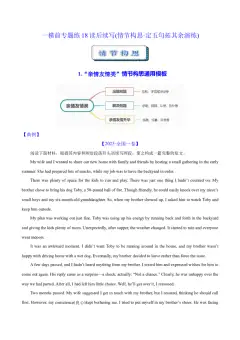
2025 届湖南省长沙市湖南师范大学附属中学高三下学期三模英语
阅读下面材料,根据其内容和所给段落开头语续写两段,使之构成一篇完整的短
文。
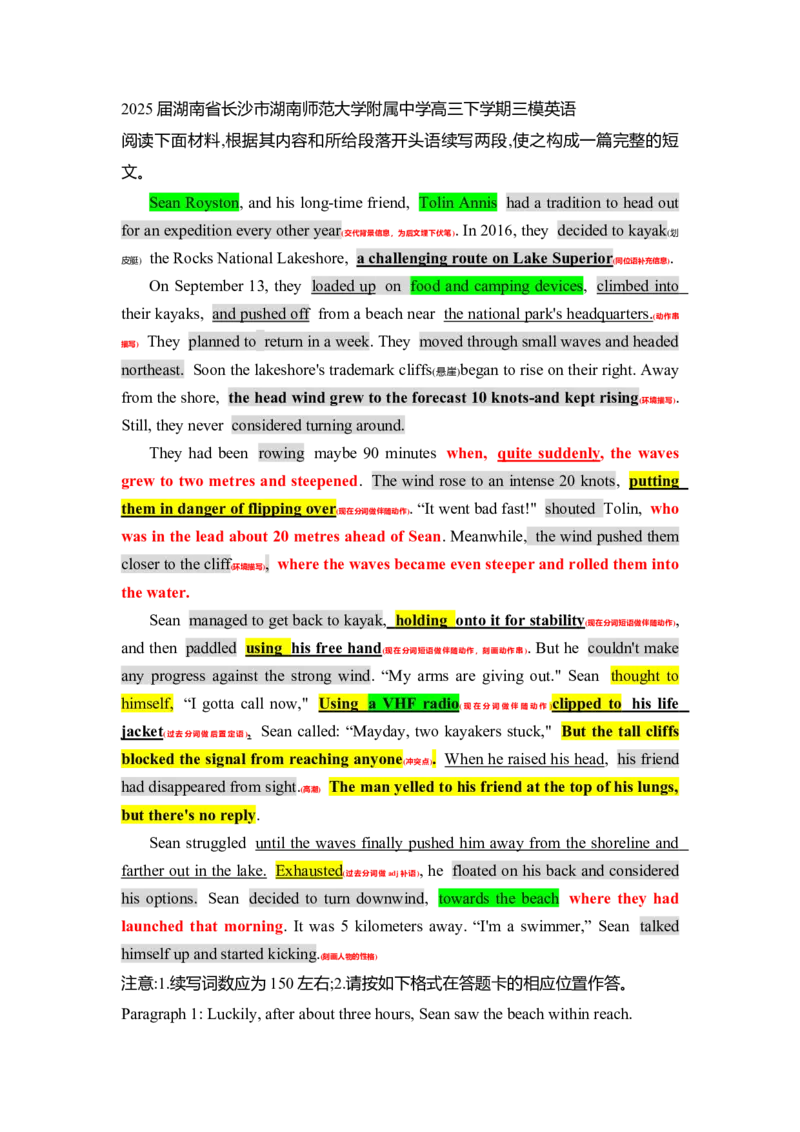
Sean Royston, and his long-time friend, Tolin Annis had a tradition to head out
for an expedition every other year(交代背景信息,为后文埋下伏笔). In 2016, they decided to kayak(划
皮艇) the Rocks National Lakeshore, a challenging route on Lake Superior(同位语补充信息).
On September 13, they loaded up on food and camping devices, climbed into
their kayaks, and pushed off from a beach near the national park's headquarters.(动作串
描写) They planned to return in a week. They moved through small waves and headed
northeast. Soon the lakeshore's trademark cliffs(悬崖)began to rise on their right. Away
from the shore, the head wind grew to the forecast 10 knots-and kept rising(环境描写).
Still, they never considered turning around.
They had been rowing maybe 90 minutes when, quite suddenly, the waves
grew to two metres and steepened. The wind rose to an intense 20 knots, putting
them in danger of flipping over(现在分词做伴随动作). “It went bad fast!" shouted Tolin, who
was in the lead about 20 metres ahead of Sean. Meanwhile, the wind pushed them
closer to the cliff(环境描写), where the waves became even steeper and rolled them into
the water.
Sean managed to get back to kayak, holding
onto it for stability
(现在分词短语做伴随动作),
and then paddled using
his free hand
(现在分词短语做伴随动作,刻画动作串). But he couldn't make
any progress against the strong wind. “My arms are giving out." Sean thought to
himself, “I gotta call now," Using
a VHF radio
( 现在分词做伴随动作)clipped to
his life
jacket( 过去分词做后置定语), Sean called: “Mayday, two kayakers stuck," But the tall cliffs
blocked the signal from reaching anyone(冲突点). When he raised his head, his friend
had disappeared from sight.(高潮) The man yelled to his friend at the top of his lungs,
but there's no reply.
Sean struggled until the waves finally pushed him away from the shoreline and
farther out in the lake. Exhausted(过去分词做adj 补语), he floated on his back and considered
his options. Sean decided to turn downwind, towards the beach where they had
launched that morning. It was 5 kilometers away. “I'm a swimmer,” Sean talked
himself up and started kicking.(刻画人物的性格)
注意:1.续写词数应为150 左右;2.请按如下格式在答题卡的相应位置作答。
Paragraph 1: Luckily, after about three hours, Sean saw the beach within reach.
Paragraph 2: The rescue team headed out immediately for Tolin.
2025 届湖南省长沙市湖南师范大学附属中学高三下学期三模英语
阅读下面材料,根据其内容和所给段落开头语续写两段,使之构成一篇完整的短
文。
Sean Royston, and his long-time friend, Tolin Annis had a tradition to head out
for an expedition every other year. In 2016, they decided to kayak(划皮艇) the Rocks
National Lakeshore, a challenging route on Lake Superior.
On September 13, they loaded up on food and camping devices, climbed into
their kayaks, and pushed off from a beach near the national park's headquarters. They
planned tore turn in a week. They moved through small waves and headed northeast.
Soon the lakeshore's trademark cliffs(悬崖)began to rise on their right. Away from the
shore, the head wind grew to the forecast 10 knots-and kept rising. Still, they never
considered turning around.
They had been rowing maybe 90 minutes when, quite suddenly, the waves grew
to two metres and steepened, The wind rose to an intense 20 knots, putting them in
danger of flipping over. “It went bad fast!" shouted Tolin, who was in the lead about
20 metres ahead of Sean. Meanwhile, the wind pushed them closer to the cliff, where
the waves became even steeper and rolled them into the water.
Sean managed to get back to kayak, holding onto it for stability, and then paddled
using his free hand. But he couldn't make any progress against the strong wind. “My
arms are giving out." Sean thought to himself, “I gotta call now," Using a VHF radio
clipped to his life jacket, Sean called: “Mayday, two kayakers stuck," But the tall
cliffs blocked the signal from reaching anyone. When he raised his head, his friend
had disappeared from sight, The man yelled to his friend at the top of his lungs, but
there's no reply.
Sean struggled until the waves finally pushed him away from the shoreline and
farther out in the lake. Exhausted, he floated on his back and considered his options.
Sean decided to turn downwind, towards the beach where they had launched that
morning. It was 5 kilometers away. “I'm a swimmer,” Sean talked himself up and
started kicking.
注意:1.续写词数应为150 左右;
2.请按如下格式在答题卡的相应位置作答。
Paragraph 1: Luckily, after about three hours, Sean saw the beach within reach.
Paragraph 2: The rescue team headed out immediately for Tolin.
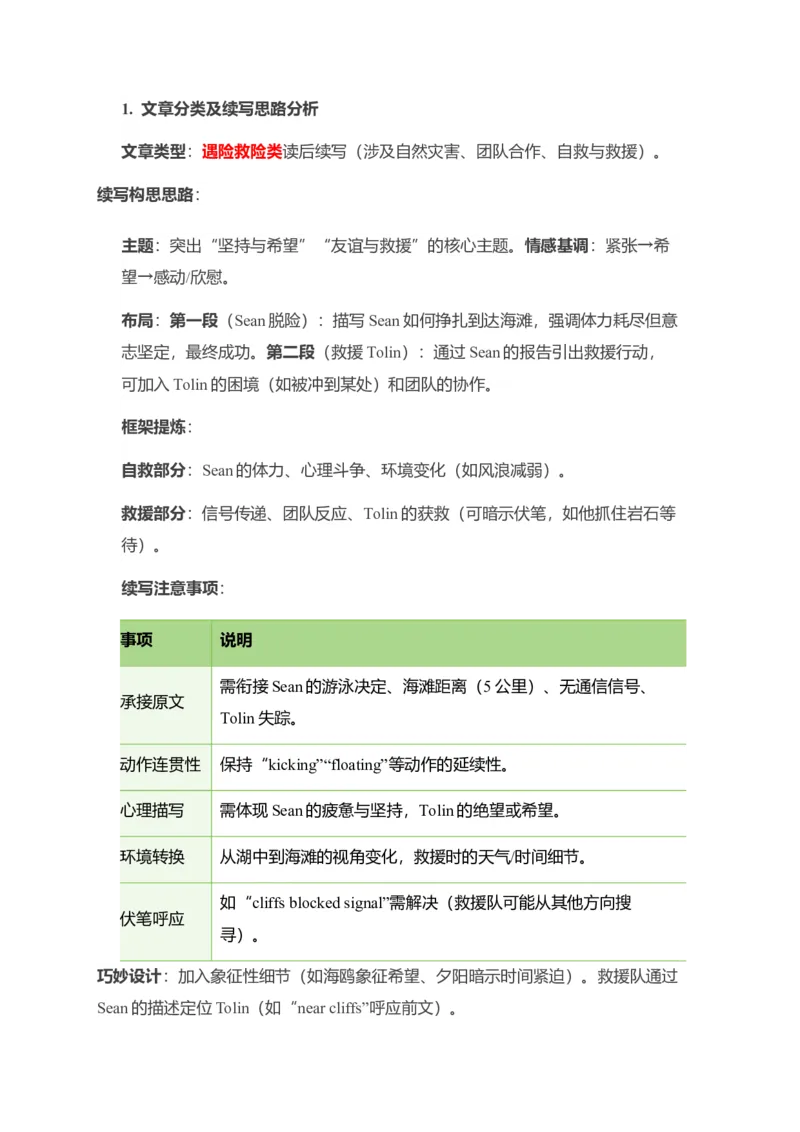
1. 文章分类及续写思路分析
文章类型:遇险救险类读后续写(涉及自然灾害、团队合作、自救与救援)。
续写构思思路:
主题:突出“坚持与希望”“友谊与救援”的核心主题。情感基调:紧张→希
望→感动/欣慰。
布局:第一段(Sean 脱险):描写Sean 如何挣扎到达海滩,强调体力耗尽但意
志坚定,最终成功。第二段(救援Tolin):通过Sean 的报告引出救援行动,
可加入Tolin 的困境(如被冲到某处)和团队的协作。
框架提炼:
自救部分:Sean 的体力、心理斗争、环境变化(如风浪减弱)。
救援部分:信号传递、团队反应、Tolin 的获救(可暗示伏笔,如他抓住岩石等
待)。
续写注意事项:
事项
说明
承接原文
需衔接Sean 的游泳决定、海滩距离(5 公里)、无通信信号、
Tolin 失踪。
动作连贯性
保持“kicking”“floating”等动作的延续性。
心理描写
需体现Sean 的疲惫与坚持,Tolin 的绝望或希望。
环境转换
从湖中到海滩的视角变化,救援时的天气/时间细节。
伏笔呼应
如“cliffs blocked signal”需解决(救援队可能从其他方向搜
寻)。
巧妙设计:加入象征性细节(如海鸥象征希望、夕阳暗示时间紧迫)。救援队通过
Sean 的描述定位Tolin(如“near cliffs”呼应前文)。
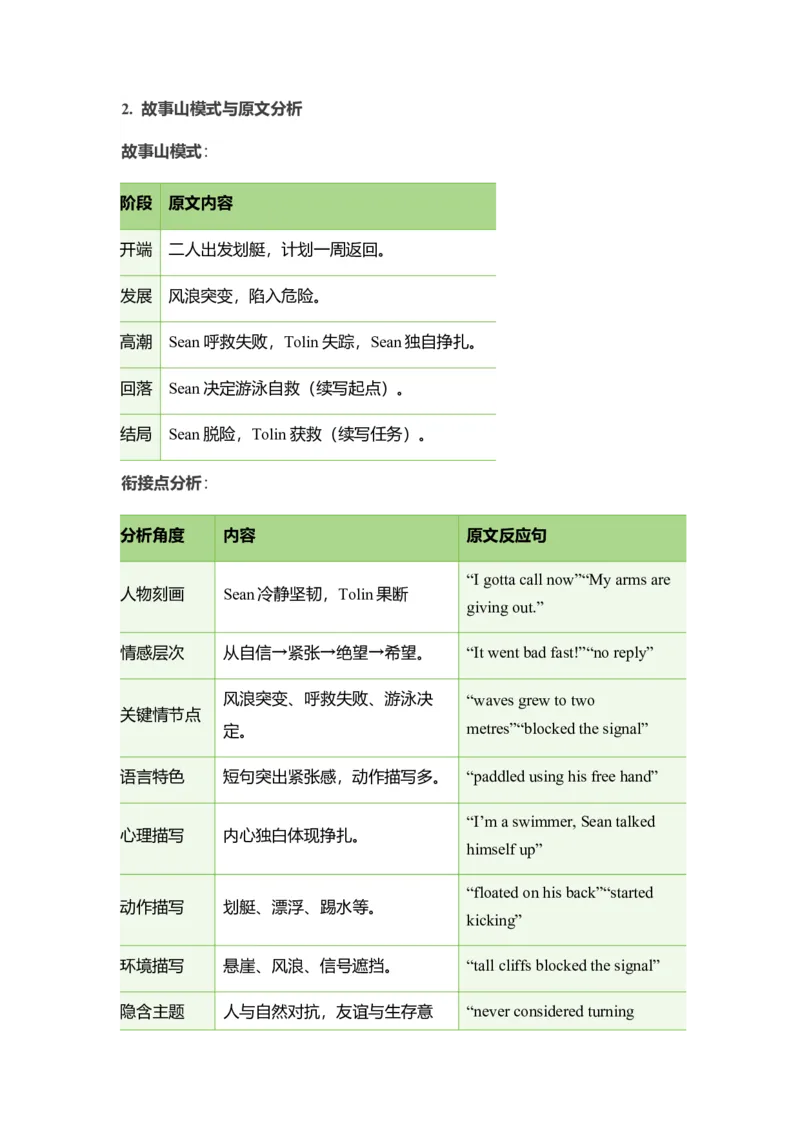
2. 故事山模式与原文分析
故事山模式:
阶段
原文内容
开端
二人出发划艇,计划一周返回。
发展
风浪突变,陷入危险。
高潮
Sean 呼救失败,Tolin 失踪,Sean 独自挣扎。
回落
Sean 决定游泳自救(续写起点)。
结局
Sean 脱险,Tolin 获救(续写任务)。
衔接点分析:
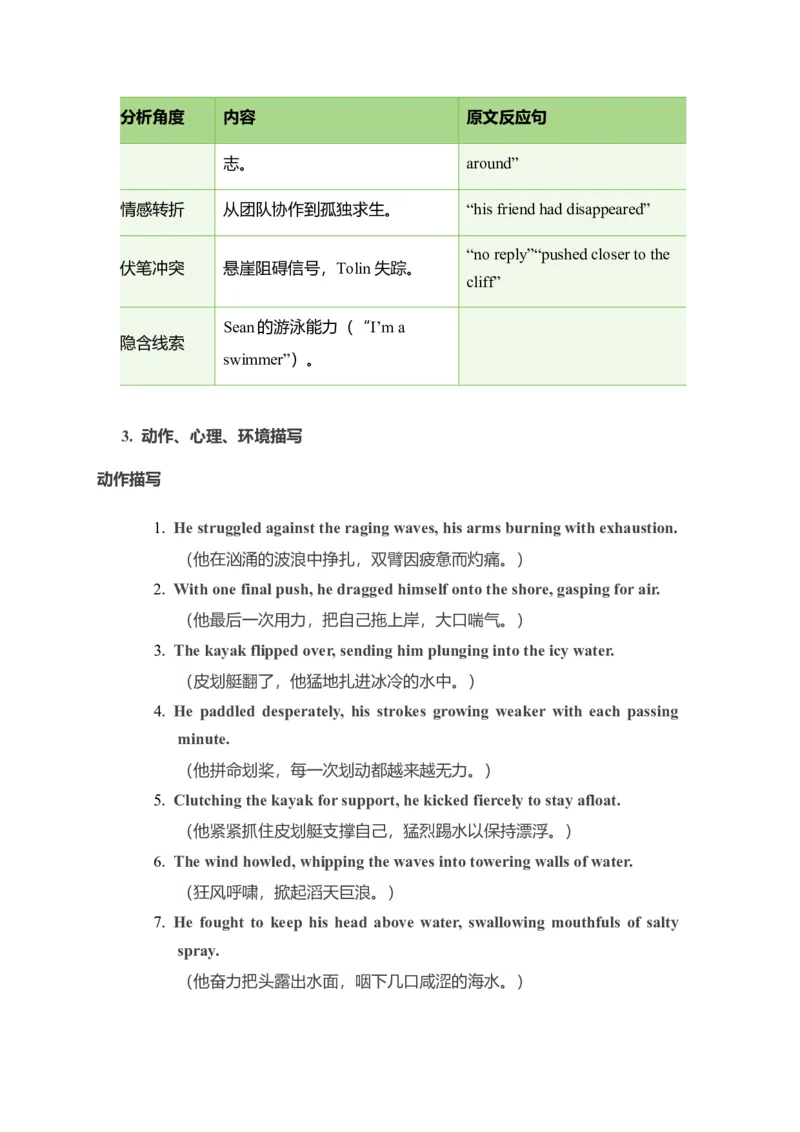
分析角度
内容
原文反应句
人物刻画
Sean 冷静坚韧,Tolin 果断
“I gotta call now”“My arms are
giving out.”
情感层次
从自信→紧张→绝望→希望。
“It went bad fast!”“no reply”
关键情节点
风浪突变、呼救失败、游泳决
定。
“waves grew to two
metres”“blocked the signal”
语言特色
短句突出紧张感,动作描写多。
“paddled using his free hand”
心理描写
内心独白体现挣扎。
“I’m a swimmer, Sean talked
himself up”
动作描写
划艇、漂浮、踢水等。
“floated on his back”“started
kicking”
环境描写
悬崖、风浪、信号遮挡。
“tall cliffs blocked the signal”
隐含主题
人与自然对抗,友谊与生存意
“never considered turning
分析角度
内容
原文反应句
志。
around”
情感转折
从团队协作到孤独求生。
“his friend had disappeared”
伏笔冲突
悬崖阻碍信号,Tolin 失踪。
“no reply”“pushed closer to the
cliff”
隐含线索
Sean 的游泳能力(“I’m a
swimmer”)。
3. 动作、心理、环境描写
动作描写
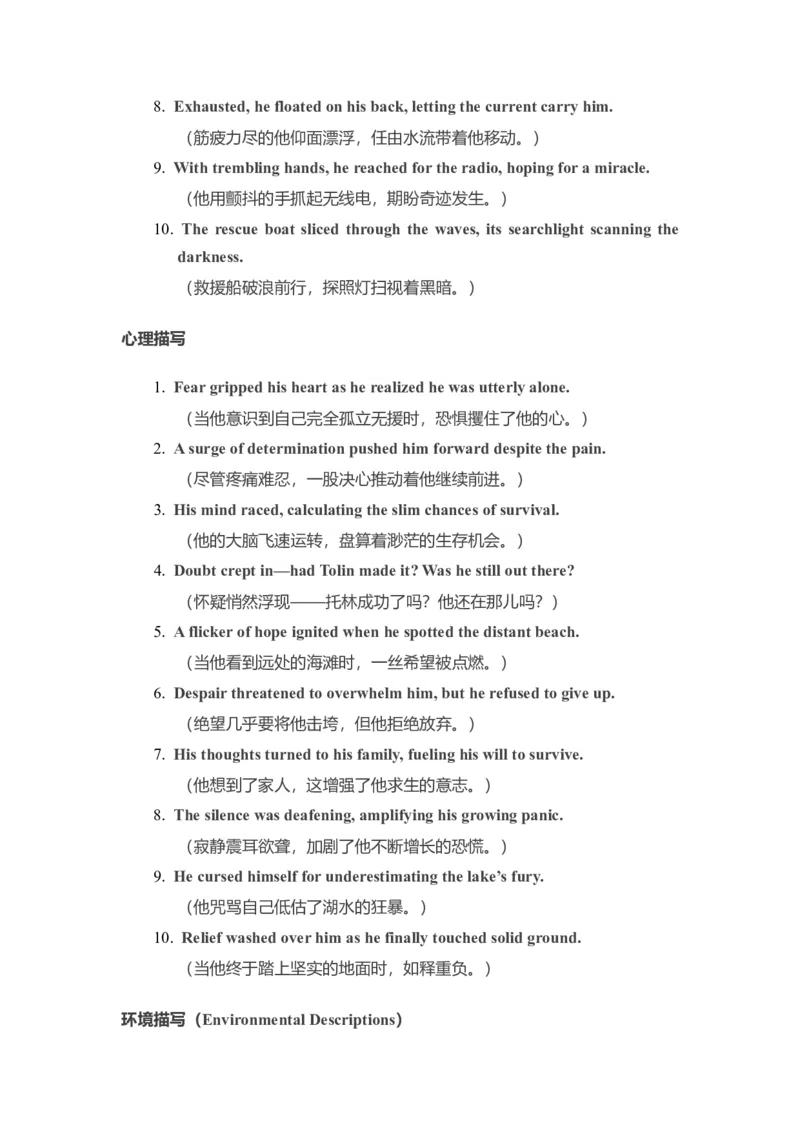
1. He struggled against the raging waves, his arms burning with exhaustion.
(他在汹涌的波浪中挣扎,双臂因疲惫而灼痛。)
2. With one final push, he dragged himself onto the shore, gasping for air.
(他最后一次用力,把自己拖上岸,大口喘气。)
3. The kayak flipped over, sending him plunging into the icy water.
(皮划艇翻了,他猛地扎进冰冷的水中。)
4. He paddled desperately, his strokes growing weaker with each passing
minute.
(他拼命划桨,每一次划动都越来越无力。)
5. Clutching the kayak for support, he kicked fiercely to stay afloat.
(他紧紧抓住皮划艇支撑自己,猛烈踢水以保持漂浮。)
6. The wind howled, whipping the waves into towering walls of water.
(狂风呼啸,掀起滔天巨浪。)
7. He fought to keep his head above water, swallowing mouthfuls of salty
spray.
(他奋力把头露出水面,咽下几口咸涩的海水。)
8. Exhausted, he floated on his back, letting the current carry him.
(筋疲力尽的他仰面漂浮,任由水流带着他移动。)
9. With trembling hands, he reached for the radio, hoping for a miracle.
(他用颤抖的手抓起无线电,期盼奇迹发生。)
10. The rescue boat sliced through the waves, its searchlight scanning the
darkness.
(救援船破浪前行,探照灯扫视着黑暗。)
心理描写
1. Fear gripped his heart as he realized he was utterly alone.
(当他意识到自己完全孤立无援时,恐惧攫住了他的心。)
2. A surge of determination pushed him forward despite the pain.
(尽管疼痛难忍,一股决心推动着他继续前进。)
3. His mind raced, calculating the slim chances of survival.
(他的大脑飞速运转,盘算着渺茫的生存机会。)
4. Doubt crept in—had Tolin made it? Was he still out there?
(怀疑悄然浮现——托林成功了吗?他还在那儿吗?)
5. A flicker of hope ignited when he spotted the distant beach.
(当他看到远处的海滩时,一丝希望被点燃。)
6. Despair threatened to overwhelm him, but he refused to give up.
(绝望几乎要将他击垮,但他拒绝放弃。)
7. His thoughts turned to his family, fueling his will to survive.
(他想到了家人,这增强了他求生的意志。)
8. The silence was deafening, amplifying his growing panic.
(寂静震耳欲聋,加剧了他不断增长的恐慌。)
9. He cursed himself for underestimating the lake’s fury.
(他咒骂自己低估了湖水的狂暴。)
10. Relief washed over him as he finally touched solid ground.
(当他终于踏上坚实的地面时,如释重负。)
环境描写(Environmental Descriptions)
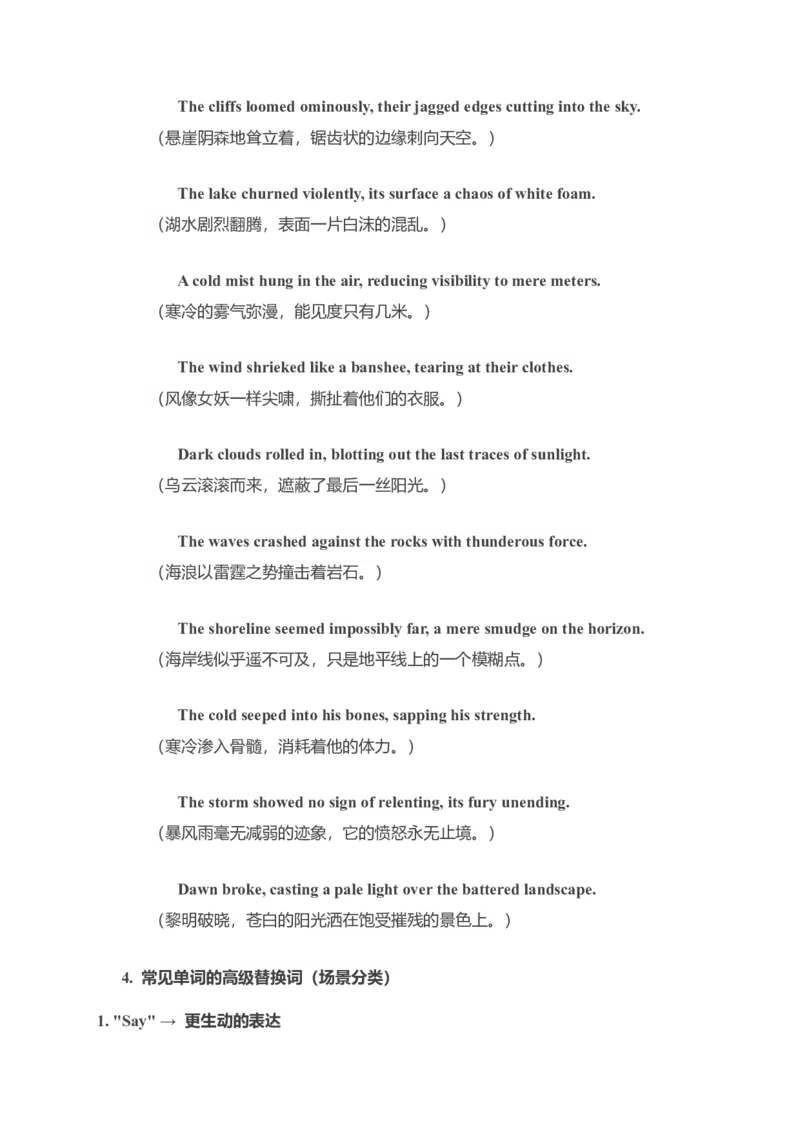
The cliffs loomed ominously, their jagged edges cutting into the sky.
(悬崖阴森地耸立着,锯齿状的边缘刺向天空。)
The lake churned violently, its surface a chaos of white foam.
(湖水剧烈翻腾,表面一片白沫的混乱。)
A cold mist hung in the air, reducing visibility to mere meters.
(寒冷的雾气弥漫,能见度只有几米。)
The wind shrieked like a banshee, tearing at their clothes.
(风像女妖一样尖啸,撕扯着他们的衣服。)
Dark clouds rolled in, blotting out the last traces of sunlight.
(乌云滚滚而来,遮蔽了最后一丝阳光。)
The waves crashed against the rocks with thunderous force.
(海浪以雷霆之势撞击着岩石。)
The shoreline seemed impossibly far, a mere smudge on the horizon.
(海岸线似乎遥不可及,只是地平线上的一个模糊点。)
The cold seeped into his bones, sapping his strength.
(寒冷渗入骨髓,消耗着他的体力。)
The storm showed no sign of relenting, its fury unending.
(暴风雨毫无减弱的迹象,它的愤怒永无止境。)
Dawn broke, casting a pale light over the battered landscape.
(黎明破晓,苍白的阳光洒在饱受摧残的景色上。)
4. 常见单词的高级替换词(场景分类)
1. "Say" → 更生动的表达
Shout(大喊)
Yell(吼叫)
Whisper(低语)
Mutter(咕哝)
Exclaim(惊呼)
例句:
"Mayday!" he shouted into the radio.
"We’re sinking!" she exclaimed in panic.
2. "Walk" → 不同方式的行走
Stagger(蹒跚)
Trudge(艰难跋涉)
Stumble(绊倒)
Crawl(爬行)
Limp(跛行)
例句:
He staggered to his feet after the fall.
Exhausted, they trudged through the deep snow.
3. "Look" → 更具体的视觉描写
Peer(眯眼看)
Gaze(凝视)
Glance(瞥一眼)
Stare(盯着看)
Scan(扫视)
例句:
He peered through the fog, searching for land.
She scanned the horizon for any sign of rescue.
4. "Run" → 不同速度的跑动
Sprint(冲刺)
Dash(猛冲)
Bolt(突然逃跑)
Race(竞速)
Flee(逃离)
例句:
He sprinted toward the boat before it drifted away.
The deer bolted into the forest at the sound of gunfire.
5. "Strong" → 不同强度的描述
Fierce(猛烈的)
Intense(强烈的)
Powerful(强大的)
Overwhelming(压倒性的)
Unrelenting(无情的)
例句:
The fierce wind made it impossible to stand.
The pain was overwhelming, but he kept moving.
5. 固定搭配、词法解析及可积累语料
常见固定搭配(Collocations)
o "Brave the storm"(勇敢面对风暴)
o They had to brave the storm to reach safety.
o "Fight against the current"(逆流而上)
o He fought against the current, but it was too strong.
o "Lose sight of"(看不见)
o The fog was so thick that they lost sight of the shore.
o "Summon one’s strength"(鼓起力气)
o With a deep breath, he summoned his strength and swam on.
o "Hold on for dear life"(拼命抓住)
o He held on to the rope for dear life as the waves crashed around him.
o 可积累的生词短语
"Plunge into"(v. 猛冲进)He plunged into the icy water without hesitation.
近义词:Dive into 反义词:Emerge from
"Give out"(v. 耗尽)His strength gave out after hours of swimming.
近义词:Run out 反义词:Recover
"Block the signal"(v. 阻碍信号)
The mountains blocked the radio signal, making communication impossible.
近义词:Jam 反义词:Transmit
"At the top of one’s lungs"(adv. 用最大声音)
He shouted at the top of his lungs, but no one heard him.
近义词:Loudly 反义词:Silently
"Float on one’s back" (v. 仰面漂浮)Exhausted, he floated on his back to
conserve energy.近义词:Drift 反义词:Sink
总结
动作描写:多用动态动词(struggle, paddle, kick, clutch)。
心理描写:结合情绪变化(fear, determination, despair, relief)。
环境描写:增强氛围(howling wind, churning waves, looming cliffs)。
高级替换词:避免重复,增加细节(如 "stagger" 代替 "walk")。
固定搭配:提升语言地道性("brave the storm", "hold on for dear life")。
6. Possible Version(3)
Version 1:
Paragraph 1: Luckily, after about three hours, Sean saw the beach within
reach. His legs numb and arms trembling(独立主格刻画人物状态), Sean kept kicking, his
eyes fixed on the distant shoreline(独立主格刻画人物) that grew clearer with each stroke.
The familiar sight of the pine trees and park signs gave him a glimmer of hope.
As he
staggered
out of the water
, collapsing
onto the sand
(现在分词做伴随动作), he gasped
for air, his lungs burning(独立主格刻画人物). He looked around the deserted shoreline,
trying
to spot any sign of help
(现在分词做伴随动作), but the area was eerily quiet.
Summoning the last of his strength (现在分词做伴随动作), he staggered toward a nearby
information booth he had passed earlier that morning. A map displayed the
emergency contact number for park services. With shaking fingers, Sean used the
public phone beside the booth to call for help, struggling
to remain coherent
(现在分词做
伴随动作). “Kayak... accident... friend still in water...” he choked out. The operator’s calm
voice reassured him that a rescue team was already sent. Though exhausted and
drenched, Sean waited by the roadside, eyes fixed on the lake (独立主格刻画人物), silently
pleading (现在分词做伴随动作) that Tolin would hold on a little longer.
Paragraph 2: The rescue team headed out immediately for Tolin. With a boat
equipped with
high-powered lights and sonar
(过去分词做后置定语,with 复合结构), the team scanned
the rough waters where Sean and Tolin had last been seen. Sean, now
wrapped
in dry clothes (过去分词做后置定语)and
sipping
warm tea
(现在分词短语做后置定语), kept describing
every detail he could remember—the distance between them, the direction of
the wind, even Tolin's bright red kayak (名词并列). The rescuers navigated cautiously,
eyes scanning the restless waves (独立主格). At last, a faint cry echoed across the water.
They turned sharply and found Tolin, clinging to a rock (现在分词做伴随动作), exhausted but
alive (adj 做补语). Pulled aboard (过去分词做主语补语), Tolin muttered a weak "thanks" before
passing out. Hours later, both men lay in hospital beds, bruised but grateful (adj 做主语
补语). That night, Sean whispered, "We’ll kayak again—but next time, we check the
weather."
亮点分析:
地道搭配:keep kicking;gasp for air;summon strength;radio
for;wrapped in;sipping tea
同义词替换:collapsed (fell down),expression turned grave (looked
serious),navigate (steer/guide)
情绪描写:a glimmer of hope;lungs burning;expression turned
grave;anxious;grateful
动作描写:staggered ;collapsed ;crawled ;waved weakly ;
scanned;clinging
表达积累与升级:
exhausted → drained / worn out
shouted → cried out / yelled / called at the top of one’s lungs
help → assistance / aid / rescue
例句:
He collapsed onto the sand, completely drained from the fight against the waves.
With trembling fingers, he managed to dial the radio frequency and call for aid.
The ranger's face turned grave as he realized the seriousness of the situation.
Clinging to hope, Sean waited for news of his friend.
Version2
Paragraph 1:
Luckily, after about three hours, Sean saw the beach within reach. His
muscles burned with exhaustion(无灵主语句), but the sight of the shore ignited a final
surge of determination. Gritting
his teeth against the pain
(现在分词做伴随动作), he forced
his numb limbs to keep moving through the relentless waves. The current, now
mercifully weaker, seemed to guide him forward(环境描写) as if nature itself
acknowledged his struggle. With each labored stroke, the shoreline grew clearer(无灵主语
句) - a narrow strip of golden sand framed by jagged cliffs(独立主格). As he finally
dragged himself onto solid ground, his body collapsed like a puppet with cut
strings(比喻). The VFH radio, miraculously still attached to his life jacket(过去分词做后置定
语), crackled weakly. Summoning his last ounce of strength(现在分词做伴随动作), Sean
pressed the transmit button and gasped, "Mayday... two kayakers... Tolin missing...
near the cliffs..." before darkness engulfed him(环境描写). In the distance, the faint wail
of sirens pierced the howling wind.
Paragraph 2:
The rescue team headed out immediately for Tolin. Armed
with Sean's last
known coordinates(过去分词做方式状语), the rescue team, on boat, sliced through the
swirling waters toward the cliffs, another team on helicopter(独立主格). Meanwhile,
Tolin clung desperately to a narrow rock ledge, his body battered by waves and
his right leg bleeding from a deep gash(独立主格刻画人物). The storm had separated them
violently(环境描写), tossing
him against the unforgiving stone face
(现在分词做伴随动作). "Hold
on," he muttered through chattering teeth, recalling
Sean's stubborn optimism
(现在分
词做伴随动作) during their training. Just as his grip began to falter, a mechanical roar cut
through the wind - a helicopter! Waving
frantically with one arm
(现在分词做伴随动作) while
clinging to the rock with the other(状从省略), Tolin watched as a rescue swimmer
descended on a swaying cable(场景描写). Strong hands secured him in a harness(借代), and
as they ascended, tears of relief mixed with the stinging rain on his face.
Version 3
Paragraph 1:
Luckily, after about three hours, Sean saw the beach within reach. Every kick
sent searing pain through his exhausted legs(无灵主语句), but the distant shoreline
fueled his determination(环境心理描写). The current, now working in his favor, carried
him closer. His vision blurred with fatigue and saltwater, but he focused on the
rhythmic motion of his strokes - left, right, breathe. When his fingers finally
scraped
the coarse sand
, he rolled onto his back, a cracking
sound
echoing
(独立主格).
The VHF radio! With stiff, trembling fingers, he fumbled for the device still
clipped to his life vest.(过去分词做后置定语) "Mayday... kayaker down... near the cliffs..." he
muttered. Somewhere beyond the fading storm clouds, the distant but
unmistakable
voice
of helicopter blades answered his call.
Paragraph 2:
The rescue team headed out immediately for Tolin.
Using Sean's
description
as their guide, the search-and-rescue team zeroed in on the towering cliffs where
the currents converged. Tolin, nearly worn-out but conscious(adj 做主语补语), had
managed to wedge himself into a narrow crevice, their
kayak shattered against the
rocks below(独立主格). The storm's fury had subsided, but the waves still crashed
against
rock
violently
. "Sean would never give up," he whispered, forcing
himself to stay alert (现在分词做伴随动作)despite the bone-deep cold. Suddenly, a brilliant
spotlight pierced the gloom(无灵主语句), illuminating his position(现在分词做伴随动作). "Here! Over
here!" he shouted, his voice raw from saltwater and exhaustion(独立主格). Within
minutes, a rescue swimmer reached him, securing
him in a harness
(现在分词做伴随动作)
before signaling the helicopter. As they ascended, Tolin's final thought before losing
consciousness was whether his stubborn friend had made it too.
Version 4
Paragraph 1:
Luckily, after about three hours, Sean saw the beach within reach. His strokes
had become sluggish and uncoordinated, but the glimmer of sand through the
dissipating fog spurred him forward(无灵主语句). The waves, now reduced to gentle
swells, lifted him rhythmically toward shore(无灵主语句) as if the lake had finally spent
its anger. Saltwater stung his eyes and the taste of blood filled his mouth from
biting his tongue during the worst of the storm. When his knees finally scraped the
lakebed, he crawled the last few yards like a wounded animal before collapsing face-
down in the wet sand. The VHF radio! With a groan, he rolled onto his side and
activated the emergency channel. "Two... kayakers..." he panted, "Tolin... missing...
cliffs..." before static swallowed his words. Somewhere beyond his fading
consciousness, he heard voices shouting and the crunch of boots on gravel.
Paragraph 2:
The rescue team headed out immediately for Tolin. The search team divided
into two groups - one tending to the semiconscious Sean( 独立主格,或后置定语) while the
others sped toward the cliffs in a inflatable boat. Meanwhile, Tolin had been swept
into a sea cave, his life jacket
hung
on a protruding rock
( 独立主格) that kept him
from being pulled back into the lake's depths. Fear set in as the icy water
lapped
at his chest, but he was worrying Sean's safety. A beam of light suddenly danced
across the cave's walls(无灵主语句), followed
by shouted commands
(过去分词做状语). "Here!
I'm here!" Tolin roared, his voice barely audible over the waves( 独立主格). The
rescuers' flashlight illuminated his pale face just as his grip began to fail. Strong
hands hauled him into the boat where blankets and warm hands awaited.
"Sean...?" he managed to whisper before a medic silenced him
with a reassuring nod
and an oxygen mask.