湖南省华大新高考联盟2025-2026 学年高
三上学期9 月教学质量测评英语试题
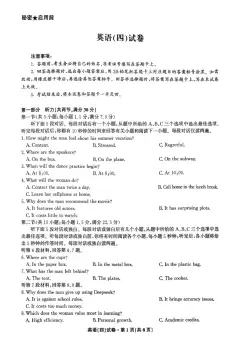
1. What do the speakers mainly talk about the phone?
A. The battery.
B. The price.
C. The screen.
2. Which platform should the speakers arrive at?
A. No.3.
B. No.5.
C. No.7.
3. What does the woman think of the library?
A. It is quiet to common readers.
B. It is becoming less popular.
C. It is crowded and noisy.
4. Which part of the man's new job makes him discontent?
A. The work duration.
B. The low salary.
C. The far location.
5. What happened to the speakers?
A. They were misled by the signs.
B. They forgot to get off the bus.
C. They failed to find their phones.
听第6 段材料,回答第6、7 题。
6. What is the man doing?
A. Driving a new car.
B. Directing heavy traffic.
C. Coaching a learner driver.
7. Why is the woman anxious?
A. She fails to get the man's idea.
B. She forgets how to control a car.
C. She fears getting into an accident.
听第7 段材料,回答第8 至10 题。
8. What makes the woman thrilled?
A. A new computer.
B. A trip to China.
C. A good exam result.
9. What will the man probably do this winter?
A. Work on the side.
B. Study on his own.
C. Travel on holiday.
10. What is the probable relationship between the speakers?
A. Colleagues.
B. Family members.
C. Classmates.
听第8 段材料,回答第11 至13 题。
11. What is the yard sale meant to do?
A. Offer drill for volunteers.
B. Sponsor school education.
C. Earn money for the community.
12. What will volunteers do for the yard sale?
A. Purchase the stands.
B. Keep sellers in order.
C. Prepare the venue.
13. When will volunteers get together?
A. At 4:00 a.m.
B. At 7:00 a.m.
C. At 6:00 p.m.
听第9 段材料,回答第14 至17 题。
14. How did the woman feel when first attending university?
A. Stressed out.
B. Slightly puzzled.
C. Very satisfied
15. What might the woman do halfway through the first semester?
A. Resolve to stop campus activities.
B. Begin to devote herself to study.
C. Schedule her classes at random.
16. When does the woman plan for her daily self-access study?
A. In the morning.
B. In the afternoon.
C. In the evening.
17. What is the woman's final suggestion?
A. To use a specific planner.
B. To set clear study goals.
C. To balance study and rest.
听第10 段材料,回答第18 至20 题。
18. What is the main trend about Chinese technology?
A. China leads in various tech areas.
B. Chinese apps dominate social media.
C. China publishes more research papers.
19. What is the reason for China's success in the electric car industry?
A. The status of the biggest battery maker.
B. The high popularity of Chinese-brand cars.
C. The widespread use of renewable energy.
20. What's China's share of global solar panel supply?
A. 60%.
B. 70%.
C. 90%.
A Day Trip to Terelj National Park and the Statue of Chinggis Khan
Overview
Book this private, guided tour to Terelj National Park and the Statue of Chinggis Khan (成吉思汗) to
learn about the rich history of this area. You’ll be collected from your hotel in Ulaanbaatar for ease, then get
driven out to the national park. You’ll have lunch along the way, and visit the Statue of Chinggis Khan, too.
Go at your own pace on this private tour.
Your experienced guide will be with you the entire way
Learn all about the history of the region
All fees and taxes are included
What to Expect
No.
Attraction
Event
Duration
1
Chinggis Khan Statue
See the Statue of Chinggis Khan (A museum is
available)
1 hour
2
Nalaikh (Pass By)
Pass by a typical Mongolian town
—
3
Aryabal Meditation
Temple
Hike up to the temple and learn about ancient beliefs
1 hour
4
Gorkhi Terelj National
Park
Go through the national park and then have lunch
2 hours
Price
Age
15~59
60~85
11~14
4~10
1~3
Price
$105.00
$100.00
$87.00
$78.00
$0.00
Additional Info
Confirmation will be received upon booking
Not wheelchair accessible
Stroller (婴儿车) accessible
Baby seats available
Bottled water
Near public transportation
Most travelers can participate
Cancellation without processing fee (up to 24 hours before the tour starts)
21. What can visitors do during the tour?
A. Drive to Aryabal Meditation Temple.
B. Communicate with locals in Nalaikh.
C. Picnic in Gorkhi Terelj National Park.
D. Show respect to a historical celebrity.
22. What kind of service does the tour skip?
A. Hotel pick-ups.
B. Disability care.
C. Free cancellation.
D. Seasoned guides.
23. How much should a young couple with 5-year-old twins pay?
A. $183.00.
B. $261.00.
C $366.00.
D. $384.00.
I was born in a small town in Pakistan called Quetta in 1980. When I was a little boy of about ten years
old. I developed an interest in calligraphy. Back then we only had a TV channel with limited programs, One
of the programs was about learning calligraphy. I was engaged and spent several years learning different
calligraphy scripts (笔迹) in the Urdu language.
After graduation, I came to Dubai, UAE. Falling in love with the architecture and high-rise buildings, I
wanted to shoot the amazing beauty form different angles. So I bought a camera and learned photography,
joined photography groups and attended workshops. After few years, I got bored of photographing landscapes
and cityscapes.
Seven years ago, while going through the photography blogs and looking through others’ works. I read
the term called “light painting”. a photography technique that allows you to draw in space. I started
experimenting with that and soon it hit me: why not bring back my passion for calligraphy using light painting
technique? Since that day. I’ve been drawing light calligraphy. To achieve the best results. I decided to build
the lights myself. The best part about my work is that they are not photoshopped. I prefer to get the results
straight out of the camera. I don’t even turn over the images. To achieve that, I have to write in reverse (倒置)
and that took a lot of practice to get it right.
Currently, I’m working on the idea of bringing abandoned places back to life, including buildings which
have lost their charm and are hidden in darkness. Through my photography, I try to employ light calligraphy
by writing a word that attaches a deep meaning to those places and telling stories behind them. In this way, I
hope people will revisit these places and appreciate the real reason for their construction.
24. What can be implied from the author’s experience in Quetta?
A. He had access to plenty art resources.
B. He was fond of calligraphy channels.
C He grasped scripts of many languages.
D. He was willing to dig into calligraphy.
25. What made the author interested in taking pictures in Dubai?
A. Visual impacts of structures.
B. Remarkable urban planning.
C. Mysterious building stories.
D. Odd angles of architecture.
26. How did the author enhance the effects of light calligraphy?
A. By learning from others.
B. By sticking to originality.
C. By beautifying his photos.
D. By drawing in open space.
27. What is the author’s role in practising his current idea?
A. A writer putting down real thoughts.
B. An educator spreading sound values.
C. An artist regenerating forgotten sites.
D. A historian looking for ignored areas.
A major reason why plastic bags and yogurt containers aren’t recycled is that it’s much more frugal to
make these products from the ground up than to recover them. A new recycling technique reported in the
journal Science promises a cost-effective way to transform these common plastic waste items into high-quality
liquid fuels.
What makes plastics useful, namely their strength and resistance to high temperatures, becomes an
annoyance when it comes to recycling the materials. The strong carbon-carbon bonds in these plastics require
very high temperatures to break, making the process energy-consuming. Once the bonds break, the smaller
molecules (分子) that are created quickly form new bonds, giving unwanted chemicals. These byproducts
then have to be broken down again adding time and complexity.
Researchers developed a way to turn these plastics into useful fuels at temperatures below 100℃, without
creating any side products. They conduct the chemical reaction in the presence of a new type of catalyst (催
化剂) in a special acidic solution. In these reaction conditions, as soon as the carbon bonds in the plastic break
apart, new bonds form in a controlled way, giving off the chemicals called alkanes. The alkanes can be used
either as a fuel or as raw material for new plastics. The entire reaction takes place in a single reaction container.
It takes only three hours and occurs at 70℃. By comparison, existing recycling techniques typically require
two stages, take much longer and need temperatures of over 200℃.
The catalyst that the researchers use is already used by some factories. But it will take more research to
know whether the technique can be translated to more occasions. If so, such a one-step, low-cost method to
turn single-use plastics into chemicals, fuels and high-value materials could go a long way in making the
plastic economy sustainable.
28. What does the underlined word “frugal” mean in paragraph 1?
A. Typical.
B. Reliable.
C. Reasonable.
D. Economical.
29. What can we know about plastics from paragraph 2?
A. They stretch easily and quickly.
B. They fail to resist heat perfectly.
C. They are stable in chemical properties.
D. They are productive in poisonous gases
30. What does the new way of recycling plastics feature?
A. Keeping new bonds from forming.
B. Regulating acidity of the solution.
C. Stressing cleanliness and speed.
D. Extending functions of plastics.
31. What is researchers’ attitude toward the technique’s wide application?
A. Critical.
B. Mindful.
C. Hopeless.
D. Optimistic.
Telegraphic (电报的) speech, limited to a noun and verb and usually containing little to no grammar,
obtains its name from its brief nature. It is characterized by using only the most essential words to get the
point across, such as “dog running” instead of “the dog is running”.
Some parents use telegraphic speech when communicating with their children in the belief that speaking
this way will enable a child to learn to speak faster because only the key words are employed. Experts disagree,
however. Telegraphic speech may block the child from learning proper grammar and word meaning, according
to Marc Fey, a professor at the University of Kansas Medical Center. For example, when parents use
grammatically correct sentences, a child can learn that words ending in “-ing” are usually verbs, which gives
him or her the ability to make clear distinctions between verbs and nouns.
To encourage a child to leave the telegraphic speech stage, parents want to repeat what their child says in
a complete, grammatically correct sentence. The Hanen Center recommends this rule: use only the sentences
with your child that you use with an adult.
A child’s vocabulary dramatically increases during the post-telegraphic stage. On average, after 24
months, children begin using grammatical constructions of various kinds, such as adding “-ing” to verbs and
using define articles such as “the”. Although it may seem that a child’s vocabulary is on decline after leaving
this stage, it is actually the contrary. Children begin learning new rules for grammar, which they tend to
overgeneralize, thus leading them to make mistakes, such as the use of “-ed” for the past tense of all verbs.
However, parents do not need to worry about these mistakes, as the children are going through a stage
that generally passes after they learn and become more familiar with grammar rules. Repeating your child’s
sentence with a grammatically correct one will enhance his or her linguistic abilities faster than if you do not
correct his or her sentence.
32. How does the author introduce the topic of the passage?
A. By offering statistics.
B. By defining a concept.
C. By making a contrast.
D. By quoting an expert.
33. Why are experts against using telegraphic speech?
A. It harms parent-child chats.
B. It mistakes verbs for nouns.
C. It dismisses contextual clues.
D. It excludes functional words.
34. What can we infer from the post-telegraphic stage?
A. Linguistic learning should be flexible.
B. Children’s vocabulary seems stable.
C. Generalization should not be promoted.
D. Kids can naturally grasp grammar rules
35. What does the passage suggest parents do?
A. Regard kids as adult speakers.
B. Try to use various vocabulary.
C. Value targeted language inputs.
D. Foresee kids’ expressive errors.
In today’s world, there are many voices of opposition to the regulations on wearing school uniforms.
Some argue uniforms are restrictive and take away individuality. ____36____
Uniforms reduce peer (同辈) pressure and conflict. When students come to school dressed in their own
clothes, they may feel pressure to keep up with the latest trends or worry about what their peers might think.
This can lead to feelings of anxiety and social exclusion. ____37____ No one child is better or worse off
because of what they are wearing. This removes the constant comparisons and competition that can be stressful
for some students, and instead, establishes a sense of belonging and community.
Wearing a uniform also simplifies the lives of parents and teachers. There is no more worrying about what
to wear or stressing about finding the perfect clothing for a special occasion. Parents can distribute more time
and resources to their children’s education, and teachers can focus on teaching, rather than policing students’
dress codes. ____38____ Sustainability and reusability are their main characteristics.
When students wear the same uniform, they feel a sense of belonging and identity with their school.
____39____ Uniforms reflect the values and principles of a school, such as teamwork, discipline, and respect,
which are essential for a positive and productive learning environment.
____40____ It requires careful consideration of the benefits and drawbacks, as well as consultation with
all interested parties. By weighing the pros and cons, schools can make an informed decision that prioritizes
the well-being of all students.
A. Virtually, uniforms benefit at least three sides.
B. This can lead to a sense of pride in their school.
C. However, adopting a school uniform policy is not easy.
D. Uniforms reduce waste and the impact of fast fashion.
E. By wearing uniforms, they are on a same level playing field.
F. Nowadays, simple uniforms have already taken schools by storm.
G. Others claim school uniforms create a positive learning environment.
As a child, I was convinced that a career in health was for me. I dreamed of creating pioneering
____41____ to treat patients all around the world.
But as the years progressed, my ____42____ seemed unattainable. It was hard to see myself in a field
where few people from my background were ____43____, since I was one of the only Black students in my
STEM courses. I wanted to become both a(n) ____44____ and a surgeon. As a first-generation student, I also
struggled to find guidance on how to reach my career goal. But my undergraduate advisers were ____45____
and suggested I focus on one field. These experiences left me ____46____ my plans.
But things changed after I started rowing. I ____47____ joined my college’s boat club just to expand my
social circle. Rowing suffers from the same lack of ____48____ as biomedical research, with very few Black
women rowers. When I joined the boat club, I was very nervous — the same feeling I experienced in science. I
assumed rowing was demanding. Luckily, my fellow rowers ____49____ me, who not only gave me guidance
to improve my ____50____, but made me feel valued. Thus, I now ____51____ the fact I’m already doing
what once appeared impossible when I’m having my doubts about ____52____ in science.
Rowing also helped me develop discipline and a new approach for tackling difficult tasks. I also began to
use a strategy of rowing in my PhD. : viewing my ____53____ experiments as many simple goals. Instead of
giving in to the fear of ____54____, I focused on how to ensure each step was successful. Over time, I’ve
found a new level of ____55____ — both on the water and in the lab.
41. A. systems
B. styles
C. facilities
D. cures
42. A. ambition
B. fantasy
C. effort
D. exploration
43. A. spotted
B. represented
C. rewarded
D. charged
44. A. inventor
B. instructor
C. researcher
D. rower
45. A. frustrated
B. opposed
C. refreshed
D. motivated
46. A. canceling
B. ignoring
C. suspecting
D. updating
47. A. initially
B. smoothly
C. secretly
D. eagerly
48 A. inspiration
B. respect
C. tolerance
D. diversity
49. A. promoted
B. accepted
C. forgave
D. persuaded
50. A. adaptability
B. productivity
C. mood
D. technique
51. A. reflect on
B. put forward
C. account for
D. look into
52. A. belonging
B. meaning
C. suffering
D. training
53. A. vital
B. innovative
C. complex
D. permanent
54. A. discontent
B. disharmony
C. inflexibility
D. incompetence
55. A. peace
B. confidence
C. sympathy
D. balance
When I set off in 2008 from Nashville in the U.S. for Shenyang, China, my wallet was filled with cash
and credit cards. Seventeen years later, my wallet ___56___ (gather) dust. My smartphone handles everything
about payment.
In my early days in Shenyang, cash ruled. Today, even an elderly ___57___ (sell) at the local market
greets customers with a payment QR code (二维码). China's mobile payment development, ___58___ (push)
by many advanced mobile software platforms, has been a way of life. These apps process some 500 trillion
yuan ___59___ (annual), connecting people to services ranging from public transit to healthcare.
The next hit came in late 2019 with ___60___ launch of the pilot programs of digital yuan, a state-backed
currency designed ___61___ (function) both online and offline, which safeguards privacy and reduces
transaction (交易) fees. ____62____ the popularity of American mobile payment service Venmo, digital yuan
is ___63___ (efficient) than physical cash and heightens my perception of safety. By the end of June 2024,
China's e-CNY transactions increased to 7 trillion yuan.
China's innovations are drawing global attention, ___64___ (create) projects like mBridge, a cross-border
payment project involving the Chinese mainland, Hong Kong Special Administrative region, Thailand and the
United Arab Emirates, are testing the e-CNY for international trade, ___65___ aim is to simplify transactions
and lessen reliance on systems like SWIFT, the U.S-dominated global banking network.
在英语课堂小组讨论的环节,英语老师让大家就高中生用AI 写作文的现象发言,请你作为小组
代表,撰写一篇发言稿汇报讨论成果,内容包括:
1.发表看法:
2.提出建议。
注意:
1.写作词数应为80 个左右;
2.请按如下格式在答题卡的相应位置作答。
Opinion on High School Students’ Using AI to Write Essays
Hello, everyone!
Amy shut the bedroom door behind her, annoyed, “Why do I always have to do the dishes? It’s so unfair!”
she whispered, sinking onto her bed.
Her mother. Mrs. Thompson, always tried to explain. “Doing housework helps you grow into a responsible
person. Amy, And it shows you care about our family.” But Amy never listened. To her, household chores
were a tiresome burden, a waste of her precious teenage years.
One Monday evening, as Amy sat at the dinner table pushing her food around her plate, her mother
coughed violently. Her face turned pale, and she excused herself, saying she wasn’t feeling well, Mrs.
Thompson went to bed early, leaving a sink full of dirty dishes.
Amy thought about asking her mother to wash the dishes later, but something held her back. Remembering
her mother’s pale face and weak voice. Amy was overwhelmed with a strange feeling. For the first time, she
noticed how tired her mother looked lately. She realized that, besides taking care of the family, her mother
also worked long hours at the office.
With a sigh. Amy stood up and walked into the kitchen. She stared at the mountain of dishes, feeling
discouraged. But she rolled up her sleeves. As she washed the plates and bowls, she thought about all the times
her mother had done this without a single complaint. Just as she was finishing up, she heard a soft voice behind
her. “Amy?” It was her mother, looking surprised and touched, “You...you did the dishes.”
Amy turned around, feeling a bit embarrassed, “Yeah, well... you weren’t feeling well. so I thought I’d
help out,” Mrs. Thompson smiled. her eyes filled with pride. “Thank you, dear, That’s very kind of you.”
That night, as Amy lay in bed, she couldn’t stop thinking. Maybe her mother was right. Maybe doing
housework wasn’t just a chore-it was a way to show love and care for her family.
___________________________________________________________________________________
_______________________________________________________________________________________
_______________________________________________________________________________________
_______________________________________________________________________________________
___________________________________________________
The next morning, Amy woke up early and headed straight to the kitchen.
From that day on, Amy’s perspective on doing household chores changed.