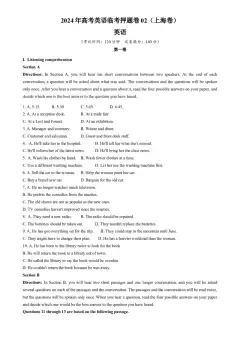
备战2024年高考英语模拟卷02(上海卷)
(考试时间:120分钟 试卷满分:140分)
注意事项:
1.答卷前,考生务必将自己的姓名、考生号等填写在答题卡和试卷指定位置上。
2.回答选择题时,选出每小题答案后,用铅笔把答题卡对应题目的答案标号涂黑。如需改动,用
橡皮擦干净后,再选涂其他答案标号。回答非选择题时,将答案写在答题卡上。写在本试卷上无效。
3.考试结束后,将本试卷和答题卡一并交回。
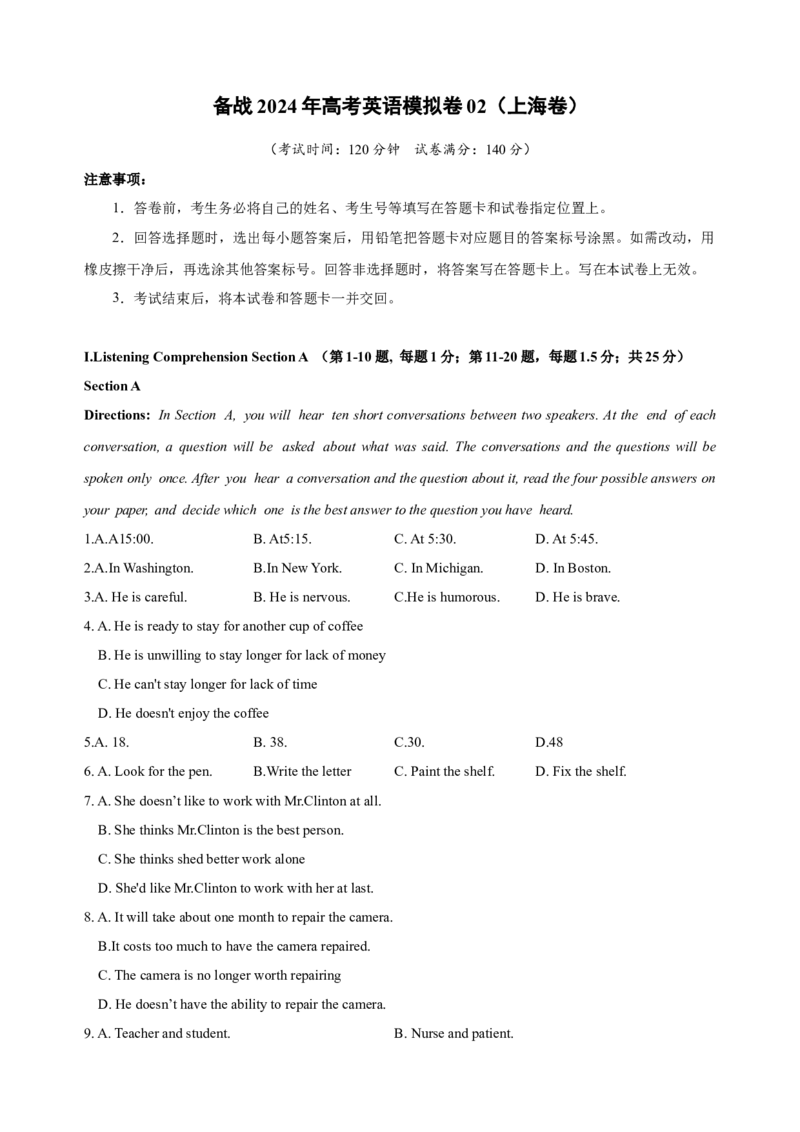
I.Listening Comprehension Section A (第1-10题, 每题1分;第11-20题,每题1.5分;共25分)
Section A
Directions: In Section A, you will hear ten short conversations between two speakers. At the end of each
conversation, a question will be asked about what was said. The conversations and the questions will be
spoken only once. After you hear a conversation and the question about it, read the four possible answers on
your paper, and decide which one is the best answer to the question you have heard.
1.A.A15:00. B. At5:15. C. At 5:30. D. At 5:45.
2.A.In Washington. B.In New York. C. In Michigan. D. In Boston.
3.A. He is careful. B. He is nervous. C.He is humorous. D. He is brave.
4. A. He is ready to stay for another cup of coffee
B. He is unwilling to stay longer for lack of money
C. He can't stay longer for lack of time
D. He doesn't enjoy the coffee
5.A. 18. B. 38. C.30. D.48
6. A. Look for the pen. B.Write the letter C. Paint the shelf. D. Fix the shelf.
7. A. She doesn’t like to work with Mr.Clinton at all.
B. She thinks Mr.Clinton is the best person.
C. She thinks shed better work alone
D. She'd like Mr.Clinton to work with her at last.
8. A. It will take about one month to repair the camera.
B.It costs too much to have the camera repaired.
C. The camera is no longer worth repairing
D. He doesn’t have the ability to repair the camera.
9. A. Teacher and student. B. Nurse and patient.C. Boss and secretary. D. Father and daughter
10. A. Professor Smith is going to speak some other night.
B. He's never heard of Professor Smith.
C.He didn't know Professor Smith was speaking tonight.
D. Professor Smith is giving his speech in this room.
Section B
Directions: In Section B. you will hear two short passages several and one longer conversation, and you will
be asked several questions on each of them. The passages and the conversation will be read twice, but the
questions will be spoken only once. When you hear a question, read the four possible answers on your paper
and decide which one is the best answer to the question you have heard.
Questions 11 through 13 are based on the following passage.
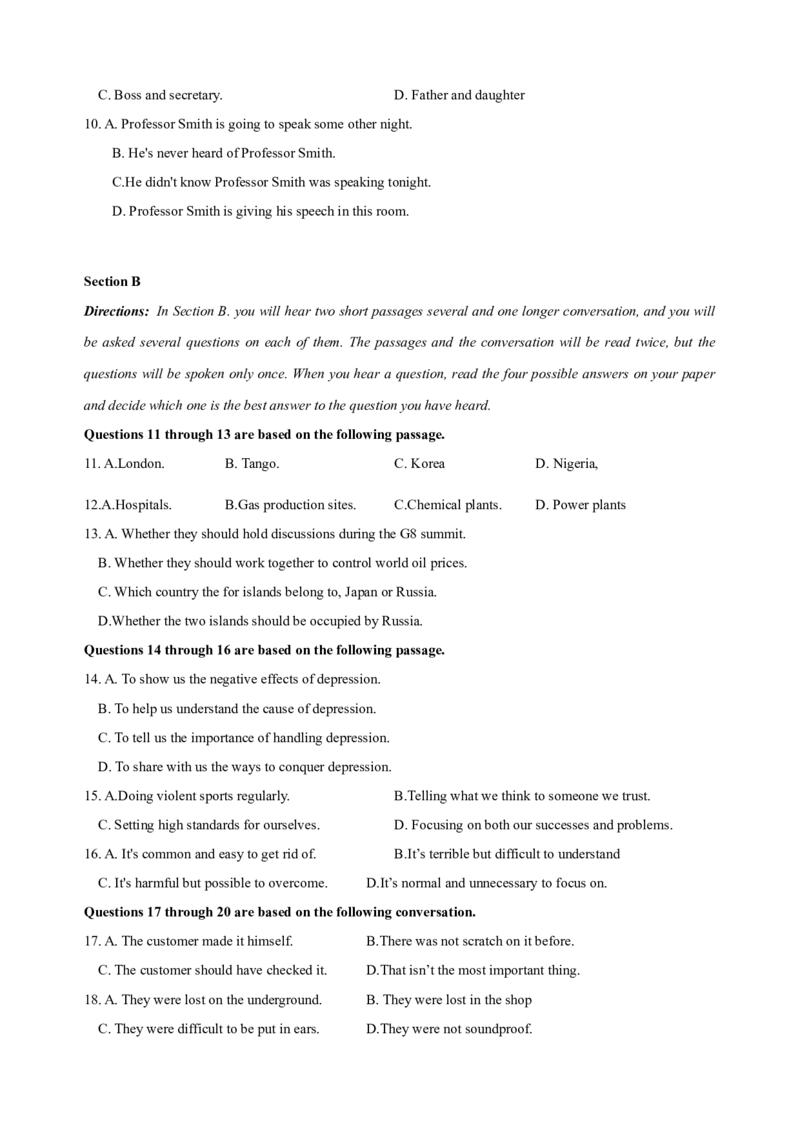
11. A.London. B. Tango. C. Korea D. Nigeria,
12.A.Hospitals. B.Gas production sites. C.Chemical plants. D. Power plants
13. A. Whether they should hold discussions during the G8 summit.
B. Whether they should work together to control world oil prices.
C. Which country the for islands belong to, Japan or Russia.
D.Whether the two islands should be occupied by Russia.
Questions 14 through 16 are based on the following passage.
14. A. To show us the negative effects of depression.
B. To help us understand the cause of depression.
C. To tell us the importance of handling depression.
D. To share with us the ways to conquer depression.
15. A.Doing violent sports regularly. B.Telling what we think to someone we trust.
C. Setting high standards for ourselves. D. Focusing on both our successes and problems.
16. A. It's common and easy to get rid of. B.It’s terrible but difficult to understand
C. It's harmful but possible to overcome. D.It’s normal and unnecessary to focus on.
Questions 17 through 20 are based on the following conversation.
17. A. The customer made it himself. B.There was not scratch on it before.
C. The customer should have checked it. D.That isn’t the most important thing.
18. A. They were lost on the underground. B. They were lost in the shop
C. They were difficult to be put in ears. D.They were not soundproof.19. A.He was annoyed at the salesgirl’s excuse. B. He was so grateful for the salesgirls help.
C.He had a terrible quarrel with the salesgirl D. He was worried about his headphones.
20. A. A photo of the scratch. B. The receipt.
C. An application for exchange. D. A photo of the headphone.
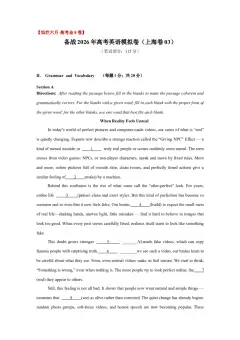
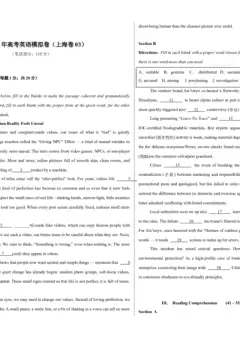
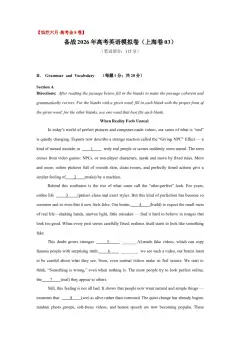
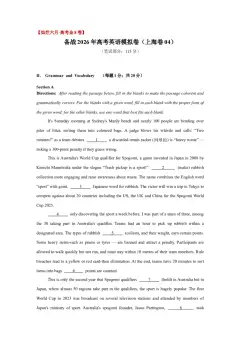
II.Grammar and Vocabulary (每题1分;共20分)
Section A
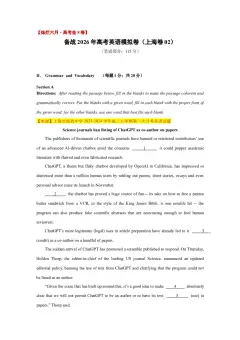
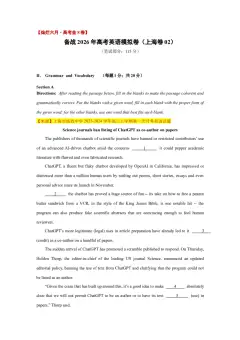
Directions: After reading the passage below, fill in the blanks to make the passage coherent and
grammatically correct. For the blanks with a given word, fill in each blank with the proper form of the given
word; for the other blanks, use one word that best fits each blank.
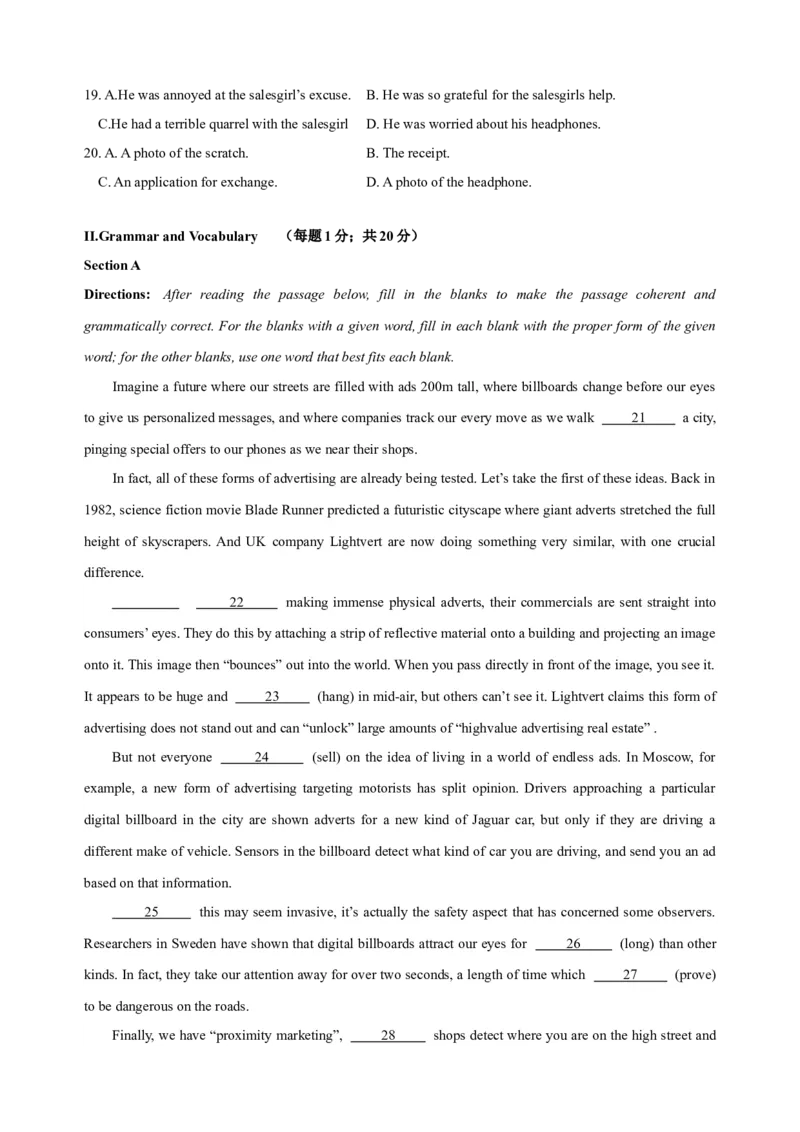
Imagine a future where our streets are filled with ads 200m tall, where billboards change before our eyes
to give us personalized messages, and where companies track our every move as we walk 21 a city,
pinging special offers to our phones as we near their shops.
In fact, all of these forms of advertising are already being tested. Let’s take the first of these ideas. Back in
1982, science fiction movie Blade Runner predicted a futuristic cityscape where giant adverts stretched the full
height of skyscrapers. And UK company Lightvert are now doing something very similar, with one crucial
difference.
22 making immense physical adverts, their commercials are sent straight into
consumers’ eyes. They do this by attaching a strip of reflective material onto a building and projecting an image
onto it. This image then “bounces” out into the world. When you pass directly in front of the image, you see it.
It appears to be huge and 23 (hang) in mid-air, but others can’t see it. Lightvert claims this form of
advertising does not stand out and can “unlock” large amounts of “highvalue advertising real estate” .
But not everyone 24 (sell) on the idea of living in a world of endless ads. In Moscow, for
example, a new form of advertising targeting motorists has split opinion. Drivers approaching a particular
digital billboard in the city are shown adverts for a new kind of Jaguar car, but only if they are driving a
different make of vehicle. Sensors in the billboard detect what kind of car you are driving, and send you an ad
based on that information.
25 this may seem invasive, it’s actually the safety aspect that has concerned some observers.
Researchers in Sweden have shown that digital billboards attract our eyes for 26 (long) than other
kinds. In fact, they take our attention away for over two seconds, a length of time which 27 (prove)
to be dangerous on the roads.
Finally, we have “proximity marketing”, 28 shops detect where you are on the high street andsend tailored adverts to your phone. Devicescape is one company trialing the use of Wi-Fi as a means of
tracking customers. Their technology 29 work anywhere whether in a supermarket, a concert hall, or
a bus, says Owen Geddes from their marketing team. What would customers see?“ 30 could be a
discount offer to use in the shop the person is visiting, or a piece of content such as a movie trailer,” says Mr.
Geddes.
Section B
Directions: Fill in each blank with a proper word chosen from the box. Each word can be used only
once. Note that there is one word more than you need.
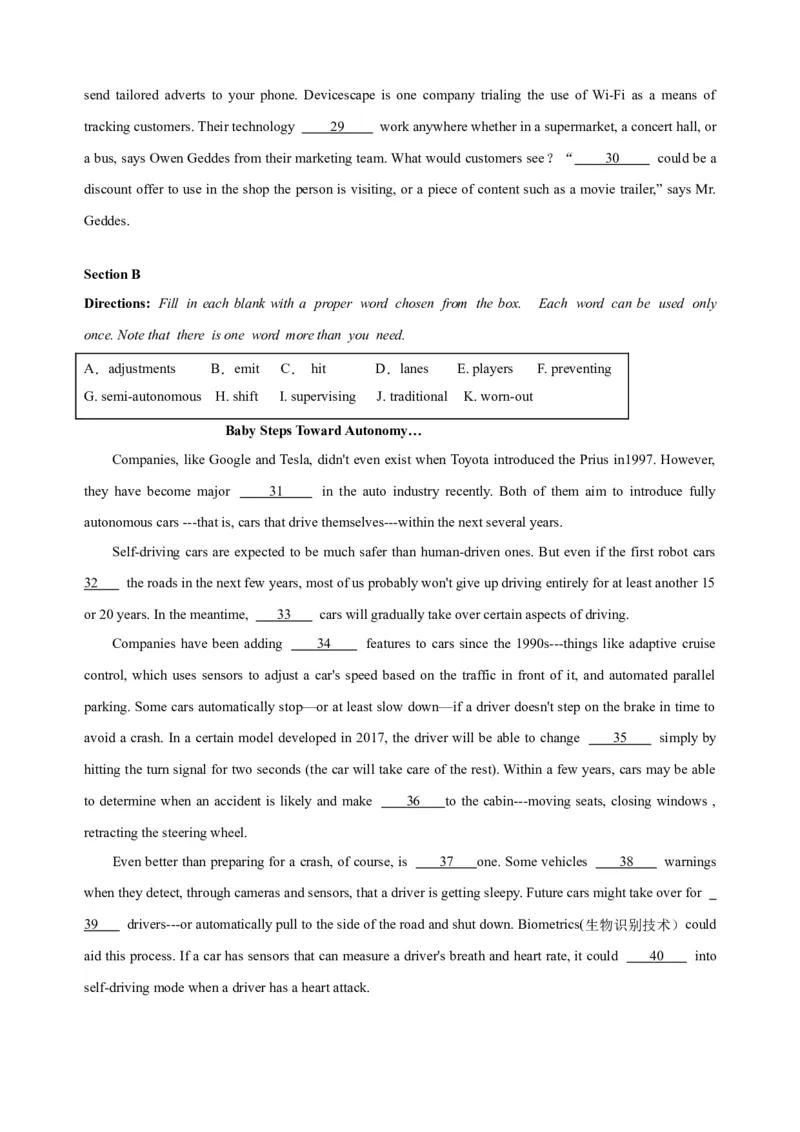
A.adjustments B.emit C. hit D.lanes E. players F. preventing
G. semi-autonomous H. shift I. supervising J. traditional K. worn-out
Baby Steps Toward Autonomy…
Companies, like Google and Tesla, didn't even exist when Toyota introduced the Prius in1997. However,
they have become major 31 in the auto industry recently. Both of them aim to introduce fully
autonomous cars ---that is, cars that drive themselves---within the next several years.
Self-driving cars are expected to be much safer than human-driven ones. But even if the first robot cars
32 the roads in the next few years, most of us probably won't give up driving entirely for at least another 15
or 20 years. In the meantime, 33 cars will gradually take over certain aspects of driving.
Companies have been adding 34 features to cars since the 1990s---things like adaptive cruise
control, which uses sensors to adjust a car's speed based on the traffic in front of it, and automated parallel
parking. Some cars automatically stop—or at least slow down—if a driver doesn't step on the brake in time to
avoid a crash. In a certain model developed in 2017, the driver will be able to change 35 simply by
hitting the turn signal for two seconds (the car will take care of the rest). Within a few years, cars may be able
to determine when an accident is likely and make 36 to the cabin---moving seats, closing windows ,
retracting the steering wheel.
Even better than preparing for a crash, of course, is 37 one. Some vehicles 38 warnings
when they detect, through cameras and sensors, that a driver is getting sleepy. Future cars might take over for
39 drivers---or automatically pull to the side of the road and shut down. Biometrics(生物识别技术)could
aid this process. If a car has sensors that can measure a driver's breath and heart rate, it could 40 into
self-driving mode when a driver has a heart attack.III.Reading Comprehension (41 – 55题,每题1分;56 – 70题,每题2分;共45分)
Section A
Directions: For each blank in the following passage there are four words or phrases marked A, B, C and
D. Fill in each blank with the word or phrase that best fits the context.
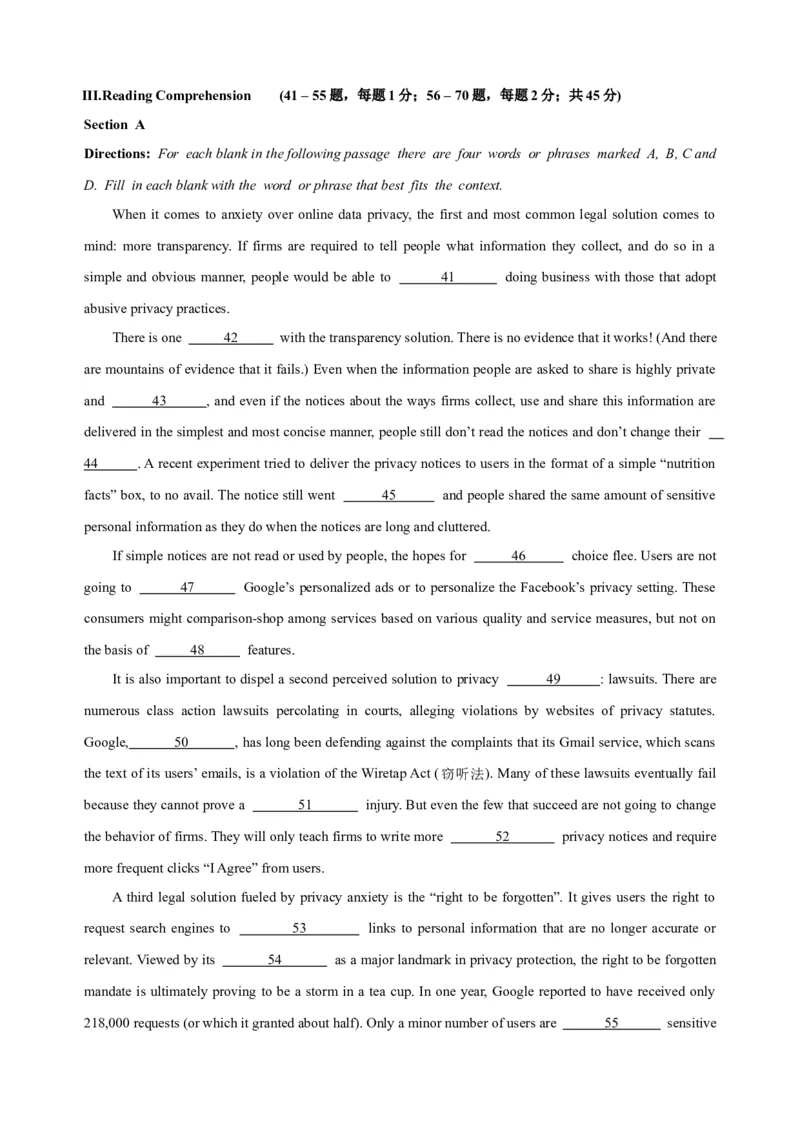
When it comes to anxiety over online data privacy, the first and most common legal solution comes to
mind: more transparency. If firms are required to tell people what information they collect, and do so in a
simple and obvious manner, people would be able to 41 doing business with those that adopt
abusive privacy practices.
There is one 42 with the transparency solution. There is no evidence that it works! (And there
are mountains of evidence that it fails.) Even when the information people are asked to share is highly private
and 43 , and even if the notices about the ways firms collect, use and share this information are
delivered in the simplest and most concise manner, people still don’t read the notices and don’t change their
44 . A recent experiment tried to deliver the privacy notices to users in the format of a simple “nutrition
facts” box, to no avail. The notice still went 45 and people shared the same amount of sensitive
personal information as they do when the notices are long and cluttered.
If simple notices are not read or used by people, the hopes for 46 choice flee. Users are not
going to 47 Google’s personalized ads or to personalize the Facebook’s privacy setting. These
consumers might comparison-shop among services based on various quality and service measures, but not on
the basis of 48 features.
It is also important to dispel a second perceived solution to privacy 49 : lawsuits. There are
numerous class action lawsuits percolating in courts, alleging violations by websites of privacy statutes.
Google, 50 , has long been defending against the complaints that its Gmail service, which scans
the text of its users’ emails, is a violation of the Wiretap Act (窃听法). Many of these lawsuits eventually fail
because they cannot prove a 51 injury. But even the few that succeed are not going to change
the behavior of firms. They will only teach firms to write more 52 privacy notices and require
more frequent clicks “I Agree” from users.
A third legal solution fueled by privacy anxiety is the “right to be forgotten”. It gives users the right to
request search engines to 53 links to personal information that are no longer accurate or
relevant. Viewed by its 54 as a major landmark in privacy protection, the right to be forgotten
mandate is ultimately proving to be a storm in a tea cup. In one year, Google reported to have received only
218,000 requests (or which it granted about half). Only a minor number of users are 55 sensitiveto privacy issues to exercise the cherished right.
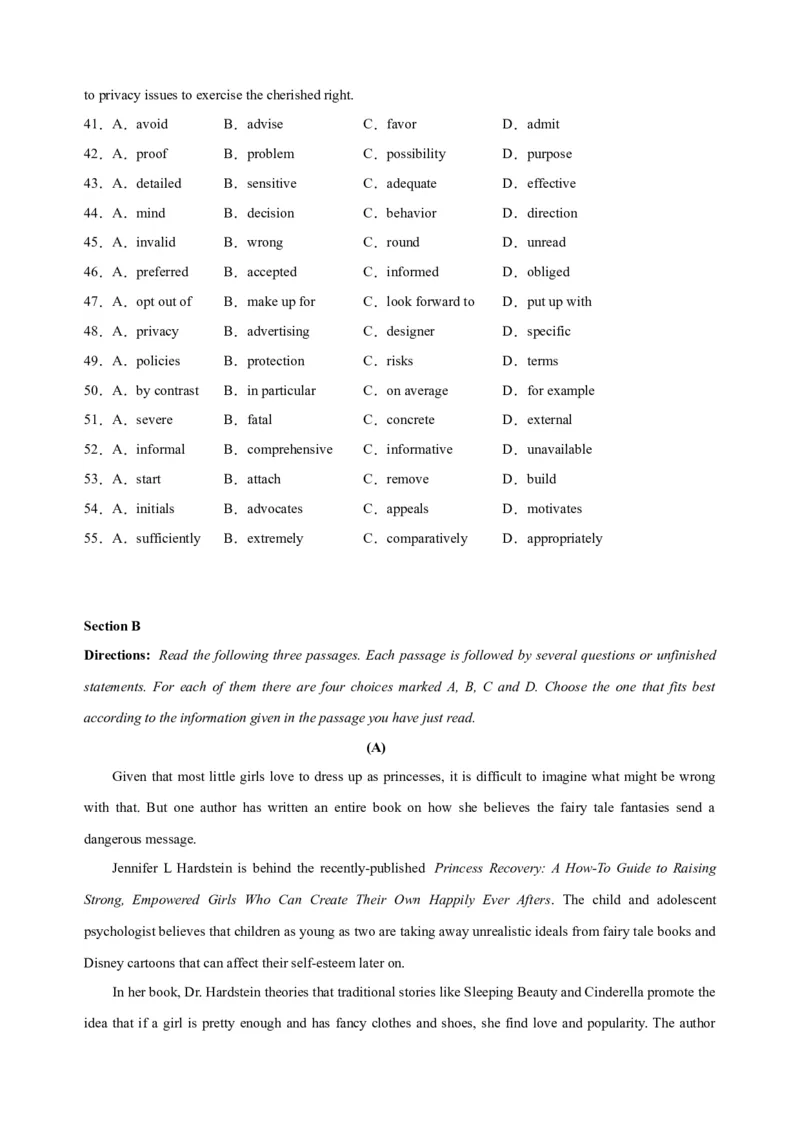
41.A.avoid B.advise C.favor D.admit
42.A.proof B.problem C.possibility D.purpose
43.A.detailed B.sensitive C.adequate D.effective
44.A.mind B.decision C.behavior D.direction
45.A.invalid B.wrong C.round D.unread
46.A.preferred B.accepted C.informed D.obliged
47.A.opt out of B.make up for C.look forward to D.put up with
48.A.privacy B.advertising C.designer D.specific
49.A.policies B.protection C.risks D.terms
50.A.by contrast B.in particular C.on average D.for example
51.A.severe B.fatal C.concrete D.external
52.A.informal B.comprehensive C.informative D.unavailable
53.A.start B.attach C.remove D.build
54.A.initials B.advocates C.appeals D.motivates
55.A.sufficiently B.extremely C.comparatively D.appropriately
Section B
Directions: Read the following three passages. Each passage is followed by several questions or unfinished
statements. For each of them there are four choices marked A, B, C and D. Choose the one that fits best
according to the information given in the passage you have just read.
(A)
Given that most little girls love to dress up as princesses, it is difficult to imagine what might be wrong
with that. But one author has written an entire book on how she believes the fairy tale fantasies send a
dangerous message.
Jennifer L Hardstein is behind the recently-published Princess Recovery: A How-To Guide to Raising
Strong, Empowered Girls Who Can Create Their Own Happily Ever Afters. The child and adolescent
psychologist believes that children as young as two are taking away unrealistic ideals from fairy tale books and
Disney cartoons that can affect their self-esteem later on.
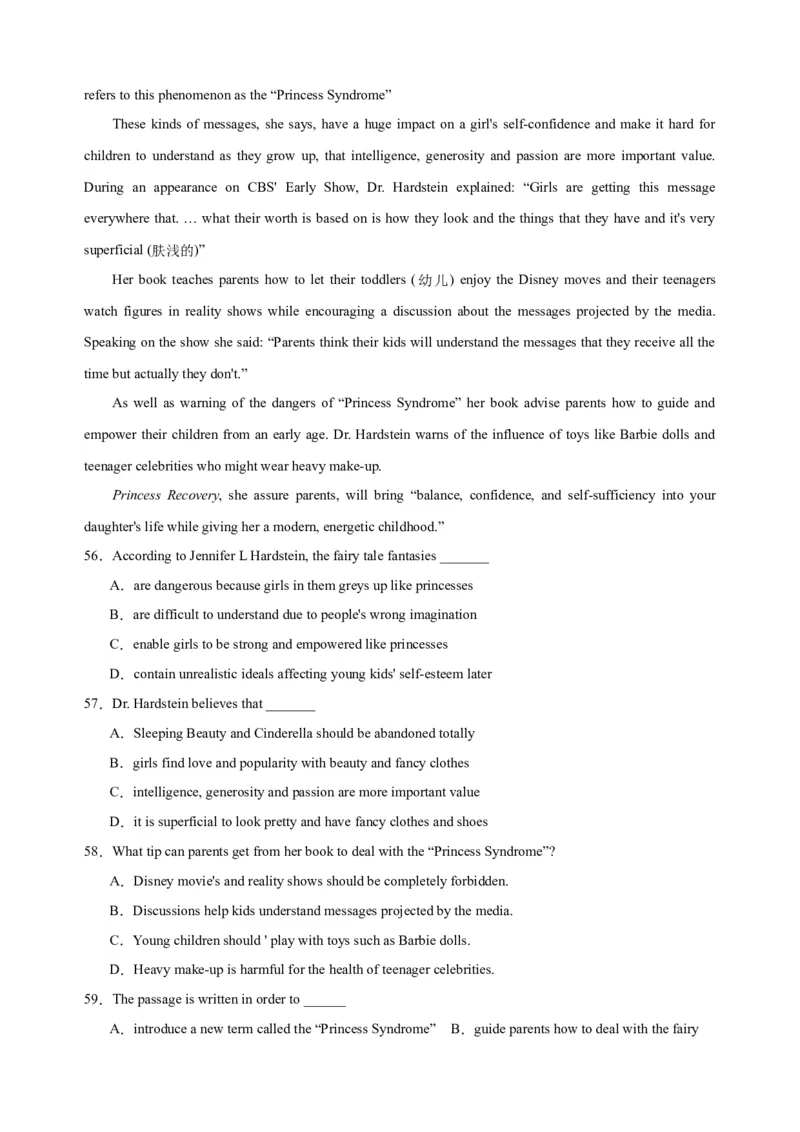
In her book, Dr. Hardstein theories that traditional stories like Sleeping Beauty and Cinderella promote the
idea that if a girl is pretty enough and has fancy clothes and shoes, she find love and popularity. The authorrefers to this phenomenon as the “Princess Syndrome”
These kinds of messages, she says, have a huge impact on a girl's self-confidence and make it hard for
children to understand as they grow up, that intelligence, generosity and passion are more important value.
During an appearance on CBS' Early Show, Dr. Hardstein explained: “Girls are getting this message
everywhere that. … what their worth is based on is how they look and the things that they have and it's very
superficial (肤浅的)”
Her book teaches parents how to let their toddlers (幼儿) enjoy the Disney moves and their teenagers
watch figures in reality shows while encouraging a discussion about the messages projected by the media.
Speaking on the show she said: “Parents think their kids will understand the messages that they receive all the
time but actually they don't.”
As well as warning of the dangers of “Princess Syndrome” her book advise parents how to guide and
empower their children from an early age. Dr. Hardstein warns of the influence of toys like Barbie dolls and
teenager celebrities who might wear heavy make-up.
Princess Recovery, she assure parents, will bring “balance, confidence, and self-sufficiency into your
daughter's life while giving her a modern, energetic childhood.”
56.According to Jennifer L Hardstein, the fairy tale fantasies _______
A.are dangerous because girls in them greys up like princesses
B.are difficult to understand due to people's wrong imagination
C.enable girls to be strong and empowered like princesses
D.contain unrealistic ideals affecting young kids' self-esteem later
57.Dr. Hardstein believes that _______
A.Sleeping Beauty and Cinderella should be abandoned totally
B.girls find love and popularity with beauty and fancy clothes
C.intelligence, generosity and passion are more important value
D.it is superficial to look pretty and have fancy clothes and shoes
58.What tip can parents get from her book to deal with the “Princess Syndrome”?
A.Disney movie's and reality shows should be completely forbidden.
B.Discussions help kids understand messages projected by the media.
C.Young children should ' play with toys such as Barbie dolls.
D.Heavy make-up is harmful for the health of teenager celebrities.
59.The passage is written in order to ______
A.introduce a new term called the “Princess Syndrome” B.guide parents how to deal with the fairytale fantasies
C.introduce and advertise a new book on child raising D.warning of the dangers of the “Princess
Syndrome”
(B)
Guaranteed! The fastest way to learn a language.
Finally, we have a different approach that has millions of people impressed. Using the award-winning
Dynamic Immersion method, our interactive software teaches without translation, memorization or grammar
drills. Combining thousands of real-life images and the voices of native speakers in a step-by-step immersion
process, our programs successfully copy the experience of learning your first language. Guaranteed to teach
faster and easier than any other language product or your money back. No questions asked.
Russia
Chinese Vietnamese Indonesia Korean
n
Hebrew Danish English Spanish Hindi
Portugues
Welsh Greek Dutch
e
60.Which of the following is the advantage of the Dynamic Immersion method?
A.It encourages active memorization of words.
B.It provides extensive drills on grammar items.C.It allows the user to acquire a language in a shorter time.
D.It teaches by translating the foreign language into your native language.
61.In order to know one’s progress, one has to _______.
A.call 1800-6310-1389 to consult the teacher
B.get feedback from the automated tutorials
C.complete all the 20 activities in each lesson
D.compare one’s voice with the native speaker’s
62.Which of the following skills in the program has more to do with the learner’s life experience?
A.Listening B.Reading
C.Speaking D.Writing
(C)
When Mexican scientist of the evolution of animal behavior, Laura Cuaya, moved to Hungary for her
postdoctoral studies in Budapest, she brought her pet dog, Kun-kun, along for the ride. Cuaya couldn't help
noticing how locals warmed to dogs. This prompted her naturally curious scientific mind to start asking
questions. “Here people are talking all the time to Kun-kun, but I always wonder if Kun-kun can recognize that
people in Budapest speak Hungarian, not Spanish?” So she set out to find an answer through a scientific study.
Cuaya and her colleagues decided to use brain images from MRI scanning to shed light on her hunch.
They worked with dogs of various ages that had, until the experiment, only heard their owners speak just one of
the two languages, Spanish or Hungarian. Not surprisingly, getting the dogs to happily take part in the
experiment took some creative coaxing and animal training! The researchers first needed to teach Kun-kun and
her 17 fellow participating dogs including a labradoodle, a golden retriever and Australian shepherds, to lie still
in a brain scanner. Their pet parents were always present, and they could leave the scanner at any point.
The research team played children's book classic The Little Prince in both Spanish and Hungarian while
scanning the dogs' brains with an MRI machine. They were looking for evidence that their brains reacted
differently to a familiar and unfamiliar language. The researchers also played scrambled versions of the story to
find out if dogs could distinguish between speech and non-speech.
The images reveal that dogs' brains show different patterns of activity for an unfamiliar language than for
a familiar one — the first time anyone has proved, researchers say, that a non-human brain can distinguish
between two languages. This means that the sounds and rhythms of a familiar language are accessible to non-
humans.
Interestingly, the team also found that the brains of older dogs were more skilled at detecting speech“suggesting a role for the amount of language exposure”. They suggest that dogs have refined their ability to
distinguish between human languages over the long process of domestication.
63.What is paragraph 1 mainly about?
A.The background of the study. B.The significance of the study.
C.The concern of the researcher. D.The introduction to the researcher.
64.What did Cuaya consider when choosing dogs for study?
A.Age limits. B.Brain patterns. C.Language exposure.D.Owners' commands.
65.The results of the study are ________.
A.practical B.contradictory C.compromising D.groundbreaking
66.Which of the following can be the best title?
A.Dogs Can Tell Foreign Languages B.Dog Brains Have Different Patterns
C.Old Dogs Know More About Human Speech D.Dogs Can Differ Speech From Non-Speech
Section C
Directions: Read the following passages. Fill in each blank with a proper sentence given in the box. Each
sentence can be used only once. Note that there are two more sentences than you need.
Bouncier running shoes may be bad
Despite regular changes in running shoes over the years, it is estimated that every year at least a third of
runners get muscle or joint injuries caused by repeated striking of the ground. Many sports shoe-makers have
begun adding extra material to running shoes, to try to soften the impact on the legs — so-called maximalist
footwear. 67
A new study suggests this is because the extra cushioning alters the spring-like mechanics of the legs of a
runner in a way that means their legs experience a greater impact with every step.
Juha-Pekka Kulmala at the University of Helsinki in Finland and his colleagues studied the biomechanics
of 12 healthy men aged between 22 and 32 as they ran in two shoes types.
The first wore regular running shoes with 33 millimetres of cushioning under the heel and 22 millimetres
under the forefoot, and then highly-cushioned shoes with a heel 43 millimetres thick and a forefoot of 37
millimetres.
The participants ran at two set speeds — 10 and 15 kilometres per hour — along a 30-metre platform that
measured how hard their feet hit the ground. They also wore reflective stickers that allowed video cameras to
capture their motion for analysis.68 The peak impact force was 6 percent higher on average at the slower running speed and 11
percent higher at the faster speed.
Normally when we run, our legs act like springs, with the ankle and knee joints bending, so that the leg as
a whole compresses (压缩) as the foot lands, says Kulmala. But because highly cushioned shoes already
compress under the feet, our bodies subconsciously respond by no longer bending the leg joints as much. In
other words, our legs become stiffer (更僵硬的). 69
Kade Paterson at the University of Melbourne in Australia says the findings make sense from a
biomechanical point of view. 70 I’ve seen patients who have reported improvements with maximalist
running shoes and others who have got injured in them, so there probably isn’t a one-size-fits-all approach,” He
says.
IV. Summary Writing (10分)
Directions: Read the following passage. Summarize the main idea and the main point(s) of the passage in no
more than 60 words. Use your own words as far as possible.
To adjust you baby to the external world, educating him is your main assignment. How will you educate
him? What role will he play in the world?
According to Darwin’s theory of the evolution of the species, we are a competitive species and one
survives by adapting itself biologically to various environments through various ways. Competition was useful
for the progress of society and for the survival of human beings.
Today, however, the challenges are different. There are environmental imbalance, deaths of thousands of
children every day by starvation and countless diseases. Therefore, it is urgent that the philosophy of preparing
our children for competition and power be replaced by one of preparing them for love and cooperation.
The earth is a unique home to us all. We must educate our children so that they want to preserve nature
and it can in return make them more powerful and capable in society. Our children have to learn that we don’t
need to practice actions that benefit only our homeland while all other countries are destroyed. The destruction
of other countries and lives leads to the impossibility of the future existence of our home. We must teach our
children that the main necessity of men and children is love. Love is good to ourselves, others and nature.
But it is getting harder to love. We are not capable of demonstrating hate to a flower, grabbing it and
throwing it at the floor and stepping on it. It sounds insane! But we are insensitive to the extent of seeing a
homeless person on the ground and pretending it’s not our problem! Our strong idea of competition has led usto total insensibility!
71._______________________________________________________________________________________
_________________________________________________________________________________________
_________________________________________________________________________________________
_________________________________________________________________________________________
_________________________________________________________________________________________
__
_______________________________________
V. Translation (第1-2句,每句3分;第3句,4分;第4句5分;共15分)
Directions: Translate the following sentences into English, using the words given in the brackets.
72.凡今天购买该榨汁机的顾客可享七折,仅限今日。(exclusive)
73.在田野里奔跑,看夕阳西下,我们是多么享受简单而纯粹的童年啊!(how)
74.政府向市民保证,那些无法上网的人同样有权利享受这项公共服务。 (access)
75.尽管有网红受邀为这款产品站台,消费者仍需考虑价格、质量等诸多因素。(account)
VI. Guided Writing (25分)
Directions: Write an English composition in 120-150 words according to the instructions given below in
Chinese.
学校旁边的小区近日和学校沟通, 希望能够在工作日非教学时段和周末全天开放学校内闲置的停
车位以帮助缓解小区内停车难的问题。校物业希望听取师生的意见和建议, 如果你是该校学生王梓,
请你给物业写一封邮件,谈谈你的看法和理由。
_________________________________________________________________________________________
_________________________________________________________________________________________
_________________________________________________________________________________________
_________________________________________________________________________________________
_________________________________________________________________________________________
_________________________________________________________________________________________