2 0 2 3 下 粉 笔 教 资
全 真 模 拟 高 中 1
▹
讲师:原 原
更多干货关注 粉笔教师教育 粉笔教师一 、单 项 选 择 题
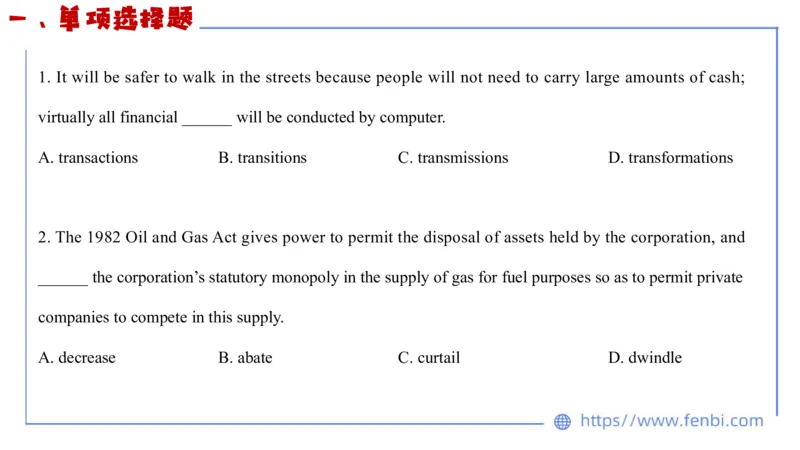
1. It will be safer to walk in the streets because people will not need to carry large amounts of cash;
virtually all financial ______ will be conducted by computer.
A. transactions B. transitions C. transmissions D. transformations
2. The 1982 Oil and Gas Act gives power to permit the disposal of assets held by the corporation, and
______ the corporation’s statutory monopoly in the supply of gas for fuel purposes so as to permit private
companies to compete in this supply.
A. decrease B. abate C. curtail D. dwindle3. The old couple were not rich themselves, but they hated to turn away anyone who were ______ food
and shelter.
A. at the mercy of B. on the point of
C. with the exception of D. in need of
4. ______for months, John finally decided to go abroad.
A. Hesitating B. Hesitated
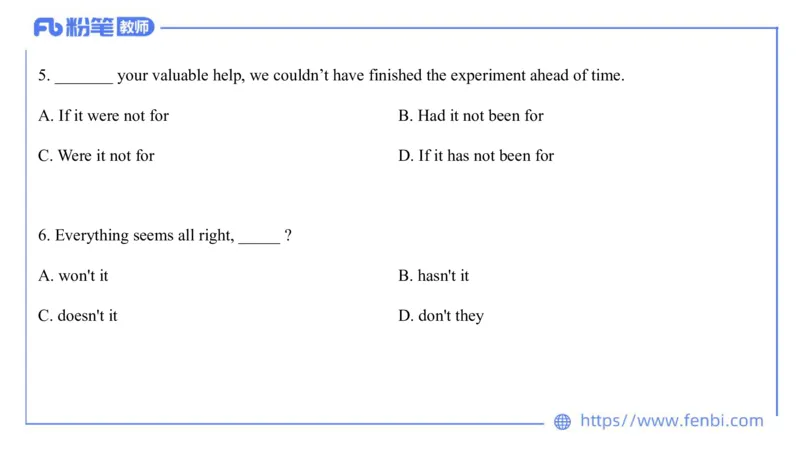
C. Having hesitated D. To hesitate5. _______ your valuable help, we couldn’t have finished the experiment ahead of time.
A. If it were not for B. Had it not been for
C. Were it not for D. If it has not been for
6. Everything seems all right, _____ ?
A. won't it B. hasn't it
C. doesn't it D. don't they7. The police were seeking more information to find out _______ the rich man.
A. who was it that killed B. who it was that killed
C. it was who killed D. who was it killed
8. He insisted that this matter ______ be discussed at the next meeting.
A. could B. would
C. should D. might9. Which of the following sounds is a voiced bilabial stop?
A. /n/
B. /tʃ/
C. /p/
D. /b/10. The underlined letters in the following words have the same sound EXCEPT ______.
A. helmet
B. energetic
C. edition
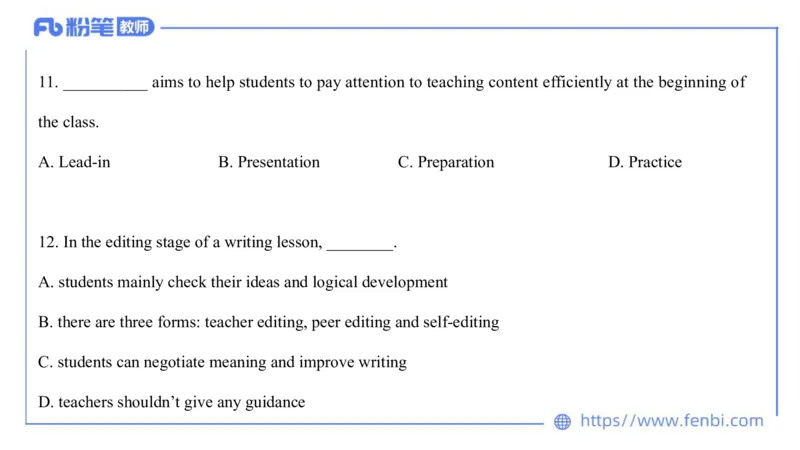
D. except11. __________ aims to help students to pay attention to teaching content efficiently at the beginning of
the class.
A. Lead-in B. Presentation C. Preparation D. Practice
12. In the editing stage of a writing lesson, ________.
A. students mainly check their ideas and logical development
B. there are three forms: teacher editing, peer editing and self-editing
C. students can negotiate meaning and improve writing
D. teachers shouldn’t give any guidance13. When a teacher leads students to predict the main idea of the passage based on the contextual clue
and the title, which one of the following models does he/she use?
A. Bottom-up Model. B. Top-down Model.
C. Interactive Model. D. 3P Model.
14. Work in pairs and look at the two pictures very carefully. Student A should not look at Student B's
picture and vice versa. Each one of you should describe your own picture to the other so that you can find
out the differences between the two pictures. This activity is called _____ .
A. information-gap activity B. accuracy-focused activity
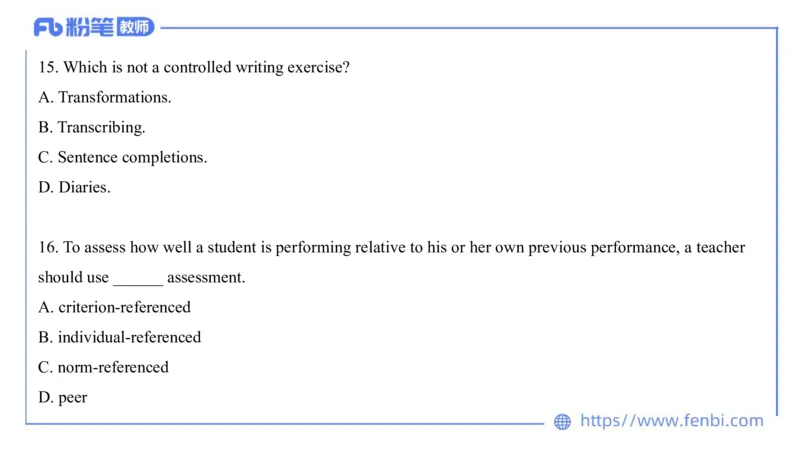
C. decision-making activity D. word-bingo activity15. Which is not a controlled writing exercise?
A. Transformations.
B. Transcribing.
C. Sentence completions.
D. Diaries.
16. To assess how well a student is performing relative to his or her own previous performance, a teacher
should use ______ assessment.
A. criterion-referenced
B. individual-referenced
C. norm-referenced
D. peer17. Which of the following is a referential question used by a teacher in class?
A. Who is the first Chinese astronaut to land on the moon?
B. What’s the end of Snow White’s story?
C. What’s the highest mountain in the world?
D. How do you deal with conflict in your life?
18. Which of the following is NOT a suitable pre-listening activity?
A. Predicting the main idea.
B. Discussing a relevant picture.
C. Associating vocabulary with the topic.
D. Recognizing communicating signals.19. If a teacher wants to design the lead-in stage of a lesson plan, which of the following might be of
his/her least concern?
A. The time of lead-in.
B. The content of teaching and students’ age.
C. To concentrate students’ attention.
D. The number of students.20. Which of the following statements about lesson plan is NOT true?
A. A clear lesson plan makes a teacher aware of the aims and language contents of the lesson.
B. A lesson plan can help a teacher distinguish the various stages of a lesson.
C. A good lesson plan gives a teacher, especially a novice teacher, confidence in class.
D. Experienced teachers do not need to do lesson planning.Passage 1
21. Generation Zs graduating college this spring ______.
A. are recognized for their abilities
B. are optimistic about the labor market
C. are in favor of office job offers
D. are drawing growing public attention
【第一段】Now that members of Generation Z are graduating college this spring—the most commonly-
accepted definition says this generation was born after 1995,give or take a year—the attention has been
rising steadily in recent weeks.22. Generation Zs are keenly aware ______.
A. what their parents expect of them
B. how valuable a counselor's advice is
C. what a tough economic situation is like
D. how they differ from past generations
【第二段】According to the career counselors and experts who study them, Generation Zs are clear-
eyed, economic pragmatists. Despite graduating into the best economy in the past 50 years, Gen Zs
know what an economic train wreck looks like. They were impressionable kids during the crash of
2008, when many of their parents lost their jobs or their life savings or both. They aren't interested in
taking any chances.23. The word“assuage”(Para.2) is closest in meaning to ______.
A. deepen
B. define
C. maintain
D. relieve
【第二段】They aren't interested in taking any chances. The booming economy seems to have done little
to assuage this underlying generational sense of anxious urgency, especially for those who have college
debt. College loan balances in the U.S.now stand at a record $1.5 trillion, according to the Federal Reserve.24. It can be learned from Paragraph 3 that Generation Zs ______.
A. give top priority to professional training
B. have a clear idea about their future jobs
C. care little about their job performance
D. think it hard to achieve work-life balance
【第三段】One survey from Accenture found that 88 percent of graduating seniors this year chose their
major with a job in mind.In a 2019 survey of University of Georgia students, meanwhile, the career office
found the most desirable trait in a future employer was the ability to offer secure employment (followed by
professional development and training, and then inspiring purpose). Job security or stability was the second
most important career goal(work-life balance was number one), followed by a sense of being dedicated to a
cause or to feel good about serving the greater good.25. Michelsen thinks that compared with millennials, Generation Zs are ______.
A. less adventurous
B. less realistic
C. more generous
D. more diligent
【最后一段】That's a big change from the previous generation. “Millennials wanted more flexibility in
their lives,” notes Tanya Michelsen, ... “Generation Zs are looking for more certainty and stability,
because of the rise of the gig economy. They have trouble seeing a financial future and they are quite risk-
averse.”Passage 2
26. Scientists generally believe that the effects of ethics classes are ______.
A. hard to determine
B. narrowly interpreted
C. difficult to ignore
D.poorly summarized
【第一段】Although ethics classes are common around the world, scientists are unsure if their lessons can
actually change behavior; evidence either way is weak, relying on contrived laboratory tests or sometimes
unreliable self-reports. But a new study published in Cognition found that, in at least one real-world
situation, a single ethics lesson may have had lasting effects.27. Which of the following is a reason for the researchers to study meat-eating?
A. It is common among students.
B. It is a behavior easy to measure.
C. It is important to students' health.
D. It is a hot topic in ethics classes.
【第二段】The researchers investigated one class session's impact on eating meat. They chose this
particular behavior for three reasons, according to study co-author Eric Schwitzgebel, a philosopher at the
University of California, Riverside: students' attitudes on the topic are variable and unstable, behavior is
easily measurable, and ethics literature largely agrees that eating less meat is good because it reduces
environmental harm and animal suffering.28. Eric Schwitzgebel's previous findings suggest that ethics professors ______
A. are seldom critical of their students
B. are less sociable than other professors
C. are not sensitive to political issues
D.are not necessarily ethically better
【第三段】Schwitzgebel predicted the intervention would have no effect; he had previously found that
ethics professors do not differ from other professors on a range of behaviors, including voting rates, blood
donation and returning library books.29. Nina Strohminger thinks that the effect of the intervention is ______.
A. permanent
B. predictable
C. Uncertain
D. unrepeatable
【第四段】“That's actually a pretty large effect for a pretty small intervention,” Schwitzgebel says.
Psychologist Nina Strohminger at the university of Pennsylvania, who was not involved in the study, says
she wants the effect to be real but cannot rule out some unknown confounding variable. And if real, she
notes, it might be reversible by another nudge: “Easy come, easy go.”30. Eric suspects that the students' change in behavior _____
A. can bring psychological benefits
B. can be analyzed statistically
C. is a result of multiple factors
D. is a sign of self-development
【第五段】Schwitzgebel suspects the greatest impact came from social influence—classmates or teaching
assistants leading the discussions may have shared their own vegetarianism, showing it as achievable or more
common. Second, the video may have had an emotional impact.Least rousing he thinks, was rational
argument, although his co-authors say reason might play a bigger role. Now the researchers are probing the
specific effects of teaching style, teaching assistants' eating habits and students' video exposure.Meanwhile
Schwitzgebel—who had predicted no effect—will be eating his words.二 、简 答 题
31. 一名高中英语教师在口语课堂上围绕“cultural relics”展开小组讨论活动,其作用是什么(10
分)?如何使学生更好地融入课堂小组讨论活动(10分)?【参考答案】
(1)小组讨论活动的作用:
①小组讨论是使用较为广泛的一种学习方式,有利于学生在集体思维中分担重任,体现自身价值。
②讨论不仅能训练听力,练习口语,而且还能提高学生彼此间的交际能力,而不只是流于形式。
③教师也会在学生的口语小组讨论中更为真实地把握学生的实际英语水平,方便后期英语教学的
查漏补缺。二 、简 答 题
31. 一名高中英语教师在口语课堂上围绕“cultural relics”展开小组讨论活动,其作用是什么(10
分)?如何使学生更好地融入课堂小组讨论活动(10分)?【参考答案】
(2)使学生更好地进行小组讨论的方法:
①合理安排小组人数,太多或太少都不利于讨论顺利进行。
②考虑学生实际水平,按层次分组,每个组里最好是各种不同能力的学生都有,实现能力互补。
③掌握好讨论的时间,充分发挥教师的作用,在必要的时候给予学生一些指导,使得讨论能够顺
利进行。三 、教学 情 境分 析题
32. 阅读所给材料,回答下列三个问题:
材料1
Tom: Hello, Alice, I′m interested in your work saving birds.What do you think is the most difficult part of
your work?
Alice: Well, I suppose it′s saving wild birds covered in oil. That′s the most difficult of all.
Tom: How does that happen?
Alice: The oil comes from boats. It flows on the water and covers the bird′s feathers when they swim
through it.Tom: That sounds terrible. What do you do about it?
Alice: The first thing we do is making sure the bird hasn’t tried to clean itself with its beak. As it does so,
the bird eats some oil and becomes sick.
Tom: Oh,dear! Did the birds always die?
Alice: Sometimes...but we try to save them. Birds use their feathers like a raincoat to keep out cold water.
When feathers are covered in oil, they stick together and the bird’s skin gets cold in the water. So without
help the bird would die of cold!材料2
Scientists have discovered that when chimpanzees have stomach pains, typically because of intestinal
parasites, they look for a certain plant to eat, Lippea. It is common in the jungles where chimpanzees live,
and it contains chemical substances effective against many parasites. Lippea is not the only natural
medicine in the chimpanzees’ cabinet. They may actually use up to thirty different plants--for different
problems. Interestingly, the local people make use of many of the same plants for medical purposes. It is
almost certain that chimpanzees discovered these herbal remedies before humans.根据上面所提供的信息,从下面三个方面作答:
(1)这两份材料分别属于哪种语篇类型?(5分)
(2)这两份材料分别适合于哪种课堂教学?说明理由(至少写出两个要点)(15分)
(3)分析教师选用文本材料时需要考虑的基本要素(至少写出三个要点)(10分)【参考答案】
(1)语篇指实际使用的语言单位,是交流过程中的一系列连续的语段或句子所构成的语言整体。
由一个以上的句子或段落组成,各句子或段落之间在形式上是衔接的,语义上是连贯的。它可以
是对话,也可以是独自,它包括书面语,也包括口语。根据语篇的概念,第一篇属于会话语篇,
第二篇属于段落语篇。根据上面所提供的信息,从下面三个方面作答:
(1)这两份材料分别属于哪种语篇类型?(5分)
(2)这两份材料分别适合于哪种课堂教学?说明理由(至少写出两个要点)(15分)
(3)分析教师选用文本材料时需要考虑的基本要素(至少写出三个要点)(10分)(2)第一篇适合于口语教学,第二篇适合于阅读教学。
理由:①第一篇语言比较简单,没有生僻词汇,句式偏向口语化,适合口语练习;第二篇语言偏
重书面化,词汇相对比较复杂,并且有长难句,适合进行句子的分析,因此适合阅读教学;
②第一篇比较生活化,有生活气息,适合平时与人交际时使用,英语口语教学的最终目的就是让
学生达到沟通交流的目的,因此会话语篇更适合口语教学;第二篇偏向说明性语言,是补充介绍
知识的,因此可以作为阅读材料来使学生在知识层面有所丰富和提高,同时也加强了语言理解方
面的训练。根据上面所提供的信息,从下面三个方面作答:
(1)这两份材料分别属于哪种语篇类型?(5分)
(2)这两份材料分别适合于哪种课堂教学?说明理由(至少写出两个要点)(15分)
(3)分析教师选用文本材料时需要考虑的基本要素(至少写出三个要点)(10分)(3)教师选用文本材料时需要考虑的基本要素:
①教学内容要素
教学内容是要完成的教学任务,是实现教学目标的主要载体。因此教师在选择材料时,往往会将
教科书作为主要依据,对于教材的分析基本关注教学的重点、难点及考点方面。
②教学对象要素
学生是分析教学任务必须要考虑的因素。分析学生是为了帮助学生解决学习中的困难,完成教学
任务。教师应该做到以下两点:一是要了解教学活动开始前学生在认知、情感、态度等方面已经
达到了什么样的水平,这一水平标志着学生已经能做什么,说什么,想明白了什么等等(即学生
的学情)。这是学生掌握新的学习任务的起点水平。二是要了解教授了教学材料后预期学生在认
知、情感、态度等方面必须达到的状态。对这种状态的把握最终会转化为确定的教学任务与具体
的学习目标。只有当教师的心中对教学前和教学后这两种状态的差距做到心中有数时,才能根据
学生的实际情况,确定恰当的教学内容。③教学目标要素
教学目标是教育者在教学过程中,希望受教育者达到的要求或产生的变化结果,也是教师完成教
学任务的归宿。新课程标准从关注学生的学习出发,强调学生是学习的主体,教学目标是教学活
动中师生共同追求的,而不是由教师所操纵的。因此,教学目标的主体显然应该是学生。教师在
选择教学材料的同时也要以学生为出发点,思考需要完成怎样的教学目标或达到怎样的教学效果。教师选择课外阅读材料的原则/ 注意事项:
(1)将英语教材和课外材料有机结合,实现课内外的协调。课外材料是课内教学的辅助和
补充,是课内知识的延伸和夯实,所以要与课内紧密相连。
(2)教师在选择材料时应当对所选材料的难度进行严格把关,选用难度适中的材料。
(3)阅读材料的选择应遵循因材施教的原则,可以把班级学生的阅读能力分为不同层次。
这样在选择阅读材料时,也应分不同等级。
(4)阅读材料应体裁多样,题材丰富,融合知识性和实用性为一体。可以是名人轶事、历
史传说、民间故事、寓言、新闻报道、政治经济、科普文章等,各种类型的文章都应有所涉
及,如叙述、描写、应用、说明、议论等各种文体皆备。
(5)教师应选择有趣味性的材料要有一定的趣味性,使学生对所选材料感兴趣,激发学生
的阅读欲望。四 、教学 设 计 题
根据提供的信息和语言素材设计教学方案,用英文作答。
设计任务:请阅读下面的学生信息和语言素材,设计一份时长15分钟的阅读教学方案。
教案没有固定格式,但须包含下列要点:
① Teaching objectives
② Teaching contents
③ Key and difficult points
④ Major steps and time allocation
⑤ Activities and justifications
教学时间:20 分钟
学生概况:某城镇普通中学八年级(初中二年级)学生,班级人数40人,多数学生已经达到《义务教
育英语课程标准(2022 年版)》三级水平。学生课堂参与积极性一般。语言素材:
The health care system of a country is very important and different countries have different ways of paying for it.
Britain was the first country in the world to have a free health care system paid for by the government. Health care is
free for everyone living in Britain. Most doctors and nurses work for the government and most hospitals are owned by
the government. Until recently this system was very successful but recently there have been problems. This is because
the government has not put enough money into the health service. As a result, more people are using private health
insurance. They see doctors who work for themselves and pay the doctors through the health insurance company.
In America the system is very different. Most people have private health insurance. Doctors work for themselves
and hospitals are privately owned. The health insurance company pays the doctors and the hospitals. The problem
with this system is that poorer people don't have the money to pay for private health insurance. As a result, they often
have both health and money problems. Canada has a different system again. Health care is free. Doctors work
privately and hospitals are privately owned. When you become ill, medical fees are paid for by the government.【参考设计】
1. Teaching contents
The material for this reading lesson is about the health care systems in Britain, America and Canada.2. Teaching objectives
①Students can have a deep understanding of the whole passage and acquaint themselves with the health care systems
of foreign countries.
②Students can enhance their awareness of keeping healthy.
③Students can use English to think independently and creatively.
④Students can make clear learning objectives and plans and arrange learning tasks reasonably.3. Teaching key and difficult points
Key point
Help students know three different health care systems and know how to compare the differences among them.
Difficult point
Help students cultivate their awareness of keeping healthy.4. Teaching procedures
Step 1 Pre-reading (3 minutes)
(1) New knowledge teaching
With the help of pictures, the teacher will guide students to understand the meaning and usage of the new words,
including health, insurance, and private.
(2) Ask students to have a free talk with students about Chinese health care system.
(Justification: Having a brief knowledge of health care systems can help students better understand this passage, and
this step can arouse students’ interest.)Step 2 While-reading (8 minutes)
(1) Extensive reading
①Skimming: Students will read the passage for the first time to check their predictions and conclude the main idea of
the passage./ Before reading the passage for the first time, remind students that during reading they should not pay
much attention to specific words or expressions and all they need to do is to get the main idea.
②Scanning: Ask students to locate certain information by reading the text quickly and answer the following questions.
Which country was the first country in the world to have a free health care system paid for by the government?
Where do most people have private health insurance?(2) Intensive reading
Ask students to read the passage for the second time and complete the exercise:
(3) Reading and repeating
Students will listen to the passage and read after it. They should pay attention to the pronunciation and intonation.
(Justification: In the process of completing reading tasks at different levels, students can understand the content and
certain details of the text, and improve their reading skills.)Step 3 Post-reading (4 minutes)
Group discussion
Students need to work in groups to discuss: the differences among three health care systems and talk about which one
is the best and explain the reasons by using the target language. Several minutes will be given. When time’s up, some
students will be invited to share their results. Then the teacher will comment on students’ performance.
(Justification: Group activities provide students with the opportunity to apply what they have learned to practical use,
improve their comprehensive language skills, boost their confidence in learning English.)