1
第四讲:Unit 2 语法篇
__________________________________________________________________________________
__________________________________________________________________________________
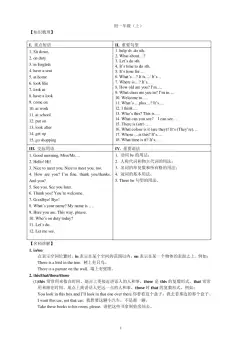
掌握单词和短语
时间状从句
一般现在时的被动语态
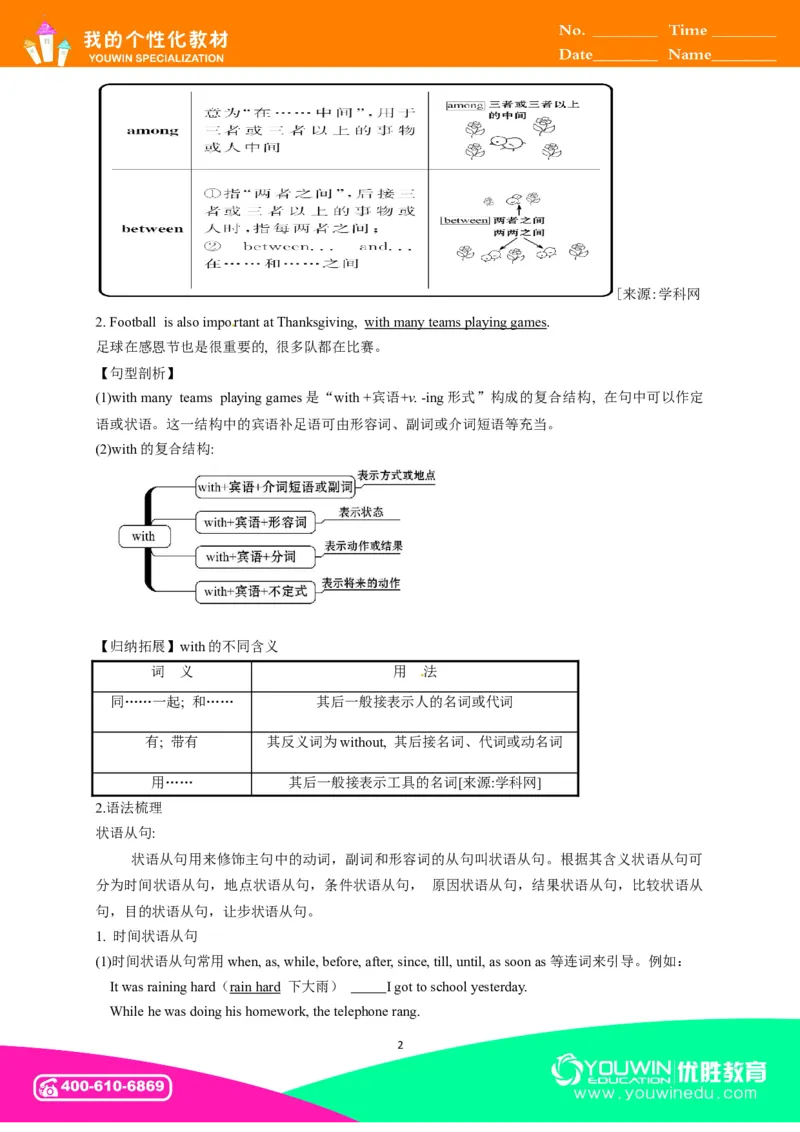
1. among prep. 在……之中
【语境领悟】
*It is a tim e for a special dinner among family and friends.
这是一个在家人和朋友之间吃顿特殊晚餐的时间。
*The teacher sat among the children.
老师坐在孩子们中间。
*I am sitting between my parents.
我正坐在我父母中间。
2
[来源:学科网
2. Football is also important at Thanksgiving, with many teams playing games.
足球在感恩节也是很重要的, 很多队都在比赛。
【句型剖析】
(1)with many teams playing games 是“with +宾语+v. -ing 形式”构成的复合结构, 在句中可以作定
语或状语。这一结构中的宾语补足语可由形容词、副词或介词短语等充当。
(2)with 的复合结构:
【归纳拓展】with 的不同含义
词 义
用 法
同……一起; 和……
其后一般接表示人的名词或代词
有; 带有
其反义词为without, 其后接名词、代词或动名词
用……
其后一般接表示工具的名词[来源:学科网]
2.语法梳理
状语从句:
 状语从句用来修饰主句中的动词,副词和形容词的从句叫状语从句。根据其含义状语从句可
分为时间状语从句,地点状语从句,条件状语从句, 原因状语从句,结果状语从句,比较状语从
句,目的状语从句,让步状语从句。
1. 时间状语从句
(1)时间状语从句常用when, as, while, before, after, since, till, until, as soon as 等连词来引导。例如:
It was raining hard(rain hard 下大雨)      I got to school yesterday.
While he was doing his homework, the telephone rang.
3
As he walked along(沿着走) the lake, he sang happily.
He had learned a little Chinese before he came to China.
After he finished middle school, he went to work in a factory.
(2)在时间状语从句里,通常不用将来时态,用现在时态表示将来的动作或状态。例如:
I’ll ring you up as soon as I get to New York.
I will tell him everything when he comes back.
He won’t believe it until he sees it with his own eyes.
(3)在带有till 或until 引导的时间状语从句的主从复合句里,如果主句用肯定式,其含义是“一直
到……时”,谓语动词只能用延续性动词。如果主句用否定式,其含义是“直到……才……” ,
“在……以前不……”, 谓语动词可用瞬间动词。例如:
The young man read till the light went out(熄灭).
Let’s wait until the rain stops.
  We won’t start until Bob comes.
  Don’t get off(从下来) until the bus stops.
【Till 是指直到某一特定事件发生的时候,而在那个时刻之后,该事情或状况仍将持续。 Until 是
指直到某一特定事件发生的时候,而讲话的人在自己心里认为,在那个时刻之后,该事情或该状况
将中止(不怎么可能持续)。固定组合里from morning till night,till/until 是不能替换的,】
2.when, while 的用法
 when 和while 与过去进行时有着密切的关系,他们作从属连词时都有“当…….时候”之意,
 用法稍有不同:
①
when

  引导的时间状语从句的谓语动词可以是短暂性动词,也可以是延续性动词,而

 while


引导的时间状语从句中的谓语动词只能是延续性动词。
②
when

 引导的从句谓语动词如果是短暂性动词则用一般过去时,主句是延续性动词则用过


去进行时,从句动作发生在主句动作的时间段之内(长动作用过去进行时,短动作用一般
过去时);如果主句和从句两个谓语动词都是延续性动词则全部用过去进行时

 , 这时

 when


和
  while

 都可以用。


③
when

 从句的谓语动词可以在主句谓语动作之前、之后或同时发生;

 while

 和
   as
  从句的谓语


动作必须是和主句谓语动作同时发生。
④
when

  和
   while

  两个词还可以用作并列连词,但意思不同,

 when

 相当于“在那时”,等于


at that time

  或
   just then;

 而
   while

 则相当于“而;却;但是”;相当于

  but,

 表示对比关系。


(这一点暂时可以不掌握)
eg.
 I
⑴
was playing computer games when my father got home.
       = When my father got home,I was playing computer games.
 (2) Mother was cooking when/while I was doing my homework.
     = When/While I was doing my homework, mother was cooking.
3.常见的时间状语从句:
when +短/延
while +延
4
    (1)when 引导的从句: 表示主句的动作和从句的动作同时发生, 或从句的动作发生在主句动作之
前。
    (2)while 引导的从句: 表示“当……过程中”, 强调某一段时间内主句和从句中谓语动词所表示
的动作在同一时期发生。由于while 从句表示一个持续的行为, 所以从句中要用延续性动词, 并且延
续性动词常用进行时态。
    (3)as 引导的时间状语从句: 由as 引导的时间状语从句, 表示“当……的时候, 一边……一
边……, 随着……”。其从句的主语与主句的主语往往是同一人或物。
    (4)before 引导的从句: 一般表示主句的动作发生在从句动作之前。例如: I didn’t know any
English before I came here. 我到这儿来之前, 一点英语都不懂。
(5)after 引导的从句: 表示主句的动作发生在从句动作之后。例如: After he locked the door, he
left. 他锁上门, 就走了。
(6)since 引导的从句: 表示“自从……以来”, 从句中的动词一般表示动作的起点, 用一般过去
时。主句中的动词表示动作延续的情况, 一般用现在完成时。如果主句中的动词表示的不是延续的
动作而是表示目前的状态, 可用一般现在时。
(7)until 引导的从句:
    ①表示“直到……”, 主句和从句都用肯定式。例如: They worked until it was late. 他们一直工
作到天黑。
    ②表示“直到……才”, 主句用否定式, 从句用肯定式。
    例如: She didn’t go to bed until she finished her homework.
    她一直到写完作业才睡觉。
    (8)as soon as 引导的从句: 表示“一……就”, 强调动作紧密相连。例如: As soon as she came to
the classroom, she began to read English. 她一到教室, 就开始读英语。
1. (·天津中考)______I got back, I found my mother cooking for me.
A. When
B. Before
C. Since
D. Although
2. (·莱芜中考)You’d better make a good plan ______you take a holiday.
A. before        B. during        C. until          D. after
3. (淮安中考)Many people do not realize the importance of health ______they have fallen.
A. until
        B. while         C. when          D. after
4. (·宜昌中考)—The local living conditions(条件)have improved a lot ______China set up the city of
Sansha.
—And more and more people would like to go there for business.
A. before
B. when
C. since
D. after
5. (·菏泽中考)______the children have fun, parents can take dance lessons on the beach.
A. When         B. If            C. While         D. Once
5
6. (·南充中考)My mother bought me a sweater for my ______ birthday.
A. twelfth        B. twelve        C. the twelfth
解析
1.选A。考查状语从句的连接词辨析。when“当……的时候”引导时间状语从句; before“在……之
前”引导时间状语从句; since“自从, 由于”引导时间或原因状语从句; although“虽然”引导让步状
语从句。理解两分句意思: 我回到家; 我发现妈妈正在为我做饭。由此知用when 引导时间状语从句
符合语境和逻辑, 故选A。
2.选A。考查连词用法辨析。before 在……之前; during 在……期间; until 直到; after 在……之后。句
意: 在你去度假之前, 你最好制订一个好计划。计划应在度假之前制订好。故选A。
3. 选A。考查连词的用法。until 到……为止; while 当……时候; when 当……时候; after 在……之后。
句意: 许多人直到失去了, 才知道健康的重要性。not. . . until 直到……才, 所以选择A。
4.选C。考查从属连词的辨析。“since +一般过去时的句子”是现在完成时的标志, 根据“The local
living conditions have improved a lot”可以判断用since。所以选择答案C。
5. 选C。考查连词辨析。句意: 当孩子们开心玩的时候, 家长们可以在海滩上参加舞蹈课。while 引
导时间状语从句, 意为“当……的时候”, 句中谓语动词通常是延续性动词。故选C。
6. 选A。考查数词用法。句意: 我妈妈为我十二岁生日给我买了一件毛衣。十二岁生日应用序数词
表示, 排除B; 当序数词前有物主代词、名词所有格等限定词时, 不再用定冠词the。故选A。
基础演练
I.单项选择。
1 The meeting didn't start___ everyone was there.
A. because
B. until
C. why
D. if
2 The boy ___ to bed ___ his mother came in.
A. went not; until
B. didn't go; after
C. went; until
D. didn't go; until
3 I won't believe you___ I have seen it with my own eyes.
A. before
B. until
C. after
D. when
4 He ___ home ___ she was satisfied ___ his answer yesterday.
A. didn't go; until; with
B. wasn't go; after; to
C. doesn't go; before; with
D. didn't go; until; to
5 He ___ back until the work ___ done.
A. isn't; will be
B. isn't; is
C. won't be; will be D. won't be; is
6 They didn't start the work ___ their teacher came back.
A. until
B. while
C. as soon as
 D. if
7. Tom will call me as soon as he ___ Shanghai.
6
A. arrives
B. will reach
C. arrives in
 D. get to
8. I'm sure he'll come to see me before he ___ Beijing.
A. will leave
B. is leaving
C. leave
 D. leaves
9. I will tell him the news as soon as he___ back.
A. come
B. comes
C. will come
 D. cam
10. I’ll give him your message        he comes back from lunch.
A. until
B. while
C.  before
 D. as soon as
III. 完成句子
1. 贝蒂, 暑假玩得开心吗?
Did you __________ __________during the summer holiday, Betty?
2. 饭前, 张先生做了一次演讲, 为了感谢大家的帮助。
Before dinner, Mr. Zhang __________ __________ __________to __________ __________
__________everyone’s help.
3. 在宴会的开始, 我们摆设餐具。
We __________ __________ __________at __________ __________of the party.
4. 谁教会了先驱们种植谷物?
Who taught the __________to __________ __________?
5. 小女孩靠卖报纸为生。
The little girl earns her living __________ __________newspapers.
答案: I. BDBAD AADBD
     II.1. enjoy yourself/have fun 2. made a speech; give thanks for 3. lay the table; the start 4.
pioneers; grow corn 5. by selling
巩固提高
I.单项选择。
1. You should finish your lessons _______ you go out to play.
A. before
B. after
C. when
D. while
2. All the students went home _____ school was o ver.
A before
B since
C as soon as
D while
3. You will feel much better _____ you take the medicine.
A before
B after
C when
D while
4. ____ we were playing football , they were playing volleyball.
A until
B When
C If
D while5. My grandma didn’t go to sleep
____ got back home.
A where
B until
C as soon as
D while
6. _____ did you see a cat from behind the door?  As soon as I entered the room.
AWhat
B When
C Where
D Why
7. It was raining ________I were waiting for you.
7
A after
B while
C before
D until[来源:Z#xx#k.Com]
8. _____ he finished his work , he left his office.
A Before
B After
C Until
D While
II.用所给动词的适当形式填空。
1. She _____ (write) to me as soon as she _____ (reach) Beijing next week.
2. My mother ________ (cook) when I got home yesterday evening.
3.They will wait until she _____(come) back.
4.I was just leaving when someone ______ (knock)  on the door.
5. After we ____(arrive) in Beijing tonight, we ____(have) a big meal.
6.He ____ (wait) until the rain ________(stop).
III.句型攻关
1. 昨天直到那个小男孩找到妈妈, 我才离开。
Yesterday I __________leave __________the little boy found his mother.
2. 记得你一到那儿就要给我打电话。
Remember to ring me up __________ __________ __________ you get there.
3. 当我到家的时候, 妹妹正在看电视。
 _________I got home, my sister __________ __________TV.
4. 当我正做饭时, 我切到手指了。
While I __________ __________, I __________my finger.
5. 他们正在努力地工作, 不是吗?
They are working hard,  __________ __________?
6. 自从你离开上海, 就没有见过王先生吗?
 __________you __________Mr. Wang __________ you left Shanghai?
7. 我们希望在老师的帮助下, 很容易地完成作业。
We hope we can finish homework easily, __________ the teacher __________ us.
答案:I.ACBDBBBB
      II. will write reaches, was cooking, comes, knocked,arrived had, waited stopped
      III.didn’t  until, as soon as, while was watching, was cooking cut,aren’t they? have met
since,
If help
I.单项选择
1. Students in Beijing       away many books to the Hope Schools since 2009.
A. have given
B give
C gave
D gives
2.Many people do not realize the importance of health        they have fallen.
A until
B  while
C when
D  after
3. I will call you as soon as I       free time.
8
A will have
B had
C  have
D am having
4. My father was reading the newspaper        my mother came back.
A as
B. when
C. because
D. if
5. I watched the girl        across the street.
A walked
B. walking
C  walks
D. to walk
6. The old man wanted to retire        .
A. somewhere quiet
B. quiet somewhere
C. anywhere quiet
D. quiet anywhere
7.       John was watching TV, his mother was cooking.
A. While
B. As soon as
C.  Before
D. Since
8. I’ll give him your message        he comes back from lunch.
A. until
B. while
C.  before
D. as soon as
9. ----- It’s too late. I have  to go now.
 ----- Oh, it’s raining outside. Don’t  leave ----- it stops.
A. since
B. until
C. while
D. when
10.       I was in the US, I made a lot of American friends.
A. While
B. Although
C. Until
D. Unless
II.完成句子
1. 如果你觉得工作太累了, 不妨去度假。
If you feel too tired at work, just __________ __________ __________.
2. 我明天可以请一天假吗?
May I have __________ __________ __________tomorrow?
3. 中国人民解放军建立于1927 年8 月1 日。
The PLA __________ __________ __________the First of August, 1927.
4. 我1995 年毕业, 从那以后, 我住在伦敦。
I left school in 1995, and __________ __________I have lived in London.
5. 超市里有各种各样的水果, 不是吗?
There are __________ __________ __________fruit in the supermarket,  __________ __________?
III.完型填空
The Adventures of Huckleberry Finn is a great book by Mark Twain. As its name suggests, it’s an
adventure
  1
  .
“Huck” Finn (first introduced as Tom Sawyer’s friend in The Adventures of Tom Sawyer) is a young
boy in the 1840s. Huck’s
  2
   has a really bad drinking problem, and he always abuses (辱骂) Huck
after he has drunk too much. Huck is so
  3
   his father that one day he runs away from home. He
  4

a runaway slave (奴隶) named Jim, and the
  5
   decide to run away together.
As Huck and Jim float (漂泊) down the Mississippi River,
  6
   meet many colourful characters
and have many great adventures. The theme of the story, however, is the
  7
   between Huck and Jim.
9
Huck has been taught that helping a runaway slave is
  8
  , but he truly believes that Jim is a good man.
With each adventure their friendship grows stronger and deeper.

  9
   Mark Twain wrote the book a long time ago, it is still very popular today. During the whole story
Mark Twain
  1 0
   everything stay exciting and interesting. Well, I felt like I was on the adventures with
Huck and Jim. I just couldn’t stop reading.
1.A. film
B. trip
C. story
D. lesson
2.A. father
B. mother
C. uncle
D. brother
3.A. worried aboutB. proud of
C. afraid of
D. interested in
4.A. catches
B. buys
C. brings
D. meets
5.A. two
B. three
C. four
D. five
6.A. we
B. they
C. you
D. I
7.A. fight
B. distance
C. secret
D. friendship
8.A. wise
B. wrong
C. kind
D. easy
9.A. Because
B. If
  C. Although
D. As
10.A. made
B. saw
C. heard
D. Found
答案: I.AACBBAADBA
     II.1. take a vacation 2. one day off  3. was founded on 4. since then 5. all kinds of; aren’t there
     III.1-5 CACDA
6-10 BDBCA
_________________________________________________________________________________
_________________________________________________________________________________
I.单项选择
1. The meeting didn’t start ______everyone was there.
A. because
B. until
C. why
D. if
2. Tom will call me as soon as he ______Shanghai.
A. arrives
B. will reach
C. arrives in
        D. get to
3. We ______TV when the telephone______.
A. watched; was ringing
    B. were watching; rang
C. watch; rings
                       D. are watching; rang
4. I ______him since I began to live in the city.
A. know           B. have known
 C. knew            D. will know
5. Mother was worried because little Alice was ill, especially ______ Father was away in France.
10
A. as               B. that
C. during            D. if
6. ______he had closed the door, he left the house.
A. Before
B. After
C. When             D. If
7. It was evening ______we reached the little town of Winchester.
A. that
B. until             C. since              D. before
8. While she ______a phone call, I ______a letter.
A. was making; wrote

B. was making; was writing
C. made; was writing

D. made; wrote
II. 完形填空
Once there lived two brothers. The elder was called Simon and the younger Victor. They
  1   each other very much, and always took care of one another. Every day they worked from morning
2    night, getting as much grain(谷物) as possible from their fields.
One late autumn evening, after their work in the    3    was done, Simon said to his wife, "Victor
got married last month. He has many bills(账单) to pay. I think I will put a bag of rice in his barn(谷仓)."
"Oh, that's a good idea," said his wife. "But please don't tell him," said Simon, "If he knows I put the rice
there, he will   4   take it.”
So, late that night Simon took a bag of rice to Victor's barn. The next day, while looking at his own
barn, he found   5   strange. "I took a bag of rice to Victor's house last night,   6
I still have the same number of bags in my barn.   7   did that happen?"
Simon decided to take another bag of rice to his brother's barn that night. But the next morning, he
found the   8   number of bags in his barn again! "This is very strange," he thought.
That night he   9   again. He carried a large bag of rice on his shoulder(肩膀); and   walked down
the road to his younger brother's house. In the bright moonlight, he could see another   10   coming
down the road. He was carrying something on his   11   too.
"Younger Brother!" Simon cried, "What are you doing?"
"I was   12  you, Older Brother," said Victor, "Your family is   13  than mine. I thought you
needed more rice. “The two brothers quickly   14   that they had been taking rice to each other. They
15   what had happened. "It is good to have a brother like you," they both said. And they lived happily
ever after.
 1. A. disliked
B. hated
C. loved
D. enjoyed
2. A. until
B. at                C. through
D. with
3. A. shops
B. fields             C. hospitals
D. factories
4. A. never
B. sometimes         C. usually
D. ever
5. A. everything
B. anything
C. nothing
D. something
6. A. so
   B. and
C. but
D. or
7. A. How
B. What             C. Why
D. Where
8. A. small
B. different
C. huge
D. same
9. A. planned
   B. failed
C. hoped
D. tried
11
10. A. brother

B. person            C. sister
D. wife
11. A. back
B. shoulder
C. head
D. hand
12. A. proud of
B. polite to           C. angry with
D. worried about
13. A. smaller

B. richer             C. larger
D. happier
14. A. remembered
B. realized
C. imagined
D. explained
15. A. laughed about
B. dreamed about
C. pointed at
D. shouted at
III.阅读理解
                                   A
Family Pictures
1 We visited Grandma last week.
She went to her bedroom.
She brought down old books of pictures.
  We looked at the old pictures.
2 We sat at the kitchen table.
A mother, a grandmother, and a daughter
looked at photos of mothers,
grandmothers, and daughters.
3 We turned the yellow pages of the books.
 The pictures were old.
They had men, women,
and children I don’t remember.
4 We listened to Grandma talk. “There’s
little Bonita,” she said. “She had long,
curly, brown hair and big brown eyes.”
Granma touched the page.
5 We listened to stories about aunts,
uncles, cousins, mothers, fathers, sons
and daughters. I don’t remember them.
But from the stories I know them.
1. Which word is repeated at the beginning of each stanza (诗节)?21         5
    A. Books.            B. Grandma.           C. Remember.        D. We.
2. Where does Grandma keep her books of photos?
    A. In her bedroom.     B. In the kitchen.     C. On the table.         D. On the sofa.
3. In which stanza does Grandma describe Bonita?
    A. Stanza 2.          B. Stanza 3.         C. Stanza 4.            D. Stanza
4. Where does this poem take place?
    A. At the author's home. B. At a school.       C. At Grandma's home.   D. At a library.
5. What is the writer's message in this poem?
    A. Visiting Grandma is boring.              B. Stories help you know people.
     C. Photos are useless.                     D. Grandmothers don't like to tell stories.

                                    B
Once upon a time, there was a spider with the name Anansi. He knew that he was very clever but he
also knew he wasn't wise(英明的). He didn't like this, but he did not know what to do. One day he had an
idea. He went around the village with a basket and asked each person to give him some of their wisdom( 智
12
慧). The people laughed at Anansi because they knew that he needed wisdom the most. So each person put
a bit in his basket and wished him good luck.
Soon his basket was full, but Anansi was worried that his neighbors might be jealous(嫉妒 ) of his
wisdom and take it from him. He decided to hide it at the top of a tall tree. When he had tied the basket to
the front part of his body, he tried to climb the tree, but it was too difficult. He tried again and again with
out success.4
Then his youngest son walked by. "What are you doing, father?" he asked and Anansi told him." Why
don't you carry the basket on your back instead?" his son said.7
Anansi put the basket on his back and climbed the tree easily, but he wasn't happy. "I walked all over
the village and collected so much wisdom that I am the wisest person ever, but my baby son is still wiser
than me. Take back your wisdom!" he said. And he threw the basket of wisdom into the air and went home.
And that's how wisdom went all over the world.
6. Anansi went around the village because_______.
     A. he knew he was very clever             B. he wanted to show his good luck
     C. he hoped to meet his son               D. he thought he wasn't wise enough
7. Anansi wanted to get his wisdom from_______.       【 :21·    ·     ·5】
     A. his son          B. his father          C. the villagers        D. the neighbors
8. The underlined word "it" in Paragraph 2 refers to (指的是)_______.   6
     A. the tree          B. the basket         C. the luck            D. the wisdom
9. The passage above is_______.
     A. a report          B. a story           C. an advertisement     D. a diary
10. The best title for the passage would be_______.
     A. Anansi's wisdom                     B. The wisdom of Anansi's son
     C. Anansi and his son                    D. Anansi and the villagers
IV. 句型填词
1.他们登陆以后, 他们的第一个冬天比任何一个英国的冬天都糟糕。
 __________ they landed, their first winter was __________  __________ any En glish winter.
2.在我们开始吃晚饭前, 我父亲对食物表示感谢, 所以我们记得我们庆祝这个节日的原因。
 __________ we begin dinner, my father __________  __________ __________ the food, so we
remember __________ we celebrate the festival.
3.当它(晚餐)完全结束时, 大家都帮忙洗碗。[来源:学,科,网]
 __________ it is all over, everyone __________ __________ the dishes.
4.我们去看梅西感恩节游行。游行沿几条街道走并在著名的梅西百货商店结束。
We go to watch the Macy’s Thanksgiving Day Parade. The parade __________ __________ several streets
and finishes at the famous Macy’s store.
5.足球在感恩节也是很重要的, 很多队都在比赛。
Football is also important at Thanksgiving,  __________ many teams __________ games.
13
V.书面表达
    对于许多中国人来说,没有烟花爆竹的新年如同烧菜没放盐 ——— 寡淡乏味。现在,全国已
有一百多个城市在实施“禁放令”后重新有限开禁。请根据下列要求,写一篇发言稿,谈谈你对春
节燃放烟花爆竹的看法。
要求: ① 不得照抄原文;

 70
②
词左右。


答案:I.BCBBA BDB
      II.CABADCADDBBDCBA
      III.DACCBDCDBA
      IV.1. After; worse than 2. Before; gives thanks for; why
    3. When; helps wash 4. goes along 5 with; playing
      V.One possible version:
In my opinion, we should continue the tradition. As everyone knows, setting off fireworks plays an
important part in traditional Chinese festivals like Spring Festival. It shows not only our happiness but also
our hope for a better future.
At the same time, it’s very important for us to protect ourselves when we set off fireworks. There are many
things we can do. Most important of all, we should set off fireworks in the right place at the right time.
课程顾问签字:                        教学主管签字: