1
Module 5 语法篇
__________________________________________________________________________________
__________________________________________________________________________________
熟练掌握本模块的动词不定式及双宾语。
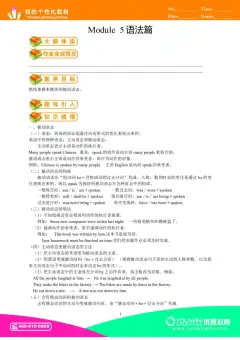
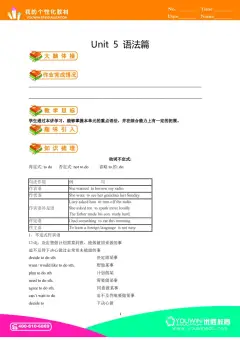
 动词不定式的用法(1)
动词不定式是由“to+动词原形”构成 (有时可以不带to)。其否定形式是“not+动词不定
式”(not 不与助动词连用)。它属于一种非谓语动词的形式,在句子中不能充当谓语,没有人称和数
的变化,但它可以保留动词的性质,其本身可以带宾语或状语等附加成分(不定式和其附加成分称
为不定式短语)。动词不定式(短语)的句法功能非常广泛,在句中可作主语、宾语、补足语、表
语、定语及状语等成分。
1. 动词不定式作宾语的用法
  动词不定式置于谓语动词之后,作动词的宾语,表明意图、希望或决定的内容。
  在英语中,并不是所有两个动词连用时都采用“动词+不定式”的形式,一般说来,用不定式
时,所表示的多为将来的行为。但是在具体使用中同学们还要注意记忆,因为动词不同,其后动词
形式的要求也就不同。
(1)能够接动词不定式作宾语的有 ask, agree, beg, decide, determine, fail, hope, manage, offer, plan,
prepare, pretend, promise, refuse, wish 及 would like/love 等动词,但 finish, enjoy, miss, appreciate,
mind, advise, suggest 等动词后面通常只能接动名词作宾语。例如:
I hope to visit this place again. 我希望能再度访问此地。
She enjoys reading very much.她非常喜欢读书。
The driver failed to see the other car in time. 司机没能及时看见另一辆车。
(2)动词不定式与名词构成复合宾语时,通常要用 it 作形式宾语,而将真正的宾语——动词不定
式后置。例如:
I think it our duty to obey the laws. 我认为遵守法律是我们的义务。
I found it difficult to see him here. 我发现在这里见到他是很难的。
口诀(接不定式作宾语的动词)
想要学习 早打算( want learn plan)
快准备 有希望( prepare hope wish expect)
同意否 供选择(agree offer choose)
决定了 已答应(decide determine promise)
尽力去 着手做(manage undertake)
别拒绝 别假装(refuse pretend)
失败不是属于你(fail)
e.g.Tom refused to lend me his pen.
2
汤姆拒绝把他的钢笔借给我。
We hope to get there before dark.
我们希望在天黑之前到达那儿。
The girl decided to do it herself.
这个女孩决定自己做。
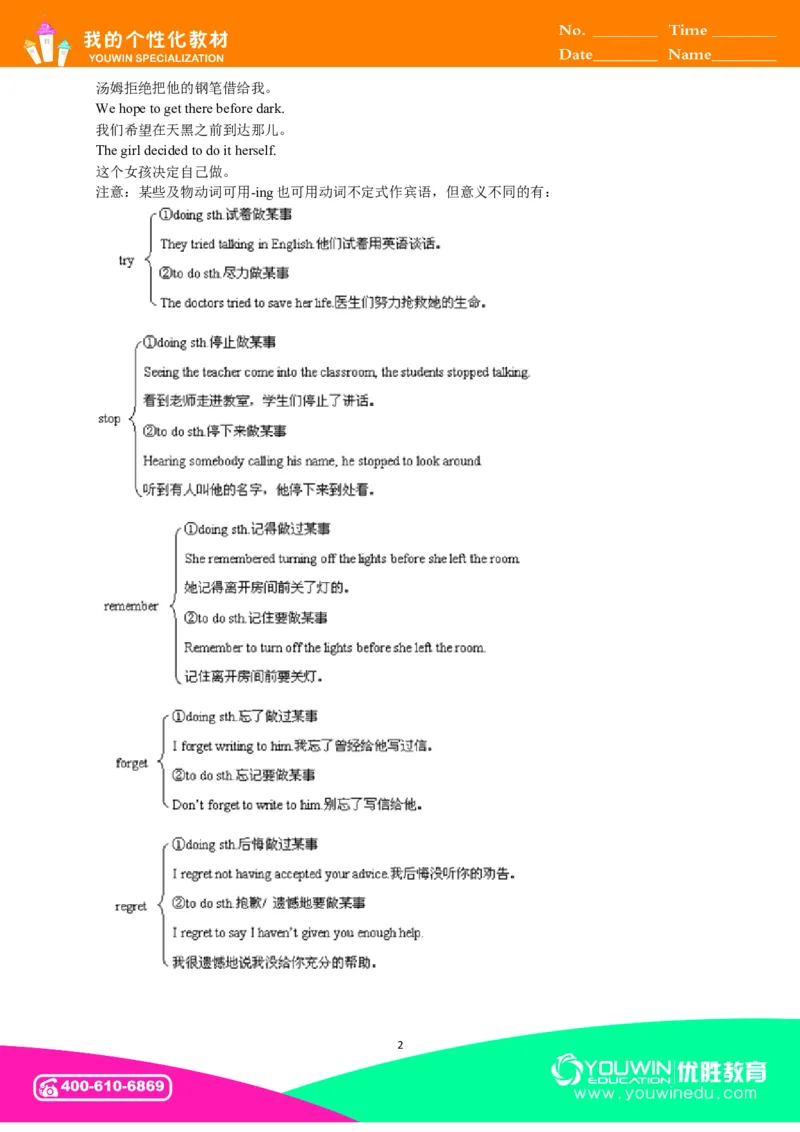
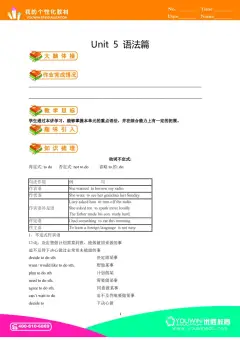
注意:某些及物动词可用-ing 也可用动词不定式作宾语,但意义不同的有:
3
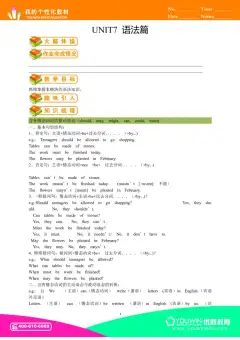
二、双宾语
双宾语由直接宾语和间接宾语组成。直接宾语是谓语动词的承受者,间接宾语表示谓语动作的
方向(对谁做)或动作的目标(为谁做),间接宾语紧接在谓语动词后,但它不能单独存在。它和
直接宾语组成双宾语。
Please show me your passport.
请把护照给我看一下。(your passport 是直接宾语,me 是间接宾语)
间接宾语可以用一个由to 表示动作方向或for 表示动作目标引起的短语来表示。这时,间接宾语
置于直接宾语之后。我们可以把上面例句改写为:
Please show your passport to me.
常见的可以接双宾语的动词有:give, bring, lend, pass, send, show, leave, buy, tell, teach, sell 等。
(  )1. Teachers often tell us _____ in the river after school.
A. don't swim
B. not swim
C. not to swim
D. to not swim
 (  )2.Tony wants _______a job as a language teacher in China.
      A. to find
B. finding
      C. Find
D. found
 (  )3. It took Janet three hours _______ reading this interesting story.
     A. to finish
B. finished
      C. finishing
D. finish
 (  )4. The weather was cool today, so we ______ play ______ after school.
      A.decided to; football

B. decided for; the football
      C. decide to; a football
D. decide with; football【
 (  )5.Many young people find it difficult     the Beijing Opera well.
A. understand
B. to understand
C. understood
D. understanding
基础演练
用所给词的适当形式填空。
1. They agreed _______ (take) the train to go there.  21*om
2. The boys decided _______ (play) basketball after school.【版权所有:21 教育】
3. What do you want ________ (be) when you grow up?21 教育名师原创作品
4. My father planned ________ (stay) in Beijing for two days.
5. The girl often goes ________ (watch) the magic show.
6. I would like ________ (show) my photos to you tomorrow.
7.The teacher has come into the room. We need to stop____________ (talk).
8. Mother told me ________________(not forget) to buy a bag for her.
9.What would you like_______ (drink)?
4
10. When I was very young, my father taught me_________(read) and write.
巩固提高
(2013 北京)
(  ) 1. Our teacher often asks us ____________ questions in groups.
A. discuss

B. to discuss
C. discussing
D. Discussed
(2013 滨州)
(  ) 2. — Would you like

  camping with me?
      — I’d like to. But I’m busy


  my homework.
A. to go; to do
B. to go; doing
C. going; to do
D. going; doing
(2013 四川雅安)
(  ) 3. — Can you finish

   these books before 10 o'clock?
      — Yes, I can.
A. to read
B. read
C. reads

D. Reading
(2013 漳州)
(  ) 4. Mr. Wang often encourages us _______ close to nature and enjoy its beauties.
A. get
B. getting
C. to get
D. got
(2013 宜宾)
(  )5. — Would you mind ________ in the dining hall?
  — Of course not.
A. not to smoke

B. not smoking

C. smoke
D. not smoke
(2013 杭州)
(  )6. She’s not strong enough _________ walking up mountains.
A. to go
B. going
C. go
D. went
(2013 河北)
(  ) 7. The children decide _____ their school yard this Friday afternoon.
A. clean
B. to clean
C. cleaning
D. cleaned
(2013 牡丹江)
(  ) 8. We spent much time _______ English last Sunday.
A.to practice speaking
B. practicing to speak
C. practicing speaking
D.practice speaking
(2013 孝感)
(  ) 9. — Dad, why must I stop           computer games?
— For your health, my boy.
A. play
                 B. to play
C. to playing
                 D. playing
(2013 四川雅安)
5
(  ) 10. Students should learn how

   problems.
A.solve
B. solving
C. can solve
D. to solve
一. 单项选择。
(  )1. — What are you going to do when you grow up?
— A singer, but my parents wish me _________ a teacher.
A.am
B. to be
C. will be
D. Be
2. Meimei likes English very much. She does her best ______ English well.
A. learn
B. learning
C. to learn
D. learns
3. It's our duty _________ the room every day.
A. to clean
B. cleaned
C. clean
D. Cleans
4. It's hard for us _________ English well.
A. learn
   B. learns
C. to learn
D. Learning
5. Mr Black asked the man ________ the queue.
A. not to jump
B. to not jump
C. didn't jump
D. not jump
6. The old man told the child ______ noisy.
A. not be
B. not to be
C. to not be
D. be not
7. There is going to ______ an important meeting tomorrow. Please try ______ late.
A. have, not to be
B. have, not be
C. be, not to be
D. be, not be
8 Don't forget ______ your homework with you when you come to school.
A. to bring
B. bringing
C. to take
D. taking
9. He found it very difficult ______.
A. sleeping
B. sleeps
C. slept
D. to fall asleep
10. Robert often asks us ______ his Chinese, so his Chinese is much better than before.
A. help him
B. to help him with
C. to help with
D. helps him with
二. 完形填空。
  先通读下面的短文,掌握其大意,然后从A、B、C、D 四个选项中选择可以填入空白处的最佳
答案。
Chi Li is one of the best known Chinese writers in the west. She was born in the west. She was born
6
in the 1950s.   1   19, Chi entered a medical college in 1976. After she graduated, she   2   as a
doctor at a hospital in Wuhan. As she loved   3   much more, she went to Wuhan University to study
Chinese language and literature in 1983. She chose   4   as her profession(专业).
During the 1980s, Chi wrote many works full of love. In the 1990s, her works, such as Apart From
Love and The Sun Was Born, were   5   lives of young people and everyday problems. Since 2003,
Chi has   6   a higher level in her works.  And many of her novels have received a   7   honor. Life
Show is one of her representative(代表)works and   8   has been translated into many languages.  The
9   shows the real life of a common woman in Wuhan. 【     】
  Chi says, “Writers don’t need to be anyone,    10   they should be able to understand everyone.
”So she often travels alone to get a feel of how the world is and tries to understand people from all social
strata(阶层).
1. A. At the age of
B. At the moment
C. In the beginning
D. At the end of
2. A. became
B. worked
C. enjoyed
D. be
3. A. medicine
B. travelling
C. literature
D. science
4. A. teaching
B. writing
C. nursing
D. singing
5. A. over
B. under
C. about
D. in
6. A. reached
B. arrived
C. went
D. came
7. A. great
B. nice
C. bad
D. worse
8. A. she
B. they
C. it
D. he
9. A. picture
B. story
C. newspaper
D. magazine
10. A. or
B. till
C. but
D. though
_________________________________________________________________________________
_________________________________________________________________________________
一.完型填空。
 One afternoon just before Christmas an old man was walking through the city center. The _1 _ were all
filled with good things and crowded with
   2
   shoppers. Suddenly he saw a dirty boy sitting on the
ground crying sadly. When the kind old man asked him why he was crying, the little boy told him that he
_ 3 _ the ten penny piece that his uncle _ 4 _ him. At once the old man took out a handful of _ 5_. He
_6  _   out a shiny new ten penny piece and handed it to the child. “Thank you very much,” said the little
7
boy, drying his    7   _ . He was happy at once.
An hour or so
  8 _
   the old man was _ 9 _ his way back home by the same road. To his surprise
he saw the dirty little boy in the same place, crying sadly as before. He went up to the boy and asked him
if he also lost the ten penny piece he had just given him. The boy told him that he didn’t lost the second
coin _ 10_  he still couldn't find the first one. “If I could find my own piece,” he said sadly, “I would
have twenty pence now.”
1. A. streets
B. houses           C. shops
D. parks
2. A. angry
B. happy            C. sad
D. surprised
3. A. spent
B. left              C. paid
D. lost
4. A. owned      B. gave             C. found
D. lent
5. A. sweets
B. pounds           C. toys
D. coins
6. A. picked
B. made            C. gave
D. left
7. A. hands
B. clothes           C. eyes
D. nose
8. A. before
B. later             C. past
D. ago
9. A. giving
B. making          C. crossing
D. leaving
10. A. and
B. but              C. so
D. as
二.阅读理解。
A
Tea parties have been around for over 3,000 years. People all over the world have tea parties every day.
Let’s talk about tea parties.
Steps
1. Choose your time. Traditionally, a tea party is in the afternoon, either late noon (11:30 am to 12:30 pm)
or afternoon (3:00 pm to 4:00 pm).
2. Send out invitations about two weeks before the tea party.
3. Set out fresh linen on the table, and make sure the garden is nice or the room for the tea party is clean.
4. Begin to set out your fine china, tea cups, eating utensils (器具) and decorations about two
hours in advance (提前).
5. Begin boiling the water and setting out the food about 10 minutes before guests arrive. Take this time to
put the tea inside the tea pot. You may use this time to talk while the water is boiling.
6. When the water is ready, put the water into the tea pot and take the tea pot to the table.
7. Bring guests to the table and chat, sip tea and eat the delicious food.
(   )1. The writer advises us to send out invitations _____before the tea party.
A. two weeks
B. three weeks
C. two days
D. three days
(   )2. The word “boil” means in the passage ___.
A. 拔掉
B. 煮沸
  C. 抢走
D. 冷冻
(   )3. Which of the following orders is right?
①Put the water into the tea pot.
②Put the tea inside the tea pot.
③Set out the food.
④Set out your fine china, tea cups, eating utensils and decorations.
A. ④③②①

B. ④②③①
C. ①④③②

D. ④③①②
(   )4. The writer gives us some ____ to have a tea party.
8
A. information
B. news
C. advice
D. facts
(   )5. The main idea of the passage is _______.
A. how to have a tea party
B. when to have a tea party
C. where to have a tea party
D. what to do at the tea party

B
Robinson was born in a poor family. At seven, he had to pick coal in a deserted mine near
his home, and then he sold what he had picked and earned a few coins to help his parents. He
had no schooling, for being so poor, how could they afford school fees?
When he was fifteen, he worked as a servant in a school. Looking at other children studying
in the classroom, he felt sorry for himself. In the day time, after the sweeping and cleaning was
over, he could stand by the window outside the classroom trying to catch what the teacher said.
At night, he tried his best to remember what he learned during the day. He worked so hard at
the lesson that he sometimes had just three or four hours’ sleep. The more he learned, the greater
interest he had. A maths teacher discovered him and came to like this diligent boy and allowed
him to sit at the back of the class. In one exam, he came first in grade in the whole school. He
would have been given the scholarship if he had been a regular boy of the school.
Robinson struggled through six long years with his study of maths and wrote several articles
which caught the attention of some university professors. They appreciated his diligence as well as
his cleverness. To give him the better chance they hired him as a librarian and offered him free
guidance. Robinson was filled with joy, for he felt that before him there was a broad road leading
to success.
(  ) 1. When he was very small, Robinson didn’t go to school because _____ .
A. there was no school there
B. his family was poor
C. the school didn’t want him
D. he didn’t like school
(  ) 2. When he was a teenager, Robinson _____.
A. went to school
B. left school
C. lived in a school
D. worked in a school
(  ) 3. At the end of the story, Robinson was sure that he ____ .
A. would no longer worry about his future life
B. would work in the library for a long time
C. would become successful in business
D. would become successful in learning
(  ) 4. The best title for the passage is _____.
A. Diligence Makes a Success
B. Cleverness Makes a Success
C. A Boy’s Early life

D. A Boy’s Early Education
C
J. K. Rowling is the writer of Harry Potter, which is now one of the best-sellers in the world.
    J. K. Rowling was born in Bristol on July 31th, 1965. She has one sister who is two years younger than
her. The girls loved listening to their father reading bedtime stories to them. They especially loved stories
9
about magical worlds. Rowling wrote her first story, called Rabbit, at the age of six.
    After she graduated from the university, Rowling worked as a translator  in London. During this time, on
a long train trip in the summer of 1990, the idea came to her of a boy who has magic  but doesn't know it.
In 1992 Rowling began to teach English. She lived with her baby daughter, Jessica, and spent much time
finishing the first Harry Potter book for young readers. It appeared in June 1997. To her surprise, the book
was greatly successful. The film came out in November 2001. Now Harry Potter series is popular with
people of all ages and about 60 million books were sold in 200 countries.
    Why has the series been so successful? There are a few things. Many other magical stories happen in
faraway lands or in past or future times. But Harry lives in modern  England. He's also a very ordinary boy:
polite, friendly and clever. So when other children read about Harry, they can imagine being like him.
    J. K. Rowling is very happy with the success, and she is now busy finishing the whole series of seven
books. She's writing full time and she's really enjoying life. She says she will go on living an ordinary life
with her daughter and writing children's books.
(  )1. J. K. Rowling _________.
   A. met a boy named Harry on a train trip
   B. loved listening to stories when she was very young
   C. got the idea of writing Harry Potter from her father's stories
   D. wrote her first story after she graduated from the university
(  )2. The first Harry Potter book came out _________.
   A. in 1992
B. in the summer of 1990
  C. in June 1997
D. in November 2001
(  )3. The Harry Potter series is _________.
   A. written for young people
B. written for her daughter, Jessica
   C. only sold well in England
D. about a young inspector
(  )4. J. K. Rowling has been successful, and she _________.
   A. likes to travel all over the world with her daughter
B. is the richest woman in England
   C. is excited about her success every day
D. is still writing stories for children
(  )5. The best title of the passage is ________.
   A. English Magical Stories
B. Successful Way-Writing Stories
   C. Harry Potter-A Boy with Magic
D. J.K. Rowling and Harry Potter Series

课程顾问签字:                        教学主管签字: