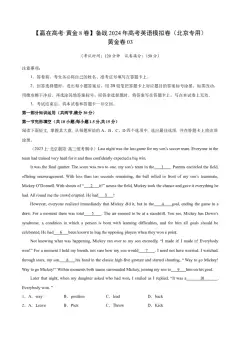
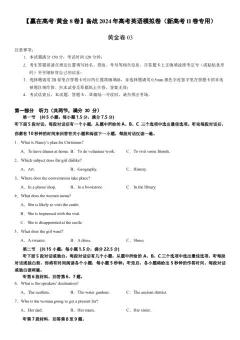
备战2024年高考英语模拟卷03(北京卷)
(考试时间:120分钟 试卷满分:150分)
注意事项:
1.答卷前,考生务必将自己的姓名、准考证号填写在答题卡上。
2.回答选择题时,选出每小题答案后,用 2B铅笔把答题卡上对应题目的答案标号涂黑。如需
改动,用橡皮擦干净后,再选涂其他答案标号。回答非选择题时,将答案写在答题卡上。写在本试
卷上无效。
3.考试结束后,将本试卷和答题卡一并交回。
第一部分知识运用(共两节,满分30分)
第一节完形填空(共10小题;每小题1.5分,共15分)
阅读下面短文, 掌握其大意, 从每题所给的A、B、C、D四个选项中, 选出最佳选项, 并在答题卡上
将该项涂黑。
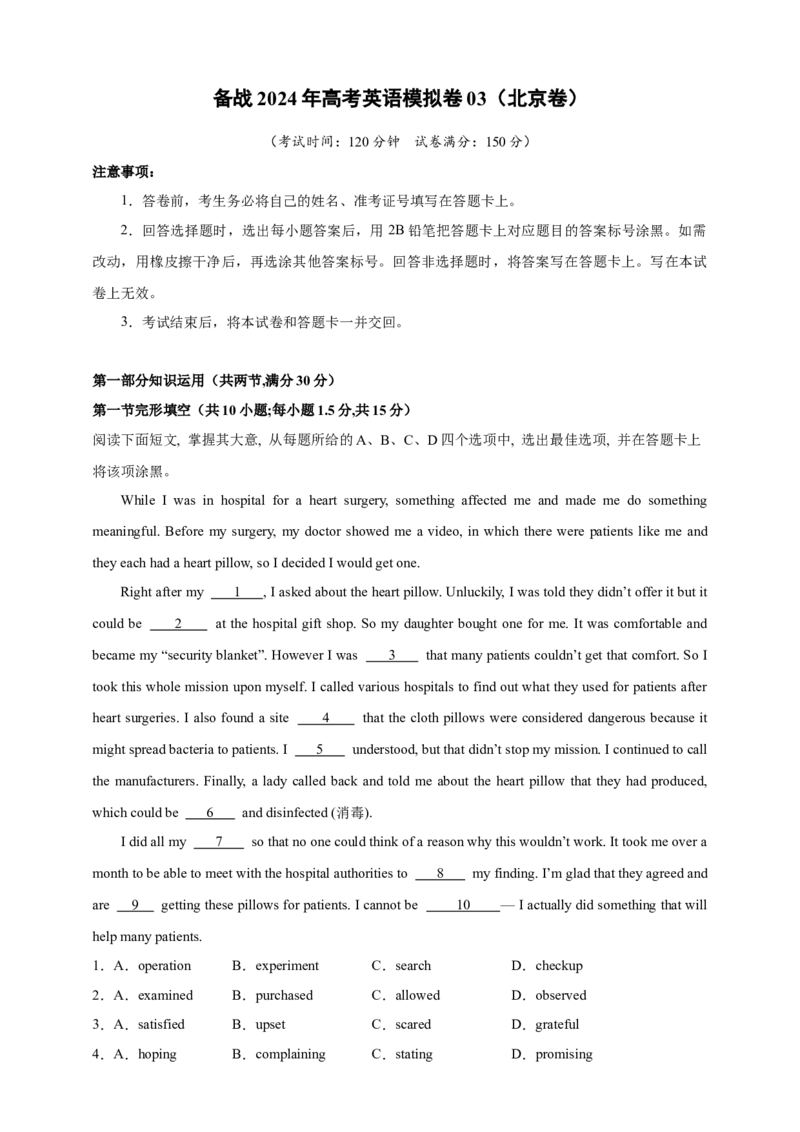
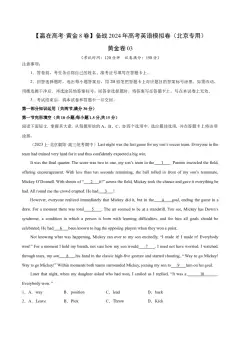
While I was in hospital for a heart surgery, something affected me and made me do something
meaningful. Before my surgery, my doctor showed me a video, in which there were patients like me and
they each had a heart pillow, so I decided I would get one.
Right after my 1 , I asked about the heart pillow. Unluckily, I was told they didn’t offer it but it
could be 2 at the hospital gift shop. So my daughter bought one for me. It was comfortable and
became my “security blanket”. However I was 3 that many patients couldn’t get that comfort. So I
took this whole mission upon myself. I called various hospitals to find out what they used for patients after
heart surgeries. I also found a site 4 that the cloth pillows were considered dangerous because it
might spread bacteria to patients. I 5 understood, but that didn’t stop my mission. I continued to call
the manufacturers. Finally, a lady called back and told me about the heart pillow that they had produced,
which could be 6 and disinfected (消毒).
I did all my 7 so that no one could think of a reason why this wouldn’t work. It took me over a
month to be able to meet with the hospital authorities to 8 my finding. I’m glad that they agreed and
are 9 getting these pillows for patients. I cannot be 10 — I actually did something that will
help many patients.
1.A.operation B.experiment C.search D.checkup
2.A.examined B.purchased C.allowed D.observed
3.A.satisfied B.upset C.scared D.grateful
4.A.hoping B.complaining C.stating D.promising5.A.secretly B.suddenly C.currently D.totally
6.A.washed B.abandoned C.repaired D.packed
7.A.essay B.homework C.practice D.magic
8.A.grab B.trace C.present D.return
9.A.depending on B.carrying on C.insisting on D.working on
10.A.happier B.calmer C.wiser D.luckier
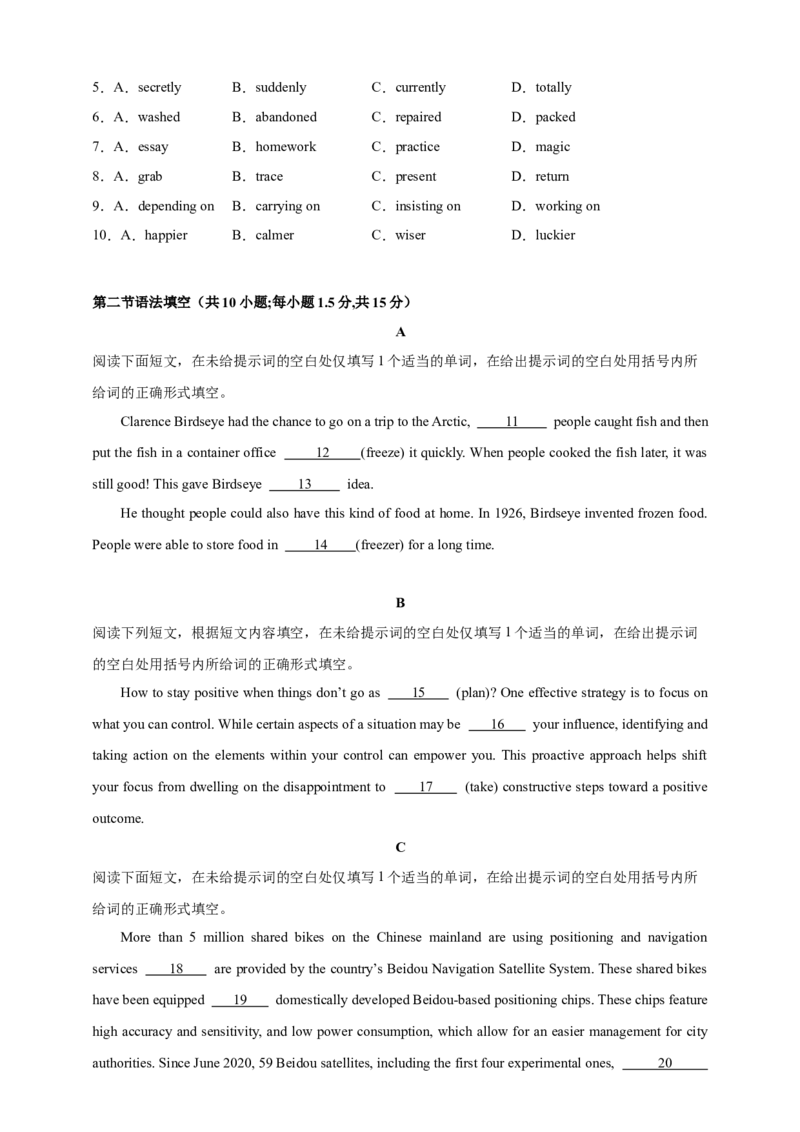
第二节语法填空(共10小题;每小题1.5分,共15分)
A
阅读下面短文,在未给提示词的空白处仅填写1个适当的单词,在给出提示词的空白处用括号内所
给词的正确形式填空。
Clarence Birdseye had the chance to go on a trip to the Arctic, 11 people caught fish and then
put the fish in a container office 12 (freeze) it quickly. When people cooked the fish later, it was
still good! This gave Birdseye 13 idea.
He thought people could also have this kind of food at home. In 1926, Birdseye invented frozen food.
People were able to store food in 14 (freezer) for a long time.
B
阅读下列短文,根据短文内容填空,在未给提示词的空白处仅填写1个适当的单词,在给出提示词
的空白处用括号内所给词的正确形式填空。
How to stay positive when things don’t go as 15 (plan)? One effective strategy is to focus on
what you can control. While certain aspects of a situation may be 16 your influence, identifying and
taking action on the elements within your control can empower you. This proactive approach helps shift
your focus from dwelling on the disappointment to 17 (take) constructive steps toward a positive
outcome.
C
阅读下面短文,在未给提示词的空白处仅填写1个适当的单词,在给出提示词的空白处用括号内所
给词的正确形式填空。
More than 5 million shared bikes on the Chinese mainland are using positioning and navigation
services 18 are provided by the country’s Beidou Navigation Satellite System. These shared bikes
have been equipped 19 domestically developed Beidou-based positioning chips. These chips feature
high accuracy and sensitivity, and low power consumption, which allow for an easier management for city
authorities. Since June 2020, 59 Beidou satellites, including the first four experimental ones, 20(lift) on the Long March 3-series rockets from the Xichang Satellite Launch Center in Sichuan province.
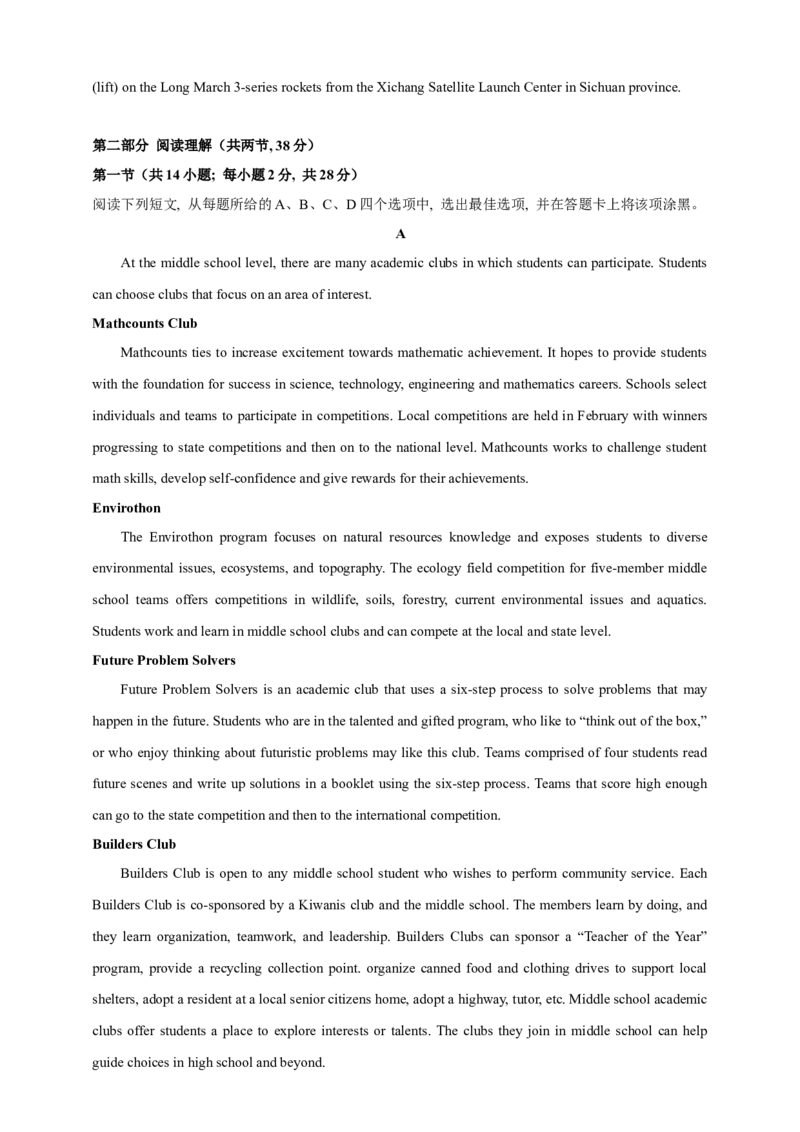
第二部分 阅读理解(共两节, 38分)
第一节(共14小题; 每小题2分, 共28分)
阅读下列短文, 从每题所给的A、B、C、D四个选项中, 选出最佳选项, 并在答题卡上将该项涂黑。
A
At the middle school level, there are many academic clubs in which students can participate. Students
can choose clubs that focus on an area of interest.
Mathcounts Club
Mathcounts ties to increase excitement towards mathematic achievement. It hopes to provide students
with the foundation for success in science, technology, engineering and mathematics careers. Schools select
individuals and teams to participate in competitions. Local competitions are held in February with winners
progressing to state competitions and then on to the national level. Mathcounts works to challenge student
math skills, develop self-confidence and give rewards for their achievements.
Envirothon
The Envirothon program focuses on natural resources knowledge and exposes students to diverse
environmental issues, ecosystems, and topography. The ecology field competition for five-member middle
school teams offers competitions in wildlife, soils, forestry, current environmental issues and aquatics.
Students work and learn in middle school clubs and can compete at the local and state level.
Future Problem Solvers
Future Problem Solvers is an academic club that uses a six-step process to solve problems that may
happen in the future. Students who are in the talented and gifted program, who like to “think out of the box,”
or who enjoy thinking about futuristic problems may like this club. Teams comprised of four students read
future scenes and write up solutions in a booklet using the six-step process. Teams that score high enough
can go to the state competition and then to the international competition.
Builders Club
Builders Club is open to any middle school student who wishes to perform community service. Each
Builders Club is co-sponsored by a Kiwanis club and the middle school. The members learn by doing, and
they learn organization, teamwork, and leadership. Builders Clubs can sponsor a “Teacher of the Year”
program, provide a recycling collection point. organize canned food and clothing drives to support local
shelters, adopt a resident at a local senior citizens home, adopt a highway, tutor, etc. Middle school academic
clubs offer students a place to explore interests or talents. The clubs they join in middle school can help
guide choices in high school and beyond.21.The students who are not interested in competitions would like to choose ________.
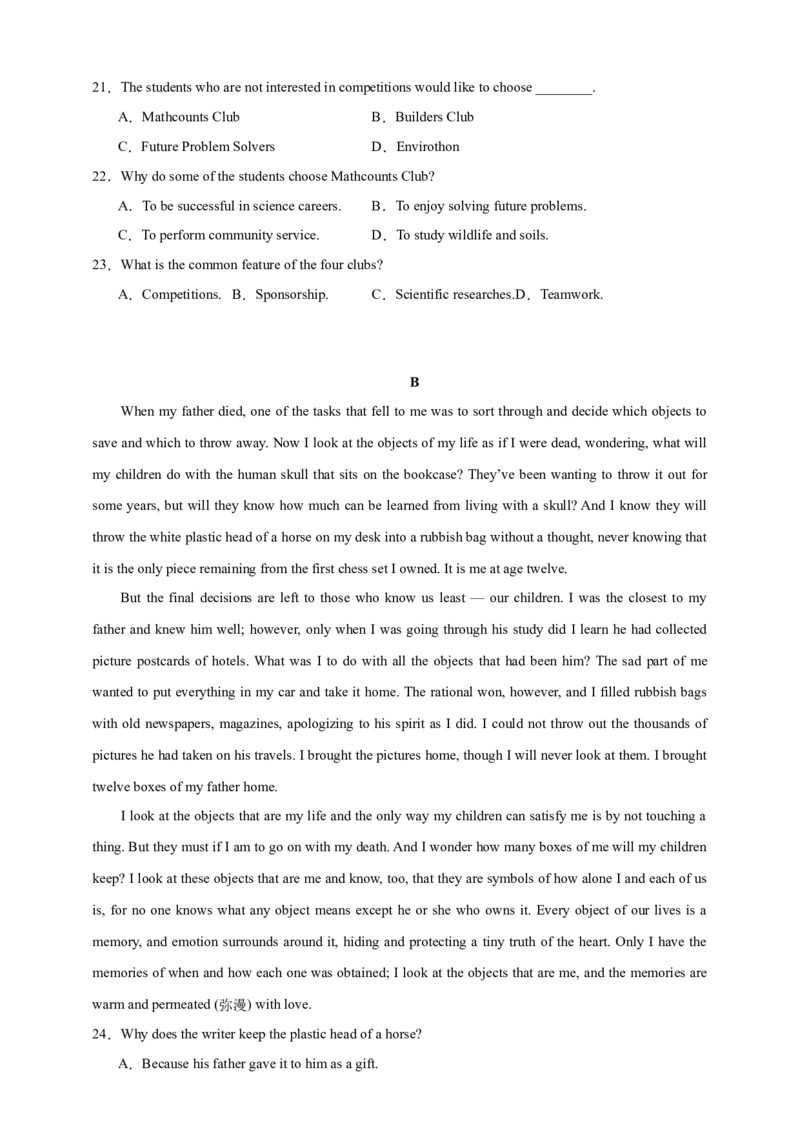
A.Mathcounts Club B.Builders Club
C.Future Problem Solvers D.Envirothon
22.Why do some of the students choose Mathcounts Club?
A.To be successful in science careers. B.To enjoy solving future problems.
C.To perform community service. D.To study wildlife and soils.
23.What is the common feature of the four clubs?
A.Competitions. B.Sponsorship. C.Scientific researches.D.Teamwork.
B
When my father died, one of the tasks that fell to me was to sort through and decide which objects to
save and which to throw away. Now I look at the objects of my life as if I were dead, wondering, what will
my children do with the human skull that sits on the bookcase? They’ve been wanting to throw it out for
some years, but will they know how much can be learned from living with a skull? And I know they will
throw the white plastic head of a horse on my desk into a rubbish bag without a thought, never knowing that
it is the only piece remaining from the first chess set I owned. It is me at age twelve.
But the final decisions are left to those who know us least — our children. I was the closest to my
father and knew him well; however, only when I was going through his study did I learn he had collected
picture postcards of hotels. What was I to do with all the objects that had been him? The sad part of me
wanted to put everything in my car and take it home. The rational won, however, and I filled rubbish bags
with old newspapers, magazines, apologizing to his spirit as I did. I could not throw out the thousands of
pictures he had taken on his travels. I brought the pictures home, though I will never look at them. I brought
twelve boxes of my father home.
I look at the objects that are my life and the only way my children can satisfy me is by not touching a
thing. But they must if I am to go on with my death. And I wonder how many boxes of me will my children
keep? I look at these objects that are me and know, too, that they are symbols of how alone I and each of us
is, for no one knows what any object means except he or she who owns it. Every object of our lives is a
memory, and emotion surrounds around it, hiding and protecting a tiny truth of the heart. Only I have the
memories of when and how each one was obtained; I look at the objects that are me, and the memories are
warm and permeated (弥漫) with love.
24.Why does the writer keep the plastic head of a horse?
A.Because his father gave it to him as a gift.B.Because it makes him a very good chess player.
C.Because it brings back memories of his childhood.
D.Because he accepted it as a prize for a competition.
25.How did the writer deal with the remaining objects of his father after he died?
A.He threw everything away.
B.He saved some of the worthless objects.
C.He took some of them to his own house.
D.He sorted them and put them into good order.
26.What do we know about the writer?
A.He is very strict with his children.
B.He prefers to collect different skulls.
C.He relies on his children to deal with his possessions.
D.He knows more about his father after his father died.
27.According to the last paragraph, the objects we save ________.
A.serve as the symbols of our social class B.are reminders of past experiences
C.are quite expensive and valuable D.make us proud of ourselves
C
“Find your passion!” is an appeal well-intended and meant to inspire. But is it good advice?
“Finding” a passion implies that it already exists and is simply waiting to be discovered. Unfortunately,
this idea doesn’t square with what science tells us. Instead, passions are developed. They often begin with a
spark (火花) of curiosity caused by something in one’s environment, such as a fascinating physics lecture.
Through a process involving repeated engagement and-positive experiences, people can come to personally
value that content or activity and internalize it. What was at first interesting becomes an interest. If these
qualities continue to intensify, a passion can emerge.
Actually, assuming passion as inborn tend to cause people to be less open, less courageous in the face
of challenges and less creative in pursuit of new interests. Thus, encouraging people to “find” their passion
may cause them to eventually believe that interests and passions are unchangeable. People who think this
have a fixed mindset of interest. By contrast, some people, whom we refer to as having a growth mindset of
interest, view their interests and passions as developed.
People with a fixed mindset of interest, for example, may fall into the trap of thinking, “If I have
already found my passion, why keep exploring?” In recent studies, after engaging in a new science task, arts
students with a fixed mindset expressed less interest in a scientific topic than arts students with a growthmindset. Meanwhile, science students with a fixed mindset responded similarly to an art-related task. For
those with a growth mindset, having a strong pre-existing interest in the arts or sciences did not get in the
way of them viewing a new area as interesting.
Worse still, people with a fixed mindset of interest tend to expect their passions to provide limitless
motivation, such that their favorite topics should never feel too difficult or demanding. Such a mindset can
also limit creativity and innovation. If people believe they are restricted to only a few inborn interests and, in
consequence, do not explore other areas, they may miss seeing important connections across different fields.
That loss is especially unfortunate considering how leaders at innovative companies have long prized
problem-solving that draw ideas from diverse disciplines.
Of course, not every activity will become a burning passion. But a growth mindset of interest will help
you remain open and curious. The old saying “find something you love to do, and you’ll never have to work
a day in your life” needs to be updated.
28.The author uses the sentence underlined in Paragraph 1 to ________.
A.set a target for criticism B.point out the fact
C.confirm people’s finding D.voice his opinion
29.What can we learn from the passage?
A.Any interesting activity can spark a passion.
B.Companies prefer those who specialize in one field.
C.People with a fixed mindset of interest are hard to be motivated.
D.A growth mindset of interest promotes creativity and innovation.
30.Which will the author probably agree with?
A.One should count on luck to excite a burning passion.
B.Reinforced positive experiences contribute to passion.
C.Those already interested in a field find new areas boring.
D.We’d better cherish the existing passion and look for more.
D
Amid rolling farms and green pasture 150 miles northwest of Sao Paulo, Brazil, two tropical forests
bloom as one. The first consists of a single species, row after row of non-native eucalyptus (桉树), planted
in perfect lines like carrots. The other is haphazard, an assortment of dozens of varieties of native saplings.
There’s no denying it: This forest looks ridiculous. The gangly (修长的) eucalyptuses shoot like witch
fingers high above patches of stubby fig (矮壮的无花果树) and evergreen trees. Yet these jumbled 2.5-acre
stands of native trees, ringed by fast-growing exotics, are among many promising efforts to resurrect theplanet’s forests.
The eucalyptuses, says Pedro Brancalion, the University of Sao Paulo agronomist who designed this
experiment, get big so quickly they can be cut after five years and sold to make paper or fence posts. That
covers nearly half or more of the cost of planting the slow-growing native trees, which then naturally reseed
ground that has been laid bare by the harvest. And this process doesn’t hamper natural regeneration.
You needn’t look far these days to find organizations trying to save the world by growing trees. Too
often, tree-planting groups are so focused on getting credit for each seedling planted that they ignore what
matters most: What kind of woodland is created? At what cost? And most importantly: How long will it last?
Using the numbers of trees planted as a magic “proxy for everything,” Brancalion says, you “spend more
money and get lower levels of benefits.” You can literally miss the forest for the trees.
Tree planting seems like a simple, natural way to counter the overwhelming crises of climate change
and biodiversity loss. Trees provide wildlife habitats and slurp carbon dioxide from the atmosphere. No
wonder trees are hailed as the ideal weapon. Yet for every high-profile planting operation, devastating
failures have occurred. In Turkey, Sri Lanka, and Mexico, mass plantings have resulted in millions of dead
seedlings or have driven farmers to clear more intact forest elsewhere. Trees that have been planted in the
wrong places have reduced water yields for farmers, destroyed highly diverse carbon-sucking grassland
soils, and allowed for invasive vegetation to spread. Simply reforesting the planet isn’t going to do much if
we don’t also start cutting down on our emissions from the burning of coal, oil, and natural gas. Tree
planting also can’t replace old-growth forests. Saving them is even more important than growing new
forests.
So, what should we do?
To Brancalion, the answer is obvious: Restore native forests, mostly in the tropics, where trees grow
fast and land is cheap. While that may require planting, it may also call for the clearing out of invasive
grasses, the rejuvenation (使有活力) of soils, and crop yield improvements so that farmers will need less
land for agriculture and more can be allowed to revert back to forests.
The combining of eucalyptus harvests with native plantings is just one more reminder that successful
restoration must provide value to local communities. In many cases, if we let nature do the heavy lifting,
Brancalion says, “the forest can regrow quite effectively.”
31.What can we learn from the first three paragraphs?
A.The non-native eucalyptuses bring profits that can pay for planting native saplings.
B.The non-native eucalyptuses compete with native saplings for water, nutrients, and light.
C.The variety of trees being planted determines whether or not the restoration will succeed.D.Planting fast-growing exotics together with local trees does harm to the natural environment.
32.The example of mass plantings in Turkey, Sri Lanka, and Mexico is used to _______.
A.emphasize the significance of protecting existing forests
B.explain why tree planting is regarded as the ideal solution
C.illustrate the serious problems planting campaigns can cause
D.indicate the most important point tree-planting groups ignore
33.According to the author, we should do all the following EXCEPT _______.
A.clear more forest to improve crop yields for farmers
B.combine harvests of fast-growing exotics with native plantings
C.restore native forests in the tropics and clear out invasive grasses
D.take into consideration the benefits of reforestation to local communities
34.Which of the following would be the best title for the passage?
A.Plant trees—and time will tell. B.Plant trees—but don’t overdo it.
C.Plant trees—and save the world. D.Plant trees—but mind the variety.
第二节(共5小题;每小题2分,共10分)
根据短文内容,从短文后的七个选项中选出能填入空白处的最佳选项,并在答题卡上将该项涂黑。
选项中有两项为多余选项。
What a comedian can teach you about managing stress
We often accept stress as part of the cost of modern life, but it really doesn’t have to be. We all know
that laughter is the best medicine. 35 People who can laugh at their own misfortunes bounce back
faster and stronger. Here is what a comedian says about coping with stress.
You can try to find a different perspective. 36 Once a friend of mine fell asleep in the middle
of a class. His teacher decided to make fun of him by inviting students to applaud, wondering whether my
friend would applaud along when he woke up. He did and the whole class burst outlaughing. After learning
everything, he was both embarrassed and ashamed of course but after a while, my friend laughed. “If this
had happened to someone else, it would have been amusing. So it’s no less funny, just because it happened
to me. “
37 There’s no doubt that we all experience great stress now and then. We’ve all been
personally affected, in some way. You might not have felt like laughing at the time But now, looking back,
you could consider all of the strange aspects of the experience and all of the things you did to keep active or
simply stay sane (神志正常的) .
When you share stories with your friends, you can choose to share stories of trauma (创伤) and pain, oryou can choose to lift their spirits with stories of hope and growth. 38 Take the exact same story
and change the focus from “feel sorry for me” to “laugh with me”. Keep in mind that we’re all in this
together, that we all share the same ridiculous experiences, and that we can laugh together at whatever life
throws at us. 39
A.Always share a good story.
B.Why not do what comedians do?
C.You can also look again and laugh.
D.But laughter does more than cheer you up.
E.Then you are able to make a simple choice.
F.In this way. you will say goodbye to stress forever.
G.If you have trouble seeing the funny side, you may find the following inspiring.
第三部分 书面表达(共两节,32分)
第一节(共4小题;第40、41题各2分,第42题3分,第43题5分,共12分)
阅读下面短文,根据题目要求用英文回答问题。
The Grand Canal is a vast waterway system in China, running from Beijing in the north to Zhejiang
province in the south. It stretches for nearly 3,200 kilometers and passes through eight of the country’s
provinces and municipalities.
Listed as a UNESCO World Heritage site, the canal is the longest and oldest artificial river in the world.
It has played an important role in ensuring China’s economic prosperity and stability, and is in use today as a
major means of transportation.
The Beijing section of the Grand Canal is 82 km long. Along it, cultural relics and sites on both banks
are important symbols of culture and are considered a top priority for protection by the local government.
The city government has unveiled two development plans: the first is an implementation plan for the
protection, inheritance and utilization of the canal’s cultural values; the second is a construction plan for
building a Grand Canal-themed national cultural park.
The plan sets up three implementation milestones in the next five years. In 2020, efforts have been
made to lay a firm foundation for the construction of the Grand Canal National Cultural Park, with the
Tongzhou section of the canal open to navigation and a management mechanism of the park established. By
2023, significant progress is expected to be made in coordinating the protection and utilization of cultural
resources along the canal, with the national cultural park basically set up. By 2025, the park will become a
new cultural landmark in Beijing. The Grand Canal, with its cultural resources put under protection andecological conservation along its banks significantly improved, will embrace improved cultural and tourism
development. Cities along the canal by then will welcome further coordinated or integrated development.
The Beijing section of the Grand Canal, a valued asset for the capital, is marked out as a river boasting
rich cultural resources, ecological value, social benefits and economic potential. The capital is set to roll out
more measures to bring out the best in the canal.
40.According to the passage, what roles has the Grand Canal played?
41.What does the Beijing government consider a top priority for protection along the Grand Canal?
42.Please decide which part is false in the following statement, then underline it and explain why.
With its protected cultural resources and improved ecological conservation along its banks, the
Grand Canal will embrace improved cultural and industrial development.
43.There are many UNESCO World Heritage sites in China. What can we do to protect them?(In about 40
words)
第二节(20分)
44.你校开展了“记录美好生活周”的活动。请你写一篇英语短文,向你校英文报投稿。内容包括:
1.你一周的主要生活情况;
2.你的感受。
注意:1.词数100左右;
2.可以适当增加细节,以使行文连贯。
_______________________________________________________________________________________
_______________________________________________________________________________________
_______________________________________________________________________________________
_______________________________________________________________________________________
_______________________________________________________________________________________
_____________________