1
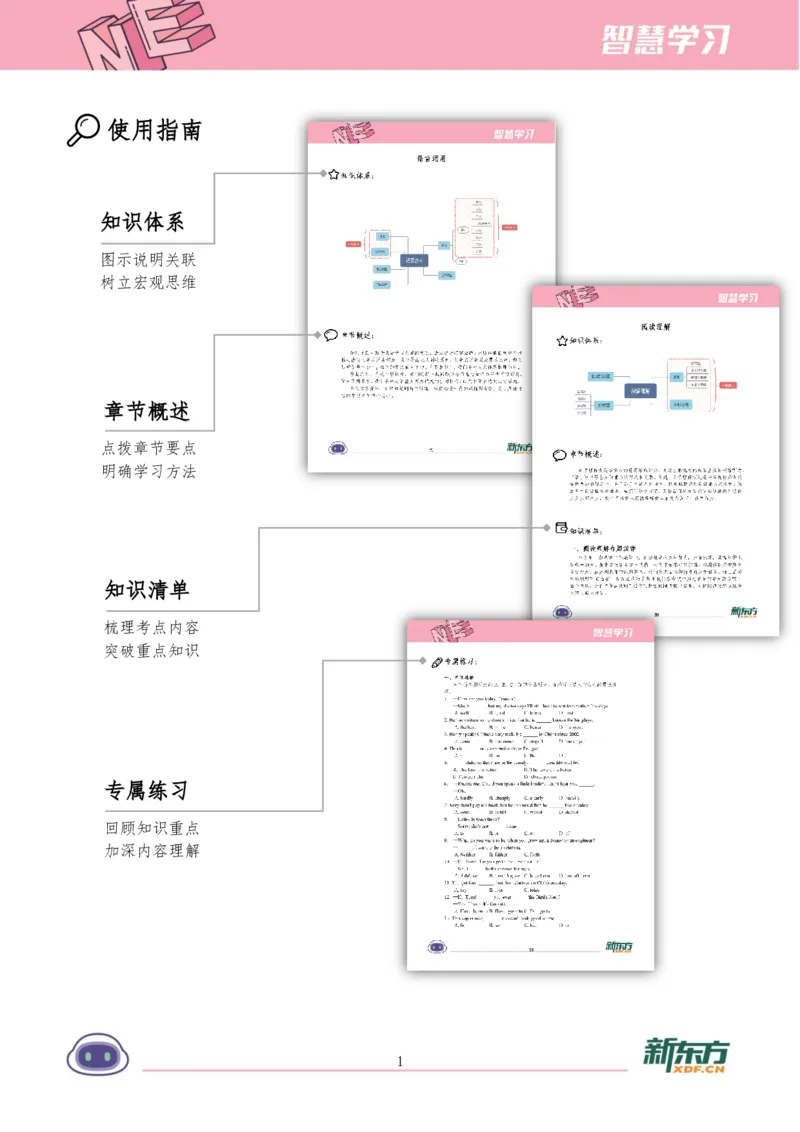
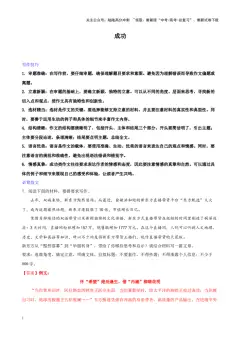
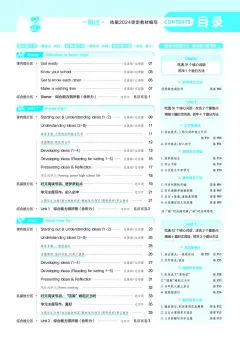
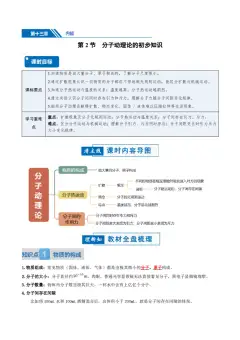
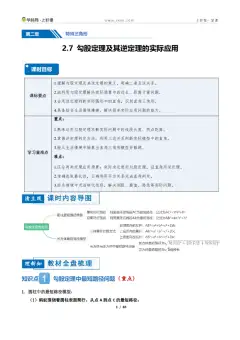
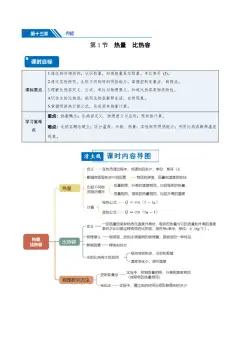
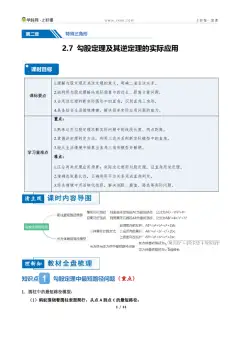
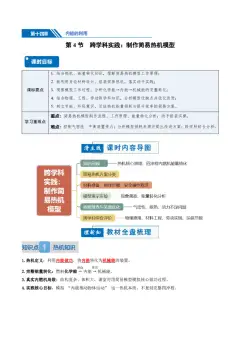
使用指南
知识体系
图示说明关联
树立宏观思维
章节概述
点拨章节要点
明确学习方法
知识清单
梳理考点内容
突破重点知识
专属练习
回顾知识重点
加深内容理解
2
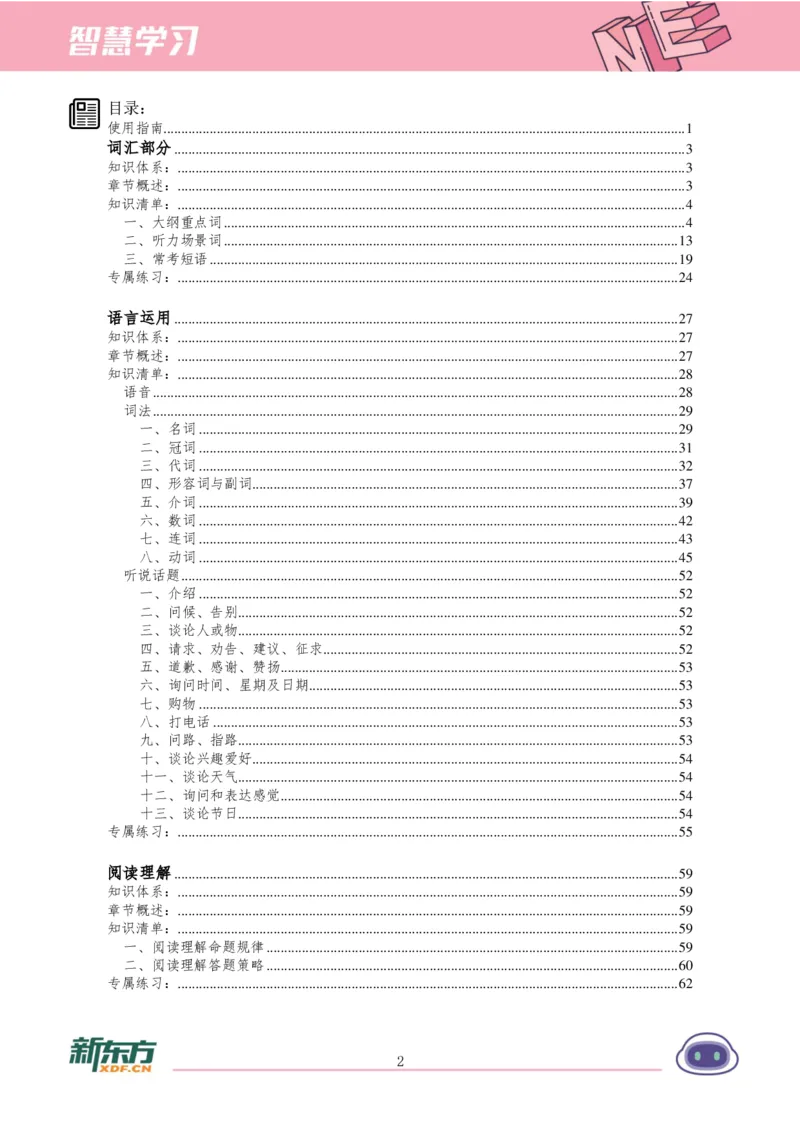
目录:
使用指南................................................................................................................................................... 1
词汇部分 ................................................................................................................................................ 3
知识体系:............................................................................................................................................... 3
章节概述:............................................................................................................................................... 3
知识清单:............................................................................................................................................... 4
一、大纲重点词 .................................................................................................................................. 4
二、听力场景词 ................................................................................................................................ 13
三、常考短语 .................................................................................................................................... 19
专属练习:............................................................................................................................................. 24
语言运用 .............................................................................................................................................. 27
知识体系:............................................................................................................................................. 27
章节概述:............................................................................................................................................. 27
知识清单:............................................................................................................................................. 28
语音 .................................................................................................................................................... 28
词法 .................................................................................................................................................... 29
一、名词 ....................................................................................................................................... 29
二、冠词 ....................................................................................................................................... 31
三、代词 ....................................................................................................................................... 32
四、形容词与副词........................................................................................................................ 37
五、介词 ....................................................................................................................................... 39
六、数词 ....................................................................................................................................... 42
七、连词 ....................................................................................................................................... 43
八、动词 ....................................................................................................................................... 45
听说话题 ............................................................................................................................................ 52
一、介绍 ....................................................................................................................................... 52
二、问候、告别............................................................................................................................ 52
三、谈论人或物............................................................................................................................ 52
四、请求、劝告、建议、征求 .................................................................................................... 52
五、道歉、感谢、赞扬 ................................................................................................................ 53
六、询问时间、星期及日期 ........................................................................................................ 53
七、购物 ....................................................................................................................................... 53
八、打电话 ................................................................................................................................... 53
九、问路、指路............................................................................................................................ 53
十、谈论兴趣爱好........................................................................................................................ 54
十一、谈论天气............................................................................................................................ 54
十二、询问和表达感觉 ................................................................................................................ 54
十三、谈论节日............................................................................................................................ 54
专属练习:............................................................................................................................................. 55
阅读理解 .............................................................................................................................................. 59
知识体系:............................................................................................................................................. 59
章节概述:............................................................................................................................................. 59
知识清单:............................................................................................................................................. 59
一、阅读理解命题规律 .................................................................................................................... 59
二、阅读理解答题策略 .................................................................................................................... 60
专属练习:............................................................................................................................................. 62
3
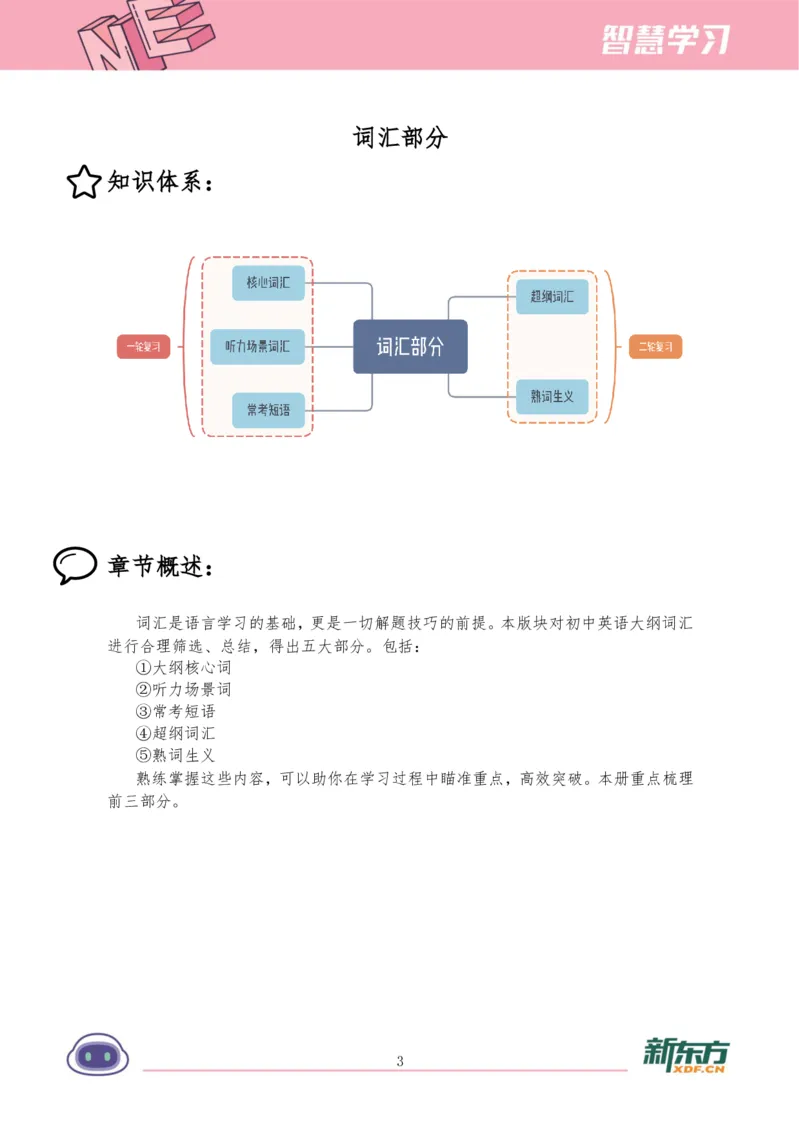
词汇部分
知识体系:
章节概述:
词汇是语言学习的基础,更是一切解题技巧的前提。本版块对初中英语大纲词汇
进行合理筛选、总结,得出五大部分。包括:
①大纲核心词
②听力场景词
③常考短语
④超纲词汇
⑤熟词生义
熟练掌握这些内容,可以助你在学习过程中瞄准重点,高效突破。本册重点梳理
前三部分。
4
知识清单:
一、大纲重点词
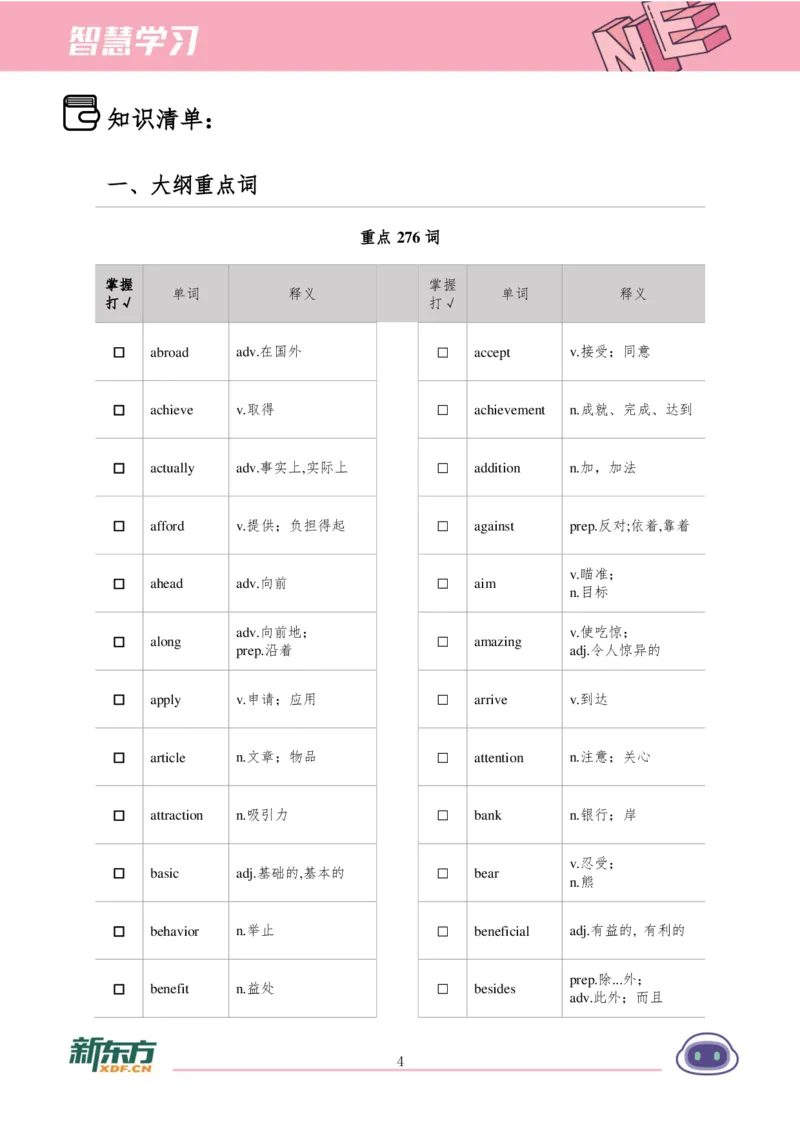
重点276 词
掌握
打√
单词
释义
掌握
打√
单词
释义
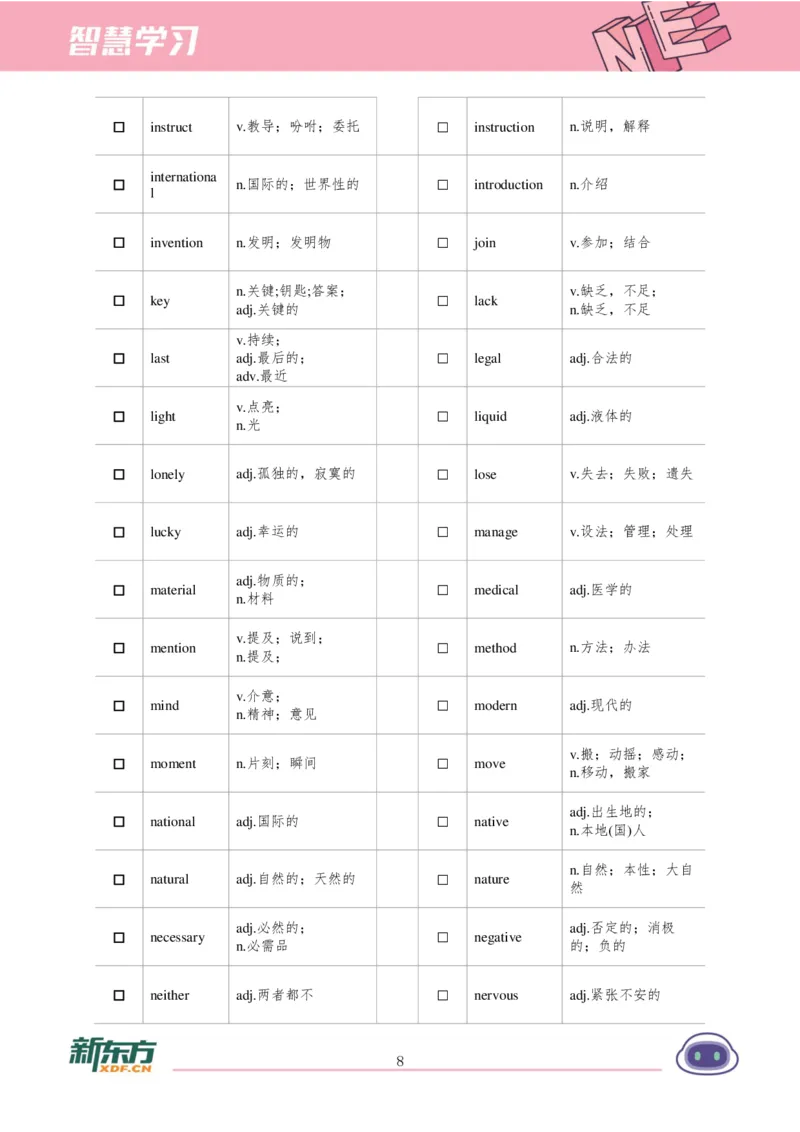
☐
abroad
adv.在国外
☐
accept
v.接受;同意
☐
achieve
v.取得
☐
achievement
n.成就、完成、达到
☐
actually
adv.事实上,实际上
☐
addition
n.加,加法
☐
afford
v.提供;负担得起
☐
against
prep.反对;依着,靠着
☐
ahead
adv.向前
☐
aim
v.瞄准;
n.目标
☐
along
adv.向前地;
prep.沿着
☐
amazing
v.使吃惊;
adj.令人惊异的
☐
apply
v.申请;应用
☐
arrive
v.到达
☐
article
n.文章;物品
☐
attention
n.注意;关心
☐
attraction
n.吸引力
☐
bank
n.银行;岸
☐
basic
adj.基础的,基本的
☐
bear
v.忍受;
n.熊
☐
behavior
n.举止
☐
beneficial
adj.有益的, 有利的
☐
benefit
n.益处
☐
besides
prep.除...外;
adv.此外;而且
5
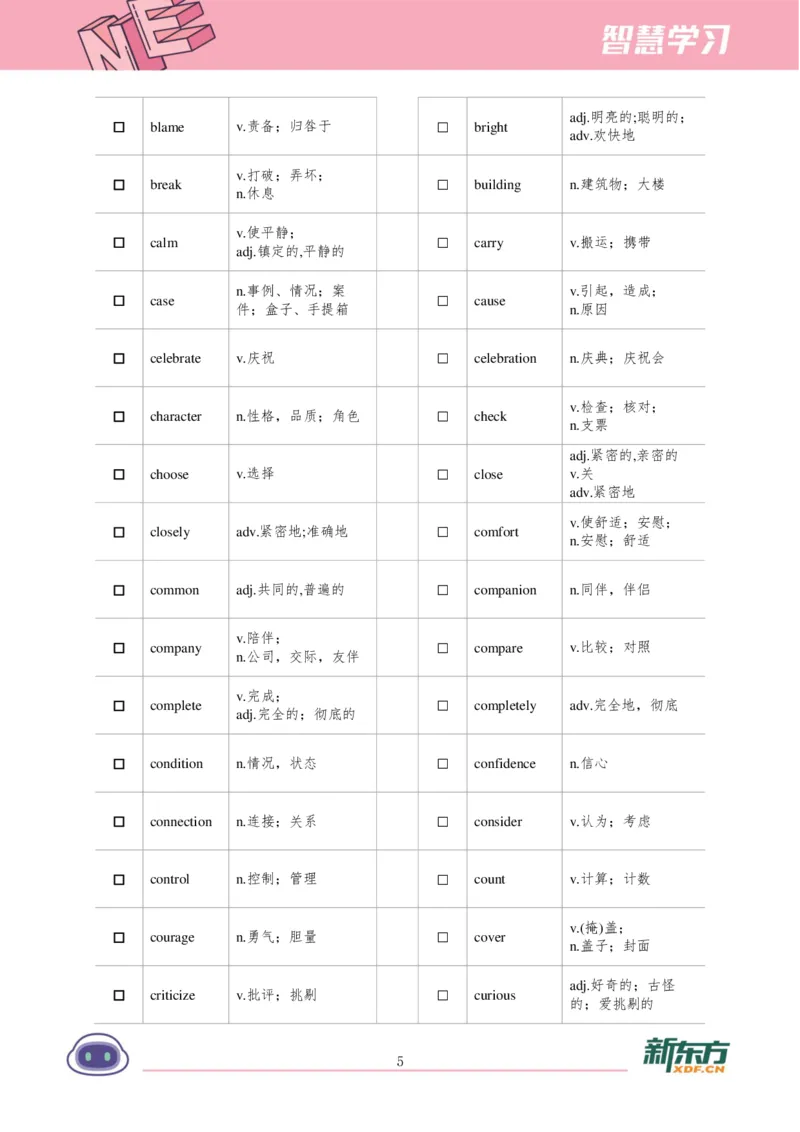
☐
blame
v.责备;归咎于
☐
bright
adj.明亮的;聪明的;
adv.欢快地
☐
break
v.打破;弄坏;
n.休息
☐
building
n.建筑物;大楼
☐
calm
v.使平静;
adj.镇定的,平静的
☐
carry
v.搬运;携带
☐
case
n.事例、情况;案
件;盒子、手提箱
☐
cause
v.引起,造成;
n.原因
☐
celebrate
v.庆祝
☐
celebration
n.庆典;庆祝会
☐
character
n.性格,品质;角色
☐
check
v.检查;核对;
n.支票
☐
choose
v.选择
☐
close
adj.紧密的,亲密的
v.关
adv.紧密地
☐
closely
adv.紧密地;准确地
☐
comfort
v.使舒适;安慰;
n.安慰;舒适
☐
common
adj.共同的,普遍的
☐
companion
n.同伴,伴侣
☐
company
v.陪伴;
n.公司,交际,友伴
☐
compare
v.比较;对照
☐
complete
v.完成;
adj.完全的;彻底的
☐
completely
adv.完全地,彻底
☐
condition
n.情况,状态
☐
confidence
n.信心
☐
connection
n.连接;关系
☐
consider
v.认为;考虑
☐
control
n.控制;管理
☐
count
v.计算;计数
☐
courage
n.勇气;胆量
☐
cover
v.(掩)盖;
n.盖子;封面
☐
criticize
v.批评;挑剔
☐
curious
adj.好奇的;古怪
的;爱挑剔的
6
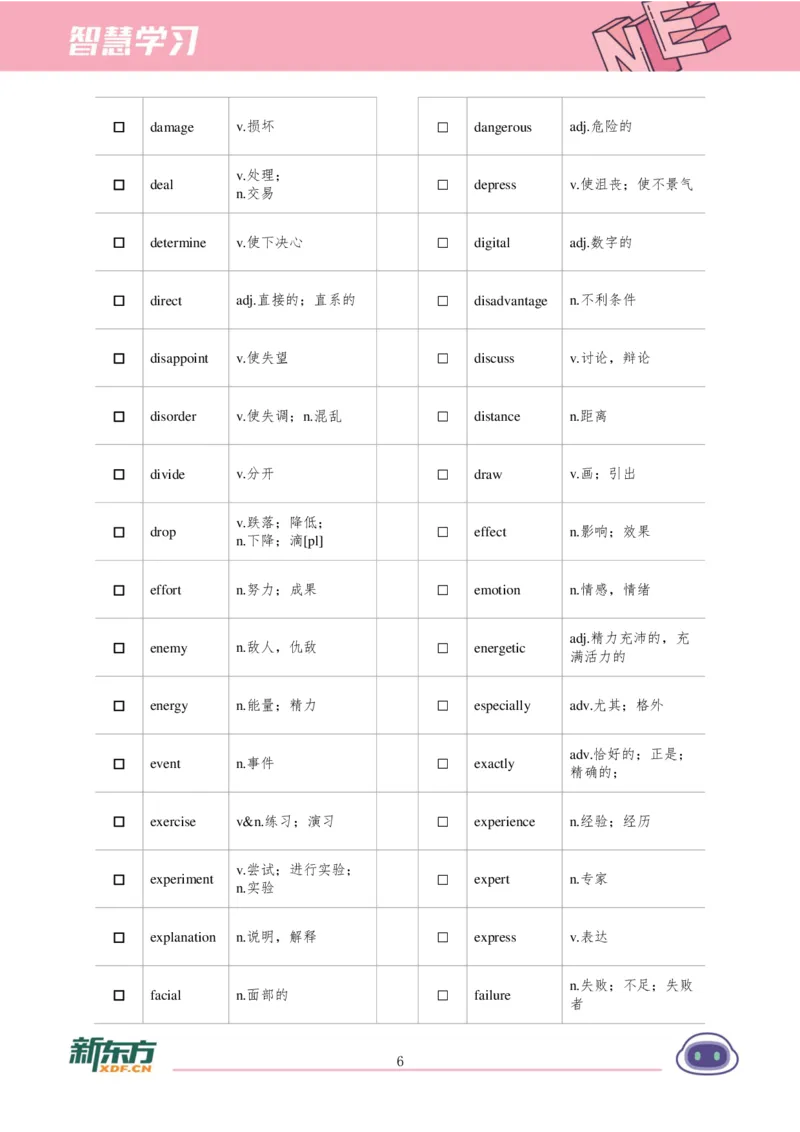
☐
damage
v.损坏
☐
dangerous
adj.危险的
☐
deal
v.处理;
n.交易
☐
depress
v.使沮丧;使不景气
☐
determine
v.使下决心
☐
digital
adj.数字的
☐
direct
adj.直接的;直系的
☐
disadvantage
n.不利条件
☐
disappoint
v.使失望
☐
discuss
v.讨论,辩论
☐
disorder
v.使失调;n.混乱
☐
distance
n.距离
☐
divide
v.分开
☐
draw
v.画;引出
☐
drop
v.跌落;降低;
n.下降;滴[pl]
☐
effect
n.影响;效果
☐
effort
n.努力;成果
☐
emotion
n.情感,情绪
☐
enemy
n.敌人,仇敌
☐
energetic
adj.精力充沛的,充
满活力的
☐
energy
n.能量;精力
☐
especially
adv.尤其;格外
☐
event
n.事件
☐
exactly
adv.恰好的;正是;
精确的;
☐
exercise
v&n.练习;演习
☐
experience
n.经验;经历
☐
experiment
v.尝试;进行实验;
n.实验
☐
expert
n.专家
☐
explanation
n.说明,解释
☐
express
v.表达
☐
facial
n.面部的
☐
failure
n.失败;不足;失败
者
7
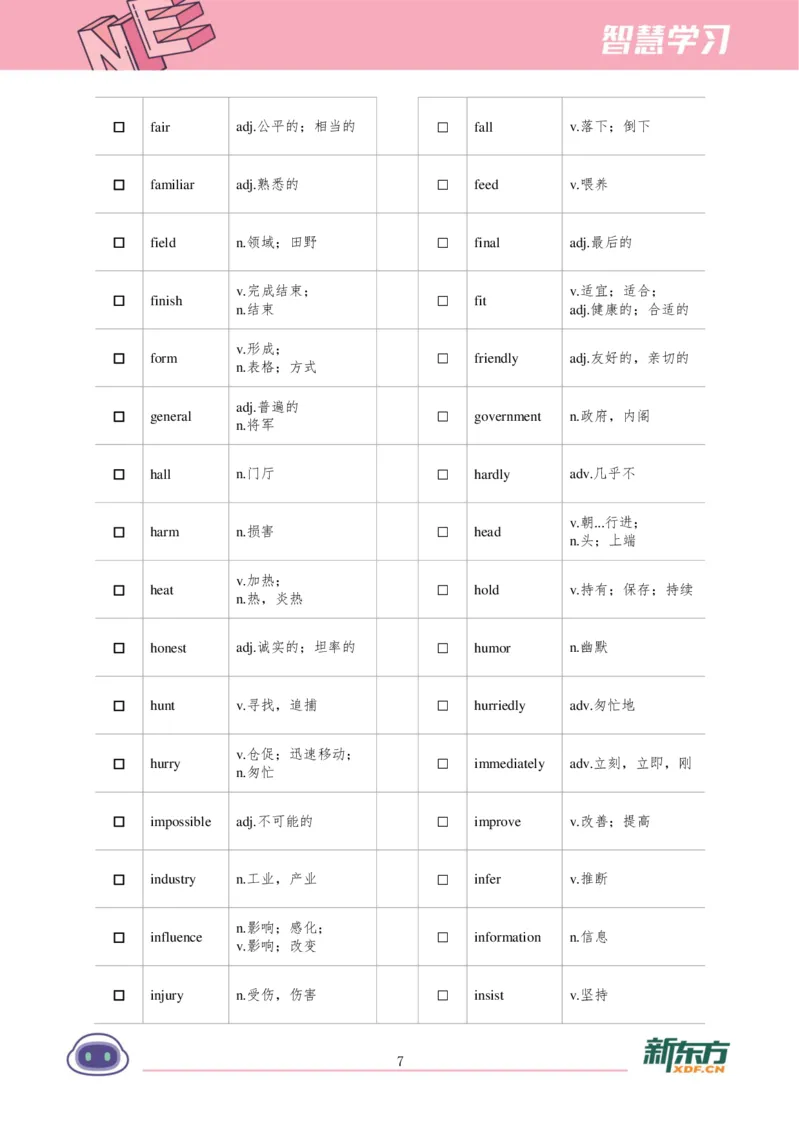
☐
fair
adj.公平的;相当的
☐
fall
v.落下;倒下
☐
familiar
adj.熟悉的
☐
feed
v.喂养
☐
field
n.领域;田野
☐
final
adj.最后的
☐
finish
v.完成结束;
n.结束
☐
fit
v.适宜;适合;
adj.健康的;合适的
☐
form
v.形成;
n.表格;方式
☐
friendly
adj.友好的,亲切的
☐
general
adj.普遍的
n.将军
☐
government
n.政府,内阁
☐
hall
n.门厅
☐
hardly
adv.几乎不
☐
harm
n.损害
☐
head
v.朝...行进;
n.头;上端
☐
heat
v.加热;
n.热,炎热
☐
hold
v.持有;保存;持续
☐
honest
adj.诚实的;坦率的
☐
humor
n.幽默
☐
hunt
v.寻找,追捕
☐
hurriedly
adv.匆忙地
☐
hurry
v.仓促;迅速移动;
n.匆忙
☐
immediately
adv.立刻,立即,刚
☐
impossible
adj.不可能的
☐
improve
v.改善;提高
☐
industry
n.工业,产业
☐
infer
v.推断
☐
influence
n.影响;感化;
v.影响;改变
☐
information
n.信息
☐
injury
n.受伤,伤害
☐
insist
v.坚持
8
☐
instruct
v.教导;吩咐;委托
☐
instruction
n.说明,解释
☐
internationa
l
n.国际的;世界性的
☐
introduction
n.介绍
☐
invention
n.发明;发明物
☐
join
v.参加;结合
☐
key
n.关键;钥匙;答案;
adj.关键的
☐
lack
v.缺乏,不足;
n.缺乏,不足
☐
last
v.持续;
adj.最后的;
adv.最近
☐
legal
adj.合法的
☐
light
v.点亮;
n.光
☐
liquid
adj.液体的
☐
lonely
adj.孤独的,寂寞的
☐
lose
v.失去;失败;遗失
☐
lucky
adj.幸运的
☐
manage
v.设法;管理;处理
☐
material
adj.物质的;
n.材料
☐
medical
adj.医学的
☐
mention
v.提及;说到;
n.提及;
☐
method
n.方法;办法
☐
mind
v.介意;
n.精神;意见
☐
modern
adj.现代的
☐
moment
n.片刻;瞬间
☐
move
v.搬;动摇;感动;
n.移动,搬家
☐
national
adj.国际的
☐
native
adj.出生地的;
n.本地(国)人
☐
natural
adj.自然的;天然的
☐
nature
n.自然;本性;大自
然
☐
necessary
adj.必然的;
n.必需品
☐
negative
adj.否定的;消极
的;负的
☐
neither
adj.两者都不
☐
nervous
adj.紧张不安的
9
☐
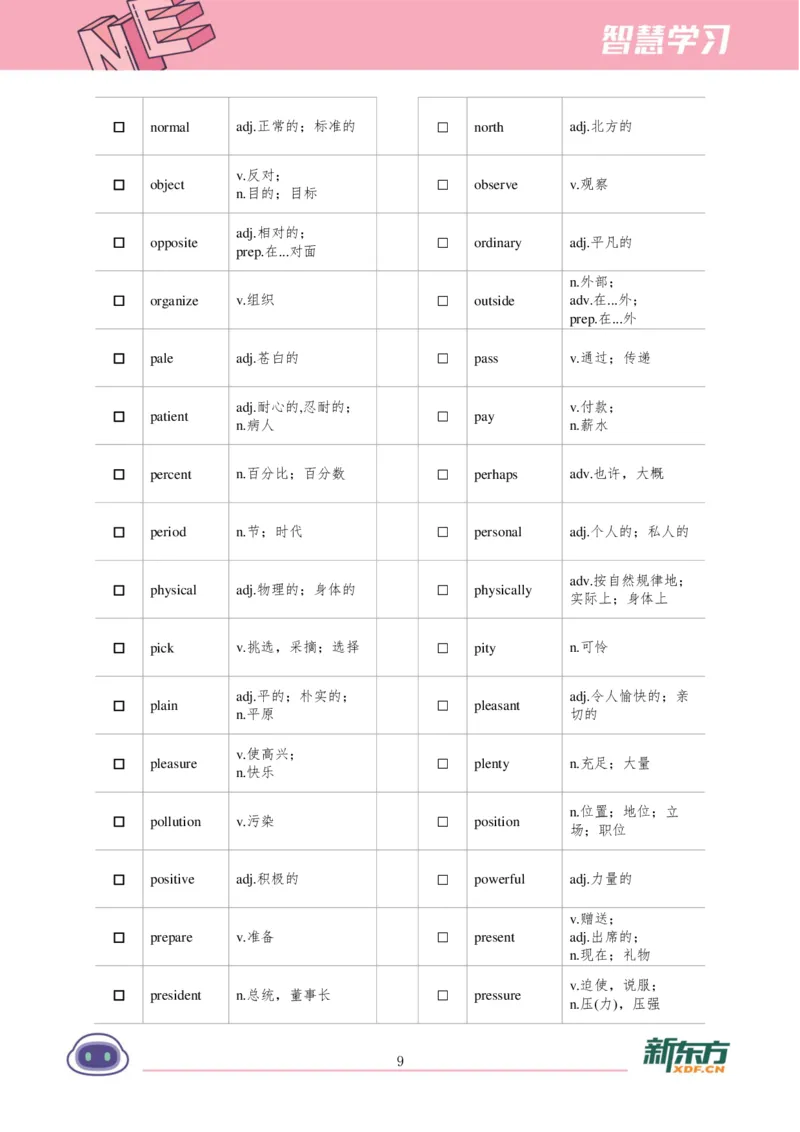
normal
adj.正常的;标准的
☐
north
adj.北方的
☐
object
v.反对;
n.目的;目标
☐
observe
v.观察
☐
opposite
adj.相对的;
prep.在...对面
☐
ordinary
adj.平凡的
☐
organize
v.组织
☐
outside
n.外部;
adv.在...外;
prep.在...外
☐
pale
adj.苍白的
☐
pass
v.通过;传递
☐
patient
adj.耐心的,忍耐的;
n.病人
☐
pay
v.付款;
n.薪水
☐
percent
n.百分比;百分数
☐
perhaps
adv.也许,大概
☐
period
n.节;时代
☐
personal
adj.个人的;私人的
☐
physical
adj.物理的;身体的
☐
physically
adv.按自然规律地;
实际上;身体上
☐
pick
v.挑选,采摘;选择
☐
pity
n.可怜
☐
plain
adj.平的;朴实的;
n.平原
☐
pleasant
adj.令人愉快的;亲
切的
☐
pleasure
v.使高兴;
n.快乐
☐
plenty
n.充足;大量
☐
pollution
v.污染
☐
position
n.位置;地位;立
场;职位
☐
positive
adj.积极的
☐
powerful
adj.力量的
☐
prepare
v.准备
☐
present
v.赠送;
adj.出席的;
n.现在;礼物
☐
president
n.总统,董事长
☐
pressure
v.迫使,说服;
n.压(力),压强
10
☐
prevent
v.阻止;避免
☐
private
n.士兵;私下;
adj.私人的
☐
probably
adv.可能地
☐
problem
n.问题
☐
production
n.生产;制作
☐
protect
v.保护,防护;为...
保险
☐
protection
n.保护
☐
prove
v.证明;表明
☐
provide
v.供给;提供
☐
public
adj.公共的;公开
的;公众的
☐
rather
adv.相当;宁可
☐
ready
adj.准备好的
☐
realize
v.意识到;实现
☐
receive
v.接收;收到
☐
recently
adv.最近地
☐
recite
v.背诵,朗诵
☐
record
v.记录;
n.记录;唱片
☐
refer
v.提到;涉及
☐
regard
v.注视,尊敬
☐
regret
v.后悔
☐
relation
n.关系;家属
☐
relaxed
adj.放松的
☐
remind
v.提醒,使想起
☐
repeat
v&n.重复,重做
☐
reply
v.回应;
n.回应
☐
report
v.报告;
n.报告
☐
requirement
n.要求
☐
research
n.研究;调查
☐
respect
n.尊敬;方面;
v.尊敬
☐
responsible
adj.承担责任的;有
责任感的
☐
right
adj.正确的;
n.权利
☐
rubber
n.橡胶;橡皮
11
☐
rule
v.统治;裁决;
n.规则;惯例
☐
rush
v.冲进;
n.冲进
☐
satisfied
adj.满意的
☐
science
n.科学
☐
scientific
adj.科学的
☐
scientist
n.科学家
☐
screen
n.屏幕
☐
separate
adj.分开的
v.分开
☐
service
n.业务;公务
☐
set
n.一套;
v.放置;安置
☐
sharp
adj.锋利的
☐
sick
adj.病人的;恶心的
☐
since
prep.自...以来;
conj.因为;既然
☐
single
adj.单一的
☐
situation
n.形势;情况
☐
special
adj.特别的;专门的
☐
specially
adv.专门地;特别地
☐
spread
v.传播;延伸
☐
square
n.广场;
adj.平方的,正方形的
☐
stand
v.站立;承受
☐
steal
v.偷窃
☐
stick
v.粘贴;
n.棍
☐
storm
n.暴雨;暴风雨
☐
strange
adj.奇怪的;古怪的
☐
strength
n.力气;效力;实力
☐
stress
v.强调;
n.压力
☐
stressful
adj.紧张的,有压力
的
☐
strict
adj.严格的,严厉的
☐
study
v.学习;研究;端
详;
n.书房
☐
subject
v.使服从;
n.题目;科目
☐
suffer
v.遭受,忍受
☐
suggest
v.建议;提议
12
☐
suggest
n.提议,建议,暗示
☐
support
v 支持;
n.支撑;
☐
suppose
v.假定,认为,料想
☐
tear
v.撕开;
n.眼泪
☐
temperature
n.温度;体温
☐
tend
v.趋势
☐
terrible
adj.可怕的;恐怖的
☐
thread
n.线索
☐
traditional
adj.传统的
☐
training
n.训练;培养
☐
translate
v.翻译
☐
travel
v.旅行;前进;
n.旅行
☐
treat
v.治疗;对待;视为;
n.请客;款待
☐
unique
adj.仅有的, 独一无
二的
☐
united
adj.联合的;一致
的;团结的
☐
unusual
adj.不寻常的;非常
的;罕见的
☐
used
adj.习惯的;使用过
的
☐
vacation
n.假期
☐
valuable
adj.贵重的,有价值的
☐
violence
n.暴力;侵犯
☐
wave
v.挥手;
n.浪花
☐
weak
adj.虚弱的
☐
weigh
v.称重量
☐
whatever
pron.无论什么;
adj.不管怎样
☐
wide
adj.宽的;广泛的
☐
wise
adj.聪明的
☐
wonder
v 想知道;怀疑;
n.奇迹
☐
worldwide
adj.全世界的
13
二、听力场景词
电影
掌握
打√
词汇
释义
掌握
打√
词汇
释义
☐
go out
外出
☐
special effects
特效
☐
acting
表演
☐
dialogue
话题
☐
story
故事
☐
see a film
看电影
☐
action movie
动作片
☐
cinema
电影院
☐
skilled actor
有技巧的演
员
☐
poster
海报
☐
director
导演
☐
cartoon
卡通
就餐
掌握打√
词汇
释义
掌握打√
词汇
释义
☐
service
服务
☐
café
咖啡
☐
restaurant
餐厅
☐
hungry
饥饿的
☐
food
食物
☐
traditional
传统的
☐
dinner
饭
☐
hamburger
汉堡
☐
coke
可乐
☐
total
总共的
☐
fast food
快餐
☐
旅游
掌握
打√
词汇
释义
掌握
打√
词汇
释义
☐
well-known
著名的
☐
take sb. around
带某人逛逛
☐
guide
引导
☐
art museum
艺术博物馆
☐
famous places
著名的地方
☐
sight
景色
☐
get back
回来
☐
vacation
假期
☐
trip
旅行
☐
experience
经历
☐
by the sea
乘船
☐
tourists
旅客
☐
campground
露营场所
☐
short trip
短途旅行
14
☐
fly off
飞出
☐
sunshine
阳光
☐
local activities
当地的活动
☐
feed the animals
喂养动物
☐
rubbish bag
垃圾袋
☐
program
项目
☐
flash photography
频闪摄影术
☐
tourism office
旅游局
☐
free ticket
门票免费
☐
tour plan
旅游计划
☐
souvenir
纪念品
☐
unusual animal
不寻常的动物
☐
beach
沙滩
☐
coast
海岸
☐
Mount Tai
泰山
☐
notebook
笔记本
☐
relax oneself
放松
☐
walk up to the top
徒步走到顶端
体育
掌握
打√
词汇
释义
掌握
打√
词汇
释义
☐
player
选手
☐
climb the mountain
爬山
☐
boating
划船
☐
race
跑步;比赛
☐
keep up
保持
☐
high jump
跳高
☐
long jump
跳远
☐
first prize
第一名
☐
record
纪录
☐
fit
适合;健康的
☐
fly kites
放风筝
☐
exercise
练习
☐
tennis
网球
☐
gym
体育馆
☐
lose weight
减肥
☐
ride a bicycle
骑自行车
☐
low speed
低速
☐
walk up the stairs
走上楼梯
☐
exercise machine
健身器
☐
购物(买礼物)
掌握
打√
词汇
释义
掌握
打√
词汇
释义
☐
birthday gift
生日礼物
☐
choose
选择
☐
dollar
美元
☐
pound
英镑
☐
be made of
由…构成
☐
silk
丝绸
☐
size
号码
☐
suggest
建议
☐
customer service
客服
☐
present
礼物
☐
expensive
昂贵的
☐
special
特别的
15
☐
pencil set
铅笔套装
☐
tie
系
☐
store
商店
☐
fresh vegetables
新鲜的蔬菜
☐
shelf
架子
☐
match
比赛
☐
skirt
短裙
☐
sweater
毛衣
☐
clothes
衣服
☐
trousers
裤子
☐
on sale
促销
☐
shirt
衬衣
☐
shoes
鞋
☐
socks
短袜
校园生活
掌握
打√
词汇
释义
掌握
打√
词汇
释义
☐
get good grades
得到高分
☐
lesson
课
☐
take classes
上课
☐
football practice
足球练习
☐
join the club
加入俱乐部
☐
international students
国际学生
☐
science teacher
科技老师
☐
high school
高中
☐
mark the coursework
给作业评分
☐
hand in
上交
☐
by e-mail
通过邮件
☐
do experiments
做实验
☐
work on one’s own
自己做
☐
log in
登陆
☐
distance education
远程教育
☐
regular school
常规学校
☐
write a paper
写论文
☐
do research
做研究
☐
school year
学年
☐
evening class
夜校
☐
troublemaker
捣乱的人
☐
personal details
个人细节
☐
free time
空闲时间
☐
school work
作业
☐
keep up with the
class
跟上班上的
进度
☐
fail the exam
考试失败
☐
exchange student
交换生
☐
school magazine
学校杂志
☐
writing group
写作组
☐
school activities
学校活动
☐
speech competition
演讲比赛
☐
leading task
主要任务
☐
field trip
实地考察
☐
fire practice
消防练习
☐
fire bell
火警警铃
☐
help out
帮助
☐
daily life
日常生活
☐
foreign students
外国学生
16
爱好与日常
掌握
打√
词汇
释义
掌握
打√
词汇
释义
☐
play the piano
弹钢琴
☐
free time
空余时间
☐
scene
场景
☐
free-time activities
课余活动
☐
visit one’s parents
拜访某人的
家长
☐
play sports
运动
☐
ball games
球类游戏
☐
part-time job
兼职
☐
lose interest in sth.
对…失去兴
趣
☐
copy one’s behaviors
复制某人的行
为
☐
pleasure
乐趣
☐
collection
收集
☐
sports team
运动队
☐
rock star
摇滚明星
☐
hobby
爱好
☐
television show
电视节目
☐
make robots
制作机器人
☐
neighbor
邻居
☐
lifestyle
生活方式
☐
volleyball
排球
☐
listen to the music
听音乐
☐
be into sth.
对…感兴趣
☐
classical music
古典音乐
☐
watch news
看新闻
☐
pop music
流行音乐
☐
fiction books
科幻书
☐
magazine articles
文章杂志
交通与问路
掌握
打√
词汇
释义
掌握
打√
词汇
释义
☐
Excuse me.
不好意思。
☐
look for
寻找
☐
Building F
F 楼
☐
the second floor
二层
☐
How can I get
there?
怎么到那
里?
☐
take bus No.8
乘坐8 号车
☐
at … street
在…大街
☐
bus stop
车站
☐
traffic lights
交通信号灯
☐
get off
下车
☐
next to
旁边
☐
turn left
向左转
☐
bus station
公交站
☐
the way to
到…的方向
☐
on one’s right
在某人的右
边
☐
post office
邮局
☐
officer
办公室人员
☐
subway station
地铁站
17
健康与就医
掌握
打√
词汇
释义
掌握
打√
词汇
释义
☐
What’s the matter
with you?
你怎么了?
☐
dentist
牙医
☐
have a fever
发烧
☐
three times a day
一天三次
☐
have a check-up
检查身体
☐
take sb. to the doctor
带某人去看医
生
☐
high temperature
高烧
☐
heart disease
心脏病
☐
have a good rest
好好休息
☐
cancer
癌症
☐
nothing serious
没什么严重
的事
☐
feel good physically
觉得身体健康
☐
get a bad cold
患重感冒
☐
take care of oneself
照顾自己
☐
take some medicine
吃药
☐
feel better
觉得更好
☐
stay in bed
在床上
住房与住宿
掌握打√
词汇
释义
掌握打√
词汇
释义
☐
flat
公寓
☐
city center
市中心
☐
fridge
冰箱
☐
sofa
沙发
☐
vase
花瓶
☐
curtain
窗帘
☐
find a place
找到一个地
方
☐
book a room
预订房间
☐
date
日期
☐
check the list
检查清单
☐
single room
单间
☐
double room
双人房
☐
suite
套间
☐
armchairs
扶手椅
☐
living room
客厅
18
职业与外貌
掌握
打√
词汇
释义
掌握
打√
词汇
释义
☐
fire fighter
消防员
☐
taxi driver
出租车司机
☐
Chinese teacher
中文老师
☐
language school
语言学校
☐
doctor
医生
☐
childish
孩子气的
☐
freelance writer
自由作家
☐
with glasses
戴眼镜
时间与日期、机场与海关
掌握
打√
词汇
释义
掌握
打√
词汇
释义
☐
go sightseeing
去观光
☐
take a bus
乘公交
☐
in ten minutes
在10 分钟内
☐
five thirty
5:30
☐
in plenty of time
在充足时间
内
☐
landing card
登录证
☐
flight number
航班号
☐
airport
飞机场
☐
see off
送别
☐
address
地址
☐
host family
寄宿家庭
☐
have a nice day
祝你开心
☐
recognize
认出
☐
take a plane
乘飞机
☐
bad weather
糟糕的天气
☐
travel by plane
乘飞机旅游
☐
delay
推迟
☐
take off
起飞
请求与建议、电话与留言
掌握
打√
词汇
释义
掌握
打√
词汇
释义
☐
need help
需要帮助
☐
ticket machine
出票机
☐
get off
下车
☐
My pleasure.
我的荣幸。
☐
Would you mind
doing…?
你介意…?
☐
turn down
关上
☐
be afraid not
恐怕不是
☐
switch on
接通
☐
operating
instructions
运行介绍
☐
switch off
断开
19
三、常考短语
be
掌握
打√
短语
含义
掌握
打√
短语
含义
□
be back/in/out
回来/在家/外
出
□
be strict with sb.
严格要求某人
□
be at home/work
在家/上班
□
be from
来自…,什么
地方人
□
be good at sth.
善于,
擅长于
□
be hungry/thirsty/
tired
饿了/渴了/累
了
□
be careful of sth.
当心,注意,
仔细
□
be worried about
担忧
□
be covered with sth.
被…覆盖
□
be (well) worth
doing
(非常)值得
做…
□
be ready for sth.
为…作好准备
□
be covered with
被…覆盖
□
be surprised (at) sth.
对…感到惊讶
□
be in (great) need of
(很)需要
□
be interested in sth.
对…感到兴趣
□
be in trouble
处于困境中
□
be born
出生
□
be glad to do sth.
很高兴做…
□
be on
在进行,在上
演,(灯)亮着
□
be late for sth.
…迟到
□
be able to do sth.
能够做…
□
be made of
由…制成(物
理变化)
□
be afraid of sth. (to
do sth. that…)
害怕…(不敢
做…)
□
be made from
由…制成(化
学变化)
□
be angry with sb.
生(某人)的气
□
be satisfied with sth.
对…感到满意
□
be pleased (with) sth.
对……感到高
兴(满意)
□
be (ill) in bed
卧病在床
□
be famous for sth.
以…而著名
□
be busy doing (with)
忙于做…(忙
于…)
come
掌握
打√
短语
含义
掌握
打√
短语
含义
☐
come back
回来
☐
come on
快点;加油
☐
come in
进入,进来
☐
come out
出版;发表;
开花;发芽
20
☐
come down
降落
☐
come over
顺便来访
☐
come from
来自
☐
come true
(希望、梦想
等)实现
☐
come out of
从…出来
☐
come up with
想出;提出
go
掌握
打√
短语
含义
掌握
打√
短语
含义
☐
go ahead
先走,向前
走,去吧,干
吧
☐
go home (there)
回家去(去那
儿)
☐
go to the cinema
看电影
☐
go up
上去
☐
go to bed
睡觉
☐
go out for a walk
外出散步
☐
go to school/ college
上学(上大学)
☐
go on (doing)
继续(做…)
☐
go to (the) hospital
去医院看病
☐
go on with one's
work
继续某人的工
作
☐
go over/
go over to
过一遍,复习/
朝…走去
☐
go upstairs/
downstairs
上/下楼
☐
go fishing/
skating/
swimming/
shopping
去钩鱼/滑冰/
游泳/买东西
☐
(the lights) go out
(灯)熄了
have
掌握
打√
短语
含义
掌握
打√
短语
含义
☐
have a lesson/ a
meeting
上课/开会
☐
have a fever
发烧
☐
have a football
/basketball match
举行一场足球/
篮球赛
☐
have a cough (a
cold)
咳嗽(感冒)
☐
have a dictation
听写
☐
have a look (at)
看一看……
☐
have a try
试一试
☐
have a rest (a
break)
休息一会儿(工
间或课间休息)
☐
have a good/
wonderful time
玩得很高兴
☐
have a talk
谈话
21
☐
have a lecture (a
piano concert)
听讲座(钢琴音
乐会)
☐
have a
swim/walk
游泳/散步
☐
have a report (talk)
on
听一个关于…
的报告
☐
have sports
进行体育锻炼
☐
have a glass of water
(a cup of tea)
喝一杯水,(一
杯茶)
☐
have a sports meet
(meeting)
开运动会
☐
have breakfast/
lunch/supper
吃早饭/午饭/
晚饭
☐
have something
done
让人(请人)
做…
☐
have a meal (three
meals)
吃一顿饭(三餐
饭)
☐
have a test/
an exam
测验/考试
☐
have a dinner
吃正餐
☐
have an idea
有个主意
☐
have bread and milk
for breakfast
早饭吃面包和
牛奶
☐
had better do sth.
(not do sth.)
最好做…(最好
不要做…)
☐
have (have got) a
headache
头痛
☐
have a word with
与…谈几句话
do
掌握
打√
短语
含义
掌握
打√
短语
含义
☐
do one's lessons/
homework
做功课/回家作
业
☐
do a good deed
做一件好事
☐
do more speaking/
reading
多做口头练习/
朗读
☐
do morning
exercises
做早操
☐
do one's best
尽力
☐
do eye exercises
做眼保健操
☐
do some shopping
(cooking reading,
cleaning)
买东西(做饭
菜,读点书,
大扫除)
☐
do well in
在某方面干得好
make
掌握
打√
短语
含义
掌握
打√
短语
含义
☐
make a noise (a lot
of noise, much
noise)
吵闹(十分嘈
杂,响声)
☐
make room/space
for
给…腾出地方
☐
make a living
谋生
☐
make a sentence
with
用…造句
☐
make sb. do sth.
迫使某人做…
☐
make a fire
生火
22
☐
make faces/
a face
做鬼脸
☐
be made from
由…制成(化学)
☐
make friends with
与…交朋友
☐
be made of
由…制成(物理)
☐
make a mistake
犯错误
☐
be made in
在…地方制造
turn
掌握
打√
短语
含义
掌握
打√
短语
含义
☐
turn on
打开
☐
turn down
调小;关小
☐
turn off
关闭
☐
turn over
翻转过来
☐
turn up
调大;放大
☐
turn left/right
向左转;向右转
take
掌握
打√
短语
含义
掌握
打√
短语
含义
☐
take one's advice
采纳某人的建议
☐
take a look (a last
look) at
看一看(最后看
一眼)
☐
take out
拿出,取出
☐
take an exam
参加考试
☐
take down
拿下
☐
take away
拿走
☐
take place
发生
☐
take back
收回,带回
☐
take one's place
坐……的座位,
代替某人职务
☐
take hold of
抓住…
☐
take the place of
代替……
☐
take off
脱下(衣,帽,
鞋等)拿掉
☐
take a walk/rest
散步/休息
☐
take (an active)
part in
(积极)参加(活
动)
☐
take it easy
别紧张
☐
take photos
拍照
☐
take sth.with sb.
随身带着
☐
take some
medicine
服药
☐
take sb. to a park
带某人去公园/
☐
take a
bus/train/boat
乘公共汽车/火
车/船
☐
take care of
关心,照顾,保
管
☐
take sb. to London
for one's holidays
带某人去伦敦度
假
23
get
掌握
打√
短语
含义
掌握
打√
短语
含义
☐
get up
起身
☐
get rid of
摆脱
☐
get everything ready
把一切都准备
好
☐
get in
进入,收集
☐
get ready for
作好准备
☐
get on/off
上/下车
☐
get on (well) with
与…相处(融
洽)
☐
get to
到达
☐
get back
返回
☐
get there
到达那里
give
掌握
打√
短语
含义
掌握
打√
短语
含义
☐
give sb. a call
给…打电话
☐
give lessons to
给…上课
☐
give a talk
作报告
☐
give in
屈服
☐
give a lecture
作讲座
☐
give up
放弃
☐
give back
归还,送回
☐
give sb. a chance
给…一次机会
☐
give…some advice
on
给…一些忠告
☐
give a message
to……
给…一个口信
look
掌握
打√
短语
含义
掌握
打√
短语
含义
☐
look after
照顾;照看
☐
look over
仔细检查
☐
look at
看
☐
look through
浏览
☐
look around
环顾四周
☐
look up
查阅
☐
look for
寻找;寻求
☐
look out
当心
☐
look into
调查
☐
look forward to
盼望;期待
24
Others
掌握
打√
短语
含义
掌握
打√
短语
含义
☐
help sb. with sth. /
help sb. do sth.
在某方面帮某
人;帮某人做
某事
☐
put on
穿上(衣服),
戴上(帽子),
上演(戏剧)
☐
help oneself to some
chicken/
fish/meat
请随便吃点鸡
/鱼/肉
☐
put up
建造,搭起,
挂起,举起,
张帖
☐
help each other
互相帮助
☐
put into
使进入,输入
☐
keep up with
跟上…,
☐
put one's heart into
全神贯注于
☐
keep silent/quiet
保持沉默/安
静
☐
put…down…
把…放下
☐
keep sb. doing sth.
使某人一直
做…
☐
put…into…
把…译成
☐
keep one's diary
记日记
☐
set up
竖起,建起
☐
play basketball/
football/ volleyball
打篮球/踢足
球/打排球
☐
set off
出发,动身
☐
play games
做游戏
☐
set out
出发
☐
play the piano (the
violin)
弹钢琴(拉小
提琴)
☐
set an example for
为…树立榜样
☐
play with snow
玩雪
☐
send for
派人去请(叫)
☐
play a joke (on)
对…开玩笑
☐
send out
放出,发出
☐
play chess
下棋
☐
send up
把…往上送,
发射
专属练习:
一、单项选择
从下面各题所给的A、B、C、D 四个选项中,选择可以填入空白处的最佳选项。
1. The railway station is noisy but ______ in my eyes.
A. living
B. live
C. alive
D. lively
2. We should ______ making a noise in the library.
A. avoid
B. prefer
C. practice
D. enjoy
25
3. —Hello! Golden Sun Hotel. Can I help you?
—Do you have a room ______ for this weekend?
A. available
B. useful
C. empty
D. possible
4. The cow said, "Look, I give them milk while I'm ______. They see that I am generous
(慷慨的) with what I have. But you don't give them anything before you die. You give them
ham, pork and so on only after you' re dead.
A. happy
B. afraid
C. alive
D. lonely
5. If you sit with a smiling face and look ______, you are expressing friendliness.
A. worried B. surprised C. disturbed D. relaxed
6. —How often do you go skating?
—______. I can’t skate at all.
A. Always
B. Sometimes
C. Seldom
D. Never
7. Chen Dong has been a(an) ______ for many years before joining the space team. He and
his wife now have a pair of five-year-old twin sons. One-month mission is not the longest
time that Chen has ever been away from home. When he was pilot, he once did not come
back home for half a year during a mission.
A. astronaut
B. engineer
C. pilot
D. scientist
8. An engineer of that company says that since the ______ of shared bikes, people have
made fewer trips by car.
A. end
B. start
C. control
D. fall
9. It is necessary for schools to ______ the need of all the students' development.
A. cut
B. hide
C. refuse
D. satisfy
10. Mr. Black's memory is getting ______. As a result, he often leaves his keys at home.
A. older
B. poorer
C. greater
D. better
11. Taking more exercise every day will ______ fat and make you fit.
A. turn to
B. sell out
C. burn off
D. put on
12. He not only ______ it, but he also finished in first place!
A. refused
B. left
C. completed
D. invented
13. Many wild animals are ______, and it's time for us to do whatever we can to protect
them.
A. on duty
B. on show
C. in order
D. in danger
14. For our own safety, it is important to ______ the traffic rules on the way to school.
A. follow
B. change
C. make
D. break
15. In 1998, Liu Xiang's ______ in hurdling was noticed by Sun Haiping.
A. ability
B. trade
C. electricity
D. memory
16. Lucy, could you please help me ______ the map on the blackboard? We won't need it.
A. put away
B. put off
C. put on
D. put up
17. I think you should complain, ______, of course, you are happy with the situation.
A. unless
B. however
C. until
D. though
18. —What a good ______ you've given me! Thanks a lot.
—My pleasure.
26
A. information B. news
C. suggestion
D. advice
19. The children ______ very early because they live far away from the school.
A. take off
B. turn off
C. put off
D. set off
20. He failed to break the world record for long jump many times but he never ______ his
hope.
A. took off
B. put away
C. gave up
D. turned down
27
语言运用
知识体系:
章节概述:
如果词汇和短语像是学习大厦的砖石,语法就是钢筋结构。本版块囊括初中阶段
核心语法点中的词法部分,具体是由九大词性展开,其中名词的用法最为细碎,却又
贯穿了整个初中;动词的用法最为关键。在下册书中,我们会带大家详尽梳理句法。
除此之外,在这个版块中,我们还将一起回顾语音的基础知识和常考听说话题。
而在下册书中,我们会带大家盘点听力试题的应对技巧,以及书面表达的必背话题。
希望这份资料,可以通过明晰的梳理,帮你迅速一览知识框架全貌,对于英语语
言的学习更加得心应手。
28
知识清单:
语音
一、音标
用来记录音素的符号。为了避免与字母混淆,音标被放在斜括号/ … /内。
二、音素
语音的最小单位。
英语中共有48 个音素,其中元音音素20 个,辅音音素28 个。
1. 元音
发音时气流不受阻碍。元音分为单元音和双元音两类。
单元音发音时唇形和舌位不变;双元音发音时由一个元音向另一个
元音滑动,唇形和舌位有一个变化过程,且前重后轻,前长后短。
2. 辅音
发音时气流受到阻碍。辅音分为清辅音和浊辅音两类。
清辅音发音时声带不振动;浊辅音发音时声带振动。
音标分类汇总
元音
单元音
/ i: / , / ɪ / , / ɜ: / , / ə / , / ɑ: / , / / ,
/ ɔ: / , / ɒ / , / u: / , / ʊ / , / e / , / æ /
双元音
/ eɪ / , / aɪ / , / ɔɪ / , / əʊ / , / aʊ / , / ɪǝ / , / eə / , / ʊə /
辅音
清辅音
/ p / , / t / , / k / , / t∫ / , / tr / , / ts / , / f / , / θ / , / s / , / ∫ / , /
h /
浊辅音
/ b / , / d / , / g / , / dʒ / , / dr / , / dz / , / v / , / ð / , / z / , / ʒ / , / r / ,
/ m / , / n / , / ŋ / , / l / , / w / , / j /
三、音节
1. 开音节:以元音字母结尾或以一个元音字母加一个辅音字母再加不发音的e 结尾
(r 除外) 的音节。元音字母在开音节中读长音,即该字母的名称音。
2. 闭音节:以一个或几个辅音字母(r 除外) 结尾。元音字母在闭音节中读短音。
a
e
i
o
u
开音节
/eɪ /
name
/i:/
we , she
/aɪ/
hi , white
/əʊ/
go , note
/ju:/ or /u:/
use
闭音节
/æ/
map
/e/
desk
/ɪ/
sit
/ɒ/
clock
//
cup
29
词法
一、名词
中考及课标要求:
1. 熟练掌握所学可数名词复数形式的构成及用法.
2. 熟练掌握名词所有格的用法.
3. 掌握物质名词及其量的表达方式
4. 掌握常用专有名词的一般用法.
5. 理解并能区别所学的可数名词和不可数名词.
6. 了解集合名词和抽象名词的概念及一般用法.
(一)名词的分类
名词是指表示人和事物名称的词,可以分为专有名词和普通名词两大类。
1. 专有名词:特定的人、地方、机构等专有的名称。第一个字母通常要大写。
e.g. Jim Green,New York,Bank of China,Peking University
星期、月份、节日、学科、报刊名也是专有名词。
e.g. Monday,May,Christmas,Spring Festival,Maths,China Daily
2. 普通名词:
表示一类人或物或抽象概念的名称。普通名词又可以分为四类:
(1) 个体名词—— 表示某类人或东西中的个体,如:student,desk
(2) 集体名词—— 表示若干个体组成的集合体,如:class,family
(3) 物质名词—— 表示无法分为个体的物质名称,如:water,rice,sand,hair
(4) 抽象名词—— 表示情感,状态,品质等抽象名称,如:love,carelessness
(二)名词的数
1. 可数名词与不可数名词
个体名词和集体名词多数可以用数目来计算,称为可数名词,有单、复数形式;
物质名词和抽象名词通常无法用数目计算,称为不可数名词,一般只有一种形式。
【注意】
(1) 集体名词被看作一个整体时,表达单数概念。
e.g. His family was well known in the town. 他家在镇里是名门望族。
(2) 集体名词被看作若干个体的集合时,表达复数概念。
e.g. His family are waiting for him. 他的家人正在等他。
(3) 集体名词表达多个集体时,也有复数形式。
e.g. Our village is made up of 300 families. 我们村有300 户人家。
2. 可数名词复数形式的构成规则:
(1) 一般名词在末尾直接加s,清辅音后读/ s /,浊辅音和元音后读/ z /
e.g. book-books,bag-bags,cat-cats,bed-beds
30
(2) 以s、x、sh、ch 结尾,加es,读/ iz /
e.g. bus-buses,box-boxes,brush-brushes,watch-watches
(3) 以辅音字母+y 结尾,变y 为i,再加es,读/ z /
e.g. baby-babies, library-libraries,factory-factories
(4) 以f 或fe 结尾,变f 或fe 为v,再加es,读/ vz /
e.g. thief-thieves,knife-knives
(5) 以o 结尾,表示无生命的物体时加s, 表示有生命的物体时,加es,都读/ z /
e.g. photo-photos,piano-pianos,radio-radios,zoo-zoos
potato-potatoes,tomato-tomatoes,mango-mangoes,hero-heroes
(6) 不规则变化
e.g. man-men
child-children
foot-feet
fish-fish
woman-women
mouse-mice
tooth-teeth
sheep-sheep
policeman-policemen
ox-oxen
goose-geese
deer-deer
▲ fish 表示鱼的数量时,单复数同形;表示鱼的种类时,复数为fishes.
e.g. My cat had two fish for lunch.
You can see a lot of different fishes in the lake.
3. 不可数名词
一般只有原形,没有复数形式,但是可以借助量词表示一定的数量。如果表达两个
或两个以上的概念时,量词需要用复数形式,不可数名词不变。
e.g. a bottle of water,a cup of coffee,two glasses of milk,five bags of rice
▲ 这种形式用于可数名词时,量词和可数名词都要用复数。
e.g. ten baskets of eggs
4. 既可用作可数,又可用作不可数的名词:
不可数
glass
玻璃
paper 纸
iron 铁
wood 木头
room 空间
可数
a glass
一只玻璃杯
a paper
一份报纸、论文、文件
a iron
一个熨斗
a wood
一片森林
a room
一个房间
(三)名词的格
1. ’s 所有格
(1) 在英语中,有些名词可以加’s 来表示所有关系,带这种词尾的名词形式称为该
名词的所有格。大多数表示有生命的东西。
e.g. Tom’s book
(2) 如果复数名词末尾已有s,就直接加 ’ 。
e.g. the teachers’ office
(3) 如果一些物品为两者共有,只需在后一个名词后加’s ;
31
如果为各自所有,则需在每个名词后加’s。
e.g. Lucy and Lily’s bedroom. (Lucy 和Lily 共用一个卧室)
Lucy’s and Lily’s bedrooms. (Lucy 和Lily 分别拥有各自的卧室)
2. of 所有格
表示无生命的物体的名词所有格,一般与of 短语连用。
e.g. a map of the world,a photo of my family
3. 双重所有格:把of 所有格和’s 所有格结合在一起表示所有关系。
e.g. a friend of my father’s 我父亲朋友中的一个。
二、冠词
中考及课标要求:
1. 熟练掌握所学不定冠词和定冠词的用法.
2. 理解并能区别不定冠词和定冠词.
3. 了解零冠词的用法.
(一)冠词的含义
冠词一般用在名词的前面,对名词起限定作用,不能离开名词单独存在。
(二)不定冠词
不定冠词a,an 用在单数可数名词前面,泛指一类人或物中的任何一个。
1. a 用于辅音音素开头的名词之前。e.g. a bed,a computer,a “U”
2. an 用于元音音素开头的名词之前。e.g. an egg,an umbrella,an hour
(三)定冠词
定冠词the 用在单数或复数可数名词前,也可用在不可数名词前。
1. 表示特指的人或物前。
e.g. The man with a flower in his hand is Jack.
2. 指说话人双方都知道的人或物前。
e.g. Lily, close the door, please.
3. 在上文提到过,第二次又提到的人或物前。
e.g. There is a man under the tree. The man is called James.
4. 表示世界上独一无二的事物前。
e.g. The sun is bigger than the moon.
5. 用在序数词前面。
e.g. It is the first day of the new term.
6. 用在西洋乐器名称前。
32
e.g. He often plays the violin at weekends.
7. 用在形容词最高级前。
e.g. Spring is the best season in a year.
8. 用在由普通名词构成的专有名词前。
e.g. I went to the Great Wall last week.
9. 用在国家名称的缩写前。
e.g. He is from the UK.
(四)零冠词
名词前不用冠词的情况。
在季节、月份、星期、节假日、三餐、球类或棋类运动前,通常不用冠词。
e.g. have breakfast, play basketball, play chess
三、代词
中考及课标要求:
1. 熟练掌握人称代词主格和宾格的形式及基本用法.
2. 熟练掌握指示代词的基本用法,并理解其在上下文中的指代用法.
3. 熟练掌握疑问代词的基本用法.
4. 掌握形容词性物主代词和名词性物主代词的形式及基本用法.
5. 掌握常见不定代词的基本用法. 如: some, any, both, all, many, much, other, another,
some-thing, everyone, nobody 等.理解其它常见不定代词的一般用法.
6. 掌握it 表示天气、时间、距离等的基本用法.
7. 理解反身代词的基本用法.
(一)人称代词
1. 含义:表示“我、你、他、她、它、我们、你们、他们”的词。
2. 主格一般用在句子开头做主语,通常用在动词前。
e.g. I am a student. They are cleaning the classroom.
3. 宾格可以用来表示动作行为的对象,一般用在动词和介词后面。
数
格
人称
单数
复数
主格
宾格
主格
宾格
第一人称
I
me
we
us
第二人称
you
you
you
you
33
第三人称
he
him
they
them
she
her
it
it
e.g. Ask her, please. Listen to me carefully.
(二)物主代词
1. 含义:表示所有关系的代词叫物主代词。
2. 形容词性物主代词后面一般要带上名词。
如:my watch, his cousin, our school
3. 名词性物主代词具有名词的特征,在句中作主语、表语、宾语,如:
eg. May I use your bike? Mine is at school. (作主语)
Whose glasses are these? They are hers. (作表语)
My dictionary is lost. Can I use yours? (作宾语)
4. 名词性物主代词可以与of 连用,做定语。
如:A friend of ours is waiting for us.
我的
你的
他的
她的
它的
我们的 你们的 他们的
形 容
词 性
my
your
his
her
its
our
your
their
名 词
性
mine
yours
his
hers
its
ours
yours
theirs
(三)不定代词
1. 含义:没有明确指定代替某个(些)人或物的词叫不定代词。
2. 不定代词一览表
可数
each, one, many, few, a few, both, another, either, neither
不可数
much, little, a little
可数和不可数 all, some, none, such, any, other
复合不定代词 anybody, anyone, anything, somebody, someone, something,
nobody, nothing, everybody, everyone, everything
2. 易混淆的不定代词
(1) some, any
some
any
修饰可数名词复数和不可数名词.
用于肯定句和表示建议、请求的疑问
句中(期待一个肯定答案).
I have some books/money.
Would you like some meat?(表建议)
用疑问句、否定句及条件句.
She doesn’t have any brothers or sisters.
Did you have any of the teachers?(单纯
提问)
34
Is there some butter in the fridge?(期待一
个肯定答案)
If you have any questions you can ask
me .
(2) few, a few, little, a little
用法
含义
肯定(有一点)
否定(几乎没有)
可数
a few(only a few)
There are a few pears on the table.
few (very few
I can see few flowers in the garden.
不可数
a little (only a little)
There is a little sugar in the jar.
little (very little)
There is little bread for supper. We’d
better buy some.
(3) many, much
many
much
表示数量很多,相当于a lot of, lots of, plenty of 等.
修饰可数名词复数.
There are many tall buildings in this area.
修饰不可数名词.
The girl drank much water after running.
(4) either, any
either
any
均有”任一个”的含义.
指两个人或物种的任一个.
Either of the twins can tell you the
address.
指两个以上的人或物种的任一个.
Any of my classmates knows the answer.
(5) each, every
each
every
均有”每一个”的含义.
指两个或两个以上的人或物中的一个,
侧重强调个体、个性.
There are many trees on each side of the
street.
指两个以上的人或物中的一个,侧重强
调全体、共性.
There were policemen on each/every side
of the square.
(6) both, all
both
all
均有”全部、都”的含义.
指两个人或物.
指两个以上的人或物.
35
Both of my parents are doctors.
I see with both of my eyes.
All of my classmates came to my
birthday party.
(7) neither, none
neither
none
均有”都不”的含义.
指两个人或物任意一个都不.
She picked up the paper with neither of
her hands.
指两个以上人或物中任意一个都不.
I know none of the three girls.
(8) another, the other, others, the others
搭配
含义
one…another
一个……(随意的)另一个(无范围)
I don’t like this one. Please show me another.
one…the other
一个……(剩余仅有的)另一个(有范围:有且只有两个)
I have two dogs; one is white, and the other is black
one…the others
一个……(剩余所有)其余的(有范围)(相当于the rest)
Five students were in the computer room. One was a boy
and the others were girls.
some…others
一些……别的(无范围)
Some (people) like swimming and others like jogging.
some…the others
一些……(剩余所有)其余的(有范围)(相当于the rest)
I know only some of the students here; the others are
strangers to me.
(四)指示代词
指示代词是用来指示或标识人或事物的代词.可以指人,指物,可以用来代替前边
说过的话.
位置
单数
复数
近指
this
these
远指
that
those
如: This is my bike. That is Tom’s.
(五)疑问代词
用来表达疑问或构成疑问句的代词,一般放在疑问句的句首。
36
What
问什么
—What’s your name?
—My name is Tom.
What color
问颜色
—What color is your coat?
—It’s red.
What day
问星期
—What day is it today?
—It’s Monday.
What date
问日期
—What date is it today? / What’s the date today?
—It’s the first of June.
What…job
问工作
—What’s your father’s job?
—He’s a bus driver.
What time
问时刻
—What time is it?
—It’s ten o’clock.
When
问时间
—When is your birthday?
—It’s on the first of May.
Which
问哪个
—Which is your watch, this one or that one?
—That one.
Where
问地点
—Where is my pen?
—It’s on the floor.
Who
问谁
—Who is the boy with big eyes?
—He’s Liu Tao.
Whose
问谁的
—Whose bag is this?
—It’s Helen’s.
Why
问原因
—Why are you absent today?
—I’m ill.
How
问方式
—How do you go to school?
—By bus.
How many
问数量
—How many books are there?
—There are five.
How much
问价钱
—How much is it?
—Twenty yuan.
How old
问年龄
—How old are you?
—I’m twelve.
How far
问距离
—How far is it from here?
—It’s about one kilometer.
How about
问情况
—I’m thirsty. How about you?
—Me, too.
(六)掌握it 表示天气、时间、距离等的基本用法
1. 代替前面提到过的名词。
如:
37
-Where is the chair?
-It’s in the living room.
2. 指时间、天气和距离。
如:
What time is it?
It was hot yesterday.
It’s three miles to the station.
3. 作形式主语和形式宾语,如:
It’s wrong to tell a lie.
I think it better to do so.
I find it easy to learn English.
(七)理解反身代词的基本用法
表示”某人自己”的代词称为反身代词。
单数
myself
yourself
himself
herself
itself
复数
ourselves
yourselves
themselves
1. 反身代词在句中常作宾语,主语或宾语的同位语
如: Her sister is too young to dress herself. (作宾语)
He himself is always making such mistakes. (主同位语)
You’d better ask your wife herself. (宾同位语)
2. 反身代词可与其他词构成固定搭配。 如:
make oneself at home, teach oneself, learn oneself, help oneself to …
四、形容词与副词
中考及课标要求:
1. 熟练掌握形容词定语、表语及宾语补足语的用法.
2. 熟练掌握表示时间、地点、方式、程度、原因等疑问副词的用法.
3. 熟练掌握形容词、副词比较级和最高级的规则变化形式.
4. 熟练掌握常见形容词、副词比较级和最高级的不规则变化形式. 如:good, well,
many, much.
5. 熟练掌握常见形容词、副词比较级的基本句型及基本用法.
6. 掌握little, far, ill, bad, badly 等词的比较级和最高级的不规则变化形式.
7. 初步掌握much, a little 等副词修饰形容词、副词比等级的用法.
(一)含义
形容词用来修饰名词或代词,表示人或事物的性质、状态和特征。它的位置通常
放在被修饰的名词前,也可以放在be 动词和look、feel、taste、sound、get 之后。
38
副词是一种用来修饰动词或形容词的词,说明时间、程度、方式等概念。大多数
副词都可以放在动词后面。
e.g. dance beautifully, listen carefully, sit quietly, speak loudly, very happy
(二)形容词、副词基本用法
1. 形容词定语、表语及宾语补足语的用法
eg. The park is nice. (作表语)
She is a polite girl. (作定语)
The news made him very happy. (作宾补)
2. 有少数的形容词只能做表语,而不能做定语,如:alone, ill, afraid, alive。
3. 形容词修饰不定代词时要放在不定代词something, anything, everything, nothing 等
词后面
4. 表示时间、地点、方式、程度、原因等疑问副词的用法
用于引出疑问句的副词叫疑问副词.主要有when, where, why, how 等。
如:Where do you come from?
When will it be ready?
Why was she crying?
(三)三级变化
在英语中,形容词有三个等级,即原级、比较级和最高级。
1. 原级
表示两者“等同”时用原级,结构为:as+原级+as,表示“xx 和xx 一样……”
e.g. Are you as tall as your twin sister?
其否定形式结构为:not+as+原级+as,表示“xx 和xxx 不一样……”
e.g. I’m not as tall as you.
2. 比较级
(1) 含义:表示两者“比较”时用比较级,结构为:比较级+than,表示“xx比xxx更……”
e.g. He’s one year younger than me.
(2) 形容词比较级的变形规则
① 一般在词尾加er
e.g. taller,longer,stronger,younger
② 以字母e 结尾,只加r
e.g. late-later,nice-nicer
③ 以辅音字母+y 结尾,变y 为i,再加er
e.g. heavy-heavier
④ 以重读闭音节结尾且词尾只有一个辅音字母时,双写末尾辅音字母再加er
e.g. fat-fatter,thin-thinner,big-bigger
⑤ 双音节和多音节词的比较级,在原级前加more
e.g. more beautiful,more careful
39
⑥ 不规则变化
e.g. good-better,many / much-more,far-farther,bad / ill-worse
3. 最高级
(1) 含义:三个或三个以上的人或物进行比较,用形容词最高级。
结构为:the + 形容词最高级 +in/of 等表示范围的短语,表示“最……”。
e.g. Autumn is the best season in New York.
She is the tallest girl of our three.
(2) 形容词最高级的变形规则
① 规则变化
分类和形容词比较级完全相同,将-er 变为-est,more 变为most。
e.g.
tall-taller-tallest,nice-nicer-nicest,heavy-heavier-heaviest,
fat-fatter-fattest,beautiful-more beautiful-most beautiful
② 不规则变化
e.g.
good-better-best,many / much-more-most,far-farther-farthest,
bad / ill-worse-worst
4. 副词三级变化
副词的比较级、最高级变化规则与形容词变化基本相同,以ly 结尾的副词一般
用more/ most。
e.g. carefully-more carefully-most carefully,quietly-more quietly-most quietly
五、介词
中考及课标要求:
1. 熟练掌握常用介词的基本方法 (表示时间、地点、位置、方式等)。如:in, on, at,
of, to, from, by, with, for, about, after, before 等。
2. 理解所学介词的一般用法。
(一)含义
介词又叫前置词,是一种用来表示词与词、词与句之间关系的词,它一般放在
名词、代词(宾格)或动词(动词ing 形式)前面。
(二)常见介词
1. in
(1) 在……里面。
如:in the classroom
(2) in+颜色,穿着……颜色的衣服。
40
如:Who’s the man in white?
(3) in+语言,用某种语言说。
如:What’s this in English?
(4) 在上午、下午、晚上。
如:in the morning,in the afternoon,in the evening
(5) 在年、月、季节前。
如:in 2008,in August,in summer
(6) 在国家、城市和较大的地方前。
如:in China,in Wuxi,in the playground
(7) 固定搭配。
如:in the middle of(在……中间),do well in(擅长),in the day(在白天)
take part in(参加),stay in bed(躺在床上),in the street(在街上)
2. on
(1) 在……上面。
如:on the desk
(2) 用在某一天(上、下午) 前。
如:on the 5th of May,on Sunday,on Monday morning
(3) 以Day 结尾的节日前。
如:on Children’s Day,on New Year’s Day
(4) 固定搭配。
如:on foot(步行),on duty(值日),put on(穿上),get on(上车)
turn on(打开),on the right / left(在右边/左边),on the wall (在墙上)
on Zhongshan Road(在中山路上)
【注意】树上长的水果用on the tree;不是树上长的外来物用in the tree。
如:I can see a lot of apples on the tree. There is a boy in the tree.
3. at
(1) 在某个时刻前。如:at seven o’clock
(2) 在传统节日前。如:at Spring Festival,at Mid-Autumn Festival,at Christmas
(3) 在较小的地点。如:at the bus stop
(4) 固定搭配。如:at once(立刻,马上),be good at(擅长……),look at(看)
at home(在家),at school(在学校),at weekends(在周末),at the back of(在……后部)
at night(在夜晚)
4. under 在……下面
如:There is a cat under the table.
5. behind 在……后面
如:There is an umbrella behind the door.
6. near 靠近……
如:There is a park near my house.
7. beside 在……旁边
如:The students are standing beside the teacher.
8. next to 紧靠……旁边
41
如:The teachers’ office is next to our classroom.
9. before (时间上) 在……之前
如:before class(上课前)
10. after (时间上) 在……之后;依照
固定搭配:after class(课后),after school(放学后),look after(照看)
run after(追赶) ,read after me(跟我读)
11. between 在两者之间
如:There are some trees between Building A and Building B.
12. by 乘某种交通工具
如:by bus,by plane,by the way(顺便说一下)
13. from
(1) be from = come from(来自……)
如:Mr Smiths is/comes from Australia.
(2) from…to…(从……到……)
如:We go to school from Monday to Friday.
14. to 到、去……
如:Let’s go to the zoo. 固定搭配:write to(给xx 写信)
15. about 关于;大约
如: I want to buy a book about animals. It’s about one kilometer away.
16. for 为、给……
如:Here’s a letter for you. What’s for breakfast?
固定搭配:look for (寻找),wait for(等候)
17. with
(1) 与……一起。如:I’ll go shopping with my mother.
(2) 具有某种特征。如:Who’s the boy with big eyes?
(3) help... with... 在某方面帮助某人 如: Can you help me with my English?
(4) play with... 和……一起玩;拿……玩 如:play with me,play with a yo-yo
18. in front of 在……前面
如:There is a tree in front of the classroom.
【注意】in the front of 在……前部 如:There is a blackboard in the front of the
classroom.
19. along 沿着,顺着
如:Go along this street.
20. as 作为
如:What would you like as a birthday present?
21. out of 从……出来;往……之外
如:The dog is running out of the house.
22. of ……的,属于……
如:a map of China, a map of the world
23. off 离开,在……之外
如:keep off the grass(勿踏草坪), get off(下车)
42
24. up 向上
如:stand up(起立) ,pull up carrots(拔胡萝卜)
25. down 向下
如:sit down(坐下) , jump up and down(上下跳)
六、数词
中考及课标要求:
1. 熟练掌握时间及日期的基本表达方法.
2. 掌握基数词和序数词的形式及基本用法.
3. 掌握日常交际活动中数词的常见用法.
4. 理解数词的某些特殊用法.
(一)基数词
1. 含义:表示数目多少。
2. 词形:
1
one
11
eleven
21
twenty-one
2
two
12
twelve
22
twenty-two
3
three
13
thirteen
30
thirty
4
four
14
fourteen
40
forty
5
five
15
fifteen
50
fifty
6
six
16
sixteen
60
sixty
7
seven
17
seventeen
70
seventy
8
eight
18
eighteen
80
eighty
9
nine
19
nineteen
90
ninety
10
ten
20
twenty
100
hundred
(二)序数词
1. 含义:表示顺序先后。
2. 词形:
1st
first
11th
eleventh
21st
twenty-first
2nd
second
12th
twelfth
22nd
twenty-second
3rd
third
13th
thirteenth
30th
thirtieth
4th
fourth
14th
fourteenth
40th
fortieth
5th
fifth
15th
fifteenth
50th
fiftieth
43
6th
sixth
16th
sixteenth
60th
sixtieth
7th
seventh
17th
seventeenth
70th
seventieth
8th
eighth
18th
eighteenth
80th
eightieth
9th
ninth
19th
nineteenth
90th
ninetieth
10th
tenth
20th
twentieth
100th
hundredth
3. 基数词变序数词记忆口诀:
一、二、三,需要记,八去t,九省e,ve 结尾时,f 来代替,
ty 结尾时,y 变ie,再加th,若是几十几,前基后序别忘记。
(三)熟练掌握时间及日期的基本表达方法
1. 表示时间,只用基数词,时间前用介词at。
(1) 直接读数
如:1:15 one fifteen 3:30 three thirty
(2) 用past/to 表示“过几分”/ “差几分”
如:1:15 a quarter past one
2. 表示日期,在具体某一天前用介词on。
英语中日期的排列顺序是: 星期、月、日、年
如:2003 年3 月17 日, 星期一,Monday, March the 17th, 2003
3. 表示世纪、年代。如:
(在)90 年代—— (in) the nineties
(在)19 世纪—— (in) the nineteenth century
(在)20 世纪70 年代—— (in)1970s 或1970’s
(四)掌握日常交际活动中数词的常见用法
1. 编号。如:No.2, the first lesson 或Lesson One, Room 808.
2. 电话号码。如:83545601 (用基数词逐个念,0 用字母o 的发音)
七、连词
中考及课标要求:
1. 熟练掌握并列连词的基本用法,如:and, but, or, so 等。
2. 掌握常用从属连词的基本用法,如:when, after, before, as soon as, because, if
等。
(一)含义
连词,顾名思义,是一种起连接作用的词。
44
(二)掌握并列连词的基本用法
并列连词用来连接并列关系的词、词组或分句。有下面几类:
表示并列关系:and, both…and, neither…nor, not only…but also
表示转折关系:but, yet, however
表示选择关系:or, either…or
表示因果关系:so, for
1. and 意为“和,与,同”
如:My brother and I study in the same school.
2. but 意为“但是,可是”
如:She looks very young, but she is already in her 30’s.
3. or 意为“或者;否则”
如:You may spend two or three days there. Hurry up, or you’ll be late.
4. so 意为“因此;因而”
如:The manager was ill so I went in her place.
5. for 意为“因为,由于”
如:I went to sleep soon, for I was very tired.
6. both…and 意为“……和……都”
如:Both she and Sophia were pleased with the girl.
7. either…or 意为“要么……要么”、 “不是……就是……”
如:You can either have tea or coffee.
8. neither …nor…意为“既不……也不……”、“……和……都不”
如:I have neither time nor money.
9. not only…but also…意为“不但……而且……”
如:Not only you but also he has to leave.
(三)掌握常用从属连词的基本方法.
从属连词引导从句,随着从句作用不同,可分为几类:
连接宾语从句,如:that, if, whether 等。
连接时间状语从句,如:while, when, before, after, as soon as, since
连接地点状语从句,如:where
连接让步状语从句,如:though, although
连接原因状语从句,如:as, because, since
连接条件状语从句,如:if, unless
连接目的状语从句,如:that, so that, in order that
连接结果状语从句,如:such…that, so …that
连接比较状语从句,如:as…as, than
45
八、动词
中考及课标要求:
1. 熟练掌握动词的物种基本形式:动词原形、第三人称单数现在氏、现在分词、过
去式和过去分词.
2. 熟练掌握一般现在时、一般过去时、一般将来时、现在完成时、现在进行时、过
去进行时的构成和基本用法.
3. 熟练掌握系动词be 的用法.
4. 掌握常用助词的一般用法.
5. 掌握情态动词的基本用法. 如:can, may, must, need 等.
6. 掌握一般现在时、一般过去时、一般将来时和带有can, may, must 等情态动词的
被动语态的构成和基本用法.
7. 掌握动词不定式作宾语、宾语补足语、状语及和疑问词连用构成不定式短语的基
本用法.
8. 初步掌握become, get, look, turn 等系动词的一般用法.
9. 初步掌握延续性动词和瞬间动词在用法上的区别.
10. 理解过去将来时、过去完成时的构成和基本用法.
11. 理解及物动词和不及物动词的用法.
12. 理解动词不定式主语、定语和表语的基本用法.
(一)含义
动词是表示动作或行为的词,在句子中通常充当谓语成分。
(二)动词的分类
按其词义和在句子中的作用可以分为连系动词、助动词、情态动词和行为动
词。
1. be 动词(am,is,are)
(1) be 动词做谓语时,要与主语在人称和数上保持一致。
如:I am a teacher. You are a student. She is a nurse. We are Chinese.
用法口诀: 我用am,你用are,is 用在他、她、它,单数is,复数are。
(2) be 动词的否定形式:am not(无缩写形式),is not=isn’t,are not=aren’t
(3) be 动词的过去形式:am/is-was, are-were
2. 助动词(do,does,did)
(1) do,does 用于一般现在时,does 用于第三人称单数,其他人称和数用do。其过
去式did 用于一般过去时。他们通常用在疑问句和否定句中。助动词后动词要用原
形。
如: Do you like this film?
Does she like playing football?
I didn’t go to school yesterday.
(2) 否定形式:do not = don’t,does not = doesn’t,did not = didn’t
46
3. 情态动词
(1) 含义
情态动词表示说话人对某一动作或状态的态度,表示“可能”,“可以”,“需要”,“必
须”,“应当”等意思。情态动词没有人称和数的变化,后面的动词要用原形。
(2) 常见的情态动词
① can 和may
都可以用来表示请求或允许,但may 比can 更正式,更客气些。
如: Can I use your pen?
May I come in?
② must 和should
must 意为“必须,应当”,含有一种命令的语气,比较生硬,不容商量。
如:You must finish yomur homework before you go to bed.
should 意为“应当,应该”,表示建议或劝告,语气比较委婉,客气。
如:You should stay in bed and have a good rest.
③ will 和would
用于疑问句,表示说话人向对方提出请求或询问,用would 比will 更委婉,更
客气。
如:Will you please open the window? / Would you like some coffee?
注意区别:
I’d like… 我想要……(接名词) 如:I’d like some tea.
I’d like to… 我想要做……(接动词原形) 如:I’d like to go with you.
I like… 我喜欢……(接名词或动名词) 如:I like monkeys. I like reading.
④ shall 在问句中表示征求对方的意见,主要用于第一人称。
如:Shall we go there by bus?
⑤ need
表示需要,只用于否定句和疑问句. 如:He needn’t pay for it.
以need 开头的一般疑问句,肯定回答用must,意为”必须”,否定回答用need not,
意为”不需要、不必”。
如:-Need I repeat it? –Yes, you must. No, you needn’t.
即可做情态动词,也可做实义动词.做实义动词时need 后加to do。
如:We need to help him.
(3) 否定形式:
can’t, may not, mustn’t, shouldn’t, wouldn’t, shall not
4. 行为动词
(1) 含义:行为动词也叫实义动词,是具有实际意义的动词。如run(跑),jump(跳),
listen(听),sing(唱),eat(吃),think(想)等。行为动词在句子中有人称和时态的变化。
(2) 时态:
在英语中,不同时间里发生的动作或存在的状态,需要用不同的动词形式来表
现,这就叫时态。
47
(三)一般现在时
1. 定义:表示经常发生或习惯性的动作、状态。句中通常有usually,often,every day,
sometimes,always,at weekends,on Sundays 等表示经常性时间的词汇或短语。
2. 构成:
(1) 当谓语是be 动词时,一般现在时的构成:主语+be 动词+其他
如:I am a student. He is Jim’s father. They are from Japan.
(2) 当谓语是行为动词时,一般现在时的构成:
① 主语(非第三人称单数) +动词原形+其他
如: I often watch TV at the weekends.
Mr Green and Mrs Green like collecting stamps.
② 主语(第三人称单数) +动词的第三人称单数形式+其他
如: Jim usually visits his grandparents on Sundays.
She sometimes goes to the park with her mother.
3. 动词三单形式的变化规则:
(1) 一般情况下,直接加s 如:read-reads,swim-swims
(2) 以s,x,sh,ch,o 结尾,加es 如:wash-washes,watch-watches,do-does
(3) 以辅音字母+y 结尾,变y 为i,再加es 如:study-studies,fly-flies
(4) 不规则变化 如:have-has
4. 一般现在时的句型转换:
肯定句
否定句
一般疑问句及回答
They watch TV
every day.
They don’t watch TV
every day.
—Do they watch TV every day?
—Yes, they do. / No, they don’t.
She watches TV
every day.
She doesn’t watch
TV every day.
—Does she watch TV every day?
—Yes, she does. / No, she doesn’t.
(四)现在进行时
1. 定义:表示现在或现阶段正在进行或发生的动作。句中常有now,look,listen
等词。
如:I am washing clothes now.
Look! Liu Tao is climbing the tree.
Listen! Jane is singing in the music room.
2. 构成:be 动词(am/is/are) + 动词现在分词(V-ing)
3. 动词现在分词构成:
(1) 一般是在动词原形后加ing
如:read-reading,drink-drinking,eat-eating,look-looking
(2) 以不发音的e 结尾的动词,去掉e,再加ing
如:write-writing,make-making,ride-riding,take-taking
(3) 以重读闭音节结尾,如末尾只有一个辅音字母,要双写这个字母,再加ing
48
如:sit-sitting,swim-swimming,put-putting,run-running,stop-stopping,get-
getting,begin-beginning,jog-jogging,forget-forgetting
4. 动名词其实就是动词的现在分词,它既有名词性质(可作主语),又有动词性质(可
带宾语)。
如: Asking the way
My hobby is collecting stamps.
He is good at skating.
5. 现在进行时的句型转换:
肯定句
否定句
一般疑问句及回答
He is running now.
He isn’t running now.
—Is he running now?
—Yes, he is. / No, he isn’t.
They are making
a puppet.
They aren’t making
a puppet.
—Are they making a puppet?
—Yes, they are. / No, they aren’t.
(五)一般过去时
1. 定义:表示过去某个时间里发生的动作或存在的状态。常和表示过去的时间状语
连用,如:a moment ago,just now,yesterday,last week,this morning 等。
如:My brother often went to school by bike last term.
The watch was beside the diary a moment ago.
I watched the moon and ate the moon cakes last Mid-Autumn Festival.
Jim went to the supermarket yesterday.
2. 构成:主语+动词的过去式+其他
3. 动词过去式的变化规则:
(1) 一般在动词原形末尾加ed
如:play-played,listen-listened,look-looked
(2) 结尾是e 的动词,加d
如:live-lived,like-liked,taste-tasted
(3) 辅音字母+y 结尾的动词,变y 为i,再加ed
如:study-studied,carry-carried,cry-cried
(4) 末尾只有一个辅音字母的重读闭音节词,双写这个辅音字母,再加ed
如:stop-stopped,plan-planned
(5) 不规则变化
am/is-was
say-said
read-read
sing-sang
are-were
tell-told
buy-bought
swim-swam
have/has-had
see-saw
come-came
meet-met
do-did
get-got
draw-drew
take-took
go-went
make-made
eat-ate
put-put
sit-sat
give-gave
fly-flew
run-ran
4. 一般过去时的句型转换
49
肯定句
否定句
一般疑问句及回答
He watched TV
yesterday.
He didn’t watch TV
yesterday.
—Did he watch TV yesterday?
—Yes, he did. / No, he didn’t.
They played games
just now.
They didn’t play
games just now.
—Did they play games just now?
—Yes, they did. / No, they didn’t.
(六)一般将来时
1. 定义:
表示将要发生的动作或存在的状态,以及打算、计划或准备某事。句中一般含有表
示将来的时间状语,如:tomorrow morning,next week,this afternoon 等。
2. 构成
(1) be going to + 动词原形
如:I am going to see a Beijing opera tomorrow.
We are going to meet at bus stop at half past ten.
Dad and I are going to see a Beijing opera this afternoon.
(2) will +动词原形
如:They will go swimming this afternoon.
3. be going to 和will 区别:
(1) be going to 表示经过事先安排、打算或决定要做的事情,基本上一定会发生;
will 则表示有可能去做,但不一定发生,也常表示说话人的临时决定。
如: I am going to take part in a party this evening.
They are cleaning the library now. I’ll go and join them.
(2) be going to 表示近期或眼下就要发生的事情;will 表示的将来时间则较远一些。
如:He is going to write a letter tomorrow.
I will meet her one day.
(3) be going to 还可以用来表示有迹象表明某件事将要发生,常用于天气等自然现
象。如:Look! It’s going to rain.
4. 一般将来时句型转换:
肯定句
否定句
一般疑问句及回答
She is going to have a
picnic tomorrow.
She isn’t going to have
a picnic tomorrow.
—Is she going to have a picnic
tomorrow?
—Yes, she is. / No, she isn’t.
They will go swimming
this afternoon.
They will not(won’t)
go swimming this
afternoon.
—Will they go swimming this
afternoon?
—Yes, they will. / No, they
won’t.
50
(七)过去进行时
1. 构成
主语+be 动词(was, were)+现在分词+……
2. 基本用法
(1) 表示过去某个时刻或某一阶段正在进行的动作。
如:The wind was blowing strongly at this time yesterday.
(2) 用于when 或while 引导的时间状语从句中。
如:They were watching TV when the lights went out.
While we were having breakfast, John was talking on the phone.
(八)现在完成时
1. 构成
主语(除第三人称单数外)+have+过去分词+……
主语(He/ She/ It)+has+过去分词+……
2. 基本用法
(1) 表示过去发生的或已经完成的某一动作对现在造成的影响或结果。
如:The car has just arrived.
The students haven’t finished the homework yet.
(2) 表示动作或状态在过去已经开始,持续到现在,也许还要持续下去。表示持续
的动作或状态多为延续性动词。
如:I have lived here for more than thirty years.
She has taught us since I came to this school.
(3) 表示从过去到现在之间曾经经历的事情。
如:This is the best gift that I have ever received.
We have never visited the city before.
(4) 瞬时动词表示动作一经发生便立即结束,不能和表示一段时间的状语一起用在完
成时,如果和表示一段时间的状语连用,要用其他词代替。
如:He come here five days ago.
He has been here since five days ago.
(5) 瞬时动词与延续性动词的转化
瞬时动词
延续性动词
buy
have
borrow
keep
begin/start
be on
finish
be over
die
be dead
join
be in/ be a member of
leave
be away from
come
be here
go
be away
51
(九)过去完成时
1. 构成
主语+had+过去分词+……
2. 基本用法
(1) 表示“过去的过去”,使用时句中一般必须有一个或暗含一个发生在过去的动作
与其相比较,使用过去完成时的动词动作发生在该过去的动作之前。
如:By the end of last year Henry had collected more than thousands of foreign stamps.
(2) 用于when, before, after 等引导的时间状语从句中,强调动作发生的时间前后。
如:When we got there, the basketball match had already started.
(3) 用于宾语从句中。
如:He told me that he had never seen the film before.
(十)被动语态的构成和基本用法.
1. 被动语态的构成
时
式
现在
过去
将来
一般
am/ is/ are+done
was/ were +done
shall/ will/ be going
to be + done
含情态动词
can/ may/ must +be +done
2. 被动语态的基本用法
(1) 不知道动作的执行者时,如:Printing was introduced into Europe from China.
(2) 不必要提出动作的执行者时,如:More trees must be planted every year.
(3) 强调或侧重动作的承受者时,如:She is liked by everybody.
(4) 有些动词习惯上常用被动语态,如:He is said to be a good teacher. I was born in
1960.
52
听说话题
一、介绍
(1) My name is Tom.
(2) I’m Gao Shan.
(3) This is David.
(4) The man in a white coat is my father.
二、问候、告别
(1) Hello! /Hi!
(2) Good morning! / Good afternoon! /Good evening!
(3) —How are you? —Fine, thank you. / Not bad, thank you. / Not so good.
(4) —Nice to meet you. —Nice to meet you , too.
(5) —How do you do? —How do you do?
(6) Goodbye! / Bye! / Bye-Bye!
(7) See you (tomorrow/later).
(8) Good night.
三、谈论人或物
(1) What’s your name? / Your name, please?
(2) Who is he?
(3) What’s this in English?
(4) How old are you?
(5) Where are you from? / Are you from the USA?
(6) What’s your job?
(7) What is she?
四、请求、劝告、建议、征求
(1) May I come in?
(2) —Can I have a look? —Yes. / Sure. / Sorry, you can’t.
(3) Don’t forget to close the windows.
(4) We must go home now.
(5) Let’s go to school.
(6) Shall we go now?
(7) Why don’t you buy a new one?
(8) What about a cup of tea?
(9) Would you like a hamburger?
(10) What would you like?
53
(11) Yes, please. / Yes, I’d like to./ Yes, I’d love to.
(12) No, thanks.
五、道歉、感谢、赞扬
(1) Excuse me.
(2) —Sorry. / I’m sorry. —That’s OK/all right. / It’s doesn’t matter.
(3) Thanks. / Thank you. / Thank you very much.
(4) Not at all. / You ‘re welcome. / It’s my pleasure.
(5) It’s pretty/ smart/nice.
(6) How nice!
六、询问时间、星期及日期
(1) —What’s the time? / What time is it now?
—It’s twelve o’clock. It’s time to have lunch.
(2) —What day is it today?
—It’s Sunday/Monday/Tuesday/Wednesday/Thursday/Friday.
(3) —What date is it today?
—It’s the 12th of July.
七、购物
— Can I help you?/ What can I do for you?/ What would you like?
— I’d like a/an/some…
Anything else?
What about the red one?
— How many kilos?
— Five kilos, please.
— How much is it/are they? — It’s /They’re twenty yuan.
Here’s your change.
八、打电话
(1) —Hello, may I speak to Nancy? —This is Nancy speaking.
(2) —Is that Tom (speaking)? —Yes, this is Tom speaking.
(3) —Who’s that(speaking)? — It’s Liu Tao here.
(4) Wait for a minutes. / Hold on , please.
(5) Sorry, she isn’t in.
九、问路、指路
54
(1) Excuse me. Where’s the nearest post office?
(2) How can I get to the nearest post office?
(3) Can you show/tell me the way to the nearest post office?
(4) How far is the nearest post office from here?
(5) How many stops are there?
(6) Go along this road and then turn right/left at the third crossing.
(7) The post office is on your right/left.
(8) It’s over there. Near the Bank of China.
(9) You can take bus No.8 and get off at the third stop.
(10) Sorry, I don’t know. You can ask the policeman.
十、谈论兴趣爱好
(1) Do you have any hobbies?
(2) What’s your hobby?
(3) Do you like swimming?
(4) I (don’t) like swimming.
(5) We have the same hobby.
十一、谈论天气
(1) What’s the weather like today?
(2) How is the weather?
(3) It’s sunny/rainy/cloudy/windy/warm/cool/hot/cold.
(4) Which season do you like best?
十二、询问和表达感觉
(1) What’s the matter? / What’s wrong with you? / How do you feel now?
(2) I’m tired. / I feel ill. / I’ve got a bad cough.
(3) I’m sorry to here that. / I hope you get better soon.
(4) Take some medicine and have a lot of rest.
(5) Here’s some medicine for you.
(6) I can get some fruit for you.
十三、谈论节日
(1) —When’s Christmas? —It’s on the 25th of December.
(2) What do people usually do on Christmas day?
(3) What’s your favourite holiday?
55
专属练习:
一、单项选择
从下面各题所给的A、B、C、D 四个选项中,选择可以填入空白处的最佳选
项。
1. —How are you today, Francis?
—Much ______, but my doctor says I'll still have to rest for another few days.
A. well
B. good
C. better
D. best
2. He has written some short stories, but he is ______ known for his plays.
A. the best
B. more
C. better
D. the most
3. Henry speaks Chinese very well. He ______ in China since 2002.
A. come
B. has come
C. stayed
D. has stayed
4. This is ______ only expensive dress I've got.
A. a
B. an
C. the
D. /
5. ______ children there are in the family, ______ their life will be.
A. The less; the better
B. The fewer; the better
C. Fewer; richer
D. More; poorer
6. —Excuse me. Could you speak a little louder? I can't hear you ______.
—OK.
A. hardly
B. cheaply
C. clearly
D. heavily
7. Jerry didn't pay me back, but he promised that he ______ this Sunday.
A. must
B. could
C. would
D. should
8. —Hello. Is Gina there?
—Sorry, she's not ______ home.
A. to
B. at
C. on
D. of
9. —What do you want to be when you grow up, a doctor or an engineer?
—______. I want to be a scientist.
A. Neither
B. Either
C. Both
10. —Hi, Jacob! Do you go to the cinema a lot?
—No, I ______ to the cinema for ages.
A. didn't go
B. haven't gone C. have been
D. haven't been
11. Tim got four ______ from his relatives on Children's day.
A. toy
B. toys
C. toies
12. —Hi, Tom! ______ you ever ______ the Bird's Nest?
—Yes. I have. It's fantastic.
A. Have, been to B. Have, gone to C. Did, go to
13. This cap is nice, ______ it doesn't look good on me.
A. for
B. so
C. but
D. or
56
14. —Happy birthday, Mr. Wang! Here are some presents from ______ of us.
—Thank you so much boys and girls!
A. both
B. neither
C. either
D. all
15. —Has Linda washed the clothes?
—No, she hasn't. She ______ it after she finishes her homework.
A. did
B. has done
C. will do
D. was doing
16. Learning is a lifelong journey because we can learn ______ every day.
A. nothing new B. new something
C. something new
17. We planted some flowers ______ the garden yesterday.
A. on
B. to
C. in
D. of
18. —When will Sally and Carol arrive?
—I don't know. I have ______ here for half an hour.
A. come
B. left
C. waited
D. arrived
19. Daily homework is necessary, ______ too much homework may bring harm to
students.
A. so
B. but
C. for
D. or
20. December is the ______ month of the year.
A. twelve
B. twelveth
C. twelfth
D. twelfith
21. In our city, ______ middle school students want to work as a teacher in the future.
A. thousand
B. thousand of
C. thousands of D. two thousand of
22. —What do you think of the show "Happy Camp"?
—______. I watch it on TV every week.
A. I don't like it
B. I don't mind it
C. I really love it
D. I can't stand it
23. — Thank you for sharing your room with me.
—______. That's what friends are for.
A. Never mind
B. It doesn't matter
C. Forget it
D. All right
24. —Have you heard of the Notre Dame Cathedral fire on Monday?
—______ It destroyed the beautiful building.
A. What a shame!
B. Is that so?
C. I hope not.
D. What a surprise!
25. —I met Li Yang ______ the way to my school. He was unhappy. Do you know
why?
—His parents thought computer games got ______ the way of his schoolwork. So
he can't play the many more.
A. on, in
B. in, on
C. on, by
57
二、语法填空
阅读下面材料,在空白处填入适当的内容(1 个单词)或括号内单词的正确
形式。
Exploring (探索) the moon
From Earth, we can only see one side of the moon. The other side has been a
mystery. But now, we have ______ (1) chance to see what's on the far side.
On Jan 3rd, a spacecraft Chang'e 4 became the first space probe (探测器) in
history to ______ (2) (successful) land on the far side of the moon. Chang'e 4 has
______ (3) (send) back photos of the far side of the moon. ______ (4) these photos,
scientists will learn more about the moon. It's difficult to grow anything on the moon,
______ (5) Chang'e 4 has made it. Chang'e 4 took six living things to the moon, such
as potatoes, cotton and fruit flies. The cotton ______ (6) is very common on Earth has
already started to grow on the moon. It is the first time ______ (7) (human) have
grown plants on the moon.
China set three goals when it started its exploration program in 2004---the probes
could circle around the moon, touch down on ______ (8) (it) surface and bring
materials back to Earth. Chang'e 4 has achieved the second goal and the third goal
will ______ (9) (realize) by Chang'e 5 in the future.
Now Chinese scientists are looking even ______ (10) (far) into our solar system
and knowing more about the universe.
(1) ______
(2) ______
(3) ______
(4) ______
(5) ______
(6) ______
(7) ______
(8) ______
(9) ______
(10) ______
三、选词填空
阅读短文,从方框中选择适当的词并用其正确形式填空,使短文通顺、意思
完整。每空限填一词,每词限用一次。
like important get down something by rule organize while this
proper chance
Liu Hao, 13, used to be addicted to playing with his cellphone. He spent nearly
all of his free time on it. As a result, his grades went ______ (1). Now Liu has got
away from his addiction, but he still feels lost. "It's like ______ (2) is missing without
my cellphone," he said.
Technology is a double-edged sword. Smartphones can make our lives more
convenient, but they can also cause problems among people. Some schools have set
strict ______ (3) to stop students from using their smartphones too much.
However, Sun Zheng, a 14-year-old who studies at Hefei No.50 Middle School,
thinks electronic products ______ (4) smartphones are an important part of students'
life. In his class, students are asked to upload their math homework on QQ or
58
WeChat. "I also enjoy watching online classes and ______ (5) information using my
smartphone," Sun added. Many students use apps on their smartphones to help them
with their schoolwork.
Maybe the best way to solve the problem is to teach kids to use their smartphones
______ (6). For example, Liu and his classmates have agreed to some rules about
smartphones use. "We agreed to put away our phones ______ (7) studying, ask our
parents before using them and only play with them for a few minutes," Liu said.
More ______ (8), spending time enjoying the "real world" can prevent smartphone
addiction, according to Zheng Lin, a 14-year-old at Hangzhou Huixing Middle School.
"Painting, badminton, climbing, riding bikes..., and ______ (9) fun activities make me
forget about my smartphone," she said. "Maybe schools and parents can ______ (10)
more activities for kids to enjoy instead of just stopping smartphones."
(1) ______
(2) ______
(3) ______
(4) ______
(5) ______
(6) ______
(7) ______
(8) ______
(9) ______
(10) ______
59
阅读理解
知识体系:
章节概述:
阅读理解是英语学习的重要组成部分,阅读理解能力的高低直接影响着听力、
口语、写作等各方面能力的形成和发展。因此,阅读理解试题是中考英语必考的
最重要的题型之一。并且近几年的各地中考,越来越重视对阅读能力的考查。随
着考生阅读量逐渐增多,知识面逐步拓宽,阅读篇目所涉及的体裁逐渐趋于议论
文及说明名文,我们不难看出阅读理解整体难度系数正在逐年加大。
知识清单:
一、阅读理解命题规律
从历年出题规律中不难看出,阅读难度在逐年加大,分值比率,篇幅结构也
在逐年加大。要求学生在单位时间内,对文章有很好的把握,对阅读能力的要求
也在增大。落实到具体的试题类型,我们究竟应该如何进行分析解答,选出正确
的选项呢?是否有一些方法技巧来帮助我们在考试中游刃有余的拿到高分呢?
结合考题,分析“考试说明”对考生提出的阅读能力要求,可将阅读理解试题分
为四大基本题型:
60
细节获取类—— “能根据不同的阅读目的运用简单的阅读策略获取信息”
推理判断类—— “能理解段落中各句子之间的逻辑关系;能根据上下文理解作者
的态度、观点和意图”
词义猜测类—— “能根据上下文和构词法推断、理解生词的含义”
主旨大意类—— “能找出文章中的主题,理解故事的情节,预测故事情节的发展
和可能的结局”
二、阅读理解答题策略
下面我们一起来具体分析下阅读理解其考查的不同题型。
(一)细节题
1. 题型特点
考查短文的细节和事实。包括事实识别、有关某一具体内容信息的判断以及
文章所述内容正误的排除等。细节题是阅读理解考查的重点,同时又是占分比例
最多的一种题型,大家在做细节题的时候主要是抓住题目中的关键词然后到原文
中定位即可,对于个别排除正误选项的细节题来说,我们仍然用关键词定位的方
法来做。大家需要注意的是我们最好定位选项中的名词,数字以及大写的词,这
样找起来比较快、准。同时我们需要注意的是选项与文章内容的细微差别,即我
们所说的同意转述的概念。
2. 解题技巧
(1) 认真审题,判断借助直接线索还是间接线索解题
(2) 快速浏览阅读材料,判断文体风格和文章大体轮廓
(3) 结合题干关键词,定位线索
(4) 必要时发挥段落首尾句和文章首尾段的作用
(5) 关注文章中心思想对于细节题答案的影响
(二)推理判断题
1. 题型特点
考查短文中对作者意图或文章中人物观点的理解,以及能从短文内容中推
断出结论和作者的弦外之音等。在中考中推断题的提问关键词通常是infer,对
于做推断题大家主要把握住两点,一是答案来自于原文,但不等同于原文;二
是答案必须要忠于原文,不能主观臆断。
2. 解题技巧
(1) 留心特定细节
(2) 注意作者的语气和态度
(三)词义猜测题
1. 题型特点
61
考查短文中词语的意思或句子的含义。这些词句一般不只是体现其表层意
义,而往往具有深层涵义。要求考生能利用阅读材料中的信息,结合上下文来
判断其特定意义,或者根据句子的语法关系分析、挖掘其涵义。这就要求考生
具备必要的语言知识、相关学科的常识及一定的分析和推断能力。在做此类型
题目时,切忌就词猜词,一定是通过上下文前后句去判断。
2. 解题技巧
(1) 通过因果关系猜测
(2) 通过同义词或同义关系猜测
(3) 通过同义词或同义关系猜测
(4) 通过构词法猜测
(5) 通过定义或释义关系猜测
(6) 通过举例来猜测
(7) 通过描述猜测
(四)主旨大意题
1. 题型特点
考查短文的主旨和大意。包括对文章大意、主题的理解,以及找出文章的
题目。主旨题在客观阅读中属于比较难的一类题型,对于主旨题的答案到底在
哪找,大家主要把握住文章的首段,尾段以及各段的首句。同时我们要找出文
章的核心词,然后看作者对此的观点态度。而主旨题的错误选项通常是文章某
一自然段的大意,或是文章核心意思的扩大,也有时是文章核心意思的缩小。
2. 解题技巧
(1) 留心关键词,抓住文章主旨
(2) 注意段落主题句,归纳文章大意
(3) 串联主要细节,推断文章中心思想
(五)阅读长难句翻译技巧
1. 步骤:
①首先找到从句部分,如that, which, who,when 这些先行词引导的句子或者将
省略句还原,并翻译,若无从句直接第4 步;
②接着找从句修饰的词,大致了解从句为了说明该词的什么特征;
③直接删去从句,只留主句部分,翻译主句;
④若无从句,但是主句比较长,找主句中的连接词,如and, but, or,however
等,在连接词处将句子分开翻译;
⑤找出句中固定搭配的短语,分开翻译;
⑥整理翻译,使其通顺。
62
2. 举例说明:
eg. But in real life there is a Santa in each one of us that shines through our personality
at some point of time, no matter which month it is. Maybe when you offered help to me
by getting me a trolley, there was a hidden Santa in you.
翻译步骤:
①找到第一行第一个词that 引导的一个从句,that shines through our personality at
some point of time. 翻译:那些通过我们的性格在一些时刻发光。第二句话中的
when 引导的时间状语从句,when you offered help to me by getting me a trolley,
翻译为:当你主动给我提供帮助,帮我拿一个手推车的时候。
②第一句话修饰的是前面的Santa,圣诞老人,也就是说,此处是为了说明通过
我们的性格得以发光使我们成为了圣诞老人;后一句话作为一个事件发生的时间。
③删去从句,第一句话只剩下主句“But in real life there is a Santa in each one of us,
no matter which month it is”就比较简单了,直接翻译:但是在现实生活中,我们
每个人内心都存在一个圣诞老人,不管是在几月份。第二句话只剩下: “there was
a hidden Santa in you”,翻译为:你的内心藏着一个圣诞老人。
④代入从句翻译,并整理使其通顺,“但是在现实生活中,我们每个人内心都存
在一个圣诞老人,他通过我们的性格在某些时刻发光,不管是在几月份。当你主
动给我提供帮助,帮我拿一个手推车的时候,你的内心就藏着一个圣诞老人。
专属练习:
一、阅读理解
阅读下列短文,根据短文内容,从短文后各题所给的A,B,C,D 四个选项
中,选择最佳选项。
A
In the days before electricity, people don’t worry much about sleep. They usually
went to bed a couple of hours after sunset (日落) and woke at sunrise. After all, there
wasn’t much to do in those days after the sun went down. But then came the electric
light bulb (电灯泡). And now we have satellite television, the Internet, 24-hour
convenience stores, and longer hours at work. How much can we sleep? How much
should we sleep?
Like it or not ,many of us are sleeping less on average (平均). In 1910, most
Americans slept 9 hours a night. That dropped to 7.5 hours by 1975. In 2002, a study
by the National Sleep Foundation found that the average American got only 6.9 hours.
63
The news is even worse for people who work the night shift. They sleep an average of
just 5 hours.
Are we sleeping enough? Not if you believe in the old rule of eight hours of rest,
eight hours of work, and eight hours of play. On the other hand, Norman Stanly, a
British scientist who studies sleep, believes people’s sleep needs are different. Some
people need as many as 11 hours, but others need as few as three. How much do you
really need? “To find out,” he says, “simply sleep until you wake naturally, without the
help of an alarm clock. That’s your sleep need.”
Meanwhile, other scientists and researchers are searching for new ways to keep us
awake longer. Some are developing chemicals (化学药品) that are safer and more
powerful than caffeine , the chemical found in coffee and tea. One experimental drug,
CX717, kept laboratory monkeys working happily for 36 hours. Further developments
may allow people to safely stay awake for several days straight. One group of
researchers is studying a gene (基因) found in some fruit flies that lets them get by on
one-third the usual amount of sleep. Another group is even working on an electric
switch that immediately wakes up a sleeping brain.
The meanings of this research are huge. On the one hand, this could lead to a world
where we work longer and longer hours with less and less sleep. On the other hand, if
we needed less sleep, we would have more free time to travel, read, volunteer, and
spend time with family.
1. How many hours did most Americans sleep a night in 1975?
A. 5
B. 6.9
C. 7
D. 9
2. What can we learn from the passage?
A. People have got enough sleep.
B. People will work longer hours.
C. Sleep time will be a big problem.
D. Saying awake for long is possible.
3. What is probably the best title of the passage?
A. To Sleep or Not to Sleep?
B. How can We Sleep Longer?
C. To Work or Not to Work?
D. How Much can We Sleep?
B
All in the memory…
Many people complain that their memory is bad, especially as they get older. Phone
numbers, names, facts we studied only a few days ago — life would be so much easier
if we could remember them all effortlessly. So how can we improve our memory?
64
Many people think that repeating things is the best way to remember them. While
this undoubtedly helps short-term memory (remembering a
telephone number for a few seconds, for example),
psychologist (心理学家) doubt whether it can help you to
remember things for very long. The British psychologist E.
C. Stanford seemed to prove this point when he tested himself
on five prayers ( 祈祷文) that he had read aloud every
morning for 25 years. He found that he could remember no
more than three words of some of them! More helpful, especially for remembering
numbers, is grouping the information. The following numbers would be impossible for
most of us to remember: 1492178919931848. But look at them in chunks, and it
becomes much easier: 1492 1789 1993 1848.
So what about “memory training”? We‘ve all heard about people who can
memorize packs of cards by heart — how is this done and can anyone learn how to do
it? According to experts, there are many ways of training your memory. Many of them
involve forming a mental picture of the things to be memorized. One method, which
may be useful in learning foreign languages, is to create a picture in your mind
connected to a word you want to remember.
Another method is to invent a story that includes all the things you want to
remember. In experiments, people were asked to remember up to 120 words using this
skill; when tested afterwards, on average, they were able to recall 90% of them!
However, not all of us are interested in learning long lists of names and numbers
just for fun. For those studying large number of information, psychologists suggest that
the best way to form meaningful connections is to ask yourself lots of questions as you
go along. So, for example, if you were reading about a particular disease (疾病), you
would ask yourself questions like: “Do people get it from water?”, “What parts of the
body does it influence?” and so on. This is said to be far more effective than time spent
passively reading and re-reading notes.
4. Which of the following is true about repeating things according to the passage?
A. It helps short-term memory for sure.
B. It makes remembering things interesting.
C It helps to remember things for long.
D. It makes remembering prayers effortlessly.
5. The word “chunks” in paragraph 2 probably means “______ “.
A. details
B. turns
C. groups
D. lines
6. What can we infer from the passage?
A. Creating a picture is useful in learning math.
B. Inventing a prayer trains our memory quickly.
C. Remembering long numbers is easy for people
65
D. Asking yourself questions activates the memory.
7. What’s the writer’s main purpose in writing this passage?
A. To complain that his memory is bad
B. To recognize some memory problems
C. To explain some memory experiments
D. To share some ways of improving memory
小学
初中