2026 年高考第一次模拟考试保分卷04(全国二卷)
高三英语
(考试时间:120 分钟  试卷满分:150 分)
注意事项:
1.答卷前,考生务必将自己的姓名、准考证号等填写在答题卡和试卷指定位置上。
2.回答选择题时,选出每小题答案后,用铅笔把答题卡上对应题目的答案标号涂黑。
如需改动,用橡皮擦干净后,再选涂其他答案标号。回答非选择题时,将答案写在答
题卡上。写在本试卷上无效。
3.考试结束后,将本试卷和答题卡一并交回
第一部分  听力(共两节,满分 30 分)
做题时,先将答案标在试卷上。录音内容结束后,你将有两分钟的时间将试卷上的答案
转涂到答题卡上。
第一节(共5 小题;每小题1.5 分,满分7.5 分)
听下面5 段对话。每段对话后有一个小题,从题中所给的A、B、C 三个选项中选出最
佳选项。听完每段对话后,你都有10 秒钟的时间来回答有关小题和阅读下一小题。每段对
话读两遍。
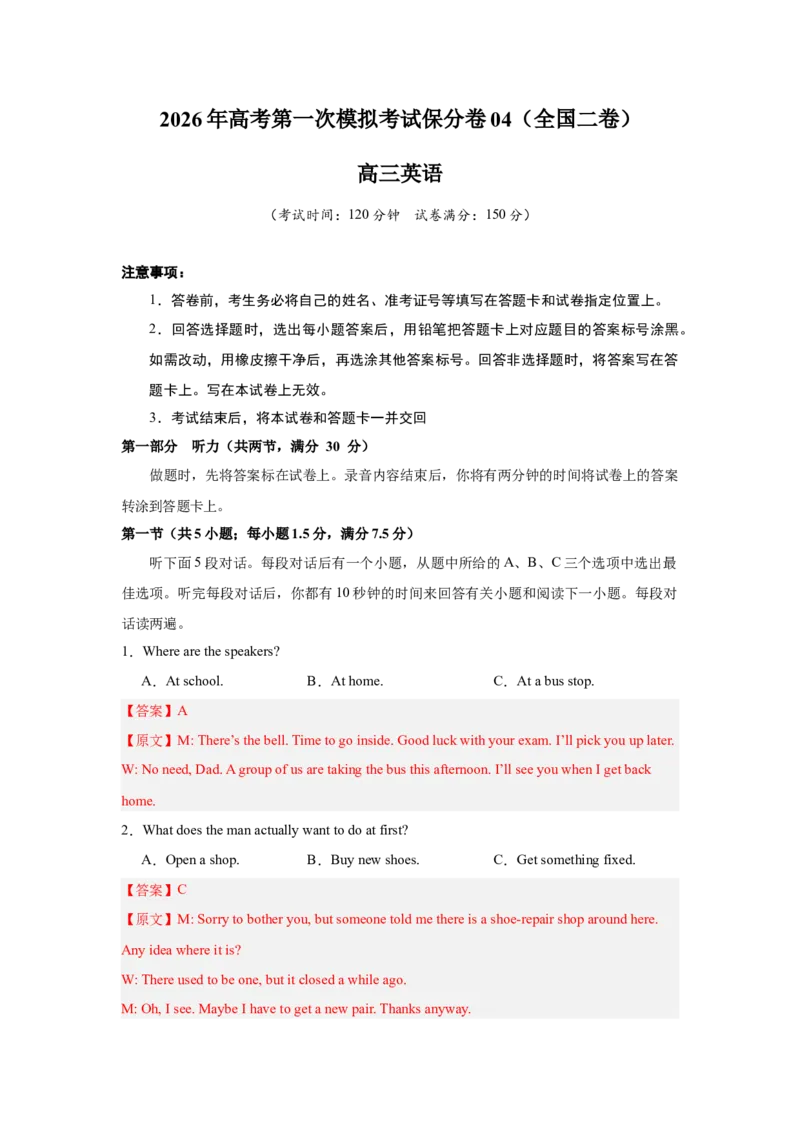
1.Where are the speakers?
A.At school.
B.At home.
C.At a bus stop.
【答案】A
【原文】M: There’s the bell. Time to go inside. Good luck with your exam. I’ll pick you up later.
W: No need, Dad. A group of us are taking the bus this afternoon. I’ll see you when I get back
home.
2.What does the man actually want to do at first?
A.Open a shop.
B.Buy new shoes.
C.Get something fixed.
【答案】C
【原文】M: Sorry to bother you, but someone told me there is a shoe-repair shop around here.
Any idea where it is?
W: There used to be one, but it closed a while ago.
M: Oh, I see. Maybe I have to get a new pair. Thanks anyway.
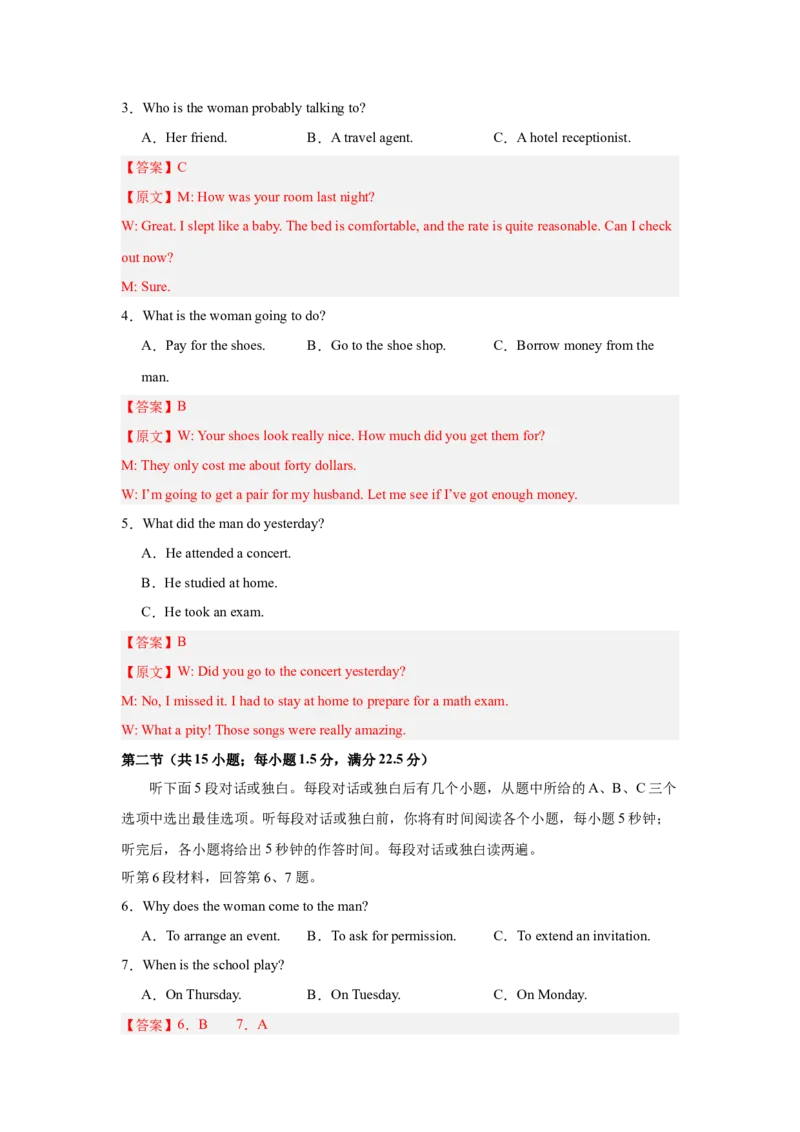
3.Who is the woman probably talking to?
A.Her friend.
B.A travel agent.
C.A hotel receptionist.
【答案】C
【原文】M: How was your room last night?
W: Great. I slept like a baby. The bed is comfortable, and the rate is quite reasonable. Can I check
out now?
M: Sure.
4.What is the woman going to do?
A.Pay for the shoes.
B.Go to the shoe shop.
C.Borrow money from the
man.
【答案】B
【原文】W: Your shoes look really nice. How much did you get them for?
M: They only cost me about forty dollars.
W: I’m going to get a pair for my husband. Let me see if I’ve got enough money.
5.What did the man do yesterday?
A.He attended a concert.
B.He studied at home.
C.He took an exam.
【答案】B
【原文】W: Did you go to the concert yesterday?
M: No, I missed it. I had to stay at home to prepare for a math exam.
W: What a pity! Those songs were really amazing.
第二节(共15 小题;每小题1.5 分,满分22.5 分)
听下面5 段对话或独白。每段对话或独白后有几个小题,从题中所给的A、B、C 三个
选项中选出最佳选项。听每段对话或独白前,你将有时间阅读各个小题,每小题5 秒钟;
听完后,各小题将给出5 秒钟的作答时间。每段对话或独白读两遍。
听第6 段材料,回答第6、7 题。
6.Why does the woman come to the man?
A.To arrange an event.
B.To ask for permission.
C.To extend an invitation.
7.When is the school play?
A.On Thursday.
B.On Tuesday.
C.On Monday.
【答案】6.B    7.A
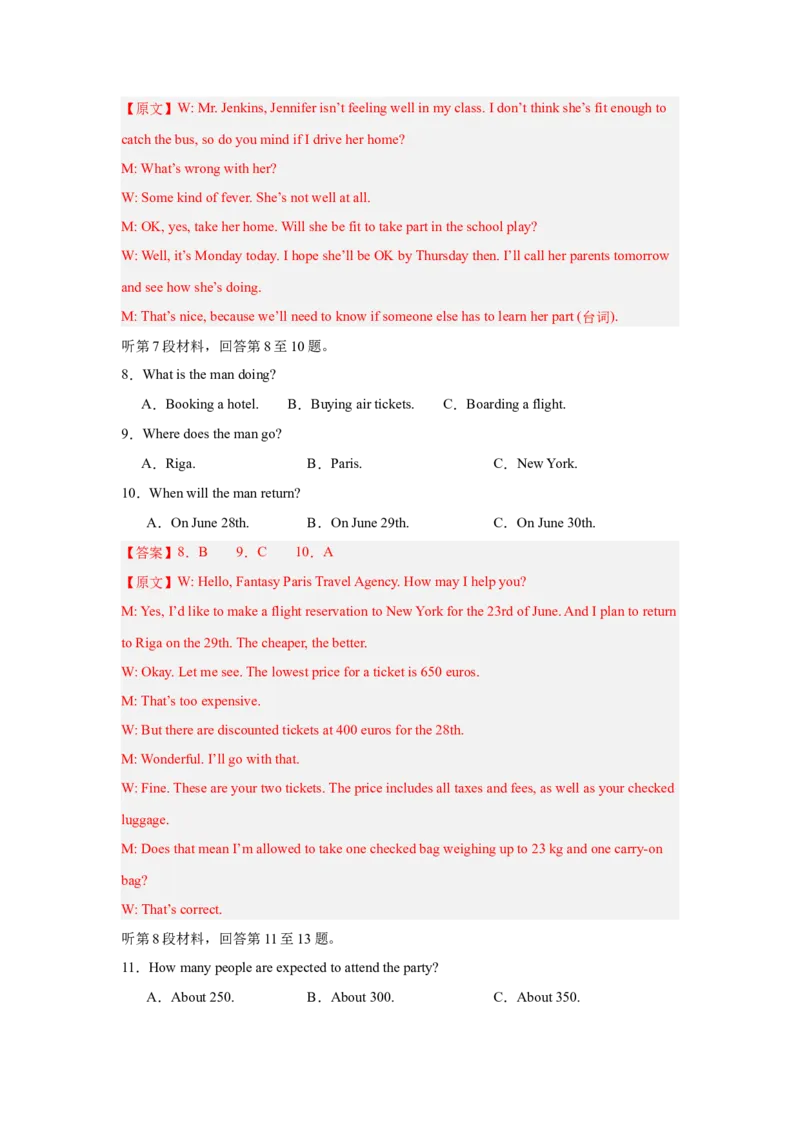
【原文】W: Mr. Jenkins, Jennifer isn’t feeling well in my class. I don’t think she’s fit enough to
catch the bus, so do you mind if I drive her home?
M: What’s wrong with her?
W: Some kind of fever. She’s not well at all.
M: OK, yes, take her home. Will she be fit to take part in the school play?
W: Well, it’s Monday today. I hope she’ll be OK by Thursday then. I’ll call her parents tomorrow
and see how she’s doing.
M: That’s nice, because we’ll need to know if someone else has to learn her part (台词).
听第7 段材料,回答第8 至10 题。
8.What is the man doing?
A.Booking a hotel.    B.Buying air tickets.    C.Boarding a flight.
9.Where does the man go?
A.Riga.
B.Paris.
C.New York.
10.When will the man return?
A.On June 28th.
B.On June 29th.
C.On June 30th.
【答案】8.B    9.C    10.A
【原文】W: Hello, Fantasy Paris Travel Agency. How may I help you?
M: Yes, I’d like to make a flight reservation to New York for the 23rd of June. And I plan to return
to Riga on the 29th. The cheaper, the better.
W: Okay. Let me see. The lowest price for a ticket is 650 euros.
M: That’s too expensive.
W: But there are discounted tickets at 400 euros for the 28th.
M: Wonderful. I’ll go with that.
W: Fine. These are your two tickets. The price includes all taxes and fees, as well as your checked
luggage.
M: Does that mean I’m allowed to take one checked bag weighing up to 23 kg and one carry-on
bag?
W: That’s correct.
听第8 段材料,回答第11 至13 题。
11.How many people are expected to attend the party?
A.About 250.
B.About 300.
C.About 350.
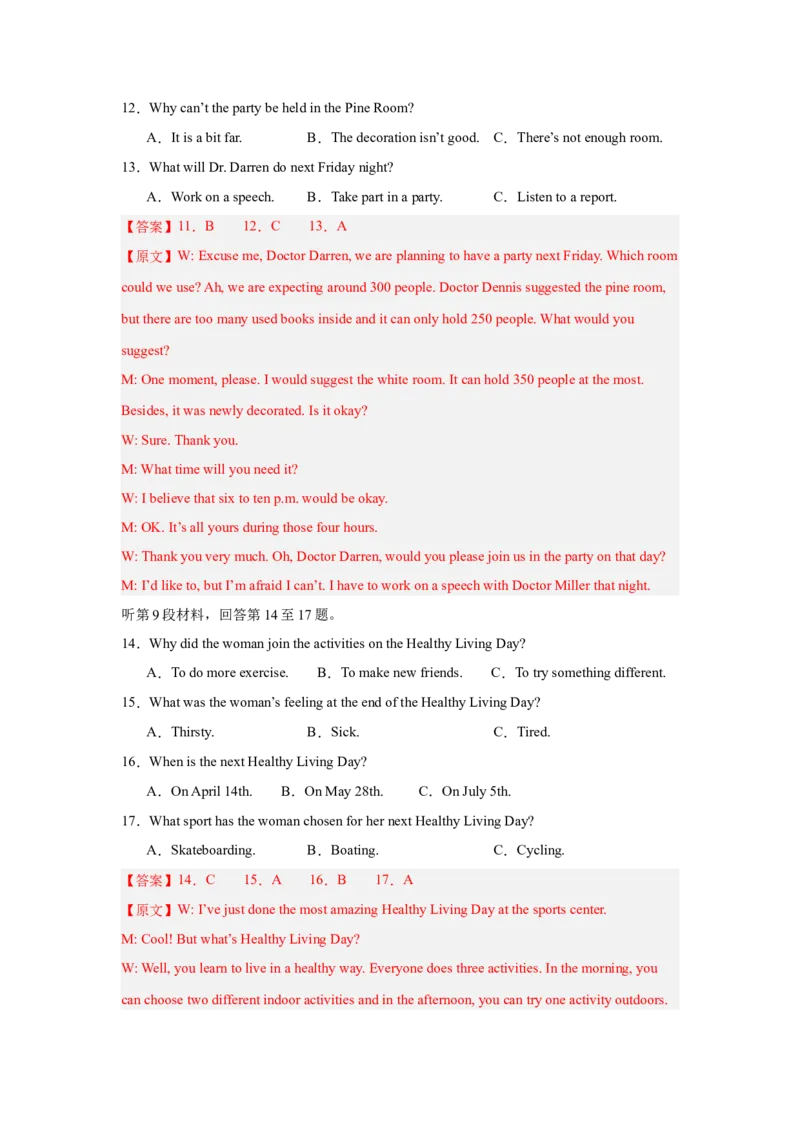
12.Why can’t the party be held in the Pine Room?
A.It is a bit far.
B.The decoration isn’t good.
C.There’s not enough room.
13.What will Dr. Darren do next Friday night?
A.Work on a speech.
B.Take part in a party.
C.Listen to a report.
【答案】11.B    12.C    13.A
【原文】W: Excuse me, Doctor Darren, we are planning to have a party next Friday. Which room
could we use? Ah, we are expecting around 300 people. Doctor Dennis suggested the pine room,
but there are too many used books inside and it can only hold 250 people. What would you
suggest?
M: One moment, please. I would suggest the white room. It can hold 350 people at the most.
Besides, it was newly decorated. Is it okay?
W: Sure. Thank you.
M: What time will you need it?
W: I believe that six to ten p.m. would be okay.
M: OK. It’s all yours during those four hours.
W: Thank you very much. Oh, Doctor Darren, would you please join us in the party on that day?
M: I’d like to, but I’m afraid I can’t. I have to work on a speech with Doctor Miller that night.
听第9 段材料,回答第14 至17 题。
14.Why did the woman join the activities on the Healthy Living Day?
A.To do more exercise.    B.To make new friends.    C.To try something different.
15.What was the woman’s feeling at the end of the Healthy Living Day?
A.Thirsty.
B.Sick.
C.Tired.
16.When is the next Healthy Living Day?
A.On April 14th.    B.On May 28th.     C.On July 5th.
17.What sport has the woman chosen for her next Healthy Living Day?
A.Skateboarding.
B.Boating.
C.Cycling.
【答案】14.C    15.A    16.B    17.A
【原文】W: I’ve just done the most amazing Healthy Living Day at the sports center.
M: Cool! But what’s Healthy Living Day?
W: Well, you learn to live in a healthy way. Everyone does three activities. In the morning, you
can choose two different indoor activities and in the afternoon, you can try one activity outdoors.
M: Sounds like hard work! Why did you do it?
W: I wanted to do a new activity, so I went with my cousin Georgia. She didn’t do enough
exercise. We made lots of new friends.
M: Were you both really tired when you finished?
W: Georgia was and she didn’t feel very well. I was OK but I needed something to drink.
M: Well, when’s the next Healthy Living Day? I’d love to go. I know I’m free on most Saturdays
after April 14th.
W: Oh, I’ve just booked a place for July 5th, but I think the next one is on May 28th.
M: Great! I’ll come to the same one as you! Are you going to go cycling again?
W: Not this time. I’m going to do advanced skateboarding. I wanted to try boating but that group
is full.
M: Wow! I’d like to do that too!
听第10 段材料,回答第18 至20 题。
18.What was one reason the flowers and the tree initially had conflicts?
A.The tree used too much water.    B.The flowers wanted more light.
C.The tree envied the beauty of the flowers.
19.What did the tree do to resist the flowers?
A.It ran out of all the water.        B.It blocked out all the sunlight.
C.It exposed them to the hot sun.
20.What does the speaker want to tell us?
A.A friend in need is a friend indeed.   B.Cooperation leads to win-win results.
C.Storms make trees take deeper roots.
【答案】18.B    19.C    20.B
【原文】M: There was a beautiful garden with some flowers and a tree. Both the flowers and the
tree gave the place a wonderful look, and they were the pride of the gardener. But no one knows
that the flowers and the tree couldn’t stand each other. The flowers hated the tree’s shadow,
because it left them only just enough light to live. The tree, on the other hand, hated the flowers
because they drank nearly all the water, leaving him just enough to live. The situation became so
serious that the flowers decided to run out of all the water in the ground so that the tree would die.
The tree fought back by not protecting the flowers from the hot sun, so they began to dry up. Soon
the flowers were really weak, and the tree was drying up. The gardener wondered why and
stopped watering them. When he did that, both the tree and the flowers realized that it was better
to help each other. They learned how to live in harmony with those around them. So they decided
to work together, using both the shade and the water to grow well. After seeing how well they
were doing, the gardener gave the best care to the garden, watering and fertilizing (施肥于) it
better than any other patch (小块土地) for miles around.
第二部分  阅读(共两节, 满分50 分)
第一节(共15 小题;每小题2.5 分, 满分37.5 分)
阅读下列短文, 从每题所给的A、B、C 和D 四个选项中选出最佳选项。
A
Get an A+ in Food Safety This School Year
As the school year begins, one often overlooked item deserves a spot on every checklist:
food safety! Here are some guidelines to keep food safe when packing your lunches.
Clean — Recently, the U.S. Department of Agriculture (USDA) has conducted an
observational study on food preparation, which showed that only 44% of the participants
attempted to wash their hands before meal preparation, a failing grade no matter how you look at
it. Even fewer participants (3%) washed their hands properly by rubbing hands for at least 20
seconds. To get an A, wet hands, apply soap, rub for at least 20 seconds, rinse, and dry with a
clean towel before, during, and after preparing food, and before eating.
Separate — Avoid spreading germs when preparing foods. Use one cutting board for raw
meats and another for vegetables, fruits, and ready-to-eat foods. When packing, keep foods that
spoil easily, such as prepared meats, in a special lunchbox with a cold source, like a frozen gel
pack. Do not reuse packaging such as resealable plastic bags, as they can spread bacteria.
Chill — You’ll pass the final “food safety exam” by never leaving food out of refrigeration
for over two hours. Leaving food out too long at room temperature can cause bacteria to grow to
dangerous levels that can cause illness. Bacteria grow most rapidly in the range of temperatures
between 4℃ and 60℃, doubling in number in as little as 20 minutes. This range of temperatures is
often called the “Danger Zone”.
Caution — Never taste food to determine its safety. When in doubt, throw it out. While you
may have substitute teachers, there is never a substitute for food safety.
For more questions about food safety, contact the USDA’s hotline at 1-888-674-6854 to talk
to a food safety expert during working hours on weekdays, or chat live at ask.usda.gov from 10
a.m. to 6 p.m., Saturday through Tuesday.
21.What percentage of participants failed to wash hands properly?
A.3%.
B.41%.
C.44%.
D.97%.
22.“4℃-60℃” is called the “Danger Zone” because ________ in this temperature range.
A.illnesses spread easily
B.bacteria multiply fastest
C.foods lose freshness easily
D.nutrients break down quickly
23.How can you know more about food safety from USDA on a Sunday noon?
A.Send an email. B.Turn to a teacher.
C.Call the hotline.
D.Access the live
chat.
【答案】21.D    22.B    23.D
【解析】本文是一篇说明文。文章主要介绍学年伊始午餐打包的四项食品安全指南及咨询
方式。
21.细节理解题。根据“Clean”部分原文“Even fewer participants (3%) washed their hands
properly by rubbing hands for at least 20 seconds. (仅有3%的参与者通过揉搓至少20 秒正确洗
手)”可知,97%的人未能正确洗手。故选D 项。
22.细节理解题。根据“Chill”部分原文“Bacteria grow most rapidly in the range of
temperatures between 4℃ and 60℃, doubling in number in as little as 20 minutes. This range of
temperatures is often called the “Danger Zone”. (细菌在4℃到60℃的温度范围内生长最快,
短短20 分钟数量就能翻倍,这一温度范围常被称为“危险区”)”可知,4℃-60℃被称为
“危险区”因为在这个温度范围内细菌繁殖最快,故选B 项。
23.细节理解题。据最后一段“For more questions about food safety, contact the USDA’s
hotline at 1-888-674-6854 to talk to a food safety expert during working hours on weekdays, or
chat live at ask.usda.gov from 10 a.m. to 6 p.m., Saturday through Tuesday. (有关食品安全的更
多问题,请在工作日工作时间拨打美国农业部热线1-888-674-6854 与食品安全专家交谈,
或在周六至周二上午10 点至下午6 点在ask.usda.gov 进行在线聊天)”可知,在周日中午可
以通过访问在线聊天了解更多关于美国农业部的食品安全信息。故选D 项。
B
After immigrating to the United States from the West Indies in 1901, 19-year-old Bob
Douglas found a job as a doorman in New York City. One day, a co-worker took him to visit an
upstairs basketball court, and he was stunned by the athletic skills on display. Inspired by that
moment, Douglas was determined to create a basketball team — the New York Renaissance —
which was the first Black-owned, all-Black professional basketball team at that time.
Needing a practice spot for his team, Douglas sought casino (赌场) owner William Roach’s
permission to use the dance floor before late-night dancing, offering to cover team costs and bear
all financial risk. Besides, the team had to travel the country playing any opponent that would
agree to schedule them to go through two financial failures. They repeatedly encountered
discrimination and racial violence, such as fistfights with white players and fans. The players were
often banned from hotels and restaurants on the road. A basketball historian, Dick Engleberg said.
“A lot of times they stayed in jails because that was the safest place they could stay.”
No matter the obstacle, the Rens just kept winning. In 1925, the Rens shocked the world by
defeating the Original Celtics, the most dominant all-white team of their day. During the 1932-33
season, the Renaissance won 88 straight games, a professional basketball record that remains
unbroken.
The Rens began to decline as its players got older and the tens of thousands of miles of
traveling took its toll, but in time, they were recognized for the important role they played in
advancing black athletes in basketball. Douglas, who had owned and coached the Rens for their
entire 25-year run, has been today known as the “Father of Black Professional Basketball,” which
ensures that although the Rens isn’t a household name, their legacy will never be forgotten.
24.What motivates Douglas to establish the team?
A.The financial support he received.
B.The impressive athletic skills he saw.
C.His concern with the jobs for Black people.
D.His desire to become a famous basketball coach.
25.What can we know from Engleberg’s words?
A.The team chose jails to save money.
B.Jails can provide basketball training facilities.
C.The players were arrested for fighting with fans.
D.The team could only find accommodation in jails.
26.What does the underlined phrase mean in the last paragraph?
A.Gained more fans.
B.Caused great losses.
C.Discouraged the players.
D.Boosted team performance.
27.What can best describe Douglas?
A.Careful and humble.
B.Strict and disciplined.
C.Tolerant and dynamic.
D.Determined and responsible.
【答案】24.B    25.D    26.B    27.D
【解析】本文是一篇记叙文。主要讲述Bob Douglas 移民美国后受篮球运动启发,组建首
支黑人职业篮球队,克服困难取得辉煌成就并获认可的故事。
24.细节理解题。根据第一段中的“One day, a co-worker took him to visit an upstairs
basketball court, and he was stunned by the athletic skills on display. Inspired by that moment,
Douglas was determined to create a basketball team — the New York Renaissance — which was
the first Black-owned, all-Black professional basketball team at that time.(一天,一位同事带他
去参观楼上的篮球场,他被展示出的运动技巧惊呆了。受那一刻的启发,道格拉斯决心组
建一支篮球队——纽约文艺复兴队,这是当时第一支由黑人拥有、全部由黑人组成的职业
篮球队。)”可知,道格拉斯是被篮球场上展示的出色运动技巧所激励,才决定组建球队。
故选B 项。
25.细节理解题。根据第二段中的“The players were often banned from hotels and restaurants
on the road. A basketball historian, Dick Engleberg said. “A lot of times they stayed in jails
because that was the safest place they could stay.”(球员们在路上经常被禁止进入酒店和餐厅。
篮球历史学家迪克·恩格尔伯格说:“很多时候他们住在监狱里,因为那是他们能找到的最
安全的地方。”)”可知,球队因种族歧视无法入住酒店,只能选择监狱作为住宿地点。故
选D 项。
26.词句猜测题。根据最后一段中的“The Rens began to decline as its players got older and
the tens of thousands of miles of traveling took its toll, but in time, they were recognized for the
important role they played in advancing black athletes in basketball. (文艺复兴队(The Rens)
开始走向衰落,一方面是因为队员年龄增长,另一方面是数万英里的奔波跋涉让球队took
its toll。但随着时间推移,他们因在推动黑人运动员参与篮球运动中所发挥的重要作用,获
得了人们的认可。)”可知,长时间的旅行对球队产生了负面影响,导致球队衰落,“took
its toll”应表示“造成损失、产生负面影响”。故选B 项。
27.推理判断题。根据第一段中道格拉斯受启发后决心组建首支黑人职业篮球队,以及第
二段中“Needing a practice spot for his team, Douglas sought casino owner William Roach’s
permission to use the dance floor before late-night dancing, offering to cover team costs and bear
all financial risk.(由于需要为球队寻找训练场地,道格拉斯请求赌场老板威廉·罗奇允许他们
在深夜舞会前使用舞池,并主动提出承担球队费用和所有财务风险。)”可知,他为球队解
决场地问题并承担风险,体现责任感;再结合球队面临种族歧视、财务失败等诸多困难仍
坚持下去,且带领球队取得辉煌成绩,可见他意志坚定,因此“有决心且有责任感”最能
描述道格拉斯。故选D 项。
C
(原创题)A new study led by the University of Bristol suggests that school dinners may
encourage picky teenagers to eat better. Published in a nutrition journal, the research focused on
13-year-old children. It found that children who were considered picky eaters during their
preschool years tended to be less picky if they chose school dinners at lunchtime rather than
packed lunches. This is the first time that lunchtime behaviors in picky children have been studied
outside of the home and away from parental influence.
Comparing the two lunch methods reveals clear differences. When eating packed lunches,
picky eaters were less likely to have meat or fish in their sandwiches and more likely to choose
fillings like cheese spreads. They were also less likely to eat fruit or salad. However, when having
school dinners, they did not avoid meat, fish, or fruit. Instead, they ate a wider variety of foods
and made choices more similar to their peers. This suggests the school environment encourages
them to explore new options.
Researchers analyzed questionnaire data from over 5,300 children in the “Children of the
90s” study. They looked at data from multiple pre-school stages and again at age 13. Although
picky eating peaks at around 3 years old, the research shows that some who were picky toddlers
still have similar characteristics at age 13. However, school dinners could help these children
explore a wider range of foods and become healthier overall, regardless of their early habits.
A major finding is that almost all children, whether picky or not, are not eating enough
vegetables. Vegetables are essential for getting fiber, vitamins, and minerals. Lead researcher Dr.
Caroline Taylor points out that while school dinners are a good way to increase variety, parents
can also help. Enjoying family meals together, showing a balanced diet, and involving children in
cooking are all effective ways to support healthy eating.
The research team plans to use the data to look at adult picky eating habits and their health
impacts in the future. The study highlights the importance of ensuring children get proper nutrition
both at home and at school.
28. How does eating school dinners affect picky teenagers compared to packed lunches?
A. They refuse to eat meat and fish entirely.
B. They consume a more limited range of foods.
C. They are more willing to try a variety of foods.
D. They eat less fruit than their non-picky peers.
29. Why did the research team analyze data from the "Children of the 90s" study?
A. To prove that school dinners are cheaper than packed lunches.
B. To understand how picky eating behavior changes over time.
C. To show that picky eaters usually skip lunch completely.
D. To find out which sandwich fillings are most popular.
30. What does Dr. Caroline Taylor suggest parents do to support healthy eating?
A. Stop giving children packed lunches completely.
B. Force children to eat vegetables at every meal.
C. Involve children in preparing family meals.
D. Only rely on school dinners for nutrition.
31. What can be inferred about children's vegetable consumption from the text?
A. Picky eaters are the only group not eating enough vegetables.
B. Most children are eating the required amount of fiber.
C. There is a general lack of sufficient vegetable intake among children.
D. School dinners do not provide enough vegetables for growth.
【答案】28. C    29. B    30. C    31. C
【解析】本文主要介绍了一项由布里斯托大学领导的研究。研究表明,相比自带午餐,学
校晚餐有助于挑食的青少年尝试更多样化的食物,减少挑食行为。虽然挑食习惯可能从幼
儿期持续到青春期,但学校环境能鼓励他们摄入肉类、水果等健康食品。此外,研究还发
现几乎所有儿童的蔬菜摄入量都不足。专家建议,除了学校供餐,父母也可以通过家庭聚
餐等方式鼓励孩子健康饮食。
28.细节理解题。根据文章第二段内容,挑食的孩子吃自带午餐时会回避肉类、水果等,但
在吃学校晚餐时,“they ate a wider variety of foods”(他们食用的食物种类更多),并且做
出了与同龄人相似的选择。由此可知,吃学校晚餐让他们更愿意尝试多样化的食物。A、B
项与原文相反;D 项原文未提及他们比同龄人吃得更少,只是说比吃自带午餐时有所改
善。
29.细节理解题。根据文章第三段“They analysed data from multiple pre-school ages and again
at age 13 years, to understand how picky eating behaviour changes over time.”可知,研究人员分
析数据是为了了解挑食行为是如何随着时间推移而变化的。A、C、D 项均不是研究团队分
析该数据的目的。
30.推理判断题。根据文章第四段Dr. Caroline Taylor 的话,“Whether that is enjoying family
meals together, modelling a balanced diet yourself, or involving them in meal preparation, it all
helps.” 无论是享受家庭聚餐、树立均衡饮食的榜样,还是“ involving them in meal
preparation”(让他们参与备餐),都有帮助。因此C 项“让孩子参与准备家庭餐”符合建
议。A 项“完全停止带午餐”和D 项“仅依赖学校晚餐”都过于绝对,且忽略了家庭的作
用;B 项“强迫吃蔬菜”原文未提及。
31. 推理判断题。根据文章第四段“A major finding is that almost all children, whether picky
or not, are not eating enough vegetables.” 一个主要发现是,几乎所有的孩子,无论是否挑
食,都没有吃足够的蔬菜。由此可以推断,儿童中普遍存在蔬菜摄入不足的问题。A 项
“只有挑食者蔬菜摄入不足”与原文“almost all children”不符;B 项“大多数孩子摄入了
足够的纤维”与原文矛盾;D 项原文未提及学校晚餐蔬菜供应不足,而是说孩子们吃得不
够。
D
(原创题)We usually think of cold as a single feeling, but it actually varies depending on
where we feel it. A recent study led by researchers from Spain has found that the skin and internal
organs use different molecular systems to detect temperature changes. This work, published in a
scientific journal, offers new insights into how the body maintains balance and may help explain
disorders related to abnormal cold sensitivity.
Research shows that in the skin, low temperatures are mainly detected by a special sensor
called TRPM8. This sensor is designed for sensing cool conditions in our environment. However,
inside the body, organs like the lungs and stomach rely heavily on a different molecular sensor
known as TRPA1. This difference explains a common experience: the feeling of cold on the skin is
very different from the sensation of breathing icy air or drinking cold water. Scientists explain that
skin sensors help us detect environmental cold and take defensive actions, while internal sensors
play a deeper role in internal regulation.
To discover these differences, the team used animal models to study sensory neurons (神经
元) responsible for detecting cold. They focused on two main nerve pathways: the trigeminal
nerve (三叉神经), which carries information from the skin, and the vagus nerve ( 迷走神经),
which connects the brain to internal organs. They used techniques like calcium imaging to observe
nerve activity in real time. They also applied drugs to block specific molecular sensors, allowing
them to identify which sensors were active in each type of nerve.
The researchers further strengthened their findings by studying genetically modified mice.
These mice were bred to lack either the TRPM8 or TRPA1 sensors. By combining these
experiments, they confirmed that each sensor plays a distinct role in cold perception depending on
the tissue involved. The results show that temperature detection is closely matched to the specific
physiological ( 生理的) role of each body part. This work reveals how complex our sensory
systems are and opens new avenues for studying diseases like certain neuropathies (神经病变).
32.Which organs mainly rely on TRPA1 to sense cold?
A. The skin and head.        B. The brain and heart.
C. The trigeminal nerves.     D. The lungs and stomach.
33.What does the difference between skin and internal cold detection reveal?
A. Cold feeling is a single and uniform experience.
B. Temperature detection matches the body part's function.
C. Internal organs are more sensitive than the skin.
D. Environmental temperature does not affect internal organs.
34.How did researchers pinpoint the active ion channels in each nerve type?
A. By applying drugs that block the sensors.
B. By analyzing the breathing rate of mice.
C. By measuring the environmental temperature.
D. By comparing human nerves with animal nerves.
35.What is the best title for the text?
A. The Secret of Keeping Warm       B. Researching Cold Sensors on Skin
C. Two Different Ways to Feel Cold    D. Curing Cold Sensitivity Disorders
【答案】32. D    33. B    34. A    35.C
【解析】文章探讨了一项科学发现:人体对寒冷的感知会因部位不同而存在差异。皮肤通
过 TRPM8 传感器检测环境中的寒冷,而肺等内脏器官则借助 TRPA1 传感器进行内部调
节。该发现已通过神经通路研究和基因修饰小鼠实验得到证实,凸显了人体感觉系统的复
杂性及其不同的生理作用。
32.细节理解题。根据文章第二段中的 “inside the body, organs like the lungs and stomach
rely heavily on a different molecular sensor known as TRPA1”(在体内,像肺和胃这样的器官
很大程度上依赖一种被称为TRPA1 的不同分子传感器)可知,肺和胃主要依赖TRPA1 来
感知寒冷。故选D。
33.推理判断题。根据文章第四段中的 “The results show that temperature detection is closely
matched to the specific physiological role of each body part”(结果显示,温度检测与身体每个
部位的具体生理角色紧密匹配)可知,皮肤和体内寒冷检测的区别揭示了温度检测方式与
身体部位的功能是相匹配的。故选B。
34. 细节理解题。根据文章第三段中的 “They also applied drugs to block specific molecular
sensors, making it possible to pinpoint which ion channels were active in each type of neuron”
(他们还应用药物来阻断特定的分子传感器,从而确定哪些离子通道在每种神经元中是活
跃的)可知,研究人员通过使用阻断传感器的药物来确定活跃的离子通道。故选A。
35.主旨大意题。文章开头指出人体通过两种不同的方式感知寒冷,随后详细介绍了皮肤和
内部器官使用不同的传感器(TRPM8 和TRPA1)以及相关的实验研究。文章主要围绕
“人体感知寒冷的两种不同方式”展开。故选C。
第二节(共5 小题;每小题2. 5 分, 满分12. 5 分)
阅读下面短文, 从短文后的选项中选出可以填入空白处的最佳选项。选项中有两项为
多余选项。
According to a 2024 attention study by King’s College London, 49% of the UK public are
experiencing “popcorn (爆米花) brain”, a mental state featuring divided attention and wandering
thoughts.     36     In response to the findings, psychologist Tina Chummun gives her top
tips.
Adopt the mind map method. To manage a distracted ( 分心的) mind, write down
everything, like appointments, worries and to - dos, without organizing it initially. Once
everything is on paper, group these into life areas like work or emotional wellbeing.     37

This creates order and gives your brain permission to concentrate.
Every time you feel your thoughts wandering, give yourself three seconds — breathe in,
name what you’re feeling, and redirect your focus.     38     By doing so, you may turn down
the heat when your brain is working overtime.
Minimizing tech is also the key to getting back on track in your daily life. A full digital
withdrawal is unrealistic.     39     Then it could be followed by a five-minute screen time
reward. It teaches your brain to tolerate stillness without feeling punished.
    40     At first, you may feel bored, as popcorn brain likes being ‘go go go’ to feel
safe. “Go for a walk without music, or simply stare out your window,” suggests Tina. “Sit in
silence and observe your thoughts. Let your brain breathe. It is sometimes exactly what your
nervous system needs.”
So, are you ready to quiet the mental popcorn and get your focus back?
A.Allow space in your day for doing nothing.
B.So, what’s making our brains pop like popcorn?
C.Instead, go totally screen-free for 25-30 minutes.
D.Starving distractions and feeding focus is a nice idea.
E.Then ask yourself: what matters now and what can wait?
F.They feel their attention less focused and deep thinking rarer.
G.This practice enables you to slow down and manage emotions.
【答案】36.F    37.E    38.G    39.C    40.A
【解析】这是一篇说明文。文章以伦敦国王学院2024 年的一项注意力研究为切入点,指出
英国49%的公众正受“爆米花大脑”(注意力分散、思绪飘忽的精神状态)困扰,随后心
理学家蒂娜·丘蒙针对该问题提出了思维导图法、思绪回归训练、减少科技使用、留白独处
等四条实用解决建议。
36.上文“According to a 2024 attention study by King’s College London, 49% of the UK
public are experiencing ‘popcorn (爆米花) brain’, a mental state featuring divided attention and
wandering thoughts. (根据伦敦国王学院2024 年的一项注意力研究,49%的英国公众正经历
“爆米花大脑”,这种精神状态的特点是注意力分散、思绪飘忽。)”定义了“爆米花大
脑”并说明其高发率,下文“In response to the findings, psychologist Tina Chummun gives her
top tips. (针对这些发现,心理学家蒂娜·丘蒙给出了她的顶级建议。)”引出解决建议。F 项
“他们感觉自己的注意力不太集中,深度思考也更少见了。”承接上文,“they”指代前文
“49% of the UK public”,“注意力不太集中”“深度思考少见”是对“注意力分散、思绪
飘忽”的进一步阐释,让读者更清晰理解“爆米花大脑”的表现,衔接自然。故选F。
37.上文“Adopt the mind map method. To manage a distracted (分心的) mind, write down
everything, like appointments, worries and to-dos, without organizing it initially. Once everything
is on paper, group these into life areas like work or emotional wellbeing. (采用思维导图法。为
了管理分心的大脑,先把所有事情都写下来,比如约会、担忧和待办事项,一开始不用整
理。一旦所有事情都写在纸上,就把它们归类到工作、情感健康等生活领域。)”详细介绍
了思维导图法的前两个步骤——记录和归类,下文“This creates order and gives your brain
permission to concentrate. (这能建立秩序,让你的大脑可以集中注意力。)”说明该方法的效
果。E 项“然后问问自己:现在什么重要,什么可以等一等?”作为思维导图法的第三步,
承接前文的“记录和归类”流程,通过设问筛选优先级,进而实现下文“建立秩序、集中
注意力”的效果,逻辑连贯。故选E。
38.上文“Every time you feel your thoughts wandering, give yourself three seconds — breathe
in, name what you’re feeling, and redirect your focus. (每次你感觉思绪飘忽时,给自己三秒钟
——吸气,说出你的感受,然后重新集中注意力。)”介绍了思绪回归训练的具体操作,下
文“By doing so, you may turn down the heat when your brain is working overtime. (通过这样做,
当你的大脑过度运转时,你可能会降温。)”说明该训练的作用。G 项“这种练习能让你慢
下来,管理情绪。”解释了该训练的直接效果,“this practice”指代上文的三秒训练法,
“慢下来”对应“吸气”的动作,“管理情绪”对应“说出你的感受”,且为下文“大脑
降温”的深层效果做铺垫。故选G。
39.上文“Minimizing tech is also the key to getting back on track in your daily life. A full
digital withdrawal is unrealistic. (减少科技产品使用也是日常生活中回归正轨的关键。完全脱
离数字产品是不现实的。)”提出减少科技使用的建议并指出完全脱离不现实,下文“Then
it could be followed by a five-minute screen time reward. (然后可以给五分钟的屏幕使用时间
作为奖励。)”说明后续的奖励机制。C 项“相反,完全不使用屏幕25 到30 分钟。”通过
“instead”承接上文“完全脱离不现实”,给出切实可行的替代方案——短时间不使用屏幕,
“25 到30 分钟”与下文“五分钟奖励”形成时长搭配,构成“限制并奖励”的有效模式,
逻辑清晰。故选C。
40.下文“At first, you may feel bored, as popcorn brain likes being ‘go go go’ to feel safe. “Go
for a walk without music, or simply stare out your window,” suggests Tina. “Sit in silence and
observe your thoughts. Let your brain breathe. (一开始,你可能会感到无聊,因为“爆米花大
脑”喜欢一直“忙忙碌碌”才觉得安全。蒂娜建议:“不带音乐散步,或者只是盯着窗
外。”“安静地坐着,观察自己的思绪。让你的大脑呼吸。”)”具体描述了“什么都不
做”的放松方式及其意义。A 项“在一天中留出时间什么都不做。”作为该段主题句,精
准概括下文内容,“留出时间什么都不做”与下文“不带音乐散步”“安静坐着”等具体
做法相呼应,符合段落主旨。故选A。
第三部分 语言运用(共两节,满分30 分)
第一节(共15 小题,每小题1 分,满分15 分)
阅读下面短文, 从每题所给的A、B、C 和D 四个选项中选出可以填入空白处的最佳选
项。
A few months ago, I     41     a random post on Facebook from a group called Poisons
Help: Emergency Identification for Mushrooms and Plants. Curious, I clicked on it. The post
42     a photo of a fungus (真菌) on a tree and a panicked message from a man whose dog was
vomiting (呕吐), with further photos showing bits of vomited mushroom. The owner     43
urgent guidance, fearing his pet had eaten something poisonous. The group, composed of trusted
experts,     44     him the mushrooms were not dangerous.
I now find myself reading post after post. When cases are resolved and pets survive, the
posters are so     45     to have access to this remarkable free resource. In the often dark and
46     world of the internet, it feels like a beautiful pocket of light and hope. It     47     me
that there is good out there too.
It is easy to feel     48     about humanity. There are ongoing wars, climate change,
violence, poverty and more. But people are using their knowledge and skills to make a     49
. This is something I see when I go to work in the National Health Service (NHS). For all the talk
of its brokenness and cuts, every day my colleagues and I     50     patients, and many of
those patients grow, develop and get better.
While facing and standing against the bad, we must also hold on to the good. It’s easy to be
overwhelmed by     51     and lose hope, especially if you’ve experienced severe hardships.
52     a grip on the good in ourselves, others and the world takes effort. It’s not about     53
everything is fine. It’s about believing in the     54     for positive change. My mentor (导师)
recently spoke about the Israel-Palestine conflict: that however far away peace may seem, we have
to believe that it is possible, so we can begin     55     the bridge that may get us there one
day. We can start to lay the bricks.
41.A.passed over
B.came across
C.drew up
D.took down
42.A.hid
B.overlooked
C.featured
D.ruined
43.A.sought
B.declined
C.supplied
D.deserted
44.A.cautioned
B.cheated
C.puzzled
D.reassured
45.A.upset
B.grateful
C.annoyed
D.skeptical
46.A.bright
B.beneficial
C.welcoming
D.awful
47.A.frightens
B.discourages
C.reminds
D.bothers
48.A.curious
B.optimistic
C.hopeless
D.confident
49.A.difference
B.chaos
C.livelihood
D.commitment
50.A.avoid
B.hurt
C.neglect
D.treat
51.A.warmth
B.cruelty
C.negativity
D.damage
52.A.Maintaining
B.Losing
C.Escaping
D.Deserting
53.A.pretending
B.proving
C.forgetting
D.acknowledging
54.A.hardship
B.unlikelihood
C.weakness
D.potential
55.A.destroying
B.building
C.crossing
D.designing
【答案】
41.B    42.C    43.A    44.D    45.B    46.D    47.C    48.C    49.
A    50.D    51.C    52.A    53.A    54.D    55.B
【解析】本文是一篇记叙文。文章主要讲述了作者偶然发现脸书上的“毒物救助”小组,
看到专家为宠物主提供蘑菇鉴定帮助,进而感悟到尽管世界存在诸多糟糕的事,但仍有人
们用知识传递善意,我们应坚守美好、相信积极改变的可能性。
41.考查动词短语辨析。句意:几个月前,我在脸书上偶然看到一个名为“毒物救助:蘑
菇和植物紧急鉴定”的小组发布的一条随机帖子。A. passed over 忽略;B. came across 偶然
遇见;C. drew up 起草;D. took down 记下。根据下文“a random post”及“Curious, I clicked
on it.”可知,作者是偶然看到这条帖子。故选B。
42.考查动词词义辨析。句意:这条帖子展示了树上一种真菌的照片,还有一名男子的恐
慌留言,他的狗正在呕吐,后续照片还显示了呕吐物中的蘑菇碎片。A. hid 隐藏;B.
overlooked 忽视;C. featured 以……为特色,展示;D. ruined 毁坏。根据下文“a photo of a
fungus (真菌) on a tree and a panicked message”可知,帖子里展示了这些内容。故选C。
43.考查动词词义辨析。句意:狗主人寻求紧急指导,担心他的宠物吃了有毒的东西。A.
sought 寻求;B. declined 拒绝;C. supplied 提供;D. deserted 抛弃。根据下文“urgent
guidance, fearing his pet had eaten something poisonous”可知,主人是寻求指导。故选A。
44.考查动词词义辨析。句意:这个由值得信赖的专家组成的小组向他保证,这些蘑菇没
有危险。A. cautioned 警告;B. cheated 欺骗;C. puzzled 使困惑;D. reassured 使安心,保证。
根据下文“the mushrooms were not dangerous”可知,专家是让主人安心。故选D。
45.考查形容词词义辨析。句意:当案例得到解决、宠物活下来时,发帖者都非常感激能
获得这个非凡的免费资源。A. upset 沮丧的;B. grateful 感激的;C. annoyed 恼怒的;D.
skeptical 怀疑的。根据下文“have access to this remarkable free resource”可知,发帖者是心
怀感激的。故选B。
46.考查形容词词义辨析。句意:在互联网这个常常阴暗又糟糕的世界里,这就像一处充
满光明和希望的美好角落。A. bright 明亮的;B. beneficial 有益的;C. welcoming 热情的;
D. awful 糟糕的。根据上文“dark and”及下文“it feels like a beautiful pocket of light and
hope”可知,此处是形容互联网的糟糕,与光明希望形成对比。故选D。
47.考查动词词义辨析。句意:它提醒我,这个世界上也有美好的事物存在。A. frightens
使害怕;B. discourages 使泄气;C. reminds 提醒;D. bothers 打扰。根据“there is good out
there too”可知,这件事是提醒了作者这一点。故选C。
48.考查形容词词义辨析。句意:人们很容易对人类感到绝望。A. curious 好奇的;B.
optimistic 乐观的;C. hopeless 绝望的;D. confident 自信的。根据下文“There are ongoing
wars, climate change, violence, poverty and more.”可知,这些事会让人对人类感到绝望。故选
C。
49.考查名词词义辨析。句意:但人们正利用自己的知识和技能发挥作用。A. difference 差
异;B. chaos 混乱;C. livelihood 生计;D. commitment 承诺。make a difference 是固定搭配,
表示“有影响,发挥作用”,根据上文“people are using their knowledge and skills”可知,
此处指人们发挥作用。故选A。
50.考查动词词义辨析。句意:尽管人们都说医疗服务体系破败不堪、经费被削减,但我
和同事们每天都在治疗病人,而且很多病人都在康复、好转。A. avoid 避免;B. hurt 伤害;
C. neglect 忽视;D. treat 治疗。根据上文“in the National Health Service (NHS)”及下文
“many of those patients grow, develop and get better”可知,作者和同事是治疗病人。故选
D。
51.考查名词词义辨析。句意:人们很容易被消极情绪压垮并失去希望,尤其是当你经历
过严重的困境时。A. warmth 温暖;B. cruelty 残忍;C. negativity 消极;D. damage 损害。根
据下文“lose hope, especially if you’ve experienced severe hardships”可知,是被消极情绪压
垮。故选C。
52.考查动词词义辨析。句意:坚持看到自己、他人和世界中的美好是需要努力的。A.
Maintaining 维持,坚持;B. Losing 失去;C. Escaping 逃避;D. Deserting 抛弃。根据上文
“hold on to the good”及下文“takes effort”可知,此处是坚持看到美好。故选A。
53.考查动词词义辨析。句意:这并不是假装一切都很好。A. pretending 假装;B. proving
证明;C. forgetting 忘记;D. acknowledging 承认。根据下文“It’s about believing in the 14
for positive change.”可知,不是假装一切都好。故选A。
54.考查名词词义辨析。句意:而是相信积极改变的潜力。A. hardship 艰难;B.
unlikelihood 不可能;C. weakness 弱点;D. potential 潜力,可能性。根据下文“however far
away peace may seem, we have to believe that it is possible”可知,是相信积极改变的可能性。
故选D。
55.考查动词词义辨析。句意:我的导师最近谈到巴以冲突时说:无论和平看起来有多遥
远,我们都必须相信它是可能的,这样我们才能开始搭建有一天能让我们抵达和平的桥梁。
A. destroying 摧毁;B. building 建造;C. crossing 穿过;D. designing 设计。根据下文“the
bridge that may get us there one day”及“We can start to lay the bricks.”可知,是搭建桥梁。故
选B。
第二节(共10 小题;每小题1.5 分 ,满分15 分)
阅读下面短文,在空白处填入1 个适当的单词或括号内单词的正确形式。
(原创题)On a quiet morning, Ye Hanzhong, a national-level inheritor of Chaozhou gongfu
cha, entered a classroom at Chengnan Middle School. He patiently guided students, teachers, and
parents
  56

   (make) and taste the tea. For Ye, this is not just
  57

   daily habit, but a
philosophy of life. He taught that precise brewing requires discipline,
  58

   sharing the tea
represents hospitality. Proper preparation teaches patience, and seizing the right moment
determines success.
To help the young accept the tradition, Ye simplified the complex 21-step process into a
framework
  59

   (call) "Three Steps and Seven Methods." In 2022, Chaozhou gongfu cha
60

   (list) as a UNESCO Intangible Cultural Heritage. President Xi
  61

   (emphasis) the need
to protect this precious culture, noting that it constitutes a precious strand of Chinese civilization.
Ye points out that the core of the tradition is its sense of ritual. The tools and procedures must
be precise. For example, pouring water from a specific height can release the aroma. The final
drops are distributed
  62

   (equal) among the cups, symbolizing balance and consideration.
Even the arrangement of cups carries a meaning of selflessness. Good water is essential,
reminding us to respect nature and the environment.
The foundation of this ritual is Phoenix Dancong tea. Li Xuan, a senior tea maker, describes
this tea as "the perfume of tea." It grows on Fenghuang Mountain,
  63

   the unique climate
gives the tea its special quality. It is celebrated for its complex and ever-changing fragrance. The
local tea
  64

    (produce) is carried out with great care.
In Chaozhou, tea is everywhere. If you walk through the streets, you will see people
  65


(drink) tea at any time. When people sit down to make tea, they naturally calm down. Many
conflicts are resolved over a cup of tea. As young people carry this culture forward, the spirit of
Chaozhou continues to thrive.
【答案】56.to make    57.a    58.while    59.called    60.was listed
61.emphasized    62.equally    63.where    64.production   65.drinking
【解析】本文主要介绍了国家级潮州工夫茶代表性传承人叶汉钟在中学开设茶文化课程的
事迹。叶老师通过简化的“三步七法”向学生传授工夫茶的技艺与哲学,强调耐心、和谐
与好客等价值观。文章还提及了潮州工夫茶被列入联合国教科文组织非遗名录及习近平总
书记对其保护的重视。此外,介绍了工夫茶的物质基础——凤凰单丛茶的特性及其在当地
人日常生活中的作用,展现了这一传统文化在年轻一代中的传承与发展。
56.考查非谓语动词。短语 guide sb. to do sth. 意为“指导某人做某事”,此处表示叶老师
指导学生、老师和家长们“去冲泡”和品尝茶,故填不定式 to make。
57.考查冠词。此处泛指“一个”日常习惯,且 daily 以辅音音素开头,故填不定冠词 a。
not just a... but... 意为“不仅仅是一个……而是……”。
58.考查并列连词。句意为“他教导说,精准的冲泡需要纪律,而分享茶则代表了好客”。
前后两个分句之间存在对比或并列关系,while 意为“然而;而”,符合语境。
59.考查非谓语动词(过去分词)。框架与动词 call 之间是被动关系,且作后置定语修饰
framework,意为“被称为‘三步七法’的框架”,故填 called。
60.考查动词的时态与语态。主语 Chaozhou gongfu cha 与 list(列入)之间是被动关系,
且事情发生在2022 年(过去),故用一般过去时的被动语态 was listed。
61.考查动词时态及词形转换。根据句子结构及语境,此处需要谓语动词。提示词 emphasis
是名词,其动词形式为 emphasize。事情发生在过去(习近平主席视察时),故用一般过
去时 emphasized。
62.考查副词。此处修饰动词短语 distributed(分配),表示“平等地”分配到各个杯子
中,故用 equal 的副词形式 equally。
63.考查定语从句引导词。先行词是 Fenghuang Mountain(地点),从句“the unique
climate gives the tea its special quality”结构完整,故用关系副词 where 引导非限制性定语从
句。
64.考查名词。空处作主语,指“茶叶的生产”,故填 produce 的名词形式 production。
65.考查非谓语动词。此处表示在任何时候都能看到有人在喝茶,故要用现在分词,故填
drinking。
第四部分 写作(共两节, 满分40 分)
第一节(满分15 分)
66.假定你是李华,学校国际部计划制作“中国社交礼仪文化手册”,现邀请你为该手册
撰写一篇短文,向外国留学生介绍中国社交礼仪。
要点:1. 介绍常用的社交礼仪(如待客之道、礼尚往来等);
2. 简要阐述其内涵。
注意:1. 词数80 左右;
2. 可以适当增加细节,以使行文连贯。
_______________________________________________________________________________
_______________________________________________________________________________
_______________________________________________________________________________
_______________________________________________________________________________
_______________________________________________________________________________
_______________________________________________________________________________
_______________________________________________________________________________
________________________
【参考范文】
In China, social etiquette reflects respect and harmony. When welcoming guests, hosts often
greet them warmly at the door, offer tea, and serve food generously — even if the guest says
they’re full. It’s common to refuse a gift politely once or twice before accepting it, as a sign of
modesty.
Another key custom is “reciprocity” (礼尚往来) — if someone gives you a gift or help, it’s
polite to return the kindness later. These practices aren’t just formalities; they show care, build
trust, and strengthen relationships. Understanding them helps foreigners connect more deeply with
Chinese friends and culture.
【写作解析】
本篇书面表达属于开放性作文。要求考生以李华的身份为学校国际部的“中国社交礼
仪文化手册”撰写短文,向外国留学生介绍中国常用社交礼仪及其内涵,帮助留学生更好
地理解和融入中国社交文化。
1. 词汇积累
反映:reflect → embody
拒绝:refuse → reject
谦逊:modesty → humility
联系:connect → bond
2. 句式拓展
合并句子
原句:These practices aren’t just formalities; they show care, build trust, and strengthen
relationships.
拓展句:Not only are these practices formalities, but they also show care, build trust, and
strengthen relationships.
【高分句型1】It’s common to refuse a gift politely once or twice before accepting it, as a sign of
modesty.(运用了“it 作形式主语,不定式短语作真正主语”固定句型)
【高分句型2】When welcoming guests, hosts often greet them warmly at the door, offer tea, and
serve food generously — even if the guest says they’re full.(运用了时间状语从句中的省略结
构以及even if 引导的让步状语从句和省略了连接词that 的宾语从句)
第二节(满分25 分)
阅读下面材料,根据其内容和所给段落开头语续写两段,使之构成一篇完整的短文。
A simple “Puppies (小狗) for Sale” sign hung on the pet shop door, catching the eyes of
passers-by, especially children. One afternoon, a boy around eight years old paused outside the
shop. His clothes were worn but neat. After a moment’s hesitation, he pushed the door open, and a
small bell announced his arrival.
The shop owner, a gentle-faced man, looked up from his work. “Can I help you, son?” he
asked kindly.
“How much are the puppies?” the boy replied, his voice shaking with hope.
“Anywhere from thirty to fifty dollars,” the owner said.
The boy’s face fell. He dug into his pocket and pulled out a handful of crumpled (皱巴巴
的) bills and coins. Carefully counting them, he said, “I have two dollars and thirty-seven cents.
May I please see the puppies?” Touched by the boy’s sincerity, the owner smiled and made a soft
sound with his mouth. A graceful Labrador named Lady emerged from the back, followed by five
tiny, energetic puppies. But one puppy lagged far behind, limping ( 跛行) painfully with every
step.
The boy’s eyes locked onto the struggling puppy. “What’s wrong with that one?” he asked,
his voice filled with concern. “The animal doctor said he was born with improper bones,” the
owner explained gently. “He’ll always limp and never run or play like the others.”
To the owner’s surprise, the boy’s face lit up. “That’s the puppy I want to buy!” he insisted.
“You don’t want him,” the owner said, shaking his head. “If you like him, I’ll give him to you for
free.”
The boy stood tall, his eyes burning with determination. “I don’t want him for free. He’s
worth as much as the others. I’ll pay two dollars and thirty-seven cents now and fifty cents every
month until he’s paid for.” The owner bent down, his voice softening. “But he won’t be able to run
or play with you like a normal puppy.”
注意:
1. 续写词数应为150 个左右;
2. 请按如下格式在答题卡的相应位置作答。
In response, the boy rolled up his left pant leg, a metal brace supporting his thin leg.
_______________________________________________________________________________
_______________________________________________________________________________
_______________________________________________________________________________
_______________________________________________________________________________
_______________________________________________________________________________
_______________________________________________________________________________
______________________________________________________________________________
Overcome with emotion, the shop owner felt tears spring to his eyes.
_______________________________________________________________________________
_______________________________________________________________________________
_______________________________________________________________________________
_______________________________________________________________________________
_______________________________________________________________________________
_______________________________________________________________________________
______________________________________________________________________________
【参考范文】
In response, the boy rolled up his left pant leg, a metal

 brace supporting his thin leg.

  The
shop owner’s kind smile froze, then faded completely as the metal brace was revealed, strapped firmly
around the boy’s thin, visibly disabled leg. A wave of understanding washed over the man, his eyes
misting as he finally comprehended the depth of the connection he was witnessing. “I don’t run so well
either,” the boy explained softly, his hand gently patting the puppy’s head. “That’s why he needs me —
we’ll understand each other in a way others can’t.”
Overcome with emotion, the shop owner felt tears spring to his eyes. The carefully counted
coins, the determined negotiation, the immediate connection to the imperfect puppy — it all
clicked into place with heartbreaking clarity. He wasn’t looking at a pitying child and a broken
dog. He was witnessing two kindred spirits finding one another. With a softened heart and
newfound respect shining in his eyes, he gently placed the limping puppy into the boy’s waiting
arms. In that quiet moment, a bond was shaped, not of pity, but of profound shared understanding
— a promise that neither would have to face the world alone.
【写作解析】
本文以人物为线索展开,讲述了宠物店门口的售狗告示吸引了一个衣衫陈旧却整洁的
小男孩。他进店询问小狗价格,得知售价30 到50 美元,而自己仅有2.37 美元,仍恳求看
看小狗。他注意到一只天生骨骼有问题、走路跛行的小狗,执意要买,拒绝店主免费赠送,
坚持按月付清全款。随后男孩露出左腿的金属支架,坦言自己也行走不便,与小狗能彼此
理解。店主深受触动,将小狗交给男孩,见证了两个灵魂因共情紧紧相依。
1.段落续写:
①由第一段首句内容“对此,男孩卷起了左腿的裤管,腿上绑着一个金属支架”可知,第
一段可描写男孩露出左腿的金属支架,坦言自己也行走不便,与小狗能彼此理解。
②由第二段首句内容“店主被触动,泪水不禁涌上了眼眶”可知,第二段可描写店主深受
触动,将小狗交给男孩,见证了两个灵魂因共情紧紧相依。
2.续写线索:男孩露出残疾的腿——男孩说明与小狗能彼此理解——店主感动——送小狗
给男孩——感悟
3.词汇激活
行为类
①席卷:wash over/flood over
②解释:explain/account for
③消失:fade/vanish
情绪类
①亲切:kind/friendly
②悲伤的:heartbreaking/sorrowful
[高分句型1] That’s why he needs me — we’ll understand each other in a way others can’t.(运
用了why 引导表语从句)
[高分句型2] The shop owner’s kindly smile froze, then faded completely as the metal brace was
revealed, strapped firmly around the boy’s thin, visibly disabled leg.(运用了as 引导时间状语从
句)