绝密★考试结束前
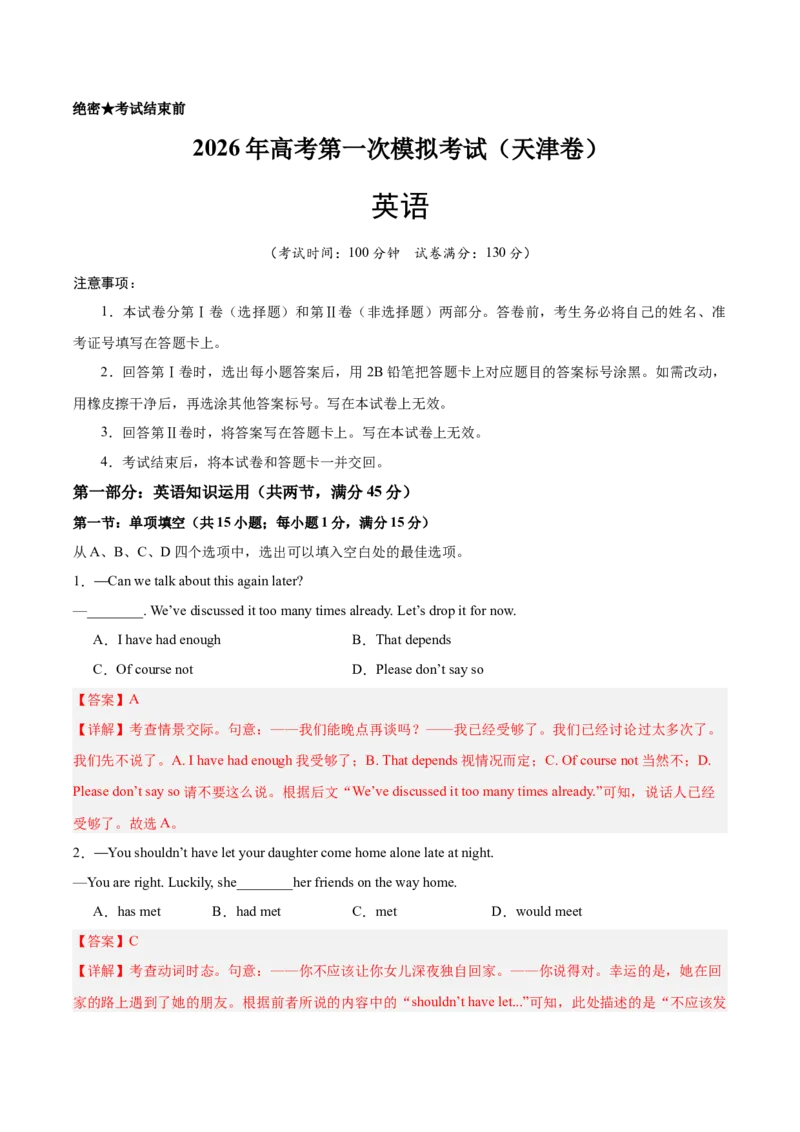
2026 年高考第一次模拟考试(天津卷)
英语
(考试时间:100 分钟  试卷满分:130 分)
注意事项:
1.本试卷分第Ⅰ卷(选择题)和第Ⅱ卷(非选择题)两部分。答卷前,考生务必将自己的姓名、准
考证号填写在答题卡上。
2.回答第Ⅰ卷时,选出每小题答案后,用2B 铅笔把答题卡上对应题目的答案标号涂黑。如需改动,
用橡皮擦干净后,再选涂其他答案标号。写在本试卷上无效。
3.回答第Ⅱ卷时,将答案写在答题卡上。写在本试卷上无效。
4.考试结束后,将本试卷和答题卡一并交回。
第一部分:英语知识运用(共两节,满分45 分)
第一节:单项填空(共15 小题;每小题1 分,满分15 分)
从A、B、C、D 四个选项中,选出可以填入空白处的最佳选项。
1.—Can we talk about this again later?
—________. We’ve discussed it too many times already. Let’s drop it for now.
A.I have had enough
B.That depends
C.Of course not
D.Please don’t say so
【答案】A
【详解】考查情景交际。句意:——我们能晚点再谈吗?——我已经受够了。我们已经讨论过太多次了。
我们先不说了。A. I have had enough 我受够了;B. That depends 视情况而定;C. Of course not 当然不;D.
Please don’t say so 请不要这么说。根据后文“We’ve discussed it too many times already.”可知,说话人已经
受够了。故选A。
2.—You shouldn’t have let your daughter come home alone late at night.
—You are right. Luckily, she________her friends on the way home.
A.has met
B.had met
C.met
D.would meet
【答案】C
【详解】考查动词时态。句意:——你不应该让你女儿深夜独自回家。——你说得对。幸运的是,她在回
家的路上遇到了她的朋友。根据前者所说的内容中的“shouldn’t have let...”可知,此处描述的是“不应该发
生的事情,却发生了,所以此处表示发生在过去的事情, “遇到朋友”也是发生在过去的一个动作,对
话的时间背景一致,因此使用一般过去时met。故选C 项。
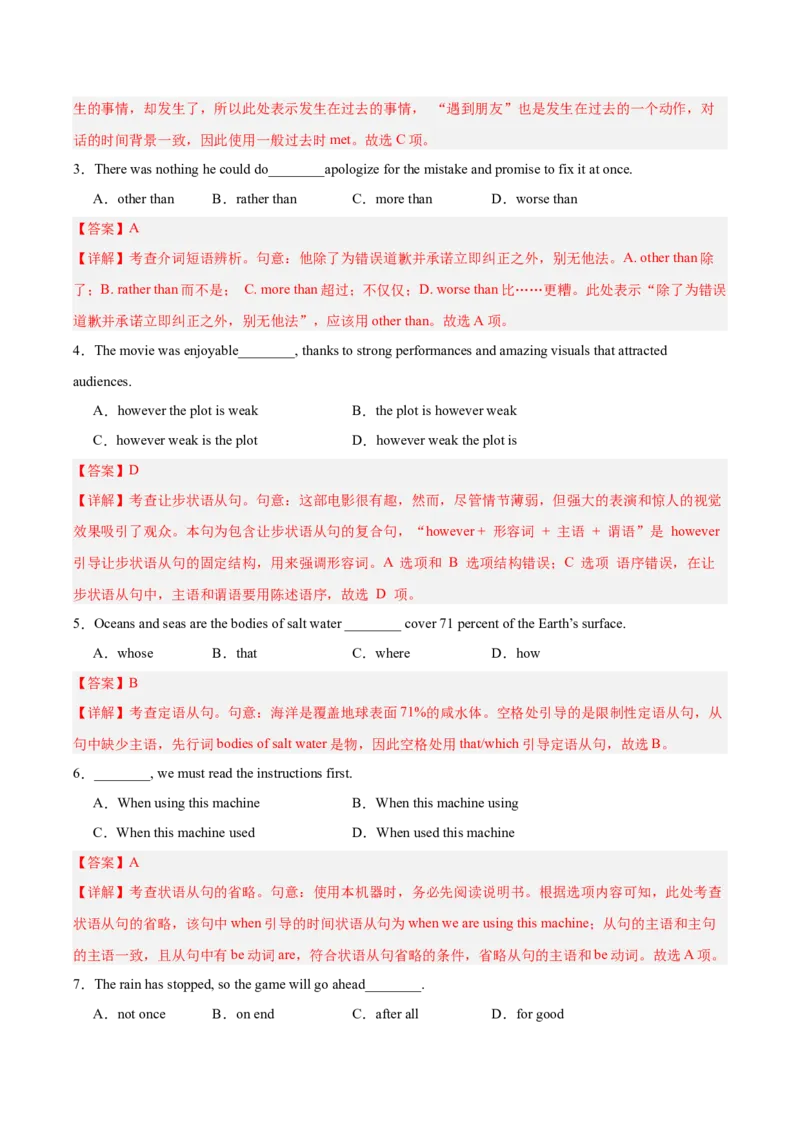
3.There was nothing he could do________apologize for the mistake and promise to fix it at once.
A.other than
B.rather than
C.more than
D.worse than
【答案】A
【详解】考查介词短语辨析。句意:他除了为错误道歉并承诺立即纠正之外,别无他法。A. other than 除
了;B. rather than 而不是; C. more than 超过;不仅仅;D. worse than 比……更糟。此处表示“除了为错误
道歉并承诺立即纠正之外,别无他法”,应该用other than。故选A 项。
4.The movie was enjoyable________, thanks to strong performances and amazing visuals that attracted
audiences.
A.however the plot is weak
B.the plot is however weak
C.however weak is the plot
D.however weak the plot is
【答案】D
【详解】考查让步状语从句。句意:这部电影很有趣,然而,尽管情节薄弱,但强大的表演和惊人的视觉
效果吸引了观众。本句为包含让步状语从句的复合句,“however + 形容词 + 主语 + 谓语”是 however
引导让步状语从句的固定结构,用来强调形容词。A 选项和 B 选项结构错误;C 选项 语序错误,在让
步状语从句中,主语和谓语要用陈述语序,故选 D 项。
5.Oceans and seas are the bodies of salt water ________ cover 71 percent of the Earth’s surface.
A.whose
B.that
C.where
D.how
【答案】B
【详解】考查定语从句。句意:海洋是覆盖地球表面71%的咸水体。空格处引导的是限制性定语从句,从
句中缺少主语,先行词bodies of salt water 是物,因此空格处用that/which 引导定语从句,故选B。
6.________, we must read the instructions first.
A.When using this machine
B.When this machine using
C.When this machine used
D.When used this machine
【答案】A
【详解】考查状语从句的省略。句意:使用本机器时,务必先阅读说明书。根据选项内容可知,此处考查
状语从句的省略,该句中when 引导的时间状语从句为when we are using this machine;从句的主语和主句
的主语一致,且从句中有be 动词are,符合状语从句省略的条件,省略从句的主语和be 动词。故选A 项。
7.The rain has stopped, so the game will go ahead________.
A.not once
B.on end
C.after all
D.for good
【答案】C
【详解】考查介词短语辨析。句意:雨已经停了,所以比赛终究会继续进行。A. not once 一次也没有;B.
on end 连续地;C. after all 毕竟/终究;D. for good 永久地。前半句“雨停”与后半句“比赛继续”构成因
果关系,需填入表示“最终结果”的短语。after all 强调“尽管之前可能有阻碍,但最终仍会发生”,符
合语境。故选C 项。
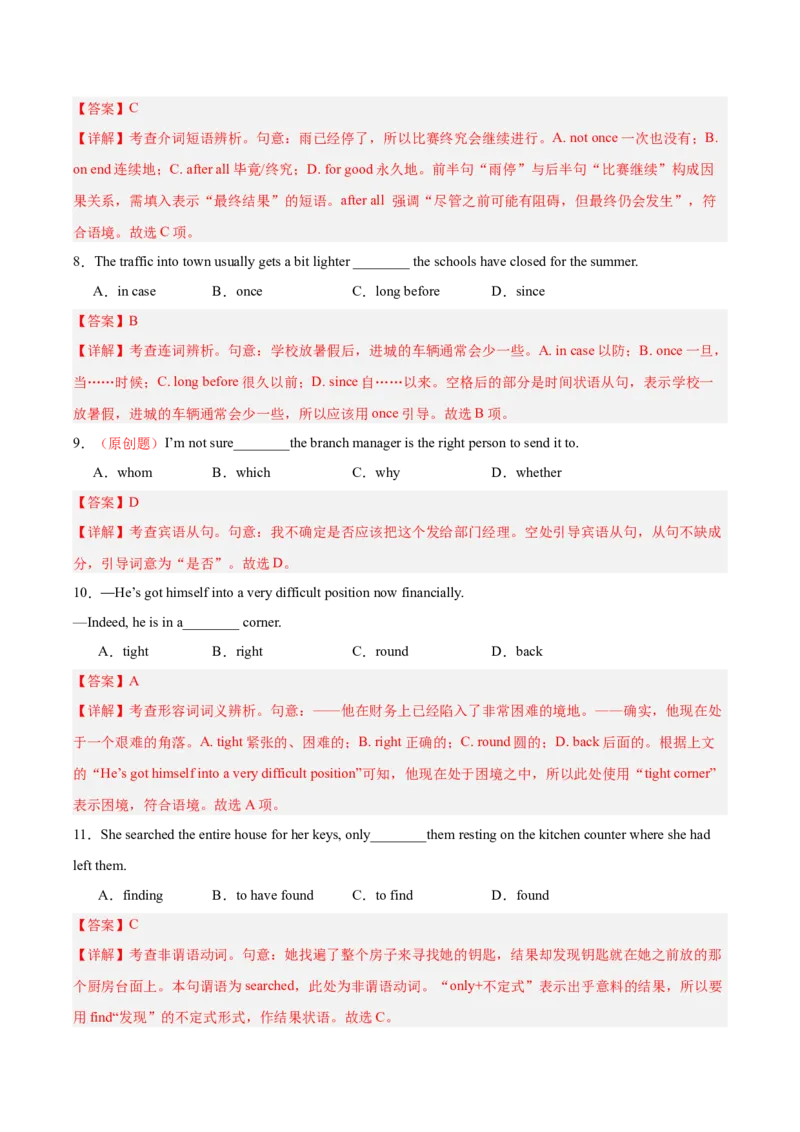
8.The traffic into town usually gets a bit lighter ________ the schools have closed for the summer.
A.in case
B.once
C.long before
D.since
【答案】B
【详解】考查连词辨析。句意:学校放暑假后,进城的车辆通常会少一些。A. in case 以防;B. once 一旦,
当……时候;C. long before 很久以前;D. since 自……以来。空格后的部分是时间状语从句,表示学校一
放暑假,进城的车辆通常会少一些,所以应该用once 引导。故选B 项。
9.(原创题)I’m not sure________the branch manager is the right person to send it to.
A.whom
B.which
C.why
D.whether
【答案】D
【详解】考查宾语从句。句意:我不确定是否应该把这个发给部门经理。空处引导宾语从句,从句不缺成
分,引导词意为“是否”。故选D。
10.—He’s got himself into a very difficult position now financially.
—Indeed, he is in a________ corner.
A.tight
B.right
C.round
D.back
【答案】A
【详解】考查形容词词义辨析。句意:——他在财务上已经陷入了非常困难的境地。——确实,他现在处
于一个艰难的角落。A. tight 紧张的、困难的;B. right 正确的;C. round 圆的;D. back 后面的。根据上文
的“He’s got himself into a very difficult position”可知,他现在处于困境之中,所以此处使用“tight corner”
表示困境,符合语境。故选A 项。
11.She searched the entire house for her keys, only________them resting on the kitchen counter where she had
left them.
A.finding
B.to have found
C.to find
D.found
【答案】C
【详解】考查非谓语动词。句意:她找遍了整个房子来寻找她的钥匙,结果却发现钥匙就在她之前放的那
个厨房台面上。本句谓语为searched,此处为非谓语动词。“only+不定式”表示出乎意料的结果,所以要
用find“发现”的不定式形式,作结果状语。故选C。
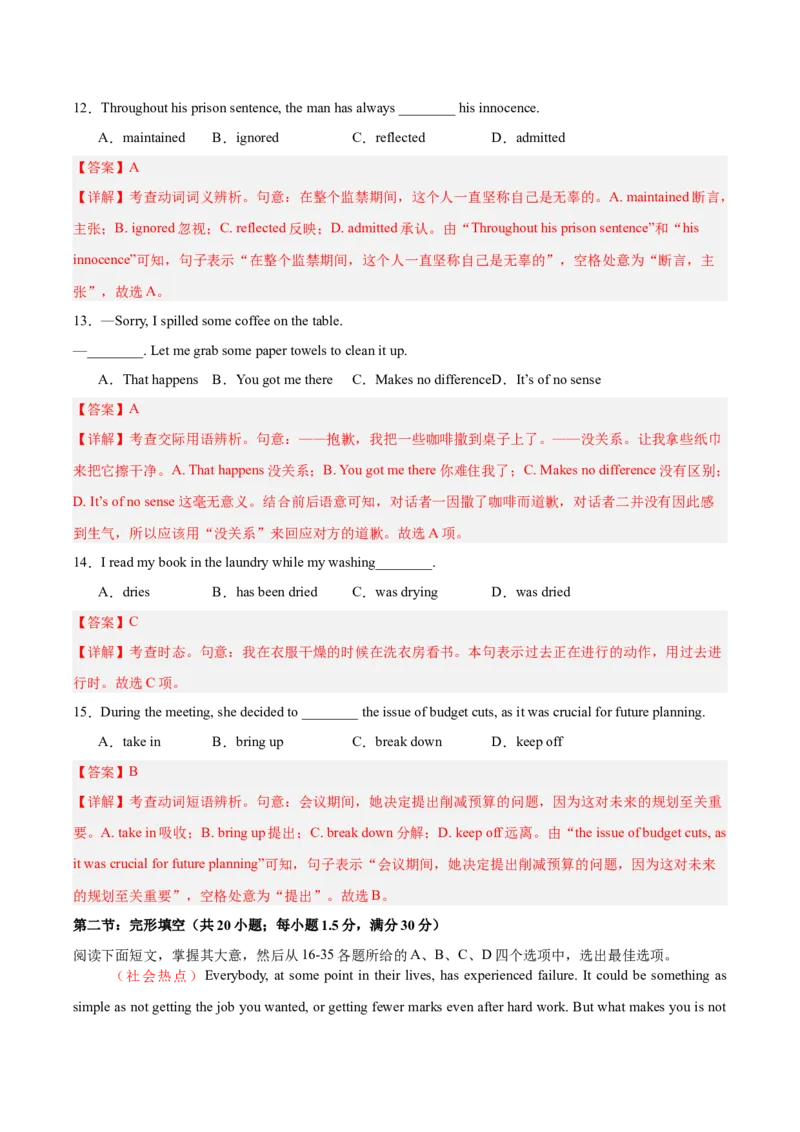
12.Throughout his prison sentence, the man has always ________ his innocence.
A.maintained
B.ignored
C.reflected
D.admitted
【答案】A
【详解】考查动词词义辨析。句意:在整个监禁期间,这个人一直坚称自己是无辜的。A. maintained 断言,
主张;B. ignored 忽视;C. reflected 反映;D. admitted 承认。由“Throughout his prison sentence”和“his
innocence”可知,句子表示“在整个监禁期间,这个人一直坚称自己是无辜的”,空格处意为“断言,主
张”,故选A。
13.—Sorry, I spilled some coffee on the table.
—________. Let me grab some paper towels to clean it up.
A.That happens
B.You got me there
C.Makes no differenceD.It’s of no sense
【答案】A
【详解】考查交际用语辨析。句意:——抱歉,我把一些咖啡撒到桌子上了。——没关系。让我拿些纸巾
来把它擦干净。A. That happens 没关系;B. You got me there 你难住我了;C. Makes no difference 没有区别;
D. It’s of no sense 这毫无意义。结合前后语意可知,对话者一因撒了咖啡而道歉,对话者二并没有因此感
到生气,所以应该用“没关系”来回应对方的道歉。故选A 项。
14.I read my book in the laundry while my washing________.
A.dries
B.has been dried
C.was drying
D.was dried
【答案】C
【详解】考查时态。句意:我在衣服干燥的时候在洗衣房看书。本句表示过去正在进行的动作,用过去进
行时。故选C 项。
15.During the meeting, she decided to ________ the issue of budget cuts, as it was crucial for future planning.
A.take in
B.bring up
C.break down
D.keep off
【答案】B
【详解】考查动词短语辨析。句意:会议期间,她决定提出削减预算的问题,因为这对未来的规划至关重
要。A. take in 吸收;B. bring up 提出;C. break down 分解;D. keep off 远离。由“the issue of budget cuts, as
it was crucial for future planning”可知,句子表示“会议期间,她决定提出削减预算的问题,因为这对未来
的规划至关重要”,空格处意为“提出”。故选B。
第二节:完形填空(共20 小题;每小题1.5 分,满分30 分)
阅读下面短文,掌握其大意,然后从16-35 各题所给的A、B、C、D 四个选项中,选出最佳选项。
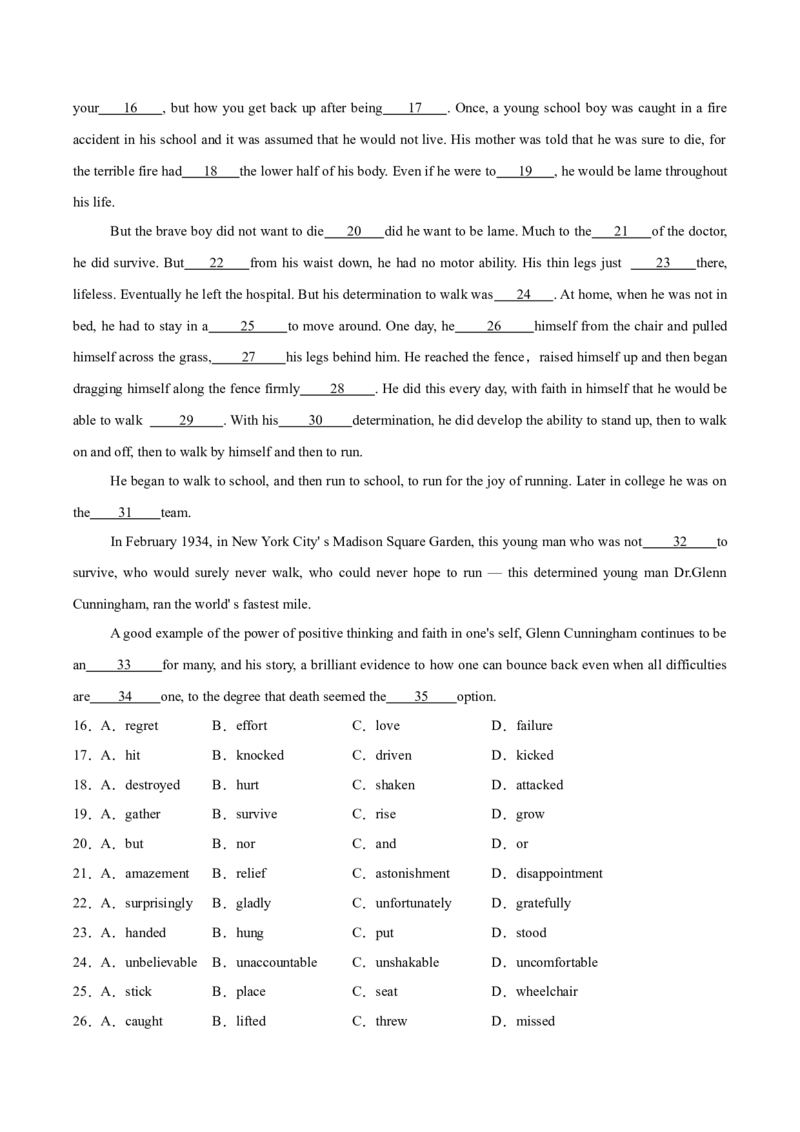
(社会热点)Everybody, at some point in their lives, has experienced failure. It could be something as
simple as not getting the job you wanted, or getting fewer marks even after hard work. But what makes you is not
your   16   , but how you get back up after being   17   . Once, a young school boy was caught in a fire
accident in his school and it was assumed that he would not live. His mother was told that he was sure to die, for
the terrible fire had   18   the lower half of his body. Even if he were to   19   , he would be lame throughout
his life.
But the brave boy did not want to die   20   did he want to be lame. Much to the   21   of the doctor,
he did survive. But   22   from his waist down, he had no motor ability. His thin legs just    23   there,
lifeless. Eventually he left the hospital. But his determination to walk was   24   . At home, when he was not in
bed, he had to stay in a    25    to move around. One day, he    26    himself from the chair and pulled
himself across the grass,    27    his legs behind him. He reached the fence,raised himself up and then began
dragging himself along the fence firmly    28    . He did this every day, with faith in himself that he would be
able to walk     29    . With his    30    determination, he did develop the ability to stand up, then to walk
on and off, then to walk by himself and then to run.
He began to walk to school, and then run to school, to run for the joy of running. Later in college he was on
the    31    team.
In February 1934, in New York City' s Madison Square Garden, this young man who was not    32    to
survive, who would surely never walk, who could never hope to run — this determined young man Dr.Glenn
Cunningham, ran the world' s fastest mile.
A good example of the power of positive thinking and faith in one's self, Glenn Cunningham continues to be
an    33    for many, and his story, a brilliant evidence to how one can bounce back even when all difficulties
are    34    one, to the degree that death seemed the    35    option.
16.A.regret
B.effort
C.love
D.failure
17.A.hit
B.knocked
C.driven
D.kicked
18.A.destroyed
B.hurt
C.shaken
D.attacked
19.A.gather
B.survive
C.rise
D.grow
20.A.but
B.nor
C.and
D.or
21.A.amazement
B.relief
C.astonishment
D.disappointment
22.A.surprisingly
B.gladly
C.unfortunately
D.gratefully
23.A.handed
B.hung
C.put
D.stood
24.A.unbelievable
B.unaccountable
C.unshakable
D.uncomfortable
25.A.stick
B.place
C.seat
D.wheelchair
26.A.caught
B.lifted
C.threw
D.missed
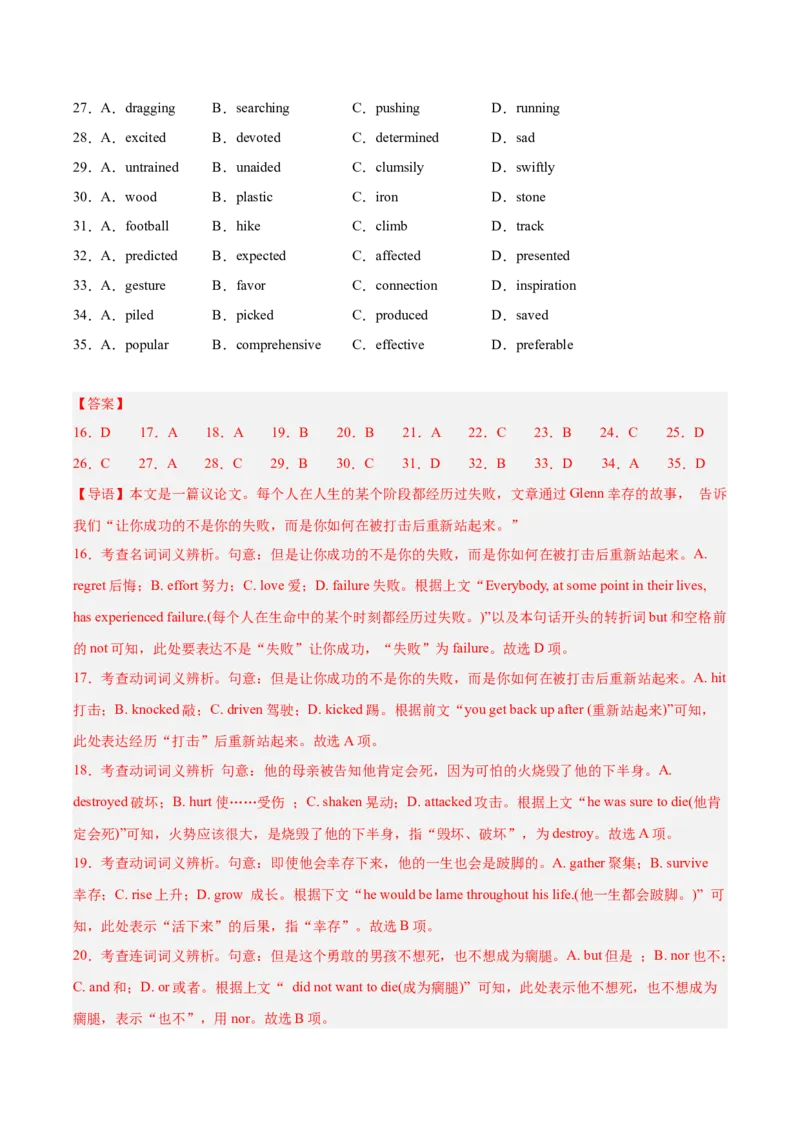
27.A.dragging
B.searching
C.pushing
D.running
28.A.excited
B.devoted
C.determined
D.sad
29.A.untrained
B.unaided
C.clumsily
D.swiftly
30.A.wood
B.plastic
C.iron
D.stone
31.A.football
B.hike
C.climb
D.track
32.A.predicted
B.expected
C.affected
D.presented
33.A.gesture
B.favor
C.connection
D.inspiration
34.A.piled
B.picked
C.produced
D.saved
35.A.popular
B.comprehensive
C.effective
D.preferable
【答案】
16.D    17.A    18.A    19.B    20.B    21.A    22.C    23.B    24.C    25.D

26.C    27.A    28.C    29.B    30.C    31.D    32.B    33.D    34.A    35.D
【导语】本文是一篇议论文。每个人在人生的某个阶段都经历过失败,文章通过Glenn 幸存的故事, 告诉
我们“让你成功的不是你的失败,而是你如何在被打击后重新站起来。”
16.考查名词词义辨析。句意:但是让你成功的不是你的失败,而是你如何在被打击后重新站起来。A.
regret 后悔;B. effort 努力;C. love 爱;D. failure 失败。根据上文“Everybody, at some point in their lives,
has experienced failure.(每个人在生命中的某个时刻都经历过失败。)”以及本句话开头的转折词but 和空格前
的not 可知,此处要表达不是“失败”让你成功,“失败”为failure。故选D 项。
17.考查动词词义辨析。句意:但是让你成功的不是你的失败,而是你如何在被打击后重新站起来。A. hit
打击;B. knocked 敲;C. driven 驾驶;D. kicked 踢。根据前文“you get back up after (重新站起来)”可知,
此处表达经历“打击”后重新站起来。故选A 项。
18.考查动词词义辨析 句意:他的母亲被告知他肯定会死,因为可怕的火烧毁了他的下半身。A.
destroyed 破坏;B. hurt 使……受伤 ;C. shaken 晃动;D. attacked 攻击。根据上文“he was sure to die(他肯
定会死)”可知,火势应该很大,是烧毁了他的下半身,指“毁坏、破坏”,为destroy。故选A 项。
19.考查动词词义辨析。句意:即使他会幸存下来,他的一生也会是跛脚的。A. gather 聚集;B. survive
幸存;C. rise 上升;D. grow 成长。根据下文“he would be lame throughout his life.(他一生都会跛脚。)” 可
知,此处表示“活下来”的后果,指“幸存”。故选B 项。
20.考查连词词义辨析。句意:但是这个勇敢的男孩不想死,也不想成为瘸腿。A. but 但是 ;B. nor 也不;
C. and 和;D. or 或者。根据上文“ did not want to die(成为瘸腿)” 可知,此处表示他不想死,也不想成为
瘸腿,表示“也不”,用nor。故选B 项。
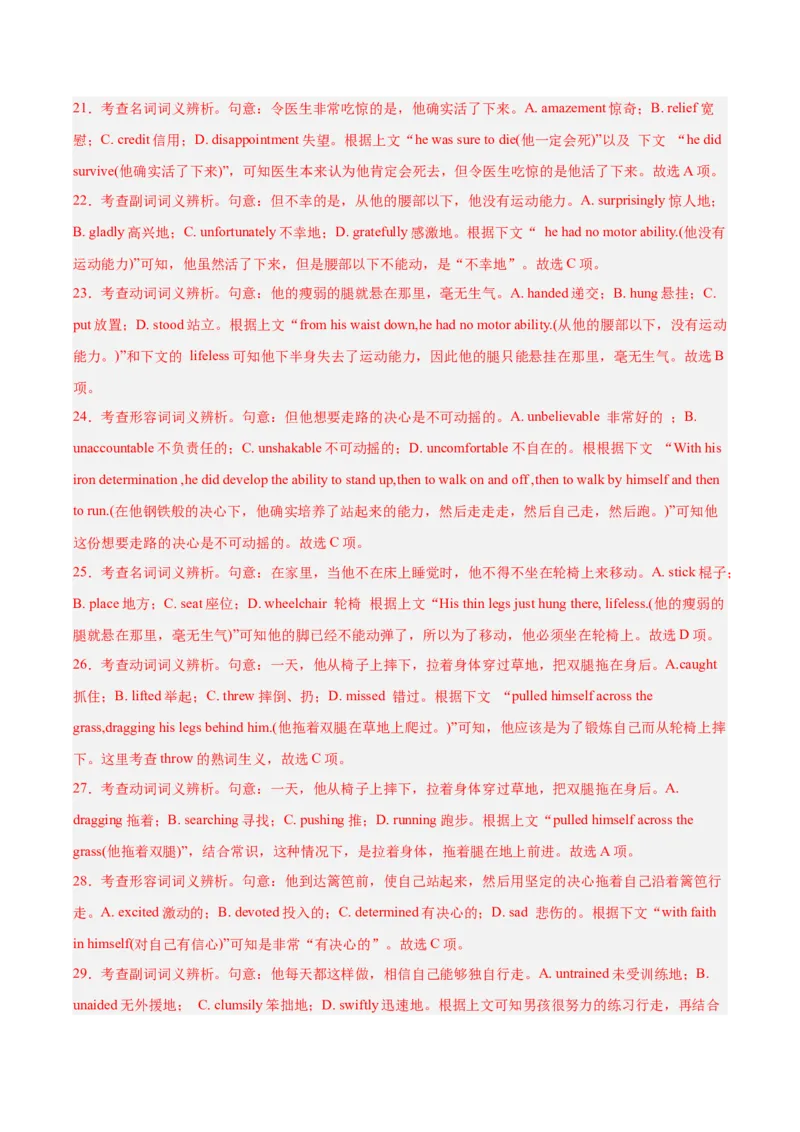
21.考查名词词义辨析。句意:令医生非常吃惊的是,他确实活了下来。A. amazement 惊奇;B. relief 宽
慰;C. credit 信用;D. disappointment 失望。根据上文“he was sure to die(他一定会死)”以及 下文 “he did
survive(他确实活了下来)”,可知医生本来认为他肯定会死去,但令医生吃惊的是他活了下来。故选A 项。
22.考查副词词义辨析。句意:但不幸的是,从他的腰部以下,他没有运动能力。A. surprisingly 惊人地;
B. gladly 高兴地;C. unfortunately 不幸地;D. gratefully 感激地。根据下文“ he had no motor ability.(他没有
运动能力)”可知,他虽然活了下来,但是腰部以下不能动,是“不幸地”。故选C 项。
23.考查动词词义辨析。句意:他的瘦弱的腿就悬在那里,毫无生气。A. handed 递交;B. hung 悬挂;C.
put 放置;D. stood 站立。根据上文“from his waist down,he had no motor ability.(从他的腰部以下,没有运动
能力。)”和下文的 lifeless 可知他下半身失去了运动能力,因此他的腿只能悬挂在那里,毫无生气。故选B
项。
24.考查形容词词义辨析。句意:但他想要走路的决心是不可动摇的。A. unbelievable 非常好的 ;B.
unaccountable 不负责任的;C. unshakable 不可动摇的;D. uncomfortable 不自在的。根根据下文 “With his
iron determination ,he did develop the ability to stand up,then to walk on and off ,then to walk by himself and then
to run.(在他钢铁般的决心下,他确实培养了站起来的能力,然后走走走,然后自己走,然后跑。)”可知他
这份想要走路的决心是不可动摇的。故选C 项。
25.考查名词词义辨析。句意:在家里,当他不在床上睡觉时,他不得不坐在轮椅上来移动。A. stick 棍子;
B. place 地方;C. seat 座位;D. wheelchair 轮椅 根据上文“His thin legs just hung there, lifeless.(他的瘦弱的
腿就悬在那里,毫无生气)”可知他的脚已经不能动弹了,所以为了移动,他必须坐在轮椅上。故选D 项。
26.考查动词词义辨析。句意:一天,他从椅子上摔下,拉着身体穿过草地,把双腿拖在身后。A.caught
抓住;B. lifted 举起;C. threw 摔倒、扔;D. missed 错过。根据下文 “pulled himself across the
grass,dragging his legs behind him.(他拖着双腿在草地上爬过。)”可知,他应该是为了锻炼自己而从轮椅上摔
下。这里考查throw 的熟词生义,故选C 项。
27.考查动词词义辨析。句意:一天,他从椅子上摔下,拉着身体穿过草地,把双腿拖在身后。A.
dragging 拖着;B. searching 寻找;C. pushing 推;D. running 跑步。根据上文“pulled himself across the
grass(他拖着双腿)”,结合常识,这种情况下,是拉着身体,拖着腿在地上前进。故选A 项。
28.考查形容词词义辨析。句意:他到达篱笆前,使自己站起来,然后用坚定的决心拖着自己沿着篱笆行
走。A. excited 激动的;B. devoted 投入的;C. determined 有决心的;D. sad 悲伤的。根据下文“with faith
in himself(对自己有信心)”可知是非常“有决心的”。故选C 项。
29.考查副词词义辨析。句意:他每天都这样做,相信自己能够独自行走。A. untrained 未受训练地;B.
unaided 无外援地; C. clumsily 笨拙地;D. swiftly 迅速地。根据上文可知男孩很努力的练习行走,再结合
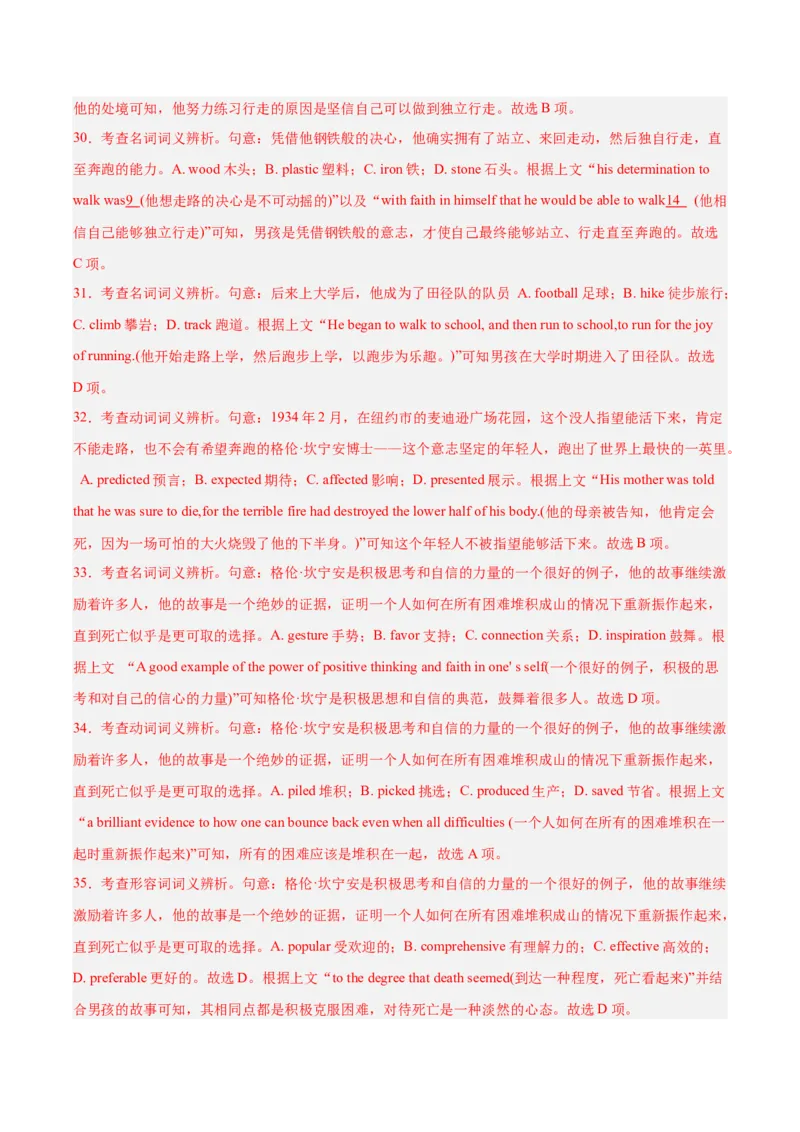
他的处境可知,他努力练习行走的原因是坚信自己可以做到独立行走。故选B 项。
30.考查名词词义辨析。句意:凭借他钢铁般的决心,他确实拥有了站立、来回走动,然后独自行走,直
至奔跑的能力。A. wood 木头;B. plastic 塑料;C. iron 铁;D. stone 石头。根据上文“his determination to
walk was9 (他想走路的决心是不可动摇的)”以及“with faith in himself that he would be able to walk14  (他相
信自己能够独立行走)”可知,男孩是凭借钢铁般的意志,才使自己最终能够站立、行走直至奔跑的。故选
C 项。
31.考查名词词义辨析。句意:后来上大学后,他成为了田径队的队员 A. football 足球;B. hike 徒步旅行;
C. climb 攀岩;D. track 跑道。根据上文“He began to walk to school, and then run to school,to run for the joy
of running.(他开始走路上学,然后跑步上学,以跑步为乐趣。)”可知男孩在大学时期进入了田径队。故选
D 项。
32.考查动词词义辨析。句意:1934 年2 月,在纽约市的麦迪逊广场花园,这个没人指望能活下来,肯定
不能走路,也不会有希望奔跑的格伦·坎宁安博士——这个意志坚定的年轻人,跑出了世界上最快的一英里。
 A. predicted 预言;B. expected 期待;C. affected 影响;D. presented 展示。根据上文“His mother was told
that he was sure to die,for the terrible fire had destroyed the lower half of his body.(他的母亲被告知,他肯定会
死,因为一场可怕的大火烧毁了他的下半身。)”可知这个年轻人不被指望能够活下来。故选B 项。
33.考查名词词义辨析。句意:格伦·坎宁安是积极思考和自信的力量的一个很好的例子,他的故事继续激
励着许多人,他的故事是一个绝妙的证据,证明一个人如何在所有困难堆积成山的情况下重新振作起来,
直到死亡似乎是更可取的选择。A. gesture 手势;B. favor 支持;C. connection 关系;D. inspiration 鼓舞。根
据上文 “A good example of the power of positive thinking and faith in one' s self(一个很好的例子,积极的思
考和对自己的信心的力量)”可知格伦·坎宁是积极思想和自信的典范,鼓舞着很多人。故选D 项。
34.考查动词词义辨析。句意:格伦·坎宁安是积极思考和自信的力量的一个很好的例子,他的故事继续激
励着许多人,他的故事是一个绝妙的证据,证明一个人如何在所有困难堆积成山的情况下重新振作起来,
直到死亡似乎是更可取的选择。A. piled 堆积;B. picked 挑选;C. produced 生产;D. saved 节省。根据上文
“a brilliant evidence to how one can bounce back even when all difficulties (一个人如何在所有的困难堆积在一
起时重新振作起来)”可知,所有的困难应该是堆积在一起,故选A 项。
35.考查形容词词义辨析。句意:格伦·坎宁安是积极思考和自信的力量的一个很好的例子,他的故事继续
激励着许多人,他的故事是一个绝妙的证据,证明一个人如何在所有困难堆积成山的情况下重新振作起来,
直到死亡似乎是更可取的选择。A. popular 受欢迎的;B. comprehensive 有理解力的;C. effective 高效的;
D. preferable 更好的。故选D。根据上文“to the degree that death seemed(到达一种程度,死亡看起来)”并结
合男孩的故事可知,其相同点都是积极克服困难,对待死亡是一种淡然的心态。故选D 项。
第二部分:阅读理解(共20 小题;每小题2.5 分,满分50 分)
阅读下列短文,从每题所给的A、B、C、D 四个选项中,选出最佳选项。
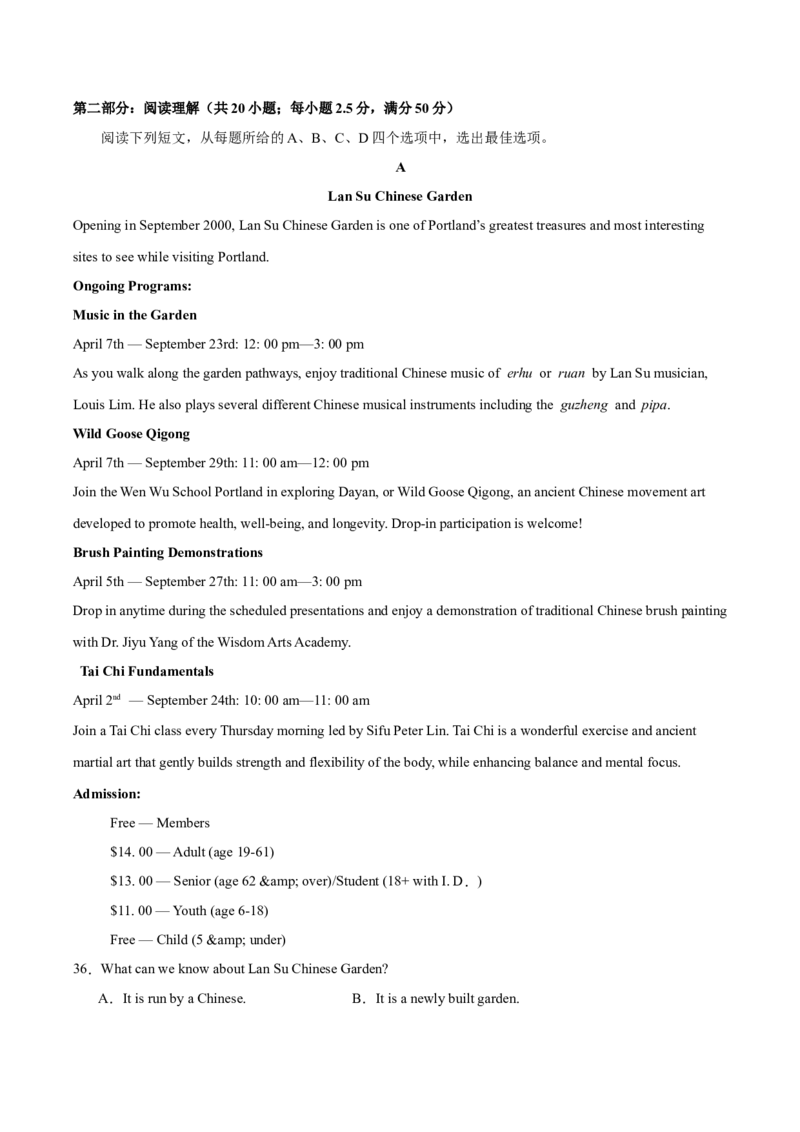
A
Lan Su Chinese Garden
Opening in September 2000, Lan Su Chinese Garden is one of Portland’s greatest treasures and most interesting
sites to see while visiting Portland.
Ongoing Programs:
Music in the Garden
April 7th — September 23rd: 12: 00 pm—3: 00 pm
As you walk along the garden pathways, enjoy traditional Chinese music of erhu or ruan by Lan Su musician,
Louis Lim. He also plays several different Chinese musical instruments including the guzheng and pipa.
Wild Goose Qigong
April 7th — September 29th: 11: 00 am—12: 00 pm
Join the Wen Wu School Portland in exploring Dayan, or Wild Goose Qigong, an ancient Chinese movement art
developed to promote health, well-being, and longevity. Drop-in participation is welcome!
Brush Painting Demonstrations
April 5th — September 27th: 11: 00 am—3: 00 pm
Drop in anytime during the scheduled presentations and enjoy a demonstration of traditional Chinese brush painting
with Dr. Jiyu Yang of the Wisdom Arts Academy.
 Tai Chi Fundamentals
April 2nd  — September 24th: 10: 00 am—11: 00 am
Join a Tai Chi class every Thursday morning led by Sifu Peter Lin. Tai Chi is a wonderful exercise and ancient
martial art that gently builds strength and flexibility of the body, while enhancing balance and mental focus.
Admission:
Free — Members
$14. 00 — Adult (age 19-61)
$13. 00 — Senior (age 62 & over)/Student (18+ with I. D.)
$11. 00 — Youth (age 6-18)
Free — Child (5 & under)
36.What can we know about Lan Su Chinese Garden?
A.It is run by a Chinese.
B.It is a newly built garden.
C.It is not well-known in Portland.
D.It has been around for over 20 years.
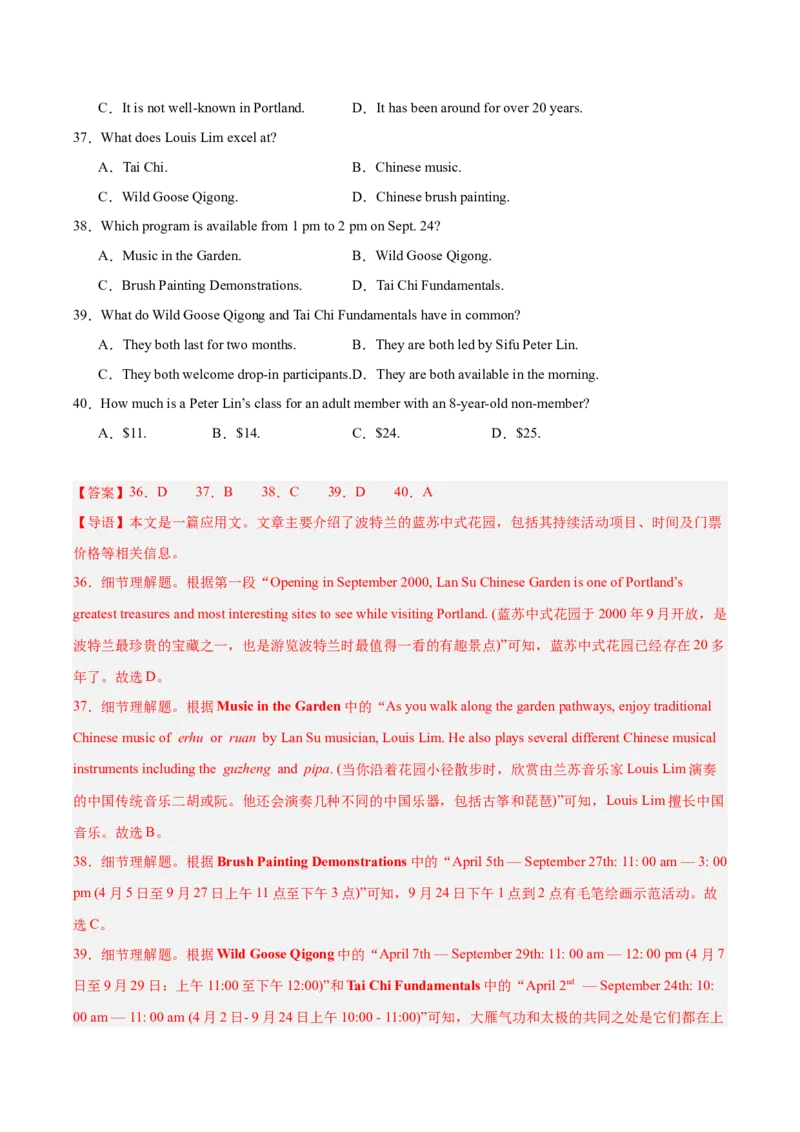
37.What does Louis Lim excel at?
A.Tai Chi.
B.Chinese music.
C.Wild Goose Qigong.
D.Chinese brush painting.
38.Which program is available from 1 pm to 2 pm on Sept. 24?
A.Music in the Garden.
B.Wild Goose Qigong.
C.Brush Painting Demonstrations.
D.Tai Chi Fundamentals.
39.What do Wild Goose Qigong and Tai Chi Fundamentals have in common?
A.They both last for two months.
B.They are both led by Sifu Peter Lin.
C.They both welcome drop-in participants.D.They are both available in the morning.
40.How much is a Peter Lin’s class for an adult member with an 8-year-old non-member?
A.$11.
B.$14.
C.$24.
D.$25.
【答案】36.D    37.B    38.C    39.D    40.A
【导语】本文是一篇应用文。文章主要介绍了波特兰的蓝苏中式花园,包括其持续活动项目、时间及门票
价格等相关信息。
36.细节理解题。根据第一段“Opening in September 2000, Lan Su Chinese Garden is one of Portland’s
greatest treasures and most interesting sites to see while visiting Portland. (蓝苏中式花园于2000 年9 月开放,是
波特兰最珍贵的宝藏之一,也是游览波特兰时最值得一看的有趣景点)”可知,蓝苏中式花园已经存在20 多
年了。故选D。
37.细节理解题。根据Music in the Garden 中的“As you walk along the garden pathways, enjoy traditional
Chinese music of erhu or ruan by Lan Su musician, Louis Lim. He also plays several different Chinese musical
instruments including the guzheng and pipa. (当你沿着花园小径散步时,欣赏由兰苏音乐家Louis Lim 演奏
的中国传统音乐二胡或阮。他还会演奏几种不同的中国乐器,包括古筝和琵琶)”可知,Louis Lim 擅长中国
音乐。故选B。
38.细节理解题。根据Brush Painting Demonstrations 中的“April 5th — September 27th: 11: 00 am — 3: 00
pm (4 月5 日至9 月27 日上午11 点至下午3 点)”可知,9 月24 日下午1 点到2 点有毛笔绘画示范活动。故
选C。
39.细节理解题。根据Wild Goose Qigong 中的“April 7th — September 29th: 11: 00 am — 12: 00 pm (4 月7
日至9 月29 日:上午11:00 至下午12:00)”和Tai Chi Fundamentals 中的“April 2nd  — September 24th: 10:
00 am — 11: 00 am (4 月2 日- 9 月24 日上午10:00 - 11:00)”可知,大雁气功和太极的共同之处是它们都在上
午进行。故选D。
40.细节理解题。根据Admission:中的“Free — Members (会员免费)”和“$11. 00 — Youth(age 6-18) (青少
年(6——18 岁):11 美元)”可知,成年会员免费,8 岁非会员收费11 美元,所以总共11 美元。故选
A。
B
On a sunny Sunday morning, I went to my first ballet class. But I didn’t do any dancing. This was Class on
Stage, a rare opportunity to watch dancers warm up during their daily 75-minute class. I went in knowing that I
would be impressed by the physicality of it. Top athletes aren’t born; they’re made.
Forty-five minutes into the class, the dancers didn’t even look tired. While watching dancers quietly plie (下
蹲屈膝) with complete control was calming, watching the floor exercises that came next was anything but. The
sequences were short but became increasingly complicated, so I stopped paying attention to the directions I
couldn’t follow, and simply allowed myself to observe the remarkable results. At the end of the class. I applauded
and watched the dancers leave the stage. They had already accomplished so much with their day, and I was left in
complete awe, not just of my inadequacy, but also of their effort.
As I headed home, I tried to think of the last time I worked as hard as those dancers at anything in my own
life. So much has been made easier by technology: I can listen to any song I want, whenever I want. I can have
pretty much anything delivered. I can stay in touch with friends without making the time to see them. But instead of
taking shortcuts, maybe I should look for challenges. Because once you start doing challenging things, they become
easier, and then you know you can do them.
With the determination and discipline of ballet dancers still fresh in my mind, I commit to doing some hard
things: I get back in the habit of practicing a language I’ve been trying to learn. I lift heavier weights. I take the
stairs. I write the essay.
Nothing demands as much of me as what ballet demands of those dancers every day. They inspire me. So, I
guess what I’m trying to say is that sometimes a fitness class can change your life, even if you’re not the one taking
it.
41.Which statement accurately describes the ballet class mentioned in the passage?
A.The writer actively took part in dancing.
B.The dancers didn’t look exhausted despite the physicality.
C.The warm-up session lasted only 45 minutes that morning.
D.The writer could follow the directions throughout the session.
42.How did the author feel when the ballet class ended?
A.She was amazed by how hard the dancers worked.
B.She regretted not putting more effort into ballet.
C.She believed she could face life’s difficulties better.
D.She felt embarrassed about her own lack of determination.
43.By mentioning the technology that has made life easier, the writer means that ________.
A.Technology allows people to avoid difficult tasks
B.Using technology helps improve work efficiency
C.A simple life requires rejecting modern tools
D.Technology’s convenience may reduce motivation to seek challenges
44.What has the writer learned from her first ballet lesson?
A.Fitness classes build both body and mind strength.
B.We should push ourselves to seek challenges for self-improvement.
C.Difficult things are worth trying as long as you enjoy doing them.
D.Watching others practice ballet is a good way to improve ourselves.
45.What can we learn from the last paragraph?
A.Fitness classes are of no significance.
B.Only through taking part in ballet can one truly change.
C.Observing others’ commitment can inspire personal growth.
D.Fitness classes are essential for everyone’s life improvement.
【答案】41.B    42.A    43.D    44.B    45.C
【导语】本文是一篇记叙文。文章主要讲述了作者观看芭蕾课受到激励,决心寻求挑战自我提升。
41.细节理解题。根据第二段的“Forty-five minutes into the class, the dancers didn’t even look tired.(上课四
十五分钟后,舞者们甚至看起来都不累)”可知,尽管训练强度大,舞者们看起来并不疲惫。故选B。
42.细节理解题。根据第二段中“They had already accomplished so much with their day, and I was left in
complete awe, not just of my inadequacy, but also of their effort.(他们这一天已经取得了如此多的成就,我感到
完全敬畏,不仅是因为我的不足,也是因为他们的努力)”可知,芭蕾舞课结束时,作者对舞者们的努力感
到惊叹。故选A。
43.推理判断题。 根据第三段中“So much has been made easier by technology: I can listen to any song I
want, whenever I want. I can have pretty much anything delivered. I can stay in touch with friends without making
the time to see them. But instead of taking shortcuts, maybe I should look for challenges.(科技让很多事情变得更
容易:我可以随时听我想听的任何歌曲。我几乎可以让任何东西送货上门。我可以和朋友们保持联系,而
不用花时间去见他们。但与其走捷径,也许我应该寻找挑战)”可推知,作者提到科技让生活变得更轻松,
是为了说明科技的便利可能会减少人们寻求挑战的动力。故选D。
44.推理判断题。 根据第三段中“But instead of taking shortcuts, maybe I should look for challenges. Because
once you start doing challenging things, they become easier, and then you know you can do them.(但与其走捷径,
也许我应该寻找挑战。因为一旦你开始做有挑战性的事情,它们就会变得更容易,然后你就会知道自己能
做到)”以及第四段中“With the determination and discipline of ballet dancers still fresh in my mind, I commit to
doing some hard things: I get back in the habit of practicing a language I’ve been trying to learn. I lift heavier
weights. I take the stairs. I write the essay.(芭蕾舞者的决心和纪律仍然清晰地印在我的脑海里,我决心做一些
困难的事情:我重新养成了练习一门我一直想学的语言的习惯。我举更重的重量。我走楼梯。我写论文)”
可推知,作者从她的第一节芭蕾课中学到了我们应该强迫自己去寻求挑战以实现自我提升。故选B。
45.推理判断题。 根据最后一段中“They inspire me. So, I guess what I’m trying to say is that sometimes a
fitness class can change your life, even if you’re not the one taking it.(他们激励了我。所以,我想说的是,有时
候一节健身课可以改变你的生活,即使你不是那个参加课程的人)”可推知,从最后一段我们可以学到观察
他人的投入可以激发个人成长。故选C。
C
Zero has had an amazing journey through history. Ancient Greek thinkers like Aristotle didn’t believe zero
could exist — they thought “nothing” wasn’t a real concept. Meanwhile in India, mathematicians were already
using zero as a real number. Surprisingly, Europe was very slow to accept zero — for hundreds of years, many
Europeans thought it was dangerous or even evil! It was only when businesses started using zero in their
accounting systems that people finally saw how useful it could be. Later, zero became essential for important
scientific discoveries like calculus (微积分).
Why was zero so controversial? The answer lies in how we think. Numbers like 1,2, or 3 are easy because
we can see and count one apple, two dogs, three books. But zero represents nothing at all, which makes it harder to
understand. As one philosopher joked, “Nobody goes to the store to buy zero fish!” Even children find zero
confusing. Scientists have found that babies can notice simple math errors (like 2+1=4), but they don’t react when
things completely disappear (like 2-2=0). This shows that understanding zero requires abstract thinking.
But is this difficulty just a matter of learning — or does it reflect something deeper in our brain’s design?
Scientists have discovered special brain cells that only respond to “nothing” — they call these“zero neurons”. Some
of these cells only activate (激活) when there’s truly nothing there, while others respond in order — strongest for
zero, then less for one, even less for two, and so on. This suggests that our brains treat zero as a unique concept and
may place it at the very start of our mental number line. Interestingly, when humans see the symbol “0”, brain scans
show activation in areas also responsible for perceiving physical emptiness. These findings imply that our
understanding of zero may be rooted in the brain’s mechanisms for detecting absence — not presence.
This connection between zero and absence raises deeper questions about how our minds process “nothing”.
In daily life, we’re much better at noticing what’s there than what’s missing. For example, spotting extra letters in a
sentence is easier than noticing missing ones. Yet absence still matters: a friend who doesn’t show up, a puzzle
piece that’s gone. This kind of awareness demands more cognitive (认知的) effort and may rely on the same brain
systems that process zero. In this way, the once-feared idea of zero may help us explore not just mathematics — but
the nature of consciousness itself.
46.How did zero eventually gain acceptance in Europe after facing initial resistance?
A.Through theoretical arguments by mathematicians.
B.By proving its practical value in business accounting.
C.Through formal recognition by some religious leaders.
D.By showing its necessity for scientific discoveries.
47.Why does the author mention “Nobody goes to the store to buy zero fish” in Paragraph 2?
A.To explain how businesses refused to use zero.
B.To demonstrate the difficulty in understanding zero.
C.To highlight cultural differences in understanding numbers.
D.To show the humor in abstract philosophical debate.
48.The term “zero neurons” in Paragraph 3 might refer to ______.
A.special cells that activate only for nothingness
B.brain cells that respond to numbers equally
C.neurons responsible for counting objects
D.cells that process mathematical symbols
49.What can be inferred from the last paragraph?
A.Mathematics is the key to understanding the mind.
B.Consciousness studies will replace mathematical models.
C.The brain normally avoids processing things that are not present.
D.Studying zero may uncover deeper truths about human awareness.
50.Which could be the best title for the passage?
A.The Mathematical Evolution
B.How Brain Processes Mathematics
C.Zero’s Journey Through Human Brain
D.A Scientific Study of Children
【答案】46.B    47.B    48.A    49.D    50.C
【导语】本文是一篇说明文。文章主要讲述了数字零从被质疑到被接受,以及它在人类认知和大脑处理机
制中的重要性。
46.细节理解题。根据第一段中“It was only when businesses started using zero in their accounting systems
that people finally saw how useful it could be. (直到企业开始在会计系统中使用零,人们才终于意识到它的有
用性。)”可知,“零”通过证明其在商业会计中的实用价值,最终在欧洲获得了认可。故选B。
47.推理判断题。根据第二段中“But zero represents nothing at all, which makes it harder to understand. As
one philosopher joked, “Nobody goes to the store to buy zero fish!” (但零代表什么都没有,这使得它更难理解。
正如一位哲学家开玩笑说的:“没人会去商店买零条鱼!”)”可知,作者提到“没人会去商店买零条鱼”
是为了证明理解零的困难性。故选B。
48.词句猜测题。根据第三段中“Scientists have discovered special brain cells that only respond to “nothing”—
they call these “zero neurons”. (科学家们发现了一种特殊的大脑细胞,它们只对“无”做出反应——他们称
之为“zero neurons”。)”可知,“zero neurons”一词指的是只对虚无起反应的特殊细胞。故选A。
49.推理判断题。根据最后一段中“In this way, the once-feared idea of zero may help us explore not just
mathematics—but the nature of consciousness itself. (这样,曾经令人恐惧的零的概念可能不仅能帮助我们探
索数学,还能帮助我们探索意识本身的本质。)”可知,研究零可能会揭示关于人类意识的更深层次真相。
故选D。
50.主旨大意题。通读全文,尤其是根据第一段中“Zero has had an amazing journey through history. (零在
历史上经历了一段奇妙的旅程。)”以及下文具体介绍零从被质疑到被接受,以及它在人类认知和大脑处理
机制中的重要性可知,C 选项“Zero’s Journey Through Human Brain (零在人类大脑中的旅程)”最符合文章
标题。故选C。
D
(新题材)Sorry, I’m just now seeing your email! (You sent it 15 minutes ago.)
Sorry that you completely misinterpreted that thing I said
Sorry you just rammed (冲撞) into me with your grocery-store cart.
Apology is everywhere in conversations and communications. We drop it indiscriminately crying “my fault”
for all manner of things we really should’t be sorry for-and diluting (稀释) the apologies that truly matter. Is it time
to stop? Could we even cut back if we wanted to?
“Sorry” has lost its meaning, she realized, no longer a heartfelt declaration of remorse (燠悔) but a knee-jerk
(下意识的) response. Now, faced with the blinking cursor (光标) of a blank email, Ms. Julig asks herself, did I
miss something, or mess someone else up? If the answer is no, she’s not sorry.
“Don’t give away your power,” suggests Jeffrey Pfeffer, a professor of organizational behavior at Stanford
Graduate School of Business and author of a book about commanding authority at work. Apologizing in business,
especially when you’ve actually done something wrong, is just asking for trouble, he says. People are never
satisfied with an apology, he adds. Groveling (卑躬屈膝) and exhibiting vulnerability (脆弱) only make you look
weak and sink team morale (士气).
“Always feeling like you need to say ‘sorry’ makes you kind of feel like crap,” says Jen Fisher, the chief
well-being officer for Deloitte. Last year, she logged her own apologies, flagging the ones that felt unnecessary and
replacing them with expressions of gratitude.
Have to move a meeting? Try, “I appreciate your flexibility,” or “I’m grateful for your understanding,” she
says. Remember that it’s not your responsibility to apologize for things out of your control, such as the weather or a
client moving a deadline. Putting “sorry” on loop (循环,环状) waters down the moments when you really do need
to show remorse, she adds.
And of course, people often employ “sorry” to mean exactly the opposite, more a passive-aggressive insult
(冒犯) than real regret.
Be aware of how others respond when you use words of contrition (忏悔), Dr. Tannen cautions. If colleagues
call out your apologizing, you might explain that you were just saying you were sorry a thing happened, and not
sorry sorry.
Kingston Vickers tried. After moving to Texas years ago, the native Canadian resolved to remove the “ehs”
and “sorrys” from his vocabulary. Doing so consumed so much mental effort that he grew nervous when talking
and wasn’t as effective at his sales job. Now he embraces his tendency, and says his work has benefited.
51.Which of the following is not a disadvantage of always wanting to apologize?
A.It may weaken the power of true apologies.
B.The people you apologize to may ask for more.
C.It makes it easy for people to look down on you.
D.It can do harm to the people you work with in business.
52.What suggestion does Jen Fisher give about making apologies?
A.Try putting sorry on loops.
B.Avoid apologies as many as possible.
C.Express more appreciation than apologies.
D.Only apologize for things out of your control.
53.Which of the following is true according to the passage?
A.Making apologies too much can be harmful to us mentally and physically.
B.Sometimes when people say they are sorry they do not genuinely mean that.
C.We should avoid making apologies in business world to avoid being exploited.
D.Sorry has lost its meaning so we should choose other words to express our regret.
54.What can we infer from the example of Kingston Vickers?
A.Natural communication style can enhance job performance.
B.Apologizing is an important part of Canadian culture.
C.Adapting to a new communication style is always beneficial for work.
D.Trying to stop apologizing is a waste of time and energy.
55.What is the main idea of the passage?
A.We should stop using the word “sorry” in our daily conversations.
B.The overuse and misuse of the word “sorry” in conversations and communications.
C.People from different cultures have different attitudes towards apologizing.
D.There are better ways to express remorse than just saying “sorry”.
【答案】51.D    52.C    53.B    54.A    55.B
【导语】本文是一篇议论文。文章主要围绕“道歉”探讨了道歉文化以及其影响,并说明了改变道歉习惯
可能带来的问题。
51.推理判断题。根据文章第三段中“Apologizing in business, especially when you’ve actually done
something wrong, is just asking for trouble, he says. People are never satisfied with an apology, he adds. Groveling
(卑躬屈膝) and exhibiting vulnerability (脆弱) only make you look weak and sink team morale (士气).(在商业活
动中道歉,尤其是当你确实做了错事的时候,简直就是自找麻烦。他还补充说,人们永远不会对一次道歉
感到满足。卑躬屈膝和表现出自己的脆弱只会让你显得软弱,还会打击团队士气)”可知,过度且不恰当的
道歉行为对商业伙伴或团队关系的负面影响,而不是本身会直接伤害同事关系。由此可知,选项D“It can
do harm to the people you work with in business.(它可能会伤害到与你共事的商业伙伴)”并不是总想道歉的直
接劣势。故选D。
52.细节理解题。根据文章第四段““Always feeling like you need to say ‘sorry’ makes you kind of feel like
crap,” says Jen Fisher, the chief well-being officer for Deloitte. Last year, she logged her own apologies, flagging
the ones that felt unnecessary and replacing them with expressions of gratitude.(德勤公司的首席幸福官Jen Fisher
说:“总是觉得自己需要说‘抱歉’会让你感觉糟透了。”去年,她记录下了自己的道歉行为,标记出那
些她觉得不必要的道歉,并把它们换成了感激之词)”以及第五段“Have to move a meeting? Try, “I appreciate
your flexibility,” or “I’m grateful for your understanding,” she says. Remember that it’s not your responsibility to
apologize for things out of your control, such as the weather or a client moving a deadline. Putting “sorry” on loop
(循环,环状) waters down the moments when you really do need to show remorse, she adds.(要是不得不更改会议
时间呢?可以试着说:“感谢你的灵活性。”或者“感谢你的理解。”她说。要记住,对于那些你无法控
制的事情,比如天气或者客户更改了截止日期,你没有责任去道歉。她还补充说,不停地说“抱歉”会淡
化那些你真正需要表达悔意的时刻)”可知,Jen Fisher 建议表达更多的感激之情而不是道歉。故选C。
53.细节理解题。根据文章第六段“And of course, people often employ “sorry” to mean exactly the opposite,
more a passive-aggressive insult (冒犯) than real regret.(当然,人们经常会用“抱歉”来表达完全相反的意思,
这更多的是一种带有消极攻击性的冒犯,而不是真正的懊悔)”可知,有时人们说抱歉并非真心。故选B。
54.推理判断题。根据文章最后一段“Kingston Vickers tried. After moving to Texas years ago, the native
Canadian resolved to remove the “ehs” and “sorrys” from his vocabulary. Doing so consumed so much mental
effort that he grew nervous when talking and wasn’t as effective at his sales job. Now he embraces his tendency,
and says his work has benefited.( Kingston Vickers 曾尝试过改变。几年前搬到得克萨斯州后,这位土生土长
的加拿大人决心从自己的词汇中去掉 “呃”和“抱歉”这类词。但这样做耗费了他太多的心力,以至于
他在交谈时变得紧张不安,做销售工作时也没有那么高效了。现在,他接受了自己的这种习惯,并且说他
的工作因此受益了)”可知,Kingston Vickers 试图改变道歉习惯却导致工作表现下降,而恢复自然沟通方式
后工作受益,由此推断自然的沟通风格能提升工作表现。故选A。
55.主旨大意题。根据文章内容可知,文章开篇通过列举生活中频繁道歉的场景,引出“道歉在对话和交
流中无处不在,我们常为不应抱歉之事随意道歉,稀释了真正重要的道歉”这一话题。接着,阐述了“抱
歉”一词失去原本意义,变成下意识反应的现象,还引用不同人的观点说明过度道歉的弊端,如在商业中
可能带来麻烦、让人感觉糟糕等,同时提到人们有时用 “抱歉”表达相反意思。最后通过Kingston
Vickers 的例子进一步说明改变道歉习惯可能带来的问题。因此,文章的主要观点是在对话和交流中“抱
歉”一词的过度使用和误用。故选B。
第二部分:写作(共两节,满分35 分)
第一节:阅读表达(共5 小题;每小题2 分,满分10 分)
阅读下面短文,并根据短文内容完成下列各题。
Awake from a short sleep in her chair, my grandmother ran her fingers through her wavy white hair, looked
out her window at the blue sky, and asked me what I would wish for if I had just one wish.
She often asks this, and I always answer the same way—“To have Granddad back” —which usually gets her
reminiscing about him. Memories of their 67-year life together would always make her smile.
My grandmother was born in Ireland. In her teens, she moved to a poor village in England. At 28, my
grandmother walked herself through the snow to birth her first child. When she was 50, she survived an emergency
surgery. In her 60s, she suffered from arthritis(关节炎)but still managed to climb Snowdon, Wales’s tallest peak.
About a decade ago, I noticed that she began to lose her hearing. If I asked what she had for lunch, she might
say, “Oh, the weather has been lovely today. ” She seemed to recycle the same handful of answers to my questions.
In recent years, I’ve been trying to show up for her more, in person. One day after I made us coffee, I asked
her: “What’s the secret to being successful in your 90s? ”
“Oh Richard, so many people are old at 60. They just want to sit all day. You won’t make it to 90 like that.
You have to try. ”
“Try what? ”
“Try walking, ” she said. “Try gardening. Try cooking. Trying doesn’t require a lot of trying. Just try a little .
Like, with this coffee you’ve made us. I know you tried . ”
Even at 93, my grandmother still knits blankets for the local hospital’s babies and buys books to continue
with her French. “Age is just another bot- her attempting to convince you of the impossible in the world, but
actually the world is filled with possibilities,” she once said.
56.What does the underlined phrase mean in Paragraph 2? (no more than 2 words)

57.What is the main idea of Paragraph 3? (no more than 10 words)

58.Why did the author’s grandmother recycle the same answers to his questions? (no more than 10 words)

59.How can people be successful in old age according to the author’s grandmother? (no more than 10 words)

60.In your opinion, what can young people do to improve the quality of old people’s life? (no more than 20
words)

【答案】56.Remembering./Thinking of. /Thinking about. /Missing.    57.My grandmother has/ had a rich
life experience./My grandmother has gone through a lot. /My grandmother is/was an extraordinary woman.
58.Because she began to lose her hearing. /Because she could not hear clearly.    59.They should remain
active in old age./By trying different things. /They should try doing things.    60.We can help old people to
learn new skills so that they can keep pace with society./They can visit their grandparents more often and spend
time with them.
【导语】本文是一篇记叙文。本文讲述了作者与祖母之间的日常交流,重点描绘了祖母积极向上、勇于尝
试的生活态度,并表达了年龄不是限制、世界充满可能性的主旨。
56.考查词义猜测。根据第二段划线词前面的内容“She often asks this, and I always answer the same way
—“To have Granddad back” (她经常问我这个问题,我总是这样回答——“为了让爷爷回来。”)”以及划线
词后的内容“Memories of their 67-year life together would always make her smile.(他们67 年的共同生活总是
让她微笑。)”可知,作者总是以同样的方式来回答:让爷爷回来,一提到这就会让奶奶想起了和爷爷在一
起的时光,这些时光总是让奶奶微笑。故划线词意为“想起,记起来,想念”。故答案为Remembering./
Thinking of./ Thinking about. /Missing.
57.考查主旨大意。根据第三段中“My grandmother was born in Ireland. In her teens, she moved to a poor
village in England. At 28, my grandmother walked herself through the snow to birth her first child. When she was
50, she survived an emergency surgery. In her 60s, she suffered from arthritis(关节炎)but still managed to climb
Snowdon, Wales’s tallest peak.(我祖母出生在爱尔兰。在她十几岁的时候,她搬到了英国的一个贫穷的村庄。
28 岁时,我的祖母在雪地里步行生下了她的第一个孩子。50 岁时,她在一次紧急手术中幸存下来。60 多
岁时,她饱受关节炎之苦,但仍成功攀登了威尔士最高峰斯诺登峰。)”可知,本段主要介绍了奶奶的生活
经历描述了奶奶具有丰富的人生经历,她是一位非凡的女性。故答案为My grandmother has/had a rich life
experience./My grandmother has gone through a lot./My grandmother is/was an extraordinary woman.
58.考查细节理解。根据第四段中“About a decade ago, I noticed that she began to lose her hearing. If I asked
what she had for lunch, she might say, “Oh, the weather has been lovely today. ”(大约十年前,我注意到她的听
力开始下降。如果我问她午餐吃了什么,她可能会说:“哦,今天天气真好。”)”可知,作者注意到祖母
十年前开始失去听力,所以当作者问她午饭吃了什么时,她可能会说“哦,今天天气真好。”,这说明她
无法听清作者的问题,因此会用同样的几个答案来回答作者的问题。故答案为Because she began to lose her
hearing./Because she could not hear clearly.
59.考查细节理解。根据第六段中““Oh Richard, so many people are old at 60. They just want to sit all day.
You won’t make it to 90 like that. You have to try. ”(“哦,Richard,很多人60 岁就老了。他们只想整天坐着。
你这样活不到90 岁的。你必须尝试。”)”以及第八段““Try walking, ” she said. “Try gardening. Try
cooking. Trying doesn’t require a lot of trying. Just try a little . Like, with this coffee you’ve made us. I know you
tried . ”(“试试走路,”她说。“试试园艺。试着做饭。尝试并不需要很多尝试。就尝一点。比如,你给我
们煮的咖啡。我知道你尽力了。”)”可知,作者祖母认为人要想在老年时成功,就要不断尝试。故答案为
They should remain active in old age./By trying different things./ They should try doing things.
60.开放性试题。本题为开放性试题,回答合理即可。根据问题内容“In your opinion, what can young
people do to improve the quality of old people’s life? (在你看来,年轻人能做些什么来提高老年人的生活质
量?)”可知,本人认为:我们可以帮助老年人学习新的技能,使他们能够跟上社会的步伐。或者他们可以
更经常地看望他们的祖父母,花时间和他们在一起。故答案为We can help old people to learn new skills so
that they can keep pace with society./They can visit their grandparents more often and spend time with them.
第二节:书面表达(满分25 分)
61.(热点话题)假设你是天津晨光中学的李津,最近你在社交媒体小红书(Red Note)上认识了一位美
国的高中生James,他希望通过你了解中国的高中生使用社交媒体的情况。请你在小红书上给他录制一段
视频,并按照以下提示,撰写视频的文字稿,要点如下:
1.高中生喜欢的社交媒体;
2.介绍你使用社交媒体的情况(从生活、学习、文化传播等方面);
3.希望以后多交流。
参考词汇:抖音 TikTok    微信WeChat        B 站 Bilibili
注意:
1.词数不少于100;
2.可适当加入细节,使内容充实、行文连贯。
Hi James,
It’s great to connect with you here on Red Note!
____________________________________________________________________________________________
____________________________________________________________________________________________
____________________________________________________________________________________________
____________________________________________________________________________________________
____________________________________________________________________________________________
【答案】Hi James,
    It’s great to connect with you here on Red Note! I’m more than happy to share some insights about how Chinese
high school students use social media.
    TikTok is one of the most favored apps for its short videos which cover a wide range of topics from daily life
moments to creative arts. WeChat is another essential part of our digital lives where we chat with friends and family
and follow official accounts for news and learning resources.
 In daily life, I often use social media to keep up with what’s happening around the world and stay connected with
friends. Moreover, I enjoy posting content related to traditional festivals, calligraphy, and classic literature on
TikTok.
   Looking forward to hearing more about your side of the story.
                                                                                                                 Yours,
                                                                                                                Li Jin
【导语】本篇书面表达属于应用文,要求考生给美国的高中生James 写一个视频的文字稿,介绍中国的高
中生使用社交媒体的情况,要点包括:高中生喜欢的社交媒体,介绍你使用社交媒体的情况和希望以后多
交流。
【详解】1.词汇积累
高兴的:happy→delighted
见解:insight→point of view
必不可少的:essential→indispensable
另外:moreover→in addition
2.句式拓展
简单句变复合句
原句:Moreover, I enjoy posting content related to traditional festivals, calligraphy, and classic literature on
TikTok.
拓展句:Moreover, I enjoy posting content which is related to traditional festivals, calligraphy, and classic
literature on TikTok.
【点睛】[高分句型1] TikTok is one of the most favored apps for its short videos which cover a wide range of
topics from daily life moments to creative arts. (运用了which 引导的限制性定语从句)
[高分句型2] WeChat is another essential part of our digital lives where we chat with friends and family and follow
official accounts for news and learning resources. (运用了where 引导的限制性定语从句)