绝密★考试结束前
2026 年高考考前押题卷
英语
(考试时间:120 分钟 试卷满分:150 分)
注意事项:
1.本试卷分第Ⅰ卷(选择题)和第Ⅱ卷(非选择题)两部分。答卷前,考生务必将自己的姓名、准
考证号填写在答题卡上。
2.回答第Ⅰ卷时,选出每小题答案后,用2B 铅笔把答题卡上对应题目的答案标号涂黑。如需改动,
用橡皮擦干净后,再选涂其他答案标号。写在本试卷上无效。
3.回答第Ⅱ卷时,将答案写在答题卡上。写在本试卷上无效。
4.考试结束后,将本试卷和答题卡一并交回。
第一部分 听力(共两节,满分 30 分)
做题时,请先将答案标在试卷上。录音内容结束后,你将有两分钟的时间将试卷上的答案转涂到答
题卡上。
第一节(共5 小题;每小题1.5 分,满分7.5 分)
听下面5 段对话。每段对话后有一个小题,从题中所给的A、B、C 三个选项中选出最佳选项。听完每段
对话后,你都有10 秒钟的时间来回答有关小题和阅读下一小题。每段对话读两遍。
1. Why does the woman support the project?
A.It creates more public parking.
B.It provides an indoor play space.
C.It benefits both wildlife and education.
【答案】C
【原文】W: Did you hear they are turning that empty lot into a butterfly garden?
M: Really? That’s better than more parking or buildings. We need more green spaces for nature.
W: Exactly. Plus, schools nearby can use it for nature lessons.
2. What will Bob do tomorrow?
A.Go camping.
B.Attend a party.
C.Fly to California.
【答案】B
【原文】M: I’m flying to California for my summer camp on Wednesday.
W: Have a nice trip. Bob, I’d like to throw a party for you the day before you leave. Are you free then?
M: Yes. I’m OK with tomorrow.
3. Who might Daniel be?
A.An astronaut.
B.A scientist.
C.An author.
【答案】C
【原文】W: Daniel, what are you up to?
M: I’m writing a new science fiction novel about an adventure in space. Three teenagers go on a space flight to
explore Mars. You know, I’m a big fan of space travel.
4. Where are the speakers probably?
A.At their home.
B.At a restaurant.
C.At a supermarket.
【答案】A
【原文】W: Where should we go for dinner tonight? How about the Italian restaurant on Willow Street?
M: It’s so cold today. I’d prefer to eat hot pot at home.
W: Sounds nice. We can buy some food downstairs and cook it at home.
5. What are the speakers mainly talking about?
A.Working as a trainer.
B.Opening a fitness center.
C.Becoming a professional athlete.
【答案】A
【原文】M: I’ve been working with professional athletes lately designing their fitness training schedules.
W: Incredible. What’s it like helping them prepare for big games?
M: Serious but rewarding. Seeing their progress and knowing you’ve played a part in their success makes all the
effort worth it.
第二节(共15 小题;每小题1.5 分,满分22.5 分)
听下面 5 段对话或独白。每段对话或独白后有几个小题,从题中所给的A、B、C 三个选项中选出最佳
选项,并标在试卷的相应位置。听每段对话或独白前,你将有时间阅读各个小题,每小题 5 秒钟;听完
后,各小题将给出 5 秒钟的作答时间。每段对话或独白读两遍。
听下面一段较长对话,回答以下小题。
6.What just happened to the speakers’ car?
A.It ran out of electricity.
B.It had a mechanical issue.
C.It got into a traffic accident.
7.Why does the man prefer to visit physical stores?
A.To have more options.
B.To get more favorable prices.
C.To directly test the comfort of the car.
【答案】6.B 7.C
【原文】M: The car was coughing up smoke on the way home just now. I think it’s high time we got a new one.
W: What kind of car do you want?
M: Maybe an electric car.
W: Have you had a look online?
M: No, I want to see it in person and sit in it to make sure it’s comfortable.
W: Sure. Have you checked out the store on Main Street?
M: Not yet. Do they have good options?
W: Yes, and they are having a sale this week.
M: Great. Let’s go there tomorrow.
听下面一段对话,回答以下小题。
8.What is the probable relationship between the speakers?
A.Friends.
B.Brother and sister
C.Teacher and student.
9.What does Naomi dislike about AI technology?
A.Its environmental impact.
B.Its tendency to produce incorrect answers.
C.Its poor ability to help people solve problems.
10.What is Naomi going to do this evening?
A.Go skating.
B.Go out for a meal.
C.Go to a friend’s house.
【答案】8.B 9.A 10.A
【原文】W: Are you nearly done with your homework? Dad wants me to look at the computer and figure out
why he keeps getting error messages.
M: I’m finished Naomi. I’m just playing around with DeepSeek. It’s meant to be just as useful as chat GPT but it
uses far less computing power.
W: That’s good. One of my biggest issues with AI has always been its energy use. All those computers require
huge amounts of electricity plus water for cooling.
M: I see.
W: Anyway, hurry up. I’m meeting my friends at the skate park in an hour and I promised dad that I’d solve the
problem before leaving.
M: Okay. Are you eating dinner here though?
W: Yeah. Let me know when it’s ready.
听下面一段对话,回答以下小题。
11.How does Brad mainly get news now?
A.From newspapers.
B.From his friends.
C.From the Internet.
12.Which kind of news does the woman like to read?
A.Entertainment news.
B.Financial news.
C.Political news.
13.What do the speakers have in common?
A.They have poor eyesight.
B.They don’t like reading online.
C.They don’t love the feel of holding books.
【答案】11.C 12.A 13.B
【原文】W: Brad, do you read newspapers these days?
M: No.
W: So, how do you find out what’s going on now?
M: I just look on the Internet.
W: Me too. However, I always choose news that interests me, like the light and entertainment articles. Thus, I may
miss really serious news like political news.
M: I take your point. I also wonder if there will be newspapers in the future. I heard that they are actually really
struggling to make money.
W: I think they will be completely online someday. The same with book publishers.
M: I’ve never read a book online. I loved the feel of holding a book. Have you ever tried to read online?
W: No, I don’t think my eyes could look at an electronic screen for like three hundred pages.
听下面一段对话,回答以下小题。
14.How long will Lucy work tomorrow?
A.One hour.
B.Two and a half hours.
C.Three and a half hours.
15.What role will Mark take on in the “Book Bus” project?
A.A driver.
B.A manager.
C.A volunteer.
16.What will Lucy do next Tuesday?
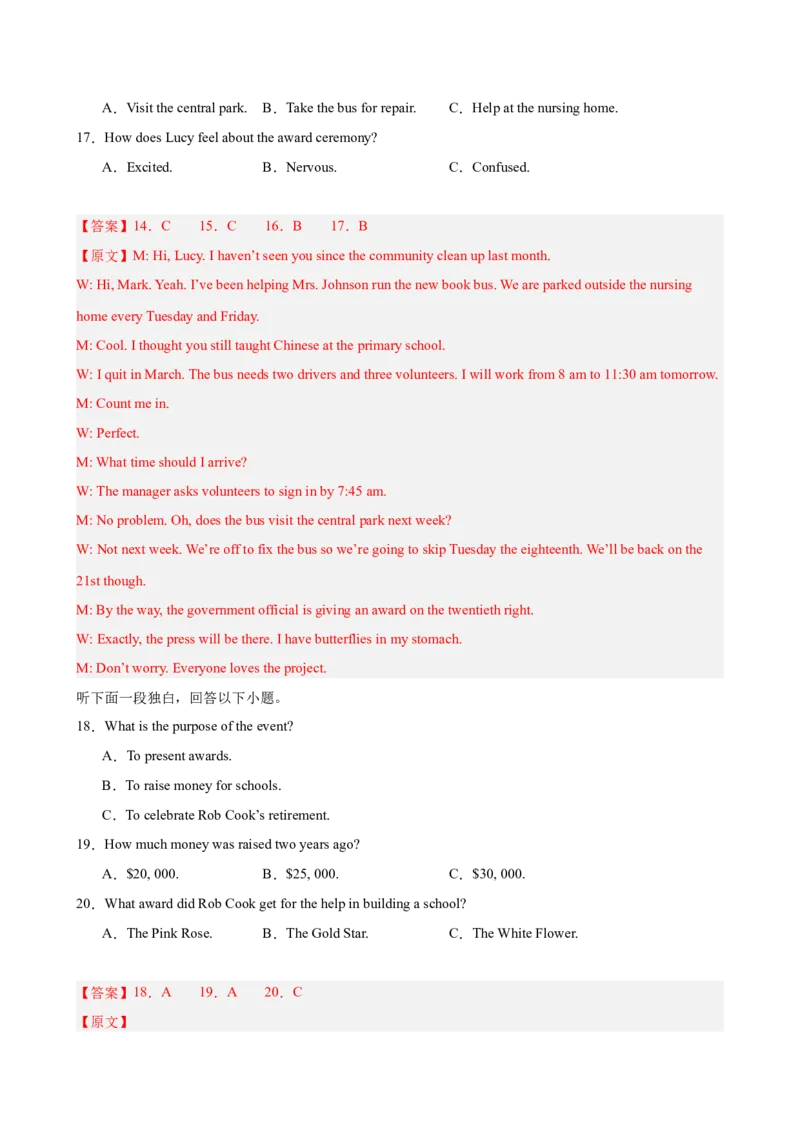
A.Visit the central park.
B.Take the bus for repair.
C.Help at the nursing home.
17.How does Lucy feel about the award ceremony?
A.Excited.
B.Nervous.
C.Confused.
【答案】14.C 15.C 16.B 17.B
【原文】M: Hi, Lucy. I haven’t seen you since the community clean up last month.
W: Hi, Mark. Yeah. I’ve been helping Mrs. Johnson run the new book bus. We are parked outside the nursing
home every Tuesday and Friday.
M: Cool. I thought you still taught Chinese at the primary school.
W: I quit in March. The bus needs two drivers and three volunteers. I will work from 8 am to 11:30 am tomorrow.
M: Count me in.
W: Perfect.
M: What time should I arrive?
W: The manager asks volunteers to sign in by 7:45 am.
M: No problem. Oh, does the bus visit the central park next week?
W: Not next week. We’re off to fix the bus so we’re going to skip Tuesday the eighteenth. We’ll be back on the
21st though.
M: By the way, the government official is giving an award on the twentieth right.
W: Exactly, the press will be there. I have butterflies in my stomach.
M: Don’t worry. Everyone loves the project.
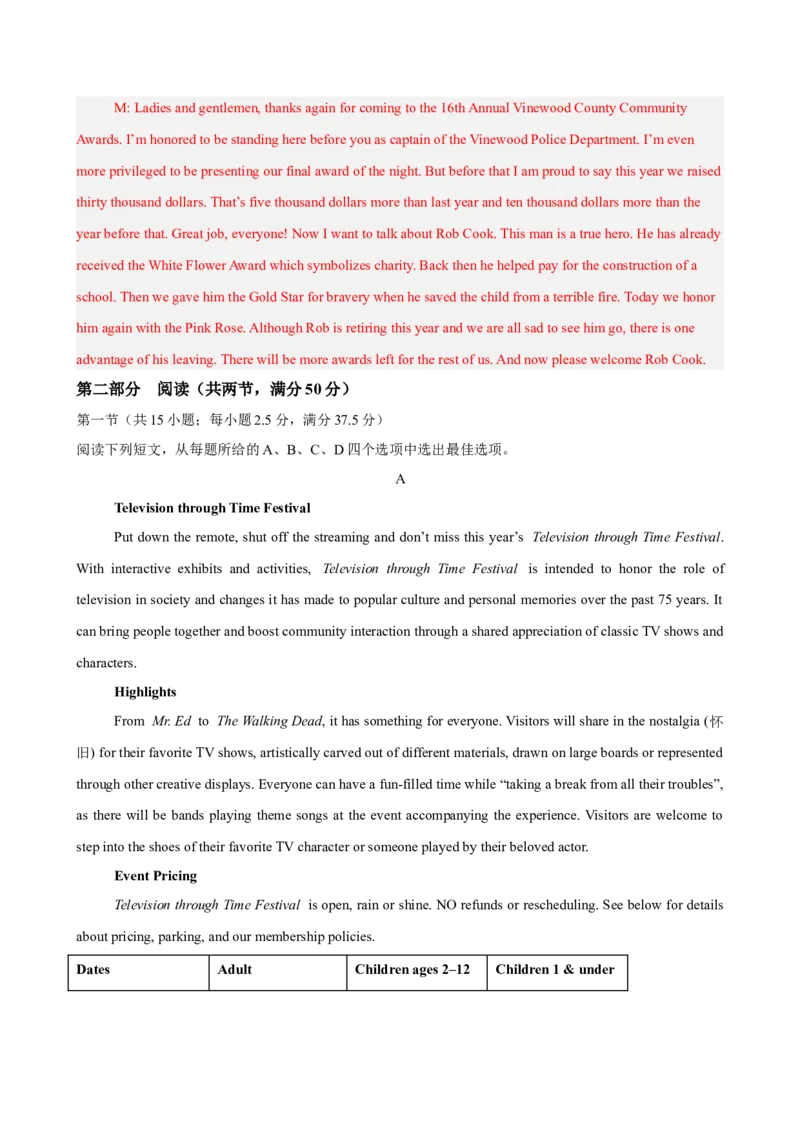
听下面一段独白,回答以下小题。
18.What is the purpose of the event?
A.To present awards.
B.To raise money for schools.
C.To celebrate Rob Cook’s retirement.
19.How much money was raised two years ago?
A.$20, 000.
B.$25, 000.
C.$30, 000.
20.What award did Rob Cook get for the help in building a school?
A.The Pink Rose.
B.The Gold Star.
C.The White Flower.
【答案】18.A 19.A 20.C
【原文】
M: Ladies and gentlemen, thanks again for coming to the 16th Annual Vinewood County Community
Awards. I’m honored to be standing here before you as captain of the Vinewood Police Department. I’m even
more privileged to be presenting our final award of the night. But before that I am proud to say this year we raised
thirty thousand dollars. That’s five thousand dollars more than last year and ten thousand dollars more than the
year before that. Great job, everyone! Now I want to talk about Rob Cook. This man is a true hero. He has already
received the White Flower Award which symbolizes charity. Back then he helped pay for the construction of a
school. Then we gave him the Gold Star for bravery when he saved the child from a terrible fire. Today we honor
him again with the Pink Rose. Although Rob is retiring this year and we are all sad to see him go, there is one
advantage of his leaving. There will be more awards left for the rest of us. And now please welcome Rob Cook.
第二部分 阅读(共两节,满分50 分)
第一节(共15 小题;每小题2.5 分,满分37.5 分)
阅读下列短文,从每题所给的A、B、C、D 四个选项中选出最佳选项。
A
Television through Time Festival
Put down the remote, shut off the streaming and don’t miss this year’s Television through Time Festival.
With interactive exhibits and activities, Television through Time Festival is intended to honor the role of
television in society and changes it has made to popular culture and personal memories over the past 75 years. It
can bring people together and boost community interaction through a shared appreciation of classic TV shows and
characters.
Highlights
From Mr. Ed to The Walking Dead, it has something for everyone. Visitors will share in the nostalgia (怀
旧) for their favorite TV shows, artistically carved out of different materials, drawn on large boards or represented
through other creative displays. Everyone can have a fun-filled time while “taking a break from all their troubles”,
as there will be bands playing theme songs at the event accompanying the experience. Visitors are welcome to
step into the shoes of their favorite TV character or someone played by their beloved actor.
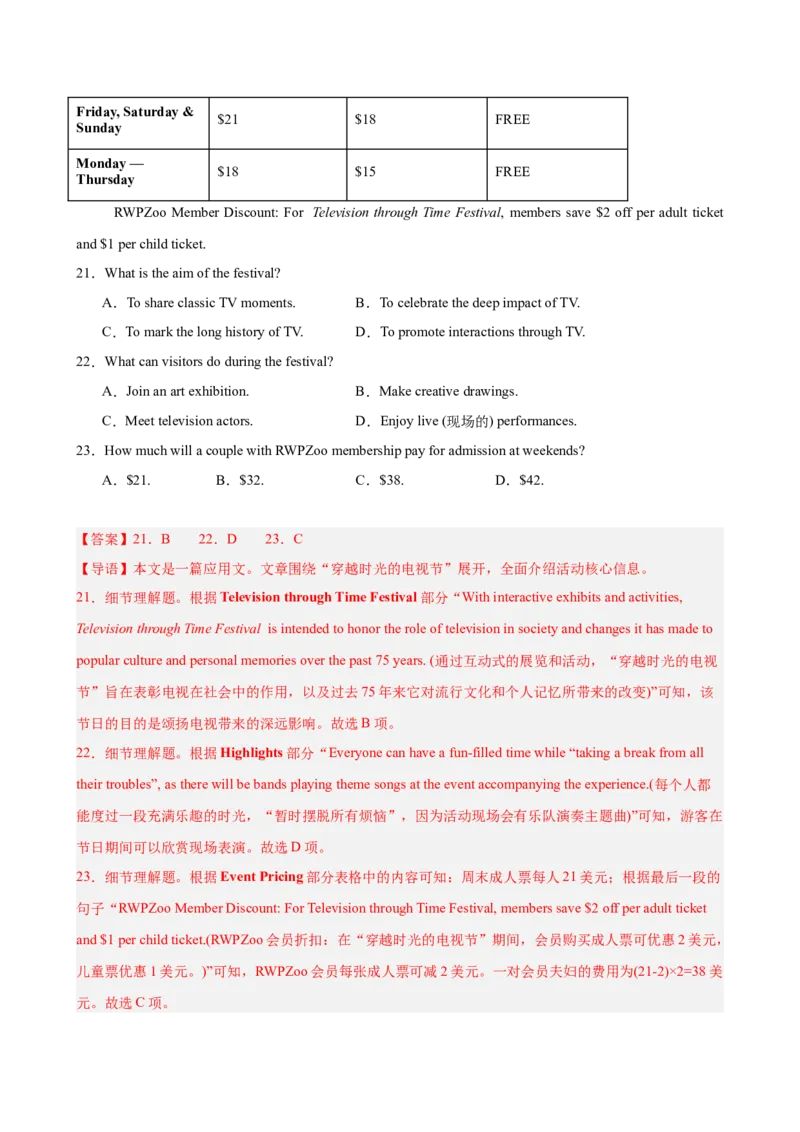
Event Pricing
Television through Time Festival is open, rain or shine. NO refunds or rescheduling. See below for details
about pricing, parking, and our membership policies.
Dates
Adult
Children ages 2–12
Children 1 & under
Friday, Saturday &
Sunday
$21
$18
FREE
Monday —
Thursday
$18
$15
FREE
RWPZoo Member Discount: For Television through Time Festival, members save $2 off per adult ticket
and $1 per child ticket.
21.What is the aim of the festival?
A.To share classic TV moments.
B.To celebrate the deep impact of TV.
C.To mark the long history of TV.
D.To promote interactions through TV.
22.What can visitors do during the festival?
A.Join an art exhibition.
B.Make creative drawings.
C.Meet television actors.
D.Enjoy live (现场的) performances.
23.How much will a couple with RWPZoo membership pay for admission at weekends?
A.$21.
B.$32.
C.$38.
D.$42.
【答案】21.B 22.D 23.C
【导语】本文是一篇应用文。文章围绕“穿越时光的电视节”展开,全面介绍活动核心信息。
21.细节理解题。根据Television through Time Festival 部分“With interactive exhibits and activities,
Television through Time Festival is intended to honor the role of television in society and changes it has made to
popular culture and personal memories over the past 75 years. (通过互动式的展览和活动,“穿越时光的电视
节”旨在表彰电视在社会中的作用,以及过去75 年来它对流行文化和个人记忆所带来的改变)”可知,该
节日的目的是颂扬电视带来的深远影响。故选B 项。
22.细节理解题。根据Highlights 部分“Everyone can have a fun-filled time while “taking a break from all
their troubles”, as there will be bands playing theme songs at the event accompanying the experience.(每个人都
能度过一段充满乐趣的时光,“暂时摆脱所有烦恼”,因为活动现场会有乐队演奏主题曲)”可知,游客在
节日期间可以欣赏现场表演。故选D 项。
23.细节理解题。根据Event Pricing 部分表格中的内容可知:周末成人票每人21 美元;根据最后一段的
句子“RWPZoo Member Discount: For Television through Time Festival, members save $2 off per adult ticket
and $1 per child ticket.(RWPZoo 会员折扣:在“穿越时光的电视节”期间,会员购买成人票可优惠2 美元,
儿童票优惠1 美元。)”可知,RWPZoo 会员每张成人票可减2 美元。一对会员夫妇的费用为(21-2)×2=38 美
元。故选C 项。
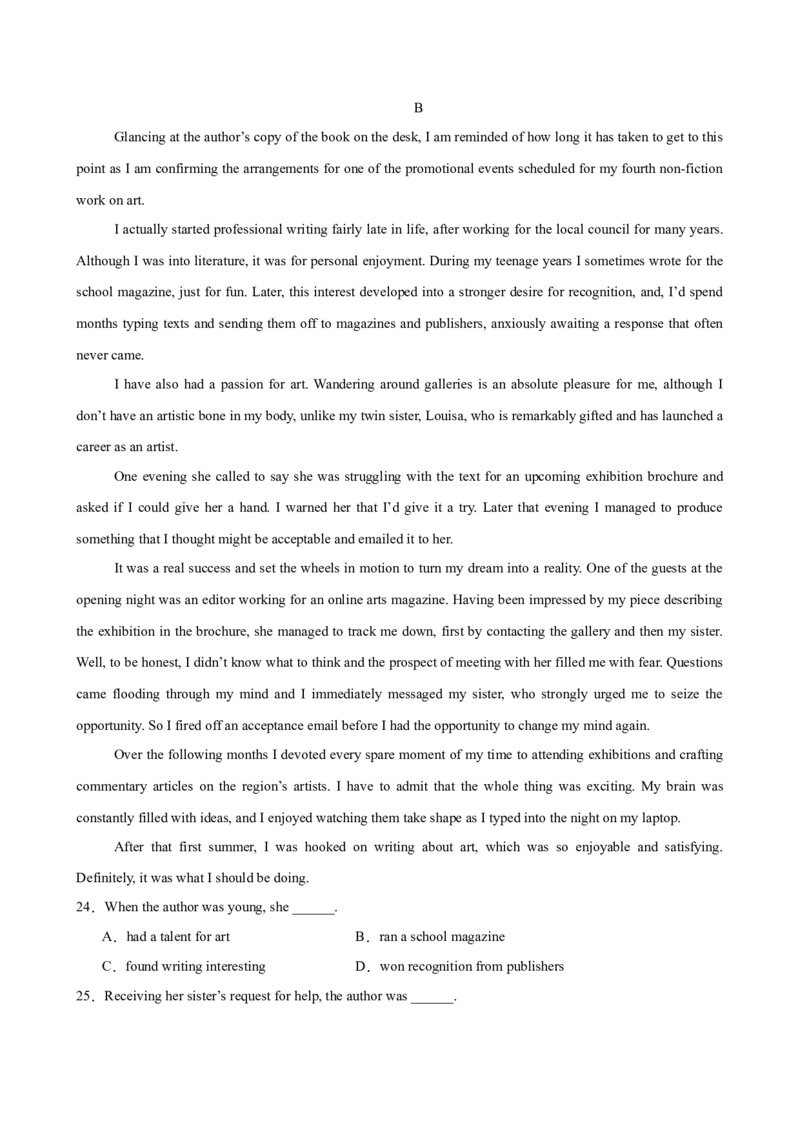
B
Glancing at the author’s copy of the book on the desk, I am reminded of how long it has taken to get to this
point as I am confirming the arrangements for one of the promotional events scheduled for my fourth non-fiction
work on art.
I actually started professional writing fairly late in life, after working for the local council for many years.
Although I was into literature, it was for personal enjoyment. During my teenage years I sometimes wrote for the
school magazine, just for fun. Later, this interest developed into a stronger desire for recognition, and, I’d spend
months typing texts and sending them off to magazines and publishers, anxiously awaiting a response that often
never came.
I have also had a passion for art. Wandering around galleries is an absolute pleasure for me, although I
don’t have an artistic bone in my body, unlike my twin sister, Louisa, who is remarkably gifted and has launched a
career as an artist.
One evening she called to say she was struggling with the text for an upcoming exhibition brochure and
asked if I could give her a hand. I warned her that I’d give it a try. Later that evening I managed to produce
something that I thought might be acceptable and emailed it to her.
It was a real success and set the wheels in motion to turn my dream into a reality. One of the guests at the
opening night was an editor working for an online arts magazine. Having been impressed by my piece describing
the exhibition in the brochure, she managed to track me down, first by contacting the gallery and then my sister.
Well, to be honest, I didn’t know what to think and the prospect of meeting with her filled me with fear. Questions
came flooding through my mind and I immediately messaged my sister, who strongly urged me to seize the
opportunity. So I fired off an acceptance email before I had the opportunity to change my mind again.
Over the following months I devoted every spare moment of my time to attending exhibitions and crafting
commentary articles on the region’s artists. I have to admit that the whole thing was exciting. My brain was
constantly filled with ideas, and I enjoyed watching them take shape as I typed into the night on my laptop.
After that first summer, I was hooked on writing about art, which was so enjoyable and satisfying.
Definitely, it was what I should be doing.
24.When the author was young, she ______.
A.had a talent for art
B.ran a school magazine
C.found writing interesting
D.won recognition from publishers
25.Receiving her sister’s request for help, the author was ______.
A.cautious
B.touched
C.relieved
D.uninterested
26.What finally encouraged the author to accept the editor’s offer?
A.Her passion for art.
B.Confidence from success.
C.The editor’s enthusiasm.
D.The push from her sister.
27.What can we learn from the passage?
A.Every end is a fresh beginning.
B.Talent is born from consistent effort.
C.Unexpected turns in life may bring gifts.
D.Lifelong learning leads to personal growth.
【答案】24.C 25.A 26.D 27.C
【导语】本文是一篇记叙文。文章讲述了作者从为个人兴趣写作到因偶然机会为妹妹撰写展览文案,从
而开启了艺术写作职业生涯的故事。
24.细节理解题。根据第二段中“During my teenage years I sometimes wrote for the school magazine, just for
fun. (在我青少年时期,我有时为校刊写作,只是为了好玩)”可知,作者年轻时觉得写作很有趣。故选C
项。
25.推理判断题。根据第四段中“One evening she called to say she was struggling with the text for an
upcoming exhibition brochure and asked if I could give her a hand. I warned her that I’d give it a try. (一天晚上,
她打电话来,说她正在为即将出版的展览宣传册的文字苦苦挣扎,问我能否帮她一把。我提醒她我会试
一试)”可知,作者在答应帮助妹妹时有所保留,态度是谨慎的。故选A 项。
26.细节理解题。根据第五段中“I immediately messaged my sister, who strongly urged me to seize the
opportunity. So I fired off an acceptance email before I had the opportunity to change my mind again. (我立刻给
妹妹发了信息,她强烈敦促我抓住这个机会。于是我趁自己还没来得及再次改变主意,火速发出了接受
邮件)”可知,最终鼓励作者接受编辑邀请的是来自妹妹的推动。故选D 项。
27.主旨大意题。通读全文,结合第三段中“I don’t have an artistic bone in my body, unlike my twin sister,
Louisa, who is remarkably gifted and has launched a career as an artist. (与我的双胞胎妹妹Louisa 不同,我没
有任何艺术天赋,她却极具天赋并开启了艺术家的职业生涯)”、第五段中“One of the guests at the opening
night was an editor working for an online arts magazine. Having been impressed by my piece describing the
exhibition in the brochure, she managed to track me down (开幕之夜的一位嘉宾是一家在线艺术杂志的编辑。
她被我在宣传册中描述展览的文章所打动,设法找到了我)”和第六段中“After that first summer, I was
hooked on writing about art, which was so enjoyable and satisfying. Definitely, it was what I should be doing. (在
那个夏天之后,我迷上了艺术写作,这是如此令人愉快和满足。毫无疑问,这正是我应该做的事情)”可知,
作者原本没有艺术天赋和写作职业背景,却因帮助妹妹撰写展览文案而偶然获得编辑赏识,最终走上了
艺术写作的职业道路。这表明人生中意想不到的转折可能会带来惊喜的礼物。故C 项“Unexpected turns
in life may bring gifts. (人生中意想不到的转折可能会带来礼物)”能概括文章内容,最适合作为本文的主旨。
故选C 项。
C
Human interaction reflects human nature. It includes both moral and immoral acts. It also includes acts that
seem moral but are in fact immoral, and those that seem immoral but are in fact moral. To depict ( 刻画) human
life truthfully, literary writers should try to capture this complexity without relying on an over-simplified moral
yardstick (标准).
Morality is short on drama, a key ingredient of literature. Drama often relies on the role of a villain (恶人),
and its absence would be keenly felt in a story populated only by good guys. In the old days, the standard recipe
for a dramatic effect called for the help of either supernatural beings or a female character, whereas modern plays
are spiced up by the presence of a villain.
We often use the numerical term “hundreds” when talking about good deeds, but use “tens of thousands” to
highlight the large number of evils. This peculiar (奇怪的) language feature reflects a relative similarity between
good deeds and an abundant variety of evils. Making a donation to the Red Cross isn’t a technically challenging
feat (壮举). It’s pretty dull to see how a donation is made, but it can be fascinating to follow the twists and turns in
a bribery (贿赂) scheme. Which story, then, do you like to hear?
Writers often experiment with what’s considered immoral when they try to be innovative. For example, a
time-honored ethical rule calls for mutual understanding between husband and wife. Many stories are based on
this rule. One way to go against convention is to run counter to it. Thus, a new story goes as follows. A man
hosted a banquet at home celebrating his 20th wedding anniversary. But the host went missing during the wining
and dining. His guests looked for him everywhere and finally found him on a stone bench in his backyard, his tie
gone, his chest bared, an empty wine bottle in his hand. His friends asked him what was wrong. He said, “Three
months after I got married, I realized I could not get along with her, but she refused to end our marriage. I wanted
to kill her, but my lawyer said I’d be put behind bars for twenty years if I did that. Twenty years would be too
long, I thought. I had no choice but to put up with the pain of this marriage. Now twenty years is gone. If I had
done it back then, I would have been freed today. I regret not doing it.” This is obviously an immoral tale. But the
temptation to write a story like this is too strong to resist.
To add drama to a story, we often have to fall back on bad guys. But they may well steal the show. A
movement toward a story’s climax may push immorality to a new level. By contrast, morality’s reach is more
limited.
28.According to paragraph 2, whose presence does NOT contribute to a dramatic effect?
A.A villain’s.
B.Good guys’.
C.A female character’s.
D.Supernatural beings’.
29.What’s the purpose of mentioning the story about a man in paragraph 4?
A.To remind us that the man in the story is indeed a bad guy.
B.To emphasize that mutual understanding between husband and wife matters.
C.To prove writing about what’s considered immoral can add drama to a story.
D.To indicate that moral deeds and actions are essential themes for story writers.
30.What does the underlined words “steal the show” mean in paragraph 5?
A.Reveal the shocking ending.
B.Take away the profits.
C.Become the focus of attention.
D.Explain the whole show.
31.Which of the following can be the best title for the passage?
A.Literature and morality.
B.Good deeds and evils.
C.Innovation of literature.
D.Limits of human nature.
【答案】28.B 29.C 30.C 31.A
【导语】这是一篇说明文。文章主要讨论的是文学与道德之间的关系。
28.细节理解题。根据第二段“Drama often relies on the role of a villain (恶人), and its absence would be
keenly felt in a story populated only by good guys. In the old days, the standard recipe for a dramatic effect called
for the help of either supernatural beings or a female character, whereas modern plays are spiced up by the
presence of a villain.( 戏剧往往离不开反派角色的塑造;如果一个故事里全是好人,观众会明显感到缺少
看点。在过去,营造戏剧效果的惯用手法是借助超自然力量或女性角色,而现代戏剧则通过反派的登场
增添张力。)”可知,只有好人的故事没有戏剧效果,因此好人的出现不能增强戏剧感。故选B。
29.推理判断题。根据第四段“Writers often experiment with what’s considered Immoral when they try to be
innovative.(作家想要创新时,常会尝试描写被视为不道德的内容。)”和“This is obviously an immoral tale.
But the temptation to write a story like this is too strong to resist.(这显然是个不道德的故事。但创作这类故事
的诱惑难以抗拒。)”可知,第四段整段用这个丈夫后悔没杀妻子的故事,举例证明写不道德内容能增加戏
剧冲突与创新性。故选C。
30.词句猜测题。根据第五段“To add drama to a story, we often have to fall back on bad guys. But they may
well steal the show. A movement toward a story’s climax may push immorality to a new level. By contrast,
morality’s reach is more limited.(为增加戏剧感,我们常要依靠反派。但他们很可能steal the show。故事走
向高潮时,不道德行为会被推向新高度,相比之下道德的影响力更有限。)”可知,反派角色增加戏剧感,
可能会成为焦点。由此可知,steal the show 意为“抢风头、成为焦点”。故选C。
31.主旨大意题。文章第一段“Human interaction reflects human nature. It includes both moral and immoral
acts.(人类互动反映了人性。它包括道德和不道德的行为。)”点明了文章的主题,即人性中的道德和不道
德行为,接下来文章通过讨论文学中的戏剧性元素,进一步探讨了道德和不道德行为在文学中的表现,
由此可知,文章主要讨论的是文学与道德之间的关系,所以选项A“文学与道德”适合作为文章标题。故
选A。
D
For decades, environmental education has focused on raising awareness about ecological problems —
melting glaciers, endangered species, and polluted oceans. While these issues remain critical, a new approach is
gaining popularity: instead of just telling people about environmental crisis, organizations are now working to
help people experience nature directly. The thinking behind this shift is simple: people protect what they love, and
they love what they know.
This movement is taking shape in cities around the world. In the United Kingdom, the Wildlife Trust runs
an annual campaign called “30 Days Wild”, which challenges participants to perform a “random act of wildness”
every day throughout June. These acts can be simple — feeding birds, planting flowers on a balcony, or simply
sitting in a park and observing the changing leaves. The goal is not to transform everyone into environmental
scientists, but to help city residents notice the nature that exists alongside their daily lives.
But why does this focus on cities? Currently, over half of the global population lives in urban areas, and in
countries like Australia, the figure reaches nine out of ten. For these people, opportunities to experience untouched
wilderness are limited. If environmentalism only speaks to those who hike mountains or camp in forests, it risks
leaving the majority behind. Urban nature projects bridge this gap, bringing nature to where people already are.
So how can individuals in cities connect with nature? The answer may be simpler than expected. You don’t
need to travel to a national park. Start by noticing the tree outside your window, the birds that visit your
neighborhood, or the weeds growing through cracks in the roadsides. Small daily bits of urban nature — what
researchers call “micro- experiences” — can build the emotional connection that motivates environmental action.
In a rapidly urbanizing world, finding nature in the city might be the key to saving nature everywhere.
32.What is the new approach to environmental education?
A.Focusing more on environmental crisis like melting glaciers.
B.Encouraging people to directly experience nature in daily life.
C.Training everyone to become professional environmental scientists.
D.Moving all environmental education to national parks.
33.What does the "30 Days Wild" campaign ask participants to do?
A.Stay in the wilderness for 30 days.
B.Donate money to wildlife protection organizations.
C.Perform simple nature- related acts every day for a month.
D.Attend environmental science classes for a month.
34.What does paragraph 3 imply about environmentalism?
A.It needs to include urban populations to be effective.
B.It should only focus on wilderness areas.
C.It should require everyone to hike mountains.
D.It has already succeeded in protecting nature.
35.How does the author suggest city residents connect with nature?
A.By moving to rural areas or national parks.
B.By taking long vacations to wilderness destinations.
C.By becoming environmental scientists first.
D.By noticing and appreciating nature in their everyday surroundings.
【答案】32.B 33.C 34.A 35.D
【导语】这是一篇说明文。文章主要介绍了环境教育的新方法,并以英国的“30 Days Wild”活动为例,
阐述了聚焦城市的原因,并指出城市居民可通过关注日常环境中的自然,建立与自然的情感联结,从而
激发环保行动。
32.细节理解题。根据第一段“a new approach is gaining popularity: instead of just telling people about
environmental crisis, organizations are now working to help people experience nature directly.(一种新方法正逐
渐流行:组织不再仅仅向人们告知环境危机,而是致力于帮助人们直接体验自然)”可知,环境教育的新方
法是鼓励人们在日常生活中直接体验自然。故选B 项。
33.细节理解题。根据第二段“the Wildlife Trust runs an annual campaign called “30 Days Wild”, which
challenges participants to perform a “random act of wildness” every day throughout June. These acts can be
simple — feeding birds, planting flowers on a balcony, or simply sitting in a park and observing the changing
leaves.(野生动物信托基金会开展名为“30 Days Wild”的年度活动,要求参与者在6 月的每一天完成一项
“随机亲近自然的行为”。这些行为很简单,比如喂鸟、在阳台种花,或者只是坐在公园观察树叶的变
化)”可知,该活动要求参与者在一个月内每天完成简单的与自然相关的行为。故选C 项。
34.推理判断题。根据第三段“If environmentalism only speaks to those who hike mountains or camp in
forests, it risks leaving the majority behind. Urban nature projects bridge this gap, bringing nature to where people
already are.(如果环保主义只针对登山或在森林露营的人,就有可能将大多数人排除在外。城市自然项目
填补了这一缺口,将自然带到人们所在的地方)”可知,如果环保主义只针对登山或在森林露营的人,就有
可能将大多数人排除在外,由此可推知,环保主义若想有效,就必须覆盖城市人口,否则会脱离大多数
群体。故选A 项。
35.细节理解题。根据最后一段“Start by noticing the tree outside your window, the birds that visit your
neighborhood, or the weeds growing through cracks in the roadsides. Small daily bits of urban nature — what
researchers call “micro-experiences” — can build the emotional connection that motivates environmental action.
(从留意窗外的树、光顾社区的鸟,或是路边裂缝里生长的杂草开始。日常细微的城市自然片段——研究
人员称之为“微体验”——能够建立起激发环境行动的情感联结)”可知,作者建议城市居民通过关注并欣
赏日常环境中的自然来与自然建立联结。故选D 项。
第二节(共5 小题;每小题2.5 分,满分12.5 分)
阅读下面短文,从短文后的选项中选出可以填入空白处的最佳选项。选项中有两项为多余选项。
We all know that protecting our eyes is important. However, many students tend to ignore the warning
signs of eye tiredness. 36 Nowadays, eye overuse has become a very common phenomenon.
37 It usually results from not following the 20-20-20 rule (looking at something 20 feet away for
20 seconds every 20 minutes), studying in poor lighting conditions, holding books too close to your eyes, or not
blinking (眨眼) enough while focusing.
What happens when you don’t give your eyes enough rest? In the short term, it can cause eye strain (疲劳)
and headaches. The discomfort associated with eye overuse can lead to difficulty concentrating, reduced learning
efficiency, and a lack of interest in reading. 38 Such discomfort typically includes dry eyes, blurred
vision, and increased sensitivity to light. In the long term, it can potentially worsen nearsightedness.
While eye strain can be troubling, the good news is that you can prevent most of these problems. 39
Specifically, start practicing the 20-20-20 rule today, which may be simple enough to help your eyes relax and
maintain good eyesight. After you’ve formed this good habit, make sure you’re also maintaining proper reading
distance and lighting.
If you drove a car without ever checking the engine, you’d eventually break down, right? The same goes
for your eyes. Just like a car, your eyes need proper care and regular maintenance to keep functioning well — not
only when you use them intensively during study sessions but throughout your entire daily life. 40
A.Therefore, be cautious during your study time.
B.The first thing you can do is develop good habits.
C.You may also experience physical eye discomfort.
D.Eye overuse means not giving your eyes enough rest.
E.In fact, ignoring eye discomfort can lead to serious problems.
F.Wearing proper glasses is essential if you have vision problems.
G.So, give them proper rest, nutritious support, and professional care when needed.
【答案】36.E 37.D 38.C 39.B 40.G
【导语】这是一篇说明文。文章主要介绍了许多学生忽视眼疲劳,过度用眼会引发短期不适甚至加重近
视。文章分析其原因,并建议养成良好习惯,好好呵护、保养眼睛。
36.前文“However, many students tend to ignore the warning signs of eye tiredness.(然而,许多学生往往会
忽视眼睛疲劳的预警信号)”提到学生忽视眼疲劳的预警信号,E 项“In fact, ignoring eye discomfort can lead
to serious problems.(事实上,忽视眼部不适会引发严重问题)”承接上文,同时引出后文 “过度用眼已十分
普遍” 的现象,逻辑连贯。故选E 项。
37.后文“It usually results from not following the 20-20-20 rule (looking at something 20 feet away for 20
seconds every 20 minutes), studying in poor lighting conditions, holding books too close to your eyes, or not
blinking (眨眼) enough while focusing.(这通常是由没有遵循20-20-20 规则(每20 分钟看20 英尺远的东西
20 秒)、在光线不佳的环境中学习、将书本拿得离眼睛太近或者在集中注意力时眨眼不够多所导致的)”
详细解释了过度用眼的多种成因,D 项 “Eye overuse means not giving your eyes enough rest.(过度用眼意
味着不让眼睛得到充分休息)”先对核心概念下定义,总领下文的原因分析。故选D 项。
38.后文“Such discomfort typically includes dry eyes, blurred vision, and increased sensitivity to light.(这种不
适通常表现为眼睛干涩、视力模糊以及对光线的敏感度增加)”指代前文的眼部不适,C 项“You may also
experience physical eye discomfort.(你可能还会感到眼部生理不适)”引出干眼、视力模糊等具体不适症状,
与后文形成指代衔接。故选C 项。
39.前文“While eye strain can be troubling, the good news is that you can prevent most of these problems.(虽
然眼睛疲劳令人烦恼,但好消息是,你可以预防大多数此类问题)”提出可以预防眼部问题,后文
“Specifically, start practicing the 20-20-20 rule today, which may be simple enough to help your eyes relax and
maintain good eyesight.( 具体来说,从今天开始就实行20-20-20 规则,这个规则可能简单到足以帮助您的
眼睛放松并保持良好的视力)”具体介绍20-20-20 规则等好习惯,B 项“The first thing you can do is develop
good habits.(你能做的第一件事就是养成好习惯)”引出下文的具体做法,衔接自然。故选B 项。
40.前文“Just like a car, your eyes need proper care and regular maintenance to keep functioning well — not
only when you use them intensively during study sessions but throughout your entire daily life.(就像汽车一样,
你的双眼也需要得到适当的保养和定期维护,以保持良好的工作状态——不仅在学习期间高强度使用时
需要如此,而且在你整个日常生活中也是如此)”将眼睛比作汽车,强调需要日常呵护,G 项“So, give
them proper rest, nutritious support, and professional care when needed.(因此,给予它们充足休息、营养支持,
必要时寻求专业护理)”总结全文,给出护眼的具体建议,收束文段。故选G 项。
第三部分 语言运用(共两节,满分30 分)
第一节 (共15 小题;每小题1 分,满分15 分)
阅读下面短文,从每题所给的A、B、C、D 四个选项中选出可以填入空白处的最佳选项。
All my life I’ve been bad at sports, so I never joined my friends’ sports games. “Hating sports” was core to
my 41 .
Last year, a friend invited me to a kickabout — a casual football game. Had we been less close, I might
have made 42 . Instead I turned up, determined to keep far from the ball. To my great 43 , I
enjoyed myself. Rather than hanging around on the 44 , I got swept up in the game. Since then,
kickabout has become one of my hobbies. A year later, our amateur kickabout team has 45 from only
five friends to 40 members. We meet at our local sports center every other Sunday. What 46 me turning
up every time? It is the joy of challenging myself, with no 47 of being skilled or professional.
Why does it feel so 48 to be bad at something? Karen Walrond, the author of the book In
Defense of Dabbling, thinks that being an amateur was not always 49 . Walrond explains that even if
you don’t make obvious 50 , you can still benefit in other ways. These benefits often 51
into your daily life. For example, although Walrond finds traditional meditation (禅修) challenging, she achieves a
mindful state when fully 52 in this activity she enjoys.
Focusing on the process helps people 53 perfectionism and enjoy the experience. This is the
54 I have discovered: You don’t need to be skilled at something to love it. 55 , loving it is
all that matters.
41.A.dream
B.identity
C.work
D.class
42.A.decisions
B.plans
C.excuses
D.notes
43.A.surprise
B.sorrow
C.delight
D.regret
44.A.platforms
B.sidelines
C.roads
D.farms
45.A.grown
B.objected
C.led
D.stuck
46.A.prevents
B.witnesses
C.keeps
D.prohibits
47.A.duty
B.need
C.reason
D.expectation
48.A.good
B.tough
C.special
D.rare
49.A.direct
B.negative
C.correct
D.equal
50.A.trouble
B.peace
C.sense
D.progress
51.A.extend
B.disappear
C.evolve
D.survive
52.A.defeated
B.forced
C.persuaded
D.absorbed
53.A.give in to
B.let go of
C.take up
D.run after
54.A.case
B.skill
C.moral
D.truth
55.A.Therefore
B.However
C.Instead
D.Meanwhile
【答案】
41.B 42.C 43.A 44.B 45.A 46.C 47.D 48.A 49.B 50.D
51.A 52.D 53.B 54.D 55.C
【导语】本文是一篇夹叙夹议文。文章通过作者从自认“运动差生”到爱上业余踢球的个人经历,并结
合作家Karen Walrond 的观点,阐述了放下对进步和完美的执念,热爱并沉浸于过程本身,就能带来快乐
和益处。
41.考查名词词义辨析。句意:“讨厌运动”曾是我身份的核心。A. dream 梦想;B. identity 身份;C.
work 工作;D. class 班级。根据上文“All my life I’ve been bad at sports, so I never joined my friends’ sports
games.”可知,作者不擅长运动,从不参与朋友的运动比赛,因此会把“讨厌运动”描述为个人特质,作
为身份的核心。故选B。
42.考查名词词义辨析。句意:如果我们关系没那么亲近,我可能会找借口(拒绝)。A. decisions 决定;
B. plans 计划;C. excuses 借口;D. notes 笔记。根据上文“Had we been less close”可知,此处为虚拟语气,
如果两人关系没那么亲近,不爱运动的作者可能会找借口拒绝。故选C。
43.考查名词词义辨析。句意:令我非常惊讶的是,我玩得很开心。A. surprise 惊讶;B. sorrow 悲伤;C.
delight 高兴;D. regret 后悔。根据上文“determined to keep far from the ball”和下文“I enjoyed myself”可知,
作者原先决心离球远远的,结果玩得很开心,因此会感到惊讶。故选A。
44.考查名词词义辨析。句意:我没有在场外闲逛,而是被卷入了比赛中。A. platforms 平台;B.
sidelines 场外;C. roads 道路;D. farms 农场。根据上文“Rather than hanging around”和下文“I got swept
up in the game”可知,前后是选择关系,作者没有在场外闲逛,而是被卷入了比赛中。故选B。
45.考查动词词义辨析。句意:一年后,我们的业余踢球队从仅有的五位朋友增长到了40 名成员。A.
grown 增长;B. objected 反对;C. led 领导;D. stuck 卡住。根据下文“from only five friends to 40
members”可知,球队从仅有的五位朋友增长到了40 名成员,短语grown from A to B 意为“从……增长
到……”。故选A。
46.考查动词词义辨析。句意:是什么让我每次都坚持参加?A. prevents 阻止;B. witnesses 见证;C.
keeps(使)处于;D. prohibits 禁止。根据上文“We meet at our local sports center every other Sunday.”可知,
作者和队员们每隔一个周日在当地的体育中心见面,此处是询问让自己每次都坚持参加的原因,短语
keep sb. doing 意为“让某人一直做某事,让某人坚持做某事”。故选C。
47.考查名词词义辨析。句意:是挑战自我的快乐,没有要变得熟练或专业的期望。A. duty 责任;B.
need 需要;C. reason 理由;D. expectation 期望。根据上文“It is the joy of challenging myself”可知,作者
参与这项运动是出于挑战自我的快乐,不必承受变得熟练或专业的期望。故选D。
48.考查形容词词义辨析。句意:为什么在不擅长某事时感觉如此之好?A. good 好的;B. tough 艰难的;
C. special 特别的;D. rare 稀有的。根据上文“I enjoyed myself”和“Since then, kickabout has become one of
my hobbies.”可知,作者玩得很开心,并把踢球作为自己的一个爱好,说明不擅长某事时感觉如此之好。
故选A。
49.考查形容词词义辨析。句意:《为浅尝辄止辩护》一书的作者Karen Walrond 认为,“作为业余爱好
者”并非总是消极的。A. direct 直接的;B. negative 消极的;C. correct 正确的;D. equal 平等的。根据下
文“you can still benefit in other ways”可知,作者引用Karen Walrond 的观点为业余爱好正名,表明社会常
视不专业为消极。故选B。
50.考查名词词义辨析。句意:Walrond 解释说,即使你没有取得明显的进步,你仍然可以从其他方面受
益。A. trouble 麻烦;B. peace 和平;C. sense 感觉;D. progress 进步。根据上文“even if”和“you can still
benefit in other ways”可知,前后是让步转折的关系,即使没有明显的进步,你仍能从其他方面受益。故选
D。
51.考查动词词义辨析。句意:这些益处常常会延伸到你的日常生活中。A. extend 延伸;B. disappear 消
失;C. evolve 进化;D. survive 生存。根据下文“although Walrond finds traditional meditation (禅修)
challenging, she achieves a mindful state”可知,Karen Walrond 本人觉得传统冥想很有挑战性,但仍能达到
一种正念状态,这个例子表明这些益处常常会延伸到日常生活中。故选A。
52.考查动词词义辨析。句意:例如,尽管Walrond 觉得传统冥想很有挑战性,但当她完全专注于自己喜
欢的这项活动时,她达到了一种正念状态。A. defeated 击败;B. forced 强迫;C. persuaded 说服;D.
absorbed 使专心。根据上文“she achieves a mindful state”可知,达到正念状态需要人完全专注于这项活动。
故选D。
53.考查动词短语辨析。句意:专注于过程有助于人们放下完美主义并享受体验。A. give into 屈服;B.
let go of 放手;C. take up 占用;D. run after 追赶。根据上文“Focusing on the process”和下文“enjoy the
experience”可知,专注于过程能让人享受体验,放下完美主义。故选B。
54.考查名词词义辨析。句意:这是我发现的真相:你不需要擅长某事才能热爱它。A. case 案例;B.
skill 技能;C. moral 道德;D. truth 真相。根据下文“You don’t need to be skilled at something to love it”可知,
作者在总结自身经历以及作家书中的观点,“你不需要擅长某事才能热爱它”是他发现的真相。故选
D。
55.考查副词词义辨析。句意:相反,热爱才是最重要的。A. Therefore 因此;B. However 然而;C.
Instead 相反;D. Meanwhile 同时。根据上文“You don’t need to be skilled at something to love it”和下文
“loving it is all that matters”可知,“不需要擅长某事才能热爱它”和“热爱才是最重要的”是替代关系,
Instead“相反地”表示重点的转移。故选C。
第二节(共10 小题;每小题1. 5 分, 满分15 分)
阅读下面材料,在空白处填入适当的内容(1 个单词)或所给单词的正确形式。
Poetry artfully combines sounds, words and grammar, making it delightful to read aloud. Drawing on
colors, emotions and vivid images 56 (paint) lively mental pictures for readers, it touches hearts across
ages and borders.
As a precious global cultural treasure, poetry has evolved diverse styles. Chinese classical poetry attaches
great importance to 57 (harmony) and rhythmic structures. It follows fixed lines and character counts,
creating 58 unique rhythm and graceful rhyme. Tang poems by Li Bai, Du Fu and Wang Wei enjoyed
immense popularity. Du Fu’s diverse themes made his works stand out, 59 (reflect) his profound
thoughts and sincere feelings.
However, as time went by, it was the new wave of literary reform in the early 20th century 60
bravely discarded old rules and eventually 61 (break) fixed conventions in the literary innovation era.
Most modern poems 62 (compose) in free verse have gained wide recognition. They focus either on
innovative forms 63 on cross-cultural expression. With its unique charm, Chinese poetry has gradually
drawn global attention, and Ezra Pound introduced classical Chinese poems to Western readers in early 1900s
Europe.
Ultimately, poetry acts as a timeless bridge linking the East and West, urging people to adopt a broad and
inclusive mindset toward diverse civilizations. It conveys shared 64 (interact) beyond mere words and
national borders. As such a precious literary treasure, it 65 (influence) human society deeply throughout
the long course of history and will undoubtedly maintain its glamour for generations to come.
【答案】
56.to paint 57.harmonious 58.a 59.reflecting 60.that 61.broke 62.composed
63.or 64.interaction 65.has influenced
【导语】本文是一篇说明文。主要介绍了诗歌的艺术特点、中国诗歌的发展历程(古典诗与现代诗)及
其作为东西方桥梁的重要意义。
56.考查非谓语动词。句意:诗歌利用色彩、情感和生动的意象为读者描绘生动的心理画面,触动着各
个年龄和国家的心灵。固定结构 draw on sth. to do sth. 表示“借助……来做某事”,不定式在句中作目的
状语。故填to paint。
57.考查名词。句意:中国古典诗歌非常重视和谐的节奏结构。此处和下文rhythmic 并列作定语修饰
structures,应用形容词harmonious“和谐的”。故填harmonious。
58.考查冠词。句意:它遵循固定的行数和字数,创造出独特的节奏和优美的韵律。rhythm 为可数名词
单数,空前无限定词,此处表示“一种独特的节奏”,为泛指,且unique 是以辅音音素开头的单词,所
以用不定冠词a。故填a。
59.考查非谓语动词。句意:杜甫的主题多样,使其作品脱颖而出,体现了他深刻的思想和真挚的情感。
此处为非谓语动词作状语,主语Du Fu’s diverse themes 与reflect 之间为主动关系,所以用现在分词形式。
故填reflecting。
60.考查强调句。句意:然而,随着时间的推移,正是20 世纪初的文学改革新浪潮,勇敢地抛弃了旧规
则,并最终在文学创新时代打破了固定的传统。此处为强调句,结构为It is/was + 被强调部分 + that/who
+ 其他部分,被强调部分为the new wave of literary reform in the early 20th century(物),所以用that。故
填that。
61.考查动词时态。句意:然而,随着时间的推移,正是20 世纪初的文学改革新浪潮,勇敢地抛弃了旧
规则,并最终在文学创新时代打破了固定的传统。此处与discarded 并列作谓语动词,根据时间状语in the
early 20th century 可知,应用一般过去时,break 的过去式为broke。故填broke。
62.考查非谓语动词。句意:大多数以自由诗形式创作的现代诗获得了广泛认可。此处为非谓语动词作
后置定语,most modern poems 与compose 之间为被动关系,所以用过去分词形式。故填composed。
63.考查固定搭配。句意:它们要么注重创新形式,要么注重跨文化表达。此处为固定搭配either...or...,
表示“要么……要么……”。故填or。
64.考查名词。句意:它传递的不仅仅是语言和国界之外的共同互动。此处作conveys 的宾语,应用名词
interaction。故填interaction。
65.考查动词时态。句意:作为这样一份珍贵的文学瑰宝,它在漫长的历史进程中深刻地影响了人类社
会,并无疑将在未来几代人中保持其魅力。此处为谓语动词,根据时间状语throughout the long course of
history 可知,此处强调动作从过去持续到现在并对现在产生影响,应用现在完成时,主语it 是第三人称
单数,所以用has influenced。故填has influenced。
第四部分 写作(共两节, 满分40 分)
第一节(满分15 分)
66.假定你是李华,你的美国笔友Tom 给你寄来了一本他喜欢的科幻小说,作为回礼,你寄去了一套中
国传统的剪纸艺术作品。请你向你校英文报Global Friendship 栏目投稿,内容包括:
1.互换礼物的经过;
2.你的感想。
注意:1.写作词数应为80 左右;
2.请按如下格式在答题卡的相应位置作答。
A Meaningful Exchange
___________________________________________________________________________________________
___________________________________________________________________________________________
___________________________________________________________________________________________
___________________________________________________________________________________________
___________________________________________
【答案】
A Meaningful Exchange
I’m Li Hua. Recently, I had a wonderful cultural exchange with my American pen-pal Tom.
Tom sent me a science fiction novel he was crazy about. In return, I carefully selected a set of traditional
Chinese paper-cut artworks. When he received my gift, he was over the moon and praised the delicate designs.
This exchange is more than just a gift-giving activity. It’s a bridge connecting our cultures. Through it,
we’ve deepened our friendship and gained a better understanding of each other’s traditions. I truly value this
experience.
【导语】本篇书面表达属于应用文。要求考生以李华的身份向校英文报Global Friendship 栏目投稿,讲述
自己和美国笔友Tom 互换礼物的经过和自己的感想。
【详解】1.词汇积累
很棒的:wonderful→fantastic/fabulous
传统的:traditional→conventional
连接:connect→link/bridge
珍惜:value→cherish
2.句式拓展
合并句子
原句:It’s a bridge connecting our cultures. Through it, we’ve deepened our friendship and gained a better
understanding of each other’s traditions.
拓展句:It’s a bridge connecting our cultures, through which we’ve deepened our friendship and gained a better
understanding of each other’s traditions.
【点睛】【高分句型1】Tom sent me a science fiction novel he was crazy about. (运用了省略关系代词
which/that 的定语从句)
【高分句型2】When he received my gift, he was over the moon and praised the delicate designs. (运用了when
引导的时间状语从句)
第二节(满分25 分)
67.阅读下面材料,根据其内容和所给段落开头语续写两段,使之构成一篇完整的短文。
For as long as I can remember, I have found small talk problematic. It was boring at best and stressful at worst.
A colleague commented on the weather, when I could see for myself that it was raining.
I worked in book publishing for years, where networking was essential. I could discuss authors, print runs or
marketing budgets with ease. But asking how a buyer had travelled to the event? Or where a journalist had
parked? I didn’t care! So why were these the conversations we were all having? Everyone else seemed at ease,
while I felt on edge.
Every exchange felt like a performance, an evaluation I was sure I was failing. I didn’t understand the rules of
engagement. For example, how long should small talk last? Should I answer honestly? I worried that my
responses were either flat or manic (狂躁的), my questions barked out like an interrogator (审讯者).
Then came an unexpected encounter that changed everything. In early May, I attended the annual publishing
gathering. I stood by the food table, holding a cup of wine and nodding with a tight smile to stop more
conversation.
Then, the self-help author Wayne Dyer approached, calm and thoughtful, like a person who could find
meaning in small things. He didn’t lead with the usual topics about the weather or my weekend. Instead, he
glanced at the event copy I was holding and remarked, “I’ve always been struck by the cover art for this series. In
your view, what really makes a cover work?” His tone was thoughtful and his gaze stayed on me. Caught off
guard, I gave a real answer. We fell into a short, easy discussion about design and what drew a reader in. For once,
the chat didn’t feel forced; it felt like an exchange. I felt listened to.
With a brief smile, he drifted away, leaving his words hanging in the air, “Change the way you look at things, and
the things you look at change.”注意:
1. 续写词数应为150 左右;
2. 请按如下格式在答题卡的相应位置作答。
Inspired, I decided to try a new approach.
___________________________________________________________________________________________
___________________________________________________________________________________________
___________________________________________________________________________________________
___________________________________________________________________________________________
_______________________________
Now small talk no longer causes me anxiety.
___________________________________________________________________________________________
___________________________________________________________________________________________
___________________________________________________________________________________________
___________________________________________________________________________________________
_______________________________
【答案】One possible version:
Inspired, I decided to try a new approach. When a colleague mentioned a long drive, I nodded and asked,
“Was the audiobook any good? I’m always looking for a recommendation.” He blinked, and launched into an
enthusiastic review of a history podcast series. In a meeting, instead of asking about someone’s weekend, I noted
the hiking boots under the table and inquired, “Which trail broke those in?” The usually quiet designer grinned
and shared stories about weekend summit hikes. Gradually, every exchange felt like a real connection rather than
forced small talk. Wayne was right: it wasn’t about learning how to handle small talk, but about changing my
relationship with it entirely.
Now small talk no longer causes me anxiety. By asking myself what I might genuinely want to know about
a person, I feel engaged in every encounter. I’m not performing politeness; I’m following a thread of curiosity. I’m
not simply filling the silence; I’m bridging it with real interest. To me, small talk feels like a door waiting to be
opened. Looking back, I owe that transformation to Wayne. His simple yet profound advice doesn’t just help me
survive small talk — it helps me find genuine connection in the most unexpected places.
【导语】本文以人物对闲聊的态度转变为线索展开,讲述作者一直对闲聊感到焦虑,直到在一次出版界
聚会上,作家Wayne Dyer 以新颖的话题开启交流,让作者体会到真正的对话感。
【详解】1. 段落续写:
①由第一段首句内容“受到启发,我决定尝试一种新方法。”可知,第一段可描写作者如何将Wayne 的
建议付诸实践,主动以贴合对方细节的话题开启闲聊,逐渐感受到真实交流的轻松。
②由第二段首句内容“现在闲聊不再让我焦虑了。”可知,第二段可描写作者对闲聊的全新认知,明白
闲聊是基于好奇心的真诚联结,感激Wayne 带来的改变。
2. 续写线索:尝试新话题——开启真诚交流——摆脱闲聊焦虑——建立真实联结——感激启发
3. 词汇激活:
行为类
①注意到:note/notice
②处理:handle/deal with
③改变:change/transform
情绪类
①热情的:enthusiastic/passionate
②好奇心:curiosity/inquisitiveness
【点睛】[高分句型1] When a colleague mentioned a long drive, I nodded and asked, “Was the audiobook any
good? I’m always looking for a recommendation.” (运用了从属连词when 引导时间状语从句)
[高分句型2] By asking myself what I might genuinely want to know about a person, I feel engaged in every
encounter. (运用了连接代词what 引导的宾语从句)