外刊阅读
学科网(北京)股份有限公司
You Don’t Remember Being a Baby, but Your Brain Was
Making Memories
研究发现,我们婴儿时期的记忆可能并未消失
词量:340 词
Article
Main idea
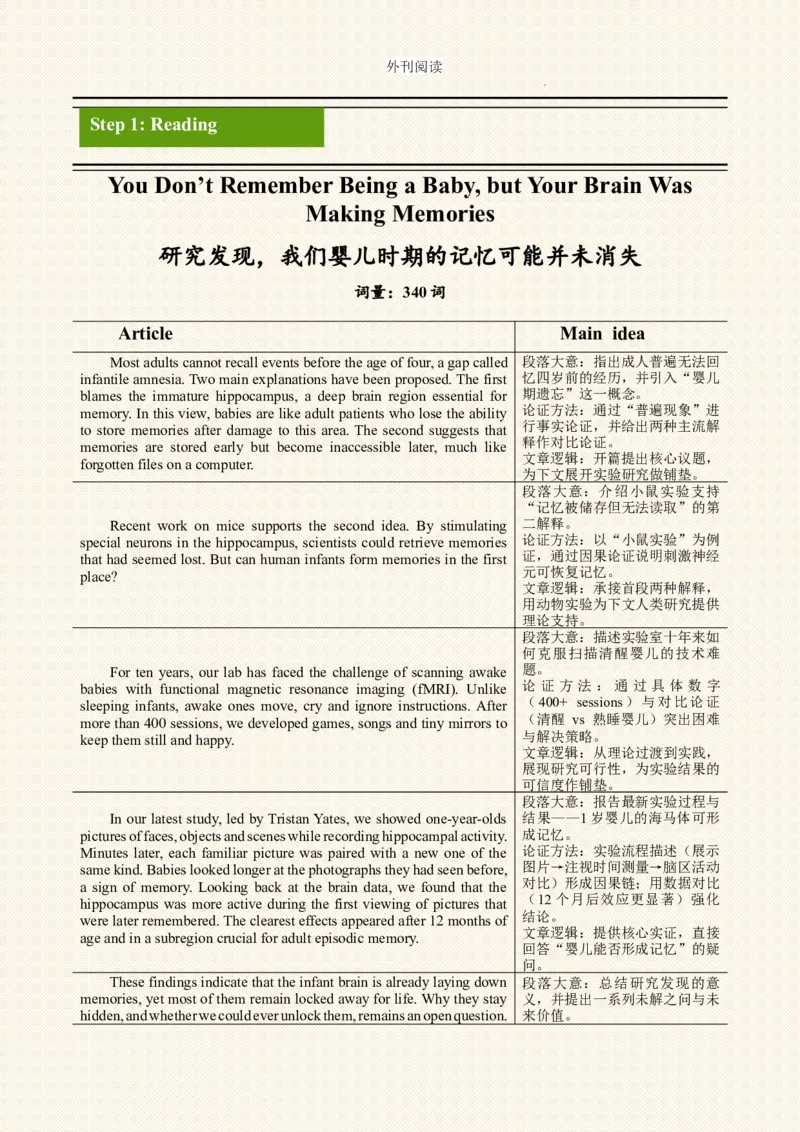
Most adults cannot recall events before the age of four, a gap called
infantile amnesia. Two main explanations have been proposed. The first
blames the immature hippocampus, a deep brain region essential for
memory. In this view, babies are like adult patients who lose the ability
to store memories after damage to this area. The second suggests that
memories are stored early but become inaccessible later, much like
forgotten files on a computer.
段落大意:指出成人普遍无法回
忆四岁前的经历,并引入“婴儿
期遗忘”这一概念。
论证方法:通过“普遍现象”进
行事实论证,并给出两种主流解
释作对比论证。
文章逻辑:开篇提出核心议题,
为下文展开实验研究做铺垫。
Recent work on mice supports the second idea. By stimulating
special neurons in the hippocampus, scientists could retrieve memories
that had seemed lost. But can human infants form memories in the first
place?
段落大意:介绍小鼠实验支持
“记忆被储存但无法读取”的第
二解释。
论证方法:以“小鼠实验”为例
证,通过因果论证说明刺激神经
元可恢复记忆。
文章逻辑:承接首段两种解释,
用动物实验为下文人类研究提供
理论支持。
For ten years, our lab has faced the challenge of scanning awake
babies with functional magnetic resonance imaging (fMRI). Unlike
sleeping infants, awake ones move, cry and ignore instructions. After
more than 400 sessions, we developed games, songs and tiny mirrors to
keep them still and happy.
段落大意:描述实验室十年来如
何克服扫描清醒婴儿的技术难
题。
论证方法:通过具体数字
(400+ sessions )与对比论证
(清醒 vs 熟睡婴儿)突出困难
与解决策略。
文章逻辑:从理论过渡到实践,
展现研究可行性,为实验结果的
可信度作铺垫。
In our latest study, led by Tristan Yates, we showed one-year-olds
pictures of faces, objects and scenes while recording hippocampal activity.
Minutes later, each familiar picture was paired with a new one of the
same kind. Babies looked longer at the photographs they had seen before,
a sign of memory. Looking back at the brain data, we found that the
hippocampus was more active during the first viewing of pictures that
were later remembered. The clearest effects appeared after 12 months of
age and in a subregion crucial for adult episodic memory.
段落大意:报告最新实验过程与
结果——1 岁婴儿的海马体可形
成记忆。
论证方法:实验流程描述(展示
图片→注视时间测量→脑区活动
对比)形成因果链;用数据对比
(12 个月后效应更显著)强化
结论。
文章逻辑:提供核心实证,直接
回答“婴儿能否形成记忆”的疑
问。
These findings indicate that the infant brain is already laying down
memories, yet most of them remain locked away for life. Why they stay
hidden, and whether we could ever unlock them, remains an open question.
段落大意:总结研究发现的意
义,并提出一系列未解之问与未
来价值。
Step 1: Reading
外刊阅读
学科网(北京)股份有限公司
Understanding this mystery could shed light on language learning,
developmental disorders and even memory loss in aging.
论证方法:归纳总结前文实验结
论,通过设问与展望进行推理论
证。
文章逻辑:收束全文,从结果上
升到理论意义与应用前景,引发
读者思考。
一、
阅读理解
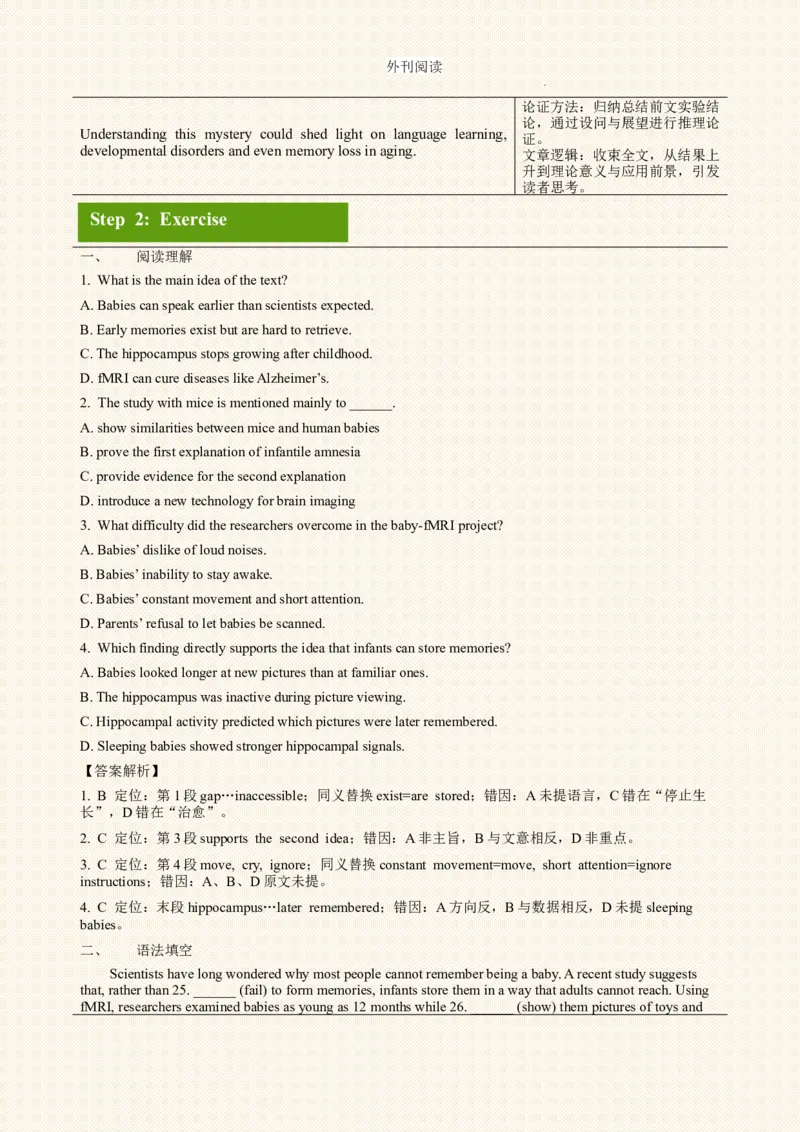
1. What is the main idea of the text?
A. Babies can speak earlier than scientists expected.
B. Early memories exist but are hard to retrieve.
C. The hippocampus stops growing after childhood.
D. fMRI can cure diseases like Alzheimer’s.
2. The study with mice is mentioned mainly to ______.
A. show similarities between mice and human babies
B. prove the first explanation of infantile amnesia
C. provide evidence for the second explanation
D. introduce a new technology for brain imaging
3. What difficulty did the researchers overcome in the baby-fMRI project?
A. Babies’ dislike of loud noises.
B. Babies’ inability to stay awake.
C. Babies’ constant movement and short attention.
D. Parents’ refusal to let babies be scanned.
4. Which finding directly supports the idea that infants can store memories?
A. Babies looked longer at new pictures than at familiar ones.
B. The hippocampus was inactive during picture viewing.
C. Hippocampal activity predicted which pictures were later remembered.
D. Sleeping babies showed stronger hippocampal signals.
【答案解析】
1. B 定位:第1 段gap…inaccessible;同义替换exist=are stored;错因:A 未提语言,C 错在“停止生
长”,D 错在“治愈”。
2. C 定位:第3 段supports the second idea;错因:A 非主旨,B 与文意相反,D 非重点。
3. C 定位:第4 段move, cry, ignore;同义替换constant movement=move, short attention=ignore
instructions;错因:A、B、D 原文未提。
4. C 定位:末段hippocampus…later remembered;错因:A 方向反,B 与数据相反,D 未提sleeping
babies。
二、
语法填空
Scientists have long wondered why most people cannot remember being a baby. A recent study suggests
that, rather than 25. ______ (fail) to form memories, infants store them in a way that adults cannot reach. Using
fMRI, researchers examined babies as young as 12 months while 26. ______ (show) them pictures of toys and
Step 2: Exercise
外刊阅读
学科网(北京)股份有限公司
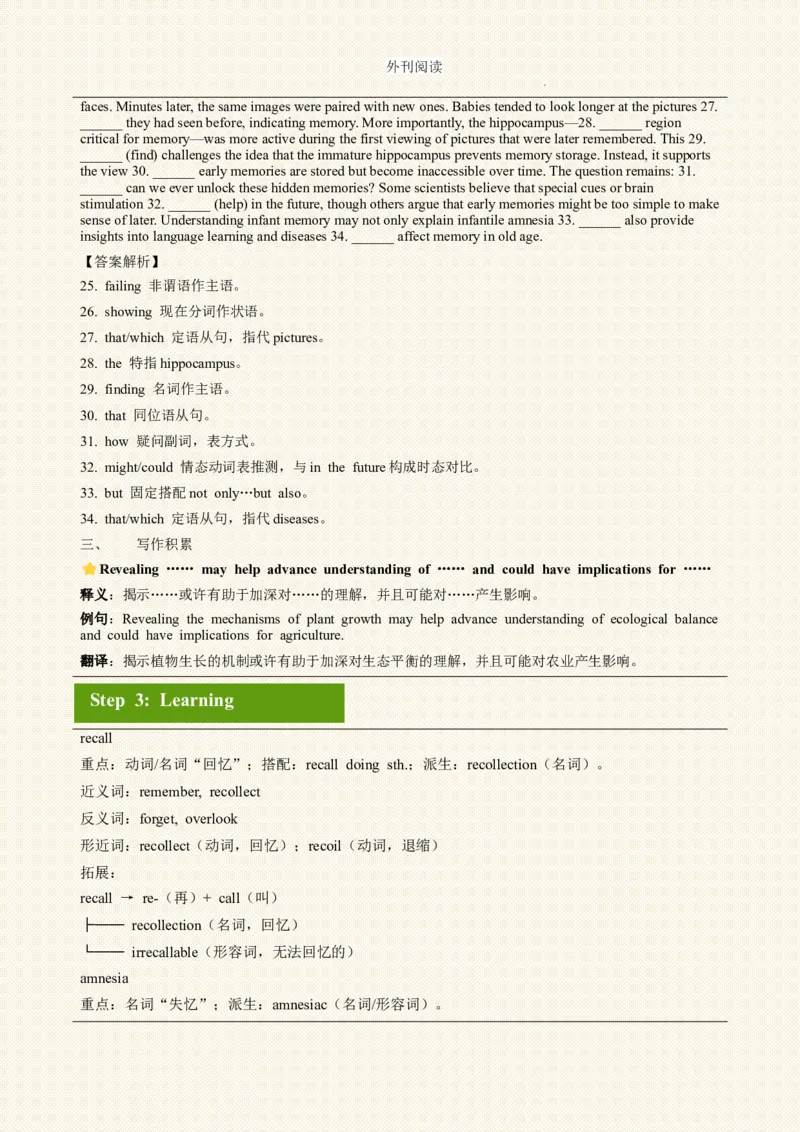
faces. Minutes later, the same images were paired with new ones. Babies tended to look longer at the pictures 27.
______ they had seen before, indicating memory. More importantly, the hippocampus—28. ______ region
critical for memory—was more active during the first viewing of pictures that were later remembered. This 29.
______ (find) challenges the idea that the immature hippocampus prevents memory storage. Instead, it supports
the view 30. ______ early memories are stored but become inaccessible over time. The question remains: 31.
______ can we ever unlock these hidden memories? Some scientists believe that special cues or brain
stimulation 32. ______ (help) in the future, though others argue that early memories might be too simple to make
sense of later. Understanding infant memory may not only explain infantile amnesia 33. ______ also provide
insights into language learning and diseases 34. ______ affect memory in old age.
【答案解析】
25. failing 非谓语作主语。
26. showing 现在分词作状语。
27. that/which 定语从句,指代pictures。
28. the 特指hippocampus。
29. finding 名词作主语。
30. that 同位语从句。
31. how 疑问副词,表方式。
32. might/could 情态动词表推测,与in the future 构成时态对比。
33. but 固定搭配not only…but also。
34. that/which 定语从句,指代diseases。
三、
写作积累
⭐️Revealing …… may help advance understanding of …… and could have implications for ……
释义:揭示……或许有助于加深对……的理解,并且可能对……产生影响。
例句:Revealing the mechanisms of plant growth may help advance understanding of ecological balance
and could have implications for agriculture.
翻译:揭示植物生长的机制或许有助于加深对生态平衡的理解,并且可能对农业产生影响。
recall
重点:动词/名词“回忆”;搭配:recall doing sth.;派生:recollection(名词)。
近义词:remember, recollect
反义词:forget, overlook
形近词:recollect(动词,回忆);recoil(动词,退缩)
拓展:
recall → re-(再)+ call(叫)
├── recollection(名词,回忆)
└── irrecallable(形容词,无法回忆的)
amnesia
重点:名词“失忆”;派生:amnesiac(名词/形容词)。
Step 3: Learning
外刊阅读
学科网(北京)股份有限公司
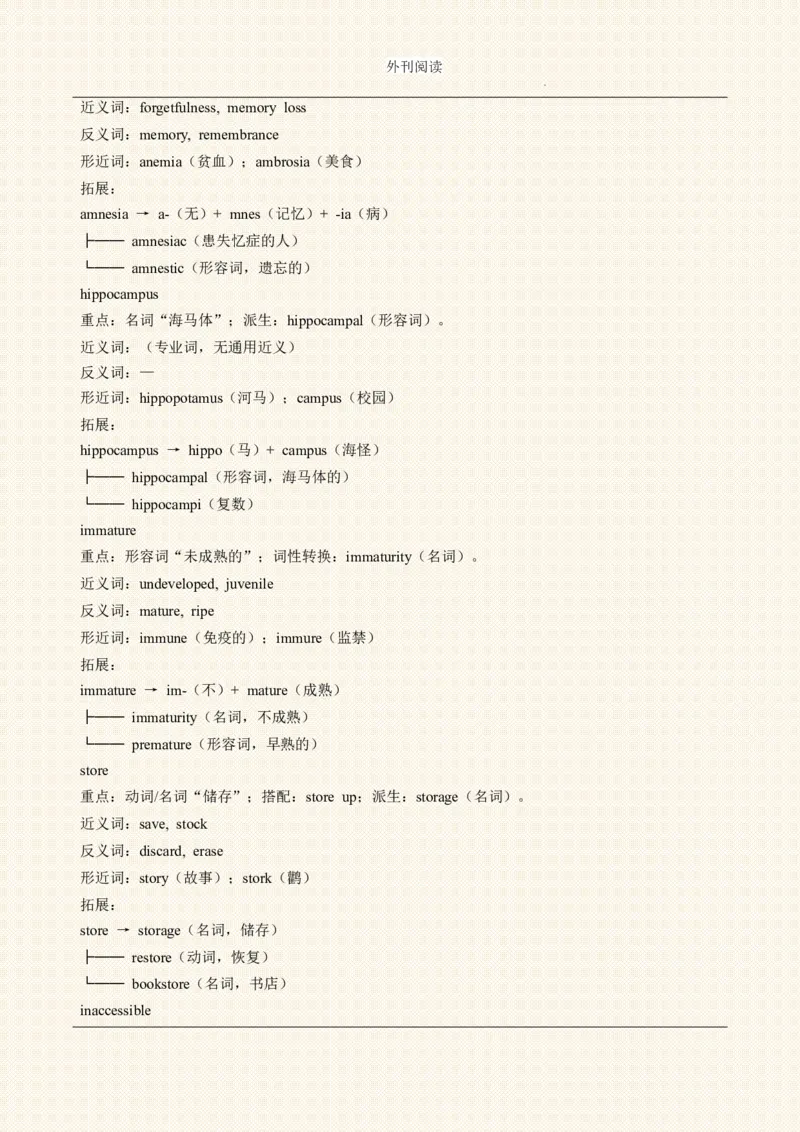
近义词:forgetfulness, memory loss
反义词:memory, remembrance
形近词:anemia(贫血);ambrosia(美食)
拓展:
amnesia → a-(无)+ mnes(记忆)+ -ia(病)
├── amnesiac(患失忆症的人)
└── amnestic(形容词,遗忘的)
hippocampus
重点:名词“海马体”;派生:hippocampal(形容词)。
近义词:(专业词,无通用近义)
反义词:—
形近词:hippopotamus(河马);campus(校园)
拓展:
hippocampus → hippo(马)+ campus(海怪)
├── hippocampal(形容词,海马体的)
└── hippocampi(复数)
immature
重点:形容词“未成熟的”;词性转换:immaturity(名词)。
近义词:undeveloped, juvenile
反义词:mature, ripe
形近词:immune(免疫的);immure(监禁)
拓展:
immature → im-(不)+ mature(成熟)
├── immaturity(名词,不成熟)
└── premature(形容词,早熟的)
store
重点:动词/名词“储存”;搭配:store up;派生:storage(名词)。
近义词:save, stock
反义词:discard, erase
形近词:story(故事);stork(鹳)
拓展:
store → storage(名词,储存)
├── restore(动词,恢复)
└── bookstore(名词,书店)
inaccessible
外刊阅读
学科网(北京)股份有限公司
重点:形容词“无法接近的”;派生:accessibility(名词)。
近义词:unreachable, unavailable
反义词:accessible, obtainable
形近词:inadmissible(不可接受的);inaccurate(不精确的)
拓展:
inaccessible → in-(不)+ access(接近)+ -ible
├── accessibility(名词,可及性)
└── accessible(形容词,可接近的)
retrieve
重点:动词“重新获得”;搭配:retrieve information;派生:retrieval(名词)。
近义词:recover, regain
反义词:lose, misplace
形近词:receive(收到);relieve(缓解)
拓展:
retrieve → re-(再)+ triev(找到)+ -e
├── retrieval(名词,检索)
└── retrievable(形容词,可检索的)
scan
重点:动词/名词“扫描”;搭配:brain scan;派生:scanner(名词)。
近义词:examine, inspect
反义词:ignore, overlook
形近词:scant(不足的);scar(伤疤)
拓展:
scan → scanner(名词,扫描仪)
├── scanning(动名词,扫描)
└── rescanned(动词过去分词,重新扫描)
motion
重点:名词“运动”;固定搭配:in motion;派生:motionless(形容词)。
近义词:movement, activity
反义词:stillness, inertia
形近词:notion(概念);emotion(情感)
拓展:
motion → mot(移动)+ -ion
├── motionless(形容词,静止的)
└── promote(动词,促进)
外刊阅读
学科网(北京)股份有限公司
reflect
重点:动词“反射;反思”;搭配:reflect on;派生:reflection(名词)。
近义词:mirror, ponder
反义词:absorb, ignore
形近词:reflex(反射);deflect(偏转)
拓展:
reflect → re-(回)+ flect(弯曲)
├── reflection(名词,反思)
├── reflective(形容词,反思的)
└── deflect(动词,使偏转)
region
重点:名词“区域”;搭配:brain region;派生:regional(形容词)。
近义词:area, zone
反义词:whole, entirety
形近词:religion(宗教);regimen(养生法)
拓展:
region → regional(形容词,区域的)
└── regionalism(名词,地方主义)
indicate
重点:动词“表明”;派生:indication(名词)。
近义词:suggest, show
反义词:conceal, contradict
形近词:indict(起诉);intimate(暗示)
拓展:
indicate → in-(向内)+ dic(说)+ -ate
├── indication(名词,指示)
├── indicator(名词,指示器)
└── indicative(形容词,指示的)
crucial
重点:形容词“至关重要的”;搭配:crucial to/for。
近义词:vital, critical
反义词:trivial, minor
形近词:crucible(坩埚);crucifix(十字架)
拓展:
crucial → cruc(十字)+ -ial
外刊阅读
学科网(北京)股份有限公司
├── crucifixion(名词,钉十字架)
└── cruciform(形容词,十字形的)
episode
重点:名词“片段”;派生:episodic(形容词)。
近义词:incident, event
反义词:continuum, whole
形近词:epidemic(流行病);epitome(缩影)
拓展:
episode → episodic(形容词,片段的)
├── episodically(副词,片段地)
└── epic(形容词,史诗的)
mystery
重点:名词“谜”;派生:mysterious(形容词)。
近义词:puzzle, enigma
反义词:clarity, explanation
形近词:mastery(精通);misery(痛苦)
拓展:
mystery → myst(神秘)+ -ery
├── mysterious(形容词,神秘的)
└── mystify(动词,使迷惑)
shed light on
重点:短语“阐明”;常考替换:throw light on。
近义词:clarify, explain
反义词:obscure, cloud
形近词:—
拓展:
shed → shedding(动名词,脱落)
├── watershed(名词,分水岭)
└── woodshed(名词,柴房)
disorder
重点:名词“紊乱”;搭配:developmental disorder;派生:disordered(形容词)。
近义词:ailment, disease
反义词:order, health
形近词:border(边界);order(顺序)
外刊阅读
学科网(北京)股份有限公司
拓展:
disorder → dis-(不)+ order(顺序)
├── disorderly(形容词,混乱的)
└── reorder(动词,重新排序)
affect
重点:动词“影响”;与effect(名词)常考辨析。
近义词:influence, impact
反义词:ignore, spare
形近词:effect(名词,效果);infect(感染)
拓展:
affect → affective(形容词,情感的)
├── affection(名词,喜爱)
└── unaffected(形容词,不受影响的)
remain
重点:系动词“仍然”;搭配:remain hidden;派生:remainder(名词)。
近义词:stay, continue
反义词:disappear, vanish
形近词:remind(提醒);realm(领域)
拓展:
remain → remainder(名词,剩余物)
├── remaining(形容词,剩余的)
└── remains(名词,残骸)
evidence
重点:名词“证据”;搭配:provide evidence;派生:evident(形容词)。
近义词:proof, indication
反义词:disproof, refutation
形近词:evident(明显的);evidence-based(循证的)
拓展:
evidence → e-(出)+ vid(看)+ -ence
├── evident(形容词,明显的)
├── evidentiary(形容词,证据的)
└── self-evident(形容词,不言自明的)
Step 4: Complex Sentence
外刊阅读
学科网(北京)股份有限公司
长难句1:
原句: Recent work on mice supports the second idea, that memories are stored early
but become inaccessible later, much like forgotten files on a computer.
汉语翻译: 最近的小鼠研究支持第二种观点:记忆在生命早期就被储存,但随后变得无法读取,就
像电脑中被遗忘的文件一样。
层级结构图:
Recent work on mice (主语)
o
supports (谓语)
the second idea (宾语)
→ that memories are stored early but become inaccessible
later (同位语从句,解释idea)
→ much like forgotten files on a computer (状语,修饰整
句)
长难句2:
原句: These findings indicate that the infant brain is already laying down
memories, yet most of them remain locked away for life, and whether we could ever
unlock them remains an open question.
汉语翻译: 这些发现表明,婴儿大脑已经在储存记忆,然而其中大多数终生被锁住,而我们是否能
够解锁它们仍是一个未解之谜。
层级结构图:
These findings (主语)
o
indicate (谓语)
that-clause (宾语从句)
the infant brain (从句主语)
is already laying down memories (从句谓语+宾语)
→ yet most of them remain locked away for life (转折并列
分句)
→ and whether we could ever unlock them remains an
open question (并列分句,主语为whether-主语从句)
序号
英语
汉语
序号
英语
汉语
序号
英语
汉语
1
recall
8
scan
15
mystery
2
amnesia
9
motion
16
shed light
on
3
hippocampus
10
reflect
17
disorder
4
immature
11
region
18
affect
Step 5: Review
外刊阅读
学科网(北京)股份有限公司
5
store
12
indicate
19
remain
6
inaccessible
13
crucial
20
evidence
7
retrieve
14
episode
大多数成年人无法回忆起四岁以前的经历,这段空白被称为“婴儿期遗忘”。对此,学界提出
了两种主要解释。第一种归咎于尚未成熟的海马体——大脑深处一个对记忆至关重要的区域。按此
观点,婴儿与那些因该区域受损而丧失记忆储存能力的成年病人无异。第二种则认为,记忆其实早
在婴儿期就已形成,只是后来变得无法读取,就像电脑里被遗忘的文件。
近期对老鼠的研究支持了第二种观点。通过刺激海马体内的特定神经元,科学家成功唤回了那
些看似已消失的记忆。然而,人类婴儿究竟能不能形成记忆呢?
十年来,我们实验室一直致力于用功能性磁共振成像(fMRI)扫描清醒的婴儿。与熟睡的婴儿
不同,醒着的他们常常扭动、哭闹,不听指令。经过四百多次尝试,我们设计出游戏、儿歌和小镜
子,让他们既安静又开心。
在特里斯坦·耶茨主持的这项最新研究中,我们给一岁左右的婴儿观看人脸、物品和场景的图
片,同时记录海马体的活动。几分钟后,每张熟悉的图片都与同类的新图配对出现。婴儿对自己见
过的照片注视时间更长,这是记忆存在的标志。回溯脑数据,我们发现:后来能被记住的图片,在
首次呈现时海马体反应更强。这种效应在12 个月以上的婴儿中最为明显,且集中在成年情景记忆
所依赖的海马体亚区。
这些发现表明,婴儿大脑已在“存档”记忆,但这些记忆大多终生封存。它们为何深藏不露?
我们能否有朝一日解锁它们?仍是未解之谜。破解这一谜团或许能为我们理解语言习得、发育障碍
乃至老年记忆衰退带来新的曙光。
Step 6: Translate