试题第1页(共12页)
试题第2页(共12页)
………………○………………内………………○………………装………………○………………订………………○………………线………………○………………
………………○………………外………………○………………装………………○………………订………………○………………线………………○………………
…
学校:______________姓名:_____________班级:_______________考号:______________________
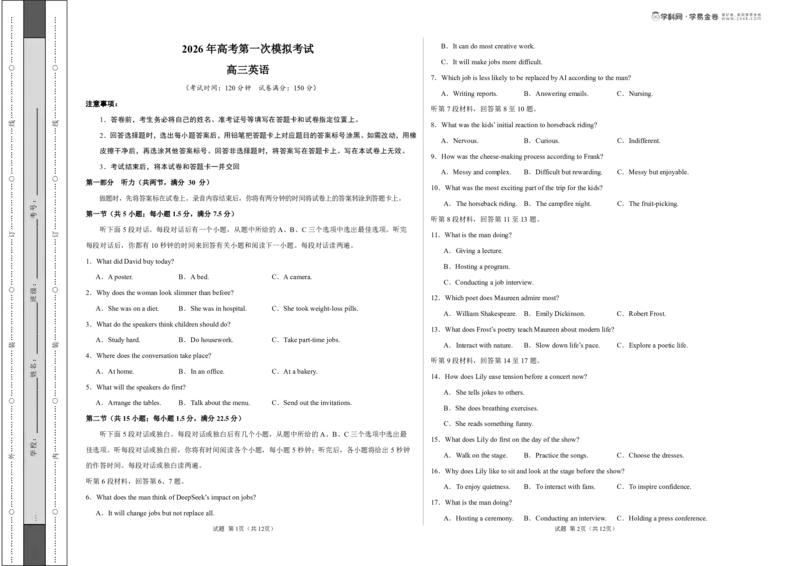
2026 年高考第一次模拟考试
高三英语
(考试时间:120 分钟
试卷满分:150 分)
注意事项:
1.答卷前,考生务必将自己的姓名、准考证号等填写在答题卡和试卷指定位置上。
2.回答选择题时,选出每小题答案后,用铅笔把答题卡上对应题目的答案标号涂黑。如需改动,用橡
皮擦干净后,再选涂其他答案标号。回答非选择题时,将答案写在答题卡上。写在本试卷上无效。
3.考试结束后,将本试卷和答题卡一并交回
第一部分
听力(共两节,满分30 分)
做题时,先将答案标在试卷上。录音内容结束后,你将有两分钟的时间将试卷上的答案转涂到答题卡上。
第一节(共5 小题;每小题1.5 分,满分7.5 分)
听下面5 段对话。每段对话后有一个小题,从题中所给的A、B、C 三个选项中选出最佳选项。听完
每段对话后,你都有10 秒钟的时间来回答有关小题和阅读下一小题。每段对话读两遍。
1.What did David buy today?
A.A poster.
B.A bed.
C.A camera.
2.Why does the woman look slimmer than before?
A.She was on a diet.
B.She was in hospital.
C.She took weight-loss pills.
3.What do the speakers think children should do?
A.Study hard.
B.Do housework.
C.Take part-time jobs.
4.Where does the conversation take place?
A.At home.
B.In an office.
C.At a bakery.
5.What will the speakers do first?
A.Arrange the tables.
B.Talk about the menu.
C.Send out the invitations.
第二节(共15 小题;每小题1.5 分,满分22.5 分)
听下面5 段对话或独白。每段对话或独白后有几个小题,从题中所给的A、B、C 三个选项中选出最
佳选项。听每段对话或独白前,你将有时间阅读各个小题,每小题5 秒钟;听完后,各小题将给出5 秒钟
的作答时间。每段对话或独白读两遍。
听第6 段材料,回答第6、7 题。
6.What does the man think of DeepSeek’s impact on jobs?
A.It will change jobs but not replace all.
B.It can do most creative work.
C.It will make jobs more difficult.
7.Which job is less likely to be replaced by AI according to the man?
A.Writing reports.
B.Answering emails.
C.Nursing.
听第7 段材料,回答第8 至10 题。
8.What was the kids’ initial reaction to horseback riding?
A.Nervous.
B.Curious.
C.Indifferent.
9.How was the cheese-making process according to Frank?
A.Messy and complex.
B.Difficult but rewarding.
C.Messy but enjoyable.
10.What was the most exciting part of the trip for the kids?
A.The horseback riding.
B.The campfire night.
C.The fruit-picking.
听第8 段材料,回答第11 至13 题。
11.What is the man doing?
A.Giving a lecture.
B.Hosting a program.
C.Conducting a job interview.
12.Which poet does Maureen admire most?
A.William Shakespeare.
B.Emily Dickinson.
C.Robert Frost.
13.What does Frost’s poetry teach Maureen about modern life?
A.Interact with nature.
B.Slow down life’s pace.
C.Explore a poetic life.
听第9 段材料,回答第14 至17 题。
14.How does Lily ease tension before a concert now?
A.She tells jokes to others.
B.She does breathing exercises.
C.She reads something funny.
15.What does Lily do first on the day of the show?
A.Walk on the stage.
B.Practice the songs.
C.Choose the dresses.
16.Why does Lily like to sit and look at the stage before the show?
A.To enjoy quietness.
B.To interact with fans.
C.To inspire confidence.
17.What is the man doing?
A.Hosting a ceremony.
B.Conducting an interview.
C.Holding a press conference.
{#{QQABCQIQogCoAIJAARgCAwVQCAAYkACAAIgGhAAcIAABwQFABAA=}#}
试题第3页(共12页)
试题第4页(共12页)
………………○………………内………………○………………装………………○………………订………………○………………线………………○………………
此
卷
只
装
订
不
密
封
………………○………………外………………○………………装………………○………………订………………○………………线………………○………………
听第10 段材料,回答第18 至20 题。
18.Which is the most famous book of Mr. Carle?
A.The Grouchy Ladybug.
B.The Mixed-Up Chameleon.
C.The Very Hungry Caterpillar.
19.Where was Mr. Carle born?
A.In Britain.
B.In Germany.
C.In America.
20.What has a great influence on Mr. Carle’s books?
A.His work environment. B.His life with his father.
C.His education experience.
第二部分
阅读(共两节, 满分50 分)
第一节(共15 小题;每小题2.5 分, 满分37.5 分)
阅读下列短文, 从每题所给的A、B、C 和D 四个选项中选出最佳选项。
A
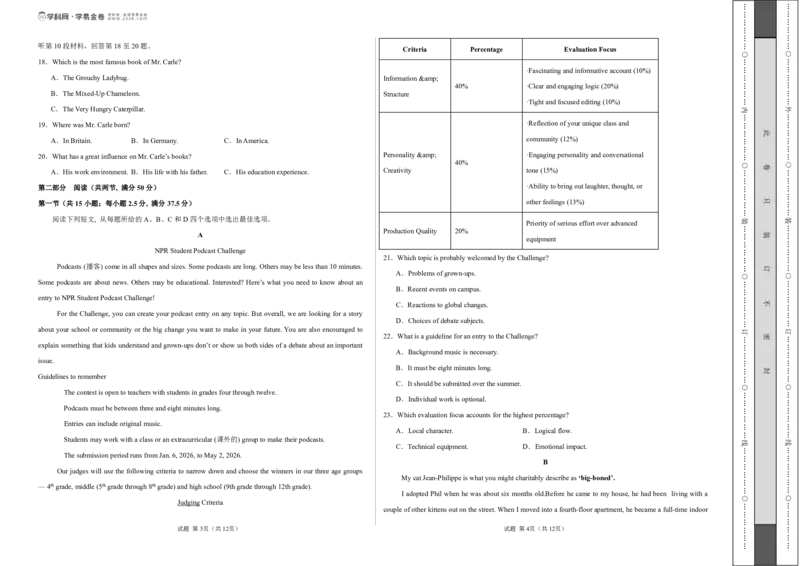
NPR Student Podcast Challenge
Podcasts (播客) come in all shapes and sizes. Some podcasts are long. Others may be less than 10 minutes.
Some podcasts are about news. Others may be educational. Interested? Here’s what you need to know about an
entry to NPR Student Podcast Challenge!
For the Challenge, you can create your podcast entry on any topic. But overall, we are looking for a story
about your school or community or the big change you want to make in your future. You are also encouraged to
explain something that kids understand and grown-ups don’t or show us both sides of a debate about an important
issue.
Guidelines to remember
The contest is open to teachers with students in grades four through twelve.
Podcasts must be between three and eight minutes long.
Entries can include original music.
Students may work with a class or an extracurricular (课外的) group to make their podcasts.
The submission period runs from Jan. 6, 2026, to May 2, 2026.
Our judges will use the following criteria to narrow down and choose the winners in our three age groups
— 4th grade, middle (5th grade through 8th grade) and high school (9th grade through 12th grade).
Judging Criteria
Criteria
Percentage
Evaluation Focus
Information &
Structure
40%
·Fascinating and informative account (10%)
·Clear and engaging logic (20%)
·Tight and focused editing (10%)
Personality &
Creativity
40%
·Reflection of your unique class and
community (12%)
·Engaging personality and conversational
tone (15%)
·Ability to bring out laughter, thought, or
other feelings (13%)
Production Quality
20%
Priority of serious effort over advanced
equipment
21.Which topic is probably welcomed by the Challenge?
A.Problems of grown-ups.
B.Recent events on campus.
C.Reactions to global changes.
D.Choices of debate subjects.
22.What is a guideline for an entry to the Challenge?
A.Background music is necessary.
B.It must be eight minutes long.
C.It should be submitted over the summer.
D.Individual work is optional.
23.Which evaluation focus accounts for the highest percentage?
A.Local character.
B.Logical flow.
C.Technical equipment.
D.Emotional impact.
B
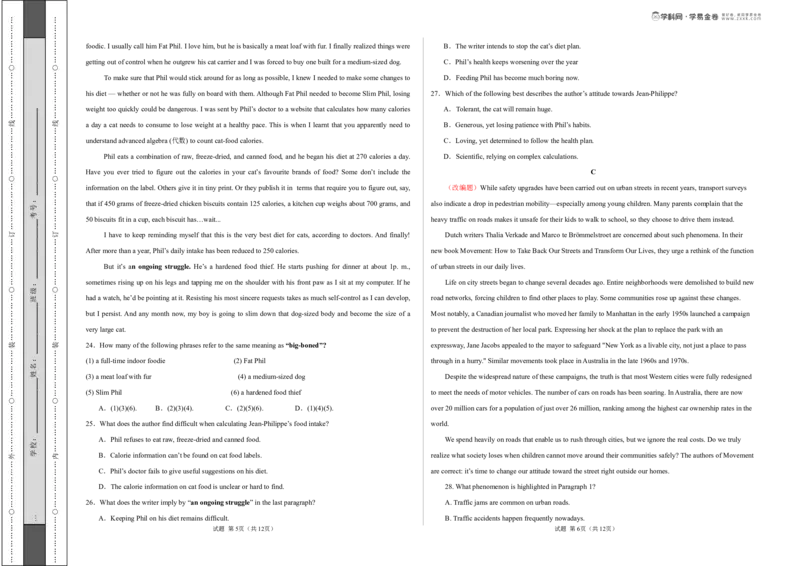
My cat Jean-Philippe is what you might charitably describe as ‘big-boned’.
I adopted Phil when he was about six months old.Before he came to my house, he had been living with a
couple of other kittens out on the street. When I moved into a fourth-floor apartment, he became a full-time indoor
{#{QQABCQIQogCoAIJAARgCAwVQCAAYkACAAIgGhAAcIAABwQFABAA=}#}
试题第5页(共12页)
试题第6页(共12页)
………………○………………内………………○………………装………………○………………订………………○………………线………………○………………
………………○………………外………………○………………装………………○………………订………………○………………线………………○………………
…
学校:______________姓名:_____________班级:_______________考号:______________________
foodic. I usually call him Fat Phil. I love him, but he is basically a meat loaf with fur. I finally realized things were
getting out of control when he outgrew his cat carrier and I was forced to buy one built for a medium-sized dog.
To make sure that Phil would stick around for as long as possible, I knew I needed to make some changes to
his diet — whether or not he was fully on board with them. Although Fat Phil needed to become Slim Phil, losing
weight too quickly could be dangerous. I was sent by Phil’s doctor to a website that calculates how many calories
a day a cat needs to consume to lose weight at a healthy pace. This is when I learnt that you apparently need to
understand advanced algebra (代数) to count cat-food calories.
Phil eats a combination of raw, freeze-dried, and canned food, and he began his diet at 270 calories a day.
Have you ever tried to figure out the calories in your cat’s favourite brands of food? Some don’t include the
information on the label. Others give it in tiny print. Or they publish it in terms that require you to figure out, say,
that if 450 grams of freeze-dried chicken biscuits contain 125 calories, a kitchen cup weighs about 700 grams, and
50 biscuits fit in a cup, each biscuit has…wait...
I have to keep reminding myself that this is the very best diet for cats, according to doctors. And finally!
After more than a year, Phil’s daily intake has been reduced to 250 calories.
But it’s an ongoing struggle. He’s a hardened food thief. He starts pushing for dinner at about 1p. m.,
sometimes rising up on his legs and tapping me on the shoulder with his front paw as I sit at my computer. If he
had a watch, he’d be pointing at it. Resisting his most sincere requests takes as much self-control as I can develop,
but I persist. And any month now, my boy is going to slim down that dog-sized body and become the size of a
very large cat.
24.How many of the following phrases refer to the same meaning as “big-boned”?
(1) a full-time indoor foodie
(2) Fat Phil
(3) a meat loaf with fur
(4) a medium-sized dog
(5) Slim Phil
(6) a hardened food thief
A.(1)(3)(6).
B.(2)(3)(4).
C.(2)(5)(6).
D.(1)(4)(5).
25.What does the author find difficult when calculating Jean-Philippe’s food intake?
A.Phil refuses to eat raw, freeze-dried and canned food.
B.Calorie information can’t be found on cat food labels.
C.Phil’s doctor fails to give useful suggestions on his diet.
D.The calorie information on cat food is unclear or hard to find.
26.What does the writer imply by “an ongoing struggle” in the last paragraph?
A.Keeping Phil on his diet remains difficult.
B.The writer intends to stop the cat’s diet plan.
C.Phil’s health keeps worsening over the year
D.Feeding Phil has become much boring now.
27.Which of the following best describes the author’s attitude towards Jean-Philippe?
A.Tolerant, the cat will remain huge.
B.Generous, yet losing patience with Phil’s habits.
C.Loving, yet determined to follow the health plan.
D.Scientific, relying on complex calculations.
C
(改编题)While safety upgrades have been carried out on urban streets in recent years, transport surveys
also indicate a drop in pedestrian mobility—especially among young children. Many parents complain that the
heavy traffic on roads makes it unsafe for their kids to walk to school, so they choose to drive them instead.
Dutch writers Thalia Verkade and Marco te Brömmelstroet are concerned about such phenomena. In their
new book Movement: How to Take Back Our Streets and Transform Our Lives, they urge a rethink of the function
of urban streets in our daily lives.
Life on city streets began to change several decades ago. Entire neighborhoods were demolished to build new
road networks, forcing children to find other places to play. Some communities rose up against these changes.
Most notably, a Canadian journalist who moved her family to Manhattan in the early 1950s launched a campaign
to prevent the destruction of her local park. Expressing her shock at the plan to replace the park with an
expressway, Jane Jacobs appealed to the mayor to safeguard "New York as a livable city, not just a place to pass
through in a hurry." Similar movements took place in Australia in the late 1960s and 1970s.
Despite the widespread nature of these campaigns, the truth is that most Western cities were fully redesigned
to meet the needs of motor vehicles. The number of cars on roads has been soaring. In Australia, there are now
over 20 million cars for a population of just over 26 million, ranking among the highest car ownership rates in the
world.
We spend heavily on roads that enable us to rush through cities, but we ignore the real costs. Do we truly
realize what society loses when children cannot move around their communities safely? The authors of Movement
are correct: it’s time to change our attitude toward the street right outside our homes.
28. What phenomenon is highlighted in Paragraph 1?
A. Traffic jams are common on urban roads.
B. Traffic accidents happen frequently nowadays.
{#{QQABCQIQogCoAIJAARgCAwVQCAAYkACAAIgGhAAcIAABwQFABAA=}#}
试题第7页(共12页)
试题第8页(共12页)
………………○………………内………………○………………装………………○………………订………………○………………线………………○………………
此
卷
只
装
订
不
密
封
………………○………………外………………○………………装………………○………………订………………○………………线………………○………………
C. People tend to drive more rather than walk.
D. Pedestrians often break traffic rules.
29. What was the goal of the Canadian journalist and other campaigners?
A. To maintain the livability of their cities.
B. To promote cultural diversity in urban areas.
C. To provide assistance for needy families.
D. To improve access to expressways.
30. What can be inferred about the Australian campaigns in the late 1960s and 1970s?
A. They led to a rise in car sales.
B. They achieved little in the end.
C. They gained official support.
D. They advocated building more parks.
31. Which of the following is a suitable title for the text?
A. Why the Rush?
B. What’s Next for Cities?
C. Where to Settle Down?
D. Who Is to Blame?
D
Are you happy? What does occur to me is that there is more to life than simply the pursuit of happiness.
Imagine that scientists have invented a machine that can be hooked (钩) up to your brain so that it can give
you every pleasurable experience you could ever want. These scientists have designed it so that you can’t
distinguish between those pleasurable feelings you have yourself and those that come from the machine, making
you blessedly unaware you are actually floating in a tank, with electrodes (电极) in your brain.
So, offered the chance to be hooked up to the machine for the rest of your life, would you choose the
machine or real life? The vast majority of people would choose real life, despite some discomfort, sorrow, and
upset. This thought-experiment aimed to show that there is something other than pure pleasure that gives our lives
meaning. As humans, we need contrast in our emotions - the dark to make the light much brighter for us.
Was Michelangelo happy when he was painting the Sistine Chapel? No one really knows, but he was
probably quite frustrated and angry at times as well as bored, lonely and tired. He might have neck pain for most
of it from looking up to paint for hours. But he didn’t do it to feel happy. It gave him a strong sense of purpose,
meaning and accomplishment. Surely this is what is at the heart of what drives us.
What’s also interesting is that it’s hard to say whether we really are happy or not. A psychiatry professor
said that happiness is often experienced in retrospect — we look back on a time of our lives, an event or a moment
and recall it with happiness. When we say we were happy in a relationship, for example, what we often mean is
that recalling that relationship gives us happiness now.
32.What is the function of the machine mentioned in paragraph 2?
A.Creating desired pleasure.
B.Boosting your brain power.
C.Detecting the surroundings.
D.Helping you identify feelings.
33.Why does the author mention Michelangelo and his creation?
A.To prove the impact of creativity.
B.To recognize his contribution to art.
C.To inspire other artists to work harder.
D.To show the importance of emotional contrast.
34.What does the underlined word “retrospect” in paragraph 5 mean?
A.A review.
B.A procedure.
C.A condition.
D.A scene.
35.What does the author intend to convey in the passage?
A.Life highlights hope.
B.Life goes beyond happiness.
C.Life calls for rapid action.
D.Life reflects your thoughts.
第二节(共5 小题;每小题2. 5 分, 满分12. 5 分)
阅读下面短文, 从短文后的选项中选出可以填入空白处的最佳选项。选项中有两项为多余选项。
(原创题)A Silent Guardian of the Campus Library
Looking for a quiet spot to study or borrow a reference book for your term paper? The campus library is
always the first choice for most students.
36
Behind this well-organized and peaceful space stands an
unsung hero—Ms. Lin, the library assistant.
Dressed in a neat gray uniform, Ms. Lin is always busy with her work. She sorts out returned books and
shelves them in the correct sections with great care.
37
When students can’t find the books they need,
she patiently guides them to use the search system or even helps them look for the books in the storage room.
Ms. Lin arrives at the library at 7:30 every morning, an hour before it opens.
38
“I need to make
sure everything is in order before students come,” she once said in an interview. Her dedication also shows in
small details: she keeps a box of tissues and a first-aid kit at the front desk for students in need.
What students appreciate most about Ms. Lin is her warm and caring attitude. Li Hua, a sophomore majoring
in Chinese literature, visits the library almost every day.
39
“Once I forgot my laptop charger and
{#{QQABCQIQogCoAIJAARgCAwVQCAAYkACAAIgGhAAcIAABwQFABAA=}#}
试题第9页(共12页)
试题第10页(共12页)
………………○………………内………………○………………装………………○………………订………………○………………线………………○………………
………………○………………外………………○………………装………………○………………订………………○………………线………………○………………
…
学校:______________姓名:_____________班级:_______________考号:______________________
was worried about my paper. Ms. Lin lent me her own charger without hesitation. Her kindness really made my
day,” he recalled.
Ms. Lin has been working in the campus library for 20 years.
40
She often says that seeing
students gain knowledge and grow here is the greatest reward for her. For her, this is not just a job, but a lifelong
commitment to supporting young people’s dreams.
A. She also checks the condition of the reading areas regularly.
B. She hopes to continue working here until she retires.
C. The library provides a comfortable environment for learning.
D. Many students consider her a friend rather than just a library assistant.
E. Sometimes she even prepares hot water for students on cold winter days.
F. It not only offers a large collection of books but also a warm atmosphere.
G. She spends the first hour cleaning the front desk and organizing the borrowing records.
第三部分语言运用(共两节,满分30 分)
第一节(共15 小题,每小题1 分,满分15 分)
阅读下面短文, 从每题所给的A、B、C 和D 四个选项中选出可以填入空白处的最佳选项。
A new study confirms that technologies installed to remove Per-and polyfluoroalkyl substances (PFAS)from
drinking water are highly effective at removing other harmful pollutants, such as trihalomethanes (三卤甲烷) and
haloacetic acids (卤乙酸).The finding
41
the argument for investing in these advanced water treatment
systems.
PFAS are a class of thousands of
42
compounds that do not easily break down in the
environment. They are linked to a range of serious
43
problems, including various cancers and
developmental delays. Their
44
presence is a major concern: a 2023 U.S. Geological Survey study
estimated that up to 45% of tap water could contain at least one PFAS chemical. So, the systems’ removal of PFAS
is of great significance. Additionally, new research from the Environmental Working Group
45
other
benefits. By analyzing data from 19 water systems that installed PFAS treatment, the study compared
46
of disinfection byproducts before and after installation. The results showed a clear reduction: trihalomethanes
decreased by an average of 42 percent; haloacetic acids by 50 percent. Long-term
47
to these
byproducts is linked to certain cancers, and getting rid of them could prevent thousands of illnesses.
48
the administration set the first-ever national legal limits on six specific PFAS chemicals in
drinking water, requiring that water suppliers meet the standard by 2029.
Just like in most cases, application of the rule faces difficulties. While experts confirm wider benefits of the
treatment systems, they also note that real-world results can
49
due to factors like seasonal differences
and diverse sources of pollution.
That’s only a minor problem; some major ones await our resolution. There were
50
from water
suppliers about the huge expected costs of installing these facilities. Afterwards, the Environmental Protection
Agency announced in May 2024 that it would
51
the rule — set limits to four of the six PFAS and
extend the deadline by two years. This
52
has created uncertainty in regulation and slowed down action.
Besides, a study showed a great
53
in adoption — only 7% of the systems are equipped with advanced
filtration (过滤) function and they serve fewer than 500 people; in contrast, the rest serve over 100,000 people in
rural or
54
communities — areas without sufficient financial assistance.
The central question now is one of
55
.Technology exists and offers proven benefits, but do we
have the resolve to enact strong policies and ensure financial support?
41.A.contradicts
B.involves
C.strengthens
D.challenges
42.A.long-lasting
B.fast-acting
C.easily-degraded
D.man-made
43.A.security
B.health
C.environment
D.growth
44.A.permanent
B.restricted
C.temporary
D.widespread
45.A.guaranteed
B.attained
C.revealed
D.maximized
46.A.sources
B.functions
C.categories
D.concentrations
47.A.resistance
B.solution
C.addiction
D.exposure
48.A.In response
B.By contrast
C.After all
D.For example
49.A.solidify
B.vary
C.worsen
D.persist
50.A.complaints
B.proposals
C.comments
D.welcomes
51.A.enforce
B.revise
C.abandon
D.tighten
52.A.association
B.hesitation
C.move
D.mess
53.A.conflict
B.divide
C.unity
D.likelihood
54.A.high-population
B.large-scale
C.under-resourced D.over-developed
55.A.technology
B.finance
C.efficiency
D.commitment
第二节(共10 小题;每小题1.5 分,满分15 分)
阅读下面短文,在空白处填入1 个适当的单词或括号内单词的正确形式。
(原创题)Suzhou Embroidery (苏绣), one of China's four famous embroideries,
56
(list) as an intangible
cultural heritage by UNESCO in 2006. With a history of over 2,000 years, it is famous for its delicate stitches (针
法) and vivid patterns,
57
can show the beauty of nature and human life perfectly.
{#{QQABCQIQogCoAIJAARgCAwVQCAAYkACAAIgGhAAcIAABwQFABAA=}#}
试题第11页(共12页)
试题第12页(共12页)
………………○………………内………………○………………装………………○………………订………………○………………线………………○………………
此
卷
只
装
订
不
密
封
………………○………………外………………○………………装………………○………………订………………○………………线………………○………………
Chen Xue, a young inheritor of Suzhou Embroidery,
58
(learn) the craft from her grandmother since she
was 10. She believes that traditional skills should not stay in the past. Instead, they need
59
(innovate) to adapt
to modern life. To make Suzhou Embroidery more popular among young people, Chen has combined modern
design concepts
60
traditional techniques. She has created many works that reflect contemporary themes, such
as urban landscapes and sports events.
One of her most famous works,
61
depicts the charm of Suzhou gardens, has won several national awards.
"Embroidery is not just a craft; it's a way to pass on our cultural memories," Chen said. She often gives lectures in
schools and communities, hoping
62
(arouse) young people's interest in this traditional art.
With the development of technology, many traditional crafts are facing challenges. However, Suzhou
Embroidery
63
(keep) its vitality through the efforts of inheritors like Chen. More and more young people are
starting to learn this craft,
64
(bring) new energy to its development.
Chen hopes that Suzhou Embroidery will not only be a symbol of Chinese culture but also become a bridge
for cultural exchange between China and other countries, allowing the world
65
(appreciate) the unique beauty
of Chinese traditional art.
第四部分写作(共两节, 满分40 分)
第一节(满分15 分)
假设你是明启中学高三学生李华。你的外国笔友Alex 正在准备一场以“Is AI a helpful study partner or a
source of distraction?”为主题的辩论赛。他需要收集世界各地同龄人的看法,并向你征求意见。请给他写
一封电子邮件,内容必须包括:
(1) 你认为AI 是学习的好伙伴还是危险的干扰;
(2) 结合自身经历阐述你的理由。
____________________________________________________________________________________________
____________________________________________________________________________________________
____________________________________________________________________________________________
____________________________________________________________________________________________
____________________________________________________________________________________________
____________________________________________________________________________________________
第二节(满分25 分)
阅读下面材料,根据其内容和所给段落开头语续写两段,使之构成一篇完整的短文。
Olly Powell’s seventh birthday wish to become invisible came true a week later with the birth of his sister,
Lily. Initially, the power felt like a brilliant secret. He could slip into the kitchen for an extra biscuit unnoticed, and
he loved listening from the hallway as his parents chatted amusedly about “that little mouse”. It was magic!
However, the joy was gone when Lily finally came home from the hospital. The reality was nothing like he
had expected. Now, he often stood invisible in the hall. His request for swimming lessons was gently declined by
his parents, who were busy with Lily. Being a big brother was the worst thing in the world. A deep sense of being
unseen settled in his heart.
Feeling left out, he made a decision. “I bet they’d love to see me at school,” he thought. He struggled to
open the front door and stepped outside. The street was quiet in the morning. He walked on, each step heavy with
a desperate, unspoken hope that someone would finally see him and call him back.
His journey ended when a sharp bark from Mrs. Cooper’s little dog, Teddy, made him look up. “Olly? You
aren’t here on your own, are you?” Mrs. Cooper called out, her kind face filled with concern. She led him gently
into her garden and phoned his father — who apologised for being so tied up with the new baby.
To pass the time while waiting, Mrs. Cooper showed Olly the incubator (孵化器) where several eggs were
kept. When he pointed out a fine crack (裂缝) on one of them, she explained it was a promising sign. Noticing
Teddy waiting patiently by the door, she added softly that the eggs currently required a great deal of her attention
— much like Lily — but Teddy understood he was still her good boy. Just then, a faint sound came from the
cracked shell. Olly leaned in, then looked up at Mrs. Cooper and Teddy, and for the first time all morning he did
not feel quite so alone.
注意:
(1) 续写词数应为150 左右;
(2) 请按如下格式在答题卡的相应位置作答。
Paragraph 1: Minutes later, Dad arrived, relieved to see Olly safe and sound.
____________________________________________________________________________________________
____________________________________________________________________________________________
____________________________________________________________________________________________
____________________________________________________________________________________________
__________________________________________________________________________________
Paragraph 2: Back home, Mum stood waiting with Lily asleep in her arms.
____________________________________________________________________________________________
____________________________________________________________________________________________
____________________________________________________________________________________________
____________________________________________________________________________________________
{#{QQABCQIQogCoAIJAARgCAwVQCAAYkACAAIgGhAAcIAABwQFABAA=}#}