绝密★考试结束前
2026 年高考第一次模拟考试(天津卷)
英语
(考试时间:100 分钟  试卷满分:130 分)
注意事项:
1.本试卷分第Ⅰ卷(选择题)和第Ⅱ卷(非选择题)两部分。答卷前,考生务必将自己的姓名、准考
证号填写在答题卡上。
2.回答第Ⅰ卷时,选出每小题答案后,用2B 铅笔把答题卡上对应题目的答案标号涂黑。如需改动,
用橡皮擦干净后,再选涂其他答案标号。写在本试卷上无效。
3.回答第Ⅱ卷时,将答案写在答题卡上。写在本试卷上无效。
4.考试结束后,将本试卷和答题卡一并交回。
第一部分:英语知识运用(共两节,满分45 分)
第一节:单项填空(共15 小题;每小题1 分,满分15 分)
从A、B、C、D 四个选项中,选出可以填入空白处的最佳选项。
1.— Skipping breakfast is a good way to lose weight.
—______. Actually it has the opposite effect.
A.I can’t agree more
B.That’s not the case
C.That’s it
D.I’m glad to know that
2.(热点话题)— Although we live in a peaceful country, there are still many areas of the world at war.
—I think we should ______ solving international dispute by negotiation instead of appealing to arms.
A.admit
B.approach
C.assess
D.advocate
3.Jason is telling kids something interesting in the living room. He ______ have had a brilliant journey in Beijing.
A.must
B.should
C.could
D.would
4.(新题材)Einstein liked Bose’s paper so much that he ________ his own work and translated it into German.
A.gave off
B.turned down
C.took over
D.set aside
5.These comments came ______________  specific questions often asked by local newsmen.
A.in memory of
B.in response to
C.in touch with
D.in possession of
6.______ going to study in the United States, Dahlia began to pack her luggage.
A.To approve of
B.Approving of
C.Having approved of
D.Having been approved of
7.(原创题)Many young people, most _________ were well-educated, headed for remote regions to chase their
dreams.
A.of which
B.of them
C.of whom
D.of those
8.The unexpected race result had the crowd ________ and then the thunderous applause burst out.
A.on the edge of the seat
B.ticking all the right boxes
C.in their own right
D.holding their horses
9.(改编题)Mr. Zhang, who is said to have moved to Beijing, _____ at No. 4 Middle School in our city for
thirty years.
A.has taught
B.is teaching
C.has been reaching
D.taught
10.Friends need to be frank with one another, so it is also possible and necessary to exchange ______ views in
time.
A.essential
B.potential
C.controversial
D.compulsory
11.The number of firms selling smartphones in this region ______ since last year.
A.dropped
B.was being dropped
C.have been dropping
D.has dropped
12.The exhibition tells us _____we should do something to stop air pollution.
A.where
B.why
C.what
D.which
13.When I entered the room, I found Emily seated quietly on the sofa, her eyes ______ on the storybook.
A.fixed
B.fixing
C.to fix
D.to be fixed
14.— Are you going to have your essay published?
—______ It’s too good an opportunity to miss.
A.No problem!
B.You bet.
C.What for?
D.Why bother?
15.______ the job takes a significant amount of time, most students agree that the experience is worth it.
A.If only
B.In that
C.Although
D.In case
第二节:完形填空(共20 小题;每小题1.5 分,满分30 分)
阅读下面短文,掌握其大意,然后从16-35 各题所给的A、B、C、D 四个选项中,选出最佳选项。
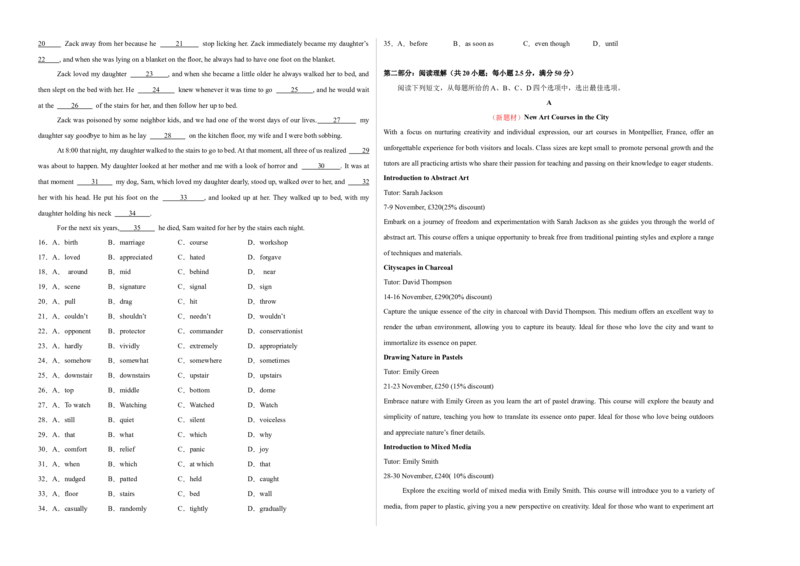
My wife and I owned two dogs that we had owned before we met and brought into the     16    . Her dog
was a pit bull named Zack, and he     17     me. When our daughter was born, I was worried that the pit bull
would be dangerous to be     18     our young daughter. I warned my wife that the dog would have to go at the
first     19     of trouble. I said, “If he nips (啃咬) at the baby, he’d go. ”
We brought our daughter home in a car seat, and both dogs sniffed and licked her, tails wagging. I had to
20     Zack away from her because he     21     stop licking her. Zack immediately became my daughter’s
22    , and when she was lying on a blanket on the floor, he always had to have one foot on the blanket.
Zack loved my daughter     23    , and when she became a little older he always walked her to bed, and
then slept on the bed with her. He     24     knew whenever it was time to go     25    , and he would wait
at the     26     of the stairs for her, and then follow her up to bed.
Zack was poisoned by some neighbor kids, and we had one of the worst days of our lives.    27     my
daughter say goodbye to him as he lay     28     on the kitchen floor, my wife and I were both sobbing.
At 8:00 that night, my daughter walked to the stairs to go to bed. At that moment, all three of us realized     29
was about to happen. My daughter looked at her mother and me with a look of horror and     30    . It was at
that moment     31     my dog, Sam, which loved my daughter dearly, stood up, walked over to her, and     32
her with his head. He put his foot on the     33    , and looked up at her. They walked up to bed, with my
daughter holding his neck     34    .
For the next six years,    35     he died, Sam waited for her by the stairs each night.
16.A.birth
B.marriage
C.course
D.workshop
17.A.loved
B.appreciated
C.hated
D.forgave
18.A. around
B.mid
C.behind
D. near
19.A.scene
B.signature
C.signal
D.sign
20.A.pull
B.drag
C.hit
D.throw
21.A.couldn’t
B.shouldn’t
C.needn’t
D.wouldn’t
22.A.opponent
B.protector
C.commander
D.conservationist
23.A.hardly
B.vividly
C.extremely
D.appropriately
24.A.somehow
B.somewhat
C.somewhere
D.sometimes
25.A.downstair
B.downstairs
C.upstair
D.upstairs
26.A.top
B.middle
C.bottom
D.dome
27.A.To watch
B.Watching
C.Watched
D.Watch
28.A.still
B.quiet
C.silent
D.voiceless
29.A.that
B.what
C.which
D.why
30.A.comfort
B.relief
C.panic
D.joy
31.A.when
B.which
C.at which
D.that
32.A.nudged
B.patted
C.held
D.caught
33.A.floor
B.stairs
C.bed
D.wall
34.A.casually
B.randomly
C.tightly
D.gradually
35.A.before
B.as soon as
C.even though
D.until
第二部分:阅读理解(共20 小题;每小题2.5 分,满分50 分)
阅读下列短文,从每题所给的A、B、C、D 四个选项中,选出最佳选项。
A
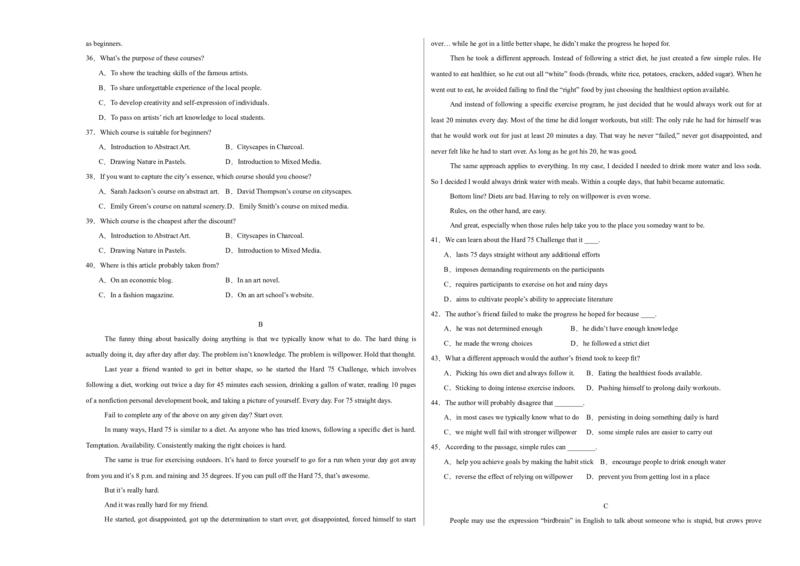
(新题材)New Art Courses in the City
With a focus on nurturing creativity and individual expression, our art courses in Montpellier, France, offer an
unforgettable experience for both visitors and locals. Class sizes are kept small to promote personal growth and the
tutors are all practicing artists who share their passion for teaching and passing on their knowledge to eager students.
Introduction to Abstract Art
Tutor: Sarah Jackson
7-9 November, £320(25% discount)
Embark on a journey of freedom and experimentation with Sarah Jackson as she guides you through the world of
abstract art. This course offers a unique opportunity to break free from traditional painting styles and explore a range
of techniques and materials.
Cityscapes in Charcoal
Tutor: David Thompson
14-16 November, £290(20% discount)
Capture the unique essence of the city in charcoal with David Thompson. This medium offers an excellent way to
render the urban environment, allowing you to capture its beauty. Ideal for those who love the city and want to
immortalize its essence on paper.
Drawing Nature in Pastels
Tutor: Emily Green
21-23 November, £250 (15% discount)
Embrace nature with Emily Green as you learn the art of pastel drawing. This course will explore the beauty and
simplicity of nature, teaching you how to translate its essence onto paper. Ideal for those who love being outdoors
and appreciate nature’s finer details.
Introduction to Mixed Media
Tutor: Emily Smith
28-30 November, £240( 10% discount)
Explore the exciting world of mixed media with Emily Smith. This course will introduce you to a variety of
media, from paper to plastic, giving you a new perspective on creativity. Ideal for those who want to experiment art
as beginners.
36.What’s the purpose of these courses?
A.To show the teaching skills of the famous artists.
B.To share unforgettable experience of the local people.
C.To develop creativity and self-expression of individuals.
D.To pass on artists’ rich art knowledge to local students.
37.Which course is suitable for beginners?
A.Introduction to Abstract Art.
B.Cityscapes in Charcoal.
C.Drawing Nature in Pastels.
D.Introduction to Mixed Media.
38.If you want to capture the city’s essence, which course should you choose?
A.Sarah Jackson’s course on abstract art.
B.David Thompson’s course on cityscapes.
C.Emily Green’s course on natural scenery.D.Emily Smith’s course on mixed media.
39.Which course is the cheapest after the discount?
A.Introduction to Abstract Art.
B.Cityscapes in Charcoal.
C.Drawing Nature in Pastels.
D.Introduction to Mixed Media.
40.Where is this article probably taken from?
A.On an economic blog.
B.In an art novel.
C.In a fashion magazine.
D.On an art school’s website.
B
The funny thing about basically doing anything is that we typically know what to do. The hard thing is
actually doing it, day after day after day. The problem isn’t knowledge. The problem is willpower. Hold that thought.
Last year a friend wanted to get in better shape, so he started the Hard 75 Challenge, which involves
following a diet, working out twice a day for 45 minutes each session, drinking a gallon of water, reading 10 pages
of a nonfiction personal development book, and taking a picture of yourself. Every day. For 75 straight days.
Fail to complete any of the above on any given day? Start over.
In many ways, Hard 75 is similar to a diet. As anyone who has tried knows, following a specific diet is hard.
Temptation. Availability. Consistently making the right choices is hard.
The same is true for exercising outdoors. It’s hard to force yourself to go for a run when your day got away
from you and it’s 8 p.m. and raining and 35 degrees. If you can pull off the Hard 75, that’s awesome.
But it’s really hard.
And it was really hard for my friend.
He started, got disappointed, got up the determination to start over, got disappointed, forced himself to start
over… while he got in a little better shape, he didn’t make the progress he hoped for.
Then he took a different approach. Instead of following a strict diet, he just created a few simple rules. He
wanted to eat healthier, so he cut out all “white” foods (breads, white rice, potatoes, crackers, added sugar). When he
went out to eat, he avoided failing to find the “right” food by just choosing the healthiest option available.
And instead of following a specific exercise program, he just decided that he would always work out for at
least 20 minutes every day. Most of the time he did longer workouts, but still: The only rule he had for himself was
that he would work out for just at least 20 minutes a day. That way he never “failed,” never got disappointed, and
never felt like he had to start over. As long as he got his 20, he was good.
The same approach applies to everything. In my case, I decided I needed to drink more water and less soda.
So I decided I would always drink water with meals. Within a couple days, that habit became automatic.
Bottom line? Diets are bad. Having to rely on willpower is even worse.
Rules, on the other hand, are easy.
And great, especially when those rules help take you to the place you someday want to be.
41.We can learn about the Hard 75 Challenge that it ____.
A.lasts 75 days straight without any additional efforts
B.imposes demanding requirements on the participants
C.requires participants to exercise on hot and rainy days
D.aims to cultivate people’s ability to appreciate literature
42.The author’s friend failed to make the progress he hoped for because ____.
A.he was not determined enough
B.he didn’t have enough knowledge
C.he made the wrong choices
D.he followed a strict diet
43.What a different approach would the author’s friend took to keep fit?
A.Picking his own diet and always follow it.
B.Eating the healthiest foods available.
C.Sticking to doing intense exercise indoors.
D.Pushing himself to prolong daily workouts.
44.The author will probably disagree that ________.
A.in most cases we typically know what to do
B.persisting in doing something daily is hard
C.we might well fail with stronger willpower
D.some simple rules are easier to carry out
45.According to the passage, simple rules can ________.
A.help you achieve goals by making the habit stick
B.encourage people to drink enough water
C.reverse the effect of relying on willpower
D.prevent you from getting lost in a place
C
People may use the expression “birdbrain” in English to talk about someone who is stupid, but crows prove
that this is unfair. Now it has been discovered that crows may understand analogies.
It was once thought that only humans could understand analogies, which help us to solve problems creatively,
put things into categories, and make scientific discoveries.
To test this ability in animals, scientists do “relational matching-to-sample”(RMTS) tests, according to the IFL
Science website. If a pair was AA, for example, then picking BB to match it would be correct. If the pair was CD,
however, then EF would be correct.
Apes and monkeys have learned RMTS, but scientists wanted to know if crows could do it, too. An
international team led by Edward Wasserman from the University of Iowa in the US first trained two hooded crows
to match things by color, shape, and number in what is called “identity matching-to-sample (IMTS)”, then moved
onto RMTS.
For the IMTS test, the birds were put in a cage with a plastic tray that had three cards and two cups in it. The
card in the middle was the sample card. The cups on either side were covered with the other two cards: One was the
same as the sample (in the color, shape, or number of shapes pictured), while the other wasn’t. The cup with the card
that matched the sample card contained two worms to eat.
In the second part of the experiment, the birds were tested with relational matching pairs. A card with two
same-sized circles, for example, meant they should pick the test card with two same-sized squares and not two
different-sized circles. The birds did well in the more difficult test and picked the correct card more than three
quarters of the time, Science News reports.
Wasserman was surprised that crows were able to solve the problem without any training in RMTS. “What the
crows have done is extraordinary,” he said in a news release. “Honestly, if it was only by force that the crows
showed this learning, then it would have been an impressive result. But this was spontaneous.”
So perhaps it’s time to stop saying “birdbrain” permanently!
46.Why does the author mention the expression “birdbrain” in the opening paragraph?
A.To get the reader interested in the origins of the expression.
B.To urge people to stop saying that birds are stupid.
C.To introduce the topic of Edward Wasserman and his experiments.
D.To introduce recent findings about crows’ intelligence.
47.Which of the following is TRUE about the tests on the hooded crows?
A.The birds did better in RMTS than in IMTS.
B.The birds were first made to do RMTS, then IMTS.
C.The birds picked almost all the correct cards in RMTS.
D.In the IMTS test, the birds needed to identify the sample card to get rewards.
48.In the RMTS test, if the birds were given the sample card with two same-sized triangles, they had to pick the
test card with ________.
A.two same-sized circles
B.one circle and one triangle
C.two different-sized circles
D.two different-sized triangles
49.The underlined word “spontaneous” in the second-to-last paragraph is closest in meaning to ________.
A.central
B.creative
C.natural
D.predictable
50.Which of the following can be the best title for the passage?
A.Monkeys Are Clever Than Crows
B.Crows Show Cleverness
C.Crows Did Well in RMTS
D.Don’t Look Down on Birds
D
(热点话题)Millions of older people, laborers and cancer sufferers could be unable to use their fingerprints
to log in online bank accounts. Banks are spending millions of pounds on fingerprint technology to replace
passwords. But banks may have to rethink these plans after warnings that the technology flawed (有缺陷).
Representatives of major banks at a London conference were told many older people’s fingerprints are too faded for
the machines to recognize.
John Daugman, a professor of computer vision and pattern recognition at the University of Cambridge, says,
“Fingerprints can ‘rub off’ for many kinds of laborers—their skin becomes almost smooth. Gardeners often acquire a
lot of wounds on their fingers, and people who work with chemicals, such as cleaners, also suffer damage of
fingerprints.”
Jean Slocombe, a senior nurse at Cancer Research UK, says, “Some drugs can cause the skin of hands and
feet to peel. In severe cases, the fingers can peel, and it’s possible that this could change a patient’s fingerprints. This
should improve once treatment ceases, but severe scarring(伤疤) can change fingerprints in the long term.”
Fingerprints are generally considered more secure than passwords for several reasons. Unlike passwords,
fingerprints cannot be easily copied, written down, shared, or guessed. Additionally, it is impossible to forget one’s
fingerprints. Currently, banks offer customers the option to use a password or PIN (personal identification number)
for online access to their money. However, technology experts have predicted that companies might do away with
passwords entirely to decrease the risk of fraud (诈骗). Should this transition to fingerprint technology occur,
there is a potential risk that millions of bank customers could find themselves unable to access their accounts.
Banks have tried other security measures, such as facial recognition—but fingerprint technology is often the
best one, as it is fast and people are more familiar with it. Nick Dryden, a chief executive of technology company
Sthaler, says, “Businesses like fingerprint technology because it’s fast.”
“There must always be a back-up so that if it doesn’t work, there is another way of paying, such as with a
password.” Dryden adds that using the veins(静脉) in someone’s fingers to identify them is more secure and
means people with faded prints will not be left behind as technology advances.
51.Which of the following is the critical flaw of using fingerprints to log into accounts?
A.Fingerprints can be easily stolen from photos.
B.Fingerprint recognition adapts to medical changes.
C.The application of fingerprint technology costs too much.
D.Elderly people’s fingerprints may be too faint for detection.
52.According to John Daugman, what causes unrecognizable fingerprints?
A.Excessive use of technology.
B.Physical labor and natural aging.
C.Environmental exposure process.
D.Lack of proper fingerprinting equipment.
53.What can we learn from Paragraph 4?
A.Experts recommend replacing passwords soon.
B.Fingerprints can totally avoid the risk of fraud.
C.Switching to fingerprints might lock out many customers.
D.Passwords and PINs are preferred by banks due to their simplicity.
54.Which is Dryden’s suggestion about fingerprint technology?
A.Using veins instead of fingerprints isn’t workable.
B.There must be other ways to get into bank accounts.
C.Its greatest advantage is its high speed of recognition.
D.Passwords are still the most reliable security measure now.
55.’What is the main idea of the passage?
A.Comparing password and fingerprint security.
B.Enhancing and upgrading bank security measures.
C.Presenting fingerprint technology challenges in banking.
D.Advancing fingerprint and facial recognition technology.
第二部分:写作(共两节,满分35 分)
第一节:阅读表达(共5 小题;每小题2 分,满分10 分)
阅读下面短文,并根据短文内容完成下列各题。
In every gym class I've taken, I felt like the odd one out. Opening the door, I hesitantly asked, “Is this where
the HIIT class is?” The instructor yelled, “Grab a dumbbell and yoga mat. We're late for warm-up!” Breathing
heavily on the mat, I wasn't sure if I'd make it through the hour.
Glancing around the room, I seemed to be the only one struggling. Everyone else, in their tightly fitted gym
wear and not a sign of sweat to be seen, looked as if they belonged. I, on the other hand, with my messy hair and
oversized clothes, wondered why I had ever bothered coming.
Earlier that year, I had decided to give fitness a real shot. All my life, exercise had been a foreign concept and
in school, gym class was a place of guaranteed embarrassment and humiliation.
I nervously showed up to my university gym for spin class (动感单车课程) on a Sunday morning. I had
considered canceling multiple times, but I told myself that showing up was all that mattered.
The instructor was incredibly kind. Within minutes of seeing my weak form, he knew I was new to the class.
He walked us through all the various positions on the bike multiple times.
The first time I tried to stand on the bike pedals, I felt my legs shake and immediately sat down. But with each
class, my comfort on the bike grew and I became less focused on how I looked and more focused on looking inward.
Whether I needed to think about something bugging me, dream about the future or just mindlessly pedal, spin class
became my hour a week just for me.
The more I spun, the more I realized how powerful my body was. For what felt like the first time, I was proud
of my body's capabilities.
After nine months of spinning, I wanted to challenge myself again. And that's how I found myself in the high-
intensity class. If spin class got me used to moving my body, then HIIT class taught me that I have to continuously
work to build my fitness and tackle my insecurities.
In all, what truly matters is showing up, not what you wear or your fitness abilities. Because once you show
up, the rest gets easier, one sweaty adventure at a time.
56.Why did the author feel like the odd one out in the gym class?(no more than 10 words)

57.What does the underlined part mean in paragraph 3?(no more than 10 words)

58.What did the author realize about her body after attending spin class for nine months?(no more than 6 words)

59.Why did the author decide to challenge herself by attending a high-intensity class? (no more than 12 words)

60.What message does the author convey in the text? How does it inspire you?(no more than 25 words)

第二节:书面表达(满分25 分)
61.假定你是高三学生李津,上周末,你和同学参加了一次志愿者活动。请你为班级英语角写一篇短文,
介绍这次活动,内容包括:
(1)活动主题;
(2)活动过程;
(3)个人感受。
注意:
(1)词数不少于100;
(2)可适当加入细节,使内容充实、行文连贯;
(3)题目已给出,不计入总词数。
My Weekend
_____________________________________________________________________________________________
_____________________________________________________________________________________________
_____________________________________________________________________________________________
_____________________________________________________________________________________________
____________________________________________________________________________