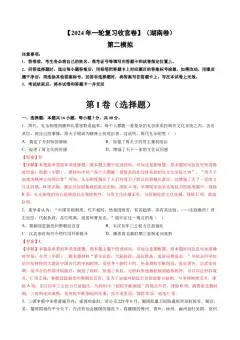
第一模拟(仿天津卷)
2025 年高考英语一轮复习模拟卷
(原卷版)
注意事项:
1.答卷前,考生务必将自己的姓名、准考证号填写在答题卡上。
2.回答选择题时,选出每小题答案后,用2B铅笔把答题卡上对应题目的答案标号涂黑。如需改动,
用橡皮擦干净后,再选涂其他答案标号。回答非选择题时,将答案写在答题卡上。写在本试卷上无效。
3.考试结束后,将本试卷和答题卡一并交回。
第一部分 英语知识运用(共两节, 满分45分)
第一节 单项填空(共15小题; 每小题1分,满分15分)从A、B、C、D四个选项中,选出可以填入空白处
的最佳选项。
1.Linda, an exchange student from Spain, is _________ university student in Yunnan now.
A.a B.an C.the D./
2.—Hey! Kate, what about your last winter camp in Hainan?
—Oh! It _________ some sweet memories in my heart in the past several months.
A.leaves B.is leaving C.has left D.will leave
3.The city ________ she lives in is famous for its beautiful scenery.
A.which B.where C.when D.whose
4.Using public transportation is a good way to ________ air pollution.
A.deal with B.check out C.care about D.take down
5.With a lot of difficult problems _______, the newly-elected president is having a hard time.
A.settled B.settling C.to settle D.being settled
6.Mount Huangshan is such an attractive place of interest ________ everyone likes to visit.
A.as B.that C.which D.what
7.Adults, ____ overly concerned with fame and fortune, sometimes fail to see the joy in simple things ____
children do not.
A.unless; but B.when; where C.although; and D.even if; unless
8.All citizens who have reached the age of 18 have the right to vote, ________ race, sex, occupation, familybackground, religious belief, or education.
A.against B.regardless of C.in spite of D.even though
9.—Must I finish the report tonight?
—No, you ________. You can hand it in the day after tomorrow.
A.mustn’t B.shouldn’t C.needn’t D.can’t
10.Although I have been working here for ten years, I still remember ________ it was like to be a trainee.
A.how B.what C.when D.that
11.One of the most wonderful migrations in nature is ______ of the North American monarch butterfly.
A.it B.what C.this D.that
12.By the time we arrived, the keynote presentation (主旨演讲) for half an hour.
A.has been going on B.had been going on
C.was going on D.will be going on
13.Nature has always been a ______ of inspiration for poets and writers throughout history.
A.source B.shelter C.barrier D.background
14.Make a note of the questions you want to ask. _______ , you’ll forget some of them.
A.Otherwise B.However C.Moreover D.Therefore
15.—Can you finish your English homework this afternoon?
—________. You know, I’m good at English.
A.It’s a piece of cake B.It serves you right
C.Sorry, I can’t D.I’m not sure
第二节 完形填空(共20小题,每小题1.5分,共30分)
阅读下面短文,掌握其大意,从每题所给的A、B、C、D四个选项中,选出最佳选项。
Katie Ortman Doble suffered from a rare form of cancer. Doctors said she had 16 months to 16 .
But her father, who was a physician himself, was 17 to find a clinical (临床的) trial that could 18
her life.
So Katie flew to New York to see if she would 19 for the trial. She had been there for two days.
20 , it was time for her to meet with the doctor to find out if she was qualified for the 21 . As she
went through a series of tests, she found herself 22 her mom, who passed away when Katie was a
teenager. On particularly 23 days, her mom would offer what she called an “energy 24 ”.
As she 25 in waiting room after waiting room, Katie 26 one of those special hugs. At
that time, she 27 a girl who looked to be about her age 28 her head in her mother’s lap (大腿). Soon, a nurse came out and 29 the girl to get her test. And when Katie turned her head back around,
the 30 was standing right in front of her. She said to Katie, “You look like you want a mom hug.” With
31 in her eyes. Katic nodded and said 32 .
“It was just one of those moments in life when somebody 33 and gave you something that you
34 ,” she recalled. In the summer of 2023, Katie and her family celebrated her first anniversary (周年纪念) of
being 35 free.
16.A.cry B.stop C.live D.rest
17.A.nervous B.able C.curious D.proud
18.A.save B.ruin C.end D.cost
19.A.pay B.work C.stay D.qualify
20.A.Actually B.Finally C.Obviously D.Unfortunately
21.A.job B.contest C.school D.treatment
22.A.discouraging B.missing C.astonishing D.confusing
23.A.hard B.boring C.pleasant D.hot
24.A.drink B.crisis C.hug D.field
25.A.ran B.wrote C.slept D.sat
26.A.adapted to B.gave up C.longed for D.got through
27.A.saw B.remembered C.accompanied D.believed
28.A.shaking B.laying C.raising D.nodding
29.A.forbade B.begged C.asked D.warned
30.A.doctor B.father C.girl D.mom
31.A.tears B.stars C.fear D.pity
32.A.no B.yes C.goodbye D.hello
33.A.spoke up B.checked in C.showed up D.went away
34.A.disliked B.owned C.afforded D.needed
35.A.cancer B.debt C.duty D.admission
第二部分:阅读理解(共20小题;每小题2.5分,满分50分)
阅读下列短文,从每题所给的A、B、C、D四个选项中,选出最佳选项。
A
To mark International Women’s Day, we asked Dezeen Awards judges to nominate (提名) a woman in
architecture and design who should have greater recognition.Shefali Balwani
Nominated by Kamna Malik
“Shefali Balwani is an Indian architect. Her projects have a certain voice that goes beyond the conventional
definitions of architecture and design. Whenever I look at her work, I see mindfulness on so many levels, whether it
is through the use of materials or the sensitivity shown towards the surroundings.”
Oana Stänescu
Nominated by Ingrid Moye
“Having met Oana Stänescu many years ago while working at SANAA in Tokyo, we have not only been
following each other’s path but also become friends. I admire Oana’s curious perspective (视角) through which she
observes the world. Her refreshing voice shows not only in her original architectural practice but also in her work
as an academic, lecturer, and writer.”
Tatu Gatere
Nominated by Stella Mutegi
“Tatu Gatere is the co-founder and CEO of Buildher — an organization that seeks to empower women with
skills needed in the construction industry, which is very male-dominated in Kenya. The skills that these women are
empowered with at Buildher make a big impact on every aspect of their daily lives.”
Jessica Smulders Cohen
Nominated by Katie Treggiden
“Having studied sustainable design at Kingston University, Jessica Smulders Cohen decided not to become a
designer or a maker, but instead to become a repair specialist. Jess and her work deserve more recognition because
our whole industry needs to move away from pursuing newness and instead prioritize reuse and repair — it is the
only hope we have for a circular future that will enable our species to live well on this planet.”
36.What do Balwani and Stänescu have in common?
A.Writing many books. B.Being creative architects.
C.Working for SANAA in Tokyo. D.Empowering construction workers.
37.What can we know about Ingrid Moye?
A.She is a writer. B.She is a friend of Stänescu.
C.She once worked for Stänescu. D.She thinks Stänescu has a beautiful voice.
38.Whose organization improves the lives of Kenyan women?
A.Shefali Balwani’s. B.Oana Stänescu’s.
C.Tatu Gatere’s. D.Jessica Smulders Cohen’s.39.What is Cohen?
A.A designer. B.A maker. C.An architect. D.A repair specialist.
40.Why does Treggiden nominate Cohen?
A.She excels at designing and making. B.She contributes to a sustainable planet.
C.She promotes equal rights between genders. D.She gets where she is through self-education.
B
You can make a difference to the life of others by signing up for a volunteer vacation.
“After 30 programs in Poland, I’ve received more than I’ve given. All benefit from this partnership — the
future leaders of this great nation, and volunteers who fall in love with the beautiful people and culture.”
– Lori Wedeking, a volunteer in Poland
Volunteer Opportunities Portugal:
Teach natives conversational skills with varying English abilities in classrooms, offices, and community
centers. Help choose assignments in public elementary and secondary schools, or with young adults in technical or
trade schools.
Peru:
Volunteers with a medical background can choose to spend their time working at medical centers. Others can
spend their time practicing conversational English with local students and teachers.
Tanzania:
Support a community quest for development through food and nutrition, health and education projects. Work
in the greenhouse nurturing seedlings for seasonal plantings.
Nepal:
Teach conversational English and business management, help repair living and learning spaces, provide
support and training for marginalized women, and nurture impoverished children.
Cuba:
Build bridges of friendship through conversational English classes. Work alongside local women sewing and
knitting baby clothes, aprons, crafts, etc, which are sold to benefit the women’s cooperative interests.
Global Volunteers’ History
Established in 1984 by Bud Philbrook and Michele Gran, Global Volunteers is an international nonprofit
organization assisting worldwide community development programs by mobilizing short-term volunteers on local
work programs, as well as providing project funding and child sponsorships. Since 1984, Global Volunteers has
helped partner communities deliver most of these services to local people worldwide, and been trusted by morethan 34,000 volunteers. As Seija Webb, an eight-time global volunteer says, “Volunteering abroad holds magic on
so many fronts. It’s the springboard for my global explorations. I can’t imagine one without the other anymore.”
41.Which is right about Lori Wedeking?
A.Lori is the organizer of 30 programs.
B.Lori had a positive experience in Poland.
C.Lori wants to be the future leader of Poland.
D.Lori received a lot of presents from volunteers.
42.What project is needed in Tanzania?
A.Working at medical centers.
B.Teaching business management.
C.Developing food and nutrition.
D.Sewing and knitting baby clothes.
43.Which country needs the project of repairing living spaces?
A.Peru. B.Tanzania. C.Nepal. D.Cuba.
44.What do we know about Global Volunteers’ History?
A.34,000 volunteer get involved in its projects every year.
B.Teaching magic shows is one of its various programs.
C.It sends short-term and long-term volunteers to help local residents.
D.Seija Webb is a regular volunteer and enjoys volunteering abroad.
45.Who is the text most probably aimed at?
A.Global explorers. B.Keen travelers.
C.Future leaders. D.Potential volunteers.
C
Although I was the class clown at school, there’s an introverted (内向的) side to my personality. That’s
because I have a neurological (神经系统的) condition that makes it hard for my brain to process visual
information. Words swim on the page for me. I wanted to learn how to read but I couldn’t.
In primary school, I didn’t talk to any teachers or family about this. I was clever at hiding it. When I had to
write anything down, I guessed, forming what I hoped was the right words. I became good at learning by heart.
When I started secondary school, a student in class made me stand on a chair and read. It was so humiliating
that I developed a bad stutter (口吃). I continued to fall through the net, emotionally and educationally. The only
thing I loved was practical biology. I wanted to be a doctor.Then I left school and joined the military. I was determined to be a medic and trained hard. But things
unraveled (揭开) when I did a course in pre-hospital emergency care. I passed all my practical exams, preparing for
them by watching others. The problem was the written exam. I was so embarrassed but had to tell the examining
doctor that I couldn’t read. He urged me to get back into education. I was 34.
I applied to do a medical degree at the Open University (OU). It was back to basics on the course. I knew the
alphabet and some words, but my vocabulary was small. I paid for a tutor, who worked with me every week,
teaching me to understand words through pictures.
It took me nine years to get that degree. Now, aged 47, I’m an ambassador for the OU, winning an award for
embracing education so late in life. I now teach pre-hospital emergency care to medical school students. I also teach
children and adults with learning difficulties because I want to give others the chances I had.
I still struggle to read a menu if I’m not wearing my special glasses, but luckily there’s always someone
around to lend me a hand. I look back and wonder how many other people have struggled with education and where
they are now. I’m proof that no one should be discounted (忽视), ever.
46.How did the author deal with his problem in primary school?
A.He tried hard to forget it.
B.He found a way to hide it.
C.He managed to overcome it.
D.He turned to teachers for help.
47.What happened to the author when he was in the military?
A.He was encouraged to be a doctor.
B.His speech disorder became worse.
C.He was advised to go back to university.
D.He failed his exams and was forced to leave.
48.What did the author struggle to do after returning to education?
A.Learn basics on the course.
B.Build confidence in learning.
C.Work hard to pass written exams.
D.Try to catch up in medical classes.
49.The underlined word in Paragraph 6 can be understood as ________.
A.raising public awareness of something
B.making a new discovery of somethingC.accepting something willingly
D.attracting great attention
50.According to the last paragraph, what message does the author want to convey?
A.Experience helps to promote excellence.
B.College education contributes to success.
C.Everyone should be treated equally in education.
D.Adults with learning difficulties need special education.
D
The wind roils the Midwest plains as if it is searching for someone or something to carry away. Dust and
chaff funnel into blinding clouds. The clatter of storms overhead makes it impossible to hear, and herds of bison (野
牛) grow restless. The Omaha tribe has wandered these plains for generations, and now, it seems that the winds
have brought back one of their own. Susan La Flesche has returned to the village where she was born. Not as a
visitor, but as the region’s only doctor.
When Susan was 8 years old, she waited at the bedside of an elderly woman writhing in pain. A doctor was
called for. They waited. A messenger was sent. The doctor still didn’t come. Susan provided what comfort she could
through the night, but by sunrise, the elderly woman had died. The episode both haunted and motivated Susan. She
threw herself into her studies and earned her way to what is now Hampton University in Virginia — a historically
Black college with a program for native American students. And she finished second in her class.
Susan would never forget the childhood she enjoyed, full of powwows, buffalo hunts and the people she
loved. But there was further to go. She enrolled in the Women’s Medical College of Pennsylvania, a tedious train
ride away from the world she knew. It was 1886, and the Victorian age held stiff against the progress of women. In
her graduation speech from Hampton, she told the East Coast audience, “Give us a chance.” Three years later, she
became a doctor.
Returning to the plains to serve her people was a difficult task. She opened an office in the government
boarding school and began seeing patients. The lines were long, old and young seeking reprieve (缓解) from
cholera and tuberculosis (肺结核) as well as a slew of other diseases. Susan worked long hours at her office but
also braved the wind and snow, walking miles to make house calls. Her work was more than as a physician. She
often acted as lawyer, accountant, priest, political liaison and counselor as she helped the Omahas navigate the new
world. And Dr. Susan La Flesche was determined to spend her entire life helping her people navigate the storms.
51.What contributed to Susan’s being a doctor?A.Her poor family.
B.Her desire for knowledge.
C.The opposition to women’s progress.
D.The lack of medical resources in her hometown.
52.What can we infer about Susan from the third paragraph?
A.She had an unhappy childhood.
B.She enjoyed the train ride to her college.
C.She got high marks in every exam.
D.She encountered difficulties in her college life.
53.What is the author’s purpose in describing diverse roles of Susan in Paragraph 4?
A.To emphasize her lack of focus on her medical career
B.To suggest that she was overburdened with responsibilities
C.To highlight her dedication to serving the community wholeheartedly
D.To showcase her adaptability in fulfilling various roles within her community
54.Which words can best describe Susan?
A.Hard-working and helpful. B.Sensitive and modest.
C.Serious and brave. D.Greedy and self-centred.
55.What could be the best title for the passage?
A.A Force of Nature: Dr. Susan La Flesche’s Impact
B.Winds of Change: Dr. Susan La Flesche’s Legacy
C.The Resilient Doctor: Dr. Susan La Flesche’s Triumph
D.Whispering Winds: Dr. Susan La Flesche’s Mysterious Journey
第Ⅱ卷 非选择题(共35分)
第三部分:写作(共两节,满分35分)
第一节 阅读表达(共5小题;每小题2分,满分10分)
At just 17, Lauren Schroeder has already made a significant impact on her community. Her voyage began at
14, volunteering at a food shelter. While packing boxes with canned goods for needy families, Lauren detected a
substantial shortage: fresh vegetables. This observation sparked an idea that soon grew into a community-wide
initiative.
Lauren pictured transforming part of her family’s 150-acre farm into a garden committed to growing producefor local families. Her proposal was met with a hint of concern from her mother, Katie Schroeder. While supportive,
she also foresaw the extensive labor involved. Despite the agricultural background—her family typically planted
soybeans and corn—vegetable cultivation was a novel pursuit. Nevertheless, Lauren was eager to tackle the
nutritional deficiency she had uncovered.
The hard work began in earnest. Not discouraged by potential obstacles, Lauren dived into research to be a
seasoned vegetable cultivator and secured a grant (拨款) from the National FFA Organization to cover initial costs.
Subsequently, she spent two to three hours daily watering her crops by hand through the hot Iowa summers,
sandwiching this commitment between softball practices. Furthermore, she carefully tended to her garden,
combating weeds and harvesting crops, with green beans proving particularly challenging.
Eventually, with assistance from her younger brothers and sisters, Lauren’s half-acre garden produced 15
varieties of vegetables. In its first year, the garden generated 40 pounds of produce, benefiting food banks, nursing
homes, and soup kitchens.
Motivated by the early achievements, Lauren doubled the garden’s size. To date, she has donated over 7,000
pounds of produce, valued at approximately $15,000, commanding community respect. Her work has found a deep
echo among others, notably a mother from a local shelter who was grateful for the fresh food that reminded her
children of home.
Lauren’s inspiration is straightforward yet deep-seated. “I wanted to have something that would impact
people,” she told KWQC. Her actions demonstrate her belief in the power of community and the joy obtained
from helping others—a feeling that will undoubtedly shape her future initiatives.
56.Why did Lauren initiate the community garden? (no more than 10 words)
57.How did Lauren overcome her lack of experience in vegetable farming? (no more than 5words)
58.What does the underlined word mean in Paragraph 3? (1 word)
59.What is the main idea of Paragraphs 3 and 4? (no more than 10 words)
60.What can you do for your community? Please explain. (no more than 20 words)
第二节:书面表达(满分25分)假定你是李华,你校将开设国画、京剧和书法选修课。你校交换生 Chris发来邮件咨询你的选课建议。请
你回复邮件,内容包括:
1.你的建议及理由;
2.你的期待。
注意:
1.词数100左右;
2.可以适当增加细节,以使行文连贯。
参考词汇: 选修课 elective course
_____________________________________________________________________________________________
_____________________________________________________________________________________________
_____________________________________________________________________________________________
_____________________________________________________________________________________________
_____________________________________________________________________________________________
_______________________________________________________________________________________