【过高考】2023 年高考英语大一轮单元复习
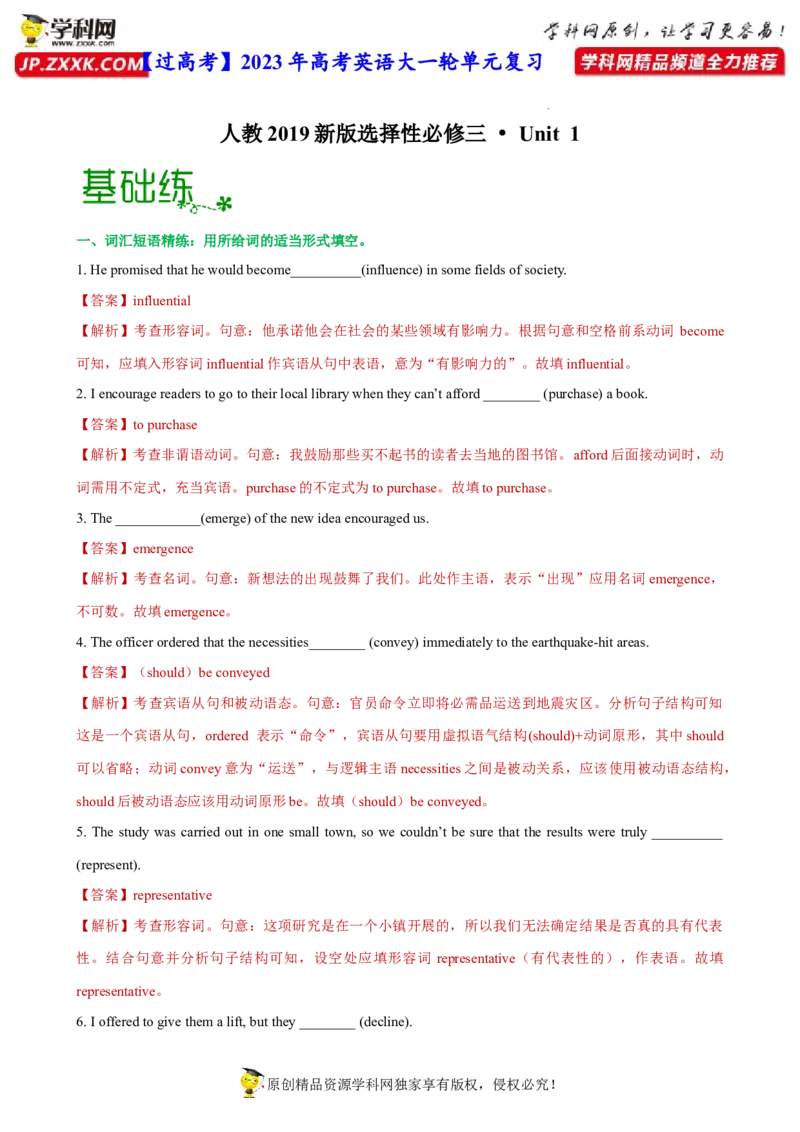
人教 2019 新版必修一 • Unit 5
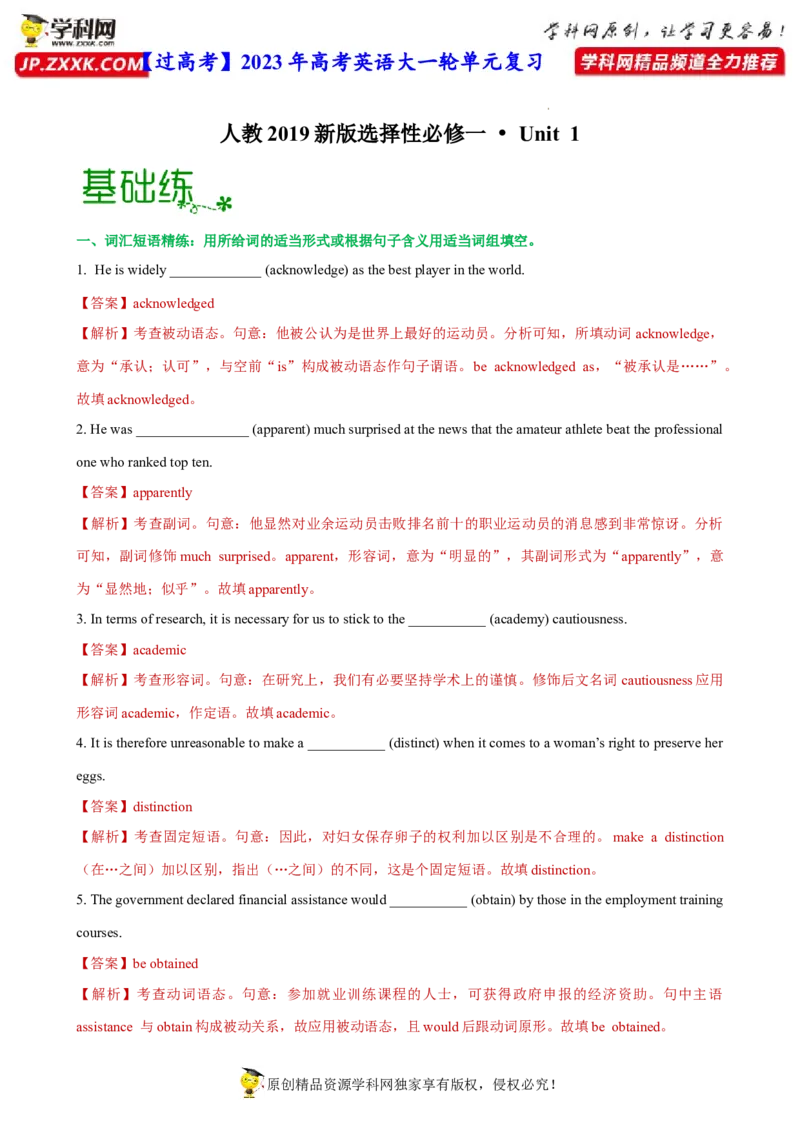
一、词汇短语精练:用所给词的适当形式或根据句子含义用适当词组填空。
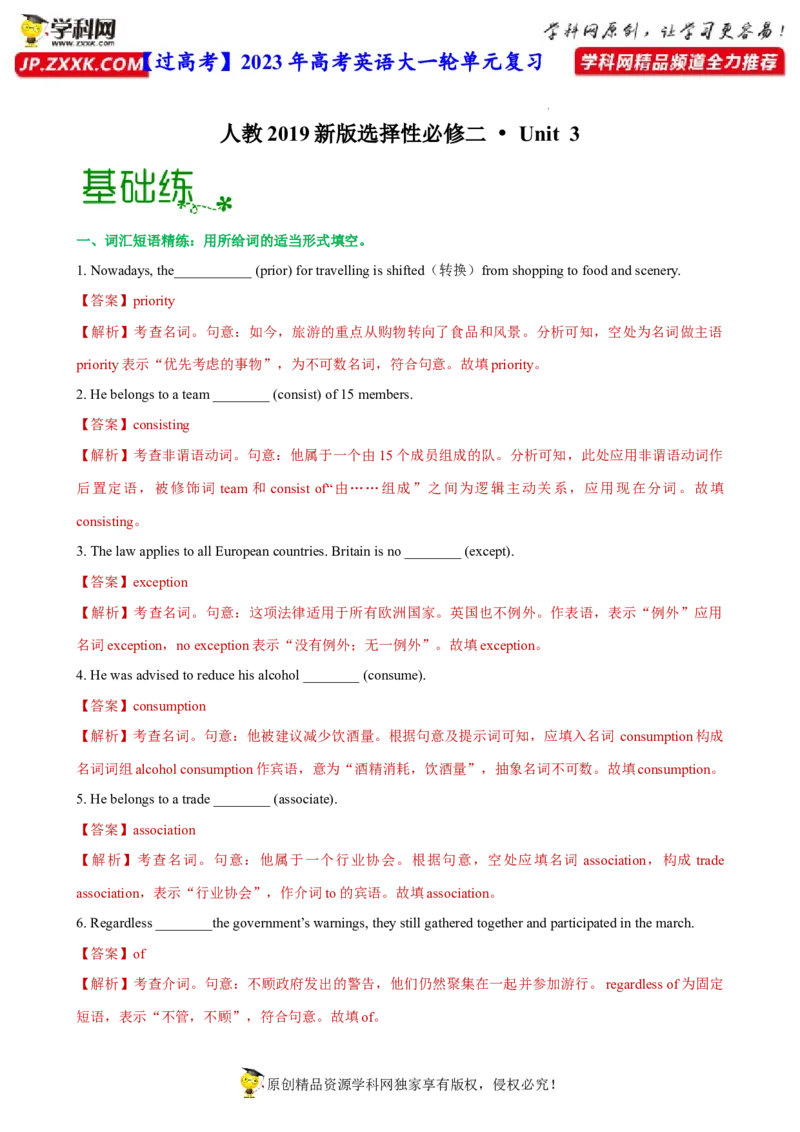
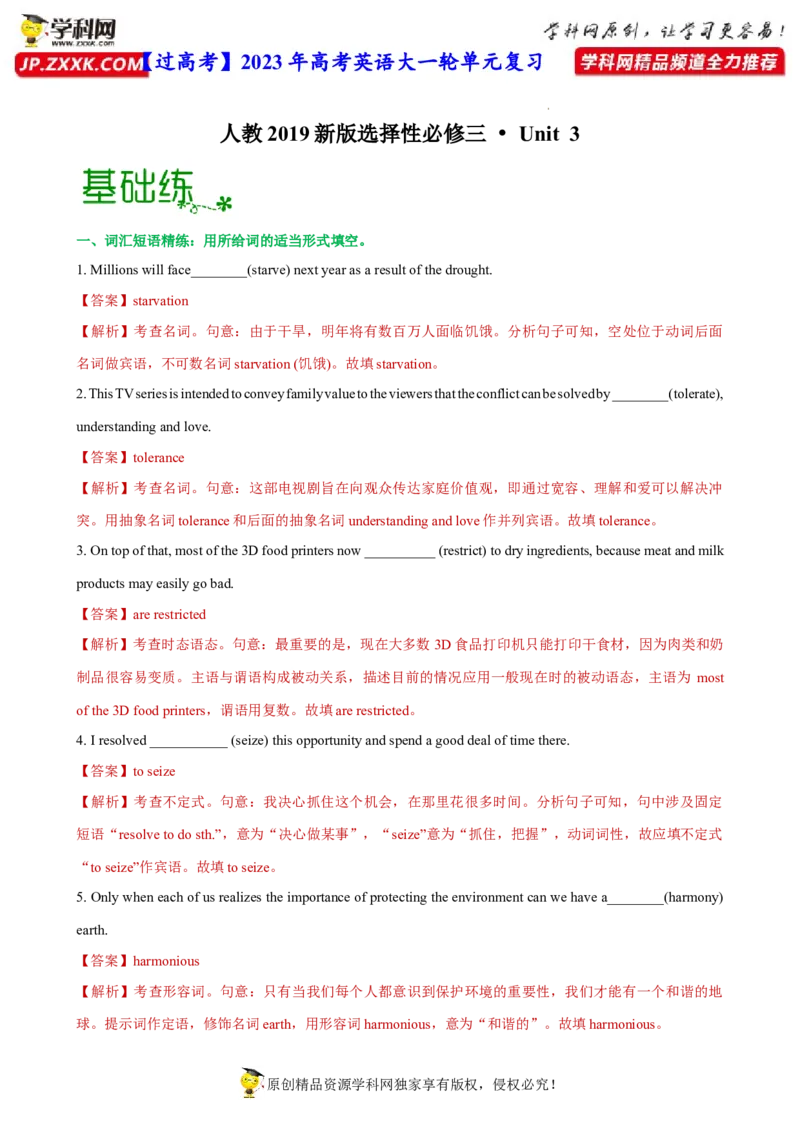
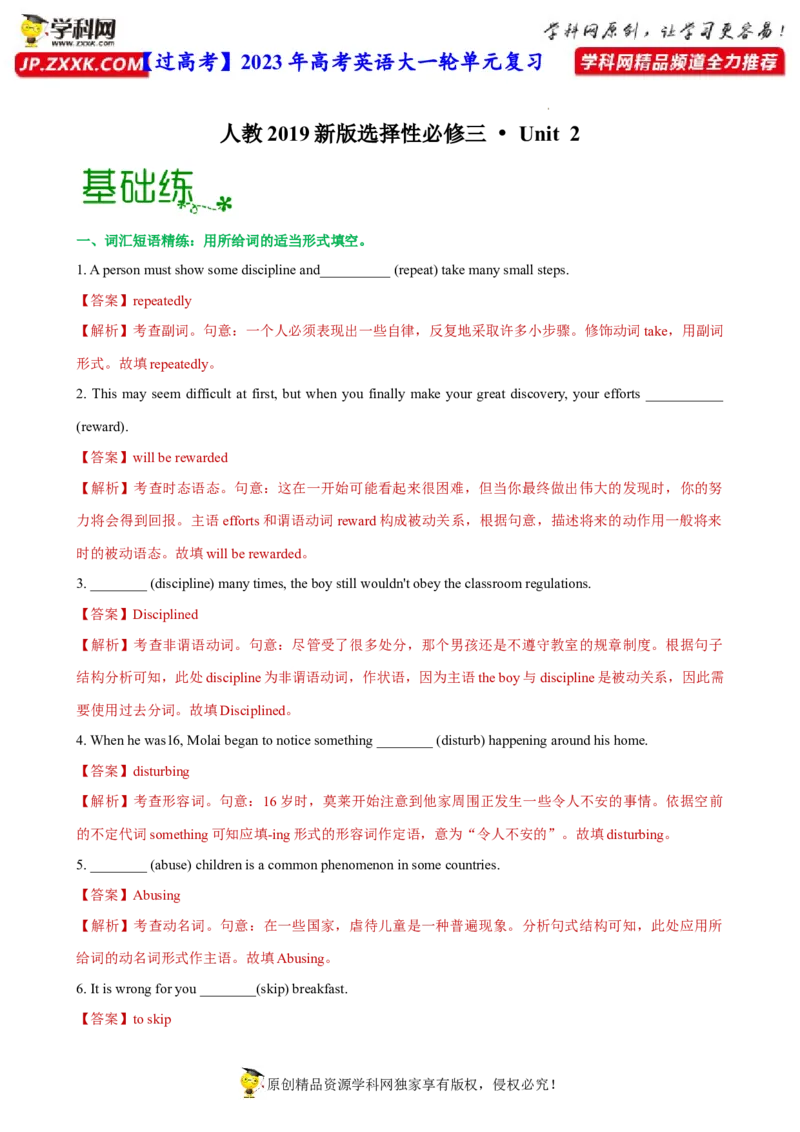
1. Solid friendship is ____________ (base) on mutual trust.
2. As an art school, it is ____________ (know) for its scientific teaching methods.
3. The veteran fighter ____________ (refer) to his experiences during the Long March.
4. Some of us think these symbols were ____________ (carve) thousands of years ago by our Chinese people.
5. When travel around our country, you will hear ____________ (variety) of dialects here and there.
6. Many foreign friends think some of the Chinese ____________ (character) difficult to write.
7. It's said that the bridge ____________ (date) back to 3,000 years ago.
8. Do you think it ____________ (importance) to practice speaking English every day?
9. Li Hua is ____________ (regard) as a good example to follow in our class.
10. The less he worried, the ____________ (well) he worked.
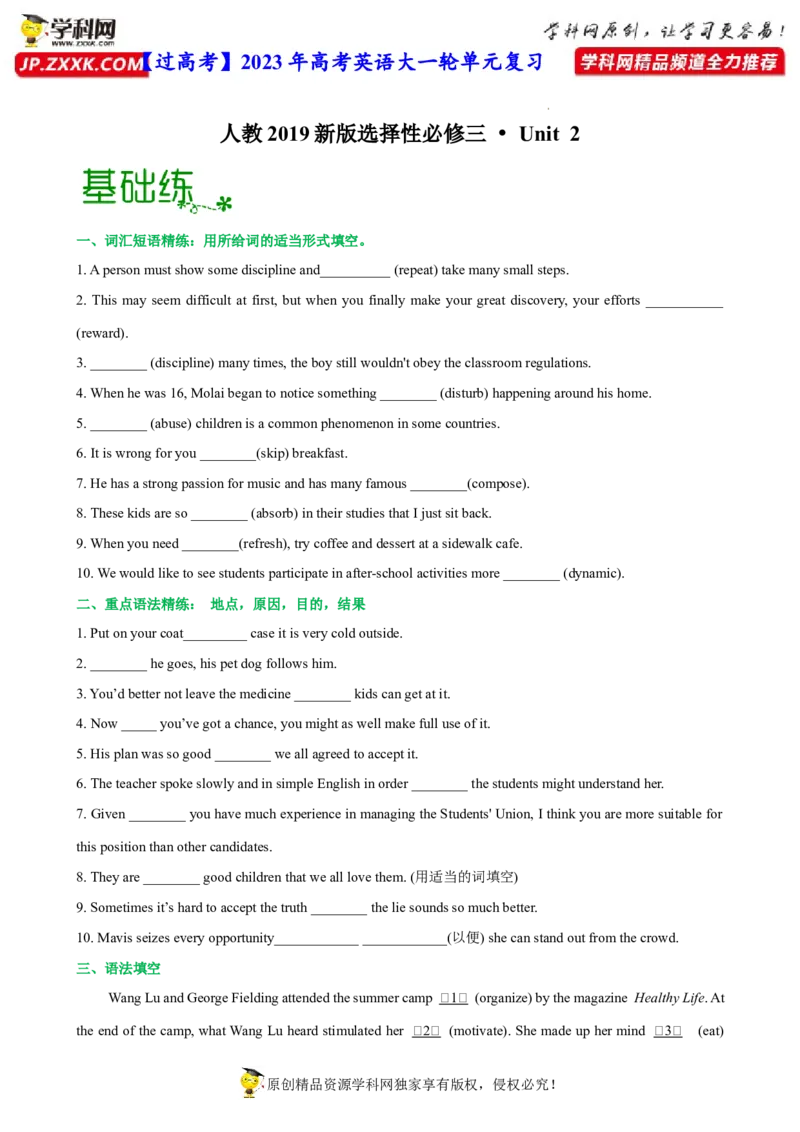
二、重点语法精练:介词专题
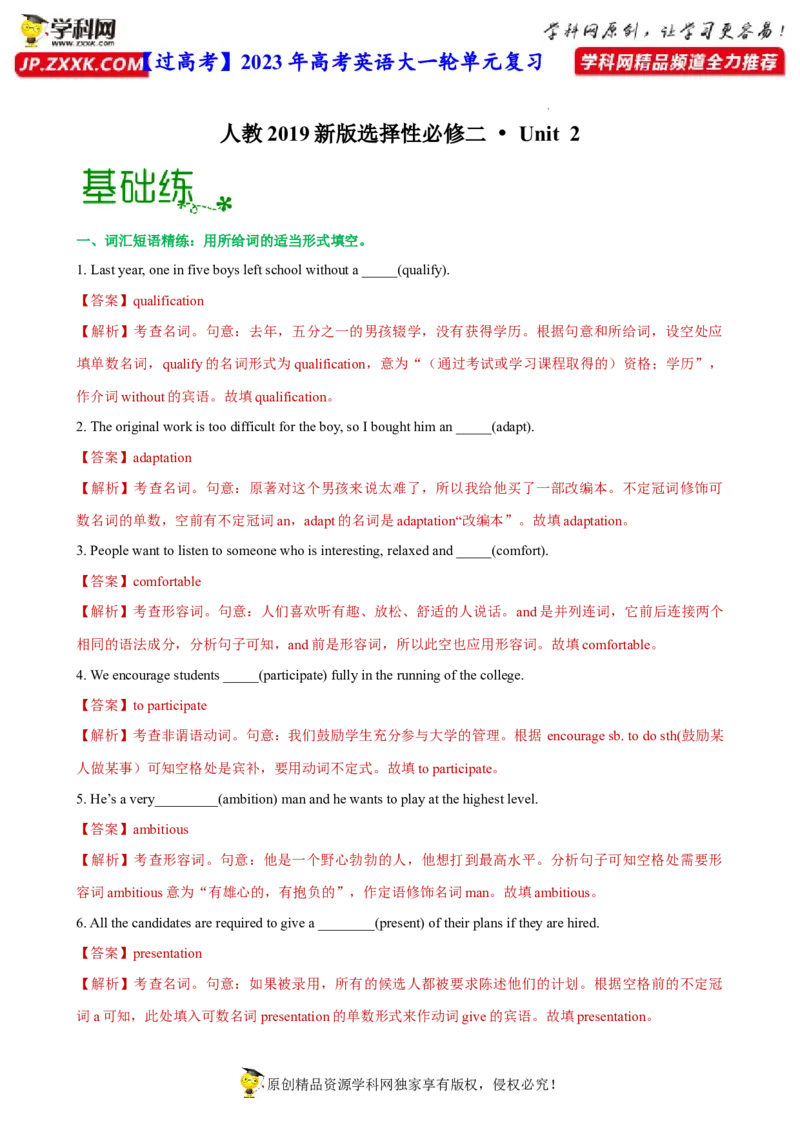
1. At about 3:00 a.m. ____________ July 28,1976, some people saw bright lights in the sky.
2. As students, we should focus our energy ____________ study.
3. The boy has impressed his doctors ____________ his courage and determination.
4. ____________ the development of modern society, many traditional ideas are being changed now.
5. Make sure you read some materials ____________ (concern) poetry of the Tang Dynasty.
6. He smiled politely as Mary apologized ____________ her drunken friend.
7. When the polluting industries argue that we've lost the battle to control carbon pollution and have no choice
____________ to adapt, it's a nonsense designed to make the case for business as usual.
8. In fact, the discontent is not useless since you may learn more from it ____________ from the things that cheer
you up.
9. ____________ the figures of 200 injured in the earthquake at large, only 5 students suffered slight injuries.
10. A company representative wrote back and told me the airline was switching over plastic to paper cups on all of
its 1,200 daily flights.
三、语法填空
原创精品资源学科网独家享有版权,侵权必究!
学科网(北京)股份有限公司【过高考】2023 年高考英语大一轮单元复习
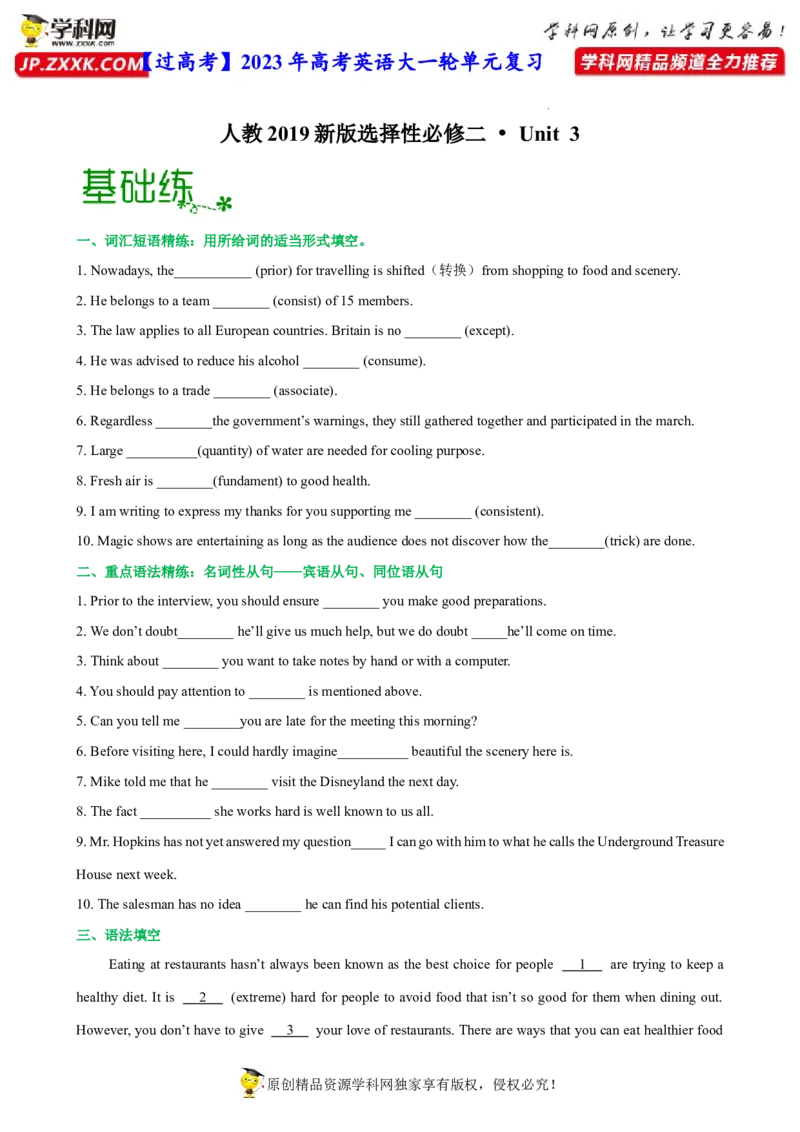
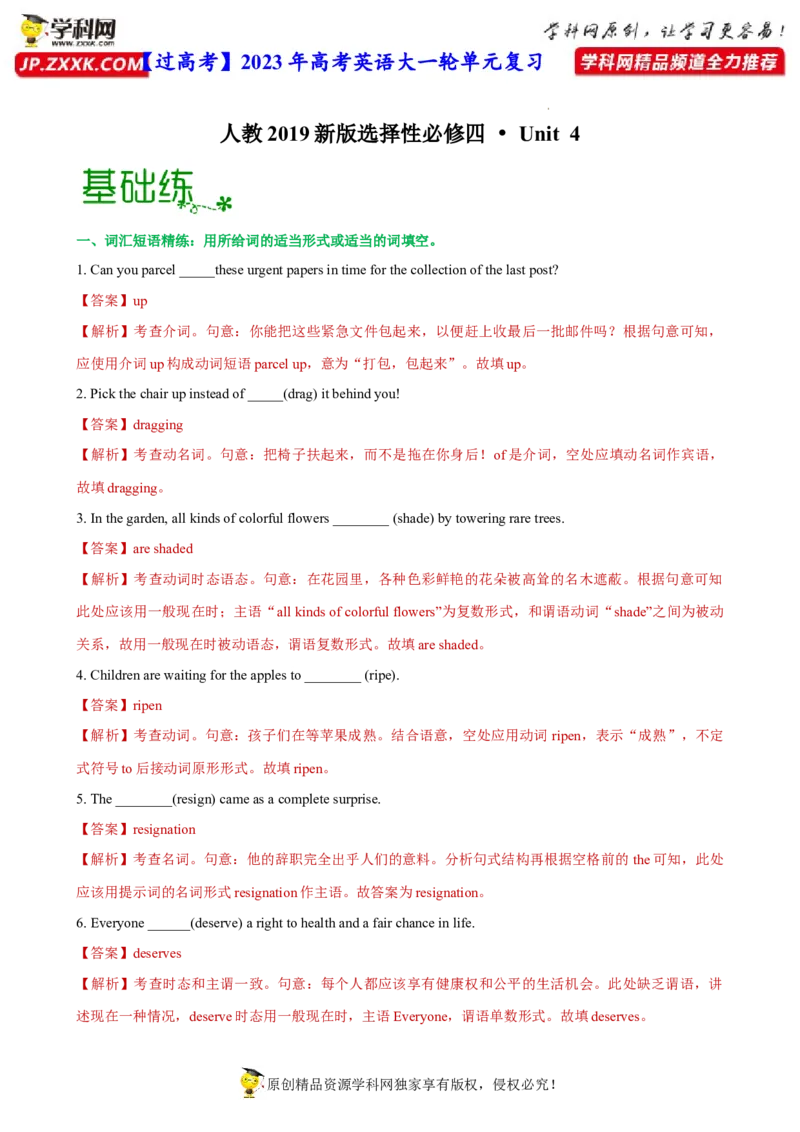
In order to know a foreign language well, four things are necessary. Firstly, we must understand
the language when we hear it 1 (speak).
Secondly, we must be able to speak it 2 (frequent).correctly without hesitation (犹豫) until we
can speak it fluently. Thirdly, we must read in the language as much as possible. Besides, we must be
able 3 (write)it. We must be able to make sentences 4 are correct in grammar.
There is 5 short way to succeed in language learning. A good memory is actually 6 great
help in learning a foreign language, but it is not enough only 7 (memorize)the rules from a
grammar book. It is no much use 8 (learn)by heart long lists of words and their
9 (meaning).studying the dictionary. and so on. We must learn by using the language. If we
are pleased with a little 10 (use)we have memorized, we are not really learning the language. We
must learn through use. Practice is important. We must practise speaking and using the language whenever
we can.
四、阅读理解
People often ask which is the most difficult language to learn, and it is not easy to answer because there are
too many factors to take into consideration.Firstly.in a first language the differences are unimportant as people learn
their mother tongue naturally, so the question of how hard a language is to learn only makes more sense when
learning a second language.
A native speaker of Spanish, for example, will find Portuguese much easier to learn than a native speaker of
Chinese, for example, because Portuguese is very similar to Spanish, while Chinese is very different, so first language
can affect learning a second language. The greater the differences between the second language and our first, the
harder it will be for most people to learn. Many people answer that Chinese is the hardest language to learn, possibly
influenced by the thought of learning the Chinese writing system, and the pronunciation of Chinese does appear to
be very difficult for many foreign learners. However, for Japanese speakers, who already use Chinese characters in
their own language, learning writing will be less difficult than for speakers of languages using the Roman
alphabet.
Some people seem to learn languages easily, while others find it very difficult. Teachers and the
circumstances in which the language is learned also play an important role, as well as each learner's motivation for
原创精品资源学科网独家享有版权,侵权必究!
学科网(北京)股份有限公司【过高考】2023 年高考英语大一轮单元复习
learning. If people learn a language because they need to use it professionally, they often learn it faster than people
studying a language that has no direct use in their day to day life.
Obviously British diplomats and other embassy staff have found that the second hardest language is Japanese,
which will probably come as no surprise to many, but the language that they have found to be the most problematic is
Hungarian, which uses a similar alphabet to English but has 35 cases (forms of a nouns according to whether it is
subject, object, genitive, etc). This does not mean that Hungarian is the hardest language to learn for everyone, but
it causes British diplomatic personnel, who are generally used to learning languages, the most difficulty. However,
Tabassaran, a Caucasian language has 48 cases, so it might cause more difficulty if British diplomats had to learn
it.
Different cultures and individuals from those cultures will find different languages more difficult. Therefore,
it is impossible to say that there is one language that is the most difficult language in the world.
1. What can we infer from the first paragraph?
A. The question of how hard a language is to learn is only applicable to first language acquisition
B. The question of how hard a language is to learn is only applicable to second language acquisition
C. The question of how hard a language is to learn is applicable to both first and second language acquisition.
D. There are too many languages in the world so it's difficult to say which one is the most difficult to learn.
2. Which language will a native Portuguese speaker probably find easier to learn?
A. Chinese, because Portuguese use Chinese characters in their own language.
B. Japanese, because it is similar to their own language.
C. Spanish, because it also uses Roman alphabet.
D. Any one but Chinese, because its pronunciation is very difficult.
3. What does the underlined word mean in Paragraph 3?
A. A particular situation or environment. B. The degree of education that somebody has obtained
C. Teachers' encouragement. D. Professional training.
4. The author is most likely to agree
A. Not Hungarian's writing system but its grammatical complexity causes problems for native British speakers.
B. Tabassaran is the hardest language to learn in the world for native European speakers.
C. Many British diplomats learn Tabassaran.
D. Learning a different writing system is easy.
五、七选五
原创精品资源学科网独家享有版权,侵权必究!
学科网(北京)股份有限公司【过高考】2023 年高考英语大一轮单元复习
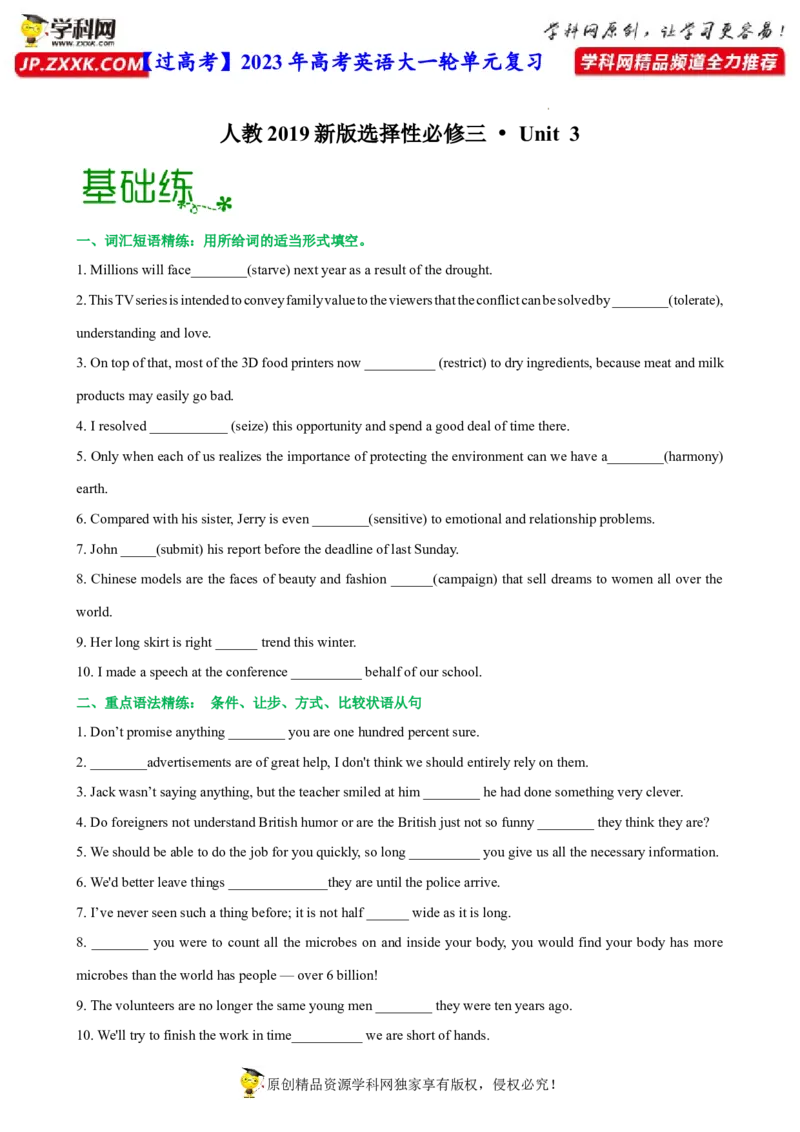
A good book can be satisfying. If reading is a habit you'd like to get into, there are some ways to develop it.
● Realize that reading is enjoyable if you have a good book. If you have a difficult book and
you are forcing yourself through it, it will seem like a task. 1
● Set time. You should have some time during every day when you'll read for at least5to10
minutes. 2 For example, make it a habit to read during breakfast and lunch and even dinner if you
eat alone.
● Always carry a book. 3 When I leave the house, I always make sure to have my car keys
and one book at hand. The book stays with me in the car, and I take it into the office and to
appointments and pretty much everywhere I go.
● 4 Find a place in your home where you can sit in a comfortable chair. Don't lie down
unless you're going to sleep. There shouldn't be a television or a computer near the chair, and no music
or no noisy family members/roommates. If you don't have a place like this, create one.
● Reduce television/the Internet. If you really want to read more, try cutting back on time on TV
or the Internet. 5 Still, every minute you reduce of the Internet/TV, you could use for reading. This
could create hours of book reading time.
A. Go to bookstores.
B. Find a quiet place.
C. This may be difficult for some people.
D. Wherever you go, take a book with you.
E. Have some good tea or coffee while you read.
F. It means you will read no matter how busy you are.
G. If this happens, give up the book and find another one that you'll really love.
六、完形填空
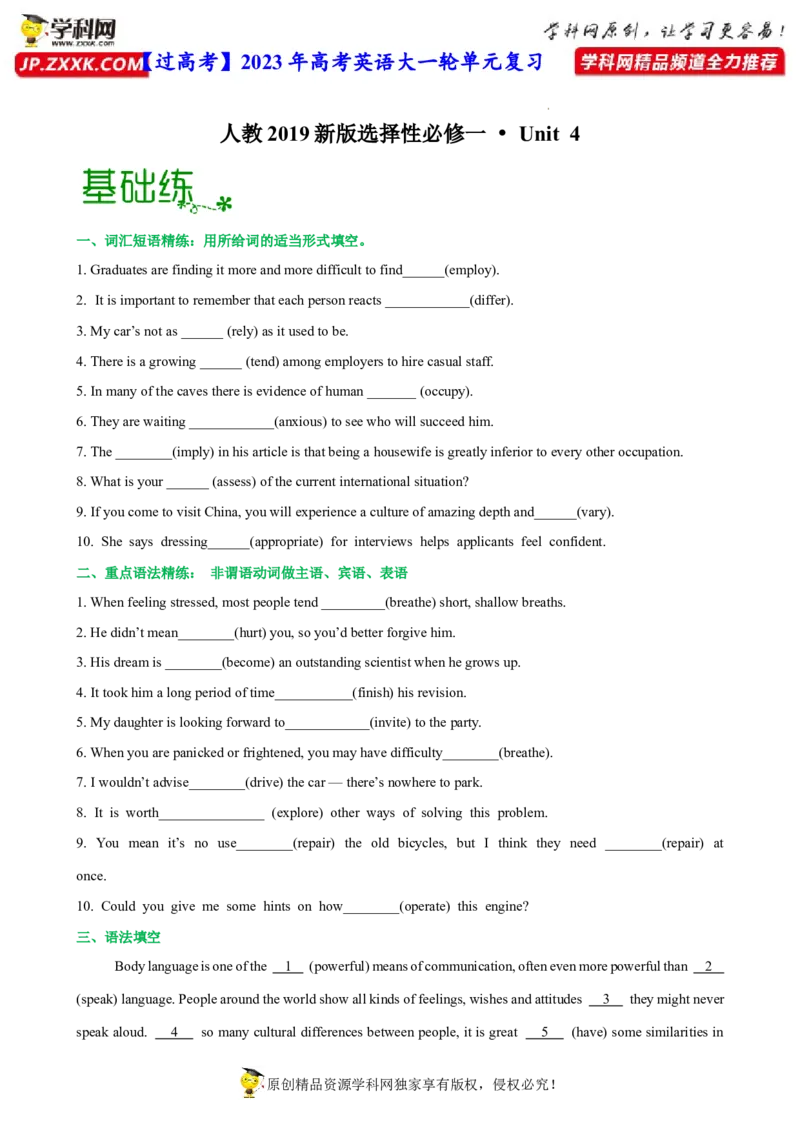
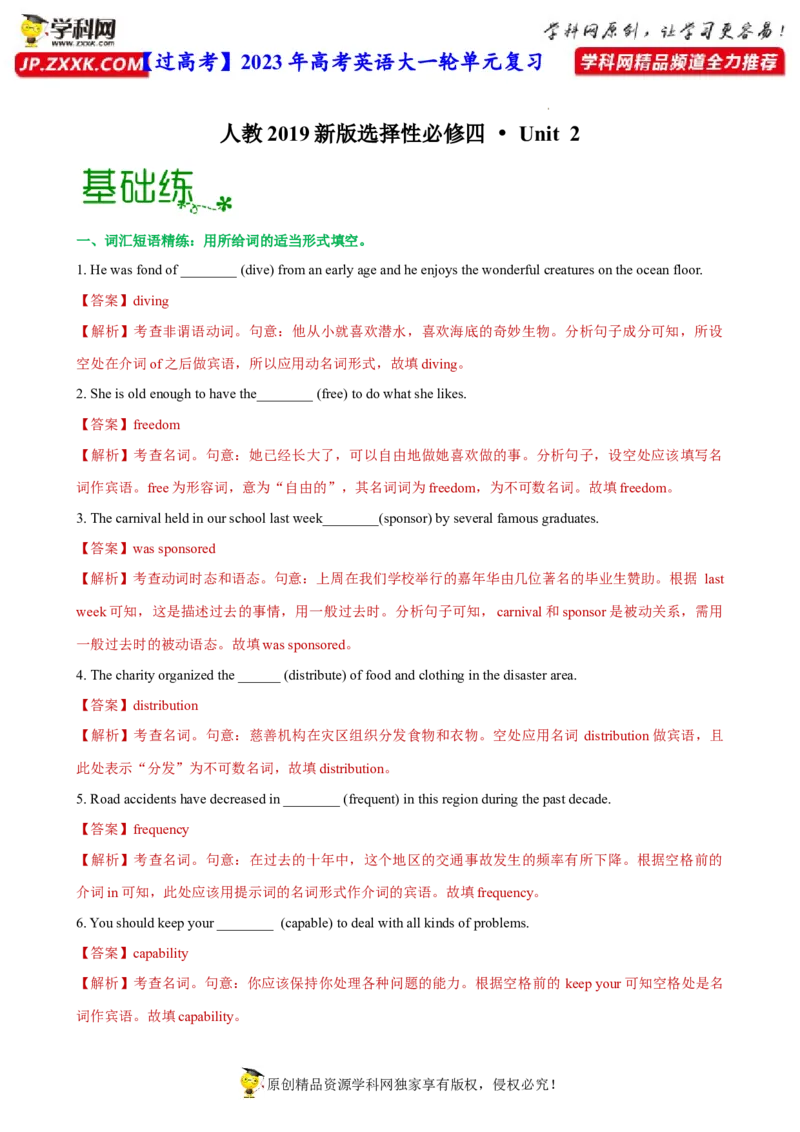
It happened a month after I began teaching in the US. I had to 1 the class schedule. “We’ll
need to prepone the quiz,” I said, preparing for the groans (咕哝) from my students. Instead, there was
a total 2 .
I looked around to see 3 expressions on their faces-that look of “I have NO idea what you just
said,” which stops any teacher mid-lecture to 4 a concept further.
It was then that I found out that “prepone” was not a(n) 5 word in English dictionaries. I believed that
prepone mean the 6 of postpone-moving an event to an earlier time rather 7 an event. So when I
原创精品资源学科网独家享有版权,侵权必究!
学科网(北京)股份有限公司【过高考】2023 年高考英语大一轮单元复习
realized it wasn't “proper” English. I was 8 . It was a great 9 in my linguistic (语言的) self-image.
I had grown up in India, where fluency in English is closely associated with 10 privilege (特
权). I was an English major with a large vocabulary, and 11 for reading Dickens and Austen. My
comfort with English had shaped my sense of 12 . In a world divided into linguistic “haves” and “have-nots”.
I 13 knew I was one of the “haves”.
But that day in the classroom, my incomprehensible English taught me that being an linguistic
“have” is 14 and delusional (妄自尊大) at best. Leaving India 15 me out of my privilege and
opened my eyes to the rich world of Englishes.
1. A. meet B. design C. arrange D. change
2. A. silence B. understanding C. mess D. commitment
3. A. genuine B. happy C. blank D. guilty
4. A. grasp B. define C. replace D. explain
5. A. useful B. simple C. ordinary D. actual
6. A. concept B. formation C. opposite D. dimension
7. A. breaking off B. putting of C. calling off D. getting off
8. A. astonished B. relieved C. excited D. disappointed
9. A. reflection B. establishment C. honor D. shift
10. A. cultural B. economic C. mental D. commercial
11. A. concern B. gratitude C. fondness D. tension
12. A. justice B. beauty C. duty D. self
13. A. humb1y B. definitely C. possibly D. barely
14. A. unusual B. unstable C. reliable D. perfect
15. A. took B. cheated C. picked D. argued
七、书面表达
假定你是李华,下个月要参加北京外国语大学入学英语面试,请你发一封邮件向你校的外教Chris请
教,内容包括:
1.口语表达;
2.面试技巧;
3.注意事项。
注意:1.词数80左右;
原创精品资源学科网独家享有版权,侵权必究!
学科网(北京)股份有限公司【过高考】2023 年高考英语大一轮单元复习
2.可适当增加细节,以使行文连贯。
Dear Chris,
_______________________________________________________________________________________
___________________________________________________________________________________________
___________________________________________________.
Sincerely,
Li Hua
原创精品资源学科网独家享有版权,侵权必究!
学科网(北京)股份有限公司【过高考】2023 年高考英语大一轮单元复习
原创精品资源学科网独家享有版权,侵权必究!
学科网(北京)股份有限公司