Unit 9 Have you ever been to a museum? 单元核心知识点全方位精练
(Section A)
【单元核心知识点全方位精练(Section A)】含以下内容:
重点单词练习:本部分设置了“根据中文或首字母提示填写单词”,“用所给词的适当形式填空”,“一
词多义”,“单项选择”等练习。
重点短语练习:本部分设置了“短语英汉互译”和“翻译句子”等练习。
重点语法练习:本部分针对单元重点语法设置了填空,选择,翻译等多类型练习。
重点句型练习:本部分设置了教材原句回译,仿写句子等练习。
【重点单词练习】
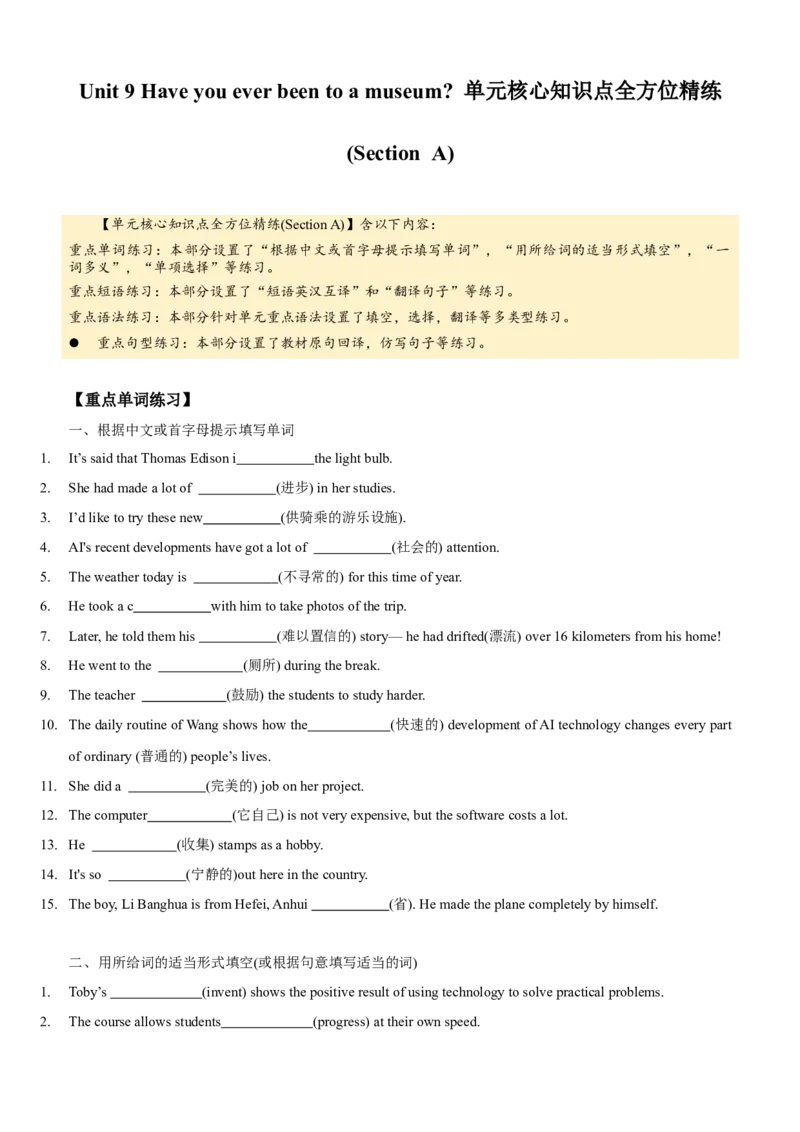
一、根据中文或首字母提示填写单词
1. It’s said that Thomas Edison i the light bulb.
2. She had made a lot of (进步) in her studies.
3. I’d like to try these new (供骑乘的游乐设施).
4. AI's recent developments have got a lot of (社会的) attention.
5. The weather today is (不寻常的) for this time of year.
6. He took a c with him to take photos of the trip.
7. Later, he told them his (难以置信的) story— he had drifted(漂流) over 16 kilometers from his home!
8. He went to the (厕所) during the break.
9. The teacher (鼓励) the students to study harder.
10. The daily routine of Wang shows how the (快速的) development of AI technology changes every part
of ordinary (普通的) people’s lives.
11. She did a (完美的) job on her project.
12. The computer (它自己) is not very expensive, but the software costs a lot.
13. He (收集) stamps as a hobby.
14. It's so (宁静的)out here in the country.
15. The boy, Li Banghua is from Hefei, Anhui (省). He made the plane completely by himself.
二、用所给词的适当形式填空(或根据句意填写适当的词)
1. Toby’s (invent) shows the positive result of using technology to solve practical problems.
2. The course allows students (progress) at their own speed.3. The teacher encouraged the students (take) part in the writing competition.
4. I feel so surprised that the boy did much better at school with your (encourage).
5. The number of the people who use HUAWEI products is rising (rapid).
6. I can cook delicious food and my sister can make her bed (perfect).
7. Happiness (it) cannot come to find you, but you can walk towards it by working hard.
8. What a (peace) moment it is to enjoy the sunset by the lake!
9. The new library has a large (collect) of books and a quiet reading area.
10. Perhaps computers (be) able to do most things for people one day.
11. Volunteers help with research and animal rescue, and they teach others sea life.
12. They also explain different meanings and show how (use) words in sentences.
13. There is nothing as (enjoy) as having a day out in the fresh air and sunshine.
14. It is impossible to stop natural disasters, but with more (prepare), you can protect yourself and your
loved ones better.
15. This is the most exciting song that I have ever (hear).
三、一词多义(写出词汇在下列句子中的中文意思)
1. ride
(1) The rides in this amusement park are free.
(2) We managed to get a ride into town when we missed the bus.
(3) It's a ten-minute bus ride from here to town.
(4) He was riding on a large black horse.
(5) I walked back while the others rode in the car.
2. lead
(1) Which door leads to the yard?
(2) Eating too much sugar can lead to health problems.
(3) What led you to this conclusion(结论)?
(4) The old couple led a happy life.
(5) We lead the way in space technology.
四、单项选择
1. Thanks to Mr. Xu, I’ve made great ________ in English.
A.trouble B.illness C.decision D.progress2. —Listen, that little boy can tell Chinese stories in English.
—Yeah. It sounds ________, but it is really true.
A.unfair B.dangerous C.independent D.unbelievable
3. —Are the singers all from ______?
—No, there are only two ______ in the group.
A.Germany; Germany B.Germany; Germans C.German; Germans
4. —I haven’t seen the movie Hero Is Back.
—______________. Let’s go to see it together this Sunday.
A.Me, too B.Me neither C.Yes, please
5. Ted’s father is a famous ________. He ________ many modern tools so far.
A.invention; invents B.inventor; has invented
C.invention; invented D.inventor; invents
6. —Mary, did you go ________ last summer vacation?
—Yes. I went to Hangzhou.
A.wonderful anywhere B.anywhere wonderful
C.somewhere wonderful D.wonderful somewhere
7. —To tell you the truth, I am now feeling very ________.
—Take it easy. You will make it.
A.peaceful B.nervous C.excited D.happy
8. Life ________ is like a box of chocolate, and you never know what you are going to get until you open it.
A.it B.itself C.it’s D.its
9. Nowadays, many schools encourage students ________vegetables to let them understand where foods come from.
A.grow B.grew C.growing D.to grow
10. My mother always encourages me to practice ________ English because she thinks practice makes ________.
A.to speak; double B.speaking; polite
C.speaking; perfect D.to speak; awful
【重点短语练习】
一、短语英汉互译
科学博物馆
一些不同的地方
乘地铁
骑自行车
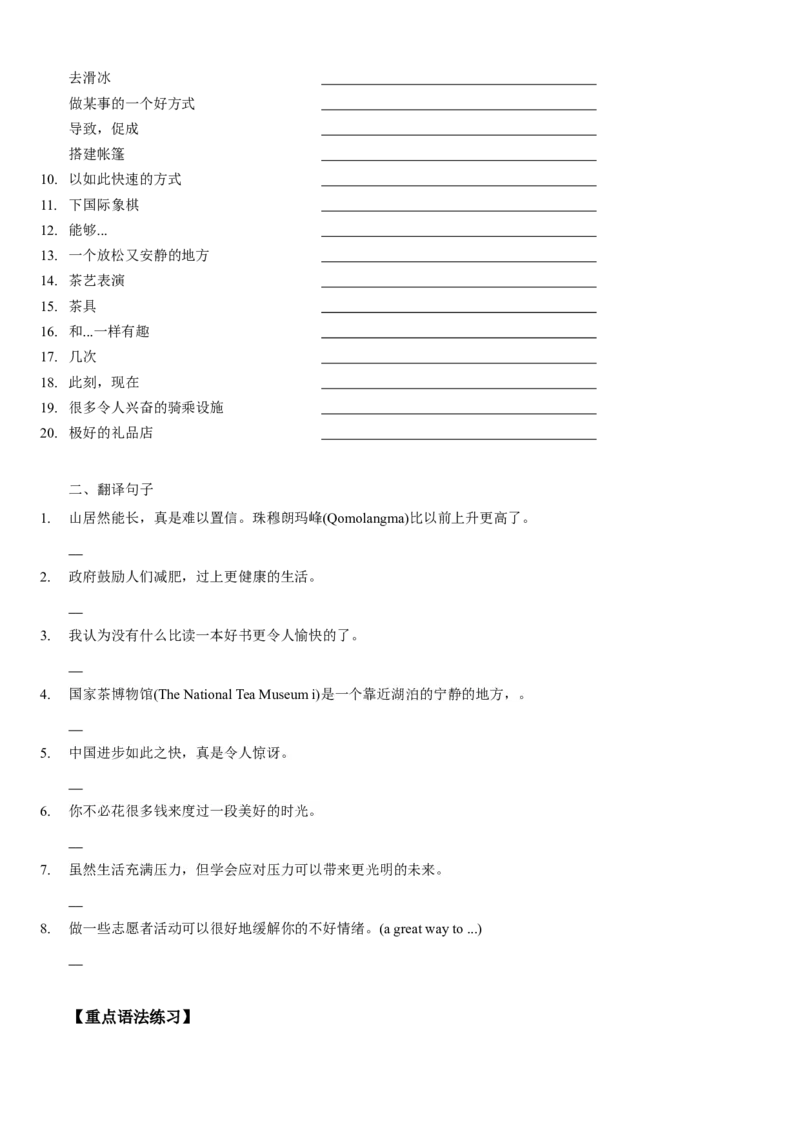
玩得开心去滑冰
做某事的一个好方式
导致,促成
搭建帐篷
10. 以如此快速的方式
11. 下国际象棋
12. 能够...
13. 一个放松又安静的地方
14. 茶艺表演
15. 茶具
16. 和...一样有趣
17. 几次
18. 此刻,现在
19. 很多令人兴奋的骑乘设施
20. 极好的礼品店
二、翻译句子
1. 山居然能长,真是难以置信。珠穆朗玛峰(Qomolangma)比以前上升更高了。
2. 政府鼓励人们减肥,过上更健康的生活。
3. 我认为没有什么比读一本好书更令人愉快的了。
4. 国家茶博物馆(The National Tea Museum i)是一个靠近湖泊的宁静的地方,。
5. 中国进步如此之快,真是令人惊讶。
6. 你不必花很多钱来度过一段美好的时光。
7. 虽然生活充满压力,但学会应对压力可以带来更光明的未来。
8. 做一些志愿者活动可以很好地缓解你的不好情绪。(a great way to ...)
【重点语法练习】现在完成时
一、单项填空。
1. Half an hour ________since the train ________.
A.has passed; leftB.has passed; has left C.passed; has left D.passed; left
2. —Have you ________ been to Guangdong?
—Not ________. But I plan to go there this summer.
A.never; already B.just; never C.yet; already D.ever; yet
3. —________ Amy with her sister ________ the Statue of Liberty in the USA?
—Yes, only once.
A.Have; been in B.Have; been to C.Has; been in D.Has; been to
4. —Mike isn’t at home. Do you know where he is?
—He ________the Ancient Huizhou City. He________there three times because of work.
A.has been to; has been B.has been to; has gone
C.has gone to; has been D.has gone to; has gone
5. —Have you ________ been to France?
—No, ________.
A.ever; never B.never; ever C.ever; ever D.never; never
6. —Have you ever ________ to Jinan?
—Yes, I ________ there last year.
A.been; went B.gone; went C.been; have been D.gone; have gone to
7. —I have ________ been to Xizang. How about you?
—Me. neither.
A.never B.ever C.already
8. —________ you ________ the film before, Lily?
—Yes. I ________ it online the other day.
A.Have; seen; have seen B.Did; see; saw
C.Have; seen; saw D.Did; see; have seen
9. I ________ a book from the library last month. I have to return it today because I ________ it for too long.
A.borrowed; have borrowed B.borrowed; have kept
C.lent; have lent D.lent; have kept
10. — Have you ever been to Shanghai during the past few years?
— Yes, I have. I________ there for a month last year. It’s such a fantastic place to visit.
A.went B.was C.have gone二、用所给词的适当形式填空。
1. —Are you a soccer player in your school?
—Yes, I (join)the team two years ago. I (be) in the team for two years.
2. — you (finish) your homework yet?
—Yes, I (finish) it just now.
3. — Oh, Tom. When did you buy your bike?
— I (buy) it in 2020. And I (have) it for five years.
4. —Have you visited Russia, Lilian?
—Yes, I (study) there for two weeks.
5. Mr. Brown (be) to New York twice.
6. Miss Gao isn’t here. She (go) to London and she (get) back in two weeks.
7. I (be) in China for three months and this is the first time I (try) on qipao.
8. Since I (start) helping as a volunteer in the school library last term, I (enjoy) both
reading books and helping others.
三、语法填空
用括号内所给词的正确形式填空。
On my recent travels in China, I went from the top to the bottom of the country. I was amazed at how different
the weather was in different cities. So far I have been freezing cold in Chongli (Hebei province) and Harbin, but
much warmer in Shanghai, Guilin, Qingdao and Yangshuo. Each city (have) a different feel and
allows you to experience different things.
In Qingdao we ate seafood, (drink) beer and even swam in the sea. In Harbin we
(wear) our warmest jackets, ate local sausage and saw the amazing ice and snow sculptures (雪雕). In Chongli we
learned how to snowboard! Shanghai (remind) me of a city in Europe or America. There are lots of
Western cafes. Guilin was a good place to be during Spring Festival. Fireworks (fill) the sky and the
streets were busy with excited people. I visited the old buildings and walked around a beautiful lake.
But Yangshuo (be) my favorite city so far. I could not stop (take) photos of the
beautiful mountains and the Li River. I (ride) a bicycle along the Yulong River in the warm sun. I ate
strawberries and drank tea from the farms in the mountains.
Now I (am) back in Beijing. I am looking forward to my next trip. I think I (go) to
another warm place!【重点句型练习】
教材原句回译与练习
1. 我也了解了一些发明,它们成就了彩色电影。
回译:
解析:
句中learn表示“了解,获知”,后加介词about或of引出具体的内容。
that led to color movies是that引导的定语从句,修饰inventions。
lead to表示“促成,导致”。
仿写:
(1) 作为一名科学爱好者,我希望我能发明一辆能在天空中飞行的自行车。
(2) 了解技术中的新事物非常重要,因为世界总是在变化。
(3) 吃健康的食物和保持活跃可以带来更好的生活。
2. 我去过的最有趣的博物馆是美国计算机博物馆。
回译: is the American Computer Museum.
解析:I’ve ever been to是省略了关系词的定语从句。关系代词引导定语从句,在句中作宾语时一般可以省
略。如:The book (which/that)I borrowed from the library is about ancient history.
仿写:
(1) 你上周借我的书非常有趣。
(2) 我读过的最有趣的书是西游记。
3. 令人难以置信的是,技术进步如此之快!
回译:
解析:本句中it是形式主语,真正的主语是后面的that主语从句,此句可当做句型使用:It’s+adj.+that从
句。
仿写:
学生们应该学习一些生活技能,这是重要的。4. 观看茶的准备过程和喝茶本身一样令人愉快。
回译:
解析:as enjoyable as是“as+形容词/副词原级+as”结构,用于同级比较,可译为“和...一样...样的”。
仿写:
我觉得参观博物馆和在山里露营一样有趣。