专题18 议论文和说明文类完形填空
(2011·广东)
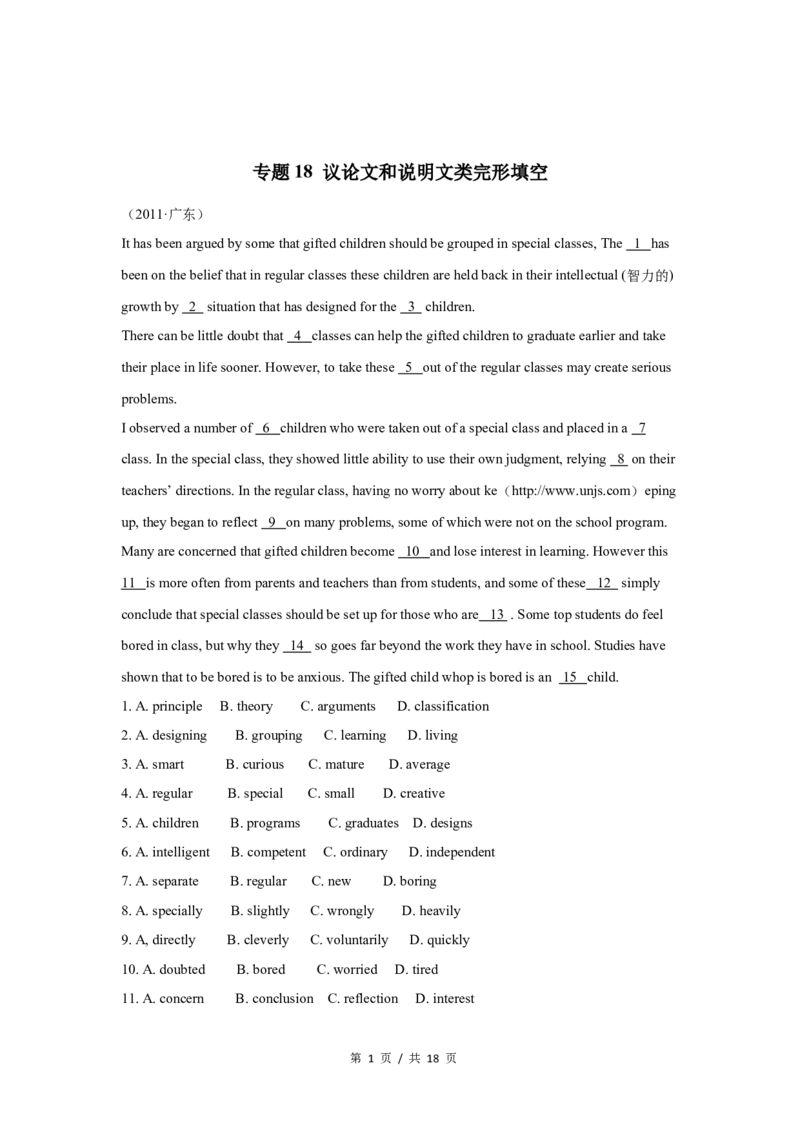
It has been argued by some that gifted children should be grouped in special classes, The   1   has
been on the belief that in regular classes these children are held back in their intellectual (智力的)
growth by   2   situation that has designed for the   3   children.
There can be little doubt that   4   classes can help the gifted children to graduate earlier and take
their place in life sooner. However, to take these   5   out of the regular classes may create serious
problems.
I observed a number of   6   children who were taken out of a special class and placed in a   7
class. In the special class, they showed little ability to use their own judgment, relying   8  on their
teachers’ directions. In the regular class, having no worry about ke(http://www.unjs.com)eping
up, they began to reflect   9   on many problems, some of which were not on the school program.
Many are concerned that gifted children become   10   and lose interest in learning. However this
11   is more often from parents and teachers than from students, and some of these   12   simply
conclude that special classes should be set up for those who are   13  . Some top students do feel
bored in class, but why they   14   so goes far beyond the work they have in school. Studies have
shown that to be bored is to be anxious. The gifted child whop is bored is an   15   child.
1. A. principle     B. theory        C. arguments      D. classification
2. A. designing        B. grouping      C. learning      D. living
3. A. smart            B. curious       C. mature       D. average
4. A. regular          B. special       C. small        D. creative
5. A. children         B. programs     C. graduates    D. designs
6. A. intelligent      B. competent     C. ordinary      D. independent
7. A. separate         B. regular       C. new         D. boring
8. A. specially        B. slightly      C. wrongly        D. heavily
9. A, directly         B. cleverly      C. voluntarily     D. quickly
10. A. doubted         B. bored         C. worried     D. tired
11. A. concern         B. conclusion    C. reflection     D. interest
 第 1 页 / 共 18 页
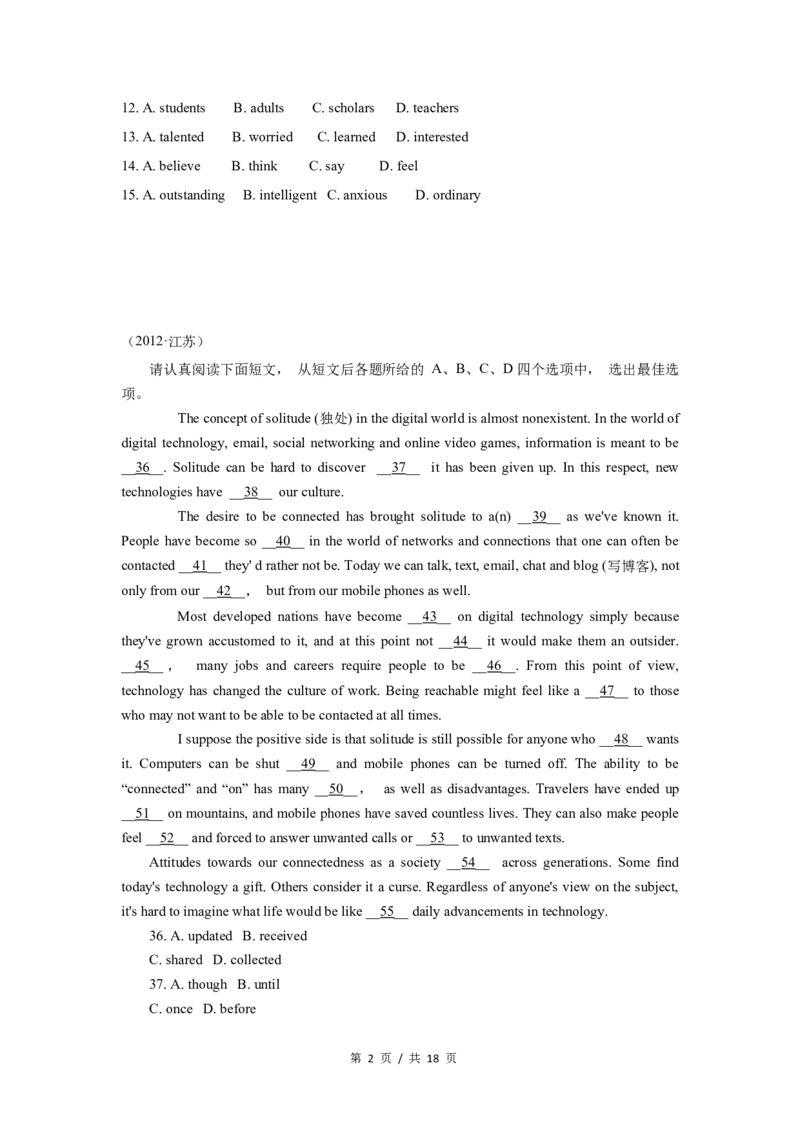
12. A. students        B. adults        C. scholars      D. teachers
13. A. talented        B. worried       C. learned      D. interested
14. A. believe         B. think         C. say          D. feel
15. A. outstanding     B. intelligent   C. anxious        D. ordinary
(2012·江苏)
请认真阅读下面短文, 从短文后各题所给的 A、B、C、D 四个选项中, 选出最佳选
项。
The concept of solitude (独处) in the digital world is almost nonexistent. In the world of
digital technology, email, social networking and online video games, information is meant to be
__36__. Solitude can be hard to discover  __37__  it has been given up. In this respect, new
technologies have  __38__  our culture.
The desire to be connected has brought solitude to a(n) __39__ as we've known it.
People have become so __40__ in the world of networks and connections that one can often be
contacted __41__ they' d rather not be. Today we can talk, text, email, chat and blog (写博客), not
only from our __42__, but from our mobile phones as well.
Most developed nations have become __43__ on digital technology simply because
they've grown accustomed to it, and at this point not __44__ it would make them an outsider.
__45__ , many jobs and careers require people to be __46__. From this point of view,
technology has changed the culture of work. Being reachable might feel like a __47__ to those
who may not want to be able to be contacted at all times.
I suppose the positive side is that solitude is still possible for anyone who __48__ wants
it. Computers can be shut __49__ and mobile phones can be turned off. The ability to be
“connected” and “on” has many __50__, as well as disadvantages. Travelers have ended up
__51__ on mountains, and mobile phones have saved countless lives. They can also make people
feel __52__ and forced to answer unwanted calls or __53__ to unwanted texts.
Attitudes towards our connectedness as a society __54__  across generations. Some find
today's technology a gift. Others consider it a curse. Regardless of anyone's view on the subject,
it's hard to imagine what life would be like __55__ daily advancements in technology.
36. A. updated   B. received
C. shared   D. collected
37. A. though   B. until
C. once   D. before
 第 2 页 / 共 18 页
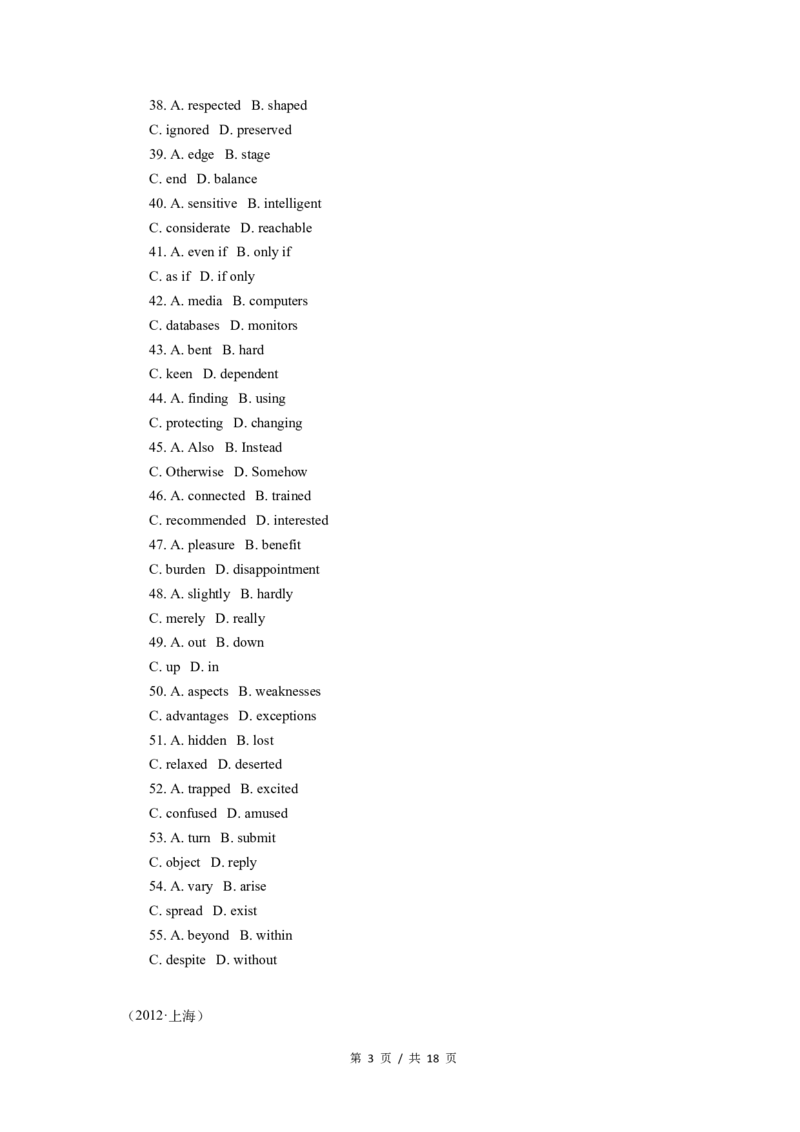
38. A. respected   B. shaped
C. ignored   D. preserved
39. A. edge   B. stage
C. end   D. balance
40. A. sensitive   B. intelligent
C. considerate   D. reachable
41. A. even if   B. only if
C. as if   D. if only
42. A. media   B. computers
C. databases   D. monitors
43. A. bent   B. hard
C. keen   D. dependent
44. A. finding   B. using
C. protecting   D. changing
45. A. Also   B. Instead
C. Otherwise   D. Somehow
46. A. connected   B. trained
C. recommended   D. interested
47. A. pleasure   B. benefit
C. burden   D. disappointment
48. A. slightly   B. hardly
C. merely   D. really
49. A. out   B. down
C. up   D. in
50. A. aspects   B. weaknesses
C. advantages   D. exceptions
51. A. hidden   B. lost
C. relaxed   D. deserted
52. A. trapped   B. excited
C. confused   D. amused
53. A. turn   B. submit
C. object   D. reply
54. A. vary   B. arise
C. spread   D. exist
55. A. beyond   B. within
C. despite   D. without
(2012·上海)
 第 3 页 / 共 18 页
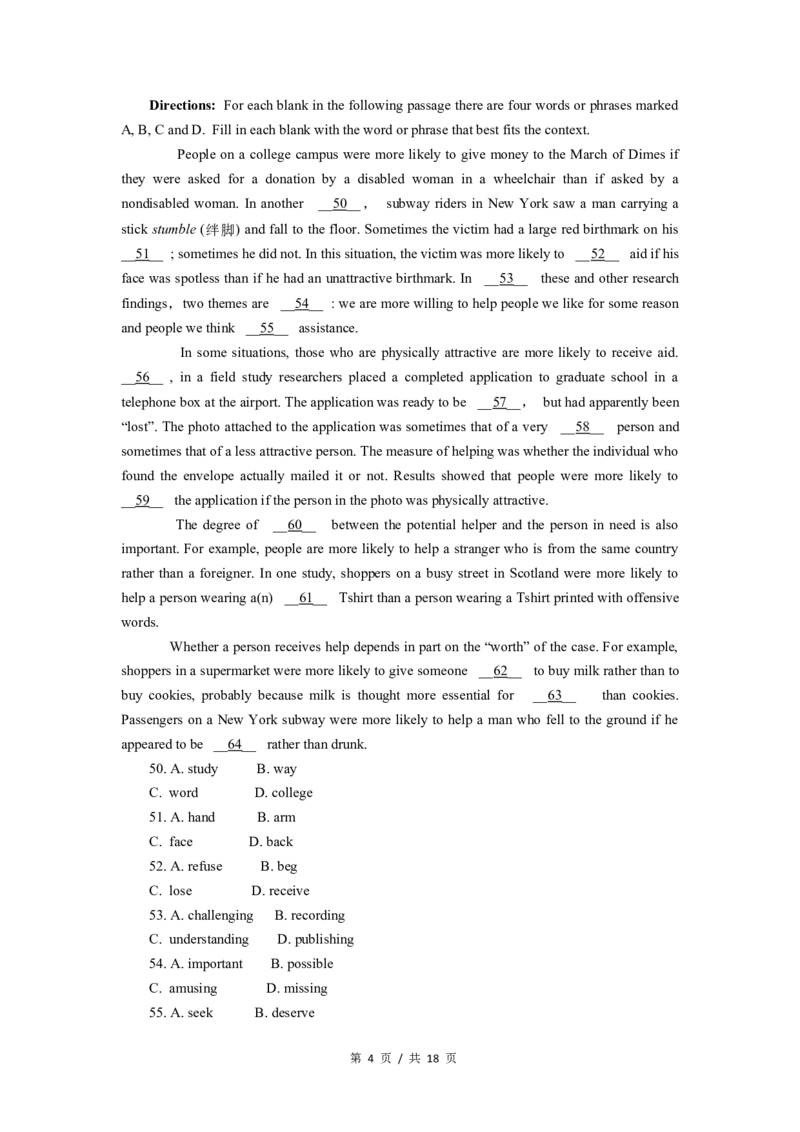
Directions:  For each blank in the following passage there are four words or phrases marked
A, B, C and D.  Fill in each blank with the word or phrase that best fits the context.
      People on a college campus were more likely to give money to the March of Dimes if
they were asked for a donation by a disabled woman in a wheelchair than if asked by a
nondisabled woman. In another   __50__, subway riders in New York saw a man carrying a
stick stumble (绊脚) and fall to the floor. Sometimes the victim had a large red birthmark on his
__51__  ; sometimes he did not. In this situation, the victim was more likely to   __52__   aid if his
face was spotless than if he had an unattractive birthmark. In   __53__   these and other research
findings,two themes are   __54__  : we are more willing to help people we like for some reason
and people we think   __55__   assistance.
      In some situations, those who are physically attractive are more likely to receive aid.
__56__ , in a field study researchers placed a completed application to graduate school in a
telephone box at the airport. The application was ready to be   __57__, but had apparently been
“lost”. The photo attached to the application was sometimes that of a very   __58__   person and
sometimes that of a less attractive person. The measure of helping was whether the individual who
found the envelope actually mailed it or not. Results showed that people were more likely to
__59__   the application if the person in the photo was physically attractive.
     The degree of   __60__   between the potential helper and the person in need is also
important. For example, people are more likely to help a stranger who is from the same country
rather than a foreigner. In one study, shoppers on a busy street in Scotland were more likely to
help a person wearing a(n)   __61__   Tshirt than a person wearing a Tshirt printed with offensive
words.
     Whether a person receives help depends in part on the “worth” of the case. For example,
shoppers in a supermarket were more likely to give someone   __62__   to buy milk rather than to
buy cookies, probably because milk is thought more essential for   __63__    than cookies.
Passengers on a New York subway were more likely to help a man who fell to the ground if he
appeared to be   __64__   rather than drunk.
50. A. study           B. way
C.  word                D. college
51. A. hand            B. arm
C.  face                D. back
52. A. refuse           B. beg
C.  lose                 D. receive
53. A. challenging      B. recording
C.  understanding        D. publishing
54. A. important        B. possible
C.  amusing              D. missing
55. A. seek            B. deserve
 第 4 页 / 共 18 页
C.  obtain               D. accept
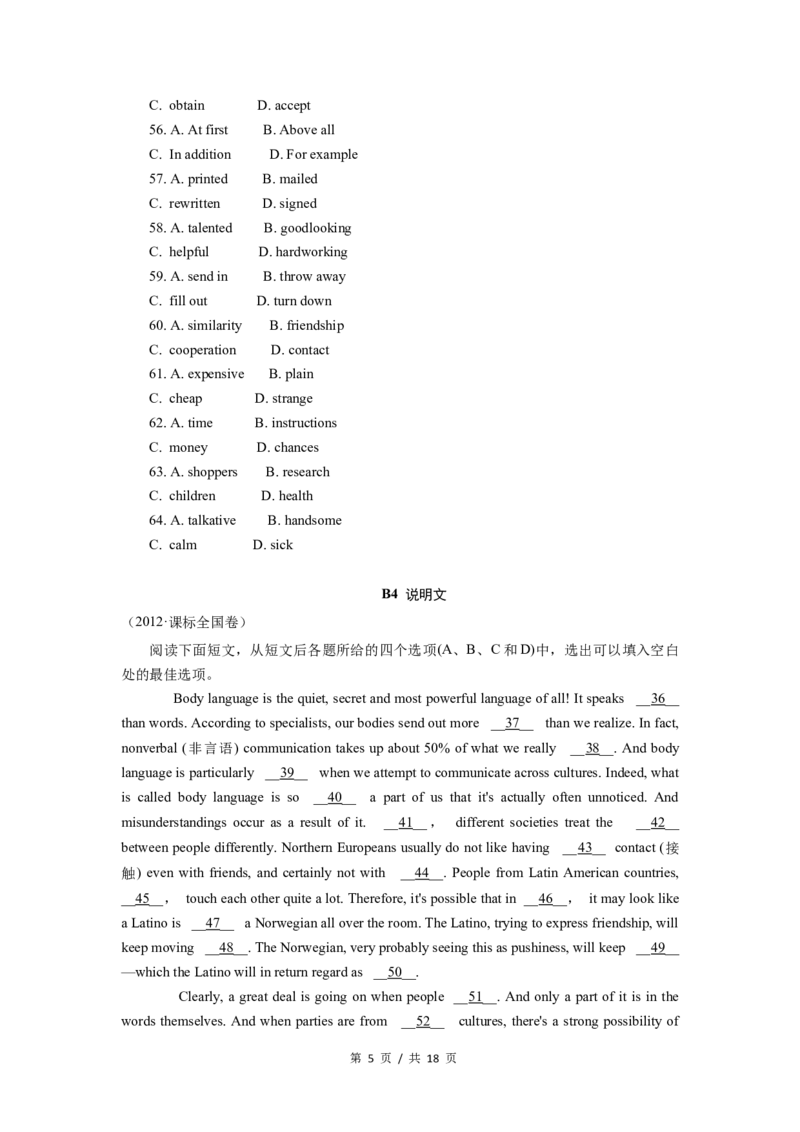
56. A. At first          B. Above all
C.  In addition           D. For example
57. A. printed          B. mailed
C.  rewritten            D. signed
58. A. talented         B. goodlooking
C.  helpful              D. hardworking
59. A. send in          B. throw away
C.  fill out              D. turn down
60. A. similarity        B. friendship
C.  cooperation          D. contact
61. A. expensive       B. plain
C.  cheap               D. strange
62. A. time            B. instructions
C.  money              D. chances
63. A. shoppers        B. research
C.  children             D. health
64. A. talkative         B. handsome
C.  calm                D. sick
B4  说明文
(2012·课标全国卷)
阅读下面短文,从短文后各题所给的四个选项(A、B、C 和D)中,选出可以填入空白
处的最佳选项。
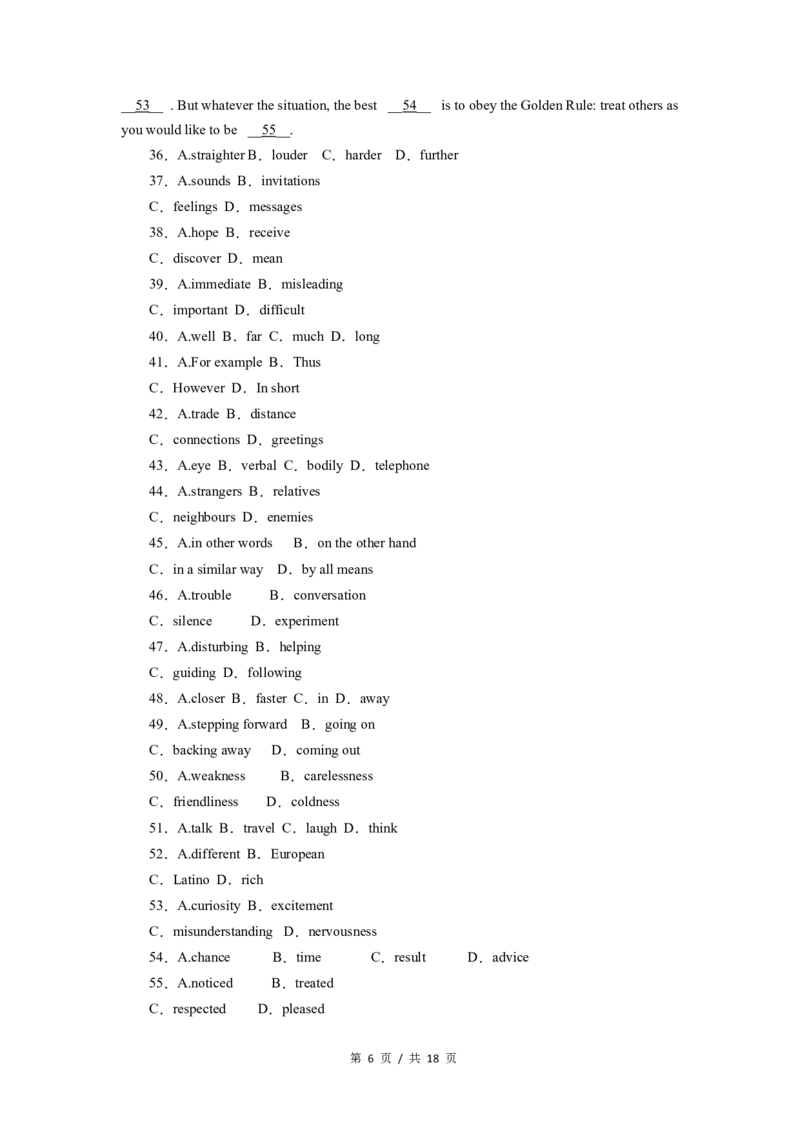
      Body language is the quiet, secret and most powerful language of all! It speaks   __36__
than words. According to specialists, our bodies send out more   __37__   than we realize. In fact,
nonverbal (非言语) communication takes up about 50% of what we really   __38__. And body
language is particularly   __39__   when we attempt to communicate across cultures. Indeed, what
is called body language is so  __40__  a part of us that it's actually often unnoticed. And
misunderstandings occur as a result of it.   __41__ , different societies treat the    __42__
between people differently. Northern Europeans usually do not like having   __43__  contact (接
触) even with friends, and certainly not with   __44__. People from Latin American countries,
__45__, touch each other quite a lot. Therefore, it's possible that in  __46__, it may look like
a Latino is   __47__   a Norwegian all over the room. The Latino, trying to express friendship, will
keep moving   __48__. The Norwegian, very probably seeing this as pushiness, will keep   __49__
—which the Latino will in return regard as   __50__.
      Clearly, a great deal is going on when people  __51__. And only a part of it is in the
words themselves. And when parties are from   __52__   cultures, there's a strong possibility of
 第 5 页 / 共 18 页
__53__  . But whatever the situation, the best   __54__   is to obey the Golden Rule: treat others as
you would like to be   __55__.
36.A.straighter B.louder C.harder D.further
37.A.sounds  B.invitations
C.feelings  D.messages
38.A.hope  B.receive
C.discover  D.mean
39.A.immediate  B.misleading
C.important  D.difficult
40.A.well  B.far  C.much  D.long
41.A.For example  B.Thus
C.However  D.In short
42.A.trade  B.distance
C.connections  D.greetings
43.A.eye  B.verbal  C.bodily  D.telephone
44.A.strangers  B.relatives
C.neighbours  D.enemies
45.A.in other words      B.on the other hand
C.in a similar way    D.by all means
46.A.trouble           B.conversation
C.silence           D.experiment
47.A.disturbing  B.helping
C.guiding  D.following
48.A.closer  B.faster  C.in  D.away
49.A.stepping forward    B.going on
C.backing away      D.coming out
50.A.weakness          B.carelessness
C.friendliness        D.coldness
51.A.talk  B.travel  C.laugh  D.think
52.A.different  B.European
C.Latino  D.rich
53.A.curiosity  B.excitement
C.misunderstanding   D.nervousness
54.A.chance            B.time              C.result            D.advice
55.A.noticed           B.treated
C.respected         D.pleased
 第 6 页 / 共 18 页
(2013·广东)
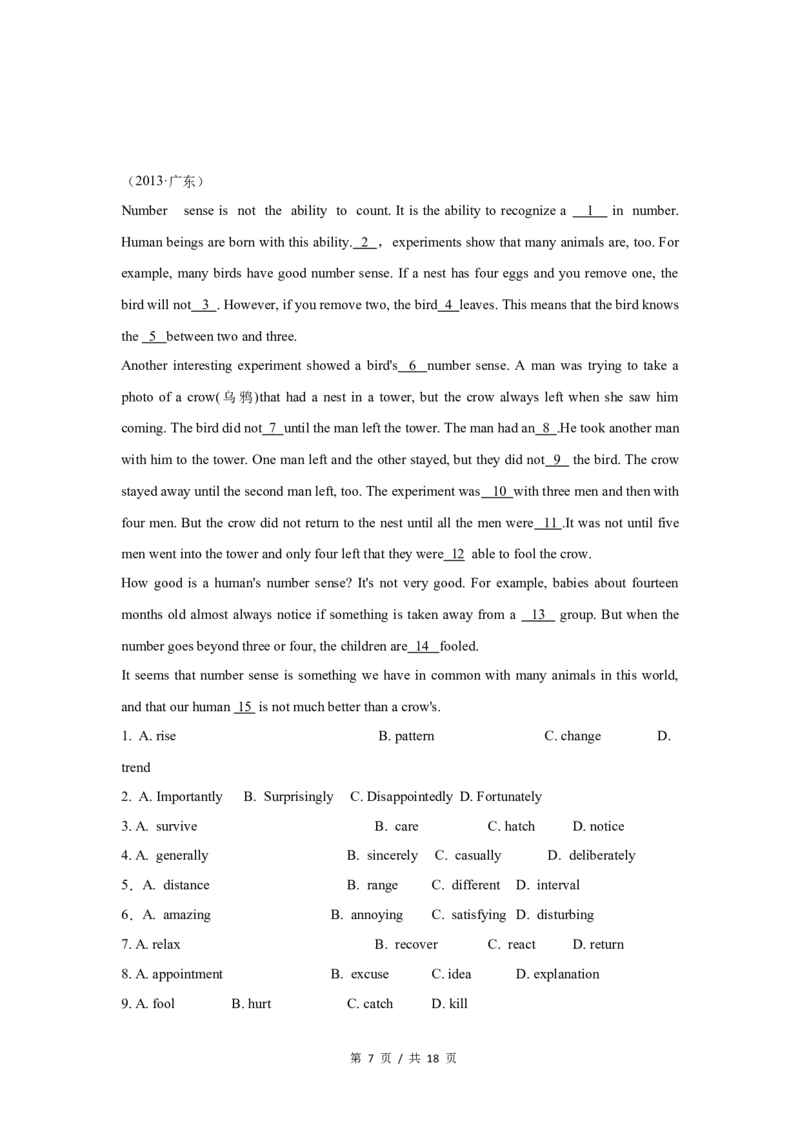
Number  sense is  not  the  ability  to  count. It is the ability to recognize a    1    in  number.
Human beings are born with this ability.  2  ,experiments show that many animals are, too. For
example, many birds have good number sense. If a nest has four eggs and you remove one, the
bird will not   3  . However, if you remove two, the bird  4  leaves. This means that the bird knows
the   5   between two and three.
Another interesting experiment showed a bird's  6  number sense. A man was trying to take a
photo of a crow( 乌鸦)that had a nest in a tower, but the crow always left when she saw him
coming. The bird did not  7  until the man left the tower. The man had an  8  .He took another man
with him to the tower. One man left and the other stayed, but they did not  9   the bird. The crow
stayed away until the second man left, too. The experiment was   10  with three men and then with
four men. But the crow did not return to the nest until all the men were  11 .It was not until five
men went into the tower and only four left that they were  12  able to fool the crow.
How good is a human's number sense? It's not very good. For example, babies about fourteen
months old almost always notice if something is taken away from a   13   group. But when the
number goes beyond three or four, the children are  14   fooled.
It seems that number sense is something we have in common with many animals in this world,
and that our human  15  is not much better than a crow's.
1. A. rise
 B. pattern
C. change
D.
trend
2. A. Importantly    B. Surprisingly
 C. Disappointedly D. Fortunately
3. A. survive
B. care
C. hatch
D. notice
4. A. generally
B. sincerely
 C. casually
 D. deliberately
5.A. distance
B. range
C. different   D. interval
6.A. amazing
B. annoying
C. satisfying D. disturbing
7. A. relax
B. recover
C. react
D. return
8. A. appointment
B. excuse
C. idea
D. explanation
9. A. fool        B. hurt
C. catch
D. kill
 第 7 页 / 共 18 页
10.A. repo
B. repeated
C. designed
D. approved
11.A. confused
B. gone
C. tired
D. drunk
12.A. gradually
B. luckily
C. strangely
D. finally
13.
A. single
B. small
C. local
D. new
14. A. seldom
B. temporarily C. merely
D. often
15. A. sight
B. nature
C. ability
D. belief
(2013·重庆)
B
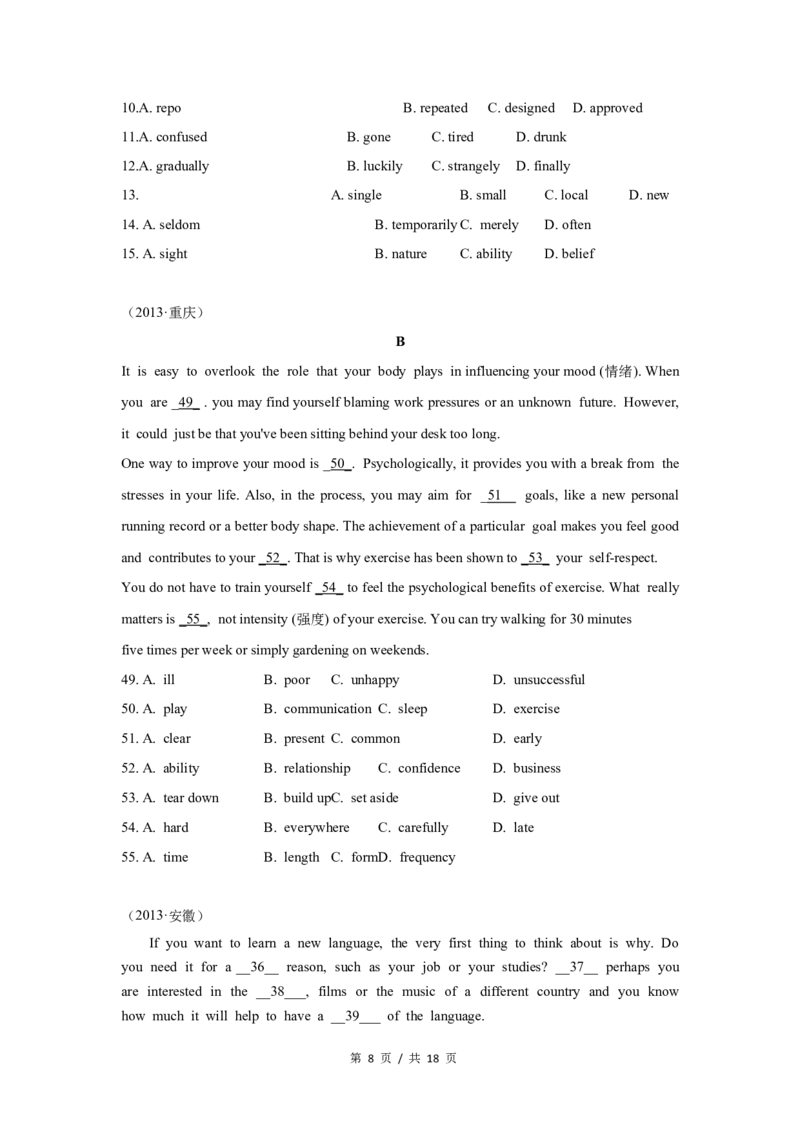
It is easy to overlook the role that your body plays in influencing your mood (情绪). When
you are _49
  _   . you may find yourself blaming work pressures or an unknown future. However,
it could just be that you've been sitting behind your desk too long.
One way to improve your mood is _50_. Psychologically, it provides you with a break from the
stresses in your life. Also, in the process, you may aim for _51

    goals, like a new personal
running record or a better body shape. The achievement of a particular goal makes you feel good
and contributes to your _52_. That is why exercise has been shown to _53_ your self-respect.
You do not have to train yourself _54_ to feel the psychological benefits of exercise. What really
matters is _55_, not intensity (强度) of your exercise. You can try walking for 30 minutes
five times per week or simply gardening on weekends.
49. A. ill
B. poor
C. unhappy
D. unsuccessful
50. A. play
B. communication C. sleep
D. exercise
51. A. clear
B. present C. common
D. early
52. A. ability
B. relationship
C. confidence
D. business
53. A. tear down
B. build upC. set aside
D. give out
54. A. hard
B. everywhere
C. carefully
D. late
55. A. time
B. length
C. formD. frequency
(2013·安徽)
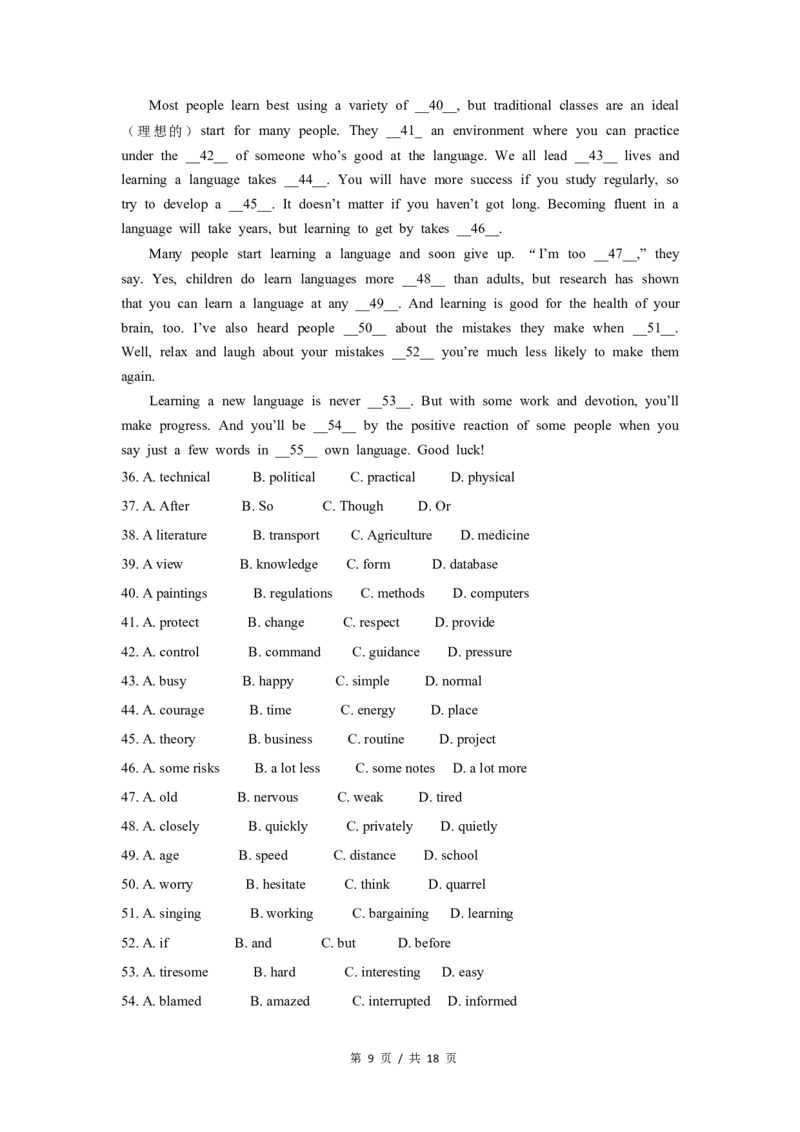
If you want to learn a new language, the very first thing to think about is why. Do
you need it for a __36__ reason, such as your job or your studies? __37__ perhaps you
are interested in the __38___, films or the music of a different country and you know
how much it will help to have a __39___ of the language.
 第 8 页 / 共 18 页
Most people learn best using a variety of __40__, but traditional classes are an ideal
(理想的)start for many people. They __41_ an environment where you can practice
under the __42__ of someone who’s good at the language. We all lead __43__ lives and
learning a language takes __44__. You will have more success if you study regularly, so
try to develop a __45__. It doesn’t matter if you haven’t got long. Becoming fluent in a
language will take years, but learning to get by takes __46__.
Many people start learning a language and soon give up. “I’m too __47__,” they
say. Yes, children do learn languages more __48__ than adults, but research has shown
that you can learn a language at any __49__. And learning is good for the health of your
brain, too. I’ve also heard people __50__ about the mistakes they make when __51__.
Well, relax and laugh about your mistakes __52__ you’re much less likely to make them
again.
Learning a new language is never __53__. But with some work and devotion, you’ll
make progress. And you’ll be __54__ by the positive reaction of some people when you
say just a few words in __55__ own language. Good luck!
36. A. technical            B. political          C. practical          D. physical
37. A. After               B. So              C. Though          D. Or
38. A literature             B. transport         C. Agriculture        D. medicine
39. A view                B. knowledge        C. form            D. database
40. A paintings             B. regulations        C. methods        D. computers
41. A. protect              B. change           C. respect          D. provide
42. A. control              B. command         C. guidance        D. pressure
43. A. busy                B. happy            C. simple          D. normal
44. A. courage             B. time              C. energy          D. place
45. A. theory               B. business          C. routine          D. project
46. A. some risks          B. a lot less          C. some notes     D. a lot more
47. A. old                 B. nervous           C. weak          D. tired
48. A. closely              B. quickly           C. privately        D. quietly
49. A. age                 B. speed             C. distance        D. school
50. A. worry               B. hesitate           C. think           D. quarrel
51. A. singing              B. working           C. bargaining      D. learning
52. A. if                   B. and              C. but            D. before
53. A. tiresome             B. hard              C. interesting      D. easy
54. A. blamed              B. amazed            C. interrupted     D. informed
 第 9 页 / 共 18 页
55. A. their                B. his               C. our            D, your
(2013·上海)
Over the past few decades, more and more countries have opened up their markets,
increasingly transforming the world economy into one free-flowing global market. The question
is: Is economic globalization   50   for all?
According to the World Bank, one of its chief supporters, economic globalization has helped
reduce   51   in a large number of developing countries. It quotes one study that shows increased
wealth   52   to improved education and longer life in twenty-four developing countries as a
result of integration (融合)of local economies into the world economy. Home some three
billion people, these twenty-four countries have seen incomes   53   at an average rate of
five percent—compared to two percent in developed countries.
Those who   54   globalization claim that economies in developing countries wilt from
new opportunities for small and home-based businesses.   55   , small farmers in Brazil who
produce nuts that would originally have sold only in   56   open-air markets can now
promote their goods worldwide by the Internet.
Critics take a different view, believing that economic globalization is actually   57   gap
between the rich and poor. A study carried out by the U.N.-sponsored World Commission on the
Social Dimension of Globalization shows that only a few developing countries have actually.   58
from integration into the world economy and that the poor, the uneducated, unskilled
workers, and native peoples have been left behind.   59   , they maintain that globalization
may eventually threaten emerging businesses. For example, Indian craftsmen who currently
seem to benefit from globalization because they are able to   60   their products may soon face
fierce competition that could put them out of   61   . When large-scale manufacturers start to
produce the same goods, or when superstores like Wal-Mart move in, these small businesses will
not be able to   62   and will be crowded out.
One thing is certain about Globalization—there is no   63   . Advances in technology
combined with more open policies have already created an interconnected world. The   64   now is
finding a way to create a kind of globalization that works for the benefit of all.
 第 10 页 / 共 18 页
50. A. possible
B. smooth
C. good
D easy
51. A. crime
B. poverty
C. conflict
D. population
52. A. contributing
B. responding
C. turning
D owing
53. A. remain
B. drop
C. shift
D. increase
54. A. doubt
B. define
C advocate
D. ignore
55. A. In addition
B. For instance
C. in other words D. All in all
56. A. mature
B. new
C. local
D. foreign
57. A. finding
B. exploring
C. bridging
D. widening
58. A. suffered
B. profited
C. learned
D. withdrawn
59. A. Furthermore
B. therefore
C. However
D. Otherwise
60. A. consume
B. deliver
C. export
D. advertise
61. A. trouble
B. business
C power
D. mind
62. A. keep up
B. come in
C. go around
D. help out
63. A. taking off
B. getting alone
C. holding out
D. turning back
64. A. agreement
B. prediction
C. outcome
D. challenge
(2014·新课标全国卷Ⅰ)
阅读下面短文,从短文后各题所给的四个选项(A、B、C 和D)中,选出可以填入空白
处的最佳选项。
As a general rule, all forms of activity lead to boredom when they are performed on a
routine(常规) basis. As a matter of fact, we can see this  __41__   at work in people of all
__42__. For example, on Christmas morning, children are excited about  __43__   with their
new toys. But their  __44__   soon wears off and by January those  __45__  toys can be
found put away in the basement. The world is full of  __46__  stamp albums and
unfinished models, each standing as a monument to someone's  __47__  interest. When parents
bring home a pet, their child  __48__  bathes it and brushes its fur. Within a short time,
however, the  __49__   of caring for the animal is handed over to the parents. Adolescents
enter high school with great __50__  but are soon looking forward to  __51__. The same is
true of the young adults going to college. And then, how many  __52__ , who  now
complain(抱怨) about the long drives to work,  __53__  drove for hours at a time when they
 第 11 页 / 共 18 页
first  __54__  their driver's licence(执照)? Before people retire, they usually  __55__  to do a
lot of __56__ things, which they never had  __57__  to do while working. But  __58__
after   retirement, the golfing, the fishing, the reading and all of the other pastimes become as
boring as the jobs they  __59__. And, like the child in January, they go searching for new
__60__.
41. A. principle       B. habit
C. way  D. power
42. A. parties  B. races
C. countries  D. ages
43. A. working    B. living
C. playing  D. going
44. A. confidence   B. interest
C. anxiety   D. sorrow
45. A. same      B. extra
C. funny   D. expensive
46. A. wellorganized  B. colourfullyprinted
C. newlycollected  D. halffilled
47. A. broad   B. passing
C. different  D. main
48. A. silently  B. impatiently
C. gladly   D. worriedly
49. A. promise  B. burden
C. right   D. game
50. A. courage    B. calmness
C. confusion  D. excitement
51. A. graduation   B. independence
C. responsibility  D. success
52. A. children  B. students
C. adults  D. retirees
53. A. carefully  B. eagerly
C. nervously  D. bravely
 第 12 页 / 共 18 页
54. A. required  B. obtained
C. noticed   D. discovered
55. A. need  B. learn
C. start    D. plan
56. A. great   B. strange
C. difficult  D. correct
57. A. time    B. money
C. skills   D. knowledge
58. A. only   B. well
C. even     D. soon
59. A. lost  B. chose
C. left  D. quit
60. A. pets     B. toys
C. friends  D. colleagues
(2015·广东)
阅读下面短文,掌握其大意,然后从1~15 各题所给的A、B、C 和D 项中,选出最佳选项,
并在答题卡上将该项涂黑。
How long can human beings live? Most scientists who study old age think that the human
body is ___1___ to live no longer than 120 years. However, 110 years is probably the longest that
anyone could hope to live —— if he or she is ___2___ healthy and lucky. Some scientists even
say we can live as long as 130 years! Yet, our cells simply cannot continue to reproduce ___3___.
They wear out, and as a result, we get old and ___4___ die.
Even though we can’t live forever, we are living a ___5___ life than ever before. In 1900, the
average American life span (寿命) was only 47 years, but today it is 75 years!
When does old age begin then? Sixty-five may be out-of-date as the ___6___ line between middle
age and old age. After all, many older people don’t begin to experience physical and mental
___7___ until after age 75.
People are living longer because more people ___8___ childhood. Before modern medicine
changed the laws of nature, many children died of common childhood ___9___. Now that the
chances of dying ___10___ are much lower, the chances of living long are much higher due to
 第 13 页 / 共 18 页
better diets and health care.
On the whole, our population is getting older. The ___11___ in our population will have
lasting effects on our social development and our way of life. Some people fear such changes will
be for the worse, while some see ___12___, not disaster, many men and women in their “golden
years” are healthy, still active, and young in ___13___ if not in age.
As the society grows old, we need the ___14___ of our older citizens. With long lives ahead
of them, they need to ___15___ active and devoted.
1. A. designed       B. selected     C. improved
D. discovered
2. A. completely    B. generally    C. apparently
D. extremely
3. A. rapidly        B. harmlessly   C. endlessly
D. separately
4. A. eventually    B. hopelessly   C. automatically
D. desperately
5. A. busier        B. longer C. richer
D. happier
6. A. finishing      B. guiding C. waiting
D. dividing
7. A. stress         B. damage C. decline
D. failure
8. A. survive      B. enjoy C. remember
D. value
9. A. problems      B. fears C. worries
D. diseases
10. A. poor       B. young C. sick
D. quiet
11. A. changes     B. recovery    C. safety
D. increases
12. A. dreams     B. chances C. strengths
D. choices
13. A. mind       B. appearance  C. voice
D. movement
14. A. protection   B. suggestions  C. contributions
D. permission
15. A. sound      B. appear C. turn
D. stay
(2015·重庆)
Imagine the first days in a new time zone. Slow to respond to the 28  , your body clock is
confused. You’re sleepy all day, but when it’s time for bed, you can hardly fall asleep. Obviously
you are  29  jet lag(时差反应).
Travelers have traditionally fought this   30   with sleeping pills or alcohol. There are actually
healthier ways that can work just as 31.
For example, the moment you get on the airplane, start  32   your biological block to the
destination’s time. If it’s daytime in your destination, try to stay  33   . Walking around the cabin
(客舱) can be of help. When it’s nighttime, try to sleep. In that case, eat before the flight,  34
 第 14 页 / 共 18 页
an empty stomach will prevent you from sleeping. These tips will help you start a new  35of sleep
and wakefulness.
28. A. flight
B. change
C. demand
D. climate
29. A. suffering from
B. working on
C. looking into
D. leading to
30. A. danger
B. problem
C. waste
    D. fear
31. A. briefly
B. slowly
C. suddenly
D. effectively
32. A. checking
B. sending
C. adjusting
D. stopping
33. A. awake
B. alone
C. hungry
D. calm
34. A. though
B. so
C. whole
    D. or
35. A. understanding
B. cycle
C. research
D. trend
(2016﹒上海)
In the 1960s, Douglas McGregor, one of the key thinkers in the art of management,
developed the mow famous Theory X and Theory Y. Theory X is the idea that people instinctively
51   work and will do anything to avoid it. Theory Y is the view that everyone has the potential to
find satisfaction in work.
In any case, despite so much evidence to the   52  , many managers still agree to Theory X.
They believe,   53   , that their employees need constant supervision if they are to work effectively,
or that decisions must be imposed from   54   without consultation. This, of course, makes for
authoritarian (专制的) managers.
Different cultures have different ways of   55   people. Unlike authoritarian management,
some cultures, particularly in Asia, are well known for the consultative nature of decision-making
—all members of the department or work group are asked to   56   to this process. This is
management by the collective opinion. Many western companies have tried to imitate such Asian
ways of doing things, which are based on general   57  . Some experts say that women will
become more effective managers than men because they have the power to reach common goals in
a way that traditional   58   managers cannot.
A recent trend has been to encourage employees to use their own initiative, to make
decisions on their own without   59   managers first. This empowerment (授权) has been part of
the trend towards downsizing:   60   the number of management layers in companies. After de-
layering in this way, a company may be   61   with just a top level of senior managers, front-line
 第 15 页 / 共 18 页
managers and employees with direct contact with the public. Empowerment takes the idea of
delegation (委托) much further than has   62   been the case. Empowerment and delegation mean
new forms of management control to   63   that the overall business plan is being followed, and
that operations become more profitable under the new organization, rather than less.
Another trend is off-site or   64   management, where teams of people linked by e-mail and
the Internet work on projects from their own houses. Project managers evaluate the   65   of the
team members in terms of what they produce for projects, rather than the amount of time they
spend on them.
51. A. desire
B. seek
C. lose
D. dislike
52. A. contrary
B. expectation
C. degree
D. extreme
53. A. vice versa
B. for example
C. however
D. otherwise
54. A. outside
B. inside
C. below
D. above
55. A. replacing
B. assessing
C. managing
D. encouraging
56. A. refer
B. contribute
C. object
D. apply
57. A. agreement
B. practice
C. election
D. impression
58. A. bossy
B. experienced
C. western
D. male
 59. A. asking
B. training
C. warning
D. firing
60. A. doubling
B. maintaining
C. reducing
D. estimating
61. A. honored
B. left
C. crowded
D. compared
62. A. economically
B. traditionally
C. inadequately
D. occasionally
63. A. deny
B. admit
C. assume
D. ensure
64. A. virtual
B. ineffective
C. day-to-day
D. on-the-scene
65. A. opinion
B. risk
C. performance
D. attractiveness
(2016·上海)
In the 1960s, Douglas McGregor, one of the key thinkers in the art of management,
developed the mow famous Theory X and Theory Y. Theory X is the idea that people instinctively
51   work and will do anything to avoid it. Theory Y is the view that everyone has the potential to
find satisfaction in work.
In any case, despite so much evidence to the   52  , many managers still agree to Theory X.
They believe,   53   , that their employees need constant supervision if they are to work effectively,
 第 16 页 / 共 18 页
or that decisions must be imposed from   54   without consultation. This, of course, makes for
authoritarian (专制的) managers.
Different cultures have different ways of   55   people. Unlike authoritarian management,
some cultures, particularly in Asia, are well known for the consultative nature of decision-making
—all members of the department or work group are asked to   56   to this process. This is
management by the collective opinion. Many western companies have tried to imitate such Asian
ways of doing things, which are based on general   57  . Some experts say that women will
become more effective managers than men because they have the power to reach common goals in
a way that traditional   58   managers cannot.
A recent trend has been to encourage employees to use their own initiative, to make
decisions on their own without   59   managers first. This empowerment (授权) has been part of
the trend towards downsizing:   60   the number of management layers in companies. After de-
layering in this way, a company may be   61   with just a top level of senior managers, front-line
managers and employees with direct contact with the public. Empowerment takes the idea of
delegation (委托) much further than has   62   been the case. Empowerment and delegation mean
new forms of management control to   63   that the overall business plan is being followed, and
that operations become more profitable under the new organization, rather than less.
Another trend is off-site or   64   management, where teams of people linked by e-mail and
the Internet work on projects from their own houses. Project managers evaluate the   65   of the
team members in terms of what they produce for projects, rather than the amount of time they
spend on them.
51. A. desire
B. seek
C. lose
D. dislike
52. A. contrary
B. expectation
C. degree
D. extreme
53. A. vice versa
B. for example
C. however
D. otherwise
54. A. outside
B. inside
C. below
D. above
55. A. replacing
B. assessing
C. managing
D. encouraging
56. A. refer
B. contribute
C. object
D. apply
57. A. agreement
B. practice
C. election
D. impression
58. A. bossy
B. experienced
C. western
D. male
 59. A. asking
B. training
C. warning
D. firing
60. A. doubling
B. maintaining
C. reducing
D. estimating
 第 17 页 / 共 18 页
61. A. honored
B. left
C. crowded
D. compared
62. A. economically
B. traditionally
C. inadequately
D. occasionally
63. A. deny
B. admit
C. assume
D. ensure
64. A. virtual
B. ineffective
C. day-to-day
D. on-the-scene
65. A. opinion
B. risk
C. performance
D. attractiveness
 第 18 页 / 共 18 页