1
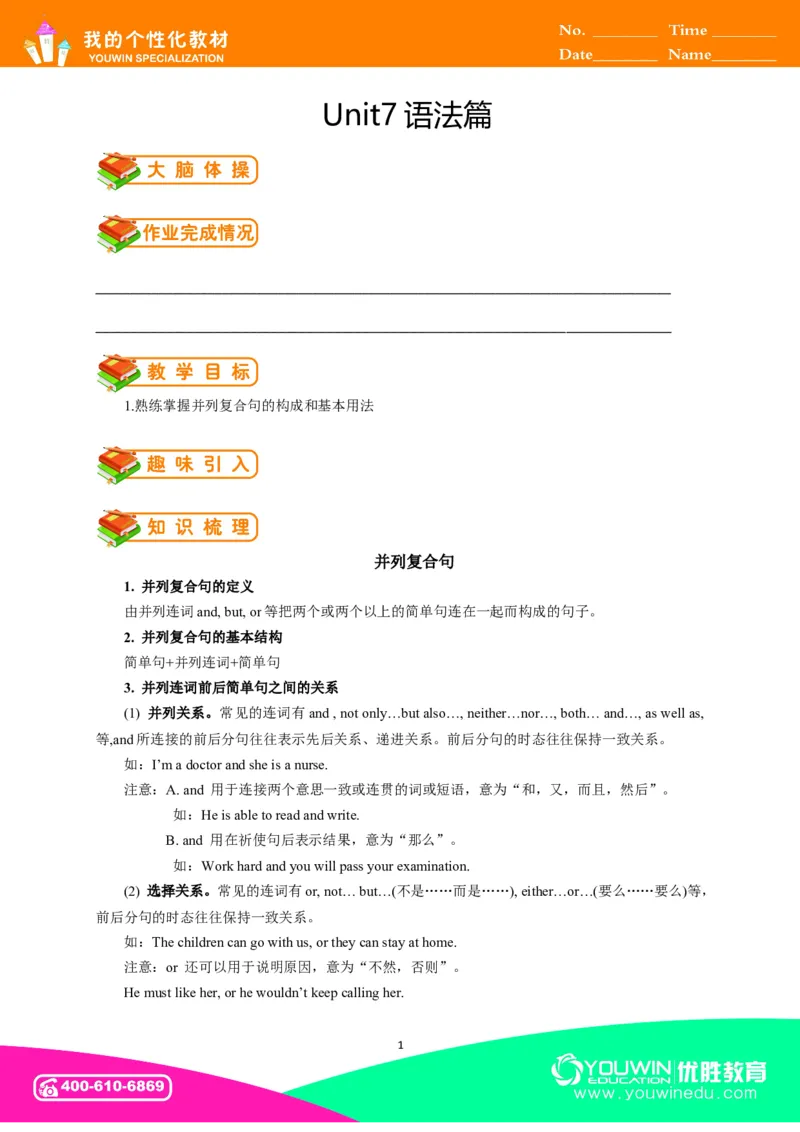
Unit7 语法篇

__________________________________________________________________________________
__________________________________________________________________________________
1.熟练掌握并列复合句的构成和基本用法
并列复合句
1. 并列复合句的定义
由并列连词and, but, or 等把两个或两个以上的简单句连在一起而构成的句子。
2. 并列复合句的基本结构
简单句+并列连词+简单句
3. 并列连词前后简单句之间的关系
(1) 并列关系。常见的连词有and , not only…but also…, neither…nor…, both… and…, as well as,
等,and 所连接的前后分句往往表示先后关系、递进关系。前后分句的时态往往保持一致关系。
如:I’m a doctor and she is a nurse.
注意:A. and 用于连接两个意思一致或连贯的词或短语,意为“和,又,而且,然后”。
       如:He is able to read and write.
      B. and 用在祈使句后表示结果,意为“那么”。
       如:Work hard and you will pass your examination.
(2) 选择关系。常见的连词有or, not… but…(不是……而是……), either…or…(要么……要么)等,
前后分句的时态往往保持一致关系。
如:The children can go with us, or they can stay at home.
注意:or 还可以用于说明原因,意为“不然,否则”。
He must like her, or he wouldn’t keep calling her.
2
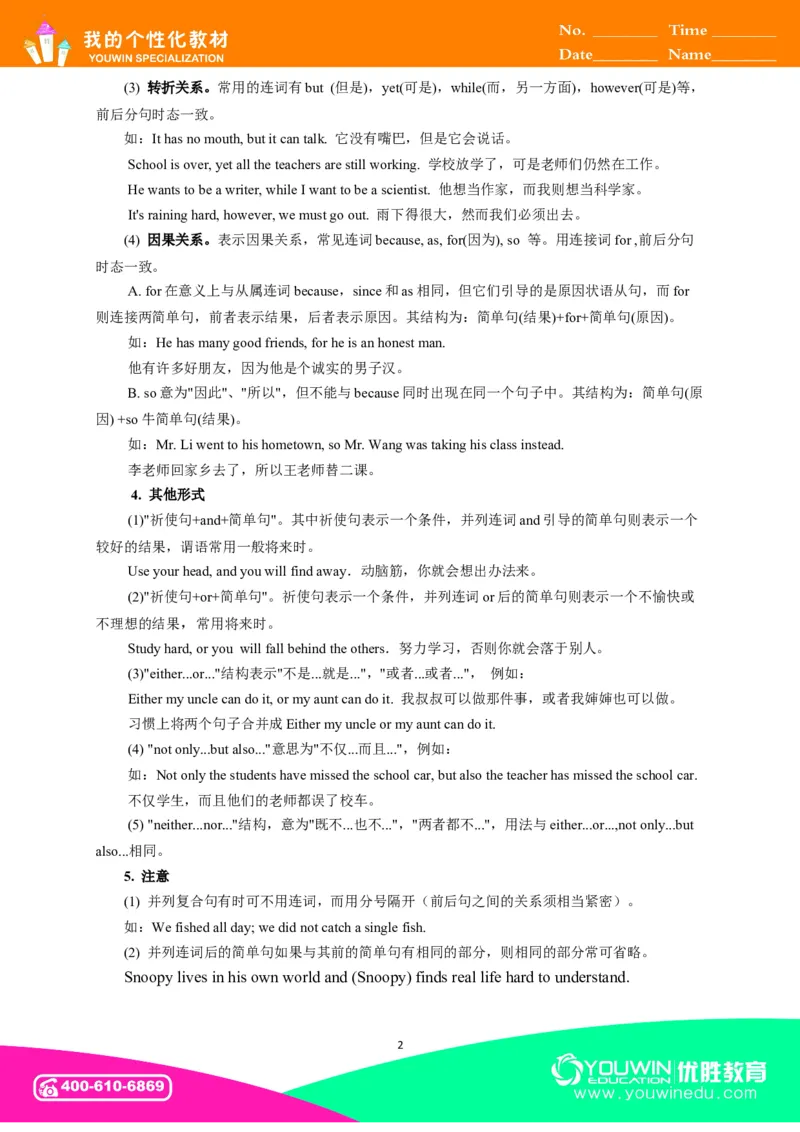
(3) 转折关系。常用的连词有but (但是),yet(可是),while(而,另一方面),however(可是)等,
前后分句时态一致。
如:It has no mouth, but it can talk. 它没有嘴巴,但是它会说话。
School is over, yet all the teachers are still working. 学校放学了,可是老师们仍然在工作。
He wants to be a writer, while I want to be a scientist. 他想当作家,而我则想当科学家。
It's raining hard, however, we must go out. 雨下得很大,然而我们必须出去。
(4) 因果关系。表示因果关系,常见连词because, as, for(因为), so 等。用连接词for ,前后分句
时态一致。
A. for 在意义上与从属连词because,since 和as 相同,但它们引导的是原因状语从句,而for
则连接两简单句,前者表示结果,后者表示原因。其结构为:简单句(结果)+for+简单句(原因)。
如:He has many good friends, for he is an honest man.
他有许多好朋友,因为他是个诚实的男子汉。
B. so 意为"因此"、"所以",但不能与because 同时出现在同一个句子中。其结构为:简单句(原
因) +so 牛简单句(结果)。
如:Mr. Li went to his hometown, so Mr. Wang was taking his class instead.
李老师回家乡去了,所以王老师替二课。
 4. 其他形式
(1)"祈使句+and+简单句"。其中祈使句表示一个条件,并列连词and 引导的简单句则表示一个
较好的结果,谓语常用一般将来时。
Use your head, and you will find away.动脑筋,你就会想出办法来。
(2)"祈使句+or+简单句"。祈使句表示一个条件,并列连词or 后的简单句则表示一个不愉快或
不理想的结果,常用将来时。
Study hard, or you will fall behind the others.努力学习,否则你就会落于别人。
(3)"either...or..."结构表示"不是...就是...","或者...或者...", 例如:
Either my uncle can do it, or my aunt can do it. 我叔叔可以做那件事,或者我婶婶也可以做。
习惯上将两个句子合并成Either my uncle or my aunt can do it.
(4) "not only...but also..."意思为"不仅...而且...",例如:
如:Not only the students have missed the school car, but also the teacher has missed the school car.
不仅学生,而且他们的老师都误了校车。
(5) "neither...nor..."结构,意为"既不...也不...","两者都不...",用法与either...or...,not only...but
also...相同。
5. 注意
(1) 并列复合句有时可不用连词,而用分号隔开(前后句之间的关系须相当紧密)。
如:We fished all day; we did not catch a single fish.
(2) 并列连词后的简单句如果与其前的简单句有相同的部分,则相同的部分常可省略。
Snoopy lives in his own world and (Snoopy) finds real life hard to understand.
3
单项选择
1.(2015 黑龙江齐齐哈尔中考)---Excuse me , could you please tell me the way to the nearest hospital ?
---I 'm sorry ,       I am new here. You can ask the policeman over there .
A. and
B. but
C. so
2.(2015 安徽中考) Going to the movies is good ,       I really only like listening to music.
A. and
B. but

C. so
D. or
3.(2014 上海中考)---Would you like to go to the cartoon show with me ?
---It sounds like fun ,     I'm too busy .
A. so
B. for
C. or
D. but
4. We are going to the bookstore in Tony's car . You can come with us       you can meet us there later .
A. but           B. and
C. or
D. then
5. Study hard ,       you are sure to have a good result in the exam .
A. or
B. and
C. for
D. but
6.(2015 浙江温州中考)Mr. Smith has a habit of taking a shower

  he has breakfast.
A. though
B. before
C. because
D. since
7.(2014 北京六十六中期中)They missed the school bus,


  They were late for class.
A. or
B. but
C. because
D. so
8.(2015 江苏扬州江都期末)---Remember to return the book to the library in time,


  you will be
fined.
---Yes, I know.
A. or
B. and
C. but
D. then
9. I can't understand this passage _______ there are no new words in it.
A. if
B.  because
C. though
D. and
基础演练
一、单项选择
1. Money is very important

    it's not the most important thing.
A.
 or
B.
 and
C.
 so
D.
 but
2. Jenny, put on your coat

    you will catch a cold.
A.
 but
B.
 and
C.
 or
D.
 so
3. To make our dreams come true, we are supposed to set goals

    then try our best to
achieve(实现) them.
A.
 or
B.
 and
C.
 but
D.
 so
4. --- I hear a new film is on these days. Shall we go to the cinema together, Lucy and Lily?
4
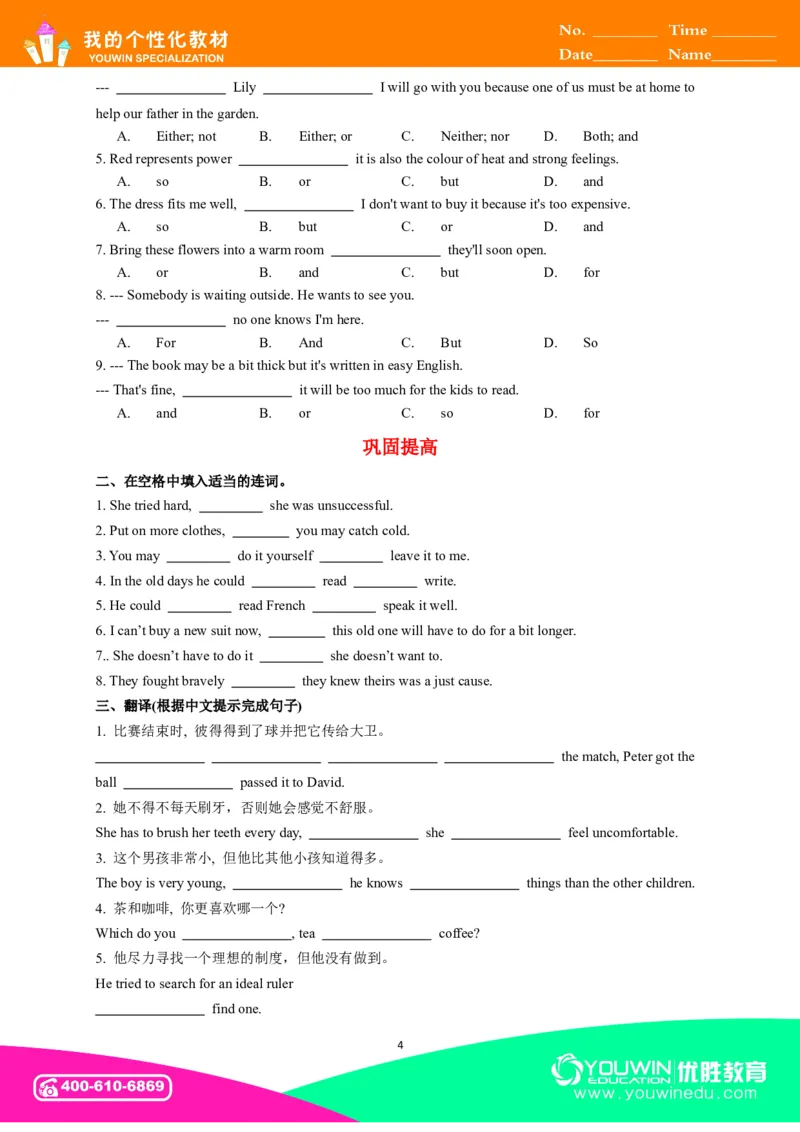
---

    Lily

    I will go with you because one of us must be at home to
help our father in the garden.
A.
 Either; not
B.
 Either; or
C.
 Neither; nor
D.
 Both; and
5. Red represents power

    it is also the colour of heat and strong feelings.
A.
 so
B.
 or
C.
 but
D.
 and
6. The dress fits me well,

    I don't want to buy it because it's too expensive.
A.
 so
B.
 but
C.
 or
D.
 and
7. Bring these flowers into a warm room

    they'll soon open.
A.
 or
B.
 and
C.
 but
D.
 for
8. --- Somebody is waiting outside. He wants to see you.
---

    no one knows I'm here.
A.
 For
B.
 And
C.
 But
D.
 So
9. --- The book may be a bit thick but it's written in easy English.
--- That's fine,

    it will be too much for the kids to read.
A.
 and
B.
 or
C.
 so
D.
 for
巩固提高
二、在空格中填入适当的连词。
1. She tried hard,           she was unsuccessful.
2. Put on more clothes,          you may catch cold.
3. You may           do it yourself           leave it to me.
4. In the old days he could           read           write.
5. He could           read French           speak it well.
6. I can’t buy a new suit now,          this old one will have to do for a bit longer.
7.. She doesn’t have to do it           she doesn’t want to.
8. They fought bravely           they knew theirs was a just cause.
三、翻译(根据中文提示完成句子)
1. 比赛结束时, 彼得得到了球并把它传给大卫。


    the match, Peter got the
ball

    passed it to David.
2. 她不得不每天刷牙,否则她会感觉不舒服。
She has to brush her teeth every day,

    she

    feel uncomfortable.
3. 这个男孩非常小, 但他比其他小孩知道得多。
The boy is very young,

    he knows

    things than the other children.
4. 茶和咖啡, 你更喜欢哪一个?
Which do you

   , tea

    coffee?
5. 他尽力寻找一个理想的制度,但他没有做到。
He tried to search for an ideal ruler


    find one.
5
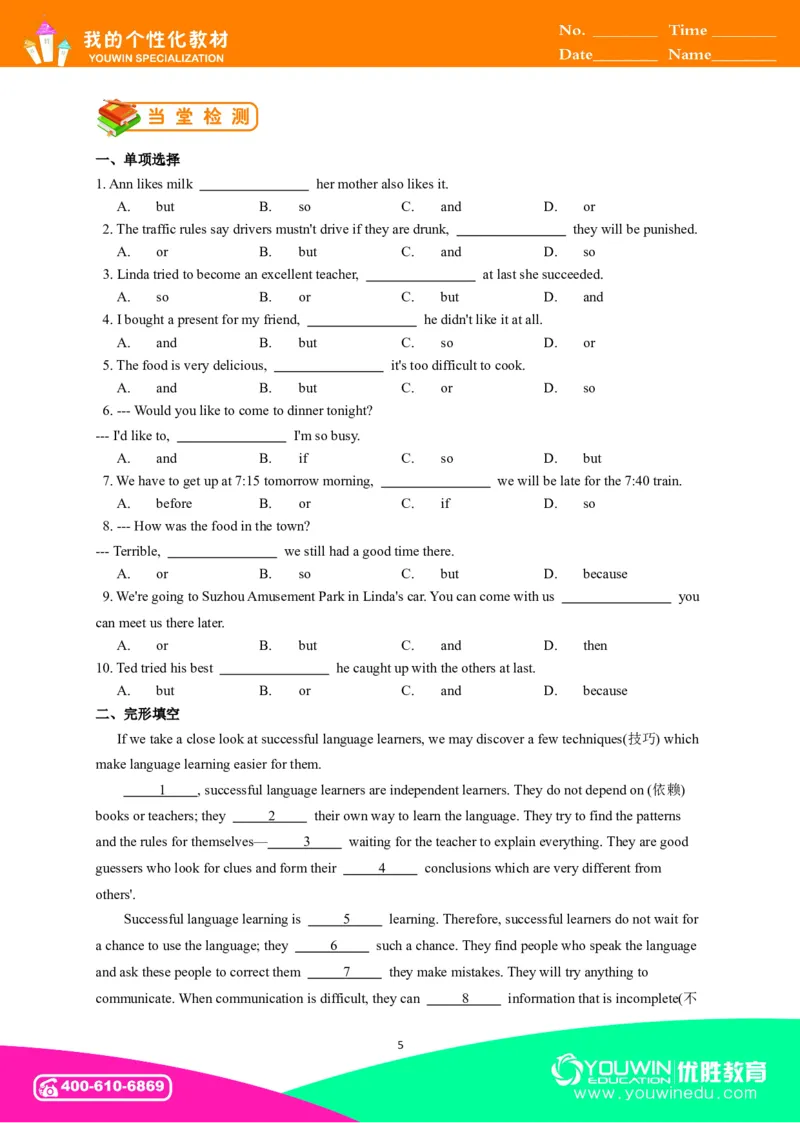
一、单项选择
1. Ann likes milk

    her mother also likes it.
A.
 but
B.
 so
C.
 and
D.
 or
 2. The traffic rules say drivers mustn't drive if they are drunk,

    they will be punished.
A.
 or
B.
 but
C.
 and
D.
 so
 3. Linda tried to become an excellent teacher,

    at last she succeeded.
A.
 so
B.
 or
C.
 but
D.
 and
 4. I bought a present for my friend,

    he didn't like it at all.
A.
 and
B.
 but
C.
 so
D.
 or
 5. The food is very delicious,

    it's too difficult to cook.
A.
 and
B.
 but
C.
 or
D.
 so
 6. --- Would you like to come to dinner tonight?
--- I'd like to,

    I'm so busy.
A.
 and
B.
 if
C.
 so
D.
 but
 7. We have to get up at 7:15 tomorrow morning,

    we will be late for the 7:40 train.
A.
 before
B.
 or
C.
 if
D.
 so
 8. --- How was the food in the town?
--- Terrible,

    we still had a good time there.
A.
 or
B.
 so
C.
 but
D.
 because
 9. We're going to Suzhou Amusement Park in Linda's car. You can come with us

    you
can meet us there later.
A.
 or
B.
 but
C.
 and
D.
 then
10. Ted tried his best

    he caught up with the others at last.
A.
 but
B.
 or
C.
 and
D.
 because
二、完形填空
   If we take a close look at successful language learners, we may discover a few techniques(技巧) which
make language learning easier for them.
         1

   , successful language learners are independent learners. They do not depend on (依赖)
books or teachers; they      2

    their own way to learn the language. They try to find the patterns
and the rules for themselves—     3

    waiting for the teacher to explain everything. They are good
guessers who look for clues and form their      4

    conclusions which are very different from
others'.
    Successful language learning is      5

    learning. Therefore, successful learners do not wait for
a chance to use the language; they      6

    such a chance. They find people who speak the language
and ask these people to correct them      7

    they make mistakes. They will try anything to
communicate. When communication is difficult, they can      8

    information that is incomplete(不
6
完整的). It is more important for them to learn to      9

    in the language than to know the meaning
of every word.
    Finally, successful language learners are learners with a      10

    in order to communicate with
these people and learn from them. They want to learn a language because they are interested in the
language and the people who speak it. It is necessary for them to learn the language.
1.
A.
 As usual
B.
 First of all
C.
 By the way
D.
 So far
2.
A.
 explain
B.
 make
C.
 discover
D.
 change
3.
A.
 instead of
B.
 after
C.
 because of
D.
 from
4.
A.
 correct
B.
 own
C.
 only
D.
 main
5.
A.
 ideal
B.
 informal
C.
 early
D.
 active
6.
A.
 look for
B.
 care about
C.
 work out
D.
 write down
7.
A.
 until
B.
 whether
C.
 before
D.
 when
8.
A.
 break
B.
 check
C.
 download
D.
 accept
9.
A.
 agree
B.
 ask
C.
 think
D.
 read
10.
A.
 purpose
B.
 certificate
C.
 guide
D.
 question
 _________________________________________________________________________________
 _________________________________________________________________________________
阅读理解
A(广东汕头金山中学2015 年第三次月考)
What better way to welcome spring than by helping to clean up the town we all
live in! Here in Rockland we have a Spring Clean-up Day every year in April. The
Clean-up Day 2014 will be April 20th.
    It will start with a town clean-up at 8 0'clock in the morning, and a tree planting
activity at the Rockland Park is to follow in the afternoon. One thousand young trees
are sure to make the park greener and prettier.
    We will divide the people coming to help into eight teams for eight different
areas. As usual, we will provide gloves, rubbish bags and other cleaning tools. You
7
will also get free lunches and T-shirts when the clean-up ends at noon. We are going
to have a friendly competition to see which team can pick up the most rubbish.21 世纪教育网
    Bring your kids with you. It is a great chance to teach them to care for the
environment around us. We have free drinks and chocolate candies for the children at
the park.
    Meeting: At the gate of Rockland Park, the town hall at 330 Jones Street, or
            the corner of Palace Street and North Street.
Sign-up(报名): Call 5862397 on weekdays, or visit our website below any time you like.
1. The Spring Clean-up Day in Rockland is held ______.www.21-cn-jy.com
     A. once a month
B. twice a month
C. once a year        D. twice a year
2. People in Rockland can help to ______ on the afternoon of April 20th.
     A. clean up the town
B. take care of the kids
     C. plant trees in the park
D. paint the park greener
3. People joining in the Clean-up Day will NOT ______.2·1·c·n·j·y
     A. get lunches and T-shirts for free
B. be provided with cleaning tools
     C. work in teams to do the cleaning
D. take young trees home to plant
4. According to the poster, the activities are a great chance to teach the kids to ______.
     A. protect the environment
B. get free drinks and candies
     C. pick up the most rubbish
D. do cleaning and plant trees
5. Which of the following is TRUE?
     A. You can call 5862397 to sign up any time you like.【出处:21 教育名师】
     B. People can visit www. springcleanup. com to sign up.
     C. The town hall is at the corner of Palace Street and North Street.
     D. People can meet for the activities only at the gate of Rockland Park.
B
    Millions of children in the United States go to summer camps. Some go to play outdoors at traditional
camps in the woods, in the mountains or on lakes. But families now have many choices of special camps.
These can be in the middle of nature or a big city. Special camps offer young people the chance to learn
about different subjects: anything from space exploration to business to medicine.
    In technology camps, one subject that children can learn about is video game design. They learn how
to use computer programs to create games of their own. One program that teaches video game design is
called Cybercamps. Children can learn how to design their own virtual(实际上的) worlds to set their video
game in. Then, they program their own rules and objects into the game.
8
    Cybercamps can also offer courses in robot building and Web design. A recent story in the
Washington Post described how one child made a robot that could sing a song. Another made a robot that
could follow a black line drawn on a piece of cardboard. Also, children can learn how to make Web sites.
One child made a site for Pokemon, one of his favourite cartoon shows.
6. Traditional camps are

   .
A.
 in the woods
B.
 in the mountains
C.
 on lakes
D.
 all above
7. Special camps offer young people the chance to learn

   .
A.
 only space
B.
 only science
C.
 only medicine
D.
 different subjects
8. In Cybercamps a child made a robot that could

   .
A.
 sing
B.
 dance
C.
 speak
D.
 draw
9. Which one is NOT true according to the passage?
A.
 There are many special camps in the U.S.A. now.
B.
 Families prefer traditional camps to special camps.
C.
 Special camps can be in the middle of nature or a big city.
D.
 In technology camps, children can create games of their own.
10. The best title for the passage is

   .
A.
 Traditional Camps
B.
 Special Camps
C.
 Summer Camps
D.
 Summer Holiday
C
    Like hundreds of other young people of all countries who take part in our language courses, you can
make the most of your holidays by studying French in an interesting way and, at the same time, discover
one of France's most beautiful areas—Nice!
    Our summer course lasts 3 weeks in July and August. You're welcome to come at any time between
July and August 6. You can choose to stay at a host family, but we suggest you stay at our international
summer camp. It makes it easy to meet other people and make new friends. What's more, you can have
your classes in the same building which is close to the beach! A free bus service brings you to and from
classes if you are living in a French host family or enables you to get into the centre of town if you are
living at the summer camp.
    Whenever you choose to come, we'll organize short trips, parties, sports and other activities and
motivate you to speak French.
    Your stay in Nice will therefore not only be an educational one, but also an enjoyable experience.
Besides offering you many opportunities to meet other people from different cultures, we will do
everything to make sure your stay will be unforgettable!
11. How long is the summer course?
A.
 Two months
B.
 Three weeks
C.
 One month
D.
 Eight weeks
12. According to the passage, they suggest the students stay

    during the study.
A.
 at the summer camp
B.
 in the hotel
C.
 at their friends' homes
D.
 in the centre of town
9
13. During the course, students can

   .
A.
 travel all over France
B.
 never leave the camp
C.
 learn French and make friends
D.
 swim alone in the sea
14. What does the underlined word “motivate” in the third paragraph mean?
A.
 激发
B.
 感谢
C.
 阻止
D.
 妨碍
15. What you've read above is

   .
A.
 A travel diary
B.
 An advertisement
C.
 An introduction to France
D.
 A piece of news
D
    Speaking English is not only about using proper grammar, but also about understanding the culture.
Here is some important advice to remember when speaking English in the United States.
    Americans have difficulties understanding foreign accents. Many Americans are not used to foreign
accents. This requires patience from both of you.
    Talk about places: Americans love to talk about places. When speaking to a stranger, ask them where
they come from and then say something about that place. For example: "Oh, I have a friend who worked in
Los Angeles. He says it's a beautiful place to live in." Most Americans will then willingly talk about their
experiences of living in or visiting that city or place.
    Talk about work: It is common for Americans to ask "What do you do?" It's not considered impolite as
in some countries and is a popular topic of discussion between strangers.
    Talk about sports: Americans love sports! However, they love American sports. When speaking about
football, most Americans understand "American football", not soccer.
    Be careful when expressing ideas about race, religion or other sensitive(敏感的) topics: The United
States is a society with different cultures. Americans are very sensitive to other cultures and ideas.
16. For Americans, the question "what do you do?" is

   .
A.
 common
B.
 impolite
C.
 boring
D.
 surprising
17. What can we learn about Americans?
A.
 They like to learn foreign accents.
B.
 They are willing to talk about places.
C.
 They prefer soccer to American football.
D.
 They accept other ideas and cultures easily.
18. The writer gives some advice mainly on

   .
A.
 talking with Americans
B.
 working with Americans
C.
 speaking American English
D.
 understanding American society
10
课程顾问签字:                        教学主管签字: