试题第1页(共12页)
试题第2页(共12页)
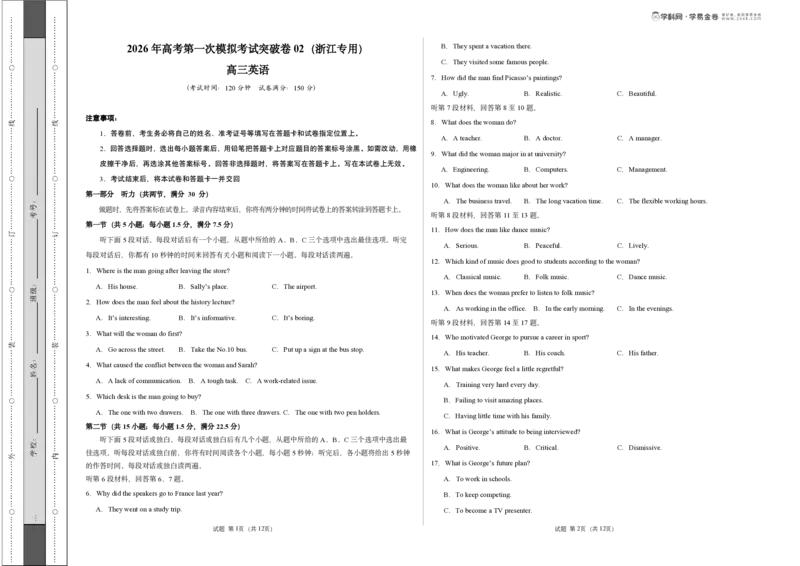
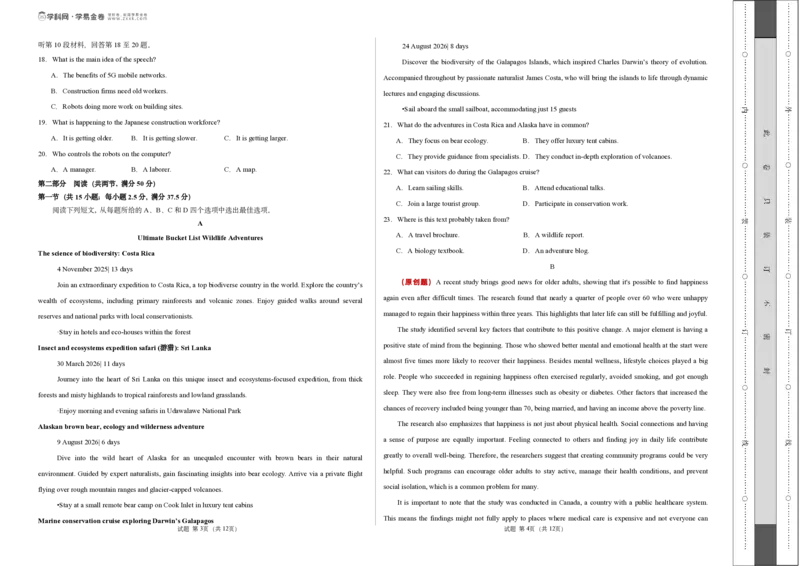
2026 年高考第一次模拟考试突破卷02(浙江专用)
高三英语
(考试时间:120 分钟
试卷满分:150 分)
注意事项:
1.答卷前,考生务必将自己的姓名、准考证号等填写在答题卡和试卷指定位置上。
2.回答选择题时,选出每小题答案后,用铅笔把答题卡上对应题目的答案标号涂黑。如需改动,用橡
皮擦干净后,再选涂其他答案标号。回答非选择题时,将答案写在答题卡上。写在本试卷上无效。
3.考试结束后,将本试卷和答题卡一并交回
第一部分
听力(共两节,满分30 分)
做题时,先将答案标在试卷上。录音内容结束后,你将有两分钟的时间将试卷上的答案转涂到答题卡上。
第一节(共5 小题;每小题1.5 分,满分7.5 分)
听下面5 段对话。每段对话后有一个小题,从题中所给的A、B、C 三个选项中选出最佳选项。听完
每段对话后,你都有10 秒钟的时间来回答有关小题和阅读下一小题。每段对话读两遍。
1.Where is the man going after leaving the store?
A.His house.
B.Sally’s place.
C.The airport.
2.How does the man feel about the history lecture?
A.It’s interesting.
B.It’s informative.
C.It’s boring.
3.What will the woman do first?
A.Go across the street.
B.Take the No.10 bus.
C.Put up a sign at the bus stop.
4.What caused the conflict between the woman and Sarah?
A.A lack of communication.
B.A tough task.
C.A work-related issue.
5.Which desk is the man going to buy?
A.The one with two drawers.
B.The one with three drawers. C.The one with two pen holders.
第二节(共15 小题;每小题1.5 分,满分22.5 分)
听下面5 段对话或独白。每段对话或独白后有几个小题,从题中所给的A、B、C 三个选项中选出最
佳选项。听每段对话或独白前,你将有时间阅读各个小题,每小题5 秒钟;听完后,各小题将给出5 秒钟
的作答时间。每段对话或独白读两遍。
听第6 段材料,回答第6、7 题。
6.Why did the speakers go to France last year?
A.They went on a study trip.
B.They spent a vacation there.
C.They visited some famous people.
7.How did the man find Picasso’s paintings?
A.Ugly.
B.Realistic.
C.Beautiful.
听第7 段材料,回答第8 至10 题。
8.What does the woman do?
A.A teacher.
B.A doctor.
C.A manager.
9.What did the woman major in at university?
A.Engineering.
B.Computers.
C.Management.
10.What does the woman like about her work?
A.The business travel.
B.The long vacation time.
C.The flexible working hours.
听第8 段材料,回答第11 至13 题。
11.How does the man like dance music?
A.Serious.
B.Peaceful.
C.Lively.
12.Which kind of music does good to students according to the woman?
A.Classical music.
B.Folk music.
C.Dance music.
13.When does the woman prefer to listen to folk music?
A.As working in the office.
B.In the early morning.
C.In the evenings.
听第9 段材料,回答第14 至17 题。
14.Who motivated George to pursue a career in sport?
A.His teacher.
B.His coach.
C.His father.
15.What makes George feel a little regretful?
A.Training very hard every day.
B.Failing to visit amazing places.
C.Having little time with his family.
16.What is George’s attitude to being interviewed?
A.Positive.
B.Critical.
C.Dismissive.
17.What is George’s future plan?
A.To work in schools.
B.To keep competing.
C.To become a TV presenter.
{#{QQABYYaEogigAIBAAQgCQwGACEEYkAACCCgOAEAUsAABARNABAA=}#}
试题第3页(共12页)
试题第4页(共12页)
听第10 段材料,回答第18 至20 题。
18.What is the main idea of the speech?
A.The benefits of 5G mobile networks.
B.Construction firms need old workers.
C.Robots doing more work on building sites.
19.What is happening to the Japanese construction workforce?
A.It is getting older.
B.It is getting slower.
C.It is getting larger.
20.Who controls the robots on the computer?
A.A manager.
B.A laborer.
C.A map.
第二部分
阅读(共两节, 满分50 分)
第一节(共15 小题;每小题2.5 分, 满分37.5 分)
阅读下列短文, 从每题所给的A、B、C 和D 四个选项中选出最佳选项。
A
Ultimate Bucket List Wildlife Adventures
The science of biodiversity: Costa Rica
4 November 2025| 13 days
Join an extraordinary expedition to Costa Rica, a top biodiverse country in the world. Explore the country’s
wealth of ecosystems, including primary rainforests and volcanic zones. Enjoy guided walks around several
reserves and national parks with local conservationists.
·Stay in hotels and eco-houses within the forest
Insect and ecosystems expedition safari (游猎): Sri Lanka
30 March 2026| 11 days
Journey into the heart of Sri Lanka on this unique insect and ecosystems-focused expedition, from thick
forests and misty highlands to tropical rainforests and lowland grasslands.
·Enjoy morning and evening safaris in Udawalawe National Park
Alaskan brown bear, ecology and wilderness adventure
9 August 2026| 6 days
Dive into the wild heart of Alaska for an unequaled encounter with brown bears in their natural
environment. Guided by expert naturalists, gain fascinating insights into bear ecology. Arrive via a private flight
flying over rough mountain ranges and glacier-capped volcanoes.
•Stay at a small remote bear camp on Cook Inlet in luxury tent cabins
Marine conservation cruise exploring Darwin’s Galapagos
24 August 2026| 8 days
Discover the biodiversity of the Galapagos Islands, which inspired Charles Darwin’s theory of evolution.
Accompanied throughout by passionate naturalist James Costa, who will bring the islands to life through dynamic
lectures and engaging discussions.
•Sail aboard the small sailboat, accommodating just 15 guests
21.What do the adventures in Costa Rica and Alaska have in common?
A.They focus on bear ecology.
B.They offer luxury tent cabins.
C.They provide guidance from specialists. D.They conduct in-depth exploration of volcanoes.
22.What can visitors do during the Galapagos cruise?
A.Learn sailing skills.
B.Attend educational talks.
C.Join a large tourist group.
D.Participate in conservation work.
23.Where is this text probably taken from?
A.A travel brochure.
B.A wildlife report.
C.A biology textbook.
D.An adventure blog.
B
(原创题)A recent study brings good news for older adults, showing that it's possible to find happiness
again even after difficult times. The research found that nearly a quarter of people over 60 who were unhappy
managed to regain their happiness within three years. This highlights that later life can still be fulfilling and joyful.
The study identified several key factors that contribute to this positive change. A major element is having a
positive state of mind from the beginning. Those who showed better mental and emotional health at the start were
almost five times more likely to recover their happiness. Besides mental wellness, lifestyle choices played a big
role. People who succeeded in regaining happiness often exercised regularly, avoided smoking, and got enough
sleep. They were also free from long-term illnesses such as obesity or diabetes. Other factors that increased the
chances of recovery included being younger than 70, being married, and having an income above the poverty line.
The research also emphasizes that happiness is not just about physical health. Social connections and having
a sense of purpose are equally important. Feeling connected to others and finding joy in daily life contribute
greatly to overall well-being. Therefore, the researchers suggest that creating community programs could be very
helpful. Such programs can encourage older adults to stay active, manage their health conditions, and prevent
social isolation, which is a common problem for many.
It is important to note that the study was conducted in Canada, a country with a public healthcare system.
This means the findings might not fully apply to places where medical care is expensive and not everyone can
{#{QQABYYaEogigAIBAAQgCQwGACEEYkAACCCgOAEAUsAABARNABAA=}#}
试题第5页(共12页)
试题第6页(共12页)
afford it. Nevertheless, the authors believe the message is universal. They call for greater investment in supporting
older adults, not only through medical care but also through efforts to ensure financial stability and provide easy
access to wellness programs. These supports can truly change an older person's life for the better.
24. What is a key factor for older adults to regain happiness?
A. Receiving free medical care.
B. Living a healthy and active lifestyle.
C. Getting support from family members.
D. Moving to a new community.
25. What can be inferred from the study?
A. Most older adults are unhappy in their later years.
B. Mental health is more important than physical health.
C. Social support can be as important as medicine.
D. Financial problems are the main cause of unhappiness.
26. Why is a "positive state of mind" crucial for the elderly?
A. It helps them make more money.
B. It greatly increases their chance of recovery.
C. It allows them to live without any illnesses.
D. It makes them more popular in society.
27. What is the main purpose of the passage?
A. To compare healthcare systems in different countries.
B. To prove that happiness is impossible for the old.
C. To show ways for older adults to recover happiness.
D. To advise people to save money for their old age.
C
(原创题)Dr. Bruce Cohen, a leading expert in brain science, is changing our understanding of mental
illnesses. For a long time, scientists believed these problems were caused by chemical imbalances in the brain.
However, Dr. Cohen’s research points to a different root cause: issues with how brain cells produce and use
energy. By using new lab techniques to grow living brain cells from patients, his team has discovered that this
energy problem is common in many disorders, including schizophrenia and bipolar disorder. This breakthrough
could lead to far more effective treatments.
The brain is the body's most energy-demanding organ. Dr. Cohen argues that when this energy supply is
disturbed, it affects how brain cells connect and communicate. This energy-based view challenges the old
chemical theory. The most hopeful aspect is that these energy defects might be correctable even before a person
shows clear signs of illness. This opens a new door for preventing mental health conditions, rather than just trying
to manage them after they develop.
Beyond the lab, Dr. Cohen also wants to change how mental illnesses are diagnosed. He believes that putting
patients into fixed categories with labels like "schizophrenia" is unhelpful. Instead, he advocates for a system that
describes a patient’s specific symptoms and experiences. This approach would reduce the shame linked to such
labels and give doctors a more precise, scientific understanding of each individual, leading to more personalized
care.
Dr. Cohen’s influence extends beyond research. As a former hospital president, he successfully improved
both patient care and scientific output. His leadership style focused on supporting frontline staff and cutting
unnecessary bureaucracy. He proved that combining scientific excellence with compassionate, practical
management can transform struggling institutions into world-class centers for healing and discovery.
Looking to the future, Dr. Cohen is optimistic. He believes that with new technologies, preventing mental
disorders is becoming an achievable goal. He encourages the scientific community to support creative and risky
research, not just safe, predictable studies. His vision is a global collaboration where discoveries are shared openly,
allowing everyone to work together to solve the mystery of mental illness.
28. Why does Dr. Cohen propose a new diagnostic system?
A. To make the diagnostic process quicker for doctors.
B. To help patients choose more suitable medicines.
C. To group patients for more convenient research.
D. To better reflect biological facts and reduce social shame.
29. What can be inferred about the traditional chemical imbalance theory?
A. It has been totally proven false by new evidence.
B. It was the main focus of Dr. Cohen's early career.
C. It may not fully explain the complexity of mental illness.
D. It is still the most effective basis for all treatments.
30. Dr. Cohen's leadership experience suggests that he values ______.
A. financial income above all else
B. strict control over research projects
C. the well-being of his staff members
{#{QQABYYaEogigAIBAAQgCQwGACEEYkAACCCgOAEAUsAABARNABAA=}#}
试题第7页(共12页)
试题第8页(共12页)
D. personal management of patient care
31. What is the main purpose of this passage?
A. To introduce Dr. Cohen's revolutionary ideas on mental illness.
B. To argue that energy problems are the sole cause of brain disorders.
C. To compare different methods of treating psychiatric patients.
D. To describe the personal difficulties Dr. Cohen overcame.
D
(原创题)Art and science, especially neurology, have a long and rich shared history. For centuries, artists
have created stunning works with an intuitive understanding of human vision and the brain, while scientists have
used art to record their findings about the brain, leading to key breakthroughs. Although art training has been
shown to help other medical students improve their observation and communication skills, its value in neurology
residency has not been fully explored.
Neurological diagnosis is an art that requires keen observation. However, residents often face heavy
workloads and emotional stress, which can weaken their clinical skills. To address this challenge, an innovative
program brought neurology residents to a museum. The program aimed to enhance their observational powers
through visual art, build empathy, help them manage uncertainty in clinical practice, and offer a unique channel
for self-expression.
The project involved a group of neurology residents who participated in three specially designed workshops
led by professional art educators. To measure the impact, they took tests before and after the training, which
included medical images, clinical videos, and artworks. The results showed remarkable progress: after the training,
their observational skills improved significantly. Moreover, most residents reported that their communication
abilities and empathy were also enhanced.
Perhaps the most profound impact was that all participants felt more comfortable dealing with the inevitable
unknowns in medicine. This suggests that art offers more than just a technical skill; it provides a safe space for
self-reflection and personal growth. By exploring the vast range of human experiences expressed in art, young
doctors can better understand suffering and challenges in healthcare, ultimately growing into more compassionate
healers. The program was considered highly valuable for future resident training.
32. What was a primary goal of the museum training program?
A. To teach residents how to create art.
B. To reduce the heavy workloads of residents.
C. To replace traditional medical training methods.
D. To improve residents' ability to handle clinical uncertainty.
33. What can be inferred about the role of art in medical training?
A. It is more important than scientific knowledge.
D. Its benefits are limited to visual arts like painting.
C. It can help doctors connect with patients on a human level.
D. It mainly focuses on improving technical drawing skills.
34. How did the residents feel about the training program?
A. They found it to be a waste of their limited time.
B. They all believed it should be continued for others.
C. They were unsure about its practical benefits at first.
D. They preferred it to their regular clinical duties.
35. What is the author's main purpose in writing this article?
A. To argue that art training is more effective than science.
B. To compare the different artistic movements in history.
C. To introduce a new method for diagnosing neurological diseases.
D. To highlight the benefits of integrating arts into medical education.
第二节(共5 小题;每小题2. 5 分, 满分12. 5 分)
阅读下面短文, 从短文后的选项中选出可以填入空白处的最佳选项。选项中有两项为多余选项。
How to Prepare an Effective Class Presentation
Class presentations are a common way to show your learning, but many students feel nervous or end up
with disorganized content.
36
Some rush to finish without explaining key points clearly; others fill their
slides with too much text, making the audience lose focus.
37
With the right steps, you can turn a stressful task into a smooth and successful experience.
Here’s how to start:
First, clarify your presentation goal.
38
Are you supposed to explain a historical event, share a
science experiment result, or argue for a certain opinion? Knowing this helps you stay focused—you won’t waste
time on unrelated details. For example, if your goal is to explain a math formula, your content should center on
“how it works” and “when to use it,” not random math facts.
Next, organize your content logically.
39
A good structure usually includes three parts: an
opening (to grab attention, like a question or a short story), a main body (to present key points with examples), and
a closing (to summarize and invite questions). Avoid jumping between ideas — this confuses your audience.
{#{QQABYYaEogigAIBAAQgCQwGACEEYkAACCCgOAEAUsAABARNABAA=}#}
试题第9页(共12页)
试题第10页(共12页)
Finally, practice until you feel confident.
40
You can record yourself to check your speed (not
too fast!) and body language (smile and make eye contact). If you forget a part, don’t panic — have a small note
card with key points to remind you. Practicing also helps you get used to speaking in front of others, reducing
nervousness.
Preparing a good presentation takes time, but it’s worth it. Not only will you get better grades, but you’ll
also build skills that help with future projects or jobs.
A.Ask yourself: What do I want the audience to learn from my presentation?
B.The first thing to do is to stop worrying about making mistakes — everyone makes them.
C.However, many students struggle with two main problems: lack of focus and poor structure.
D.Instead of choosing a complex topic to impress others, pick one you can explain thoroughly.
E.To fix these issues, you don’t need to be a “natural speaker” — you just need a clear plan.
F.Even 10 minutes of daily practice can make your delivery more natural and confident.
G.A well-organized presentation is easier for the audience to follow and for you to present.
第三部分语言运用(共两节,满分30 分)
第一节(共15 小题,每小题1 分,满分15 分)
阅读下面短文, 从每题所给的A、B、C 和D 四个选项中选出可以填入空白处的最佳选项。
One day, my friend Jack and I wandered into a stationery store. Jack immediately grabbed one press-type
pen. Eager and
41
, he pressed the top repeatedly — until, with a pop, its tiny
42
inside flew
out, bouncing across the floor, and disappeared.
We
43
everywhere for the spring, but in vain. Jack’s face turned red with
44
as the
shopkeeper walked over. “I’m sorry, but you’ll have to pay for the
45
pen,” she said. Jack paid for it
reluctantly. Just then, his eyes landed on a shiny star-patterned pen in the showcase—one he’d been
46
for. “But I don’t have enough left,” he muttered sadly.
“Tim, would you like to lend me the money? I’ll pay you back next week, I promise” he begged. I nodded
and
47
the cost for him. But weeks passed, and Jack never mentioned it.
48
crept into my
mind: Was he avoiding it on purpose? Did he not value our friendship enough to
49
? I told my dad
about it. He patted my shoulder
50
and said, “Misunderstandings happen when we stay
51
. Next time, just ask him
52
.” So at the store again, I took a deep breath and said, “Hey,
remember that star pen? Did you
53
to forget to pay me back?” “Oh my gosh I totally forgot! It
54
my mind, I’m so sorry.” He apologized, quickly giving me back the money.
Overthinking only makes things worse. Open and honest
55
is the easiest way to clear up
misunderstandings and it can save friendship from unnecessary tension.
41.A.curious
B.committed
C.determined
D.awkward
42.A.showcase
B.spring
C.store
D.star
43.A.searched
B.wandered
C.paused
D.traveled
44.A.relaxation
B.delight
C.relief
D.embarrassment
45.A.deserted
B.priceless
C.broken
D.fashionable
46.A.applying
B.accounting
C.preparing
D.longing
47.A.reduced
B.weighed
C.covered
D.estimated
48.A.Guilt
B.Doubts
C.Warmth
D.Memories
49.A.keep his word B.break his promise
C.achieve his dream
D.boost his confidence
50.A.angrily
B.gently
C.reluctantly
D.absently
51.A.silent
B.calm
C.occupied
D.focused
52.A.distantly
B.impatiently
C.hesitantly
D.directly
53.A.manage
B.refuse
C.attempt
D.happen
54.A.struck
B.slipped
C.changed
D.crossed
55.A.explanation
B.apology
C.communication
D.complaint
第二节(共10 小题;每小题1.5 分,满分15 分)
阅读下面短文,在空白处填入1 个适当的单词或括号内单词的正确形式。
Dongjiao Minxiang is a historically significant hutong located in Beijing, China.
56
(Stretch)
about 1,500 meters, it lies to the east of Tian’ ammen Square and has developed into a blend of cultural heritage
and modern commerce.
Originaling in the Yuan Dynasty, it served initially
57
a strategic trade and supply center, later
becoming a diplomatic (外交的) hub during the Second Opium War,
58
the hutong opened its doors to
diplomats from different countries. This period
59
(witness) the construction of numerous
Western-style buildings.
60
in the mid-20th century, diplomats were relocated to the Sanlitum area.
Despite these changes, Dongjiao Minxiang keeps its architectural and historical legacy through its
61
(preserve) buildings and cultural landmarks.
Over the years, Dongjiao Minxiang
62
(transform) into a dynamic area, home to both high-end
restaurants and common shops, offering a wide array of food and shopping experiences. The hutong’s history is
closely associated with significant events and transitions in Beijing, making it
63
fascinating subject
for historians and visitors interested in the architectural and cultural evolution of the capital. Its significance lies in
{#{QQABYYaEogigAIBAAQgCQwGACEEYkAACCCgOAEAUsAABARNABAA=}#}
试题第11页(共12页)
试题第12页(共12页)
its
64
(continue) adaptation, which makes it not just a historical site, but one of the active
65
(participate) in Beijing’s ongoing urban narrative, offering insights into China’s engagement with global
influences across centuries.
第四部分写作(共两节, 满分40 分)
第一节(满分15 分)
假定你是李华,你校将于4 月23 日举办“校园读书节”(Campus Reading Festival),旨在鼓励学生多读书、
读好书。请你代表校学生会,给你校英国外教Peter 写一封邀请信,邀请他担任读书节“读书分享会”环节的
嘉宾。
内容包括:1. 介绍读书节的时间和主题;
2. 说明邀请他的原因及希望他参与的环节。
注意:1. 词数80 个左右;
2. 可适当增加细节,使行文连贯。
____________________________________________________________________________________________
____________________________________________________________________________________________
____________________________________________________________________________________________
____________________________________________________________________________________________
____________________________________________________________________________________________
____________________________________________________________________________________________
第二节(满分25 分)
阅读下面材料,根据其内容和所给段落开头语续写两段,使之构成一篇完整的短文。
The rain tapped hard on the classroom window as I hurried to my desk. Suddenly, I spotted something small
and brown curled up in a puddle (小水洼) under an oak tree beside our teaching building — too still to be a leaf.
With curiosity, I rushed out to it. However, when I knelt down, my breath caught: a sparrow with one wing broken,
feathers knotted, eyes half-closed. “Don’t move,” I whispered, wrapping her in my handkerchief, then dashed
back.
Ms. Sophie, my English teacher, helped me make a nest from a shoebox and tissues. “We need to act fast,”
she said. “Who knows about birds?” Mia, who fed stray cats daily, raised her hand, “My uncle is a vet — he can
show us how to cure the wing.” Jake, our art club member, grabbed his drawing book, “I’ll draw diagrams so we
won’t mess up.” Lila, who usually kept to herself, spoke up: “I can research what sparrows eat online.”
That afternoon, our group crowded around the shoebox. Mia gently held the sparrow while Jake carefully
attached a small stick to her broken wing. Lila read aloud from her phone: “Warm water and crushed blueberries,
but only a drop at a time.” I took notes, marking when we fed her or changed the tissues. At one point, the sparrow
chirped (发啁啾声) softly, and we all froze, grinning. For the first time, we weren’t just classmates-we were a
team, each doing what we did best.
Problems popped up. The sparrow refused food the next day, and Lila panicked. “Did we hurt her?” Mia
checked and shook her head. “Maybe she’s scared. Let’s leave her alone for a while.” We took turns sitting by the
window, talking softly so she would get used to our voices.
注意:
(1)续写词数应为150 个左右;
(2)请按如下格式在答题卡的相应位置作答。
By Friday, something different happened.
____________________________________________________________________________________________
____________________________________________________________________________________________
____________________________________________________________________________________________
____________________________________________________________________________________________
_________________________________________________________________________________________
Then came the news that the vet said the sparrow was ready to fly.
____________________________________________________________________________________________
____________________________________________________________________________________________
____________________________________________________________________________________________
____________________________________________________________________________________________
_________________________________________________________________________________________
{#{QQABYYaEogigAIBAAQgCQwGACEEYkAACCCgOAEAUsAABARNABAA=}#}