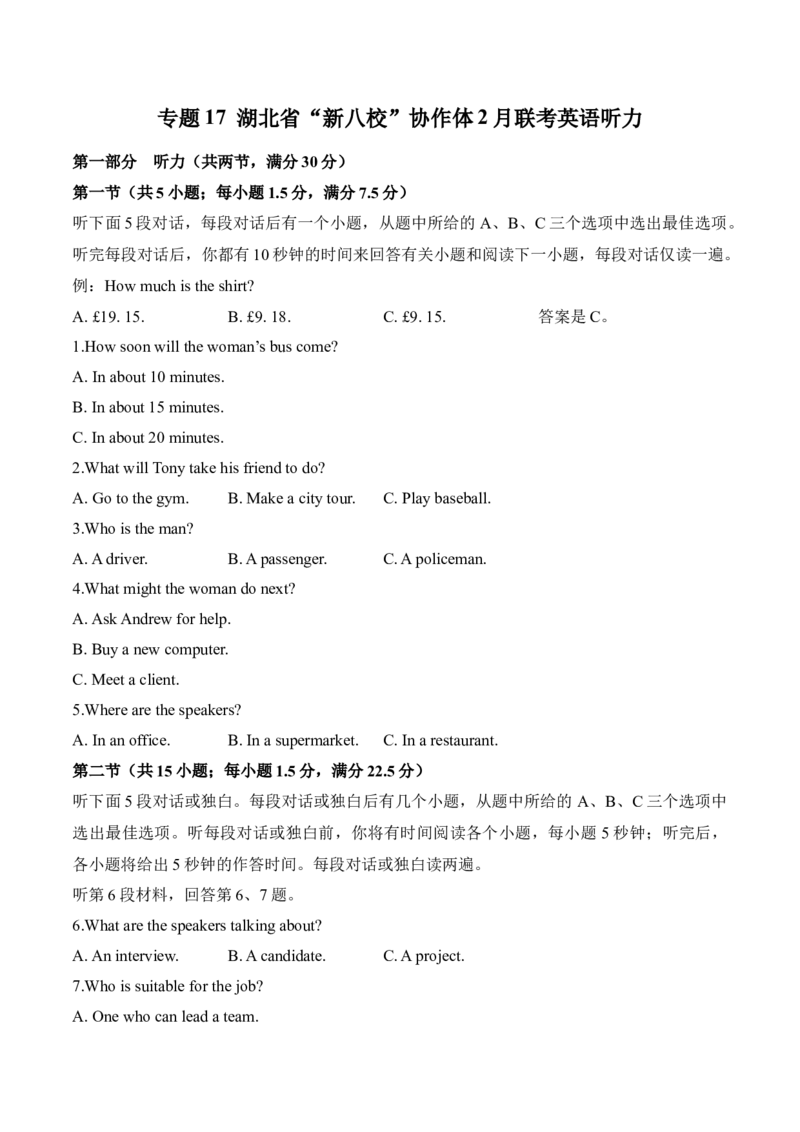
专题17 湖北省“新八校”协作体2 月联考英语听力
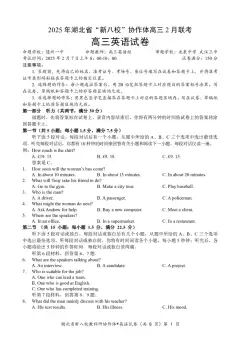
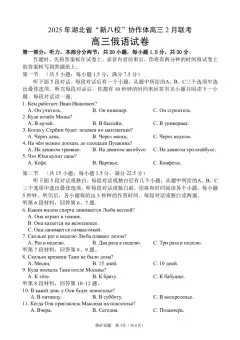
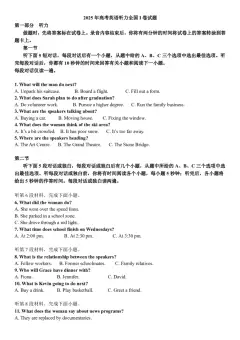
第一部分 听力(共两节,满分30 分)
第一节(共5 小题;每小题1.5 分,满分7.5 分)
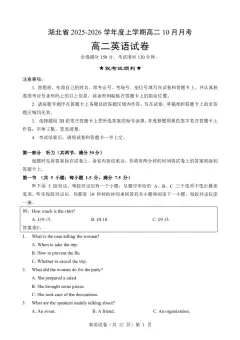
听下面5 段对话,每段对话后有一个小题,从题中所给的A、B、C 三个选项中选出最佳选项。
听完每段对话后,你都有10 秒钟的时间来回答有关小题和阅读下一小题,每段对话仅读一遍。
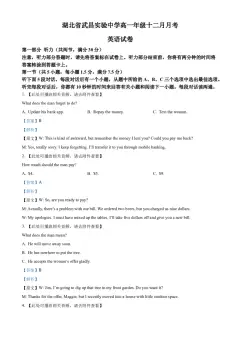
例:How much is the shirt?
A. £19. 15.
B. £9. 18.
C. £9. 15.
答案是C。
1.How soon will the woman’s bus come?
A. In about 10 minutes.
B. In about 15 minutes.
C. In about 20 minutes.
2.What will Tony take his friend to do?
A. Go to the gym.
B. Make a city tour.
C. Play baseball.
3.Who is the man?
A. A driver.
B. A passenger.
C. A policeman.
4.What might the woman do next?
A. Ask Andrew for help.
B. Buy a new computer.
C. Meet a client.
5.Where are the speakers?
A. In an office.
B. In a supermarket.
C. In a restaurant.
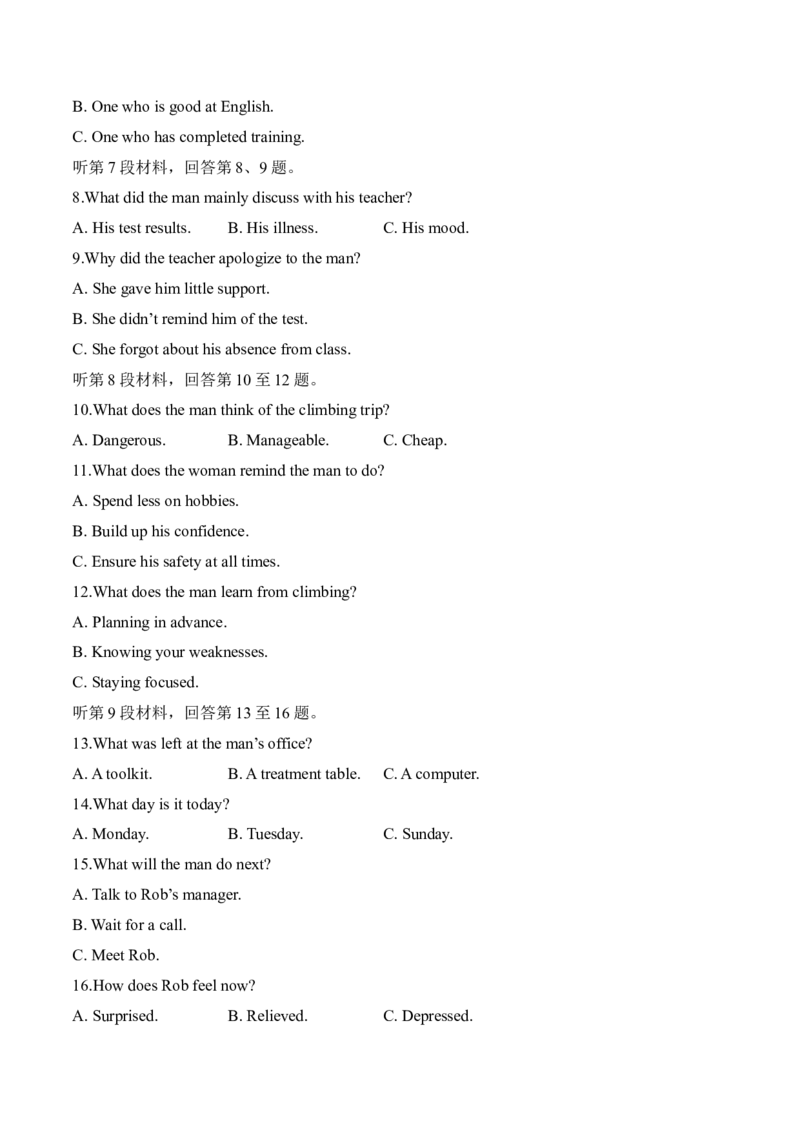
第二节(共15 小题;每小题1.5 分,满分22.5 分)
听下面5 段对话或独白。每段对话或独白后有几个小题,从题中所给的A、B、C 三个选项中
选出最佳选项。听每段对话或独白前,你将有时间阅读各个小题,每小题5 秒钟;听完后,
各小题将给出5 秒钟的作答时间。每段对话或独白读两遍。
听第6 段材料,回答第6、7 题。
6.What are the speakers talking about?
A. An interview.
B. A candidate.
C. A project.
7.Who is suitable for the job?
A. One who can lead a team.
B. One who is good at English.
C. One who has completed training.
听第7 段材料,回答第8、9 题。
8.What did the man mainly discuss with his teacher?
A. His test results.
B. His illness.
C. His mood.
9.Why did the teacher apologize to the man?
A. She gave him little support.
B. She didn’t remind him of the test.
C. She forgot about his absence from class.
听第8 段材料,回答第10 至12 题。
10.What does the man think of the climbing trip?
A. Dangerous.
B. Manageable.
C. Cheap.
11.What does the woman remind the man to do?
A. Spend less on hobbies.
B. Build up his confidence.
C. Ensure his safety at all times.
12.What does the man learn from climbing?
A. Planning in advance.
B. Knowing your weaknesses.
C. Staying focused.
听第9 段材料,回答第13 至16 题。
13.What was left at the man’s office?
A. A toolkit.
B. A treatment table.
C. A computer.
14.What day is it today?
A. Monday.
B. Tuesday.
C. Sunday.
15.What will the man do next?
A. Talk to Rob’s manager.
B. Wait for a call.
C. Meet Rob.
16.How does Rob feel now?
A. Surprised.
B. Relieved.
C. Depressed.
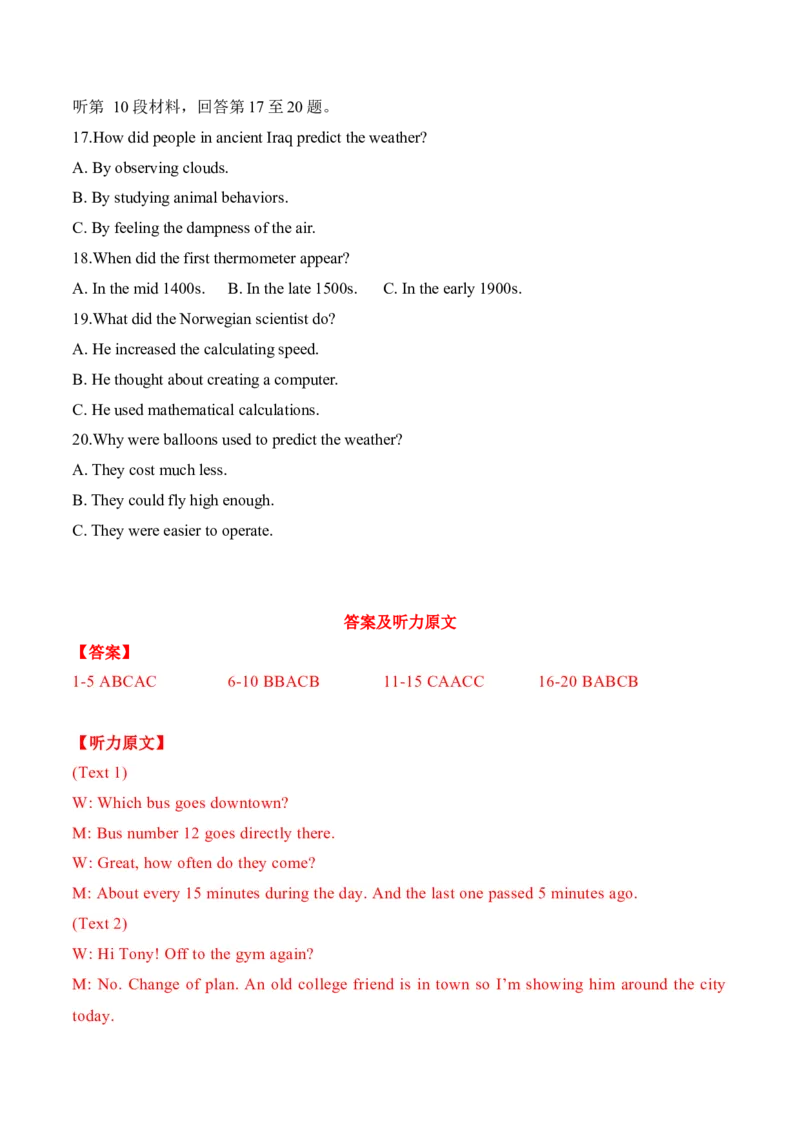
听第 10 段材料,回答第17 至20 题。
17.How did people in ancient Iraq predict the weather?
A. By observing clouds.
B. By studying animal behaviors.
C. By feeling the dampness of the air.
18.When did the first thermometer appear?
A. In the mid 1400s.
B. In the late 1500s.
C. In the early 1900s.
19.What did the Norwegian scientist do?
A. He increased the calculating speed.
B. He thought about creating a computer.
C. He used mathematical calculations.
20.Why were balloons used to predict the weather?
A. They cost much less.
B. They could fly high enough.
C. They were easier to operate.
答案及听力原文
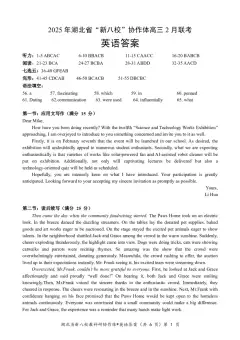
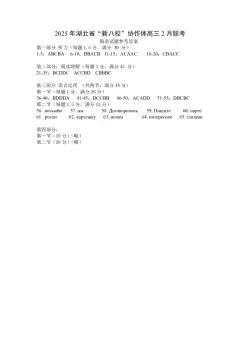
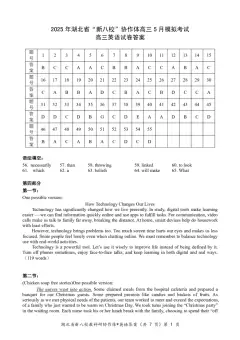
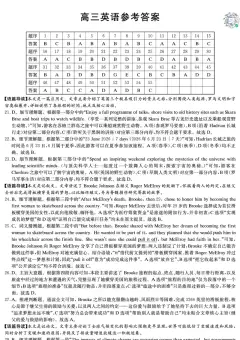
【答案】
1-5 ABCAC
6-10 BBACB
11-15 CAACC
16-20 BABCB
【听力原文】
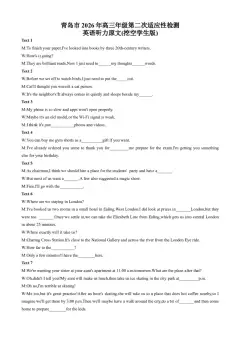
(Text 1)
W: Which bus goes downtown?
M: Bus number 12 goes directly there.
W: Great, how often do they come?
M: About every 15 minutes during the day. And the last one passed 5 minutes ago.
(Text 2)
W: Hi Tony! Off to the gym again?
M: No. Change of plan. An old college friend is in town so I’m showing him around the city
today.
W: So long as you don’t miss the main attractions for a tour of the baseball stadium.
(Text 3)
M: Where is your seat belt?
W: Sir, I am sorry. I’ll just wear it.
M: Since you were driving without a seat belt, I’m afraid you are going to pay a fine.
(Text 4)
W: David, can you help me? My computer keeps getting disconnected from the Wi-Fi.
M: Sorry, I’m on my way to a meeting with a client. Andrew helped me with my computer
yesterday and now it is running like new. He might be available now.
W: Oh, thanks for your advice.
(Text 5)
W: That was really nice.
M: I thought you’d like it. Working in this part of the city, I often come here and it’s always
good.
W: You can tell that the ingredients are fresh.
M: Yes. Everything is full of flavor. Nothing frozen.
(Text 6)
M: We need a project engineer, and I think Amelia Henks is suitable for this position. She is
currently a trainee. What do you think of her?
W: Yes, Matt. I have seen her working with her colleagues. She seems like a good team player.
M: Yes, and I heard her speaking English in the office yesterday. She sounded quite confident.
Fluency in English is essential for this job. Well, let’s go and interview Amelia.
W: Of course, with pleasure.
(Text 7)
W: Did you speak to your teacher?
M: Yes, I had a word with her yesterday. And she said that she was disappointed in me. She
told me I should have done better.
W: Oh, dear! You must have been upset.
M: Yes! It was completely unexpected. I reminded her that I had been ill and had missed some
lessons. Actually, she admitted that she had forgotten about my illness. She apologized for
forgetting. And she promised me that she would support me in any way necessary.
W: And what did you say to that?
M: I said that I would try my best to do better in the next test.
(Text 8)
M: Look, these photos were taken on the trip I took with my climbing club.
W: Wow! I didn’t realize you were tackling such advanced climbs already.
M: I know, it’s awesome! I mean, I wouldn’t have attempted it if I didn’t think I could do it.
And the trip wasn’t cheap, so I wanted to make sure I was ready for it.
W: Yes, you always manage to pick expensive hobbies! But seriously, I know you love
exciting things, but not at the expense of safety, I hope.
M: Well, you need confidence and courage to do any extreme sport, but I still know my limits.
W: Is that because you’re constantly aware of dangers?
M: Well, that’s true of all extreme sports. But with climbing, you’re always thinking several
moves ahead to figure out the best route and anticipate possible problems. It’s a skill that I’m
using in other aspects of my life.
W: Well, that sounds great. Maybe I should give it a try!
(Text 9)
W: Good afternoon, you’ve reached Dr. Patterson’s Physio Office.
M: This is Neil Ecob. Our office had your company work on one of our treatment tables
yesterday, but it looks like someone on your team left their toolkit here.
W: Wow! Thanks for letting us know. Our technician, Rob, has been in a panic all day and will
be very happy to hear this, as will his manager. When should I send him over to get his tools
back?
M: We are only closed tomorrow, but other than that, we are open Tuesday to Sunday from 9 in
the morning until 4 in the afternoon. He can swing by anytime. The equipment will be at the
front desk with me.
W: Great. He is actually right here beside me and said he is going to leave right now to get
them. He should be there in the next thirty minutes. Thank you again for giving us a call!
(Text 10)
W: Hi everyone, my name’s Marion Fordham and I’m a climate scientist. I’m here today to talk
to you about the history of weather forecasting. Records from as far back as 600 BCE from
Babylon, in ancient Iraq, suggest that cloud shapes were used to make forecasts. Different
animal behaviors were used to predict short-term weather patterns in Japan and many other
nations.
Methods of weather forecasting remained unchanged for the next 2,000 years or so, until
technological breakthroughs led to greater accuracy. The first of these, in the mid-15th century,
measured how damp air was. The first thermometer, which was used to measure temperature,
was created in the late 16th century and improved weather predictions. By the start of the 20th
century, a Norwegian scientist employed mathematical calculations for forecasts, starting in
1904. It was time-consuming, as computers hadn’t been invented yet. In the 1920s, electrical
equipment for recording weather-related data had become more reliable. Airplanes of the time
were still unable to fly high enough to gather relevant information, so balloons performed this
role instead, as they were able to travel up to 30 kilometers above the earth’s surface before
bursting. Since the first satellite to be sent into space specifically to help with forecasts was
launched in 1960, this technology has been a continuous presence above earth.