2025 年10 月「江
南十校」新高三第
一次综合素质检测
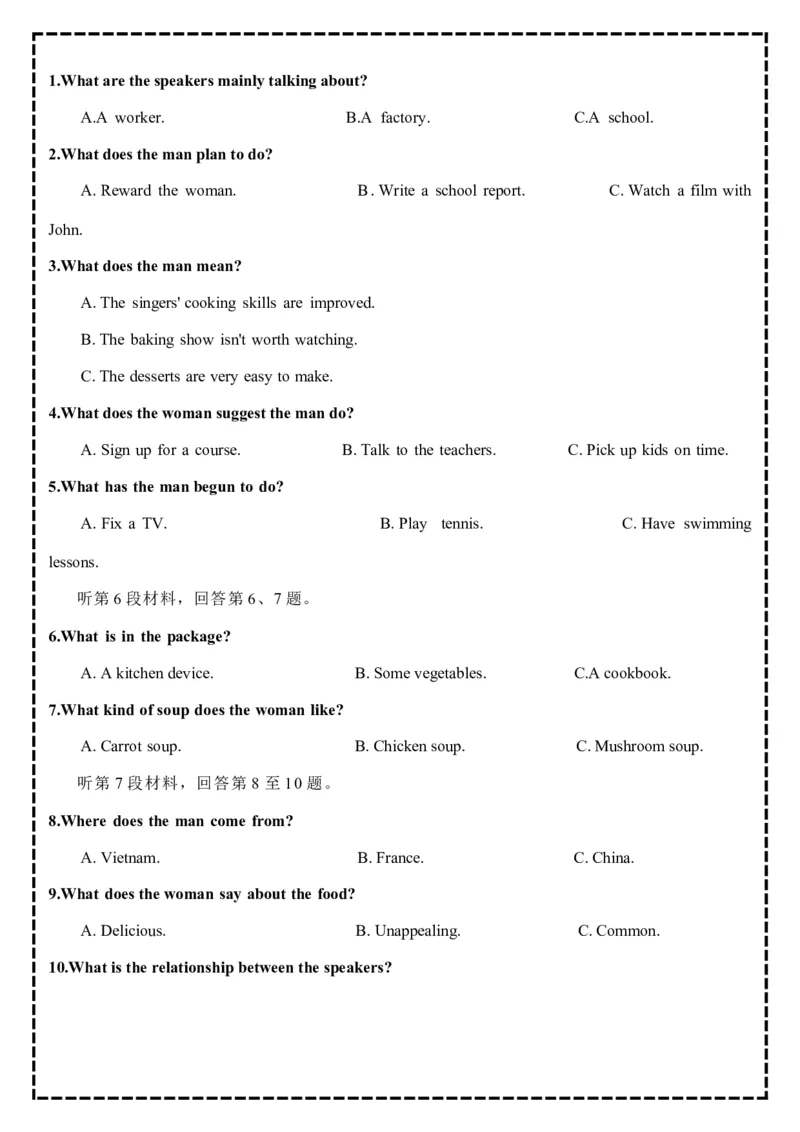
1.What are the speakers mainly talking about?
A.A worker.                                             B.A  factory.                                    C.A  school.
2.What does the man plan to do?
A. Reward the woman.                           B. Write a school report.                   C. Watch a film with
John.
3.What does the man mean?
A. The singers' cooking skills are improved.
B. The baking show isn't worth watching.
C. The desserts are very easy to make.
4.What does the woman suggest the man do?
A. Sign up for a course.                         B. Talk to the teachers.                  C. Pick up kids on time.
5.What has the man begun to do?
A. Fix a TV.                                              B. Play   tennis.                              C. Have  swimming
lessons.
听第6 段材料,回答第6、7 题。
6.What is in the package?
A. A kitchen device.                                   B. Some vegetables.                      C.A cookbook.
7.What kind of soup does the woman like?
A. Carrot soup.                                           B. Chicken soup.                            C. Mushroom soup.
听第7 段材料,回答第8 至10 题。
8.Where does the man come from?
A. Vietnam.                                                 B. France.                                     C. China.
9.What does the woman say about the food?
A. Delicious.                                               B. Unappealing.                             C. Common.
10.What is the relationship between the speakers?
A. Teacher and student.                              B. Classmates.                                 C.
Employer and employee.
听第8 段材料,回答第11 至13 题。
11.What is the man worried about?
A. When to buy food.                    B. How to raise funds.               C. Whether to prepare a
meal.
12.What did the children in the local schools do for the man's problem last year?
A. They held a spelling competition.
B. They organized a sale in the yard.
C. They sold morning coffee.
13.How does the woman feel about what the man is doing?
A. Strange.                                      B. Crazy.
C. Nice.
听第9 段材料,回答第14 至17 题。
14.What is the woman?
A.A photographer.                         B.A  writer.
C.A driver.
15.Where does the conversation probably take place?
A. In a library.                               B .On a bus.
C. At the station.
16.What does the woman invite Fred to do?
A.Travel with books.                    B. Read the  series.
C. Take a picture.
17.What is Fred like according to the woman?
A. Enthusiastic.                              B. Honest.
C. Ambitious.
听第10 段材料,回答第18 至20 题。
18.Why is the school closing early?
A. There will be a meeting.            B. The weather is horrible.
C. The hall will be occupied.
19.When will Year 13 leave school?
A. At 1:15 pm.                              B. At 1:30 pm.
C. At 2:45 pm.
20.What are the students required to do tomorrow?
A. Pay attention to the latest updates.
B. Show respect for their teachers.
C. Take a break at home.
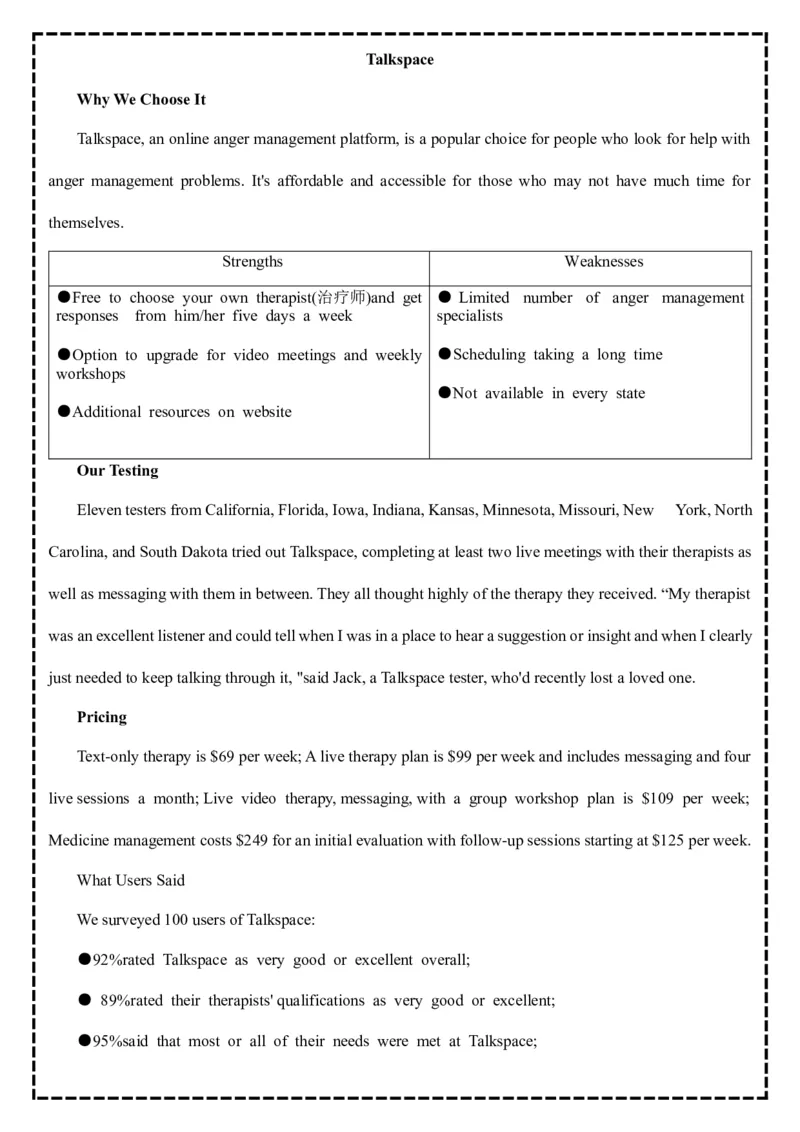
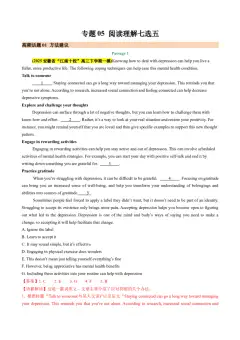
Talkspace
Why We Choose It
Talkspace, an online anger management platform, is a popular choice for people who look for help with
anger management problems. It's affordable and accessible for those who may not have much time for
themselves.
Strengths
Weaknesses
●Free to choose your own therapist(治疗师)and get
responses  from him/her five days a week
●Option to upgrade for video meetings and weekly
workshops
●Additional resources on website
●Limited number of anger management
specialists
●Scheduling taking a long time
●Not available in every state
Our Testing
Eleven testers from California, Florida, Iowa, Indiana, Kansas, Minnesota, Missouri, New      York, North
Carolina, and South Dakota tried out Talkspace, completing at least two live meetings with their therapists as
well as messaging with them in between. They all thought highly of the therapy they received. “My therapist
was an excellent listener and could tell when I was in a place to hear a suggestion or insight and when I clearly
just needed to keep talking through it, "said Jack, a Talkspace tester, who'd recently lost a loved one.
Pricing
Text-only therapy is $69 per week; A live therapy plan is $99 per week and includes messaging and four
live sessions  a  month; Live  video  therapy, messaging, with  a  group  workshop  plan  is  $109  per  week;
Medicine management costs $249 for an initial evaluation with follow-up sessions starting at $125 per week.
What Users Said
We surveyed 100 users of Talkspace:
●92%rated Talkspace as very good or excellent overall;
● 89%rated their therapists' qualifications as very good or excellent;
●95%said that most or all of their needs were met at Talkspace;
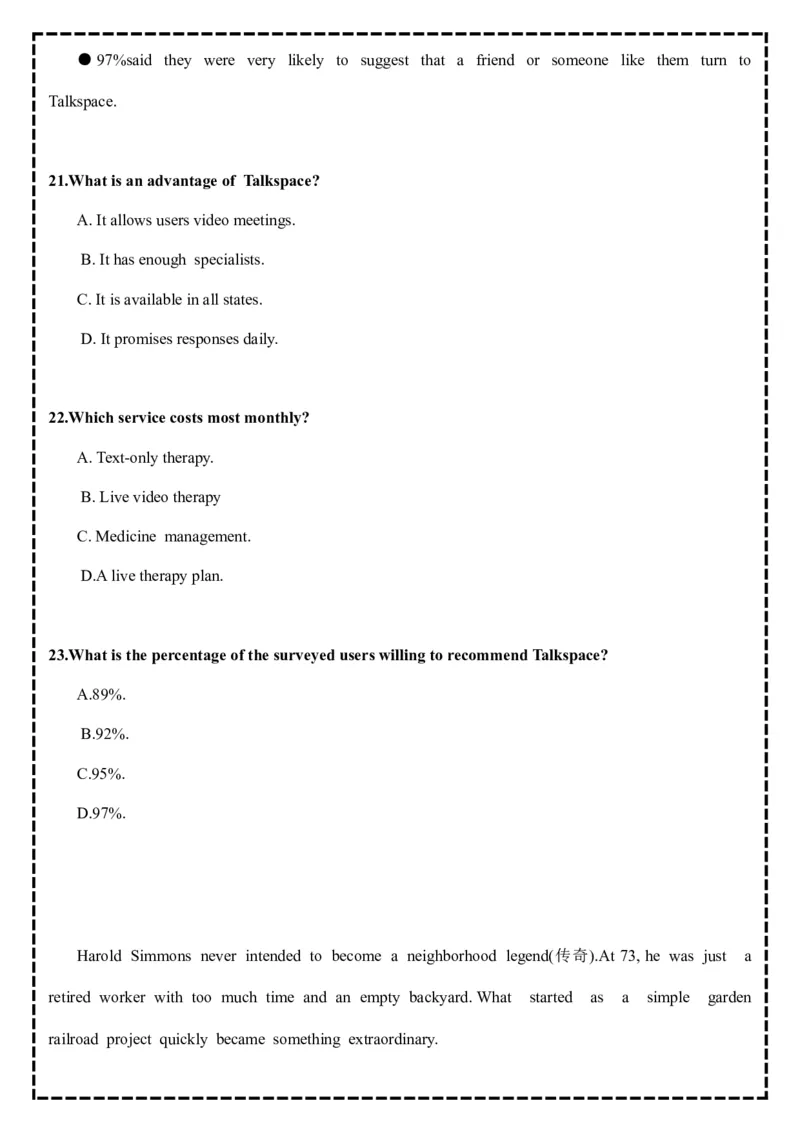
●97%said they were very likely to suggest that a friend or someone like them turn to
Talkspace.
21.What is an advantage of  Talkspace?
A. It allows users video meetings.
 B. It has enough  specialists.
C. It is available in all states.
 D. It promises responses daily.
22.Which service costs most monthly?
A. Text-only therapy.
 B. Live video therapy
C. Medicine  management.
 D.A live therapy plan.
23.What is the percentage of the surveyed users willing to recommend Talkspace?
A.89%.
 B.92%.
C.95%.
D.97%.
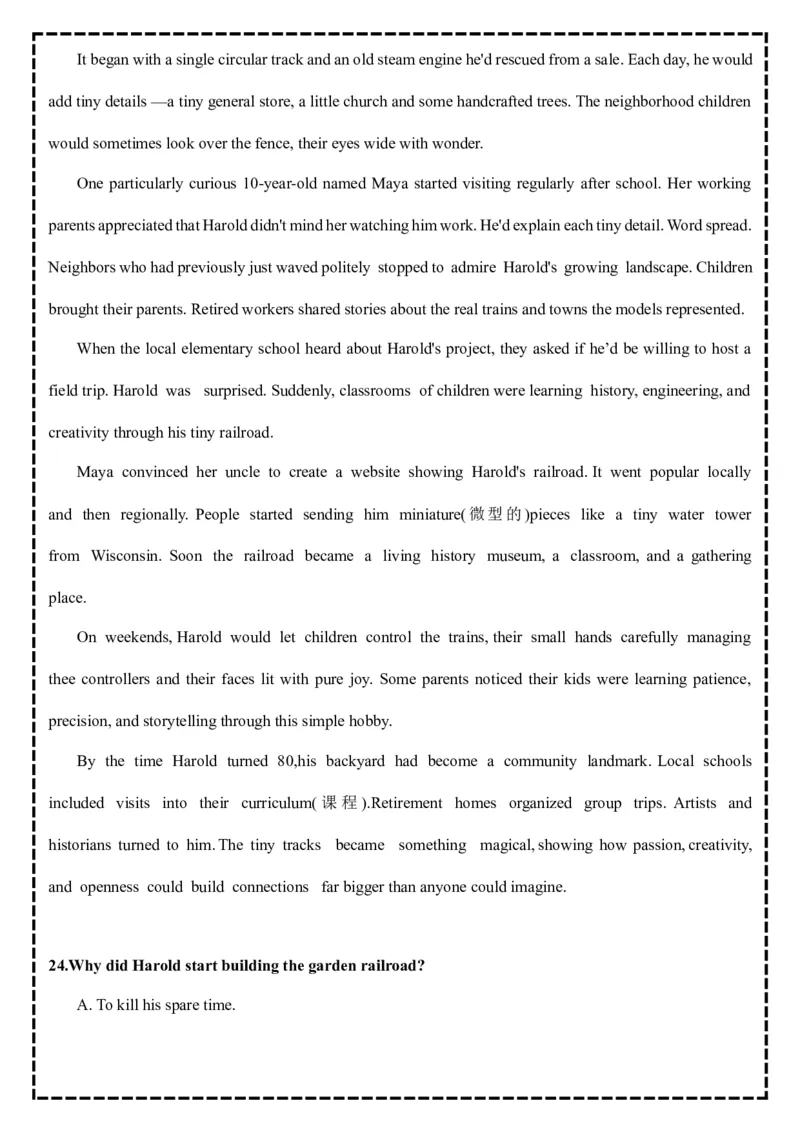
Harold Simmons never intended to become a neighborhood legend(传奇).At 73, he was just  a
retired worker with too much time and an empty backyard. What  started  as  a  simple  garden
railroad project quickly became something extraordinary.
It began with a single circular track and an old steam engine he'd rescued from a sale. Each day, he would
add tiny details —a tiny general store, a little church and some handcrafted trees. The neighborhood children
would sometimes look over the fence, their eyes wide with wonder.
One particularly curious 10-year-old named Maya started visiting regularly after school. Her working
parents appreciated that Harold didn't mind her watching him work. He'd explain each tiny detail. Word spread.
Neighbors who had previously just waved politely  stopped to  admire  Harold's  growing  landscape. Children
brought their parents. Retired workers shared stories about the real trains and towns the models represented.
When the local elementary school heard about Harold's project, they asked if he’d be willing to host a
field trip. Harold  was   surprised. Suddenly, classrooms  of children were learning  history, engineering, and
creativity through his tiny railroad.
Maya convinced her uncle to create a website showing Harold's railroad. It went popular locally
and then regionally. People started sending him miniature( 微型的)pieces like a tiny water tower
from Wisconsin. Soon the railroad became a living history museum, a classroom, and a gathering
place.
On  weekends, Harold  would  let  children  control  the  trains, their  small  hands  carefully  managing
thee controllers and their faces lit with pure joy. Some parents noticed their kids were learning patience,
precision, and storytelling through this simple hobby.
By the time Harold turned 80,his backyard had become a community landmark. Local schools
included visits into their curriculum( 课程).Retirement homes organized group trips. Artists and
historians turned to him. The tiny tracks  became  something  magical, showing  how  passion, creativity,
and  openness  could  build  connections   far bigger than anyone could imagine.
24.Why did Harold start building the garden railroad?
A. To kill his spare time.
B. To host field trips.
C. To train local children.
 D. To become famous.
25.What was the neighbors' attitude toward Harold's project?
A. Critical.
B. Negative.
C. Appreciative.
D. Uncertain.
26.Why did Harold's project attract the local elementary school?
A. It included a new steam engine.
B. It had an educative value.
C. It was praised on a website.
 D. It was a garden programme.
27.What lesson can we learn from the story?
A. One is never too old to learn.
B. Many hands make light work.
C. Education knows no boundaries.
D. Small things make a big difference.
As  artificial  intelligence(AI)takes  off, how  do  we  efficiently  integrate  it  into  our  lives  and  our
work? Bridging the gap between promise and practice, Jann Spiess, an associate professor at Stanford
Graduate School of Business, is  exploring  how  algorithms(算法)can be  designed to most effectively
support —rather than replace —human   decision-makers.
"We  don't  have  much  work—yet—that  takes   design   of  the  human-AI   interface  really   seriously,
"says Spiess.“Our debate about AI and the capabilities of AI is really misplaced, because it's all about 'Is AI
better than the human?”, he continues. "I think instead we should be asking,' What are the
complementary(互补的)uses of AI?'”
If users rely too heavily on an algorithm, they may ignore relevant context or information the algorithm
may not know. On the other hand, if users view recommendations as overly complex or irrelevant, they may
dismiss them altogether, forgoing any advantages algorithmic recommendations may provide.
"Therefore, the best algorithm should take into account how a human will interact with the
information it provides,”Spiess says. In  a recent paper, Spiess  outlines  a  conceptual  (概念
的)design framework modeling how humans respond to algorithmic recommendations —and presents a
different approach to building AI tools. This approach is known as complementarity.
The  researchers  tested  different  recommendation  strategies  in  an  experiment, where  participants
made  25 hiring decisions with different levels of algorithmic assistance. People using a complementary
algorithm —which offered selective recommendations in cases where a human was likely to be uncertain or
incorrect —made the most accurate decisions, outperforming those using a purely predictive algorithm and
those using no algorithmic support.
It's  an   encouraging  result. "There's  much  promise  around  AI  improving  decisions,"
says   Spiess, who's  particularly interested in applications that affect how services are allocated(分
配)in resource-limited environments, such  as placing  teachers  in underserved  school  districts  with
limited  budgets." If you  could  use  algorithms  to  improve resource allocation, there are many high-value
use cases in areas where we don't have ready or clear  solutions," he  says.
28.What is the main issue with current AI debates according to Spiess?
A. Ignoring the potential of AL
 B. Overemphasis on AI's superiority.
C. Misunderstanding AI's purpose.
D. Lack of focus on AI's efficiency.
29.What does the underlined word "forgoing "in paragraph 3 mean?
A. Abandoning.
B. Stressing.
C. Admitting.
D. Assessing.
30.What does Spiess think is the key to effective AI design?
A. Enhancing algorithm complexity.
B. Reducing human dependence on AI.
C. Considering human-AI interaction.
 D. Improving AI's independent capability.

31.What does the experiment on hiring decisions show?
A. Predictive algorithms were the most helpful.
B. Human judgment alone was the most accurate.
C. No algorithmic support was completely the best.
 D. Complementary algorithms were highly effective.
In Costa Rica, even small areas of tree cover can reduce the presence of invasive(入侵的)mosquito
species known to spread diseases like dengue fever (登革热),according to a Stanford University-led study
published on May 28h in Landscape Ecology. The findings can inform land use decisions and tree
preservation strategies in rural  areas, according to the researchers.
Using field observations and satellite data on land cover for an area of forests, farms, and residential
areas in  southern Costa Rica, the researchers found the presence of the Aedes albopictus mosquito, a dengue
vector(媒介), decreased  in  areas  with  more  tree  cover  while  the  total  number  of mosquito  species
increased. More  species  demand more space and resources, making it harder for an invasive species to find
unoccupied space or resources.
Costa Rica has numerous mosquito-borne diseases and two invasive mosquito species serving as
vectors. The forests surveyed in the study hosted a high diversity of mosquito species, none of which
were the dengue vector Aedes albopictus. Residential areas, by contrast, had much fewer mosquito species
and were far more likely to hold the  invasive, disease-spreading  species. Agricultural  areas  fell
somewhere  in  between, with  outcomes  seemingly tied to the intensity and type of land use.
Natural habitats exist alongside agriculture and development in rural areas. In Costa Rica and beyond,
these areas can provide pathways to conserving biodiversity. The study shows that protecting trees can
help conserve biodiversity  while  also  reducing  the  likelihood  of  disease  spread. That's  good  news  in
the  face  of  warmer temperatures, changes in rainfall, and human activity that are enabling the spread
of mosquito-borne illnesses to new places.
The researchers emphasize the need to do more research to understand how other vector species
react to increased tree cover. “We need to know more about what drives dengue in rural areas,” said
study senior author Erin Mordecai, associate professor of biology in Stanford University. “This work
shows forests and tree cover can reduce risk, but identifying other land use types that sustain vector
populations is the next frontier for controlling this rapidly expanding disease.”
32.How does increased tree cover prevent invasive mosquitoes?
A. By reducing dengue vectors.
B. By increasing species competition.
C. By upgrading human habitats.
 D. By ensuring agricultural outputs.
33.What can be known about residential areas?
A. They have lower mosquito diversity.
B. Their land use is more intensive.
C. Their living conditions are poor.
D. They host fewer disease risks.
34.What is the significance of the study?
A. It helps agricultural development.
B. It solves the problem of disease spread.
C. It offers a potential win-win strategy.
 D. It leads to the study of climate patterns.
35.What can be a suitable title for the text?
A. Mosquito-borne Disease Risks Increase
B. Protecting Trees Improves Life Quality
C. Disease-spreading Species Are Coming
D. Tree Cover Limits Invasive Mosquitoes
Every day, we speak to and spend time with the people who mean the most to us. However, think
about how many people you interact with in a typical week are the ones you wouldn't consider as close
connections.        36

      In sociology, these are known as our “weak ties”, referred to as such to differentiate
them from our strong ties, like close friends and family members.


  37

 For  example, if you  spoke  about your job hunt to  a  group of close friends, they might only
be aware of the same job opportunities as you because you move in the same circles. However, mentioning it
to an  acquaintance, like  a  regular  waiter, connects  you  to  people  outside  your  own  social  circle, which
can  provide unexpected job opportunities.
"Weak  ties  can   serve   special  functions  not   served  by  close  ties, including  providing   access  to
unique information and resources, "says Susan Sprecher, distinguished professor at Illinois State University.“
Additionally, many people interact with more weak ties throughout a day than they do with close ties.         38
”
Indeed, weak ties can give us a real mental health boost. A recent study done by Sprecher indicated people
with wider connections of weak ties tend to be happier.        39          They  reported  feeling  more  happiness
and greater feelings of belonging on days when they interacted with more classmates than usual.
Given they have such a strong impact on our lives, why not create weak ties?         40       .Often, this  will
mean going outside and speaking to people, whether it's those you pass in the street,  who serve you in shops,
or with whom you share a class.
A. The research involved students
B. You find yourself in a better mood
C. We just need to engage with other people
D. Weak ties can have a smaller effect than you might think
E. This diverse social network is related with good health and well-being
F. For example, you chat with the guys who regularly serve you at the store
G. Strong ties tend to form closed social groups with limited new information
My husband's career has led to our family relocating many times. With each move, to make friends, I
explored new         41        like drawing, and joined various clubs and groups, just without a ball.
That         42         when our family moved to Ankara, Turkey. If I wanted a        43        life in the new
community, I'd have to play tennis. Having bought a tennis skirt and a racket(球拍),I appeared at my         44
With an encouraging coach, I        45         to show up, with a racket in hand and a smile on my face. I
46


 criticism and learned to laugh at my mistakes. Despite my new can-do         47         my swings
were often met with  nothing but air. Laughing and learning, I kept swinging and trying,         48         the
progress I was making.
After a few months of lessons, the practice provided me with the        49     to play Cardio Tennis
before a sold-out audience. Grasping my racket, I made my way to the court. As they        50        the rules
of the game to me, I worriedly declared," I’m an amateur! Though I'm         51        to be here, I apologize
in advance!”
The hours we spent together were full of laughter,         52       and  friendship. They  praised  my
forehand and sympathized when I        53      a return. I put myself out  there, unashamedly         54        my
rookie(新 手)state. But  by putting myself in the         55        ,I developed a sense of achievement, learned
a new skill and made new friends.
41.A.missions                        B. routes                          C. hobbies                         D. traditions
42.A.occurred                        B. changed                      C. failed                            D. developed
43.A.global                            B. practical                      C. common                       D. social
44.A.lessons                           B. activities                     C. researches                    D. events
45.A.decided                          B. continued                   C. stopped                         D. refused
 46.A.demanded                     B. guided                        C. discovered                     D. accepted
47.A.attitude                          B. analysis                      C. attempt                           D. strategy
48.A.working out                  B. giving up                    C .focusing on                     D. putting away
49.A.need                              B. confidence                 C. aim                                  D. duty
50.A.explained                      B. contributed                C. applied                            D. referred
51.A.disappointed                 B. calm                           C. confused                         D. happy
52.A.pressure                        B. encouragement           C. silence                             D. blame
53.A.spotted                         B. picked                          C. missed                              D. rewarded
54.A.showing                       B. doubting                      C. expecting                         D. noticing
55.A.target                            B. theory                          C. plan                                  D. game
A train enthusiast from China has set a new Guinness World Record for the “greatest distance
travelled by train in 24 hours."        56       (cover)an  impressive  5,887.76 kilometers within a  single day,
according to the official WeChat account of Guinness World Records.
The traveler, Wang Dong, journeyed from Shenzhen in South China's Guangdong Province to Beijing,
then to Shanghai, Guiyang, and         57        (eventual)to Yibin in Southwest China's Sichuan Province, in
February,2025, arriving with only 40 seconds to spare before the 24-hour deadline.
The most intense moment came,

 58


 Wang had only 31 minutes to transfer(换
乘)from Beijing West Station to Beijing South Station by subway. With his incoming train

 59

(delay)by three minutes, he relied on experience and ran through the station —managing        60
(catch)his next train in just 22 minutes.
The real         61        (excite)came near the end of the journey. "My final train,D5122 from Guiyang to
Yibin, was planned just four minutes before the 24-hour mark,” Wang said.“ If it had been put off by over
three minutes, my attempt would have failed."
Unfortunately, when D5122 pulled into Yibin, it was indeed late —but only by 2 minutes. As
the doors opened and Wang

 62


  (step)onto the platform, his watch showed just 40
seconds remaining —an exciting margin(差距)

 63


  success and failure.
At        64        end of his journey, Wang thought highly of the power of China's high-speed railway system,
whose rapid development        65       high efficiency made the impossible possible.
.
假定你是李华,上周六你班组织了一次市图书馆义工活动。请你给热衷志愿工作的留学Daniel 写
一 封邮件,
内容包括:
(1)活动的目的和过程;
(2)你的感悟。
注意:
(1)写作词数应为80 左右;
(2)请按如下格式在答题纸的相应位置作答。
     Dear Daniel,
     Knowing you are passionate about volunteer activities, I'm writing to tell you one.
Yours,
Li Hua
On the graduation day,  there would be a ceremony(典礼),which was to be held in a large church
downtown  I'd never visited. I chose a simple, black dress that would fit nicely under my robe(礼
服).I even put on a bit of  makeup for the occasion and I was getting ready. However, I heard about
the stairs that I'd have to manage during  my graduation accidentally. I decided that I couldn't handle the pressure
of steps. Walking across the stage was  going to be scary enough. Thinking of the stairs I'd have to handle during my
graduation, I felt depressed. I wasn't  able to climb the stairs without a ramp(斜坡).So I called Sally in
tears and told her that I wasn't going. Sally was a  nice person who always helped me since I came to
the university because I suffered a cerebral palsy(脑瘫). Hearing my fears, she knew I needed a good
cry.
Sally told me she'd take care of everything. My breathing slowed, and I could feel my body again. At this
time, I knew I had to sit quietly and let Sally work her plan, whatever that was. She made me promise that I'd be
at the  church soon.
An hour later, I arrived at the church and saw the stairs on both sides of the stage. I would walk up from one
side, shake everyone's hand, and then walk down the stairs on the other side to leave the stage. It wasn’t just the
stairs I worried about; it was the handshake, too. My cerebral palsy gave me limited control over my right hand.
When I found Sally, she rushed over and hugged me. "I had it all worked out, "she said. "It's going to be
fine." Now, thinking I would make it through, I felt better. However, when the staff started calling graduates up
in order, I began to get nervous. My name was about to be called.
Suddenly, I saw a staff member roll out a temporary ramp beside the steps.
  I shook their left hands firmly.