教师资格考试(高中)英语学科知识与教学能力
卷(一)
(考试时间: 120分钟 满分: 150分)
一、 单项选择题(本大题共30小题,每小题2分,共60分)
1 . The underlined letters in the following words have the same sound EXCEPT
A. b竺过 B. pear
C. nuclear D. hear
2. Which of the following correctly describes the English phoneme /tf/?
A. A voiceless alveolar fricative. B. A voiceless post-alveolar affricate.
C. A voiced palatal affricate. D. A voiced alveolar fricative.
3 . I am afraid the book is not now but I promise I'll contact you the moment it's
returned to the library.
A. available B. acceptable
C. visible D. suitable
4. The official the accusation that he was bribed, saying he was innocent.
A. proved B. rejected
C. deserved D. supported
5. Did the party come to power in 1960s?
A. the; the B. the; I
C. a;/ D. /; the
6. The famous singer, as well as his daughter and wife, to the new program twice so
far.
A. has been invited B. have been invited
C. was invited D. were invited
7. It was around five o'clock the guests began to amve.
A. since B. when
C. then D. that
—
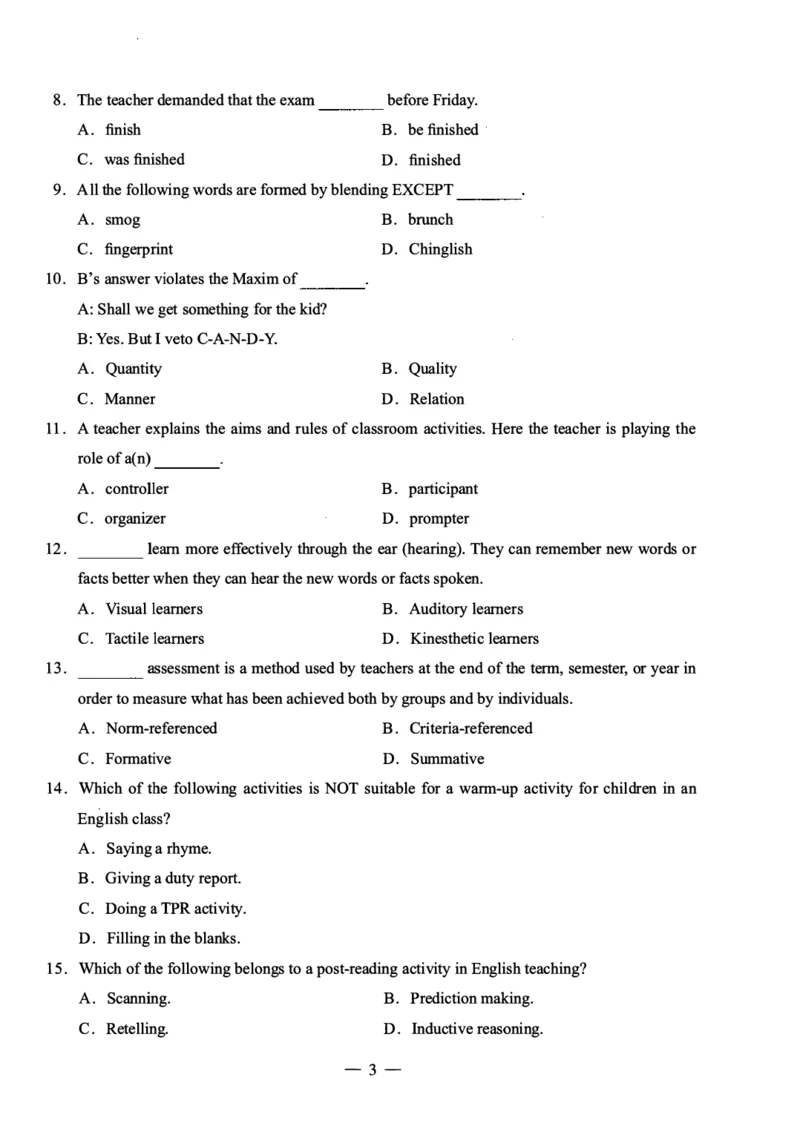
2-8. The teacher demanded that the exam before Friday.
A. finish B. be finished
C. was finished D. finished
9. All the following words are formed by blending EXCEPT
A. smog B. brunch
C. fingerprint D. Chinglish
10. B's answer violates the Maxim of
A: Shall we get something for the kid?
B: Yes. But I veto C-A-N-D-Y.
A. Quantity B. Quality
C. Manner D. Relation
11. A teacher explains the aims and rules of classroom activities. Here the teacher is playing the
role of a(n)
A. controller B. participant
C. organizer D. prompter
12. learn more effectively through the ear (hearing). They can remember new words or
facts better when they can hear the new words or facts spoken.
A. Visual learners B. Auditory learners
C. Tactile learners D. Kinesthetic learners
13. assessment is a method used by teachers at the end of the term, semester, or year in
order to measure what has been achieved both by groups and by individuals.
·
A. Norm-referenced B. Cntena-referenced
C. Formative D. Summative
14. Which of the following activities is NOT suitable for a warm-up activity for children in an
English class?
A. Saying a rhyme.
B. Giving a duty report.
C. Doing a TPR activity.
D. Filling in the blanks.
15. Which of the following belongs to a post-reading activity in English teaching?
A. Scanning. B. Prediction making.
C. Retelling. D. Inductive reasoning.
-3 —16. When teaching grammar, "You are a stranger in this town, …" and "A policeman were asking
some questions, …" are two examples of using .
A. word bingo B. body language
C. created situation D. chain of questions
17. theory believes that learning is a process in which the learner constructs meaning
based on his/her own experiences and what he/she already knows.
A. Behaviorist B. Cognitive
C. Constructive D. Structural
18. It is believed that the inductive method is more effective than the deductive method because
students while engaged in language use.
A. never learn the grammar rules
B. discover the grammar rules by themselves
C. are told by the teacher the grammar use
D. learn the grammar rules without any difficulty
19. If there is only one language used in classroom interaction, which one can describe this kind of
language context?
A. Multilingual Teaching. B. Monolingual Teaching.
C. Bilingual Teaching. D. Trilingual Teaching.
20. Work in pairs and look at the two pictures very carefully. Student A should not look at Student
B's picture and vice versa. Each one of you should describe your own picture to the other so
that you can find out the differences between the two pictures. This activity is called
A. mformat10n-gap activity B. accuracy-focused activity
C. decision-making activity D. word-bingo activity
请阅读Passage 1, 完成第21-25小题。
Passage 1
Only two countries in the advanced world provide no guarantee for paid leave from work to
care for a newborn child. Last spring one of the two, Australia, gave up the dubious distinction by
establishing paid family leave starting in 2011. I wasn't surprised when this didn't make the news
—
here in the United States we're now the only wealthy country with�ut such a policy.
The United States does have one explicit family policy, the Family and Medical Leave Act,
passed in 1993. It entitles workers to as much as 12 weeks' unpaid leave for care of a newborn
— 4 —or dealing with a family medical problem. In spite of the modesty of the benefit, the Chamber of
Commerce and other business groups fought it bitterly, describing it as "government-run personnel
management" and a "dangerous precedent" . In fact, every step of the way, as Democratic leaders
have tried to introduce work-family balance measures into the law, business groups have been
strongly opposed.
As Yale law professor Anne Alcott argues, justifying parental support depends on defining the
family as a social good that, in some sense, society must pay for. In her book No Exit: What Parents
Owe Their Children and What Society Owes Parents, she argues that parents are burdened in many
ways in their lives: there is "no exit" when it comes to children. "Society expects-and needs一
parents to provide their children with continuity of care, meaning the intensive, intimate care that
human beings need to develop their intellectual, emotional and.moral capabilities. And society
expects-and needs—parents to persist in their roles for 18 years, or longer if needed."
While most parents do this out of love, there are public punishments for not providing care.
What parents do, in other words, is of deep concern to the state, for the obvious reason that caring
for children is not only. morally urgent but essential for the future of society. The state recognizes
this in the large body of family laws that govern children's welfare, yet parents receive little help in
meeting the life-changing responsibilities society imposes. To classify parenting as a personal choice
for which there is no collective responsibility is not merely to ignore the social benefits of good
parenting; really, it is to steal those benefits because they accrue to the whole of society as today's
children become tomorrow's productive citizens. In fact, by some estimates, the value of parental
investments in children, investments of time and money (including lost wages), is equal to 20o/o-30%
of entire domestic product. If these investments generate huge social benefits—as they clearly do—
the benefits of providing more social support for the family should be that much clearer.
21. What do we learn about paid family leave from the first paragraph?
A. America is now the only developed country without the policy.
B. Its meaning was clarified when it was established in Australia.
C. It came as a surprise when Australia adopted the policy.
D. It has now become a hot topic in the United States.
22. What has prevented the passing of work-family balance laws in the United States?
A. The lack of a precedent in American history.
B. The existing Family and Medical Leave Act.
C. The opposition from business circles.
—
5 一D. The incompetence of the Democrats.
23. What is Professor Anne Alcott's argument for parental support?
A. The cost of raising children in the U.S. has been growing.
B. The U.S. should keep up with other developed countries.
C. Good parenting benefits society.
D. Children need continuous care.
24. What does the author think of America's large body of family laws governing children's
welfare?
A. They fail to ensure children's healthy growth.
B. They fail to provide enough support for parents.
C. They emphasize parents'legal responsibilities.
D. They impose the care of children on parents.
25. Why does the author object to classifying parenting as a personal choice?
A. It is regarded as a legal obligation.
B. It relies largely on social support.
C. It is basically a social undertaking.
D. It produces huge social benefits.
请阅读Passage2, 完成第26-30题。
Passage 2
When it comes to schooling, the Herrera boys are no match for the Herrera girls. Last week,
four years after she arrived from Honduras, Martha, 20, graduated from Fairfax High School in Los
Angeles. She managed decent grades while working 36 hours a week at a Kentucky Fried Chicken.
Her sister, Marlin, 22, attends a local community college and will soon be a certified nurse assistant.
The brothers are a different story. Oscar, 17, was expelled two years ago from Fairfax for carrying
a knife and later dropped out of a different school. The youngest, Jonathan, 15, is now in a juvenile
boot camp after running into trouble with the law. "The boys get sidetracked more," says the kids'
mother, Suyapa Landaverde. "The girls are more confident."
This is no aberration. Immigrant girls consistently outperform boys, according to the
preliminary findings of a just-completed, five-year study of immigrant children—the largest of
its kind, including Latino, Chinese and Haitian kids—by Marcelo and Carola Suarez-Orozco of
the Harvard Graduate School of Education. Though that trend holds for U.S.-born kids as well,
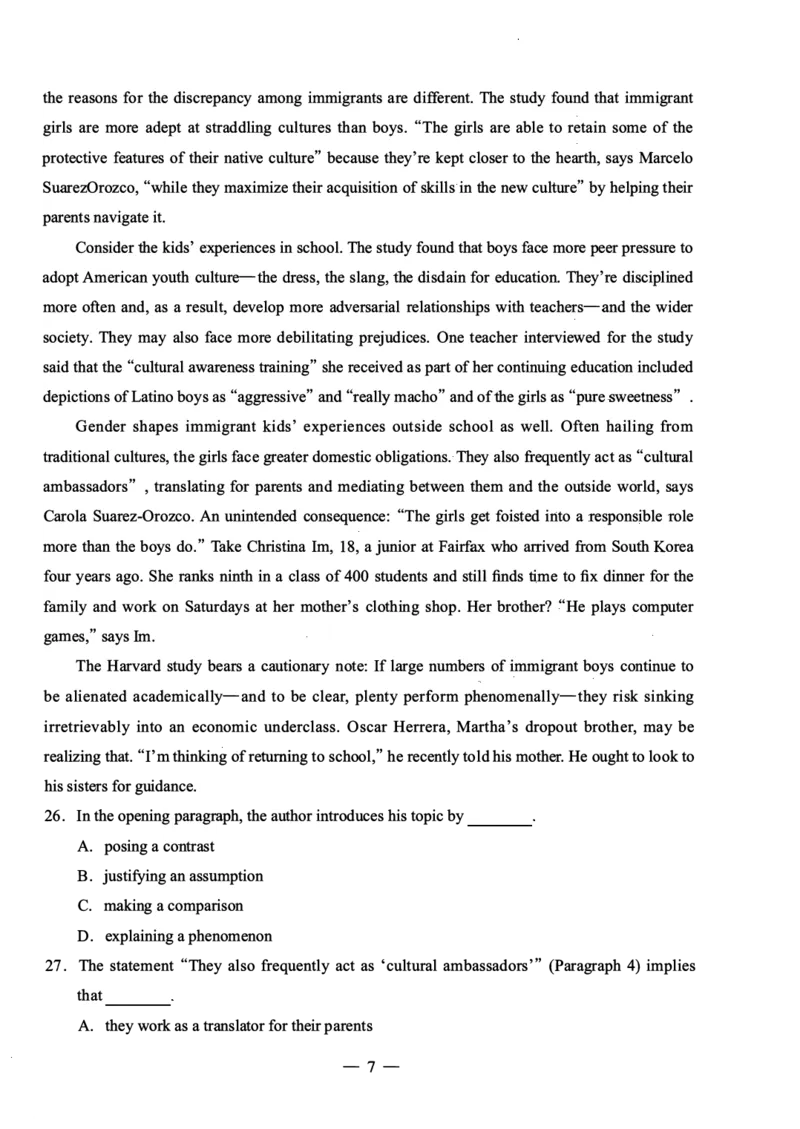
— 6 —the reasons for the discrepancy among immigrants are different. The study found that immigrant
girls are more adept at straddling cultures than boys. "The girls are able to retain some of the
protective features of their native culture" because they're kept closer to the hearth, says Marcelo
SuarezOrozco, "while they maximize their acquisition of skills in the new culture" by helping their
parents navigate it.
Consider the kids' experiences in school. The study found that boys face more peer pressure to
—
adopt American youth culture the dress, the slang, the disdain for education. They're disciplined
—
more often and, as a result, develop more adversarial relationships with teachers and the wider
society. They may also face more debilitating prejudices. One teacher interviewed for the study
said that the "cultural awareness training" she received as part of her continuing education included
depictions of Latino boys as "aggressive" and "really macho" and of the girls as "pure sweetness" .
Gender shapes immigrant kids' experiences outside school as well. Often hailing from
traditional cultures, the girls face greater domestic obligations. They also frequently act as "cultural
ambassadors" , translating for parents and mediating between them and the outside world, says
Carola Suarez-Orozco. An unintended consequence: "The girls get foisted into a responsible role
more than the boys do." Take Christina Im, 18, a junior at Fairfax who arrived from South Korea
four years ago. She ranks ninth in a class of 400 students and still finds time to fix dinner for the
family and work on Saturdays at her mother's clothing shop. Her brother? "He plays computer
games," says Im.
The Harvard study bears a cautionary note: If large numbers of immigrant boys continue to
— —
be alienated academically and to be clear, plenty perform phenomenally they risk sinking
irretrievably into an economic underclass. Oscar Herrera, Martha's dropout brother, may be
realizing that. "I'm thinking ofreturning to school," he recently told his mother. He ought to look to
his sisters for guidance.
26. In the opening paragraph, the author introduces his topic by
A. posing a contrast
B. justifying an assumption
C. making a comparison
D. explaining a phenomenon
27. The statement "They also frequently act as'cultural ambassadors'" (Paragraph 4) implies
that
A. they work as a translator for their parents
— 7 —三、教学情境分析题(本大题1小题, 30分)
根据题目要求完成下列任务, 用国家通用语言文字作答。
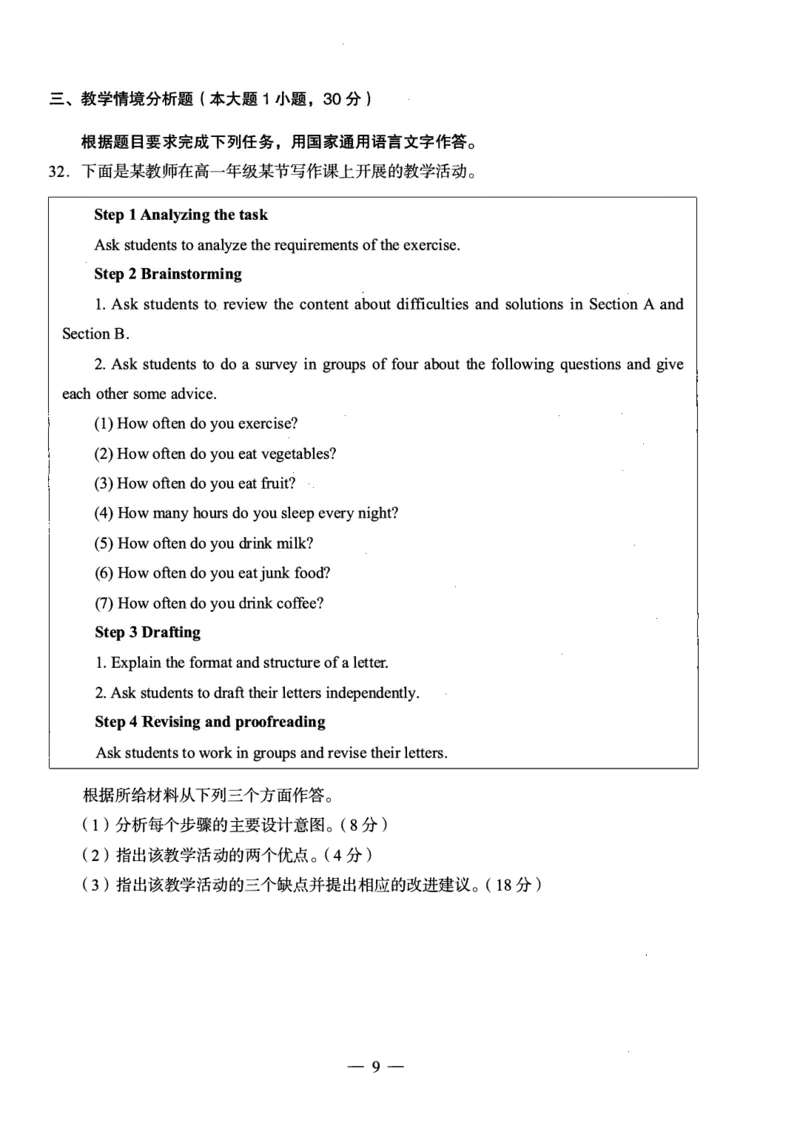
下面是某教师在高一年级某节写作课上开展的教学活动。
32.
Step 1 Analyzing the task
Ask students to analyze the requirements of the exercise.
Step 2 Brainstorming
1. Ask students to review the content about difficulties and solutions in Section A and
Section B.
2. Ask students to do a survey in groups of four about the following questions and give
each other some advice.
(1)How often do you exercise?
(2)How often do you eat vegetables?
(3)How often do you eat fruit?
(4)How many hours do you sleep every night?
(5)How often do you drink milk?
(6)How often do you eat junk food?
(7)How often do you drink coffee?
Step 3 Drafting
1. Explain the format and structure of a letter.
2.Ask students to draft their letters independently.
Step 4 Revising and proofreading
Ask students to work in groups and revise their letters.
根据所给材料从下列三个方面作答。
(1) 分析每个步骤的主要设计意图。 (8 分)
(2) 指出该教学活动的两个优点。 (4 分)
(3) 指出该教学活动的三个缺点并提出相应的改进建议。 (18 分)
-9-教师资格考试(高中)英语学科知识与教学能力
卷(二)
(考试时间: 120分钟 满分: 150分)
一、 单项选择题(本大题共30小题, 每小题2分 , 共60分)
1. /ml, In/ are
A. fricatives B. dentals
C. laterals D. nasals
2. The correct pronunciation of the underlined letters in the word "p呾icular" is
A. IA/ B. /n/
C. 厄/ D. la:/
3. My mother was against my idea while my father was it.
A. inneedof B. in favor of
C. in front of D. in search of
4. Jim is so that he won't buy his wife a birthday present. He only cares how much
money 1s saved.
A. calm B. stubborn
C. reliable D. mean
5. David is honest. So he doesn't know how to others.
A. turn up B. turn 1ll
C. turn down D. turn around
6. Once he is employed, Tom to China to do market research.
A. is sent B. will send
C. will be sent D. had been sent
7. I will make friends with shares both my joys and sorrows.
A. whoever B. whose
C. that D. whatever
— 12 —教师资格考试(高中)英语学科知识与教学能力
卷(三)
(考试时间: 120分钟 满分: 150分)
一、 单项选择题(本大题共30小题, 每小题2分, 共60分)
1. What's the proper pronunciation of the segment "meet you" in connected speech?
A. /mi:tju/ B. /mi:d3u/
C. /mi:tJu/ D. /mi:3u/
2. He has attended the Olympics Games three times, so he has the of rich experience.
A. advantage B. use
C. benefit D. interest
3 . If the chance would , I'd love to go abroad.
A. rise B. raise
C. arise D. happen
4. To be great, you must be smart, confident, and, , honest.
A. therefore B. after all
C. in all D. above all
5. It was when I went there I began to make more friends.
A. who B. where
C. which D. that
6. -Howlong at this job?
—
Since 1990.
A. had you been employed B. have you been employed
C. were you employed D. will you be employed
7. The professor could hardly find enough grounds his arguments in favour of the new
theory.
A. to be based on B. to base on
C. which to base on D. on which to base
-21-