1
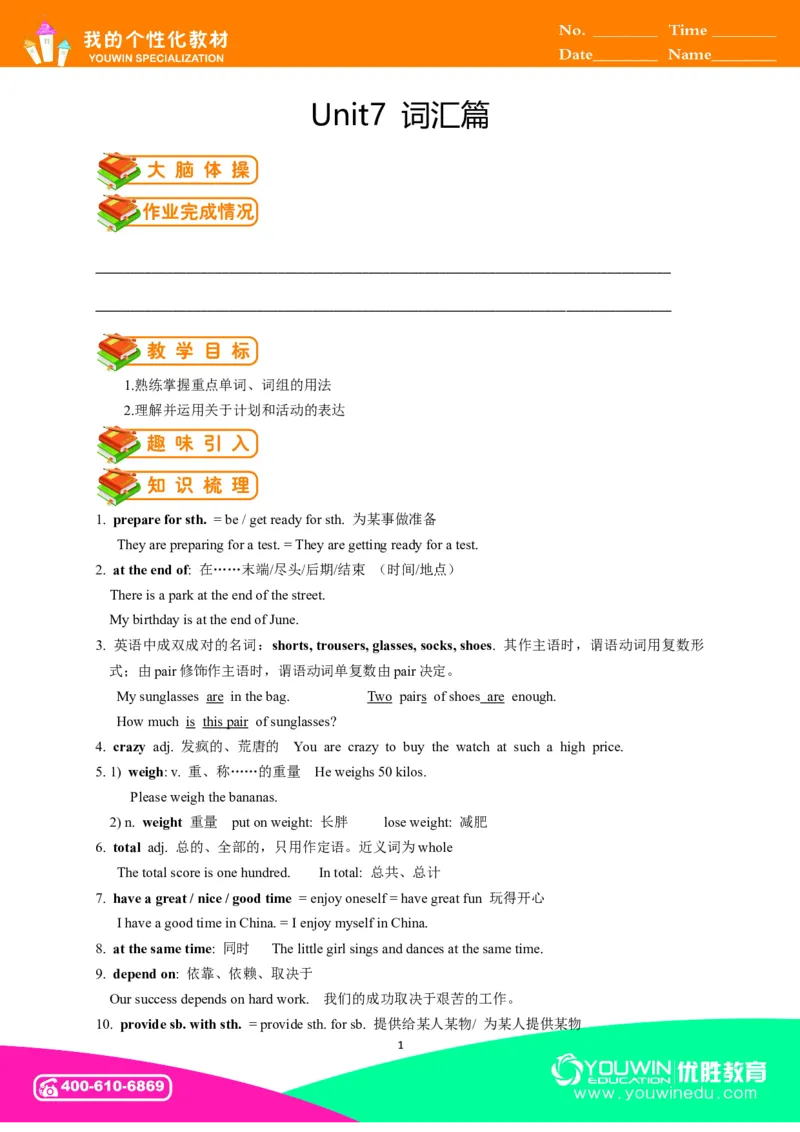
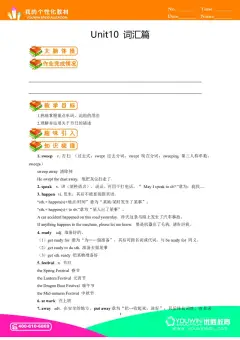
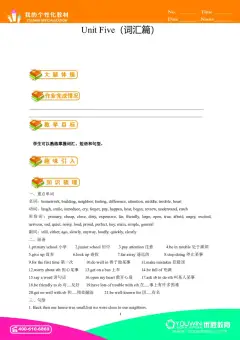
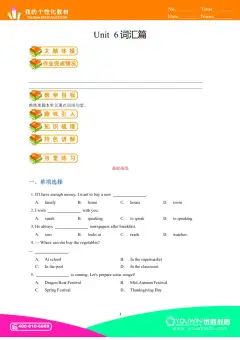
Unit7 词汇篇

__________________________________________________________________________________
__________________________________________________________________________________
1.熟练掌握重点单词、词组的用法
2.理解并运用关于计划和活动的表达
1. prepare for sth. = be / get ready for sth. 为某事做准备
   They are preparing for a test. = They are getting ready for a test.
2. at the end of: 在……末端/尽头/后期/结束 (时间/地点)
  There is a park at the end of the street.
  My birthday is at the end of June.
3. 英语中成双成对的名词:shorts, trousers, glasses, socks, shoes. 其作主语时,谓语动词用复数形
式;由pair 修饰作主语时,谓语动词单复数由pair 决定。
   My sunglasses are in the bag.           Two pairs of shoes are enough.
   How much is this pair of sunglasses?
4. crazy adj. 发疯的、荒唐的  You are crazy to buy the watch at such a high price.
5. 1) weigh: v. 重、称……的重量  He weighs 50 kilos.
     Please weigh the bananas.
  2) n. weight 重量  put on weight: 长胖     lose weight: 减肥
6. total adj. 总的、全部的,只用作定语。近义词为whole
   The total score is one hundred.    In total: 总共、总计
7. have a great / nice / good time = enjoy oneself = have great fun 玩得开心
   I have a good time in China. = I enjoy myself in China.
8. at the same time: 同时   The little girl sings and dances at the same time.
9. depend on: 依靠、依赖、取决于
  Our success depends on hard work.  我们的成功取决于艰苦的工作。
10. provide sb. with sth. = provide sth. for sb. 提供给某人某物/ 为某人提供某物
2
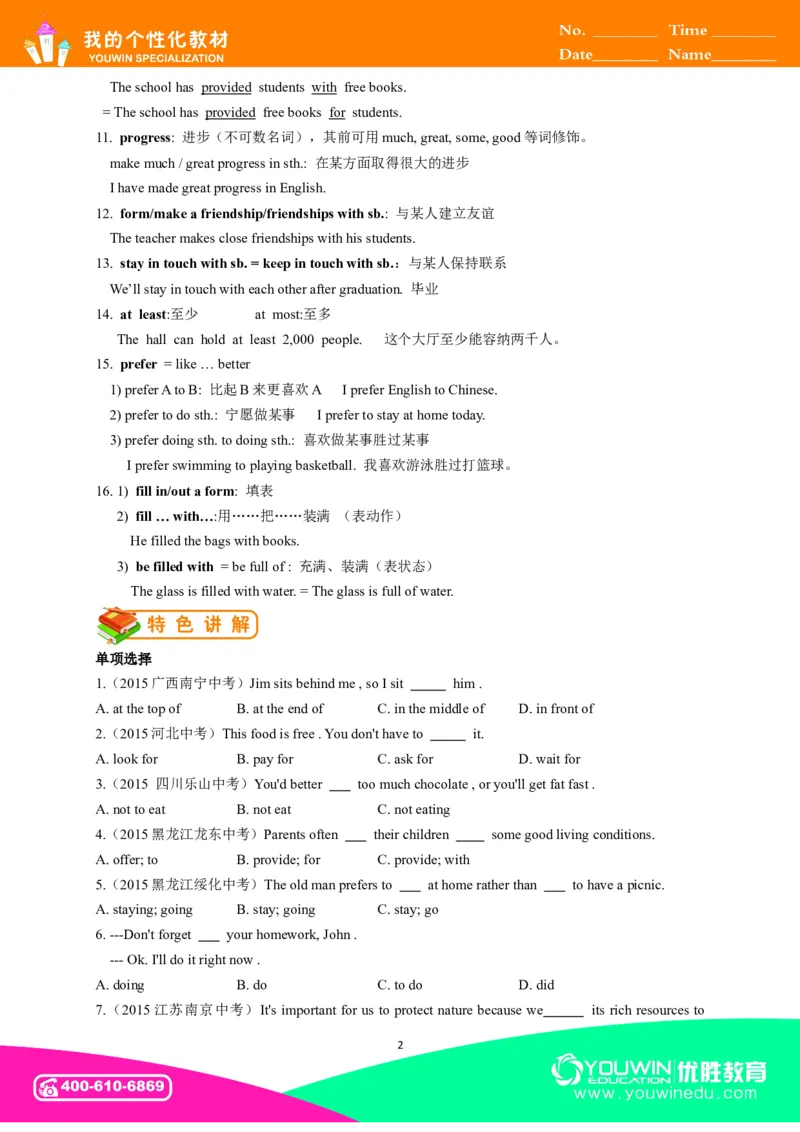
  The school has provided students with free books.
 = The school has provided free books for students.
11. progress: 进步(不可数名词),其前可用much, great, some, good 等词修饰。
  make much / great progress in sth.: 在某方面取得很大的进步
  I have made great progress in English.
12. form/make a friendship/friendships with sb.: 与某人建立友谊
  The teacher makes close friendships with his students.
13. stay in touch with sb. = keep in touch with sb.:与某人保持联系
  We’ll stay in touch with each other after graduation. 毕业
14. at least:至少        at most:至多
   The hall can hold at least 2,000 people.   这个大厅至少能容纳两千人。
15. prefer = like … better
  1) prefer A to B: 比起B 来更喜欢A   I prefer English to Chinese.
  2) prefer to do sth.: 宁愿做某事   I prefer to stay at home today.
  3) prefer doing sth. to doing sth.: 喜欢做某事胜过某事
I prefer swimming to playing basketball. 我喜欢游泳胜过打篮球。
16. 1) fill in/out a form: 填表
   2) fill … with…:用……把……装满 (表动作)
     He filled the bags with books.
   3) be filled with = be full of : 充满、装满(表状态)
     The glass is filled with water. = The glass is full of water.
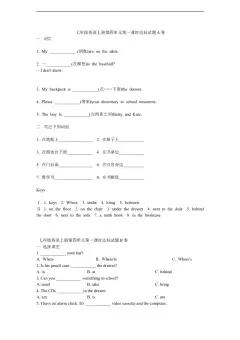
单项选择
1.(2015 广西南宁中考)Jim sits behind me , so I sit       him .
A. at the top of
B. at the end of
C. in the middle of
D. in front of
2.(2015 河北中考)This food is free . You don't have to       it.
A. look for
B. pay for

C. ask for
D. wait for
3.(2015 四川乐山中考)You'd better     too much chocolate , or you'll get fat fast .
A. not to eat
B. not eat
C. not eating
4.(2015 黑龙江龙东中考)Parents often     their children      some good living conditions.
A. offer; to
B. provide; for
C. provide; with
5.(2015 黑龙江绥化中考)The old man prefers to     at home rather than     to have a picnic.
A. staying; going
B. stay; going
C. stay; go
6. ---Don't forget     your homework, John .
  --- Ok. I'll do it right now .
A. doing
B. do

C. to do
D. did
7.(2015 江苏南京中考)It's important for us to protect nature because we      its rich resources to
3
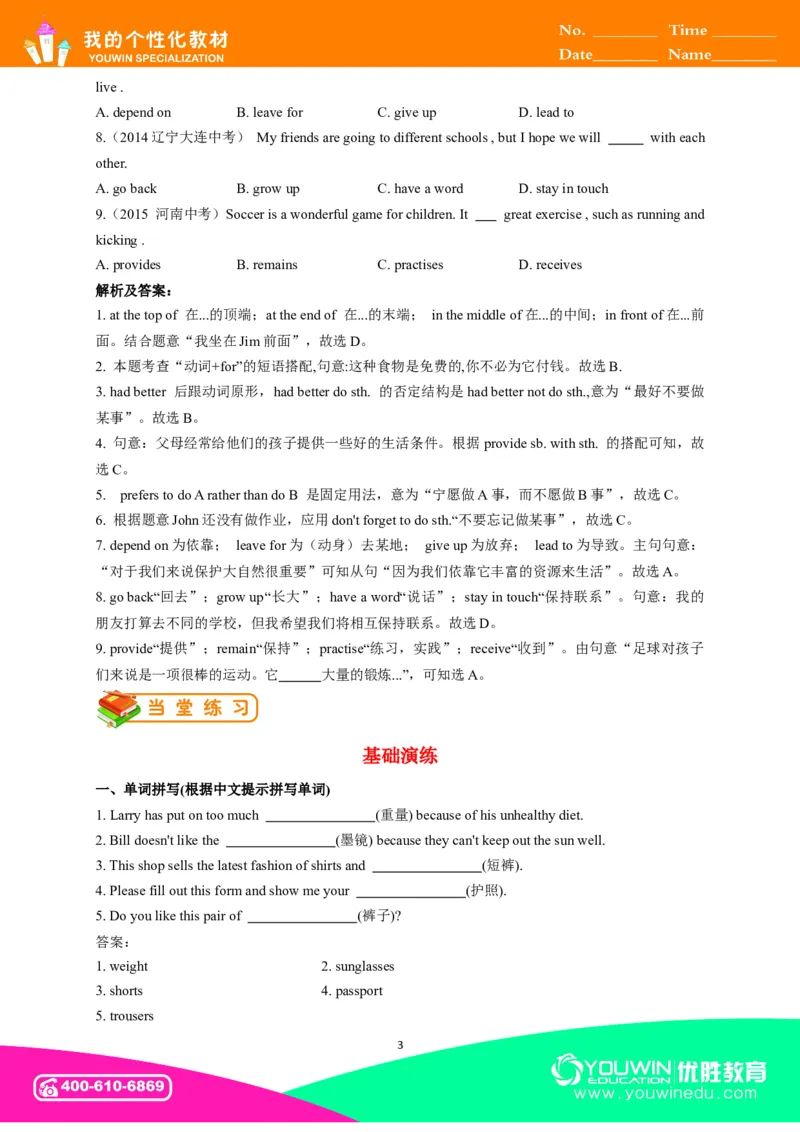
live .
A. depend on
B. leave for
C. give up
D. lead to
8.(2014 辽宁大连中考) My friends are going to different schools , but I hope we will       with each
other.
A. go back
B. grow up

C. have a word
D. stay in touch
9.(2015 河南中考)Soccer is a wonderful game for children. It     great exercise , such as running and
kicking .
A. provides
B. remains

C. practises
D. receives
解析及答案:
1. at the top of 在...的顶端;at the end of 在...的末端; in the middle of 在...的中间;in front of 在...前
面。结合题意“我坐在Jim 前面”,故选D。
2. 本题考查“动词+for”的短语搭配,句意:这种食物是免费的,你不必为它付钱。故选B.
3. had better 后跟动词原形,had better do sth. 的否定结构是had better not do sth.,意为“最好不要做
某事”。故选B。
4. 句意:父母经常给他们的孩子提供一些好的生活条件。根据provide sb. with sth. 的搭配可知,故
选C。
5.  prefers to do A rather than do B 是固定用法,意为“宁愿做A 事,而不愿做B 事”,故选C。
6. 根据题意John 还没有做作业,应用don't forget to do sth.“不要忘记做某事”,故选C。
7. depend on 为依靠; leave for 为(动身)去某地; give up 为放弃; lead to 为导致。主句句意:
“对于我们来说保护大自然很重要”可知从句“因为我们依靠它丰富的资源来生活”。故选A。
8. go back“回去”;grow up“长大”;have a word“说话”;stay in touch“保持联系”。句意:我的
朋友打算去不同的学校,但我希望我们将相互保持联系。故选D。
9. provide“提供”;remain“保持”;practise“练习,实践”;receive“收到”。由句意“足球对孩子
们来说是一项很棒的运动。它


 大量的锻炼...”,可知选A。
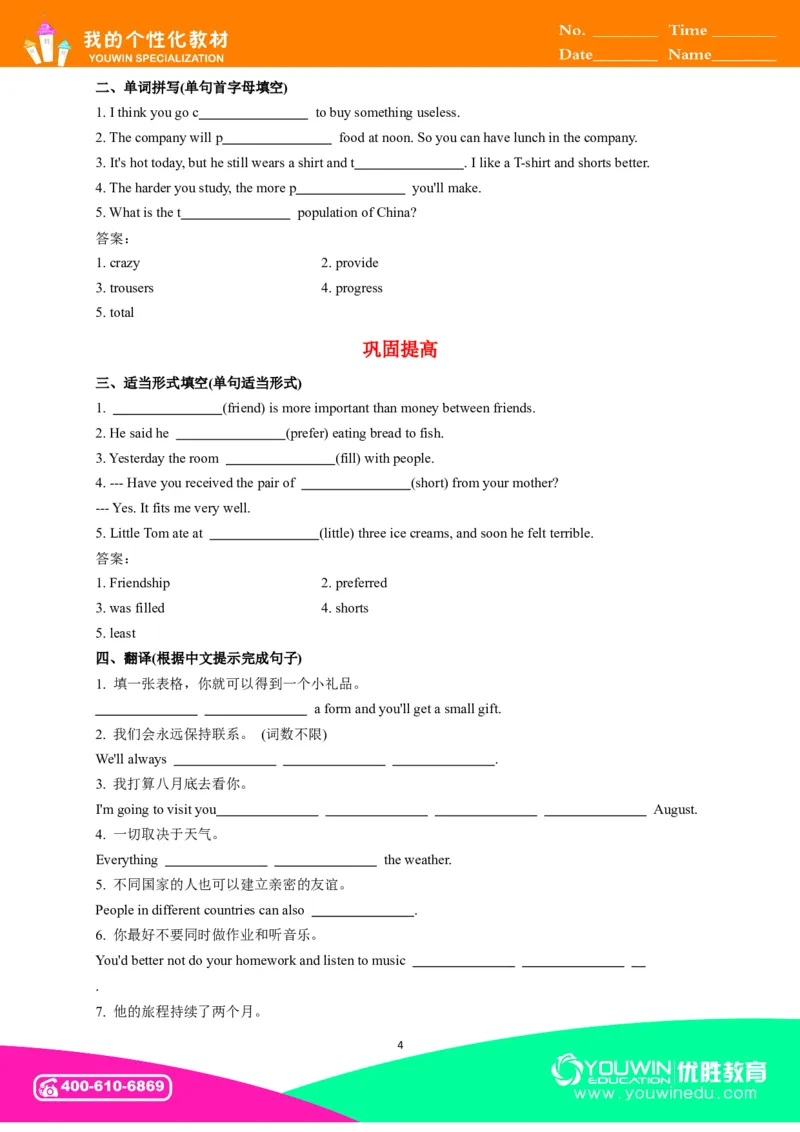
基础演练
一、单词拼写(根据中文提示拼写单词)
1. Larry has put on too much

   (重量) because of his unhealthy diet.
2. Bill doesn't like the

   (墨镜) because they can't keep out the sun well.
3. This shop sells the latest fashion of shirts and

   (短裤).
4. Please fill out this form and show me your

   (护照).
5. Do you like this pair of

   (裤子)?
答案:
1. weight
2. sunglasses
3. shorts
4. passport
5. trousers
4
二、单词拼写(单句首字母填空)
1. I think you go c

    to buy something useless.
2. The company will p

    food at noon. So you can have lunch in the company.
3. It's hot today, but he still wears a shirt and t

   . I like a T-shirt and shorts better.
4. The harder you study, the more p

    you'll make.
5. What is the t

    population of China?
答案:
1. crazy
2. provide
3. trousers
4. progress
5. total
巩固提高
三、适当形式填空(单句适当形式)
1.

   (friend) is more important than money between friends.
2. He said he

   (prefer) eating bread to fish.
3. Yesterday the room

   (fill) with people.
4. --- Have you received the pair of

   (short) from your mother?
--- Yes. It fits me very well.
5. Little Tom ate at

   (little) three ice creams, and soon he felt terrible.
答案:
1. Friendship
2. preferred
3. was filled
4. shorts
5. least
四、翻译(根据中文提示完成句子)
1. 填一张表格,你就可以得到一个小礼品。


    a form and you'll get a small gift.
2. 我们会永远保持联系。 (词数不限)
We'll always


   .
3. 我打算八月底去看你。
I'm going to visit you


    August.
4. 一切取决于天气。
Everything


    the weather.
5. 不同国家的人也可以建立亲密的友谊。
People in different countries can also

   .
6. 你最好不要同时做作业和听音乐。
You'd better not do your homework and listen to music


.
7. 他的旅程持续了两个月。
5
His


    two months.
8. 一只大熊猫重达120 千克,60 厘米高。
A giant panda

   120 kilos, 60 centimeters

   .
9. 明天是端午节。我的妈妈和奶奶现在正在为家人准备丰盛的餐饭。
Tomorrow is Dragon Boat Day. My mother and my grandma are

    a big meal

our family now.
答案:
1. Fill out/in
2. stay/keep in touch
3. at the end of
4. depends on
5. form close friendships
6. at the same time
7. journey/travel lasted
8. weighs, tall
9. preparing, for
一、单项选择
1. Lily has made

    great progress in English.
A.
 a
B.
 an
C.
 the
D.
 /
2. --- Can you

    us with another bigger room?
--- Yes.
A.
 give
B.
 offer
C.
 provide
D.
 find
3. --- May I use your pen? I need to

    the application(申请) form.
--- Here you are.
A.
 take off
B.
 pick up
C.
 fill out
D.
 depend on
4. --- What do you like doing

    reading?
--- I also like playing football and dancing.
A.
 except
B.
 as well as
C.
 without
D.
 or
5. You can

    the course online.
A.
 pay for
B.
 cost
C.
 spend
D.
 take
6. Jane preferred

    TV at home to

    to the concert.
A.
 to watch; go
B.
 watching; going
C.
 watching; go
D.
 to watch; going
7. Is there

    in today's newspaper?
A.
 special something
B.
 special anything
C.
 something special
D.
 anything special
8. --- How much

    your sunglasses, Tony?
--- $10.
A.
 is
B.
 am
C.
 are
D.
 be
9. --- I'll go to Japan for a trip next month.
--- Great!
A.
 Good luck!
B.
 Have a good time!
6
C.
 Best wishes!
D.
 Glad to see you again!
10.

    September, we met our teachers again. New term began.
A.
 In the end
B.
 By the end of
C.
 At the end of
D.
 At the beginning of
答案:1-5 DCCBA
6-10 BDCBD
二、完形填空
   My host father woke me up at about six this morning. I then      1

    my school uniforms. After
eating a Chinese pastry, I      2

    a bike to school. The bicycle is the most common traffic tool in
this city. You could see people riding bicycles      3

   .
    In just five minutes I arrived at the school gate. After locking my bike, I joined my      4

    to
do morning exercises. At 8 a.m., our class started for math. It is my favourite      5

   . For lunch I had
a delicious egg and tomato dish with rice at the school      6

   . In the afternoon, I had Chinese
history. Advanced Spoken Chinese is my last      7

    of the day. Today I learned ten Chinese words.
Our teacher walked around the classroom to check our      8

    correctly. I tried almost ten more
times to practice it. It is quite      9

    to learn Chinese, but I will try my best to work at it. After
school, I went back to my host family to      10

    the rest of the day with them. It's a fun and
exciting day.
1.
A.
 took off
B.
 put on
C.
 lay down
D.
 put up
2.
A.
 sent
B.
 gave
C.
 passed
D.
 rode
3.
A.
 everywhere
B.
 somewhere
C.
 wherever
D.
 nowhere
4.
A.
 neighbours
B.
 teachers
C.
 classmates
D.
 family
5.
A.
 food
B.
 colour
C.
 sport
D.
 subject
6.
A.
 dining hall
B.
 library
C.
 gate
D.
 lab
7.
A.
 thing
B.
 song
C.
 class
D.
 group
8.
A.
 grammar
B.
 pronunciation
C.
 spelling
D.
 writing
9.
A.
 comfortable
B.
 interesting
C.
 difficult
D.
 relaxing
10.
A.
 read
B.
 learn
C.
 draw
D.
 spend
答案:1-5 BDACD
6-10 ACBCD
 _________________________________________________________________________________
 _________________________________________________________________________________
一、单项选择
1. Good health

    good food, exercise and enough sleep.
A.
 depends on
B.
 turns on
C.
 decides on
D.
 works on
2. --- What do you think of his idea?
7
--- It sounds

    but it just might work.
A.
 nice
B.
 healthy
C.
 crazy
D.
 successful
3. --- Could you please

    some information for us about the students' health?
--- Of course, it's my pleasure.
A.
 show
B.
 give
C.
 pass
D.
 provide
4. --- Goodbye, everyone.

   .
--- Bye, Sally! Don't forget to write.
A.
 Stay in touch
B.
 Just wait and see
C.
 Sounds great
D.
 Come this way
5. It's

    that Jet will pass the exam. He works hard every day.
A.
 certain
B.
 common
C.
 strange
D.
 necessary
6. She

    in study because of her hard work.
A.
 made a progress
B.
 makes progresses
C.
 has made a progress
D.
 has made progress
7.

    each blank with the correct word given.
A.
 Fill
B.
 Fill out
C.
 Full
D.
 Fill with
8. You must

    the English course one month before it begins.
A.
 pay
B.
 pay for
C.
 spend
D.
 take
9. --- What a heavy rain!
--- So it is. I prefer

    rather than

    on such a rainy day.
A.
 to go out; stay at home
B.
 to stay at home; go out
C.
 going out; stay at home
D.
 staying at home; go out
10. If you read a lot, you life will be full

    pleasure.
A.
 by
B.
 of
C.
 for
D.
 with
二、完形填空
    Xiao Qiang, a 12-year-old Chinese boy, has too many activities. His father      1

    him away
from school four afternoons a week and drives him across town to practice. “I do most of my      2
in the car when we are     3

    to practice, and I have to do the rest when I get home. I am too tired, I
just want to sleep.” He said.
    “More and more kids become unhappy      4

    they have too many activities to do.” said Mr.
Wang, an expert(专家) of child development. “41% of me children aged 9-13 said they felt      5
most of the time, and more than 75% of them said that wished they had more       6

    to play.
    “Over-scheduling(过量的课时安排) is a growing problem for Chinese families.” said Mr. Wang. It is
not good for both kid and their parents. More families eat dinner      7

    or often eat fast food

8

    their way to football practice or music lessons. We all know it is important for kids to learn how
to relax. If they don't learn that now, it will be more difficult to learn when they get      9

    kids
need time to relax. Parents should

 1  0

    about what is right for kids.
1.
A.
 take
B.
 takes
C.
 took
D.
 has taken
2.
A.
 sports
B.
 business
C.
 homework
D.
 housework
3.
A.
 riding
B.
 flying
C.
 walking
D.
 driving
4.
A.
 but
B.
 or
C.
 because
D.
 so
8
5.
A.
 excited
B.
 interested
C.
 worried
D.
 dangerous
6.
A.
 great time
B.
 full time
C.
 right time
D.
 free time
7.
A.
 slowly
B.
 quickly
C.
 quietly
D.
 happily
8.
A.
 on
B.
 by
C.
 in
D.
 across
9.
A.
 taller
B.
 stronger
C.
 older
D.
 better
10.
A.
 hear
B.
 think
C.
 look
D.
 tell
三、补全对话(选择)
Jim: I'd like to take a summer course this year. 1.
Tina: 2.

   . Every two weeks, starting from the beginning of June until the end of September.
Jim: 3.
Tina: No, you have to pay for your flights separately. 4.

    we can make all the
arrangement(安排) for you.
Jim: Thanks! What about accommodation(住处)?
Tina: 5.

    if you wish. It's a really good way to improve your English, too.
A.
 You can stay with a British family.
B.
 And does the price include flights?
C.
 But if you fill in this form here,
D.
 Of course.
E.
 Can you tell me when they take place?
四、阅读理解
A
    Living in a foreign culture can be exciting, but it can also be confusing(令人迷惑的). A group of
Americans who taught English in other countries recently discussed their experiences. They decided that
miscommunications were always possible, even over something as simple as "yes" and "no".
    On her first day in Micronesia, an island in the Pacific, Lisa thought people weren't paying any
attention to her. The day was hot. She went into a store and asked, "Do you have cold drinks?" The woman
there didn't say anything. Lisa repeated the question. Still the Woman said nothing. She later learned that
the woman had answered her: She had raised her eyebrows(眉毛), which in Micronesia means "yes".
    Jan remembered an experience she had in Bulgaria, a country in Europe. She went to a restaurant that
was known for its cabbage. She asked the waiter, "Do you have cabbage today?" He nodded his head. Jan
waited, but the cabbage never came. In that country, a nod means no.
    Tom had a similar problem when he arrived in India. After explaining something in class, he asked his
students if they understood. They answered with many different nods and shakes of the head. He thought
some people had not understood, so he explained again. When he asked again, they did the same thing—he
soon found out that his students did understand. In India, people nod and shake their heads in different
ways depending on where they come from. You have to know where a person is from to understand
whether they mean "yes" or "no".
1. These Americans teaching English in other countries found that they

   .
A.
 should go abroad for vacations
B.
 needed to learn foreign languages
9
C.
 should often discuss their experiences
D.
 had problems with communications
2. People in Micronesia show "yes" by

   .
A.
 nodding heads
B.
 raising eyebrows
C.
 shaking heads
D.
 saying "no"
3. Tom misunderstood his class at first because

   .
A.
 he did not know much about Indian culture
B.
 he didn't explain everything clearly enough
C.
 some students didn't understand his questions
D.
 he didn't know where the students came from
4. Which of the following is TRUE according to (根据) this passage?
A.
 In Bulgaria, nodding heads means no.
B.
 Jan taught English on a Pacific island.
C.
 Lisa was trying to buy some cabbage.
D.
 In India, only shaking heads means "YES".
5. The passage is mainly about

   .
A.
 body language in foreign restaurants
B.
 class discussion in Indian schools
C.
 miscommunication in different cultures
D.
 English teaching in other countries
B(江苏灌云县陡沟中学2015 年6 月月考)
    Here are some good table rules about eating Western food.
    As soon as you sit down, you should sit up straight, keep your elbows (肘) off the table. Open your
napkin (餐巾) and place it on your lap (大腿). The napkin stays on your lap (except for use) until the end
of the meal. If you need to leave the table for a moment, you may leave the napkin on your chair. When the
meal is finished, place your napkin well on the left of your plate.
    Remember the rule: liquids (液体) on the right, solids (固体) on the left. Your water glass is on the
right of the plate and your bread plate is on the left. You should pass the dishes from left to right. Do try a
little of everything on your plate. Bread should be broken off into small pieces and butter is about a small
mouth as you eat it. You may leave some food to one side of your plate if you feel you have had enough.
Don't leave your plate so clean that it looks as if you haven't eaten for days! If others ask you for the salt,
pass it with both hands together. If the soup is hot, don't blow on it; just wait for it to cool off. When a lady
arrives at or leaves the table, it's polite for all gentlemen at the table to stand up.
6. When you eat Western food at the table, you should _______.
    A. put your elbows on the table
B. keep your elbows off the table
    C. keep your elbows straight
D. keep your napkin clean
7. According to (根据)the passage, if a person leaves for a while, he has to _______.
    A. take the napkin with him
B. take the napkin in his hand
    C. put the napkin on his chair
D. put the napkin on the table.
8. When you finish eating a Western meal, you should _______.
    A. put your napkin well on the left of you plate
10
    B. put your napkin well on the right of your plate
    C. place your napkin into the dustbin
    D. take your napkin with you
9. If you pass the dishes, you should _______.【出处:21 教育名师】
    A. pass them from right to left
    B. stand up and pass them to the person next to you
    C. pass liquids first, then the solids
    D. pass them from left to right
10. Which of the following is true according to the passage?
    A. If the soup is hot, you can blow on it.
    B. You should eat all the things up on your plate though(即使)you are full.
    C. When a lady arrives at the table, it's polite to stand up for a gentleman.
    D. It's good to leave your plate so clean.
五、阅读与表达(填空式)
Dear mum,
    I'm having a great time in Hong Kong, although I have to be honest and say that I prefer Shanghai.
Still, it's a great place to visit and I'm lucky to be here for my sixmonth English course.
    My accommodation is with an English family. They are friendly to me. We are getting on well with
each other. By the way, my host family will take me to the Indian film festival next weekend.
    There are so many things to see and to do here. Every day I have many activities which take place
after class. I can make trips to the beaches, Disneyland and so on. I can also go to various shopping centres,
sports centres, cinemas and concerts.
    There are lots of different kinds of food here. Last night I went for Italian food before the concert. Do
you like it? I don't know what to try next.
    Recently I have made rapid progress in my speaking and listening skills. My host family also teaches
me something about English culture. In general, I'm having a good time, but I miss you very much.
Yours,
Li Feng
Name: Li Feng
Favorite place: 1.
Accommodation: is with an English family
Length of course: 2.
What course: 3.
Activities done: eat Italian food
Activities to do next weekend: 4.
Skills: made progress speaking skill, 5.
答案:
一、单项选择
11
1-5 ACDAA
6-10 DBBBB
二、完形填空
1-5 BCDCC
6-10 DBACB
三、补全对话(选择)
1-5 EDBCA
四、阅读理解
1-5 DBAAC
6-10 BCADC
五、阅读与表达(填空式)
1. Shanghai
2. six months
3. English course
4. Indian film festival
5. listening skill
课程顾问签字:                        教学主管签字: