热点话题01   AI 与教育发展
【话题·导语】
加州大学洛杉矶分校和加州大学圣地亚哥分校的研究人员确定了有希望的干预措施,以解决学术表现
方面的不平等,包括人工智能生成的提示。
【原文·时文阅读】
Study Finds Unique Strategies to Improve Student Performance on Physics Exams
(文章来源:https://today.ucsd.edu/story/study-finds-unique-strategies-to-improve-student-
performance-on-physics-exams)
A team of researchers from the University of California Los Angeles and the University of California San
Diego have discovered positive uses for AI and extra credit assignments to help improve student performance in
introductory(开端的) physics courses, including reducing the impacts of inequities, as featured in the June 12,
2025 issue of the Physical Review Physics Education Research Journal.
This study is one of the first to explore the impact on exam performance of offering large language model
(LLM)-based AI-generated hints during homework assignments for an undergraduate physics course.
The study also addressed inequities in student access to foundational mathematics, such as trigonometry(三
角学) and calculus(微积分). Black, Hispanic/Latine, Native American students, and students from low-
income backgrounds are less likely to have had the opportunity to take advanced math courses in high school,
putting them at a disadvantage for successful academic performance in college physics.
To mitigate(vt.使缓和,使减轻) these disparities, the researchers implemented a two-pronged(双管齐
下的) intervention:
1. Incentivized(鼓励) Supplemental Math Assignments: Extra credit was scaled to provide greater value
to students with lower exam scores, encouraging participation and reinforcing foundational skills.
2.AI-Generated Learning Support Tools: Optional hints embedded within physics homework assignments
offered personalized assistance, reducing barriers to help-seeking and promoting independent learning.
读时文精读
Both interventions(干预) were grounded in the situated expectancy-value theory of achievement
motivation: a theory that hypothesizes that students are more likely to engage in tasks they expect to succeed in and
perceive as valuable.
Most of the students explored the AI-generated hints feature. When available, 88% of the students used AI-
generated hints on at least one homework question (among the problems that were found to match the exam
questions), and 57% of the students used AI-generated hints on at least five questions. On average, students used
AI-generated hints on at least 20% of the questions.
The study’s findings indicate that these interventions are associated with increased exam scores and reduced
disparities in completion rates of supplemental math assignments. Notably, the scaled extra credit system was
particularly effective for students who might benefit most from additional support.
Yifan Lu, the first author and a doctoral student in the Department of Physics and Astronomy at UCLA, said:
 “By implementing scalable(可升级的) and low-cost interventions, we can create more equitable learning
environments. Using AI tools can remove social barriers that prevent students from asking instructors, teaching
assistants, and/or peers for help.”
Elizabeth H. Simmons, study co-author and Executive Vice Chancellor and Distinguished Professor in the
Department of Physics at UC San Diego, added:“Our findings demonstrate that thoughtful integration of
technology and targeted incentives can make a meaningful difference in student academic performance. These
strategies are effective and feasible for widespread adoption in a wide range of undergraduate courses that include
mathematical topics.”Based on the findings of this study, several introductory physics courses taught at UCLA
have already incorporated supplemental math assignments and AI-generated hints, with plans for wider
implementation underway.
“In the next year, we are working with faculty members in the Chemistry and Life Science core departments
who will adapt the supplemental math to their context and implement our approach in their courses,” said K.
Supriya, Associate Director of Assessment at the UCLA Center for Education Innovation and Learning in the
Sciences.
The study’s findings underscore(强调,突出) an effective use of AI in supporting improved learning
outcomes. For future studies, the research team recommended exploring the factors that shape students’ decisions
to use or not use the optional supports offered.
This collaborative effort highlights the commitment of both institutions to advancing effective instructional
practices and finding innovative ways to foster inclusive learning environments across all disciplines, including
STEM.
【原创·阅读理解】
1. What is the purpose of research about AI and extra credit assignments?
A.To help the students to use AI in the classroom.
B. To help the students to earn physics credits .
C. To improve student performance in beginning physics courses.
D. To encourage the students to choose more credit assignments.
2. Which word has the similar meaning with the word“inequities”in paragraph 3?
A. Imbalances.
B. Differences.
C. Difficulties.
D. Efforts.
3. According to K. Supriya, What will they do in the next year?
A. They will explore the factors that shape students’ decisions.
B. They will improve the students’ maths score.
C. They will foster inclusive learning environments.
D. They will implement their approach in the Chemistry and Life Science.
4. What kind of students benefit from the program a lot according to Yifan Lu?
A. Students who want to improve their learning level.
B. Students who have social barrier to ask for help.
C. Students who want to ask peers for help.
D. Students who likes to ask instructors for help.
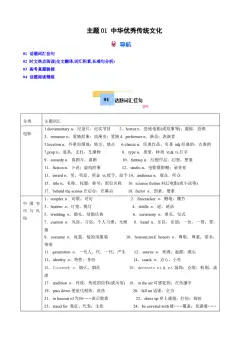
【课标词汇积累】
1.assignment n.作业,任务, 分配
•I stayed up late to finish my science assignment because I procrastinated too much."我熬夜赶科
学作业,因为拖延太久了。
2.feature n.特征, 五官, 特写, 正片,故事片; v.
…
以为特征, 占重要地位
•The talent show will feature a dance performance by the senior class."
(才艺表演将压轴播出毕业班的舞蹈节目。)
3.explore v.
…
在探险, 探讨, 勘探, 摸索
•"I want to explore joining the debate club, but I’m nervous about public speaking."
(我想试试参加辩论社,但对公开演讲有点紧张。)
4.participation n.参加,参与, 分享
•"Active participation in class discussions can boost your final grade."
(课堂积极发言能提高期末成绩。)
5.independent adj.独立的, 公正的
•Seniors can choose an independent study project instead of a regular elective."
(高年级学生可以选独立研究项目代替常规选修课。
6.available adj.可用的,可获得的, 有空的
•There are limited spots available for the school trip to the art museum, so students need to sign up
quickly.(去艺术博物馆的学校旅行名额有限,所以学生们需要尽快报名。)
7.effective adj.有效的, 实际的, 起作用的
•Using flashcards has been an effective way for me to memorize new vocabulary words in English class.
(在英语课上,使用抽认卡对我来说是记忆新单词的一种有效方法。)
8. adapt v.(使)适应/适合, 改编, 改造
•Some students find it difficult to adapt to the new school rules after a major policy change.(在一项重大
政策改变后,一些学生觉得很难适应新的校规。)
9.approach v.

接近,临近n.方法,方式, 途径,道路
•The school is taking a new approach to promoting students' physical fitness by organizing more fun
sports events.(学校正在采取一种新的方式来促进学生的身体健康,即组织更多有趣的体育活动。)
10.optional adj.可选择的,非强制的
•Joining the school choir is optional, but many students choose to do it because they love singing.(参加
学校合唱团是可选的,但很多学生因为喜欢唱歌所以选择参加。)
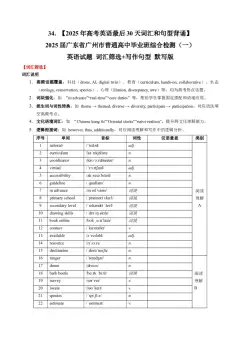
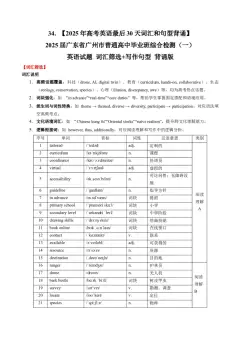
【课标词汇训练】
根据语境,从上面的“课标词汇”中选用合适的单词及其正确形式将句子补充完整。
1.Our English teacher gave us a creative writing            (assign) due next Monday.
2.Her consistent             (participate)in volunteer events earned her a leadership award."
3.The school offers some             (option) courses like photography and calligraphy for students
who want to develop their hobbies.
4.My English teacher has a unique             to teaching grammar, which makes it easier for us to
understand.
5.When starting high school, many students need to             to the faster pace of learning and
more challenging coursework.
6.The teacher's new teaching method has proven to be quite            , as the students' test scores
have improved significantly.
7.The school library has many reference books             for students to borrow when they are
working on their research projects.
8.Our biology class will             different ecosystems by visiting the wetlands next week."
9."Living in a dorm teaches you             (independence)life skills, like laundry and budgeting."
10."Our annual Science Fair will             projects on renewable energy this year."
【参考译文】
加州大学洛杉矶分校与圣地亚哥分校的研究团队在《物理评论·物理教育研究》2025 年6 月12 日刊发
的研究中发现,人工智能与额外学分作业能有效提升基础物理课程的学生成绩,其中特别强调了减少教育
不平等的影响。这项开创性研究首次通过实验验证,在本科物理课程中引入基于大型语言模型(LLM)的
人工智能生成提示对考试成绩的积极影响。研究还聚焦三角函数、微积分等基础数学知识获取不均的问题
——黑人、拉丁裔/拉美裔、原住民学生及低收入家庭子女往往缺乏高中阶段的高等数学课程机会,导致他
们在大学物理学习中处于不利地位。为消除这种差异,研究人员采取双管齐下的干预策略:1.激励性补充
数学作业:通过调整学分奖励机制,为考试成绩较低的学生提供更高价值的激励,既鼓励参与又巩固基础
知识;2.AI 生成学习辅助工具:在物理作业中嵌入个性化提示,降低求助门槛,促进自主学习。这两项干
预措施均基于成就动机的情境期望-价值理论:该理论认为,学生更倾向于参与他们预期能成功完成且认为
有价值的活动。大多数学生都尝试了AI 生成提示功能。在可用时,88%的学生至少在一个作业题目(在与
考试题目匹配的问题中)使用了AI 生成提示,57%的学生至少在五个题目上使用过该功能。平均而言,学
生在至少20%的题目上使用了AI 生成提示。研究结果表明,这些干预措施与考试成绩提升及补充数学作
业完成率差异缩小相关。值得注意的是,可扩展的额外学分制度对最需要额外支持的学生特别有效。第一
作者、加州大学洛杉矶分校物理与天文学系博士生吕一帆表示:“通过实施可扩展且低成本的干预措施,
我们可以创造更公平的学习环境。使用AI 工具可以消除阻碍学生向教师、助教或同学求助的社会障
碍。”伊丽莎白·H.西蒙斯——这项研究的合著者、加州大学圣地亚哥分校物理系执行副校长兼杰出教授
——补充道:“我们的研究结果表明,技术与定向激励措施的科学整合能够显著提升学生学业表现。这些
策略不仅效果显著,还具备广泛适用性,适用于涵盖数学主题的各类本科课程。”基于该研究发现,加州
大学洛杉矶分校已将补充数学作业和AI 生成提示纳入多门基础物理课程,并计划进一步推广实施。“未
来一年,我们将与化学和生命科学核心院系的教师团队合作,共同推进相关工作。”
这项研究的发现凸显了人工智能在提升学习成效方面的有效应用。针对后续研究,研究团队建议深
入探究影响学生选择是否使用可选支持服务的关键因素。这一合作成果彰显了两所院校在推进高效教学实
践、探索创新方式以构建跨学科(包括STEM 领域)包容性学习环境方面的坚定承诺。
Passage1 阅读理解
(2025 届云南省“美美与共”民族中学教研联盟高三下学期模拟联考(三))
Educational optimists predict that AI will soon provide amazing efficiencies and progress in teaching and
learning. But are efficiency and machine logic what our students need most?
It’s certainly true that AI is a wonderful new tool dramatically transforming human life. AI is getting faster
and better at spotting patterns in complicated information. This helps it guess what might happen next-like
predicting what a customer will buy, the next word in a sentence, a sound in spoken language, or many other tasks.
AI can answer specific complex questions or perform complex calculations at a rate impossible for the human mind
to comprehend, let alone compete with. It can also create images and speeches which not only imitate reality but
surpass it to meet programmed standards of excellence.
However, although these may be helpful to adults seeking to improve productivity, it is necessary to follow
G. K. Chesterton’s advice that children should not be controlled by educational projects and ideas without scientific
proof. Allowing students to avoid traditional learning methods with AI will have uncertain and potentially harmful
results. The same could be true of educators’ dependence on AI for student assessment and lesson planning. In
education at least, it is quite possible that AI will work against natural human development and provide not a short
cut to human formation but a short circuit.
Despite AI’s influence, traditional learning and writing assignments are crucial for promoting learning and
cognitive development. Homework, similar to music practice, teaches discipline and skills essential for personal
growth and future success. Deceptive ( 欺骗性的) practices harm genuine learning, spoiling students’
competitiveness in an AI-dominated job market. Reliance on AI-generated content weakens critical thinking and
creativity, damaging students’ intellectual growth. Moreover, it devalues the role of teachers in guiding students’
练好题精练
development. In contrast, real engagement with homework cultivates invaluable human qualities essential in an AI-
driven world, ensuring students’ competitive advantage and overall development.
1.Which advantage of AI is NOT mentioned in paragraph 2?
A.Creating speeches that surpass reality.
B.Solving logic problems faster than humans
C.Predicting customers’ potential purchasesD.Recognizing patterns in complicated data.
2.Why does the author quote G. K. Chesterton’s advice?
A.To prove that traditional learning methods are outdated.
B.To show that AI is not that advanced for modem education.
C.To emphasize that children need strict discipline in learning.
D.To argue against exposing children to immature educational ideas.
3.What is the advantage of traditional learning and writing assignments according to the text?
A.They can be used to assess students’ success.
B.They promote students’ music competitiveness.
C.They can help students avoid deceptive practice.
D.They are crucial for students’ overall development.
4.Where is the passage most likely taken from?
A.A business report.
B.A science fiction novel.
C.An educational journal.
D.A technology magazine.
【长难句分析】
【文章原句】However, although these may be helpful to adults seeking to improve productivity, it is necessary to
follow G. K. Chesterton’s advice that children should not be controlled by educational projects and ideas without
scientific proof.
【句式分析】这是一个主从复合句,由一个主句和一个让步状语从句组成,同时在主句中还包含一个同位
语从句。although these may be helpful to adults seeking to improve productivity 是让步状语从句,that children
should not be controlled by educational projects and ideas without scientific proof 是同位语从句,it 是形式主语,
to follow G. K. Chesterton’s advice 是真正主语。
【翻译】然而,尽管这些方法可能对那些想要提高生产力的成年人有所帮助,但有必要遵循G. K.切斯特
顿的建议:儿童不应该被没有科学证明的教育计划和想法所控制。
【词汇积累】
1.overall development 全面发展  2.students’ competitive advantage 学生的竞争优势  3.optimist n.乐观主义
者4.efficiency n.效率  5.dramatically adv.戏剧地, 显著地  6.improve productivity 提高生产效率
7.potentially adv.潜在地, 可能地 8.cognitive adj.认知的, 认识过程的
Passage 2 阅读理解
Technology makes school more fun
智能化录入、沉浸式教学...... 学校生活大变样
Today, the advancement of technology has taken a front-row seat in the creation of smart campuses. In recent
years, many schools in China have embraced technologies such as AI and big data to make school life simpler and
easier for students and teachers alike.
Using a smart campus system by the Chinese tech company iFlytek, Tianjin Eco-City School Affiliated to
Beijing Normal University has introduced innovative applications to transform the educational experience. In
aerospace classes, students use simulation (模拟) devices and VR glasses for immersive (沉浸式的) learning,
enabling them to find out about rocket launches and a rocket’s internal structure through gamified ( 游戏化的)
learning. Similarly, in swimming classes, “by wearing smart earphones, children can receive real-time instructions
from the coach underwater, ensuring maximum safety,” Li Rui, the school’s vice-principal, told CCTV.
For PE classes, Yuwen School in Wuhu, Anhui, has installed (安装) self-testing kits with AI visual analysis
technology for activities such as long-distance running, standing long jump, sit-ups and skipping rope. Students’
faces are registered in a facial recognition system, allowing them to receive voice reports and instant performance
results after each exercise.
“Before, when I threw the shot put, the teacher had to use a ruler to measure the distance. Now, the results
are generated automatically. You can also see which parts of your exercise require improvements, with the teacher
then helping to guide you to make those improvements,” Wu Shengguo from the school told Dajiang Evening
News.
Globally, schools are adopting smart campus technologies. In Australia, Deakin University’s School of
Medicine offers an AR app called cARdiac ECG, allowing students to see the human heart in 3D.The tool vividly
displays the organ’s various parts and blood flow and helps students learn how to measure its electrical signals.
Besides immersive technologies, universities are also using artificial intelligence to create increasingly
powerful digital assistants. The UK-based Bolton College has launched a chatbot called Ada. Powered by AI, Ada
can tell students information on things such as their attendance records, which courses they’re enrolled in, who
their professors are for the given semester, and when and where their next class is.
Smart campuses can reshape how and what students learn and how they study and interact with an
institution.
More than just ‘smart’ learning
Smart cafeteria
In June, Yingkou No 1 Middle School in Liaoning adopted a smart cafeteria with an “online meal selection
and facial recognition meal pickup” system. To meet the diverse dietary needs of its students, the smart cafeteria
offers a selection of over 400 dishes, providing six to seven options per meal to ensure variety throughout the week.
These options are pre-released on the smart cafeteria online platform for parents and students to choose from, with
the students able to collect their selected meals thanks to the facial recognition system. Through this system, the
school is preinformed of the dishes and quantities needed, greatly reducing kitchen and food waste.
Smart labs
In Shuizhai Middle School in Wuhua, Guangdong, there are 27 science labs for physics, chemistry and
biology. These labs have been equipped with video monitoring and network systems to record high-definition
videos of the entire experiment-conducting process. With the help of smart technology like AI, the labs can
monitor, record, and check how students do in their experiments. This helps teachers know what’s happening in the
experiment room at all times and makes grading easier.
5.How does Tianjin Eco-City School Affiliated to Beijing Normal University incorporate technology into their
aerospace classes?
A.By using smart earphones for immersive learning.
B.By using AI to gather data on students’ interest in aerospace.
C.By using self-testing kits to assess students’ understanding of aerospace.
D.By using VR glasses to learn about simulated rocket launches.
6.What do we know about the technology used in PE classes at Yuwen School?
A.It is convenient and helpful.
B.It is somewhat complicated.
C.It could be further improved.
D.It is cost-effective and efficient.
7.What is the main function of cARdiac ECG used at Deakin University’s School of Medicine?
A.Offering real-time guidance.
B.Providing instant feedback on physical exercises.
C.Displaying 3D images of the human heart for student learning.
D.Tracking students’ attendance records and enrolled courses.
Passage 3  7 选5
(2025 届东北三省精准教学高三下学期三模联考)
How to Use AI Tools to Improve Time Management for Students
Time management is super important for students, but juggling schoolwork, activities, and personal life can
be tough. With so many distractions around, it’s easy to put things off and miss deadlines.

 1

 Here are some
tips on using AI to manage your time better.
Use Smart Scheduling Tools. Pick tools like Calendly or Google Calendar. These can help you organize your
schedule by sharing class times, reserving study periods, and adding breaks between study sessions.

 2

 AI
can even suggest the best time to study based on your own schedule. It can tell you when you’re most productive
and help you plan your study sessions.
Automate Simple Tasks. Let AI handle repetitive tasks like sorting emails or entering data. Apps like Zapier
can link your emails to task lists, keeping everything organized without extra effort, which frees up your mind for
more important things and reduces mental stress.

 3


 4

 Give your to-do list to an AI assistant like ChatGPT to sort out which tasks are most important
and help you avoid feeling overwhelmed. By focusing on what truly matters, you can stay productive and get more
done. AI can also break down big tasks into smaller steps, making them easier to tackle.
Stay Focused with AI. Set timers and reminders to stay on track and avoid distractions. AI can track your
screen time and suggest the best time to take a break.

 5

 This helps you stay focused and recharge without
losing drive.
A.Prioritize Your Tasks.
B.Manage Your Workload.
C.The good news is that AI tools can help.
D.It’s important to stay focused and avoid distractions.
E.By automating these tasks, you can save time and stay focused.
F.This way, you can focus more on studying and less on planning.
G.For instance, it can remind you to do some stretches after a long study session.
Passage 4 完形填空
(2025 届山西省临汾市高三下学期第二次模拟)
A late afternoon in the fall of 1986, I was sitting with the poet James’ Dickey.
I remember that particular meeting because of one

 1

  word. In a poem that was otherwise

 2

 ,
a single adjective was clearly wrong. We batted

 3

  back and forth, but in vain. Hours later, the suitable word
came to me. I was

 4

  about that word and opened the phone book to

 5

  Mr. Dickey’s-number. When
he

 6

 , I said, “The word is ‘pale’.” He entirely agreed. For an instant, the world made a kind of

 7

  it
hadn’t made before.
I had not thought about that phone call, much less that poem, in many years, but I’ve begun to think about it
often. A flurry of “AI assistants” has suddenly

 8

  my inboxes and Word do cuments and texts. Everything I
type now is

 9

  with hovering (悬浮的) robots suggesting

 10


  robot words.
The writing teachers I know

 11


  to persuade their students not to use these tools. They are
everywhere,

 12


  to brush them away. But letting a robot structure your essay, or

 13


  your style
by removing novel elements, is dangerous. We know who we are by

 14


  the right words to tell others, and
ourselves, how we

 15


  the world. The world which no one else sees in exactly that way.
1.A.ill-chosen
B.misplaced
C.well-matched
D.misleading
2.A.translated
B.finished
C.transformed
D.described
3.A.techniques
B.concepts
C.alternatives
D.topics
4.A.doubtful
B.excited
C.curious
D.confused
5.A.list out
B.write down
C.sort out
D.look up
6.A.answered
B.confirmed
C.hesitated
D.waited
7.A.effort
B.trouble
C.attempt
D.sense
8.A.neglected
B.emptied
C.dominated
D.copied
9.A.thick
B.content
C.decorated
D.consistent
10.A.vivid
B.complex
C.unwelcome
D.informal
11.A.demand
B.struggle
C.seem
D.volunteer
12.A.impolite
B.inconvenient
C.improper
D.impossible
13.A.sharpen
B.flatten
C.improve
D.keep
14.A.marking
B.memorizing
C.finding
D.spelling
15.A.change
B.shape
C.redefine
D.perceive
Passage 4 语法填空
(2025 届湖北省华中师范大学第一附属中学高考学科核心素养卷)
阅读下面短文,在空白处填入1 个适当的单词或括号内单词的正确形式。
Psychologist Zong Min, while pursuing her PhD at Beijing Normal University, led a three-year program to
help students who didn’t want to go to school, an issue increasingly troubling parents. The phenomenon

 1
(intensify) during the pandemic due to online learning, and Zong realized the situation was worse than initially
2

  (estimate).
Referencing a survey conducted in Guangzhou, she noted that 24.6% of junior high school students and
37.6% of senior high school students exhibited

 3

  (refuse) to attend school. One

 4

  (memory) case
involved a 13-year-old boy who excelled

 5

  (academic) in primary school but began avoiding classes in
junior high.
Drawing on research and personal experience, Zong developed the idea of a program called Xin Niu Dai to
bridge schools, parents, and students, assist them to collectively find solutions to alleviate academic pressure,

 6
help children regain their passion for life. Pointing to the rise in reluctance to go to school, Zong emphasized that
the underlying

 7

  (cause) have grown more complex today, and parents must face the reality

 8

  not
wanting to go to school is a global challenge,

 9

  hospitals increasingly establishing specialized clinics for
those exhibiting this behavior.
Zong envisions her program

 10


  (consist) of three sections: helping students discover their resilience,
inspiring teachers to recognize a student’s potential rather than criticizing them, and empowering parents to better
protect their child’s mental health. Plans include educational leaflets and an AI app for emotional support.