ARTICLE · 1361471
【优质课13】人教版高中英语(2019版)必修第三册Unit 1 Festivals and celebrations单元整体教学设计
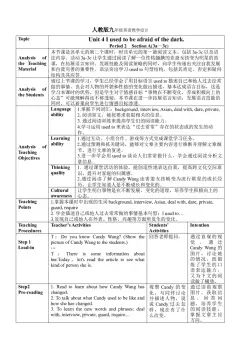
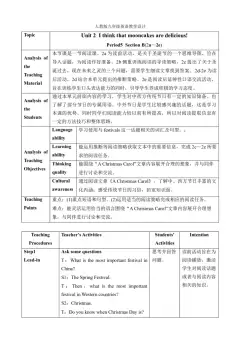
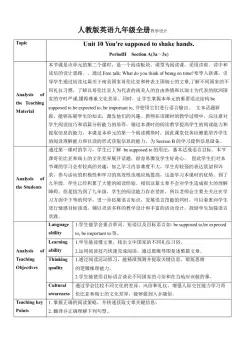
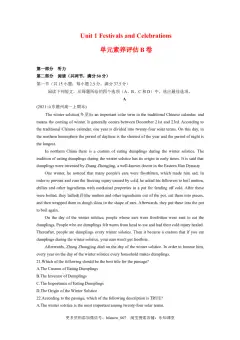
【优质课13】人教版高中英语(2019版)必修第三册Unit 1 Festivals and celebrations单元整体教学设计【优质课13】人教版高中英语(2019版)必修第三册Unit 1 Festivals and celebrations单元整体教学设计 Zhang Shuangcheng 人教版高中英语(2019版)必修第三册 Unit 1 Festivals and celebrations 教材结构分析 单元内容分析: The theme of this section is “Talk about festival activities and festival experiences”. Festival and holiday is a relaxing and interesting topic for students. This part talks about the topic from the daily life of students’. In the part A ---Listening and Speaking, there are three conversations among different speakers from three countries(Japan, Rio and China), where the speakers are participating in or going to participate in the festivals and celebrations. So listening for the relationship among them is a fundamental task. Actually, with the globalization and more international communication, it is normal for Chinese or foreigners to witness different festivals and celebrations in or out of China. At the same time, the scripts also insert the targeted grammar --- v‑ing as attributive and predicative, which students can perceive and experience in a real context and make a road for the further study. That is the third task. In the Part B--- Listening and Talking, the theme is “Talk about festival experience”, which is the common topic in our daily conversations. After the listening, perhaps students find there are some similarities between Christmas and the Chinese Spring Festival as there are some differences in the origins and celebrations. For example, people always visit friends and relatives, decorate their houses, have a big dinner together, chat and give presents to each other. 单元课时划分: 第一课时Listening and Speaking:通过对 Chinese Lanten Festival、Coming‑of‑Age Day 及 Rio Camival 的图片引入及听力理解,拓展学生对各国节日的认知,增进学生跨文化的理解。 第二课时Reading and Thinking:课文语篇阅读教学。通过文号“Why Do We Celebrate Festvals",加深学生对节目的理解,文章中对传统文化及习俗的进售 教师的 堂补充及引领也可让学生认知自己国家的优秀传统文化,会超到对文化的传承及交流的作用,增强学生的文化自信。 第三课时Reading and Thinking:课文词汇教学。通过重点单词在句子中的应用,让学生了解和学习单词的用法,掌握句子结构,更好的为短文的理解提供帮助。 第四课时Discovering Useful Structures:通过几个典型的句子分析和拓展Ving的用法,学生总结和讨论Ving在句子中作表语和定语,并通过几名学生在网络论坛上的评论,学会现在分词作定语和表语描述节日的不同侧面。最后通过西班牙的laTomatina 这个节日,得到充分的运用。 第五课时Listening and Talking:通过断力部分 Seng Lin 及 Max 最近的节目经历以及回答书本P7的五个问题,可以让学生了解如何去谈论 日经历。Activity2里也给学生提供了表达自己情感的形容词,可让学生充分表达个人感觉,填养与人交流的能力,同样也为卜课时打下了基础。 第六课时Reading for Writing:通过文章“My Amazing Naadam Expenence”对中国地方特色节日的介绍,与本单元主题呼心。拓果了学生对中国外色节日的知识,培养学生的爱国主义精神。通过对文章结构的及制型的学 最终使得些生能够独立完成对一个节日经历的写作任务。 第七课时Assessing your progress,通过活动1检测学生对本单元重点词汇的掌握情况;活动2旨在考查动词ing形式用作定语和表语的用法。Reflecting部分设置了一些问题,目的是让学生回顾和总结本单元所学内容,这样及可以帮助他们了解自己的兴趣点和学习困难,又便于他们有针对性的解决问题,改善学习方式,提高学习能力。 Unit 1 Festivals and Celebrations Period 1 Listening &Speaking&Talking 教学设计 教学目标与核心素养 1. Students learn to listen for relationship among the speakers according their attitudes. 2. Students learn to predict the content of listening and try to get the detailed information. 3. Students can use background knowledge and relative words and expressions to describe the festivals and festival activities. 4. Students can talk about their own festival experiences and express their emotions with proper sentences. 教学重难点 1. Students learn to listen for relationship among the speakers according their attitudes. 2. Students learn to predict the content of listening and try to get the detailed information. 3. Students can use background knowledge and relative words and expressions to describe the festivals and festival activities. 4. Students can talk about their own festival experiences and express their emotions with proper sentences. 教学过程 Part A Listening and Speaking‑‑‑ Talk about festival activities Step 1 Lead in‑‑Small talk There are many traditional festivals in our country. Can you list them and the activities in the festivals ? Answers: 1. Spring Festival: eat dumplings; have a big dinner with family together; pay a new year’s visit to friends and relatives 2. the Lantern Festival: admire all kinds of lanterns; guess riddles; eat Yuanxiao 3. Tomb Sweeping Festival: clean tombs; light incense; honour our ancestors 4. the Dragon Boat Festival: eat zongzi; enjoy the dragon boat races; 5. Mid‑Autumn Festival: admire the moon; eat mooncakes; have a big meal with family 6. Double‑Ninth Day: visit the old, especially the alone; help them as much as possible Step 2 Before‑listening 1. Read the phrases and write down the Chinese meaning. 1)wear traditional costumes _______________ 2)march along the streets _______________ 3)attend the ceremony _________________ 4)watch samba dance _________________ 5. dress up in carnival costumes ______________ 6)guess riddles _________________ 7)receive congratulations from _______________ 8)give performances _________________ Answers: 1)着传统服饰 2)游街 3)参加仪式 4)观赏桑巴舞 5)着狂欢服 6)猜谜语 7)收到祝福 8)进行表演 Look at the the pictures and choose the phrases above to describe each festival. Chinese Lantern Festival:2. 6. Rio Carnival:2. 4. 5. 8 Japanese Coming‑of‑Age Day:1. 3. 7 Step 3 While‑listening Listen for relationships: To listen for a relationship, you need to pay attention to how people talk to each other(e.g. friends usually call each other by first names) and some particular questions in the conversation (e.g. “Could I have the bill, please? Tells us that the speaker is a customer in a restaurant). Listen and write the order of the conversations next to the names of the festivals above. Then match each conversation with the relationship between the speakers below. __________ a tour guide and members of a tour group __________ an interview and an interviewee __________a reporter and a tourist __________ two friends Answers: order: Chinese Lantern Festival: 3; Japanese Coming‑of‑Age Day: 1 Rio Carnival: 2 Chinese Lantern Festival: a tour guide and members of a tour group(Conversation 3) Coming‑of‑Age: an interviewer and an interviewee(Conversation 1) Rio Carnival: two friends(Conversation 2) Listen again and complete the sentences with the correct words. 1. In Conversation 1, the woman is wearing ___________ colours. It took her a long time to do her hair and make‑up, and to get ____________. She is going to meet her ___________soon. 2. In Conversation 2, Carla advises Li Mei to change her ___________. This is because the weather is ___________ and they will be outside for a long time. 3. In Conversation 3, the people are enjoying the ___________show. Answers: 1. bright; dressed; family 2. dress and shoes; hot 3. lantern Listen again and make a list of each festival’s activities. Chinese Lantern Festival: ___________________________________________________________ Coming‑of‑Age Day:________________________________________________________________ Rio Carnival:______________________________________________________________________ Answers: Chinese Lantern Festival: guess riddles; see the colorful lanterns; watch the dragon or lion dances; eat yuanxiao Coming‑of‑Age Day: girls do their hair and make‑up; wear traditional costumes; attend the Coming‑of‑Age ceremony; say congratulations; have a party. Rio Carnival: wear carnival costumes; march along the streets; dance Step 4 Post‑Listening‑‑‑Speaking In pairs, discuss which of these festivals attracts you the most and why. A: I think the Rio Carnival would be the most exciting.After all, as you know, I love to dance! B: I love dancing, too, but I’m not sure I’d enjoy it in such hot weather. A: So which festivals do you like best ? B: I like the Coming‑of‑Age Day best. A: Why ? B: Well, I think it would be neat to dress up in traditional costumes and attend a ceremony to mark becoming an adult. It is a special time, and so it would be nice to celebrate it with my friends and family. A: That’s true, but the Lantern Festival also has its good points. B: What do you like best about it ? A: Well, the lanterns are pretty cool to look at, and the dragon dances can be quite fun. But I like eating yuanxiao with my family most of all. Step 5 Exercise Listen and read aloud the words or phrases to you partner. Pay attention to the change in the pronunciation of the bold letters. 1. duty; education 2 use; usually 2. news, newspaper 3. is, issue 4. last year 5. in bed 6. those shirts 7. as you see Listen to the following sentences, paying attention to the consonants in the bold. How do their pronunciations change when they are read in the sentences ? 1. Did you enjoy the holiday ? 2. Miss, congratulations on becoming an adult! 3. It’ll be too tiring to walk or dance for a long time in those shoes. 4. I was hoping to hear that you had a great time throughout. 5. Children then take part in Easter egg hunts to find the eggs and win prizes. 6. In Mexico, the Day f the Dead is celebrated between October 31st and November 2nd. Unit 1 Festivals and Celebrations Period 2 Reading and Thinking(课文语篇阅读教学)教学设计 教材分析 The topic of this part is “Discover the reasons for festivals and celebrations. The Listening & Speaking & Talking part aims at talking about the experiences and feelings or emotions about the festivals and celebrations. This section aims at detecting the reason why the people celebrate the festivals, the time, the places, the types and the way of celebrations. It also explains why some traditions in the old celebrations are disappearing, like the firecrackers in the big cities and some new things are appearing like the prosperity of business or commerce. 教学目标与核心素养 1. Students can talk about what festivals they know and the reasons and the way of celebrating them. 2. Students should learn the reading skills such as the headline and get the topic sentences, the structures of articles. 3. Students can understand the past, the present situation of some festival around the world and why there are some changes about them. 4. Students can have the international awareness about the festivals. 教学重难点 1. Students should learn the reading skills such as the headline and get the topic sentences, the structures of articles. 2. Students can understand the past, the present situation of some festival around the world and why there are some changes about them. 教学过程 Step 1 Lead in‑‑‑Small talk What festival do you like best ? Why ? I like the Spring Festivals because I can set off the fireworks, receive the lucky money and enjoy the Gala with my families. Step 2 Before reading‑‑‑Pair work Why do people celebrate different festivals ? The Spring Festivals is to celebrate the end of winter and the coming of spring and new life. The Mid‑autumn Day is to celebrate the harvest and admire the moon. The Tomb Sweeping Day is in memory of the ancestors/to honour the dead. Step 3. Analyze the title Why do we celebrate festivals ? The subjects: the reason(s) Chinese or the people of other countries some festivals From the title, we can know that the article might be about detecting some festivals in China, even around the world and the reasons why the people celebrate them. So we can know that it is an exposition. Step 4 While reading ‑‑‑ Task 1 Read the text quickly and find the topic sentences in each paragraph. Reading tips‑‑‑the Topic Sentence Identifying the main idea of paragraphs is necessary when analysing a text. Most paragraphs will have a “topic sentence” that tell you the paragraph’s main idea. It is often the first sentence, but sometimes it is found elsewhere in the paragraph. Para 1 Festivals are celebrated all around the world for the different reasons and the same spirit. Para 2 Of all the traditional festivals, the harvest festival can be found in almost every culture. Para 3 Customs play a significant role in festivals, but sometimes they can change over time. Para 4 Festivals are becoming more and more commercial. Para 5 Festivals are an important part of society. Step 5 While reading‑‑‑Task 2 Read the text and answer the following questions. Q1: What do most festivals seem to have in common ? The spirit of sharing joy, gratitude, love or peace Q2: What festival can be found in almost every culture? The harvest festival Q3: Why do people celebrate the harvest festival ? To show that they are grateful for the year’s supply of food Q4: How do you feel about festival customs that have already faded away ? The development of modern society and the spread of new ideas Q5: What is the writer’s attitude towards the commercialisation of festivals ? Not mentioned/neutral Q6: Why do you think people around the world find the festivals are important ? They reflect people’s wishes, beliefs, faiths, and attitudes towards life and allow them to relax and enjoy life, and forget about their work for a little while. They also can help them understand where they came from, who they are and what to appreciate. Step 6 Post reading‑‑‑Consolidation Complete the following passage using suitable words from the text. Today’s festivals have a wide 1._______ of origins, including the seasons of the year, famous 2., important events, and religions. The 3._ festival is one of the most popular festivals and is celebrated in many cultures. Customs play a 4.________ role in festivals, but they can change over time. For example, some Chinese cities no longer allow firecrackers during the Spring Festival, as they can increase air pollution. These days, festivals are becoming more 5., with people spending more money on gifts. Festivals 6.___ people’s wishes, beliefs, faiths, and attitudes towards life. They are 7.________ to spend time with family, and to relax and enjoy life. range 2. figures 3. harvest 4. significant 5. commercial 6. reflect 7. allowed Introduction of festivals around the world The differences and common Step 7 Summary‑‑‑The Structure The harvest festival — The time and the reason The change of customs — Some fade away and some appear Commercial festivals — Business take advantage of the celebrations The importance — Helpful in many ways Step 8 Homework:Review what you have learned today. 教学反思 通过本节内容学习,学生是否理解和掌握阅读文本中的新词汇的意义与用法; 通过本节内容学习,学生能否结合文本特点快速而准确地找到主题句; 通过本节内容学习,学生能否理清论说文的语篇结构和文本逻辑,了解节日风俗发展与变迁,感悟节日的内涵与意义。 Unit 1 Festivals and Celebrations Period 3 Reading and Thinking(课文词汇教学)教学设计 学习目标: 1. Students learn to words and phrases in this unit . 2. Students learn to how to use the important words and phrases in the text. 3. Students can use background knowledge and relative words and expressions to describe the festivals and festival activities. 重点难点: 1. Students learn to words and phrases in this unit . 2. Students learn to how to use the important words and phrases in the text. 3. Students can do the exercises in the students book. 教学过程 Step 1 lead in: 1、词汇积累(核心单词+重点短语) A)核心单词 1.range n. _________ 2.joy n. ________ 3.origin n. _________ 4.harvest n. ________ 5.figure n. ________ 6.agriculture n. _________ 7.crop n./v. ________ 8.gather v. ________ 9.grateful adj. _________ 10.feature n./v. ________ 11.decorate v. _________ 12.church n. _________ 13.significant n. _________ 14.fate v. ________ 15.typical adj. _________ 16.commercial adj.________ 17.medium n. ________ 18.reflect v. _________ 19.belief n. ________ 20.faith n. ________ 21.occasion n. _________ B)重点短语 1.range from…to… __________ 2.a range of ___________ 3.the medium __________ 4.have sth. in common ___________ 5.fade away __________ 6.in spite of __________ 7.no matter how __________ 8.all around/over the world _________ 9.take place __________ 10.be grateful for __________ 11.play a role in __________ 12.get together __________ Step 2 discussion: 1.They have a wide range of origins, such as the seasons of the year, … famous figures,… 2. Of all the traditional festivals, the harvest festival can be found in almost every culture. 3. This important agricultural festival takes place after all the crops have been gathered in. 4. People celebrate to show that they are grateful for the year’s supply of food. 5. It featured a parade and a great feast with music, dancing, and sports. 6. Customs play a significant role in festivals. 7. With the development of modern society and the spread of new ideas, some traditions may fade away and others may be established. 8. Another example is Halloween, which slowly became an exciting festival for children, in spite of its religious origins. 9. Festivals are becoming more and more commercial, with business taking advantage of the celebrations. 10. They are occasions that allow us to relax and enjoy life. 11. And if you study festivals carefully, you may be surprised to find that different cultures actually have a lot in common after all. Step 3 free talk: 1. However, no matter how different they may seem, all over the world, the spirit of sharing joy, gratitude, love, or peace is common in all festivals. no matter引导的让步状语从句 2. Although some believe festivals should not be commercialized, others believe the increase in spending is good for the economy and public happiness. although尽管,虽然,引导让步状语从句。两个believe后面都是省略that的宾语从句。 Step 4 Practice: 1. I’ll be your true friend, ______________________________. 无论发生什么, 我都是你真正的朋友。 2. ________________________________, he is busy with his research work. 无论何时我探望他,他都忙于做他的研究工作。 3. , I’ll buy it. 无论这辆汽车花多少钱 4)虽然累了,但是他仍在努力工作。 1., he was still working hard. 2.__________________, he was still working hard. 3. He was still working hard ________________________________. Step5 Homework: 1.Recite the words and phrases in this unit. Unit 1 Festivals and celebrations 导学案 Period 4 Discovering Useful Structures 教学目标: 能够理解动词‑ing形式用作定语和表语时的功能及意义; 能够归纳和积累用于表达情绪的相关词汇,包括动词‑ing形式和过去分词; 阅读描述西班牙布尼奥尔镇举行的节日庆祝活动——番茄大战(La Tomatina),在理解文段内容的基础上,根据上下文语境和表达逻辑,能正确运用动词‑ing形式描述节日庆典。 教学重难点: 重点: 1.引导学生结合真实语境理解动词‑ing形式作定语和表语的功能和意义; 2.指导学生正确运用动词‑ing形式描述不同的节日活动和个人感受。 难点:结合语境熟练运用动词‑ing形式作定语和表语的功能。 教学过程: Step 1 Activity 1 Warming up‑‑free talk with students Talk about what kind of festivals you are interested in is best one by one. Read the three sentences from Reading text and discuss the meaning and grammatical function of the italic ‑ing form in the sentences. ①These lanterns are amazing. _________________________ ②During the Mid‑Autumn Festival in China,families gather to admire the shining moon and enjoy delicious mooncakes. _________________________ ③Families celebrating the Lunar New Year can enjoy exciting dragon dances and carnivals together. ___________________________ Step2 Activity 2 Discuss and make a conclusion in groups. 用法一: the –ing form used as the attribute 定语 位置: ① building materials ② drinking water ③ a walking stick ④ a reading room 总结:单个的动词‑ing形式作定语,常放在被修饰词 作前置定语,既可以表示被修饰者的作用或功能,也可以表示被修饰者的动作或状态。 ① They lived in a room facing the street. ② The man standing there is Peter's father. ③ Anybody swimming in this river will be fined. 总结: 动词的‑ing形式短语作定语,常放在被修饰词 作后置定语,并且在意思上相当于一个定语从句。 意义: ① Did you see the girl dancing with your brother. ②The farmers working in the countryside will be back tomorrow. 总结一:表示 (变为定语从句时要用进行时态)。 ①We lived in a room facing the south. ②The factory making these pens is a small one. 总结二:表示 或现在(当时)的状态(变为定语从句时多用一般现在时态或一般过去时态)。 1.a walking stick=a stick for walking 拐杖 2.a washing machine=a machine for washing 洗衣机 3.a reading room=a room for reading 阅览室 总结三:动名词作定语用于说明被修饰词的 ,常放在被修饰词之前。 用法二: the –ing form used as the predicative 表语 位置: ① What I hate most is being laughed at. ② My job is looking after the children. 总结: ‑ing形式作表语时放在系动词之 ,具体说明主语的 , 即主语等同于表语,两者可互换 。 【名师点睛】系动词有哪些? 意义: 1.The problem is quite puzzling. 2.The film we saw last night was very moving. 3.The book is interesting and I’m interested in it. 总结一: ‑ing形式作表语时,表示主语的 ,其作用相当于 。 1.Her job is keeping the lecture hall as clean as possible. (=Keeping the lecture hall as clean as possible is her job.) 2.Her duty is taking care of the babies. (=Taking care of the babies is her duty.) 总结二:动词‑ing形式表示主语的 ,可以转换到句首作主语。 巩固练习: 1.The boy _________(wear) a sad look said“I can’t find my parents.” 2.They set up an __________(operate) table in a small temple to save the injured soldier. 3.Those students _______(hope) to enter that university should work really hard. 4.Today there are more airplanes _____(carry) more people than ever before in the skies. 5.People (live) in the city do not know the pleasure of country life. 6. The present situation is(terrify). 8.My sister’s hobby is _________(play) games. Step 3 Activity3 网上论坛讨论主题:Which festival is the best? Sunnyli:Rio Carnival! I spent a really fun day there with my friends. It was great fun walking along the streets, enjoying the relaxing atmosphere! The performances were just amazing. Vincent1119:The Spring Festival in China, especially the dinner on the Lunar New Year’s Eve! All family members get together. And I get lucky money in red envelopes from my parents and relatives, so it’s always an exciting time for me. Wizard_Oz:Perhaps Thanksgiving. What could be better? Families getting together and eating delicious food, people watching sports games on TV, friends laughing and talking, etc. Plus there's Black Friday, if shopping is your thing. Cooper_08:I think it's Christmas. I just can’t take my eyes off the shining lights on the Christmas trees everywhere. Lots of smiling faces, and people singing Christmas carols and wishing each other “Merry Christmas!” Ask the following questions to guide Ss to focus on the theme, text features and the core content of each comment. ①What are they discussing in the forum? ______________________ ②How are the messages arranged? ______________________ ③What festivals are mentioned in the discussion? ______________________ Read the online comments carefully, find the ‑ing form of the verb that is used as an attribute or predicate and write them down. ①Used as the attribute:____________________________________________ ②Used as the predicative:____________________________________________ Step 4 Activity 4 La Tomatina is a festival that takes place in the Spanish town Buñol every August. I think many food festivals are ________ because people are just eating. However, this festival is ________ because people don’t actually eat the tomatoes. Instead, they throw them at each other! The number of people _______ part in this tomato fight can reach up to 20,000, and it is a very ________ fight that lasts for a whole hour. The ________ thing is how clean Buñol is after the tomatoes are washed away after the fight. This is because the juice from tomatoes is really good for making surfaces clean! Look at the picture in Activity 3 and scan the passage to answer the questions. ①Where are those people? ____________________________ ②What are they doing? ____________________________ ③Why are they so excited? ____________________________ Complete the passage with the appropriate v‑ing form. Exercise 3 on the page 6. Step5 Homework Describe an interesting Chinese festival with 7 sentences using the v‑ing form. Unit 1 Festivals and Celebrations Period 5 Listening &Talking教学设计 教学目标与核心素养 1. Students learn to listen for relationship among the speakers according their attitudes. 2. Students learn to predict the content of listening and try to get the detailed information. 3. Students can use background knowledge and relative words and expressions to describe the festivals and festival activities. 4. Students can talk about their own festival experiences and express their emotions with proper sentences. 教学重难点 1. Guide students to understand the content of listening texts in terms of the whole and key details; 2. Cultivate students' ability to guess the meaning of words in listening; discuss with their peers how to talk about their own festival experience. 教学过程: Step 1 While‑listening‑‑‑Task 1 Song Lin and Max are talking about a recent festival experience. Listen to their conversation and answer the questions. 1. What festival is Max talking about?_____________________________________________ 2. What did Max do during the festival ?____________________________________________ 3. What dishes did Max’s mother cook ?___________________________________________ 4. What did Max and his family do during and after the dinner ?______________________ 5. What was the best part of the festival ?_________________________________________ Answers : 1. Max is talking about his Christmas experience with his family. 2. He decorated the Christmas tree and put presents under it. Then helped his mum prepare for the family dinner on Christmas Eve. 3. She cooked roasted turkey, mashed potatoes, Christmas pudding, and apple pie. 4. They shared stories and told jokes during the dinner. They played games with the children afterwards. 5. The best part was opening their presents on Christmas morning. Step 2 While‑listening‑‑‑Task 2 Listen again and tick the phrases that Max or Song Lin uses. Expressing feelings and emotions ( It was fantastic! ( How wonderful! ( How exciting! ( That’s amazing ( It was great fun! ( It’s very exciting. ( It was great to... ( I’m really happy that... ( I’m pleased to... Step 3 Post listening Read the conversation below and underline the phrases that express feelings about festivals. Role‑play the conversation with your partner. Joe: Did you enjoy the holiday, Song Lin ? Song Lin: Oh, yes, it was great, thanks! The food, the parades, and the beautiful fireworks‑‑‑it’s always exciting for me. It’s good to spend time with my family, too, although it can get a bit boring in my hometown after a while. How about you ? Joe: Well, this was my first Chinese New Year. I loved watching the traditional performances, and I was invited to lots of delicious meals. But, to be frank, the fireworks going off throughout the night were really annoying. Song Lin: Oh, well, yes, I can see your point there! But it’s all part of the tradition to frighten away the evil spirits. Joe: Yes, well, there seemed to be a lot of them in my area! Anyway, except for that, everything was fine. I’m really looking forward to the next festival. Step 4 Talking Share a recent festival experience with your partner and tell him/her how you felt about the festival and why. These sentence patterns may be used: 1. I think... 2. As far as I am concerned.... 3. As to me... 4. As I see it, .... 5. Personally speaking... 6. It seems to me that... 7. In my view, ... 8. If I may say so, I think... 9. I believe/feel... 10. In my opinion, ... Example: Li Ming: I love Mid‑Autumn Festival!. Betty: Why ? Li Ming: Because on the day, we can have a happy and peaceful holiday and eat moon cakes, which make me excited. Betty: What do you usually do on this day ? Li Ming: As for me, I usually go shopping in the supermarkets where a lot of goods are on discount on the day. Then visit my grandparents with some gifts and have a big dinner together. Next, all the family members make the moon cakes. I do like all of these things but personally speaking, I really love to make moon cakes with family. Finally, we eat moon cakes, admire the moon and chat with each other with a cup of tea. Betty: Wow, that sounds great. Could you tell me when to celebrate the Mid‑Autumn Festival ? Li Ming: The Mid‑Autumn Festival is on the fifteenth day of August in Chinese lunar calendar. 人教版高中英语(2019版)必修第三册 Unit 1 Festivals and celebrations Period 6 Reading for writing教学设计 教材分析 该板块的活动主题是“写你的节日经历”( Write about your festival experience)。从活动标题可知,该板块延续了前一板块的话题,但语言输出形式的要求有所不同。听说板块( Listening and Talking):要求学生就各自的过节经历进行口头交流,写作板块的最终目的是要将交流的内容转化为文字,完成一篇有关节日经历的文章。一般来说,人们大多会在日记、博客日志或旅行攻略中介绍自己独特的节日经历,因此该板块选取了一篇关于“那达慕大会”的日记供学生阅读和模仿写作。通过阅读和学习这篇日记,学生不仅能够了解我国蒙古族“那达慕大会”这一传统节日,还能从文中感受到蒙古族人民的性格特色、娱乐精神及其浓厚的文化氛围,这也有助于培养学生的文化意识,让学生学会欣赏和珍惜多姿多彩的民族文化。 教学目标与核心素养 1. Read the diary about "Naadam Fair", master the content elements of the festival and the features of the text language; 2. Can deeply understand the plot of the story according to the cause, process and result of the story, and find out the impact of the rock on different passers‑by and their emotional and behavioral reactions to understand in detail; 3. Able to deeply discuss and reflect on the impact of social development and changes on traditional festivals; able to analyze the text according to reading comprehension, prepare for the content conception, framework construction and text writing, and complete the writing of a story review. 教学重难点 Importance: 1. Guide students to analyze the deep connotation of moral stories through the comparison of characters' words and deeds; 2. Help students to express their own opinions and opinions based on real life cases; 3. Instruct the students to write a clear and structured story review. Difficulties: 1. Systematically express my own opinions and opinions on real life cases in English; 2. Independently write a story review with clear viewpoints and distinct layers. 课前准备 1. Read the passage in advance, understand the meaning of the new words and phrases in the text and understand the content of the article by referring to the context and the dictionary. 2. Understand the literary genre of allegory, the concise and incisively language, the simple but expressive plot, the decorative techniques used and the profound truth of the educational significance revealed. 教学过程 Step 1 Learning new words The teacher shows the pictures or uses the stick figure to draw the new words or phrases in the teaching text. Step 2 Reading Activity 1 1.Students read the diary quickly and answer the first two questions in activity 1. (1)What does "Naadam" mean? Which events does it include? (2)What Naadam Festival customs did you learn about? Suggested Answers: (1) Naadam means"games"in Mongolian,and it includes horse racing,wrestling, and archery. (2) Wrestling and horse racing. 2.Students read the diary carefully again with the last two questions from activity 1.After reading the diary, the students share their views in groups. Then the teacher asks some students to answer the questions. (3) What in your opinion is the most impressive thing about the festival? (4) What else would you like to know the festival and writer’s experience? Suggested Answers: (3) The horse racing is the most impressive, as it involved little children. (4) The writer did not talk about food or music, but surely they should have been interesting parts of the festival. Activity 2 Teacher asks Ss to study organization and language features.Ss read the sentences and rewrite the opening sentences of the article. Read the sentences and rewrite the opening sentences of the article. ●This was my first time spending three days experiencing the Naadam Festival in China’s Inner Mongolia Autonomous Region and it was an enjoyable and exciting experience for me./I'll never forget my experience at the Naadam Festival because it was my first time to watch the exciting Mongolian games of horse racing, wrestling, and archery so closely./I'll always remember my first experience at the Naadam Festival in China’s Inner Mongolia Autonomous Region because it was because it was an enjoyable and exciting experience for me. Step 3 Analyzing article structure Activity 3 Teachers raise questions to guide students to analyze the chapter structure of this diary and think about how to describe the festival experience. (1)What should be included in the opening/body/closing paragraph(s)? (2)How did the writer arrange his/her ideas? (3)What kind of interesting details did the writer describe? (4)How did the writer describe his/her feelings/emotions during the event? 2. Students read and compare the three sentence patterns in activity 2. Try to rewrite the first paragraph of the diary with these three sentence patterns. After that, students exchange corrections with their partners.Such as: ●This was my first time spending three days experiencing the Naadam Festival in China’s Inner Mongolia Autonomous Region and it was an enjoyable and exciting experience. ●I'll never forget my experience at the Naadam Festival because it was my first time to watch the exciting Mongolian games of horse racing, wrestling, and archery so closely. ●I'll always remember my first experience at the Naadam Festival in China’s Inner Mongolia Autonomous Region because it was so amazing to spend three days witnessing a grand Mongolian ceremony. Step 4 Accumulation of statements Activity 4 Ask the students to read the diary again. Look for sentences that express feelings and emotions, especially those with the ‑ing form and the past participle.Such as: ● …horse racing, wrestling, and archery, which are all so exciting to watch. ● some amazing performances ● I was surprised to see… ● I was a little worried about... ● feeling really tired Other emotional statements: ●I absolutely enjoyed the archery, too, but the horse races were my favourite part. ●I'm finally back home now, feeling really tired, but celebrating Naadam with my friend was totally worth it. ●He invited me back for the winter to stay in a traditional Mongolian tent and cat hot pot. I can’t wait! In addition to the use of the ‑ing form and the past participle, the teacher should guide the students in the appreciation of these statements, ask them to memorize them, and encourage them to use them reasonably in writing practice. Step 5 Writing task Activity 5 1.Writing preparation.Students review their recent holiday experiences and list in short phrases all the activities, events and feelings related to the holiday. 2. Draw an outline.Students review the discourse analysis method of Activity 2, and fill in the name, content details and emotional feelings of the festival or celebration in the outline form of Activity 3, and draw up the writing outline of the diary. 3. Write a first draft.Then write an opening sentence that introduces the topic and overall feeling of the article, a rich body paragraph, and a conclusion summarizing the holiday experience. 4. Peer review.Students work in pairs to exchange the first draft, review each other according to the six points in activity 3, and write Suggestions for revision.Students further modify the essay based on feedback from their peers. 5. Writing and sharing.Students can share and discuss in groups after finishing the revision, and recommend excellent compositions to be displayed or read aloud in class.The teacher comments on the students' work, points out the advantages and suggests the modification.In addition, the teacher can also post the excellent composition in the classroom for everyone to appreciate. Step 6 Sharing writing Activity 6 T call some Ss to share their writing. Step 7 Homework 1. Read the passage in this section to better understand the passage. 2. Carefully understand the hierarchical structure of the article, and deeply understand the plot of the story according to the causes, process and results; 3. Independently complete the relevant exercises in the guide plan. 教学反思 通过本节内容学习,学生能否掌握日记中关于节日见闻的内容要素及文本语言特点; 通过本节内容学习,学生能否根据故事的起因、经过和结果来深入理解故事的情节,从而了解文章的层次结构; 深入探讨和反思社会的发展变化对传统节日的影响,能够根据阅读理解对文本进行分析,从内容构思、框架搭建和文本撰写上做准备,完成一篇有关节日活动经历的记叙文写作。 Unit 1 Festivals and Celebrations Period7 Assessing your progress 教学设计 教学目标: 1.Use the useful words and expressions in this unit in proper situations. 2.Use the –ing form as the attribute and the predicative correctly to describe festival activities. 教学过程 Step1 In this unit, we’ve learnt the following about festivals. Talk about festival activities Discover the reasons for festivals and celebrations Describe festival activities Talk about festival experiences Write about your festival experience Step2 Fill in the blanks with the correct forms of the words in the box. 1. The beautiful flowers on cherry branches are the most ___________ sign of the arrival of spring. 2. In December, many companies have __________ dress parties to celebrate the end of the year. 3. The female soldiers forming the biggest ___________ group in the National Day parade attracted a lot of interest from the __________. 4. The most common color you see during the Spring Festival is red because red ___________ life, wealth, and good luck in Chinese culture. 5. The newly married couple received dozens of letters of _____________ from their friends. 6. If you are the best man at a wedding, it is best to keep your speech simple and __________. 7. She will never forget the __________ when she saw all the audience clapping their hands and cheering after her performance. 8. Falling on the 9th day of the 9th _________ month, the Chongyang Festival is also called the Double Ninth Festival. It is a day for people in China to show respect to seniors. 9. To be frank, this _________ chicken tastes horrible. Step3 Circle the correct word in each sentence. 1. Taking part in the celebration was a satisfying/satisfied experience for us. 2. Most of the people were amazing/amazed by the lion dances during the new year celebrations. 3. The child seemed annoying/annoyed when he found his gift broken. 4. The man dressing/dressed in a ghost costume looks quite frightening/frightened. 5. Kate was surprising/ surprised by the sight of the Kongming lanterns flying/ flown up into the sky. Step4 language points 1. … when she saw all the audience clapping their hands… vt. to hit your hands against each other many times to make a sound that shows your approval, agreement, or enjoyment 鼓掌;拍手;击掌 n. the loud sound that you make when you hit your hands together many times 鼓掌;拍手;掌声 eg One man began to clap, and others joined in. Let’s give the children a big clap. (翻译) 一个人鼓起了掌,其他人也都鼓起掌来。 2. It is a day for people in China to show respect to seniors. n. when you admire someone, especially because of their personal qualities, knowledge, or skills 尊敬;尊重 vt. to admire someone because they have high standards and good qualities such as fairness and honesty尊敬;尊重 eg The new officer soon won/earned the respect of his men. She respected him for his honesty. (翻译) 新来的军官很快博得了士兵的尊敬. 她敬佩他的诚实。 3. … chicken tastes horrible. horrible adj. very bad; very unpleasant; rude and unfriendly 令人震惊的;恐怖的;极坏的 eg The food looked horrible, but it tasted OK. (翻译) 那食物看上去很糟,可吃起来还不错。 Step5 Reflecting 1. Which festival(s) mentioned in this unit was/were new to you? 2. Which festival did you find the most interesting? Why? 3. Do you wish to add one extra holiday in China? What would you like to celebrate? Why? 4. Which part of this unit did you find the most difficult? Overall, I thought this unit was □interesting □useful □so‑so □difficult Step6 Homework Do some exercises in the workbook. 教学反思 通过本节内容学习,学生是否理解和掌握阅读文本中的新词汇的意义与用法; 通过本节内容学习,学生能否掌握日记中关于节日见闻的内容要素及文本语言特点; 英语学习法精华文章推荐: 日思搏英语学习法是如何炼成的 双语阅读精华文章推荐: 【双语阅读131】第11世:孔子·求道·传仁(1)《我是谁——地球游戏场启示录》131