文档文本内容
教 案
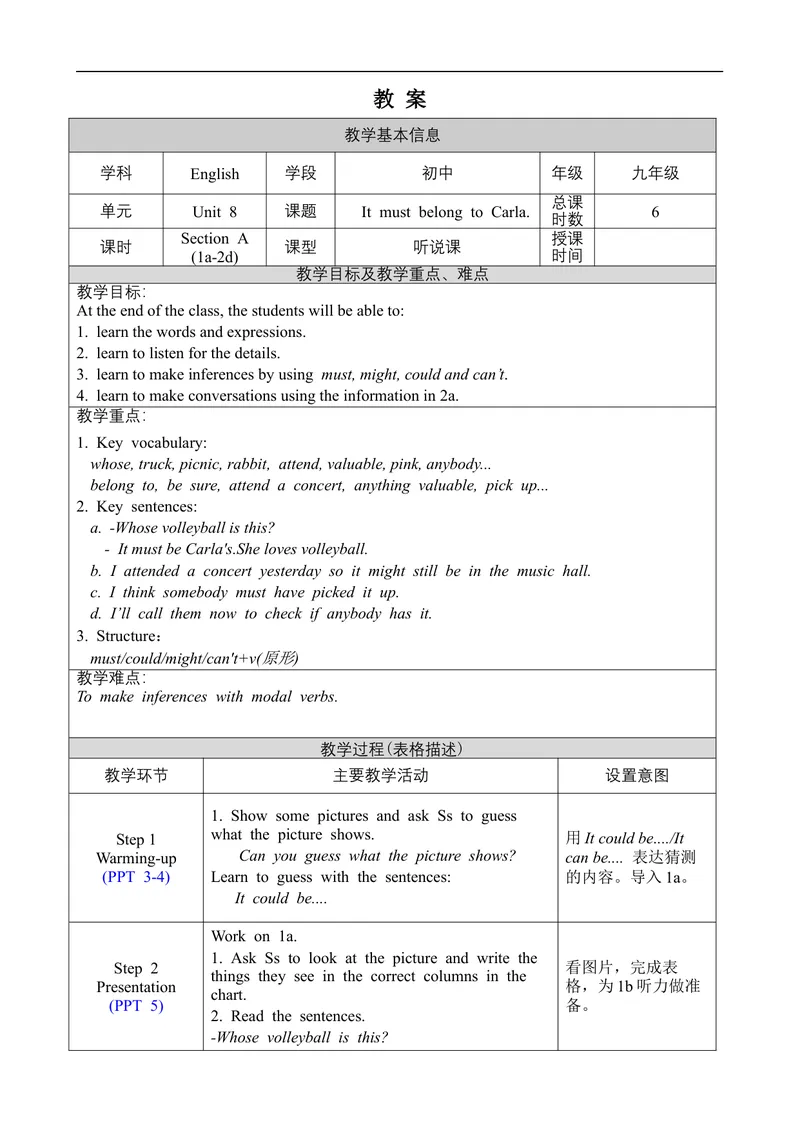
教学基本信息
学科 English 学段 初中 年级 九年级
总课
单元 Unit 8 课题 It must belong to Carla. 6
时数
Section A 授课
课时 课型 听说课
(1a-2d) 时间
教学目标及教学重点、难点
教学目标:
At the end of the class, the students will be able to:
1. learn the words and expressions.
2. learn to listen for the details.
3. learn to make inferences by using must, might, could and can’t.
4. learn to make conversations using the information in 2a.
教学重点:
1. Key vocabulary:
whose, truck, picnic, rabbit, attend, valuable, pink, anybody...
belong to, be sure, attend a concert, anything valuable, pick up...
2. Key sentences:
a. -Whose volleyball is this?
- It must be Carla's.She loves volleyball.
b. I attended a concert yesterday so it might still be in the music hall.
c. I think somebody must have picked it up.
d. I’ll call them now to check if anybody has it.
3. Structure:
must/could/might/can't+v(原形)
教学难点:
To make inferences with modal verbs.
教学过程(表格描述)
教学环节 主要教学活动 设置意图
1. Show some pictures and ask Ss to guess
Step 1 what the picture shows. 用It could be..../It
Warming-up Can you guess what the picture shows? can be.... 表达猜测
(PPT 3-4) Learn to guess with the sentences: 的内容。导入1a。
It could be....
Work on 1a.
1. Ask Ss to look at the picture and write the
Step 2 看图片,完成表
things they see in the correct columns in the
Presentation 格,为1b听力做准
chart.
(PPT 5) 备。
2. Read the sentences.
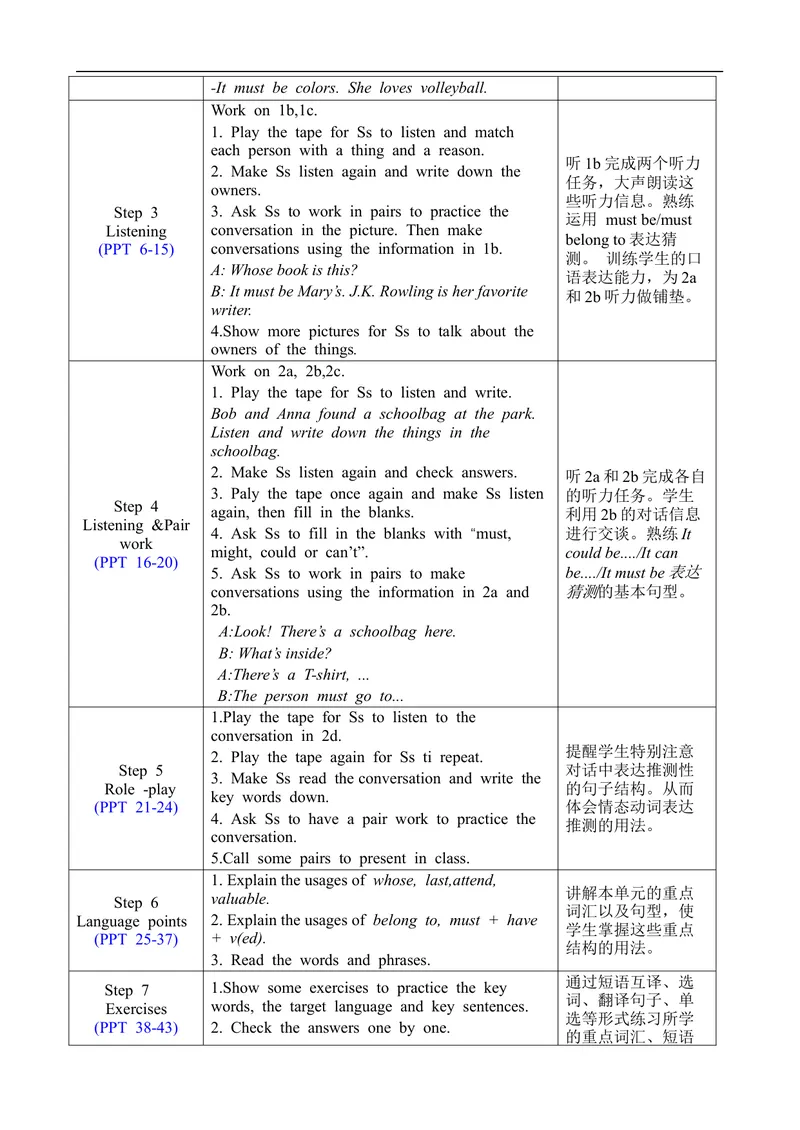
-Whose volleyball is this?-It must be colors. She loves volleyball.
Work on 1b,1c.
1. Play the tape for Ss to listen and match
each person with a thing and a reason.
听1b完成两个听力
2. Make Ss listen again and write down the
任务,大声朗读这
owners.
些听力信息。熟练
Step 3 3. Ask Ss to work in pairs to practice the
运用 must be/must
Listening conversation in the picture. Then make
belong to表达猜
(PPT 6-15) conversations using the information in 1b.
测。 训练学生的口
A: Whose book is this?
语表达能力,为2a
B: It must be Mary’s. J.K. Rowling is her favorite
和2b听力做铺垫。
writer.
4.Show more pictures for Ss to talk about the
owners of the things.
Work on 2a, 2b,2c.
1. Play the tape for Ss to listen and write.
Bob and Anna found a schoolbag at the park.
Listen and write down the things in the
schoolbag.
2. Make Ss listen again and check answers. 听2a和2b完成各自
3. Paly the tape once again and make Ss listen 的听力任务。学生
Step 4
again, then fill in the blanks. 利用2b的对话信息
Listening &Pair
4. Ask Ss to fill in the blanks with “must, 进行交谈。熟练It
work
might, could or can’t”. could be..../It can
(PPT 16-20)
5. Ask Ss to work in pairs to make be..../It must be表达
conversations using the information in 2a and 猜测的基本句型。
2b.
A:Look! There’s a schoolbag here.
B: What’s inside?
A:There’s a T-shirt, ...
B:The person must go to...
1.Play the tape for Ss to listen to the
conversation in 2d.
提醒学生特别注意
2. Play the tape again for Ss ti repeat.
Step 5 对话中表达推测性
3. Make Ss read the conversation and write the
Role -play 的句子结构。从而
key words down.
(PPT 21-24) 体会情态动词表达
4. Ask Ss to have a pair work to practice the
推测的用法。
conversation.
5.Call some pairs to present in class.
1. Explain the usages of whose, last,attend,
讲解本单元的重点
Step 6 valuable.
词汇以及句型,使
Language points 2. Explain the usages of belong to, must + have
学生掌握这些重点
(PPT 25-37) + v(ed).
结构的用法。
3. Read the words and phrases.
通过短语互译、选
Step 7 1.Show some exercises to practice the key
词、翻译句子、单
Exercises words, the target language and key sentences.
选等形式练习所学
(PPT 38-43) 2. Check the answers one by one.
的重点词汇、短语以及情态动词表可
能性的用法。
将所学的知识与中
Step 8
Do exercise to practice the usage of must and 考must and can’t表
中考链接
can’t. 示猜测的考查连接
(PPT 44-45)
起来。
1. Role-play the conversation in 2d. 作业既设计了对话
Step 9
2. Make a conversation to talk about things and 表演、编对话等练
Homework
their owners.And give the reasons of your 习本课时的重点句
(PPT 46)
inferences. 型。
Unit 8 It must belong to Carla.
Section A (1a-2d)
1. -Whose volleyball is this?
-It must be Carla's.She loves volleyball.
板书设计 2. must/could/might/can't+be+somebody's
must/could/might/can't+belong to+somebody
3.I attended a concert yesterday so it might still be in the music hall.
4. So could it still be at the park?
5. I think somebody must have picked it up.
本节课主要通过听力、口语练习,培养学生熟练运用It could be..../It
教学反思 can’t be..../It must be表示推测。学生通过情境学会熟练运用这些情态动
词强调可能性。