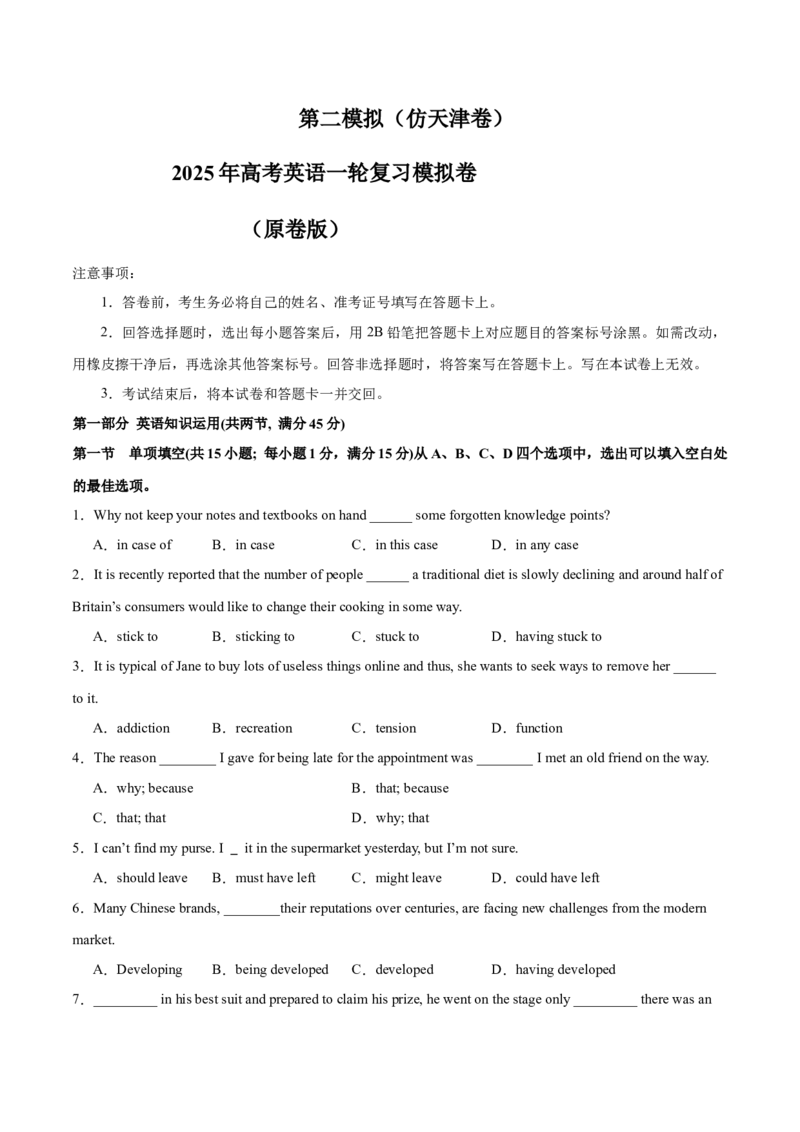
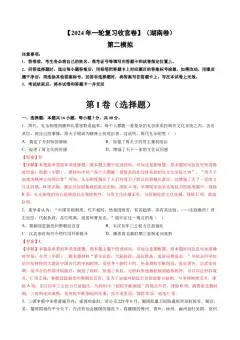
第二模拟(仿天津卷)
2025 年高考英语一轮复习模拟卷
(原卷版)
注意事项:
1.答卷前,考生务必将自己的姓名、准考证号填写在答题卡上。
2.回答选择题时,选出每小题答案后,用2B铅笔把答题卡上对应题目的答案标号涂黑。如需改动,
用橡皮擦干净后,再选涂其他答案标号。回答非选择题时,将答案写在答题卡上。写在本试卷上无效。
3.考试结束后,将本试卷和答题卡一并交回。
第一部分 英语知识运用(共两节, 满分45分)
第一节 单项填空(共15小题; 每小题1分,满分15分)从A、B、C、D四个选项中,选出可以填入空白处
的最佳选项。
1.Why not keep your notes and textbooks on hand ______ some forgotten knowledge points?
A.in case of B.in case C.in this case D.in any case
2.It is recently reported that the number of people ______ a traditional diet is slowly declining and around half of
Britain’s consumers would like to change their cooking in some way.
A.stick to B.sticking to C.stuck to D.having stuck to
3.It is typical of Jane to buy lots of useless things online and thus, she wants to seek ways to remove her ______
to it.
A.addiction B.recreation C.tension D.function
4.The reason ________ I gave for being late for the appointment was ________ I met an old friend on the way.
A.why; because B.that; because
C.that; that D.why; that
5.I can’t find my purse. I it in the supermarket yesterday, but I’m not sure.
A.should leave B.must have left C.might leave D.could have left
6.Many Chinese brands, ________their reputations over centuries, are facing new challenges from the modern
market.
A.Developing B.being developed C.developed D.having developed
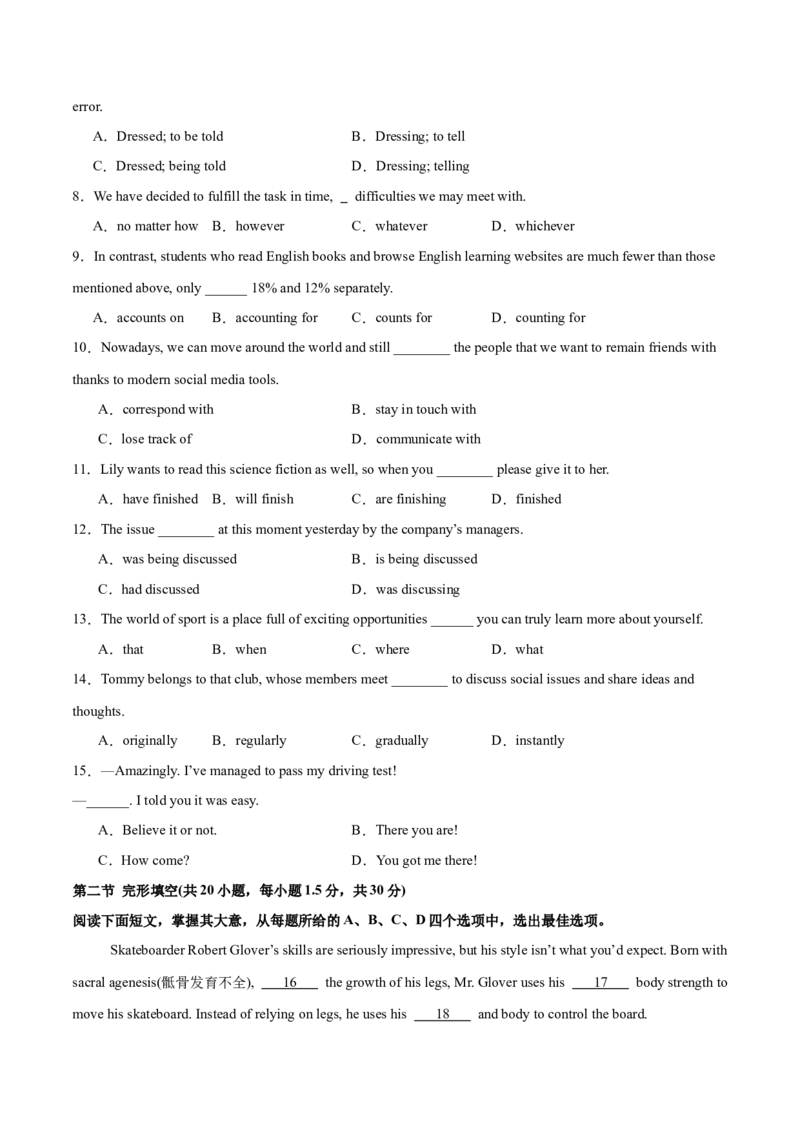
7._________ in his best suit and prepared to claim his prize, he went on the stage only _________ there was anerror.
A.Dressed; to be told B.Dressing; to tell
C.Dressed; being told D.Dressing; telling
8.We have decided to fulfill the task in time, difficulties we may meet with.
A.no matter how B.however C.whatever D.whichever
9.In contrast, students who read English books and browse English learning websites are much fewer than those
mentioned above, only ______ 18% and 12% separately.
A.accounts on B.accounting for C.counts for D.counting for
10.Nowadays, we can move around the world and still ________ the people that we want to remain friends with
thanks to modern social media tools.
A.correspond with B.stay in touch with
C.lose track of D.communicate with
11.Lily wants to read this science fiction as well, so when you ________ please give it to her.
A.have finished B.will finish C.are finishing D.finished
12.The issue ________ at this moment yesterday by the company’s managers.
A.was being discussed B.is being discussed
C.had discussed D.was discussing
13.The world of sport is a place full of exciting opportunities ______ you can truly learn more about yourself.
A.that B.when C.where D.what
14.Tommy belongs to that club, whose members meet ________ to discuss social issues and share ideas and
thoughts.
A.originally B.regularly C.gradually D.instantly
15.—Amazingly. I’ve managed to pass my driving test!
—______. I told you it was easy.
A.Believe it or not. B.There you are!
C.How come? D.You got me there!
第二节 完形填空(共20小题,每小题1.5分,共30分)
阅读下面短文,掌握其大意,从每题所给的A、B、C、D四个选项中,选出最佳选项。
Skateboarder Robert Glover’s skills are seriously impressive, but his style isn’t what you’d expect. Born with
sacral agenesis(骶骨发育不全), 16 the growth of his legs, Mr. Glover uses his 17 body strength to
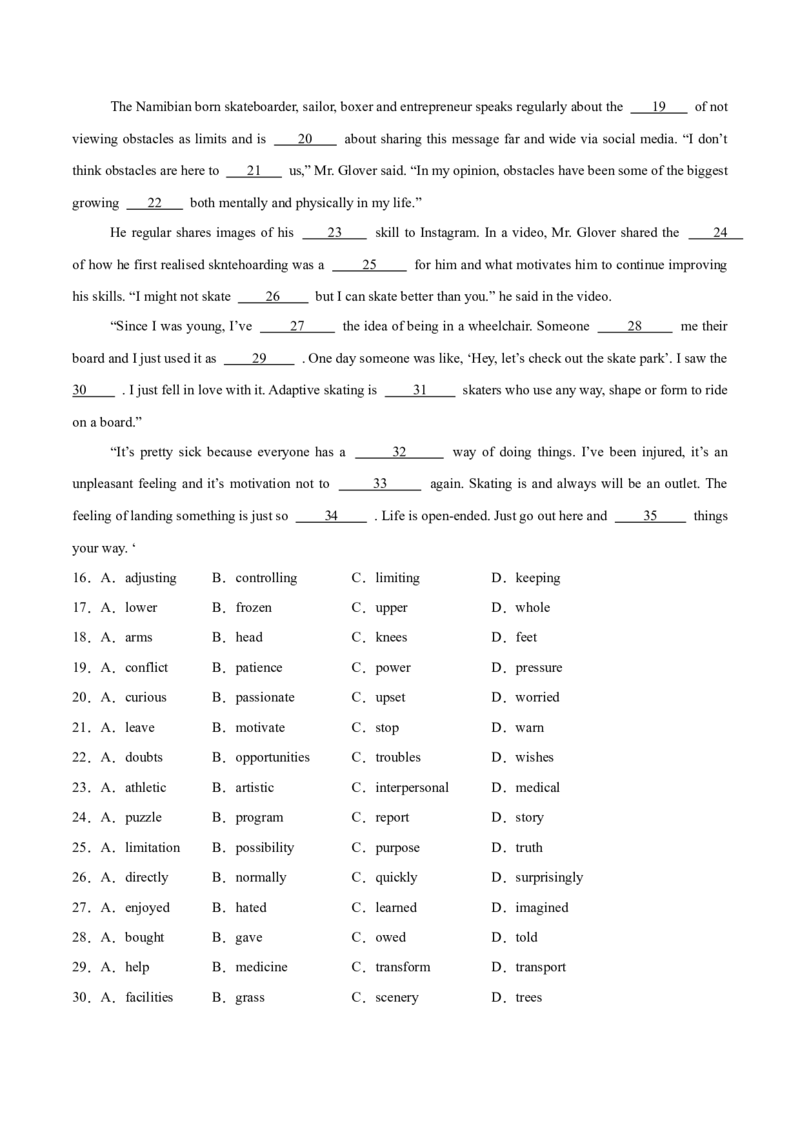
move his skateboard. Instead of relying on legs, he uses his 18 and body to control the board.The Namibian born skateboarder, sailor, boxer and entrepreneur speaks regularly about the 19 of not
viewing obstacles as limits and is 20 about sharing this message far and wide via social media. “I don’t
think obstacles are here to 21 us,” Mr. Glover said. “In my opinion, obstacles have been some of the biggest
growing 22 both mentally and physically in my life.”
He regular shares images of his 23 skill to Instagram. In a video, Mr. Glover shared the 24
of how he first realised skntehoarding was a 25 for him and what motivates him to continue improving
his skills. “I might not skate 26 but I can skate better than you.” he said in the video.
“Since I was young, I’ve 27 the idea of being in a wheelchair. Someone 28 me their
board and I just used it as 29 . One day someone was like, ‘Hey, let’s check out the skate park’. I saw the
30 . I just fell in love with it. Adaptive skating is 31 skaters who use any way, shape or form to ride
on a board.”
“It’s pretty sick because everyone has a 32 way of doing things. I’ve been injured, it’s an
unpleasant feeling and it’s motivation not to 33 again. Skating is and always will be an outlet. The
feeling of landing something is just so 34 . Life is open-ended. Just go out here and 35 things
your way. ‘
16.A.adjusting B.controlling C.limiting D.keeping
17.A.lower B.frozen C.upper D.whole
18.A.arms B.head C.knees D.feet
19.A.conflict B.patience C.power D.pressure
20.A.curious B.passionate C.upset D.worried
21.A.leave B.motivate C.stop D.warn
22.A.doubts B.opportunities C.troubles D.wishes
23.A.athletic B.artistic C.interpersonal D.medical
24.A.puzzle B.program C.report D.story
25.A.limitation B.possibility C.purpose D.truth
26.A.directly B.normally C.quickly D.surprisingly
27.A.enjoyed B.hated C.learned D.imagined
28.A.bought B.gave C.owed D.told
29.A.help B.medicine C.transform D.transport
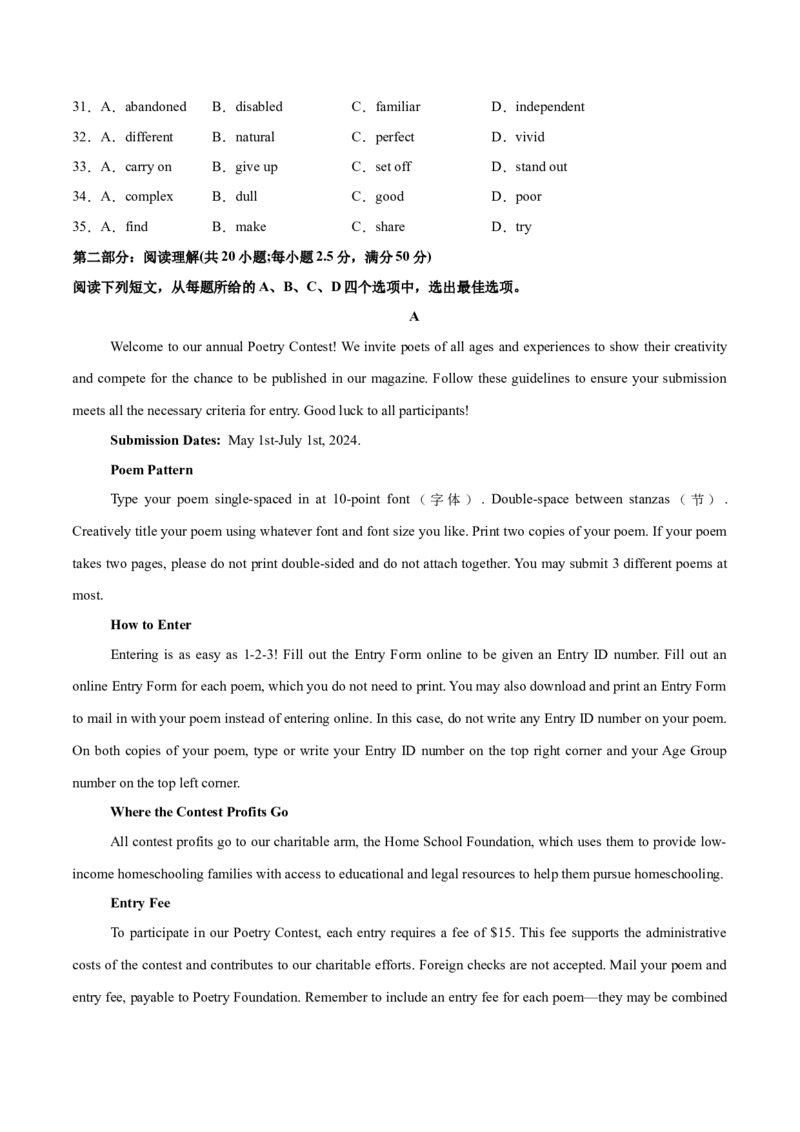
30.A.facilities B.grass C.scenery D.trees31.A.abandoned B.disabled C.familiar D.independent
32.A.different B.natural C.perfect D.vivid
33.A.carry on B.give up C.set off D.stand out
34.A.complex B.dull C.good D.poor
35.A.find B.make C.share D.try
第二部分:阅读理解(共20小题;每小题2.5分,满分50分)
阅读下列短文,从每题所给的A、B、C、D四个选项中,选出最佳选项。
A
Welcome to our annual Poetry Contest! We invite poets of all ages and experiences to show their creativity
and compete for the chance to be published in our magazine. Follow these guidelines to ensure your submission
meets all the necessary criteria for entry. Good luck to all participants!
Submission Dates: May 1st-July 1st, 2024.
Poem Pattern
Type your poem single-spaced in at 10-point font(字体). Double-space between stanzas(节).
Creatively title your poem using whatever font and font size you like. Print two copies of your poem. If your poem
takes two pages, please do not print double-sided and do not attach together. You may submit 3 different poems at
most.
How to Enter
Entering is as easy as 1-2-3! Fill out the Entry Form online to be given an Entry ID number. Fill out an
online Entry Form for each poem, which you do not need to print. You may also download and print an Entry Form
to mail in with your poem instead of entering online. In this case, do not write any Entry ID number on your poem.
On both copies of your poem, type or write your Entry ID number on the top right corner and your Age Group
number on the top left corner.
Where the Contest Profits Go
All contest profits go to our charitable arm, the Home School Foundation, which uses them to provide low-
income homeschooling families with access to educational and legal resources to help them pursue homeschooling.
Entry Fee
To participate in our Poetry Contest, each entry requires a fee of $15. This fee supports the administrative
costs of the contest and contributes to our charitable efforts. Foreign checks are not accepted. Mail your poem and
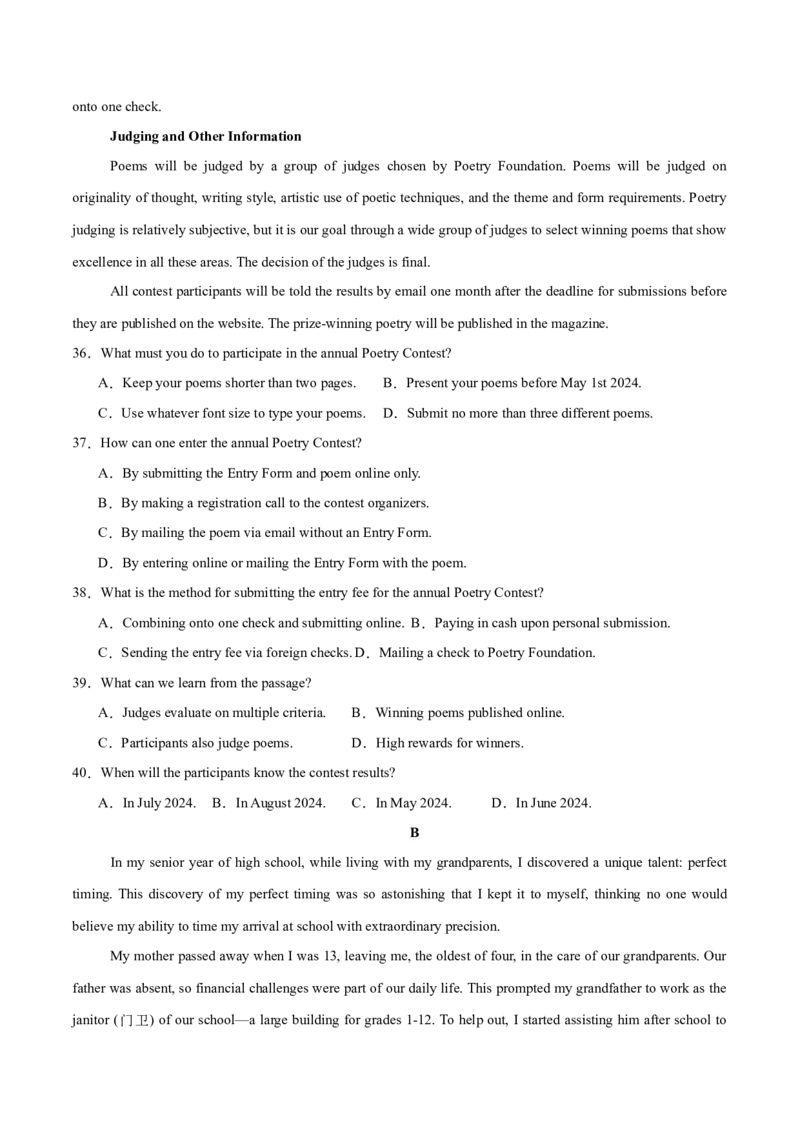
entry fee, payable to Poetry Foundation. Remember to include an entry fee for each poem—they may be combinedonto one check.
Judging and Other Information
Poems will be judged by a group of judges chosen by Poetry Foundation. Poems will be judged on
originality of thought, writing style, artistic use of poetic techniques, and the theme and form requirements. Poetry
judging is relatively subjective, but it is our goal through a wide group of judges to select winning poems that show
excellence in all these areas. The decision of the judges is final.
All contest participants will be told the results by email one month after the deadline for submissions before
they are published on the website. The prize-winning poetry will be published in the magazine.
36.What must you do to participate in the annual Poetry Contest?
A.Keep your poems shorter than two pages. B.Present your poems before May 1st 2024.
C.Use whatever font size to type your poems. D.Submit no more than three different poems.
37.How can one enter the annual Poetry Contest?
A.By submitting the Entry Form and poem online only.
B.By making a registration call to the contest organizers.
C.By mailing the poem via email without an Entry Form.
D.By entering online or mailing the Entry Form with the poem.
38.What is the method for submitting the entry fee for the annual Poetry Contest?
A.Combining onto one check and submitting online. B.Paying in cash upon personal submission.
C.Sending the entry fee via foreign checks.D.Mailing a check to Poetry Foundation.
39.What can we learn from the passage?
A.Judges evaluate on multiple criteria. B.Winning poems published online.
C.Participants also judge poems. D.High rewards for winners.
40.When will the participants know the contest results?
A.In July 2024. B.In August 2024. C.In May 2024. D.In June 2024.
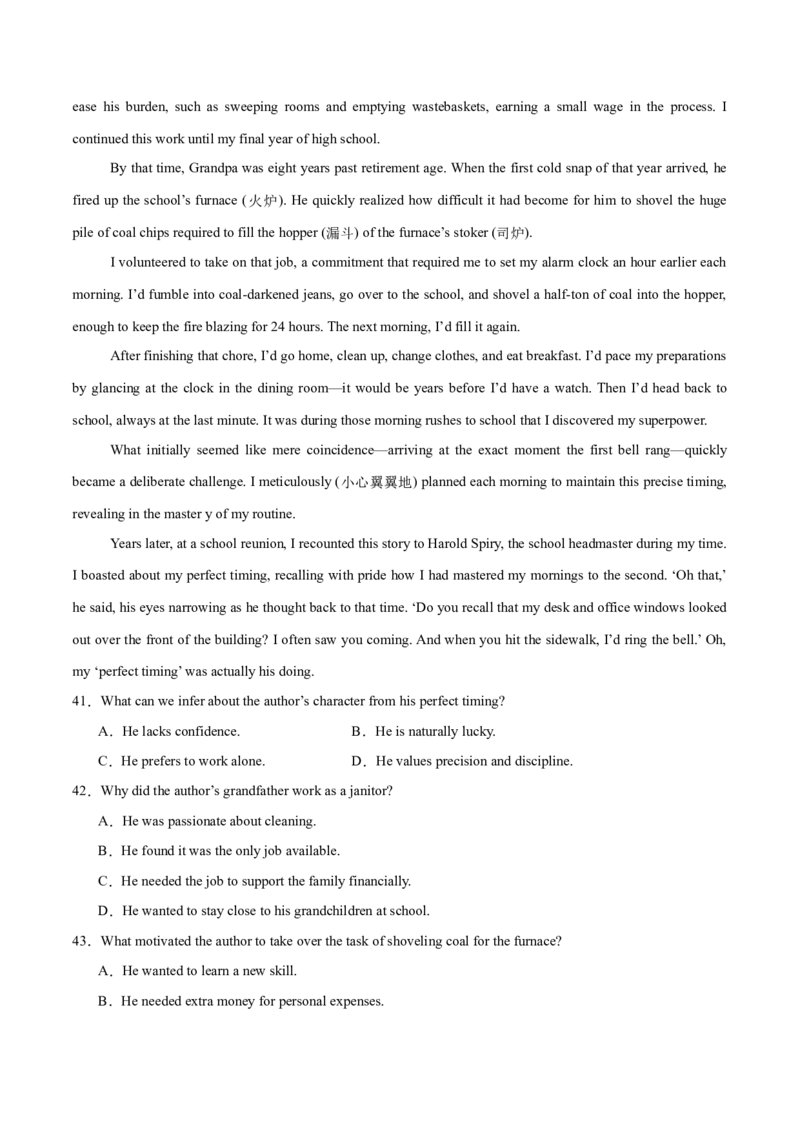
B
In my senior year of high school, while living with my grandparents, I discovered a unique talent: perfect
timing. This discovery of my perfect timing was so astonishing that I kept it to myself, thinking no one would
believe my ability to time my arrival at school with extraordinary precision.
My mother passed away when I was 13, leaving me, the oldest of four, in the care of our grandparents. Our
father was absent, so financial challenges were part of our daily life. This prompted my grandfather to work as the
janitor (门卫) of our school—a large building for grades 1-12. To help out, I started assisting him after school toease his burden, such as sweeping rooms and emptying wastebaskets, earning a small wage in the process. I
continued this work until my final year of high school.
By that time, Grandpa was eight years past retirement age. When the first cold snap of that year arrived, he
fired up the school’s furnace (火炉). He quickly realized how difficult it had become for him to shovel the huge
pile of coal chips required to fill the hopper (漏斗) of the furnace’s stoker (司炉).
I volunteered to take on that job, a commitment that required me to set my alarm clock an hour earlier each
morning. I’d fumble into coal-darkened jeans, go over to the school, and shovel a half-ton of coal into the hopper,
enough to keep the fire blazing for 24 hours. The next morning, I’d fill it again.
After finishing that chore, I’d go home, clean up, change clothes, and eat breakfast. I’d pace my preparations
by glancing at the clock in the dining room—it would be years before I’d have a watch. Then I’d head back to
school, always at the last minute. It was during those morning rushes to school that I discovered my superpower.
What initially seemed like mere coincidence—arriving at the exact moment the first bell rang—quickly
became a deliberate challenge. I meticulously (小心翼翼地) planned each morning to maintain this precise timing,
revealing in the master y of my routine.
Years later, at a school reunion, I recounted this story to Harold Spiry, the school headmaster during my time.
I boasted about my perfect timing, recalling with pride how I had mastered my mornings to the second. ‘Oh that,’
he said, his eyes narrowing as he thought back to that time. ‘Do you recall that my desk and office windows looked
out over the front of the building? I often saw you coming. And when you hit the sidewalk, I’d ring the bell.’ Oh,
my ‘perfect timing’ was actually his doing.
41.What can we infer about the author’s character from his perfect timing?
A.He lacks confidence. B.He is naturally lucky.
C.He prefers to work alone. D.He values precision and discipline.
42.Why did the author’s grandfather work as a janitor?
A.He was passionate about cleaning.
B.He found it was the only job available.
C.He needed the job to support the family financially.
D.He wanted to stay close to his grandchildren at school.
43.What motivated the author to take over the task of shoveling coal for the furnace?
A.He wanted to learn a new skill.
B.He needed extra money for personal expenses.C.He wanted to relieve his grandfather’s workload.
D.He was interested in the mechanical operation of the furnace.
44.What can we learn from Paragraph 4?
A.The author’s devotion to aiding his grandfather with coal shoveling.
B.The author’s daily routine of waking up early to attend school.
C.The author’s development of a new skill in coal shoveling.
D.The author’s realization of the importance of punctuality.
45.What message does the author’s story convey?
A.Our accomplishments are often supported by unseen kindness.
B.Challenges can only be overcome through personal hardships.
C.Personal talents bring pride and joy to an individual’s life.
D.Perseverance leads to the development of unique skills.
C
The question, “What do elephants and fish have in common?” may sound strange but researchers have found
that they both have a feature not observed in any other creature.
A team at Georgia Institute of Technology has discovered that elephants use a special form of air suction (吸
力) in their trunks to pick up food and handle delicate objects. Animals using suction to handle objects are typically
found in water. Many fish perform suction feeding that requires specialised body parts to quickly generate air
pressure that can draw nearby food into their mouths.
The researchers have found that an elephant could do the same thanks to its huge nostrils (鼻孔) and lung
capacity. The radius (半径) of an elephant’s nostrils can increase by up to 30%, and the volume of air that it can
push through its trunk increases by 64%. This allows it to take in air at 30 times the speed of a human sneeze,
enabling it to drink 3L of water a second.
In an experiment at Atlanta zoo, the researchers looked at how an elephant would pick up a small crispy (酥
脆的) pancake, which was only 0.5 mm thick. The force required to break the pancake was less than 1% of the
trunk’s weight (about 100kg). The elephant was found to either use suction at a fixed distance from the pancake to
“raise” the object in the air and hold it, or gently press the tip of its trunk against the pancake and apply suction to
pick it up. At no time during the experiment did the elephant break the pancake.
The researchers believe that the findings could help technology companies develop better machines that use
air to do their jobs, as suction has long been used in robotics to grab objects.The fascinating part of the study forrobotics is that elephants can use air suction both on ground and in water. The researchers are so impressed that
they suggest the elephant’s suction technique could help improve robotics technology.
Nature never ceases to surprise. Indeed, it is thought that over four-fifths of living species on earth remain
undiscovered. That is a reminder of how little we know of our planet, and that we are not the only creatures with
hidden complexities.
46.According to the researchers, what is the ability shared by both elephants and fish?
A.Surviving low air pressure. B.Using air suction technique.
C.Observing other creatures. D.Adapting to new environments.
47.Which of the following is TRUE about an elephant according to Paragraph 3?
A.It drinks water 30 times faster than man.B.It lets out 64% more air when sneezing.
C.Its lung capacity is smaller than we think. D.Its nostrils can get 30% bigger in radius.
48.What can be learned about an elephant’s trunk in the experiment?
A.Its tip can sense the thickness of objects.
B.Its weight affects its movement.
C.It breaks the food before holding it.
D.It picks up delicate objects in different ways.
49.The research findings may contribute to the development of________.
A.underwater robots B.nature reserves C.transport vehicles D.fish
farming
50.What is the author’s purpose in writing the passage?
A.To promote a new technology.
B.To recommend a research team.
C.To introduce a scientific discovery.
D.To explain a historical phenomenon.
D
What could well extend your life, and might assist you in the life to come? Answer: singing in a choir. It’s
not a new discovery: there are endless studies on the subject.
But there was a specific angle to this latest study done by Oxford Brookes University researchers, which
compared the collective experience of choral singing to that of taking part in team sports. Choirs apparently win
hands down. And as someone who since childhood has used singing as an excuse to stay off the sports field, I take
no issue with that.In fact, I take no issue with any of these piles of research. The only thing I find annoying is that such an
endlessly repeated truth results in relatively little action from the kind of people who could put it to good use. Not
least, in government.
From time to time I get invited as a music critic to the launch of some program to encourage more collective
singing among school-age children. Expert s like Howard Goodall usually turn up. Then, six months later,
everything goes quiet.
The hard fact is that most state schools don’t bother much with singing. They say they don’t have the
resources or the time. And even when a worthwhile singing project drops into their lap, they turn it down. I know a
woman named Golda who’s been trying hard to organize a performance of Benjamin Britten’s The Little Sweep —
perhaps the greatest work for young children to sing together. But has she found her local schools responsive?
Sadly not: it was all too much trouble.
I got the chance to tour with a choir at age 11. It opened a world to which an 11-year-old from unfashionable
parts of east London doesn’t generally get access. It spoke possibilities. All the physical and mental pluses are a
happy bonus. But the joy of access to that world of music is what counts.
Just think: if we could finally get Britain’s children singing. we wouldn’t need university researchers. We’d
just do it, and be all the better for it.
51.What does the underlined part “take no issue with” in Paragraph 2mean?
A.Feel confused about.
B.Make no comment on.
C.Get unfamiliar with.
D.Have no objection to.
52.Which of the following may the author agree with?
A.Most children think little of singing.
B.Most children prefer singing to doing sports.
C.Most schools attach little importance to singing.
D.Most schools don’t have the money or the time to form a choir.
53.What was Golda’s problem?
A.She couldn’t find a choir to join.
B.She failed to win local schools’ support.
C.Howard Goodall turned down her invitation.
D.The government was unwilling to provide resources.54.Which word best describes the impact of the 11-year-old experience on the author?
A.Eye-opening.
B.Identity-awakening.
C.Soul-comforting.
D.Character-shifting.
55.What is the purpose of the text?
A.To review the latest study on singing.
B.To advocate choir singing for children.
C.To recommend musical works for the young.
D.To compare the benefits of recreational activities.
第Ⅱ卷 非选择题(共35分)
第三部分:写作(共两节,满分35分)
第一节 阅读表达(共5小题;每小题2分,满分10分)
Science has a lot of uses. It can uncover laws of nature, cure diseases, make bombs, and help bridges to stand
up. Indeed science is so good’ at what it does that there’s always a temptation (诱惑) to drag it into problems where
it may not be helpful. David Brooks, author of The Social Animal: The Hidden Sources of Love, Character, and
Achievement, appears to be the latest in a long line of writers who have failed to resist the temptation.
Brooks gained fame for several books. His latest book The Social Animal, however, is more ambitious and
serious than his earlier books. It is an attempt to deal with a set of weighty topics. The book focuses on big
questions: What has science revealed about human nature? What are the sources of character? And why are some
people happy and successful while others aren’t?
To answer these questions, Brooks surveys a wide range of disciplines (学科). Considering this, you might
expect the book to be a dry recitation(背诵)of facts. But Brooks has structured his book in an unorthodox (非常规
的), and perhaps unfortunate, way. Instead of introducing scientific theories, he tells a story, within which he tries
to make his points, perhaps in order to keep the reader’s attention. So as Harold and Erica, the hero and heroine in
his story, live through childhood, we hear about the science of child development and as they begin to date we hear
about the theory of sexual attraction. Brooks carries this through to the death of one of his characters.
On the whole, Brooks’ story is acceptable if uninspired. As one would expect, his writing is mostly clear and,
to be fair, some chapters stand out above the rest. I enjoyed, for instance, the chapter in which Harold discovers
how to think on his own. While Harold and Erica are certainly not strong or memorable characters, the moreserious problems with The Social Animal lie elsewhere. These problems partly involve Brooks’ attempt to translate
his tale into science.
56.What is the main idea of paragraph 2?(no more than 10 words)
57.Why does Brook use a story to introduce scientific theories?( no more than 15words)
58.According to The Social Animal, how can we learn about the science of child development?(no more than 10
words)
59.Please explain the underlined word ”weighty" in English.(no more than 1 word)
60.Do you like Brooks’ way of dealing with science in The Social Animal? Why?(no more than 20 words)
第二节:书面表达(满分25分)
假定你是李华,下周三你校举行一次“Respect others”的活动,你将代表学校邀请外籍老师Mr Smith来校
参加这个活动,其内容如下:
1. 活动的地点;
2. 活动的意义;
3. 你的感想。
注意:1. 词数100左右;
2. 可以适当增加细节,以使行文连贯。
_____________________________________________________________________________________________
_____________________________________________________________________________________________
_____________________________________________________________________________________________
_____________________________________________________________________________________________
________________________________________________________________________________________