科技前沿发展 语法填空专练(二)
(1)
Humanoid Robots and Embodied AI: A New Era of Intelligence
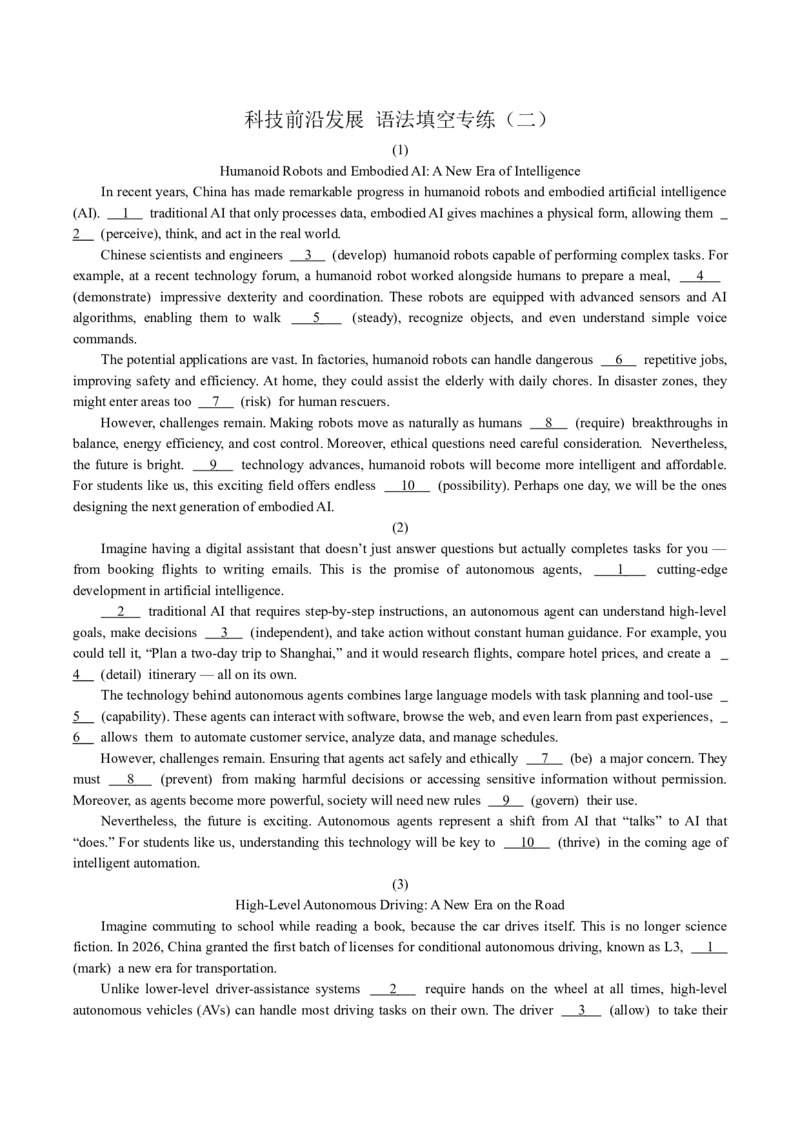
In recent years, China has made remarkable progress in humanoid robots and embodied artificial intelligence
(AI).
  1
   traditional AI that only processes data, embodied AI gives machines a physical form, allowing them
2
   (perceive), think, and act in the real world.
Chinese scientists and engineers
  3
   (develop) humanoid robots capable of performing complex tasks. For
example, at a recent technology forum, a humanoid robot worked alongside humans to prepare a meal,
  4

(demonstrate) impressive dexterity and coordination. These robots are equipped with advanced sensors and AI
algorithms, enabling them to walk
  5
   (steady), recognize objects, and even understand simple voice
commands.
The potential applications are vast. In factories, humanoid robots can handle dangerous
  6
   repetitive jobs,
improving safety and efficiency. At home, they could assist the elderly with daily chores. In disaster zones, they
might enter areas too
  7
   (risk) for human rescuers.
However, challenges remain. Making robots move as naturally as humans
  8
   (require) breakthroughs in
balance, energy efficiency, and cost control. Moreover, ethical questions need careful consideration. Nevertheless,
the future is bright.
  9
   technology advances, humanoid robots will become more intelligent and affordable.
For students like us, this exciting field offers endless
  10

   (possibility). Perhaps one day, we will be the ones
designing the next generation of embodied AI.
(2)
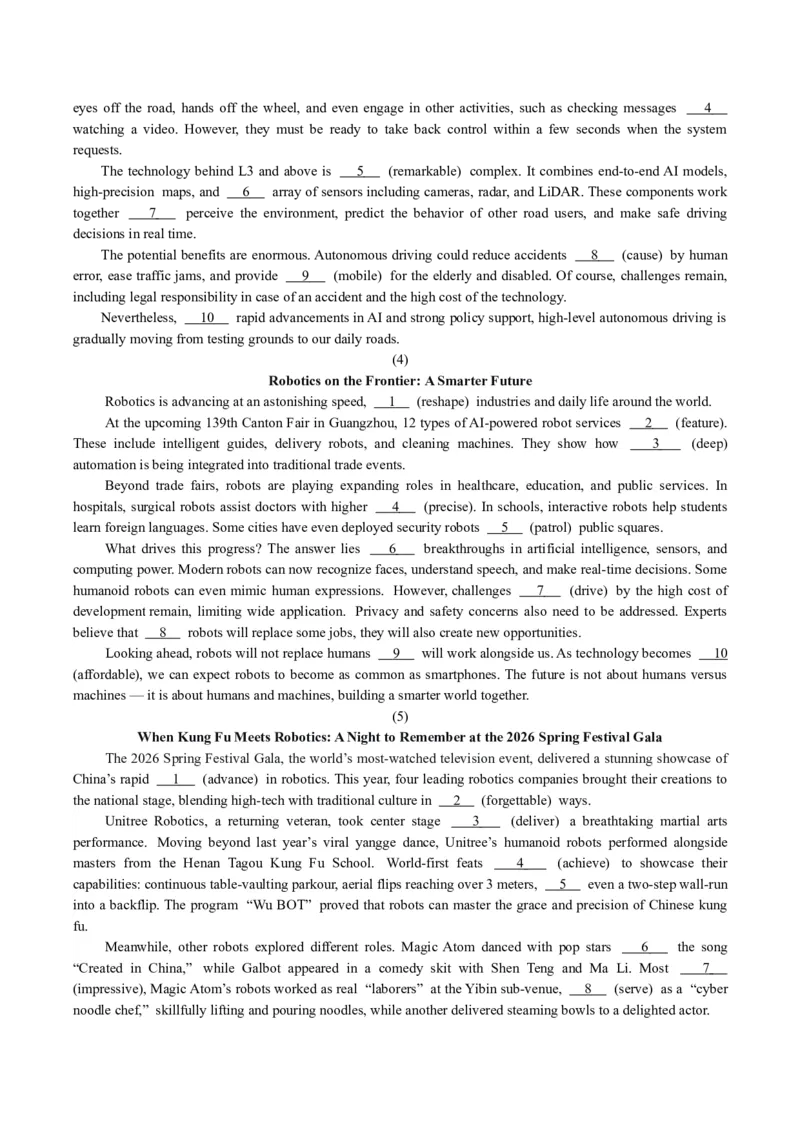
Imagine having a digital assistant that doesn’t just answer questions but actually completes tasks for you —
from booking flights to writing emails. This is the promise of autonomous agents,
  1
   cutting-edge
development in artificial intelligence.

  2
   traditional AI that requires step-by-step instructions, an autonomous agent can understand high-level
goals, make decisions
  3
   (independent), and take action without constant human guidance. For example, you
could tell it, “Plan a two-day trip to Shanghai,” and it would research flights, compare hotel prices, and create a
4
   (detail) itinerary — all on its own.
The technology behind autonomous agents combines large language models with task planning and tool-use
5
   (capability). These agents can interact with software, browse the web, and even learn from past experiences,
6
   allows them to automate customer service, analyze data, and manage schedules.
However, challenges remain. Ensuring that agents act safely and ethically
  7
   (be) a major concern. They
must
  8
   (prevent) from making harmful decisions or accessing sensitive information without permission.
Moreover, as agents become more powerful, society will need new rules
  9
   (govern) their use.
Nevertheless, the future is exciting. Autonomous agents represent a shift from AI that “talks” to AI that
“does.” For students like us, understanding this technology will be key to
  10

   (thrive) in the coming age of
intelligent automation.
(3)
High-Level Autonomous Driving: A New Era on the Road
Imagine commuting to school while reading a book, because the car drives itself. This is no longer science
fiction. In 2026, China granted the first batch of licenses for conditional autonomous driving, known as L3,
  1

(mark) a new era for transportation.
Unlike lower-level driver-assistance systems
  2
   require hands on the wheel at all times, high-level
autonomous vehicles (AVs) can handle most driving tasks on their own. The driver
  3
   (allow) to take their
eyes off the road, hands off the wheel, and even engage in other activities, such as checking messages
  4

watching a video. However, they must be ready to take back control within a few seconds when the system
requests.
The technology behind L3 and above is
  5
   (remarkable) complex. It combines end-to-end AI models,
high-precision maps, and
  6
   array of sensors including cameras, radar, and LiDAR. These components work
together
  7
   perceive the environment, predict the behavior of other road users, and make safe driving
decisions in real time.
The potential benefits are enormous. Autonomous driving could reduce accidents
  8
   (cause) by human
error, ease traffic jams, and provide
  9
   (mobile) for the elderly and disabled. Of course, challenges remain,
including legal responsibility in case of an accident and the high cost of the technology.
Nevertheless,
  10

   rapid advancements in AI and strong policy support, high-level autonomous driving is
gradually moving from testing grounds to our daily roads.
(4)
Robotics on the Frontier: A Smarter Future
Robotics is advancing at an astonishing speed,
  1
   (reshape) industries and daily life around the world.
At the upcoming 139th Canton Fair in Guangzhou, 12 types of AI-powered robot services
  2
   (feature).
These include intelligent guides, delivery robots, and cleaning machines. They show how
  3
   (deep)
automation is being integrated into traditional trade events.
Beyond trade fairs, robots are playing expanding roles in healthcare, education, and public services. In
hospitals, surgical robots assist doctors with higher
  4
   (precise). In schools, interactive robots help students
learn foreign languages. Some cities have even deployed security robots
  5
   (patrol) public squares.
What drives this progress? The answer lies
  6
   breakthroughs in artificial intelligence, sensors, and
computing power. Modern robots can now recognize faces, understand speech, and make real-time decisions. Some
humanoid robots can even mimic human expressions. However, challenges
  7
   (drive) by the high cost of
development remain, limiting wide application. Privacy and safety concerns also need to be addressed. Experts
believe that
  8
   robots will replace some jobs, they will also create new opportunities.
Looking ahead, robots will not replace humans
  9
   will work alongside us. As technology becomes
  10

(affordable), we can expect robots to become as common as smartphones. The future is not about humans versus
machines — it is about humans and machines, building a smarter world together.
(5)
When Kung Fu Meets Robotics: A Night to Remember at the 2026 Spring Festival Gala
The 2026 Spring Festival Gala, the world’s most-watched television event, delivered a stunning showcase of
China’s rapid
  1
   (advance) in robotics. This year, four leading robotics companies brought their creations to
the national stage, blending high-tech with traditional culture in
  2
   (forgettable) ways.
Unitree Robotics, a returning veteran, took center stage
  3
   (deliver) a breathtaking martial arts
performance. Moving beyond last year’s viral yangge dance, Unitree’s humanoid robots performed alongside
masters from the Henan Tagou Kung Fu School. World-first feats
  4
   (achieve) to showcase their
capabilities: continuous table-vaulting parkour, aerial flips reaching over 3 meters,
  5
   even a two-step wall-run
into a backflip. The program “Wu BOT” proved that robots can master the grace and precision of Chinese kung
fu.
Meanwhile, other robots explored different roles. Magic Atom danced with pop stars
  6
   the song
“Created in China,” while Galbot appeared in a comedy skit with Shen Teng and Ma Li. Most
  7

(impressive), Magic Atom’s robots worked as real “laborers” at the Yibin sub-venue,
  8
   (serve) as a “cyber
noodle chef,” skillfully lifting and pouring noodles, while another delivered steaming bowls to a delighted actor.
These performances are not merely for show. They demonstrate
  9
   Chinese robotics is moving from
laboratories into real-world applications—from factories to restaurants, and maybe one day, into our homes. The
gala proved that technology and tradition can dance together,
  10

   (create) a future that is both smart and
soulful.