各地最新高考模拟卷 语法填空汇编(二)
(1)
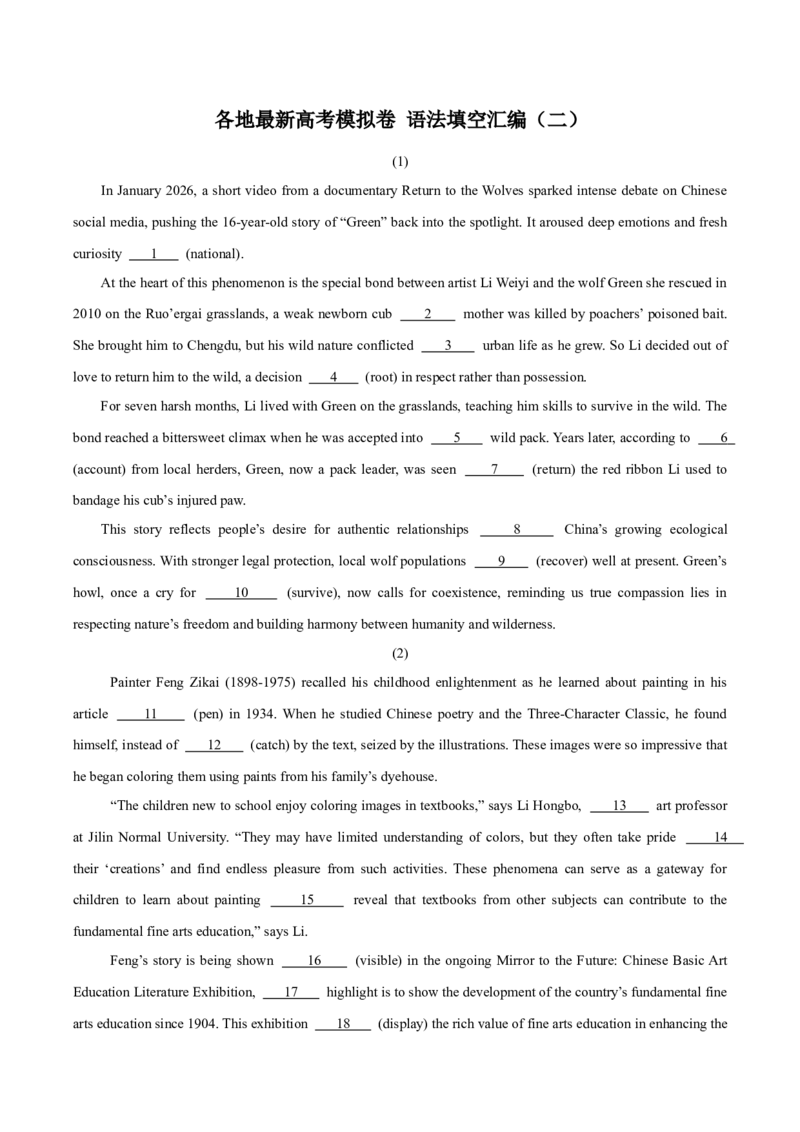
In January 2026, a short video from a documentary Return to the Wolves sparked intense debate on Chinese
social media, pushing the 16-year-old story of “Green” back into the spotlight. It aroused deep emotions and fresh
curiosity    1    (national).
At the heart of this phenomenon is the special bond between artist Li Weiyi and the wolf Green she rescued in
2010 on the Ruo’ergai grasslands, a weak newborn cub    2    mother was killed by poachers’ poisoned bait.
She brought him to Chengdu, but his wild nature conflicted    3    urban life as he grew. So Li decided out of
love to return him to the wild, a decision    4    (root) in respect rather than possession.
For seven harsh months, Li lived with Green on the grasslands, teaching him skills to survive in the wild. The
bond reached a bittersweet climax when he was accepted into    5    wild pack. Years later, according to    6
(account) from local herders, Green, now a pack leader, was seen    7    (return) the red ribbon Li used to
bandage his cub’s injured paw.
This story reflects people’s desire for authentic relationships    8    China’s growing ecological
consciousness. With stronger legal protection, local wolf populations    9    (recover) well at present. Green’s
howl, once a cry for    10    (survive), now calls for coexistence, reminding us true compassion lies in
respecting nature’s freedom and building harmony between humanity and wilderness.
(2)
Painter Feng Zikai (1898-1975) recalled his childhood enlightenment as he learned about painting in his
article    11    (pen) in 1934. When he studied Chinese poetry and the Three-Character Classic, he found
himself, instead of    12    (catch) by the text, seized by the illustrations. These images were so impressive that
he began coloring them using paints from his family’s dyehouse.
“The children new to school enjoy coloring images in textbooks,” says Li Hongbo,    13    art professor
at Jilin Normal University. “They may have limited understanding of colors, but they often take pride    14
their ‘creations’ and find endless pleasure from such activities. These phenomena can serve as a gateway for
children to learn about painting    15    reveal that textbooks from other subjects can contribute to the
fundamental fine arts education,” says Li.
Feng’s story is being shown    16    (visible) in the ongoing Mirror to the Future: Chinese Basic Art
Education Literature Exhibition,    17    highlight is to show the development of the country’s fundamental fine
arts education since 1904. This exhibition    18    (display) the rich value of fine arts education in enhancing the
ability to appreciate beauty, cultivate the soul and stimulate innovation. It also makes possible the    19
(integrate) of the rich resources into the field of education, giving full play to    20    (they) roles of preserving
history and educating people.
(3)
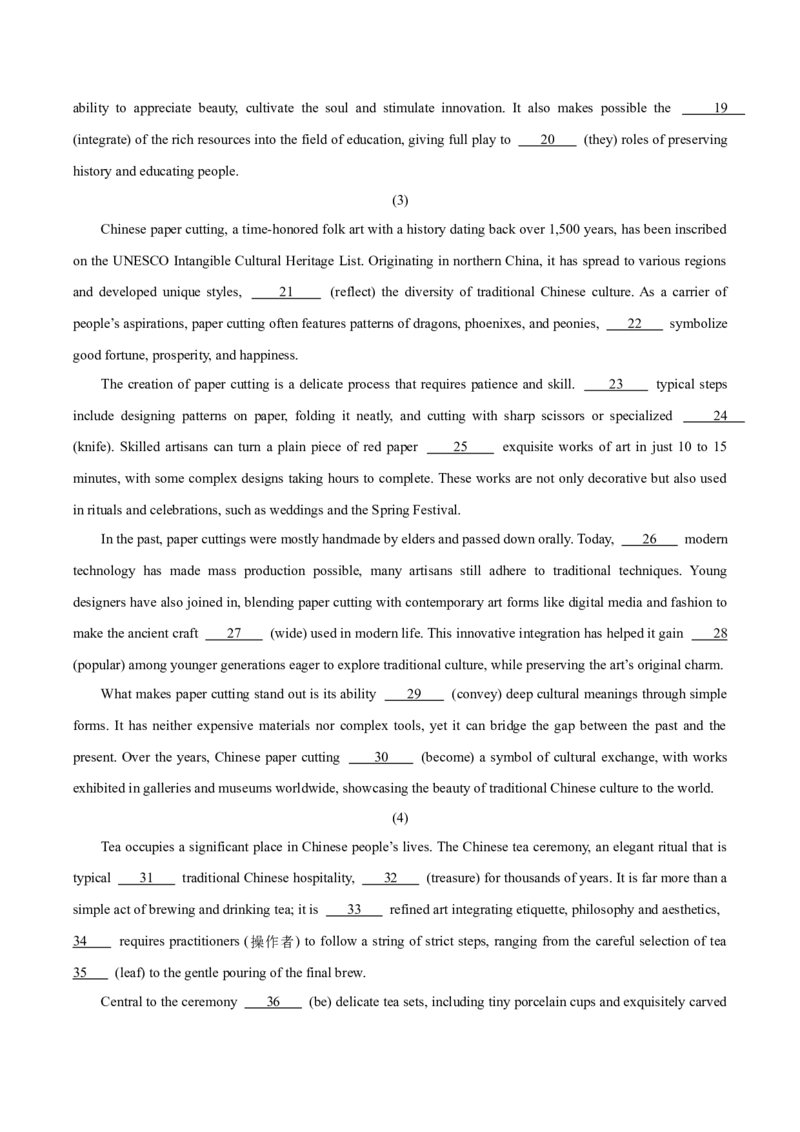
Chinese paper cutting, a time-honored folk art with a history dating back over 1,500 years, has been inscribed
on the UNESCO Intangible Cultural Heritage List. Originating in northern China, it has spread to various regions
and developed unique styles,    21    (reflect) the diversity of traditional Chinese culture. As a carrier of
people’s aspirations, paper cutting often features patterns of dragons, phoenixes, and peonies,    22    symbolize
good fortune, prosperity, and happiness.
The creation of paper cutting is a delicate process that requires patience and skill.    23    typical steps
include designing patterns on paper, folding it neatly, and cutting with sharp scissors or specialized    24
(knife). Skilled artisans can turn a plain piece of red paper    25    exquisite works of art in just 10 to 15
minutes, with some complex designs taking hours to complete. These works are not only decorative but also used
in rituals and celebrations, such as weddings and the Spring Festival.
In the past, paper cuttings were mostly handmade by elders and passed down orally. Today,    26    modern
technology has made mass production possible, many artisans still adhere to traditional techniques. Young
designers have also joined in, blending paper cutting with contemporary art forms like digital media and fashion to
make the ancient craft    27    (wide) used in modern life. This innovative integration has helped it gain    28
(popular) among younger generations eager to explore traditional culture, while preserving the art’s original charm.
What makes paper cutting stand out is its ability    29    (convey) deep cultural meanings through simple
forms. It has neither expensive materials nor complex tools, yet it can bridge the gap between the past and the
present. Over the years, Chinese paper cutting    30    (become) a symbol of cultural exchange, with works
exhibited in galleries and museums worldwide, showcasing the beauty of traditional Chinese culture to the world.
(4)
Tea occupies a significant place in Chinese people’s lives. The Chinese tea ceremony, an elegant ritual that is
typical    31    traditional Chinese hospitality,    32    (treasure) for thousands of years. It is far more than a
simple act of brewing and drinking tea; it is    33    refined art integrating etiquette, philosophy and aesthetics,
34    requires practitioners (操作者) to follow a string of strict steps, ranging from the careful selection of tea
35    (leaf) to the gentle pouring of the final brew.
Central to the ceremony    36    (be) delicate tea sets, including tiny porcelain cups and exquisitely carved
teapots, with the most valued ones    37    (measure) no more than a few centimeters in height. These small
vessels are believed    38    (lock) in the tea’s rich aroma and enhance its flavor, turning a casual drink into a
profound    39    (sense) experience.
Hosts usually serve tea to guests with both hands to show respect,    40    guests respond by tapping the
table twice to express gratitude. This quiet and graceful ceremony showcases the ancient wisdom of harmony.
(5)
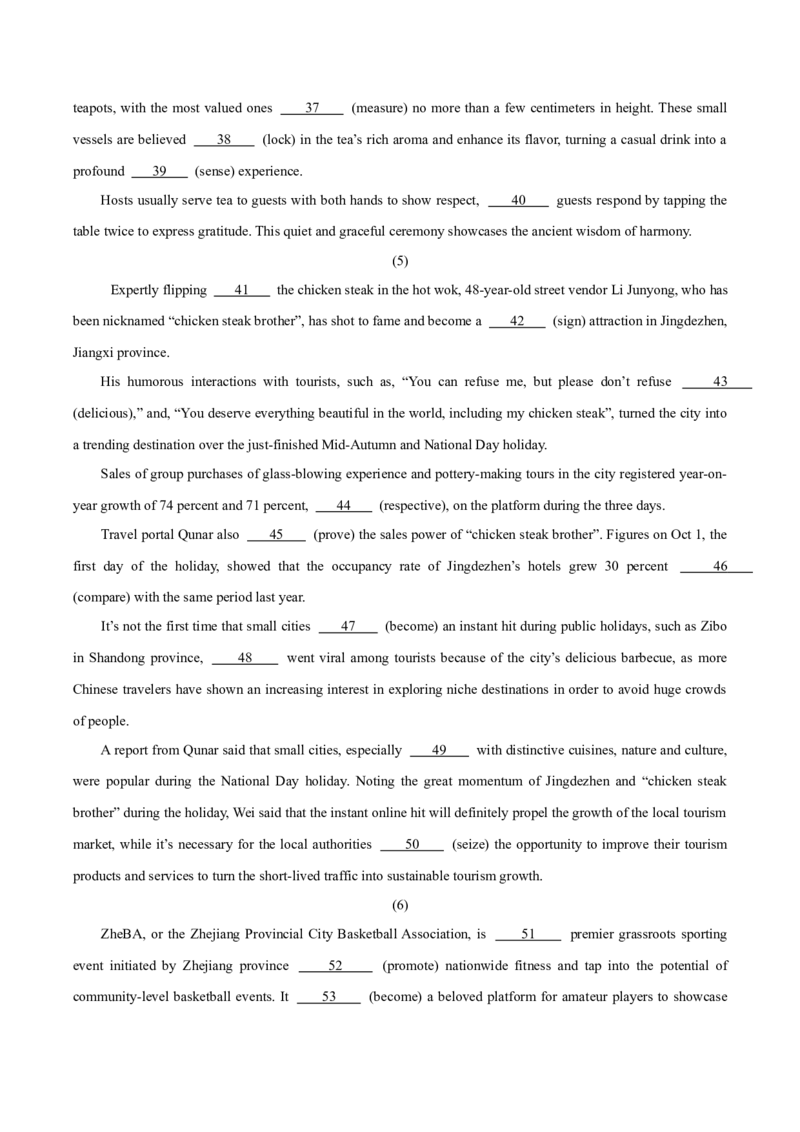
Expertly flipping    41    the chicken steak in the hot wok, 48-year-old street vendor Li Junyong, who has
been nicknamed “chicken steak brother”, has shot to fame and become a    42    (sign) attraction in Jingdezhen,
Jiangxi province.
His humorous interactions with tourists, such as, “You can refuse me, but please don’t refuse    43

(delicious),” and, “You deserve everything beautiful in the world, including my chicken steak”, turned the city into
a trending destination over the just-finished Mid-Autumn and National Day holiday.
Sales of group purchases of glass-blowing experience and pottery-making tours in the city registered year-on-
year growth of 74 percent and 71 percent,    44    (respective), on the platform during the three days.
Travel portal Qunar also    45    (prove) the sales power of “chicken steak brother”. Figures on Oct 1, the
first day of the holiday, showed that the occupancy rate of Jingdezhen’s hotels grew 30 percent    46

(compare) with the same period last year.
It’s not the first time that small cities    47    (become) an instant hit during public holidays, such as Zibo
in Shandong province,    48    went viral among tourists because of the city’s delicious barbecue, as more
Chinese travelers have shown an increasing interest in exploring niche destinations in order to avoid huge crowds
of people.
A report from Qunar said that small cities, especially    49    with distinctive cuisines, nature and culture,
were popular during the National Day holiday. Noting the great momentum of Jingdezhen and “chicken steak
brother” during the holiday, Wei said that the instant online hit will definitely propel the growth of the local tourism
market, while it’s necessary for the local authorities    50    (seize) the opportunity to improve their tourism
products and services to turn the short-lived traffic into sustainable tourism growth.
(6)
ZheBA, or the Zhejiang Provincial City Basketball Association, is    51    premier grassroots sporting
event initiated by Zhejiang province    52    (promote) nationwide fitness and tap into the potential of
community-level basketball events. It    53    (become) a beloved platform for amateur players to showcase
their skills and for local residents to embrace the joy of sports to date.
On the evening of July 6, the opening match of the 2025 ZheBA was held in Zhuji, Shaoxing, marking the
official launch of the province’s    54    (large) grassroots basketball competition.
The Association spans all 11 cities and 90 counties across the province and    55    (structure) into two
phases. The first phase is the“Hundred counties Battle” preliminary round (预赛) taking place in July, during     56
11 county-level champion teams emerged after fierce round-robin matches. The second phase—the City
Championship—is running from August 8 to February. At this stage, 22 teams,    57    (compose) of the 11
county champions and 11 city-level joint teams, are competing in a mixed format    58    the ultimate provincial
title.
Using basketball as a unifying force, Zhejiang is promoting a deeper integration of mass fitness and local
culture,    59    (inject) fresh vitality into grassroots sports development. This basketball celebration is set to
ignite the sporting    60    (enthusiastic) of people across the province, strengthening community bonds and
fostering a healthier, more active lifestyle for all participants and spectators alike.
(7)
Over the past few years, a fascinating cultural phenomenon    61    (emerge) across China: a growing
number of foreign tourists are    62    (enthusiastic) embracing traditional Chinese clothing like Hanfu. At
iconic sites such as the Forbidden City, visitors can    63    (see) dressed in exquisite Hanfu, posing for photos
against historic backdrops. This trend reflects a deeper appreciation for    64    profound cultural heritage rather
than mere curiosity.
This stylish wave is also taking over short video platforms like TikTok,    65   , observers say, is a symbol
of China’s booming national confidence. On TikTok, the Hanfu hashtag (话题标签) has collected billions of views,
66    foreigners sharing their photoshots and expressing how wearing Hanfu makes them feel like super stars in
Chinese dramas. Meanwhile, Chinese content creators and bloggers have been actively promoting Hanfu overseas,
organizing activities    67    (introduce) the stories behind the clothing.
This exchange is mutually enriching: foreigners gain meaningful immersion into Chinese traditions,    68
Chinese youth find creative channels to share their heritage. The    69    (blend) of traditional clothing with
modern fashion and media has not only boosted cultural confidence but also created new consumption scenarios,
turning Hanfu into a dynamic symbol of    70    (China) soft power.
(8)
Su Shi was a poet, politician and educator, but he had many other strings to his bow. One of the many talents
of this    71    (amaze) clever and creative man was cooking. By far and away his most famous dish is Dongpo
Pork.
Su Shi was also a master calligrapher,    72    (rank) first of the four great calligraphers of the Song
Dynasty. Prior to his adulthood, he had studied the calligraphy of Wang Xizhi and later on in life, he turned to the
works of Yan Zhenqing. Nonetheless, Su Shi’s calligraphy reflected his open nature and desire for self-expression.
His “Cold Food Observance”    73    (tell) of his time in exile (流放). The rising and falling strokes (笔法) are
expressions of Su Shi’ s emotions, and    74    the story builds, so do the characters.
In addition to being a gifted calligrapher, Su Shi was a    75    (distinguish) painter. The trees, rocks and
76    (bamboo) he produced with a few twists and turns of his paintbrush were free and simple in style, but varied
and expressive in meaning. To Su Shi, an old tree was particularly    77    (symbol), as it represented surviving
difficult times but still    78    (continue) to stand tall and grow. Su Shi’s perspectives    79    the art of
painting were also innovative. Through his painting, he began to explore    80    an artist could express their
innermost thoughts and experiences through their works. In his eyes, painting was poetry, and poetry was painting.