临高县新盈中学2024-2025 学年高一下学期
期末考试英语试题
(满分:150 分  考试时间:120 分钟)
第一部分 听力(共两节,满分30 分)
第一节(共5 小题;每小题1.5 分,满分7.5 分)
听下面5 段对话。每段对话后有一个小题,从题中所给的A、B、C 三个选项中选出最
佳选项,听完每段对话后,你都有10 秒钟的时间来回答有关小题和阅读下一小题。每段对
话仅读一遍。
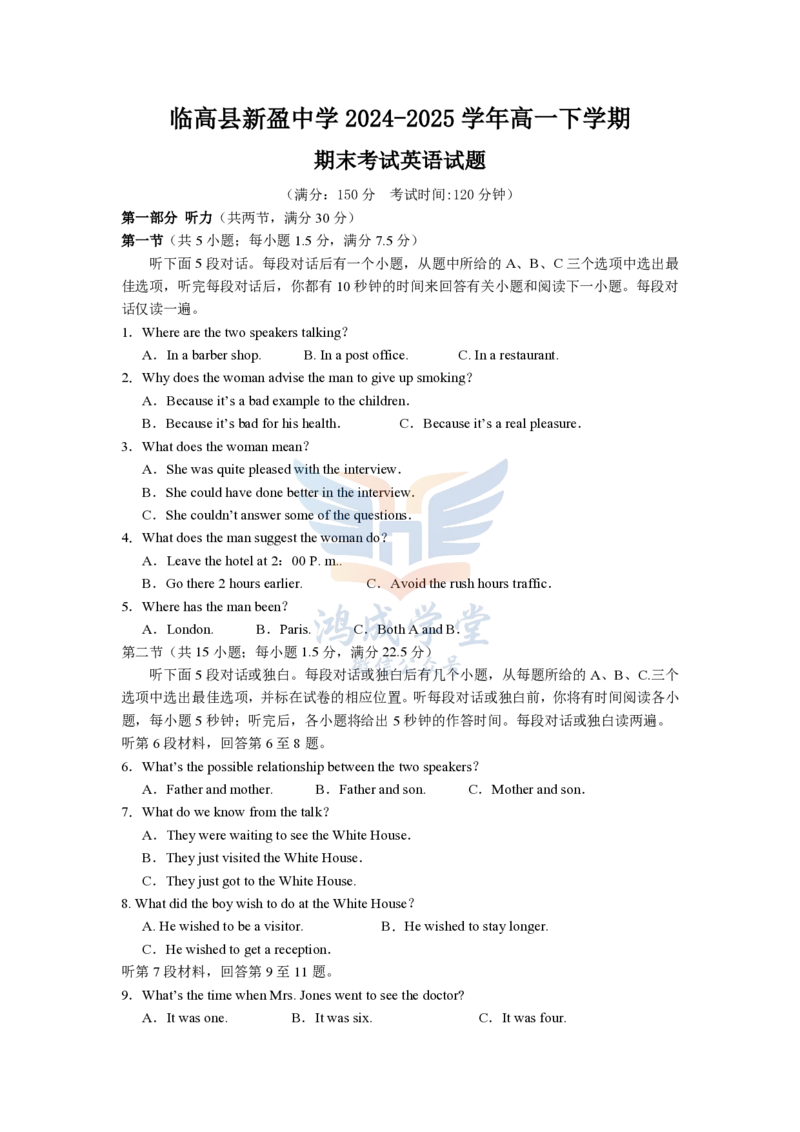
1.Where are the two speakers talking?
   A.In a barber shop.
B. In a post office.
C. In a restaurant.
2.Why does the woman advise the man to give up smoking?
   A.Because it’s a bad example to the children.
   B.Because it’s bad for his health.
C.Because it’s a real pleasure.
3.What does the woman mean?
   A.She was quite pleased with the interview.
   B.She could have done better in the interview.
   C.She couldn’t answer some of the questions.
4.What does the man suggest the woman do?
   A.Leave the hotel at 2:00 P. m..
   B.Go there 2 hours earlier.
C.Avoid the rush hours traffic.
5.Where has the man been?
   A.London.
B.Paris.
C.Both A and B.
第二节(共15 小题;每小题1.5 分,满分22.5 分)
听下面5 段对话或独白。每段对话或独白后有几个小题,从每题所给的A、B、C.三个
选项中选出最佳选项,并标在试卷的相应位置。听每段对话或独白前,你将有时间阅读各小
题,每小题5 秒钟;听完后,各小题将给出5 秒钟的作答时间。每段对话或独白读两遍。
听第6 段材料,回答第6 至8 题。
6.What’s the possible relationship between the two speakers?
   A.Father and mother.
B.Father and son.
C.Mother and son.
7.What do we know from the talk?
   A.They were waiting to see the White House.
   B.They just visited the White House.
   C.They just got to the White House.
8. What did the boy wish to do at the White House?
   A. He wished to be a visitor.
B.He wished to stay longer.
   C.He wished to get a reception.
听第7 段材料,回答第9 至11 题。
9.What’s the time when Mrs. Jones went to see the doctor?
   A.It was one.
B.It was six.
C.It was four.
10.What’s the doctor’s suggestion?

A.Having some milk and soup as much as she can.

B.Having some milk,porridge and soup for meals for two days.

C.Having some milk,porridge and soup for meals for three days.
11.Which following statement is CORRECT?

A.The doctor pulled the woman’s tooth at last.
B.The woman was told to come back three days later to have a check-up.
   C.The doctor gave her pills and told her to take two three times a day.
听第8 段材料,回答第12 至14 题。
12.Where are the man and the woman?

A.In a hotel.
B.In a store.
C.In a restaurant.
13.What does the man need from the store?

A.  A toothbrush and some envelopes.

B.A toothbrush and some stamps.
C.A pen and a toothbrush.
14.Where is the store that is still open?

A.On the left side of the hall.
B.On the right side of the hall.

C.Just ten minutes’ walk from the hotel.
听第9 段材料,回答第15 至16 题。
15.What’s the possible relationship between the two speakers?

A.Colleagues.
B. Classmates.
C. Student and teacher
16.Who bought a new dictionary?

A.Peter.
B.Rebecca.
C.Neither of them.
听第10 段材料,回答第17 至20 题。
17.Where did congressman Haines like to talk with his close friends?

A. In the drawing room(客厅).
B.In the sun room.
C.In the
kitchen.
18.When did congressman Haines die?

A.In 1880.
B.In 1990.
C.In 1915.
19. In addition to(除了)being a congressman,what else was Haines?

A.A professor.
B. A judge.
C.A governor.
20.What did Mrs. Haines love to do?

A.Write letters.
B. Play the violin.
C. Grow plants.
第二部分 阅读理解(共两节,满分50 分)
第一节(共15 题;每小题2.5 分,满分37.5 分)

阅读下列短文,从每题所给的A、B、C 和D 四个选项中,选出最佳选项。
A
Restaurants in the USA
Steve’s Pizza
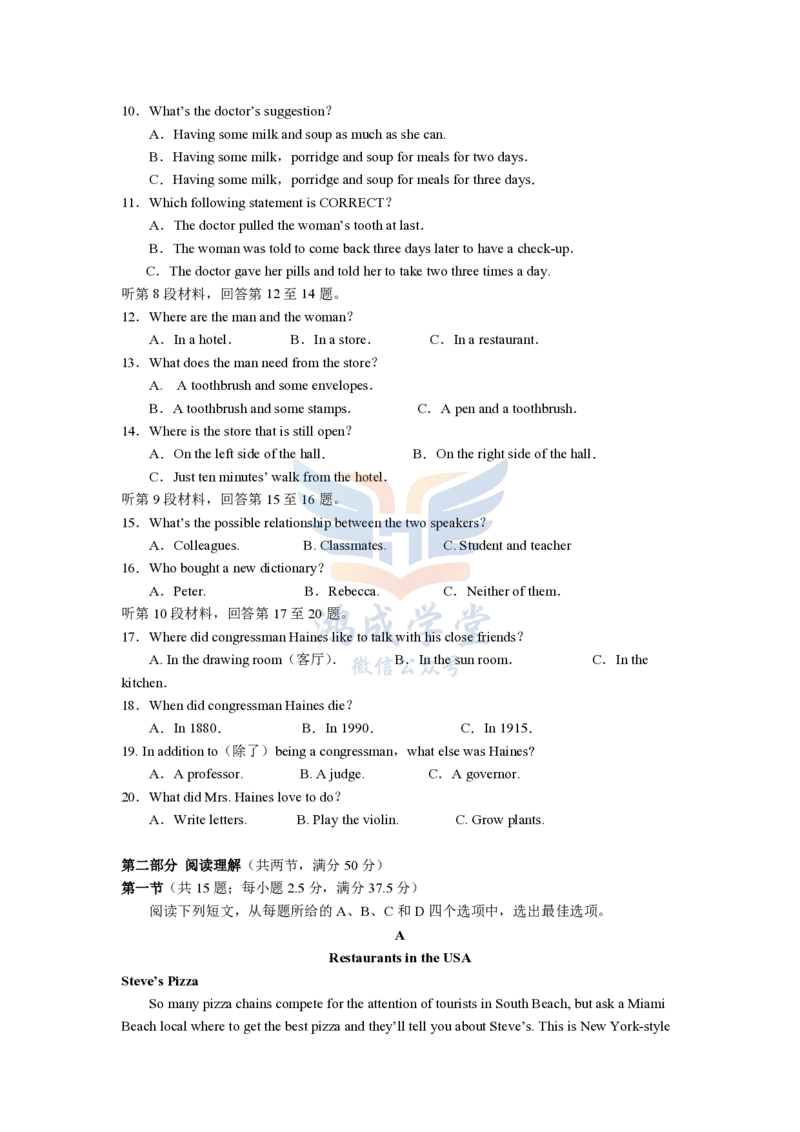
So many pizza chains compete for the attention of tourists in South Beach, but ask a Miami
Beach local where to get the best pizza and they’ll tell you about Steve’s. This is New York-style
pizza, handmade with care and good ingredients. New branches of Steve’s are opening elsewhere
in Miami, all in non-tourist areas.
Opening hours: 11am.-3am.
Cattleman’s Steakhouse
This place is 20 miles east of the city, but local folks would probably drive 200 miles to eat
here. The food is good, and the scenery is even better. Come early and wander around the grounds
of Indian Cliffs Ranch, where you’ll see everything from rabbits to buffalo (水牛), then catch the
sunset either before or after your meal.
Opening hours: 5pm.-10pm.
Absolute Baking & Cafe
The screen door is always swinging open at this town hot spot with giant breakfasts. Try the
green chili on eggs--it’s made from scratch, as are the organic breads. Lunch includes salads, big
sandwiches and local grass-fed beef burgers. Don’t miss a square of soft, fresh carrot cake.
Opening hours: 7am.-2pm.
Walt’s Wharf
Everybody’s favorite for fresh fish (some drive in from LA), Walt’s packs them in on
weekends. You can’t make reservations for dinner (though they’re accepted for lunch), but it’s
worth the wait for the tree fire-grilled seafood and steaks in the many-windowed ground floor or
upstairs in captain’s chairs.
Opening hours: 11am.-3:30pm.
21. A tourist arriving at midnight may go to __________.
A. Steve’s Pizza
 B. Cattleman’s Steakhouse
C. Absolute Baking & Cafe
D. Walt’s Wharf
22. Besides good food, you can also enjoy wonderful __________ at Cattleman’s Steakhouse.
A. wine
   B. discount
C. service
D. view
23. From the passage we learn that customers can’t __________.
A. reserve a table for dinner at Walt’s Wharf
B. expect new branches of Steve’s in non-tourist areas
C. enjoy a beautiful sight at Cattleman’s Steakhouse
D. have a good breakfast at Absolute Baking & Cafe
B
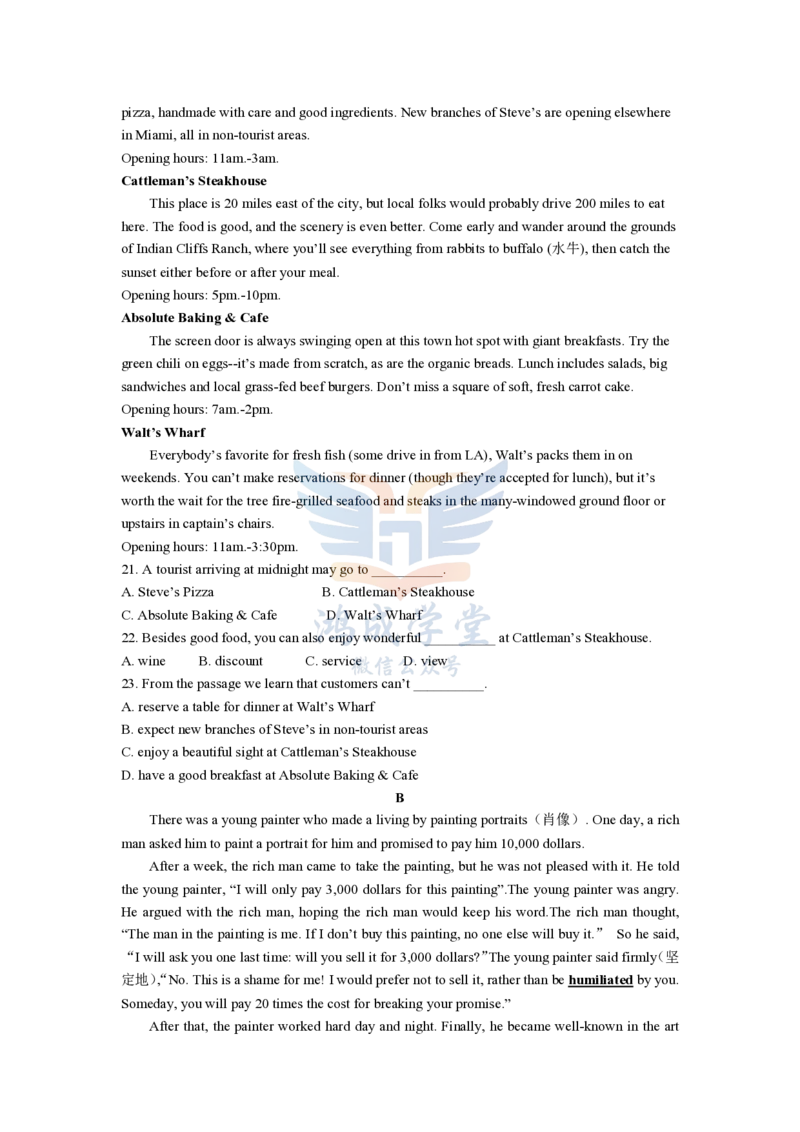
There was a young painter who made a living by painting portraits(肖像). One day, a rich
man asked him to paint a portrait for him and promised to pay him 10,000 dollars.
After a week, the rich man came to take the painting, but he was not pleased with it. He told
the young painter, “I will only pay 3,000 dollars for this painting”.The young painter was angry.
He argued with the rich man, hoping the rich man would keep his word.The rich man thought,
“The man in the painting is me. If I don’t buy this painting, no one else will buy it.” So he said,
“I will ask you one last time: will you sell it for 3,000 dollars?”The young painter said firmly(坚
定地),“No. This is a shame for me! I would prefer not to sell it, rather than be humiliated by you.
Someday, you will pay 20 times the cost for breaking your promise.”
After that, the painter worked hard day and night. Finally, he became well-known in the art
world.The rich man forgot about the artist and what he had told him. But one day, some friends
told him, “There is a painting selling for 200,000 dollars and the man in the painting looks exactly
like you. It has a name of “Thief(贼)”.Then, the rich man remembered the artist. He quickly
went to say sorry and paid 200,000 dollars to buy the portrait. The young painter made the rich
man lower his head in the end.
24. The rich man would only pay 3,000 dollars for the painting because ______.
A. he didn't have 10.000 dollars
B. he wasn’t very satisfied with it
C. he thought others would buy it
D. he didn’t like the young painter
25. The painter became famous by______.
A. working hard
B. making friends
C. making a lot of money
D.selling many paintings
26. The underlined word “humiliated” means “______” in Chinese.
A.欺骗
B.吓唬
C.羞辱
D.责骂
27. The man in the painting with the name “Thief” is ______.
A. the artist
B. the rich man
C. the rich man's friend
D.the artist’s family
28. What happened at the end of the story?
A. The rich man kept his promise
B. The rich man fought with the painter
C. The rich man was punished by the painter
D. The rich man stole the painting
C
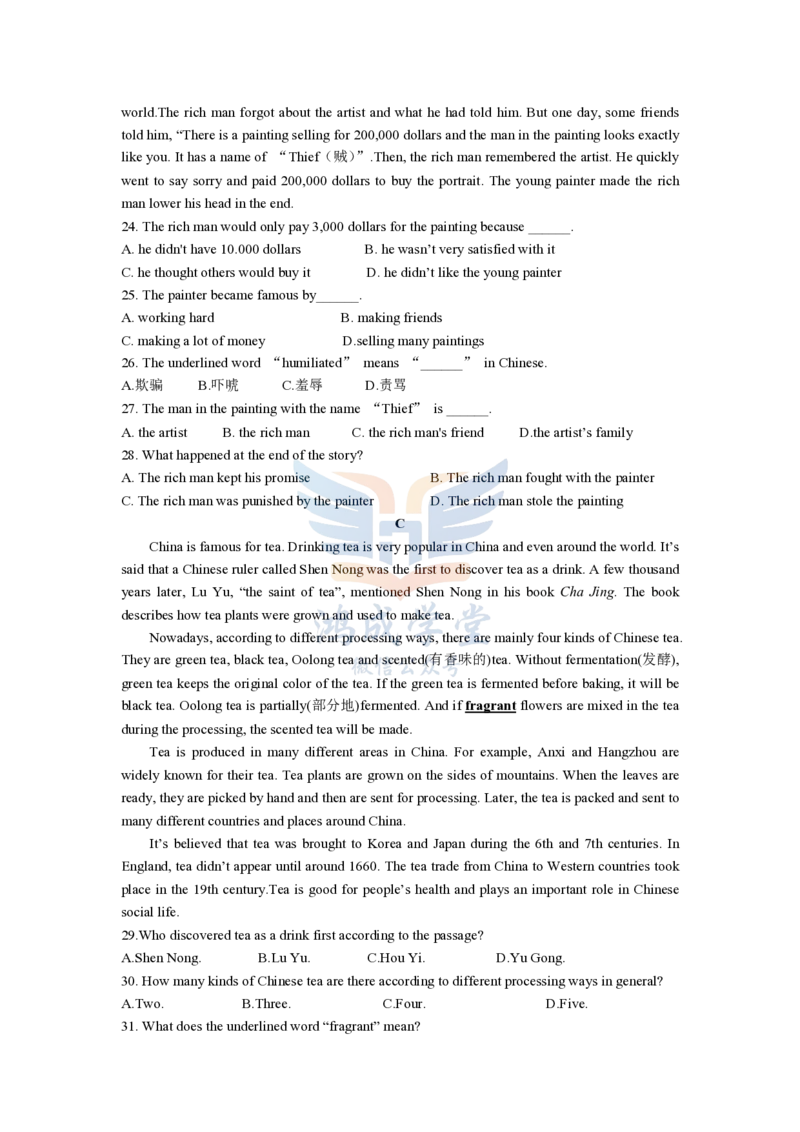
China is famous for tea. Drinking tea is very popular in China and even around the world. It’s
said that a Chinese ruler called Shen Nong was the first to discover tea as a drink. A few thousand
years later, Lu Yu, “the saint of tea”, mentioned Shen Nong in his book Cha Jing. The book
describes how tea plants were grown and used to make tea.
Nowadays, according to different processing ways, there are mainly four kinds of Chinese tea.
They are green tea, black tea, Oolong tea and scented(有香味的)tea. Without fermentation(发酵),
green tea keeps the original color of the tea. If the green tea is fermented before baking, it will be
black tea. Oolong tea is partially(部分地)fermented. And if fragrant flowers are mixed in the tea
during the processing, the scented tea will be made.
Tea is produced in many different areas in China. For example, Anxi and Hangzhou are
widely known for their tea. Tea plants are grown on the sides of mountains. When the leaves are
ready, they are picked by hand and then are sent for processing. Later, the tea is packed and sent to
many different countries and places around China.
It’s believed that tea was brought to Korea and Japan during the 6th and 7th centuries. In
England, tea didn’t appear until around 1660. The tea trade from China to Western countries took
place in the 19th century.Tea is good for people’s health and plays an important role in Chinese
social life.
29.Who discovered tea as a drink first according to the passage?
A.Shen Nong.
B.Lu Yu.
C.Hou Yi.
D.Yu Gong.
30. How many kinds of Chinese tea are there according to different processing ways in general?
A.Two.
B.Three.
C.Four.
D.Five.
31. What does the underlined word “fragrant” mean?
A.悦耳的
B.难闻的
C.难看的
D.芳香的
D
Optimism (乐观) doesn’t mean paying no attention to things that cause stress. But when bad
things happen, optimistic people are less likely to be unhappy about themselves and more likely to
see the bad things as something that lasts a short time.
A new research has found a direct connection between optimism and healthier diet and
exercise behaviors, as well as better heart health, a stronger immune system (免疫系统), better
lung function, and lower death risk. “Optimistic people, whether they are male or female, often
have goals and the confidence to reach them,” Lee said. “Those goals could include healthy habits
that contribute to a longer life.”
Studies find only about 25% of our optimism is controlled by our genes, and the rest is up to
us. It turns out we can actually train our brain to be more positive. Researchers studied the brains
of monks (僧侣) and found surprising results: Tens of thousands of hours of deep thinking had
changed the function of their brains, which support positive qualities. And that may be key in
producing the effect on the body.
There are simple mental exercises to develop an optimistic attitude. One of the most effective
ways to increase optimism is called the “Best Possible Self” method. That is to imagine ourselves
in a future in which we have achieved all our life goals. And keeping a diary in which we list the
positive experiences we had can also help shape our attitude. Taking a few minutes each day to
write down what makes us thankful can improve our view on life, too.
32. What is the meaning of Lee’s words?
A. Goals can lead to confidence.
B. Better lung function lowers death risk.
C. Optimism is connected with length of life.
D. Sex should be taken into consideration when studying optimism.
33. Why are the brains of monks studied?
A. To lengthen their life.
B. To improve their brains’ function.
C. To prove optimism can be learned.
D. To show genes’ connection with optimism.
34. What is the last paragraph mainly about?
A. How to be a positive person.

B. How to make people thankful.
C. What to write about in a diary.
D. What to do to achieve the goals.
35. Where is this text most likely from?
A. A science magazine.
B. A guidebook.
C. A novel.   D. A diary.
第二节(共5 小题;每小题2 分,满分10 分)
根据短文内容,从短文后的选项中选出能填入空白处的最佳选项。选项中有两项为多余
选项。
Are you truly happy? Do you ever know what it means to be happy and what it takes to
achieve happiness?   36   . The following are a few tips that I follow to create happiness in my
life.
Make a plan for attaining goals that you believe will make you happy. Your moods will very
likely increase if you are going after something you value.
Surround yourself with happy people. It is easy to begin to think negatively when you are
surrounded by people who think that way.   37  .
When something goes wrong, try to figure out a solution instead of being absorbed in self
pity. Truly happy people don’t allow setbacks to affect their mood because they know that with a
little thought they can turn the circumstances back to their favor.
  38  . These few minutes will give you the opportunity to focus on the positive things in
your life and will lead you to continuous happiness.
  39  . Whether you treat yourself to lunch, take a long, relaxing bath or simply spend a few
extra minutes on your appearance, you will be subconsciously (下意识地) putting yourself in a
better mood.
Finding the humor in situations can also lead to happiness. Find a way to make light of a
situation that would otherwise make you happy.
Keeping healthy is another way to achieve happiness.   40  .
A.What makes one person happy may be very different from what makes someone else happy.
B .On the contrary, if you are around people who are happy, their emotional state will be
infectious.
C.Being overweight or not eating nutritious foods can have a negative effect on your mood.
D.These are important questions for anyone who is seeking happiness to ask themselves.
E.Spend a few minutes each day thinking about the things that make you happy.
F.There are some tips in life that lead to happiness.
G.It’s also important to take some time each day to do something nice for yourself.
36.
 37.
 38.
39.
40.
第三部分 语言运用(共两节,满分25 分)
第一节(共15 小题;每小题1 分,满分15 分)
阅读下面短文,从每题所给的A、B、C、D 四个选项中选出可以填入空白处的最佳选
项。
I have a close childhood friend. He spent the last eight years attending night  41  to get his
bachelor’s degree (学士学位) while also doing a full-time job. Last month, after years of late
nights and weekends of studying, he  42   graduated.
He  43  in our hometown after high school,   44   most of his friends, myself included,
left long ago for other states for university and jobs. Over time, work, families, and other  45
have made it difficult for us all to be   46   in our hometown at the same time.
I put forward a wonderful idea: plan a weekend that we’d all be   47   to fly back to our
hometown to surprise him and celebrate his   48  . It was so much fun   49   the affair. The
bait (诱饵): his mom told him that he was going to have   50   with just his grandparents to
celebrate. Little did he know that the family dinner would   51   a 20-person affair with friends
from all around the states. I got to   52   a cake so that everyone   53   could enjoy it.
When the guest of honour arrived to “dinner with the   54  ”, he was greatly surprised and
told us it made him feel special. The “white lie” dinner plan was a great   55   for me.
41. A. club
 B. party
C. cafe
D. school
42. A. finally
B. quickly
C. suddenly
  D. luckily
43. A. taught
B. stayed
C. arrived
D. married
44. A. but

B. so

C. or

D. for
45. A. adventures
B. requests
C. experiences  D. arrangements
46. A. inside
B. apart
C. back

D. out
47. A. safe

B. eager
C. free

D. anxious
48. A. birthday

B. achievement
C. examination
D. wisdom
49. A. debating
B. studying
C. planning
  D. controlling
50. A. lunch

B. dinner
C. time

D. fun
51. A. turn into
B. give up
C. relate to
  D. focus on
52. A. sell

B. deliver
C. cut

D. order
53. A. attending
B. leaving
C. receiving
 D. tasting
54. A. teachers
B. grandparents
C. classmates D. friends
55. A. surprise
B. worry
C. success
 D. stress
第二节(共10 小题;每小题1 分,满分10 分)
阅读下面句子,在空白处填入括号内单词的正确形式。
56. Taking part in the celebration was a
(satisfy)experience for us.
57. Most of the people were
 (amaze) by the lion dances.
58. The child seemed
 (annoy) when he found his gift broken.
59. The man dressed in a ghost costume looks quite
 (frighten).
60. Her brother complained,
(think) of the high tuition tees.
61. The new People's Republic of China saw Dr Lin Qiaozhi
(play) a key role.
62. The child lay on her mother’s lap,
 (smile) sweetly.
63. He suddenly woke up at midnight when he heard someone
(knock) at his door.
64. You have kept me
 (wait) the whole morning.
65. She sat at the desk
(read) a newspaper.
第四部分 写作(共两节,满分40 分)
第一节(满分15 分)
春节是中国的传统节日,也是家家户户团圆的日子。假设你叫李华,你的美国朋友Tom
写信询问中国的春节以及庆祝情况。请你用英语写一封回信,内容包括:
1. 介绍春节的作用;
2. 节日准备及庆祝活动;
3. 谈谈你的感受。
注意:
1. 词数80 左右,开头和结尾已给出,不计入总词数;
2. 可适当增加细节,以使行文连贯。
Dear Tom,
I’m so glad to hear from you. Now I want to tell you about Chinese Spring Festival.


Yours,

Li Hua
第二节 读后续写(满分25 分)
阅读下面材料,根据其内容和所给段落开头语续写两段,使之构成一个完整的故事。
A farmer grew some vegetables in his garden. One day his wife was ill and he had no money
He had to sell some cabbages and carrots in the market.The next morning he took two baskets of
vegetables to town.But it was raining hard that afternoon and there were few people in the street.
When his vegetables were sold out,it was dark.He bought some medicine and hurried to his
village.
On his way home he saw a person lying on the snow.He placed his baskets on the ground and
was going to help the person to get up. At that time he found it was a dead man and there was
much blood on his body.He was so frightened that he ran away quickly,without taking the baskets
with him.
The next afternoon the farmer was sent to the police station.Having shown the baskets,a
officer asked,“Are these yours?”“Yes, sir.”the farmer answered timidly(胆怯地).“Have yo killed
the man?”“No, no, sir.” the farmer said in a hurry. “When did you see the dead man About seven
last evening.”“Did you see who killed the man?”“No, sir.” The officer brought out a knife and
asked, “Have you seen it yet?” “No, sir.”The officer became angry and told the policemen to beat
him up and sent him into prison. The officer wanted to trap the farmer into the confession(供认),
but the farmer didn’t admit he was the murderer.
注意:
1.续写的词数应为150 左右;
2.请按如下格式在答题卡的相应位置作答。
Paragraph 1:
The officer was so angry that he asked the policeman to beat him up again.


Paragraph 2:
The farmer was lucky. A few days later,