2026 年高考第一次模拟考试(上海卷)
英语
(考试时间:120 分钟  试卷满分:140 分)
注意事项:
1.答卷前,考生务必将自己的姓名、考生号等填写在答题卡和试卷指定位置上。
2.回答选择题时,选出每小题答案后,用铅笔把答题卡对应题目的答案标号涂黑。如需改动,用橡皮
擦干净后,再选涂其他答案标号。回答非选择题时,将答案写在答题卡上。写在本试卷上无效。
3.考试结束后,将本试卷和答题卡一并交回。
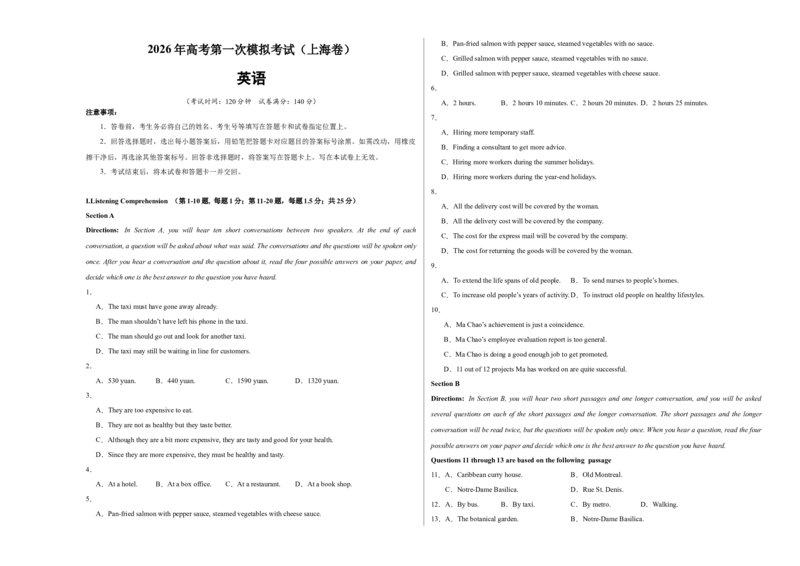
I.Listening Comprehension (第1-10 题, 每题1 分;第11-20 题,每题1.5 分;共25 分)
Section A
Directions: In Section A, you will hear ten short conversations between two speakers. At the end of each
conversation, a question will be asked about what was said. The conversations and the questions will be spoken only
once. After you hear a conversation and the question about it, read the four possible answers on your paper, and
decide which one is the best answer to the question you have heard.
1.
A.The taxi must have gone away already.
B.The man shouldn’t have left his phone in the taxi.
C.The man should go out and look for another taxi.
D.The taxi may still be waiting in line for customers.
2.
A.530 yuan.
B.440 yuan.
C.1590 yuan.
D.1320 yuan.
3.
A.They are too expensive to eat.
B.They are not as healthy but they taste better.
C.Although they are a bit more expensive, they are tasty and good for your health.
D.Since they are more expensive, they must be healthy and tasty.
4.
A.At a hotel.
B.At a box office.
C.At a restaurant.
D.At a book shop.
5.
A.Pan-fried salmon with pepper sauce, steamed vegetables with cheese sauce.
B.Pan-fried salmon with pepper sauce, steamed vegetables with no sauce.
C.Grilled salmon with pepper sauce, steamed vegetables with no sauce.
D.Grilled salmon with pepper sauce, steamed vegetables with cheese sauce.
6.
A.2 hours.
B.2 hours 10 minutes. C.2 hours 20 minutes. D.2 hours 25 minutes.
7.
A.Hiring more temporary staff.
B.Finding a consultant to get more advice.
C.Hiring more workers during the summer holidays.
D.Hiring more workers during the year-end holidays.
8.
A.All the delivery cost will be covered by the woman.
B.All the delivery cost will be covered by the company.
C.The cost for the express mail will be covered by the company.
D.The cost for returning the goods will be covered by the woman.
9.
A.To extend the life spans of old people.
B.To send nurses to people’s homes.
C.To increase old people’s years of activity. D.To instruct old people on healthy lifestyles.
10.
A.Ma Chao’s achievement is just a coincidence.
B.Ma Chao’s employee evaluation report is too general.
C.Ma Chao is doing a good enough job to get promoted.
D.11 out of 12 projects Ma has worked on are quite successful.
Section B
Directions: In Section B, you will hear two short passages and one longer conversation, and you will be asked
several questions on each of the short passages and the longer conversation. The short passages and the longer
conversation will be read twice, but the questions will be spoken only once. When you hear a question, read the four
possible answers on your paper and decide which one is the best answer to the question you have heard.
Questions 11 through 13 are based on the following passage
11.A.Caribbean curry house.
B.Old Montreal.
C.Notre-Dame Basilica.
D.Rue St. Denis.
12.A.By bus.
B.By taxi.
C.By metro.
D.Walking.
13.A.The botanical garden.
B.Notre-Dame Basilica.
C.The school for religious study.
D.The art galleries and museums.
Questions 14 through 16 are based on the following passage.
14.A.He has accumulated know-how.
B.He contributes a lot more value.
C.He learns from past mistakes and successes.
D.He is able to save troubled projects and lead them to success.
15.A.To get a raise.
B.To get a promotion.
C.To become a fireman.
D.To be the team leader.
16.A.Because he is eager to continue his role as a fireman.
B.Because he is the go-to guy who always gets called to put out fires.
C.Because he brings more technical know-know to each project.
D.Because he is the one who gets called to kick-start troubled projects.
Questions 17 through 20 are bused on the following conversation.
17.A.Reliability and tradition.
B.Trust and reassurance.
C.Innovation and adaptability.
D.The art galleries and museums.
18.A.It has a happy, feel-good style that can attract younger people, especially females.
B.Its modern-looking design matches the company image.
C.The light, carefree and friendly image portrays buying insurance as an easy decision
D.The semicircular design matches the pyramid theme in some of the advertisements.
19.A.Its dynamic feel.
B.The triangle design.
C.The thick, block lettering in red.
D.The simple color combination of red and white.
20.A.The light, carefree, friendly image.
B.The semicircle design and the lively lettering.
C.The hand-painted look and the triangle shape.
D.The old-fashioned thick, block lettering in red.
II.Grammar and Vocabulary (每题1 分;共20 分)
Section A
Directions: After reading the passage below, fill in the blanks to make the passage coherent and grammatically
correct. For the blanks with a given word, fill in each blank with the proper form of the given word; for the other
blanks, use one word that best fits each blank.
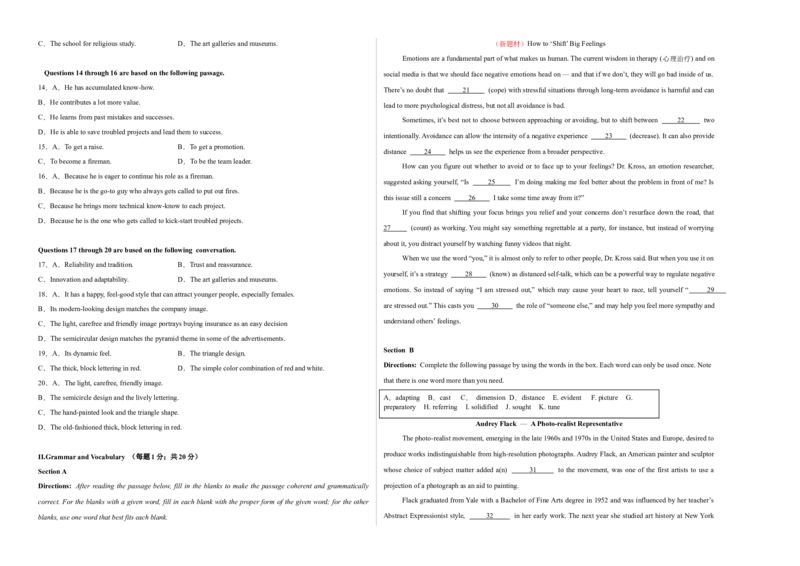
(新题材)How to ‘Shift’ Big Feelings
Emotions are a fundamental part of what makes us human. The current wisdom in therapy (心理治疗) and on
social media is that we should face negative emotions head on — and that if we don’t, they will go bad inside of us.
There’s no doubt that     21     (cope) with stressful situations through long-term avoidance is harmful and can
lead to more psychological distress, but not all avoidance is bad.
Sometimes, it’s best not to choose between approaching or avoiding, but to shift between     22     two
intentionally. Avoidance can allow the intensity of a negative experience     23     (decrease). It can also provide
distance     24     helps us see the experience from a broader perspective.
How can you figure out whether to avoid or to face up to your feelings? Dr. Kross, an emotion researcher,
suggested asking yourself, “Is     25     I’m doing making me feel better about the problem in front of me? Is
this issue still a concern     26     I take some time away from it?”
If you find that shifting your focus brings you relief and your concerns don’t resurface down the road, that
27     (count) as working. You might say something regrettable at a party, for instance, but instead of worrying
about it, you distract yourself by watching funny videos that night.
When we use the word “you,” it is almost only to refer to other people, Dr. Kross said. But when you use it on
yourself, it’s a strategy     28     (know) as distanced self-talk, which can be a powerful way to regulate negative
emotions. So instead of saying “I am stressed out,” which may cause your heart to race, tell yourself “    29

are stressed out.” This casts you     30     the role of “someone else,” and may help you feel more sympathy and
understand others’ feelings.
Section B
Directions: Complete the following passage by using the words in the box. Each word can only be used once. Note
that there is one word more than you need.
A.adapting    B.cast     C. dimension  D.distance    E. evident     F. picture    G.
preparatory    H. referring    I. solidified    J. sought    K. tune
Audrey Flack — A Photo-realist Representative
The photo-realist movement, emerging in the late 1960s and 1970s in the United States and Europe, desired to
produce works indistinguishable from high-resolution photographs. Audrey Flack, an American painter and sculptor
whose choice of subject matter added a(n)     31     to the movement, was one of the first artists to use a
projection of a photograph as an aid to painting.
Flack graduated from Yale with a Bachelor of Fine Arts degree in 1952 and was influenced by her teacher’s
Abstract Expressionist style,     32     in her early work. The next year she studied art history at New York
University’s Institute of Fine Arts. During the late 1950s Flack began to     33     herself from this style, which
she felt did not communicate effectively or clearly with viewers. She looked to artists such as Spanish Baroque artist
Luisa Roldán as models. One representative of her photo-realist paintings was Macarena of Miracles, directly     34
to Roldán’s sculpture Virgen de la Macarena, La Esperanza.
During the 1960s, the artist continued to     35     her photographic method and her subject matter. Unlike
male photo-realists such as Richard Estes and Chuck Close, who chose subjects that avoided emotional content,
Flack     36     to convey a broader meaning through her work. While going on to create works with
sociopolitical commentary, she started to     37     everyday items such as handbags and makeup, using them to
question their role in shaping female identity.
A significant painting from this period, Farb Family Portrait (1969–70), was the result of a new working
technique. Starting with a slide of the family portrait (肖像), Flack     38     the photo onto the canvas (画
布) and used it as her guide for painting. This method relieved her of having to make     39     drawings. She
also developed a method of applying paint in layers with an airbrush. Using those innovations, Flack masterfully
created a number of symbolic works.
Through these practices, Flack     40     her role as a pioneer who expanded photorealism beyond mere
copying, implanting it with layered narratives about identity and societal norms.
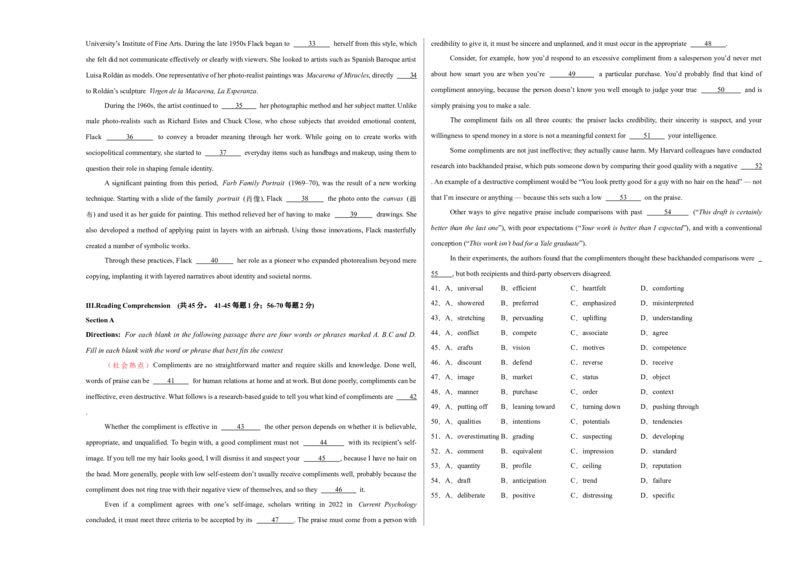
III.Reading Comprehension  (共45 分。 41-45 每题1 分;56-70 每题2 分)
Section A
Directions: For each blank in the following passage there are four words or phrases marked A. B.C and D.
Fill in each blank with the word or phrase that best fits the context
(社会热点)Compliments are no straightforward matter and require skills and knowledge. Done well,
words of praise can be     41     for human relations at home and at work. But done poorly, compliments can be
ineffective, even destructive. What follows is a research-based guide to tell you what kind of compliments are     42
.
Whether the compliment is effective in     43     the other person depends on whether it is believable,
appropriate, and unqualified. To begin with, a good compliment must not     44     with its recipient’s self-
image. If you tell me my hair looks good, I will dismiss it and suspect your     45    , because I have no hair on
the head. More generally, people with low self-esteem don’t usually receive compliments well, probably because the
compliment does not ring true with their negative view of themselves, and so they     46     it.
Even if a compliment agrees with one’s self-image, scholars writing in 2022 in Current Psychology
concluded, it must meet three criteria to be accepted by its     47    . The praise must come from a person with
credibility to give it, it must be sincere and unplanned, and it must occur in the appropriate     48    .
Consider, for example, how you’d respond to an excessive compliment from a salesperson you’d never met
about how smart you are when you’re     49     a particular purchase. You’d probably find that kind of
compliment annoying, because the person doesn’t know you well enough to judge your true     50     and is
simply praising you to make a sale.
The compliment fails on all three counts: the praiser lacks credibility, their sincerity is suspect, and your
willingness to spend money in a store is not a meaningful context for     51     your intelligence.
Some compliments are not just ineffective; they actually cause harm. My Harvard colleagues have conducted
research into backhanded praise, which puts someone down by comparing their good quality with a negative     52
. An example of a destructive compliment would be “You look pretty good for a guy with no hair on the head” — not
that I’m insecure or anything — because this sets such a low     53     on the praise.
Other ways to give negative praise include comparisons with past     54     (“This draft is certainly
better than the last one”), with poor expectations (“Your work is better than I expected”), and with a conventional
conception (“This work isn’t bad for a Yale graduate”).
In their experiments, the authors found that the complimenters thought these backhanded comparisons were
55    , but both recipients and third-party observers disagreed.
41.A.universal
B.efficient
C.heartfelt
D.comforting
42.A.showered
B.preferred
C.emphasized
D.misinterpreted
43.A.stretching
B.persuading
C.uplifting
D.understanding
44.A.conflict
B.compete
C.associate
D.agree
45.A.crafts
B.vision
C.motives
D.competence
46.A.discount
B.defend
C.reverse
D.receive
47.A.image
B.market
C.status
D.object
48.A.manner
B.purchase
C.order
D.context
49.A.putting off
B.leaning toward
C.turning down
D.pushing through
50.A.qualities
B.intentions
C.potentials
D.tendencies
51.A.overestimating B.grading
C.suspecting
D.developing
52.A.comment
B.equivalent
C.impression
D.standard
53.A.quantity
B.profile
C.ceiling
D.reputation
54.A.draft
B.anticipation
C.trend
D.failure
55.A.deliberate
B.positive
C.distressing
D.specific
Section B
Directions: Read the following three passages. Each passage is followed by several questions or unfinished
statements. For each of them there are four choices marked A, B, C and D. Choose the one that fits best according to
the information given in the passage you have just read.
A
(社会热点)Animal Welfare in Tourism
Over decades of travelling, I have come across some shocking treatment of animals clearly being exploited
for our entertainment. The last time was in Morocco, when I was investigating the macaques they use as attractions
in the markets. These poor monkeys were kept in terrible conditions and physically abused. Locked up during the
daytime, they’d be brought out in the early evening for photo opportunities with holidaymakers. It seems likely that
animal exploitation is increasing with the rise of selfie (自拍) culture, and that it’s not fully understood by much of
the public — which is why we desperately need laws to prevent travel companies selling tickets to cruel attractions.
Sadly though, the way things stand, it’s an absolutely pointless piece of legislation. While the last government went
to the trouble of passing this act, it failed to set out a list of activities banned under it. That means thousands of
holidaymakers can continue to buy tickets to attractions that treat animals cruelly this summer.
But there are some simple yet powerful things we can all do to help shut down these cruel trades. For starters
we need to use the pounds in our pockets as a form of protest. This summer, simply refuse to spend money on any
experience that might cause suffering to animals. And blow the whistle hard on any cruelty you come across. You
can report incidents of animal cruelty at tourist attractions anywhere in the world to animal welfare organizations,
who will use it to create a file of evidence to put pressure on the new government to make sure animals are not
pushed aside. Your evidence is vital.
It’s time to do better and make sure we choose well when it comes to satisfying our inborn urge to experience
the animals we share our planet with. We should have respect for all life and want to treasure it. No five-minute thrill
or subsequent social media post we get from an animal encounter is worth a lifetime of misery for them. We need to
remember, their lives are as important as ours.
56.According to the passage, which of the following is true about the macaques in Morocco?
A.They were part of a wildlife conservation project.
B.They were free to move around during the daytime.
C.They were taken care of by animal welfare organizations.
D.They were caged in the day and used for photos in the evening.
57.Why does the author consider the current law against animal cruelty ineffective?
A.It lacks a clear list of banned practices.
B.It was rejected by the previous government.
C.It only applies to domestic animal abuse.
D.It is not supported by the travel companies.
58.What can be inferred about the author’s opinion on “selfie culture”?
A.It helps promote animal welfare through social media.
B.It contributes to the rise of animal exploitation.
C.It encourages tourists to be more environmentally aware.
D.It reflects human indifference to animal suffering.
59.What is the main purpose of the passage?
A.To describe a shocking tourist experience in Morocco.
B.To expose animal cruelty in tourism and call for action.
C.To analyze the reasons for the increase in animal exploitation.
D.To introduce the current laws about animal welfare in tourism.
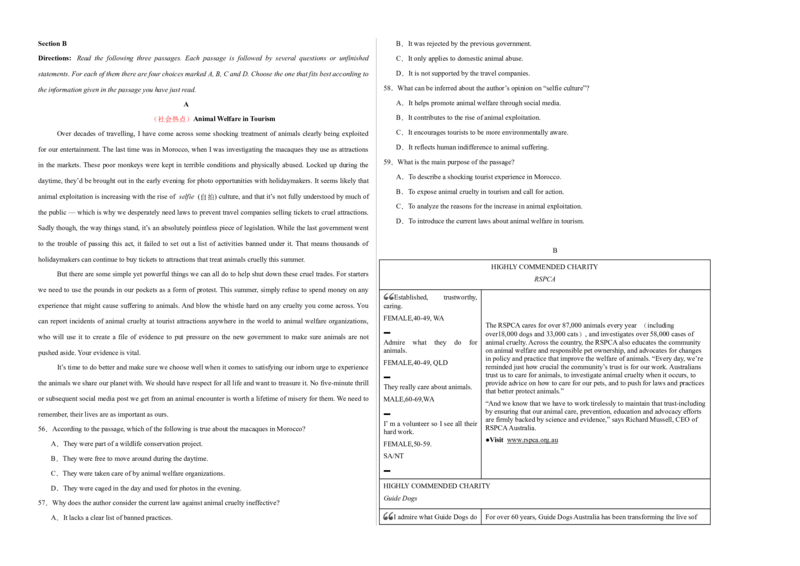
B
HIGHLY COMMENDED CHARITY
RSPCA
Established,

trustworthy,
caring.
FEMALE,40-49, WA
▂
Admire what they do for
animals.
FEMALE,40-49, QLD
▂
They really care about animals.
MALE,60-69,WA
▂
I’ m a volunteer so I see all their
hard work.
FEMALE,50-59.
SA/NT
▂
The RSPCA cares for over 87,000 animals every year (including
over18,000 dogs and 33,000 cats), and investigates over 58,000 cases of
animal cruelty. Across the country, the RSPCA also educates the community
on animal welfare and responsible pet ownership, and advocates for changes
in policy and practice that improve the welfare of animals. “Every day, we’re
reminded just how crucial the community’s trust is for our work. Australians
trust us to care for animals, to investigate animal cruelty when it occurs, to
provide advice on how to care for our pets, and to push for laws and practices
that better protect animals.”
“And we know that we have to work tirelessly to maintain that trust-including
by ensuring that our animal care, prevention, education and advocacy efforts
are firmly backed by science and evidence,” says Richard Mussell, CEO of
RSPCA Australia.
●Visit www.rspca.org.au
HIGHLY COMMENDED CHARITY
Guide Dogs
I admire what Guide Dogs do
For over 60 years, Guide Dogs Australia has been transforming the live sof
for the community.
FEMALE,60-69. QLD
▂
They offer an essential service
for the blind and vision
impaired.
FEMALE,40-49, QLD
▂
Transparent and honest.
MALE, 70+, VIC/TAS
▂
people with low vision or blindness. To achieve this, trust must be at the heart
of everything we do; from the trust our clients place in us to provide the
support and care they need, to the trust between a Guide Dog Handler and
their Guide Dog. This trust also extends to the community whose generosity
and faith in the work we do is helping to transform lives every day.
At the age of five, Melaine was diagnosed with a rare genetic disease that
affects both hearing and vision. Despite her diagnosis, Melaine had over three
decades of professional experience within a reputable animal welfare
organization. Her diverse roles included veterinary nurse and community
outreach coordinator.
Her beloved Guide Dog, Dessau, has given Melaine back her independence
and their journey has been characterized by adaptability and a determination
to break down barriers.
Funding for Guide Dogs,75 per cent of which comes from the community,
allows the charity to support clients like Melaine to live a life without limits.
● Visit www.guidedogs.com.au
60.Suppose you are conducting a research project on the RSPCA and you plan to interview Richard Mussell, the
CEO of RSPCA Australia. You have prepared the following list of questions. Which of the following should be
added to the list to gain a comprehensive understanding of the RSPCA’s approach?
Interview questions:1.What role does community education play in the RSPCA’s overall
mission?
2.How does the RSPCA balance between animal care and policy advocacy?
3.…
A.How does the RSPCA decide which applicant gets the pet first?
B.How does the RSPCA ensure that its staff are trained in customer service?
C.How can the RSPCA ensure that the advocated policies are justified?
D.How does the RSPCA assign the budget for staff medical care?
61.What can be learned about Guide Dogs Australia from the passage?
A.It trains dogs to support people with hearing and vision loss.
B.It provides independence to people with low vision or blindness.
C.Its operations are mainly funded by the government.
D.Its community outreach programs rank top nationwide.
62.Which of the following best describes a common factor between the RSPCA and Guide Dogs Australia that
supports their success?
A.Both organizations serve to provide support to the disabled.
B.Both organizations focus primarily on the welfare of animals.
C.Both organizations rely on scientific evidence to guide their practices.
D.Both organizations value trust as a key part in their operations.
C
Every day we are surrounded by large amounts of information, much of which is given by people who want to
shape our decisions. So, we need to evaluate the information and determine how we should respond.
Evaluating information and arguments requires critical thinking, the ability to think clearly and see how ideas
are connected. Like any skill, critical thinking can be learned, and the best way to learn it is by practicing.
You cannot evaluate an argument that you do not understand. Thus, the first step to critical thinking must
always be listening. You may need to ask questions to clarify the person’s claims. Ask them to define their key terms,
especially words with multiple meanings.
Once you understand what the person is saying, then you can consider whether it is true. The most important
question is whether the facts they state are actually true. You can try to figure this out by considering the source of
the facts and whether the facts line up with what you already know about the topic. If there is a conflict, you must
then discover whether your original understanding was incorrect or whether the new claims are wrong.
It’s also possible to draw incorrect conclusions from correct facts. Often this comes from mistakes in logic, so
learning about common logical fallacies (谬论) and how to recognize them can help. Also consider whether there
could be another explanation for the facts besides the one you’ve been given.
Critical thinking also involves examining people’s motivations and assumptions. For example, a salesman will
present facts that are selected to convince you to buy what he is selling. He will leave out facts that don’t help him
reach that goal. Assumptions can likewise affect people’s claims since people want to confirm what they already
believe. It is necessary that you recognize these factors to predict when someone else’s statements might not be
accurate or complete.
Finally, critical thinking requires examining your own beliefs and assumptions as well. Poking holes in other
people’s arguments can be necessary, but you must acknowledge the possibility that your own beliefs are wrong.
Your own assumptions and motivations may affect your thinking without you realizing it. By critically examining
both your own and other people’ opinions, you can understand the way the world works and make decisions in light
of the truth.
63.According to the passage, which one of the following is TRUE?
A.The majority of information given to us is actually to shape our minds.
B.Critical thinking is usually learned by practicing, like any other skills.
C.Only when you fully understand one’s claims, can you make a right evaluation.
D.A conflict between the original understanding and a new one is critical thinking.
64.What is the purpose of the example of a salesman given in the passage?
A.To illustrate the important function of critical thinking
B.To confirm the difference of people’s motivations and assumptions
C.To convince people to buy the product mentioned in the passage
D.To warn people to pay special attention to the facts given
65.The expression “Poking holes in other people’s arguements” in the last paragraph probably means ______.
A.Finding out others’ faults
B.Evaluating others’ opinions
C.Criticizing others’ points of view
D.Supporting others’ ideas
66.What can we conclude from the passage?
A.Drawing incorrect decisions from facts depends on its logic.
B.A fact may sometimes guide us to make a wrong decision.
C.Critical thinking is connected with one’s own beliefs and assumptions.
D.Without logic knowledge, critical thinking is impossible to occur.
Section C
Directions: Complete the following passage by using the sentences in the box Each sentence can only be used once.
Note that there are two sentences more than you need.
Teamwork: Important in career planning
Teamwork is a vital skill for career planning and professional growth. One of its key benefits is developing
problem-solving abilities. In any career, challenges are inevitable, and working in a team allows individuals to
combine their diverse skills, experiences, and perspectives (视角) to find creative solutions.     67     This
collaborative (合作的) approach not only leads to better outcomes but also helps you develop critical thinking and
adaptability, essential for rising to workplace challenges.
Another important aspect of teamwork is improving communication skills.     68     Team projects
provide a practical environment to practice these skills, helping you express yourself clearly and understand others’
perspectives. Strong communication is highly valued in the workplace, as it ensures smooth cooperation and
minimizes misunderstandings.
    69     In a team, you may take on roles such as leading a project, assigning tasks, or motivating others.
These experiences teach you how to manage group dynamics and inspire people to work toward a common goal. At
the same time, you learn to cooperate effectively, balancing your contributions with those of others. These skills are
particularly important in today’s interconnected work environment, where projects often require input from multiple
participants.
Finally, teamwork prepares you for the realities of the workplace. Most professional environments rely on
joint efforts, and employers value candidates who can work well in teams. By practicing teamwork early on, you
develop the ability to contribute to group efforts, adapt to different working styles, and build positive relationships
with co-workers.     70
In short, teamwork is not just a soft skill; it is a critical component of career planning and professional
success.
A.Teamwork also enhances leadership and collaboration skills.
B.Additionally, teamwork can increase your contributions in the workplace.
C.By pooling resources and ideas, teams can tackle complex problems more effectively.
D.These experiences increase your confidence and readiness for future career challenges.
E.Teamwork sometimes slows down decision-making processes due to excessive discussions.
F.Whether you’re sharing ideas or giving feedback, efficient information-exchanging is crucial.
IV.Summary Writing   (共10 分)
Directions: Read the following passage. Summarize the main idea and the main point( s)of the passage in no more
than 60 words. Use your own words as far as possible.
How to improve clinical trials?
Last year, a Swiss medicine company published a review of the clinical trials on drugs it had held between
2016 and 2021. It found that black people were under-represented in all but one. Surprisingly, that news represents
progress, because it shows that people are becoming more aware of a dangerous bias (偏见) that sets back the
safety of medical treatments.
Many trials leave out certain groups — children, for example, or people with physical or learning disabilities,
pregnant women and the elderly. There are good explanations for the exclusion, such as the difficulty of getting
informed permission or the potential harm to unborn children. Yet the consequences can be serious. A recent review
found that half of trials around the world testing hip-fracture (髋骨骨折) interventions excluded people who lived
in nursing homes, were old or had some sort of understanding problems. Though these groups make up almost a
third of all patients suffering hip fractures, it is unclear if the interventions will work as safely or as effectively on
them. Their doctors face a tough choice: tell their patients to take the medicine anyway, with uncertain results; or
deny them new treatments.
Obtaining informed permission for trials is not always easy, especially from people with learning disabilities.
Accounting for different groups’ risks of side-effects can complicate the analysis of the data. Even so, broadening the
range of trials’ participants can be practically useful, because it might lead to important new findings in medicine.
Fortunately, the bias of clinical testing may be changing. The US government has recently proposed to reduce
barriers and appeal to a wider range of participants by reducing the costs and commitments required for patients to
participate. Countries like America and Britain are discussing publishing regulations that require trial organisers to
explain whom they ought to include and how they plan to include them.
_____________________________________________________________________________________________
_____________________________________________________________________________________________
_____________________________________________________________________________________________
_____________________________________________________________________________________________
____________________________
V.Translation (共15 分。第1 小题和第2 小题,每题3 分;第3 题4 分;第4 题5 分。)
Directions:Translate the following sentences into English, using the words given in the brackets
72.社区卫生中心的入口便于轮椅进出。(access) (汉译英)

73.一些技术突破并非由科技巨头们推动,而是来自于普通人的奇思妙想。(drive) (汉译英)

74.那个城市缺少可供居民消磨时间的公园,在旧城改造时应相应地增加绿色空间。(lack) (汉译英)

75.无论雨天还是晴天,每周四的校园露天音乐会都会吸引大批学生观众,使之成为校园 生活一道亮丽的
风景线。(which) (汉译英)

VI.Guided Writing  (共25 分)
76.Directions: Write an English composition in 120-150 words according to the instructions given below in
Chinese.
(改编试题)假设你是明启中学高三学生李华,最近收到笔友Tom 的邮件,在邮件中他提到自己即将前往
上海一所高中担任志愿者,教授该校学生英语,他想了解一下适合中国学生的英语学习内容。请回复他一
封邮件,内容须包括:
(1)你建议他教授哪些内容;
(2)你的理由。
_____________________________________________________________________________________________
_____________________________________________________________________________________________
__________________________________________________________________________________________