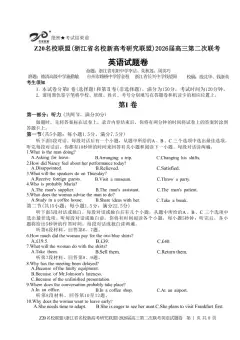
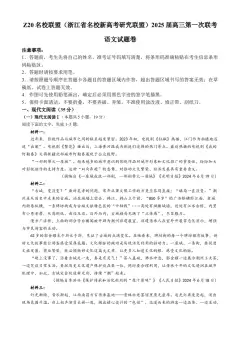
2026 届浙江省Z20
名校联盟高三上学
期第一次联考英语
试题
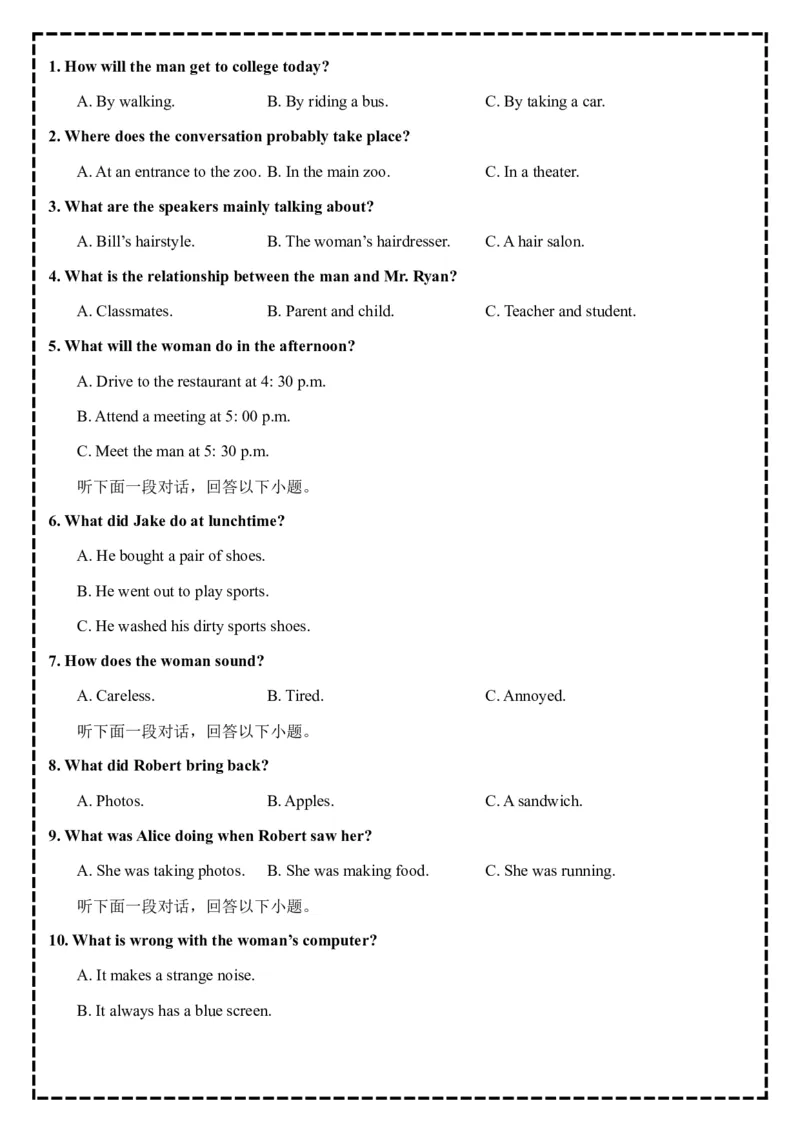
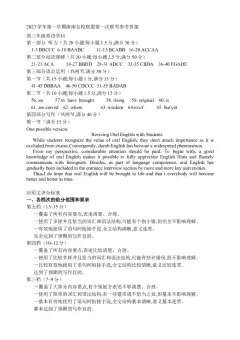
1. How will the man get to college today?
A. By walking.
B. By riding a bus.
C. By taking a car.
2. Where does the conversation probably take place?
A. At an entrance to the zoo. B. In the main zoo.
C. In a theater.
3. What are the speakers mainly talking about?
A. Bill’s hairstyle.
B. The woman’s hairdresser.
C. A hair salon.
4. What is the relationship between the man and Mr. Ryan?
A. Classmates.
B. Parent and child.
C. Teacher and student.
5. What will the woman do in the afternoon?
A. Drive to the restaurant at 4: 30 p.m.
B. Attend a meeting at 5: 00 p.m.
C. Meet the man at 5: 30 p.m.
听下面一段对话,回答以下小题。
6. What did Jake do at lunchtime?
A. He bought a pair of shoes.
B. He went out to play sports.
C. He washed his dirty sports shoes.
7. How does the woman sound?
A. Careless.
B. Tired.
C. Annoyed.
听下面一段对话,回答以下小题。
8. What did Robert bring back?
A. Photos.
B. Apples.
C. A sandwich.
9. What was Alice doing when Robert saw her?
A. She was taking photos.
B. She was making food.
C. She was running.
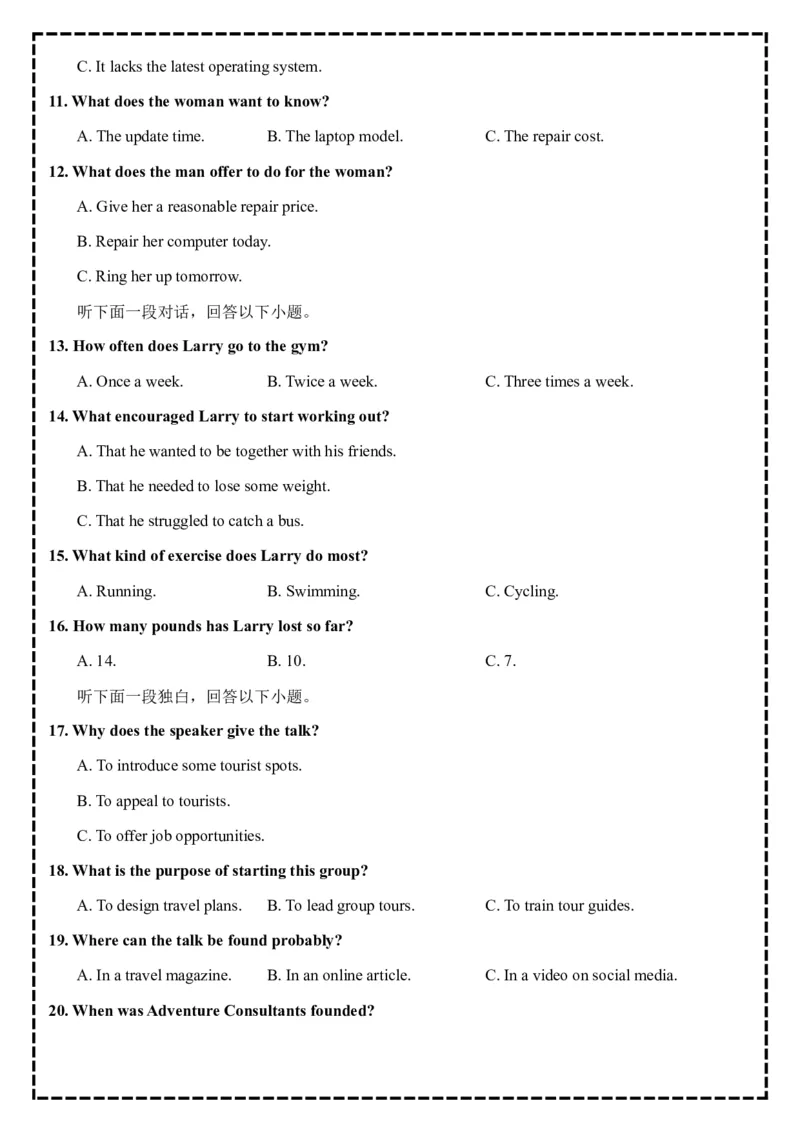
听下面一段对话,回答以下小题。
10. What is wrong with the woman’s computer?
A. It makes a strange noise.
B. It always has a blue screen.
C. It lacks the latest operating system.
11. What does the woman want to know?
A. The update time.
B. The laptop model.
C. The repair cost.
12. What does the man offer to do for the woman?
A. Give her a reasonable repair price.
B. Repair her computer today.
C. Ring her up tomorrow.
听下面一段对话,回答以下小题。
13. How often does Larry go to the gym?
A. Once a week.
B. Twice a week.
C. Three times a week.
14. What encouraged Larry to start working out?
A. That he wanted to be together with his friends.
B. That he needed to lose some weight.
C. That he struggled to catch a bus.
15. What kind of exercise does Larry do most?
A. Running.
B. Swimming.
C. Cycling.
16. How many pounds has Larry lost so far?
A. 14.
B. 10.
C. 7.
听下面一段独白,回答以下小题。
17. Why does the speaker give the talk?
A. To introduce some tourist spots.
B. To appeal to tourists.
C. To offer job opportunities.
18. What is the purpose of starting this group?
A. To design travel plans.
B. To lead group tours.
C. To train tour guides.
19. Where can the talk be found probably?
A. In a travel magazine.
B. In an online article.
C. In a video on social media.
20. When was Adventure Consultants founded?
A. One week ago.
B. One month ago.
C. One year ago.
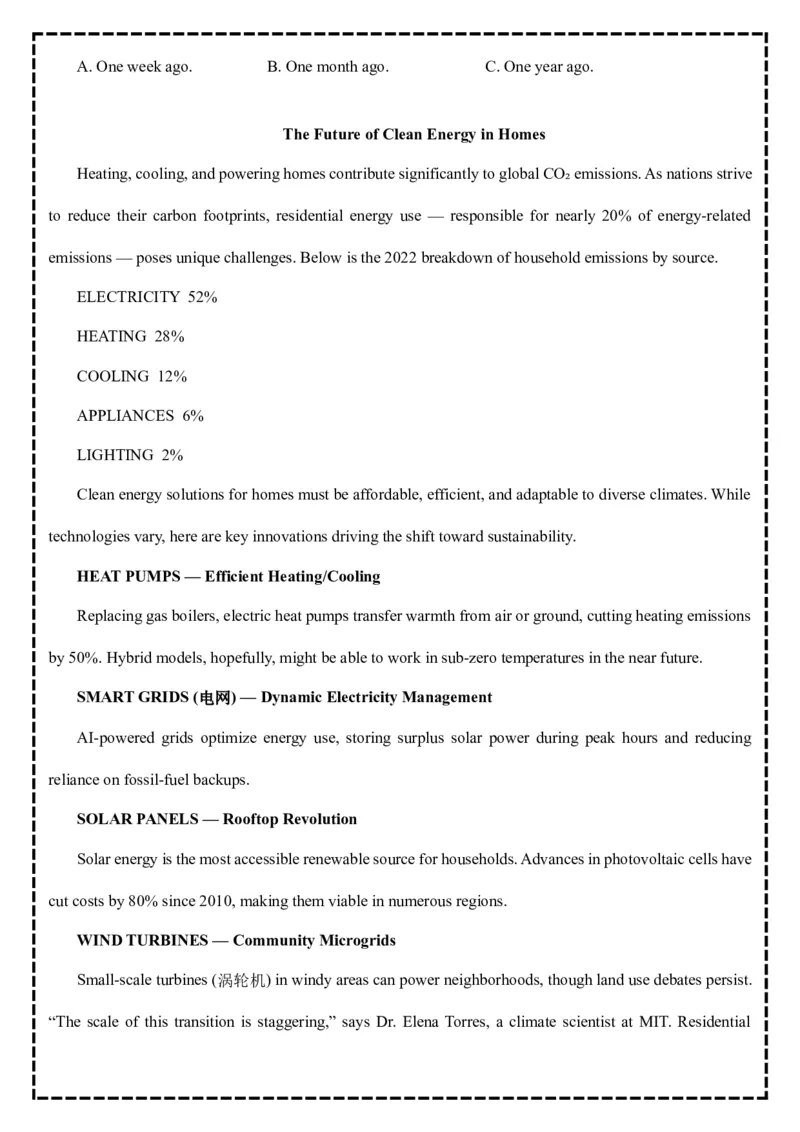
The Future of Clean Energy in Homes
Heating, cooling, and powering homes contribute significantly to global CO₂ emissions. As nations strive
to reduce their carbon footprints, residential energy use — responsible for nearly 20% of energy-related
emissions — poses unique challenges. Below is the 2022 breakdown of household emissions by source.
ELECTRICITY 52%
HEATING 28%
COOLING 12%
APPLIANCES 6%
LIGHTING 2%
Clean energy solutions for homes must be affordable, efficient, and adaptable to diverse climates. While
technologies vary, here are key innovations driving the shift toward sustainability.
HEAT PUMPS — Efficient Heating/Cooling
Replacing gas boilers, electric heat pumps transfer warmth from air or ground, cutting heating emissions
by 50%. Hybrid models, hopefully, might be able to work in sub-zero temperatures in the near future.
SMART GRIDS (电网) — Dynamic Electricity Management
AI-powered grids optimize energy use, storing surplus solar power during peak hours and reducing
reliance on fossil-fuel backups.
SOLAR PANELS — Rooftop Revolution
Solar energy is the most accessible renewable source for households. Advances in photovoltaic cells have
cut costs by 80% since 2010, making them viable in numerous regions.
WIND TURBINES — Community Microgrids
Small-scale turbines (涡轮机) in windy areas can power neighborhoods, though land use debates persist.
“The scale of this transition is staggering,” says Dr. Elena Torres, a climate scientist at MIT. Residential
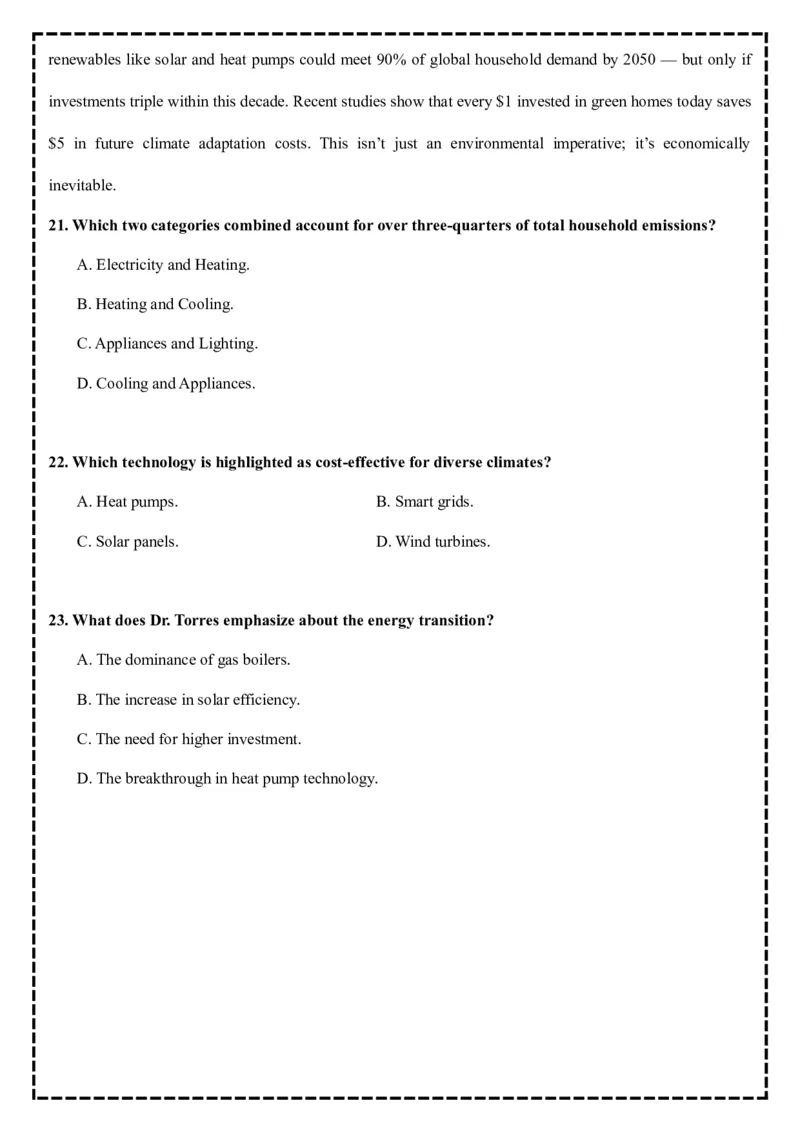
renewables like solar and heat pumps could meet 90% of global household demand by 2050 — but only if
investments triple within this decade. Recent studies show that every $1 invested in green homes today saves
$5 in future climate adaptation costs. This isn’t just an environmental imperative; it’s economically
inevitable.
21. Which two categories combined account for over three-quarters of total household emissions?
A. Electricity and Heating.
B. Heating and Cooling.
C. Appliances and Lighting.
D. Cooling and Appliances.
22. Which technology is highlighted as cost-effective for diverse climates?
A. Heat pumps.
B. Smart grids.
C. Solar panels.
D. Wind turbines.
23. What does Dr. Torres emphasize about the energy transition?
A. The dominance of gas boilers.
B. The increase in solar efficiency.
C. The need for higher investment.
D. The breakthrough in heat pump technology.
When Clara took over her grandfather’s Brooklyn bookshop in 2018, the first thing she removed wasn’t
the outdated stocks, but the WiFi router. Regulars protested. A lawyer threatened to transfer his $500 monthly
coffee budget elsewhere. “Books deserve the same undivided attention we demand from lovers,” she told me,
polishing the brass counter her grandfather installed in 1967.
Her stubbornness seemed self-destructive as stores around them closed down. Yet something unusual
happened. By 2020, the shop had become an unofficial sanctuary (庇护所). Teenagers sprawled on Persian
carpets with Dostoevsky, their phones forgotten in backpacks. A retired judge started hosting Saturday poetry
circles where participants recited verses from memory — a practice Clara called “brain tattooing.”
The pandemic should have been their death knell. Instead, when Clara launched “Survival Bundles”
(handpicked books with handwritten notes), orders poured in from tech executives exhausted by Zoom. A
Silicon Valley CEO admitted these were the first physical books he’d touched since graduate school. “We’re
starving for texture,” Clara noted, wrapping parcels in recycled paper.
Last winter, I found her battling a new threat. A property developer had purchased their building, tripling
the rent overnight. What unfolded next could fill a novel: customers organized protests on the sidewalk; the
judge represented them for free; even the lawyer who once threatened to leave funded their legal defense.
In the court, Clara quoted Melville: “We cannot live only for ourselves. A thousand fibers connect us.”
The judge — her poetry circle regular — pronounced the rent increase unreasonable. Now their shop displays
this judgment alongside signed first editions, proof that some bonds still resist digital disruption.
24. What made Clara’s approach to running the bookshop special?
A. Catering to the needs of customers.
B. Introducing modern technology.
C. Focusing on rare book collections.
D. Prioritizing full concentration.
25. What does the underlined phrase “death knell” in paragraph 3 mean?
A. A moment of celebration.
B. A desperate cry for survival.
C. An event marking the end.
D. A sudden opportunity for growth.
26. Why is the lawyer mentioned again in paragraph 4?
A. To show his contradictory behavior.
B. To illustrate the content of a novel.
C. To stress the mass support Clara received.
D. To explain the difficulty Clara came across.
27. What can we learn from the story?
A. Profit-driven decisions may lead to unexpected outcomes.
B. Community and human connection can navigate modern challenges.
C. Technology is harmful to traditional businesses and should be avoided.
D. Small bookshops are bound to encounter many threats in the digital age.
Britain’s housing crisis has created a distinct generational divide. While older generations often own
property, millions of young adults face increasing rents and unachievable homeownership. A recent official
report warns that 630, 000 people under 35 may face homelessness in old age due to chronic shortages of
affordable homes.
This crisis originates from decades of policy failure. Since the mid-1990s, house prices have skyrocketed
dramatically, widening the gap between property owners and others. Government projects like “Help-to-Buy”
intended to assist first-time buyers instead inflated prices further, making housing less accessible. University
graduates carry heavy debts from tuition fees exceeding £9, 000 annually since 2010, weakening their savings
potential.
The rental market offers little relief. Private renters have jumped from 2. 8 million to 4. 5 million
households since 2007, with those aged 25-34 consisting of over a third. Yet renters face instability and
exploitation. “No-fault drivings” allow landlords (房东) to end rentings without cause, while rents exceed
wage growth. Even social housing renters experience widening inequality compared to homeowners.
Policy responses are emerging but controversial. London Mayor Sadiq Khan proposed a landlord registry
and rent control commission to regulate the private sector. Scotland has established “rent pressure zones” to
stop increases. The Labour Party advocates abolishing no-fault drivings, arguing that secure right of habitation
are essential for dignity.
Ultimately, this is about intergenerational fairness. A functional society cannot thrive when younger
citizens bear unreasonable burdens. As one analyst notes: “We depend on the young to sustain our future —
denying them housing security damages everyone.”
28. What does the official report predict about young adults?
A. Universal elderly poverty.
B. Persistent renting difficulties.
C. Long-term housing insecurity.
D. Unachievable huge property.
29. What brings about the housing crisis?
A. Stable rental market.
B. Students’ reduced debt burden.
C. Decades-long policy failure.
D. Consistent policy responses.
30. What can be inferred from the last paragraph?
A. Young adults’ housing security should be guaranteed.
B. Efforts should be made to create a sustainable society.
C. The property of older generations should be passed on.
D. The young should be responsible for intergenerational fairness.
31. What can be a suitable title for the text?
A. Housing: Pricing out the Young?
B. Policy: Regulating the Private Owners?
C. Landlords: Forced to Accept Rent Hikes?
D. Rental Control: Solving the Renter-landlord Conflicts?
AI Radiology: Faster, Smarter, and More Accurate
Hospital waiting time for scan results could soon be reduced from days to minutes. A 2025 Stanford study
reveals that DeepMedScan, an AI system analyzing CT/MRI images, detects tumors 30% faster than human
radiologists (放射科医生) while matching top experts’ 98% accuracy. The system is now used in 40+ EU
hospitals, reducing diagnosis delays by up to 80%.
The breakthrough lies in 3D neural mapping. Unlike traditional AI recognizing 2D patterns,
DeepMedScan constructs dynamic 3D models of organs: It cross-references scans with global databases —
processing 200,000+ historical cases in 0.2 seconds. “It’s like giving each radiologist a super-powered second
brain,” explains lead researcher Dr. Aris Thorne.
Critical advantages include identifying micro-lesions under 2 mm — often missed by human eyes — and
predicting disease progression. In German trials, the AI detected early-stage pancreatic cancer in 83% of high-
risk patients a year before symptoms emerged, enabling life-saving interventions.
Challenges persist, however, Legal frameworks struggle with responsibility for AI misdiagnosis
(occurring in 0.7% of cases vs. human 1.2%). Inaccuracy risks also exist; early versions performed poorly on
pediatric (小儿科的) scans due to limited child data. Regulatory authorities now enforce “human-AI co-
diagnosis” — requiring doctor confirmation for critical cases.
Future upgrades focus on accessibility. Lightweight versions for rural clinics are being tested in India,
using smartphone-compatible calculation procedure. As WHO advisor Dr. Priya Sharma notes, “Making this
tech widely accessible could prevent 500,000+ annual late-stage cancer deaths globally by 2030.”
32. How does the article present the issue in the first paragraph?
A. By quoting an expert.
B. By defining a concept.
C. By providing statistics.
D. By presenting classifications.
33. What does the author highlight with super-powered second brain?
A. Replacing radiologists with automated systems.
B. Emphasizing its ultra-fast data processing capacity.
C. Demonstrating its superiority over human intelligence.
D. Promoting commercial sales of medical equipment.
34. What does the author intend to convey in paragraph 4?
A. The potential of AI diagnosis.
B The inaccuracy of AI diagnosis.
C. The dominance of authorities in AI diagnosis.
D. The necessity of human participation in AI diagnosis.
35. What can be inferred about AI radiology’s future development?
A. It will replace doctors.
B. It can work with smart phones.
C. It can reach people in far-off areas.
D. It can avoid late-stage cancer deaths completely.
A Piggyback Ride from a Stranger
Once a year, Bannister climbs to High Rock Lookout where she scattered her mother’s ashes 23 years
ago. ___36___ Last August, Bannister, then 79, went on her own, figuring she’d be fine because she’s an
experienced hiker.
She arrived at the trail early and made her way to the lookout. As she headed back down, her foot got
caught in a hole in the ground. ___37___ When sitting up, she knew immediately she had broken her leg. She
cried out for help, and before long, a stranger approached and called 911. They were told a search and rescue
team would arrive in five hours.
“It wasn’t very encouraging,” Bannister says. “I asked if anyone had painkillers, because the pain was
pretty substantial then.” ___38___ But two young men, Troy May, an Air Force airman and his friend Layton
Allen, came over to see what was going on. When seeing Bannister in extreme pain, they offered to carry her
to the bottom of the trail.
May eased Bannister onto his back and started hiking downward. He carried her for most of the nearly
three-hour journey, and Allen carried her for the rest. “That was just one kindness,” says Bannister. ___39___
One, a physical therapist, bandaged Bannister’s foot and built a makeshift splint (夹板) for her leg. The other
did breathing exercises with her to help calm her. During the long hike down, her rescuers shared stories to
distract her from the mounting pain. Once reaching the parking lot, they rushed Bannister to the nearest
hospital.
___40___ “I think we’ll be lifelong friends,” Bannister says.
A. She was almost in despair.
B. No one in the surrounding area did.
C She fell forward against all expectations.
D. A couple hiking that day also lent a hand.
E. They have visited her several times afterwards.
F. Therefore, she visited there regularly in honor of her.
G. She usually hikes with someone along the 3.2-mile trail.
Karen, 16, was a college freshman in a local university. She was thrilled to earn a ___41___ in the
renowned choir for their international tour. However, ___42___ overcame her when she overslept before a
key performance at a distant church. Missing the bus, she ___43___ helplessly in her dorm hallway. She had
no cars nor friends nearby to help. Ironically, her neighbor Pam emerged, the ___44___ person Karen expected
to see.
Their relationship had been ___45___. Karen’s group frequently disturbed the floor with late-night
noise, ___46___ Pam’s requests for quiet. They ___47___ temporarily just long enough to catch their breath
— before the disruptions came crashing back in. Now facing ___48___ of her own mistake, Karen awkwardly
confessed her dilemma to Pam.
To her astonishment, Pam offered a ride immediately, which stunned Karen — Why did he extend
kindness to someone who had shown ___49___? They raced to Pam’s car and arrived just as the choir entered
the church — a miraculous _ __50___.
Decades later, Karen still ___51___ that gesture. It was never ___52___ a ride, but a profound lesson in
grace. Pam’s complaints gave way to forgiveness, ___53___ Karen redemption (救赎) she hadn’t earned. If
she could speak to Pam today, Karen would offer an apology for her youthful selfishness, and ___54___ for
that transformative compassion. Its ripple effects ___55___ her next thirty years, proving that true mercy
bridges divides and heals hearts.
41. A. spot
B. chance
C. bonus
D. prize
42. A. calmness
B. panic
C. thrill
D. relief
43. A. paced
B. stormed
C. bounced
D. tripped
44. A. best
B. worst
C. first
D. last
45. A. tense
B. close
C. familiar
D. distant
46. A. disapproving
B. doubting
C. supporting
D. dismissing
47. A. stayed
B. waited
C. paused
D. hesitated
48. A. processes
B. conclusions
C. causes
D. consequences
49. A. some
B. none
C. any
D. much
50. A. save
B. contribution
C. performance
D. movement
51. A. calls on
B. reflects on
C. holds back
D. looks back
52. A. totally
B. rarely
C. merely
D. fairly
53. A. gifting
B. rewarding
C. supplying
D. sparing
54. A. complaint
B. gratitude
C. welcome
D. regret
55. A. restricted
B. formed
C. constructed
D. shaped
In the primeval forests of Hanzhong, Shaanxi province, ____56____ (grow) a remarkable vine (藤蔓). It
is known for its unmatched flexibility, ____57____ (exception) length, and a smooth surface.
Since ancient times, locals have recognized its potential as ____58____ high-quality natural weaving
material, ____59____ (prize) for the vine’s lightness, breathability and remarkable durability.
The Records of the Three Kingdoms by Western Jin Dynasty ____60____ (history) Chen Shou
documented its military applications, describing “vine armor” so effective that it could float across rivers,
resist water, and stand against arrows.
“It is an ancient handicraft that creates functional household items ____61____ (use) wooden or bamboo
frames as structures ____62____ green vines as weaving substance, and employing traditional handweaving
techniques,” explains Chen Liangshun, who ____63____ (practise) the craft for more than three decades.
At his company in Huangguan town, Nanzheng district of Hanzhong, villagers have been busy preparing
summer products, among ____64____ fans have been particularly popular recently. “The online sales have
easily reached 1,000 to 2,000 orders daily,” says Chen ____65____ his 50s.
针对国外有部分学生选择高中毕业后休学一年的现象,你校以“高中毕业生是否需要间隔年”
为题征稿,请你写一篇短文投稿,内容包括:
(1)你的看法;
(2)说明理由。
注意:
(1)写作词数应为80 个左右;
(2)请按如下格式在答题卡
相应位置作答。
Is It Necessary to Have a Gap Year Before College?
Tom Perry concentrated hard. The rocket competition would begin shortly. He had never lost a contest,
but that didn’t calm him. Being on top counted, and he pushed himself to remain there.
The other kids, however, rarely came over to him. No way was he going to let them ignore that he’d win
again. Still, he often wondered: why didn’t winning make people like him better?
He opened his toolbox and began assembling (组装) his launch pad. Then he checked his rocket again. It
looked perfect — especially compared to the others.
But one caught his eye. A thin boy named Ed lifted it carefully. Its paint shone in the sunlight, and its parts
fit perfectly. His critical eye detected that this rocket could beat his.
“Nice rocket,” said the boy nervously. “Thanks,” Tom replied flatly, and then regretted it. “Where do you
usually launch it? I’ve never seen you here.” “In the field behind my house.”
“You don’t care for these contests?”
“I never really thought about them. I keep pretty much to myself.”
The announcer explained the competition. Tom barely listened, his gaze constantly drifting to Ed’s rocket.
Suddenly his heart did a leap — as Ed lifted the rocket to place it on the launch pad, his fin (翼) had caught
against something, pulling it away from the fuselage (机身) — not enough to break it off, just enough to
loosen it.
But Ed hadn’t noticed. He glanced back at Tom and gave a thumbs-up. Tom felt a surge of guilt but
decided he wasn’t going to say anything. Anyway, it was up to Ed to keep checking his rocket.
Then the competition began. Most rockets gained respectable heights, while a few shot wildly. Tom
watched, but the knowledge he had about what was wrong with their rockets soured within him. It was like
something he had stolen.
“Ed Malovich will be our next contestant,” the announcer said, interrupting Tom’s daydream.
Immediately Ed lifted his rocket and headed to the launch area.
Without thinking, words flowed from Tom’s mouth, surprising even himself.
Minutes later, Ed’s rocket blasted (轰鸣) skyward, shooting up as if unstoppable.