文档文本内容
高中英语重难点词汇辨析汇总(讲义)
Lesson 9 词汇 C2
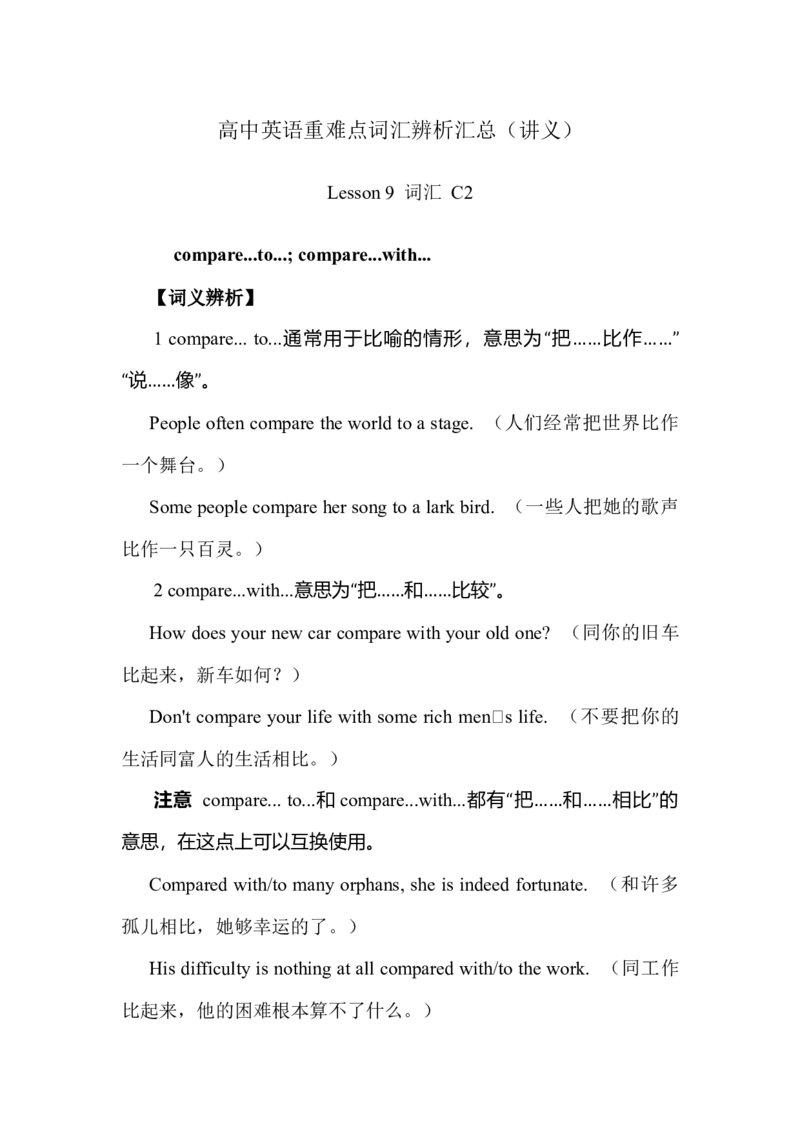
compare...to...; compare...with...
【词义辨析】
1 compare... to...
“
……
……”
通常用于比喻的情形,意思为把
比作
“
……
”
说
像。
People often compare the world to a stage. (人们经常把世界比作
一个舞台。)
Some people compare her song to a lark bird. (一些人把她的歌声
比作一只百灵。)
2 compare...with...
“
……
……
”
意思为把
和
比较。
How does your new car compare with your old one? (同你的旧车
比起来,新车如何?)
Don't compare your life with some rich mens life. (不要把你的
生活同富人的生活相比。)
注意 compare... to...和compare...with...
“
……
……
”
都有把
和
相比的
意思,在这点上可以互换使用。
Compared with/to many orphans, she is indeed fortunate. (和许多
孤儿相比,她够幸运的了。)
His difficulty is nothing at all compared with/to the work. (同工作
比起来,他的困难根本算不了什么。)
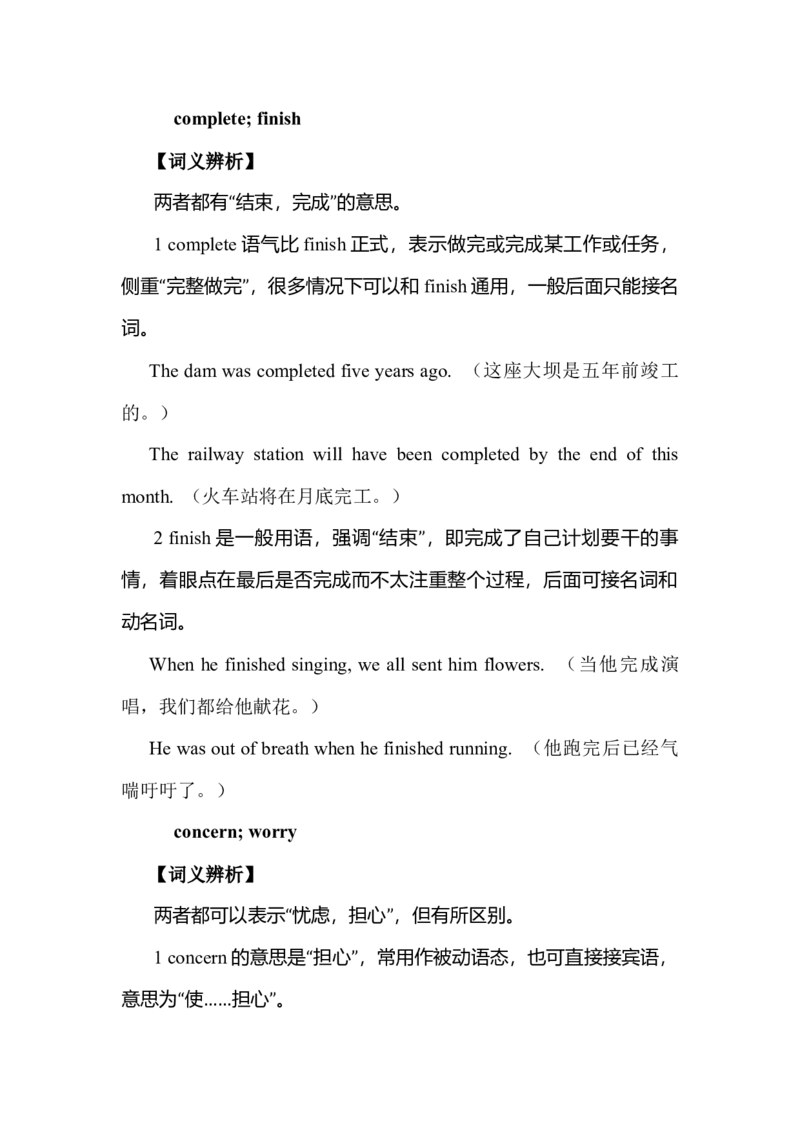
complete; finish
【词义辨析】
“
”
两者都有结束,完成的意思。
1 complete 语气比finish 正式,表示做完或完成某工作或任务,
“
”
侧重完整做完,很多情况下可以和finish 通用,一般后面只能接名
词。
The dam was completed five years ago. (这座大坝是五年前竣工
的。)
The railway station will have been completed by the end of this
month. (火车站将在月底完工。)
2 finish
“
”
是一般用语,强调结束,即完成了自己计划要干的事
情,着眼点在最后是否完成而不太注重整个过程,后面可接名词和
动名词。
When he finished singing, we all sent him flowers. (当他完成演
唱,我们都给他献花。)
He was out of breath when he finished running. (他跑完后已经气
喘吁吁了。)
concern; worry
【词义辨析】
“
”
两者都可以表示忧虑,担心,但有所区别。
1 concern
“
”
的意思是担心,常用作被动语态,也可直接接宾语,
“
……
”
意思为使
担心。
My mother is concerned that I can't pass the exam. (妈妈担心我考
试不能通过。)
The boy's poor performance at school concerned his parents. (这个
男孩在学校表现得很差,这使他父母很担心。)
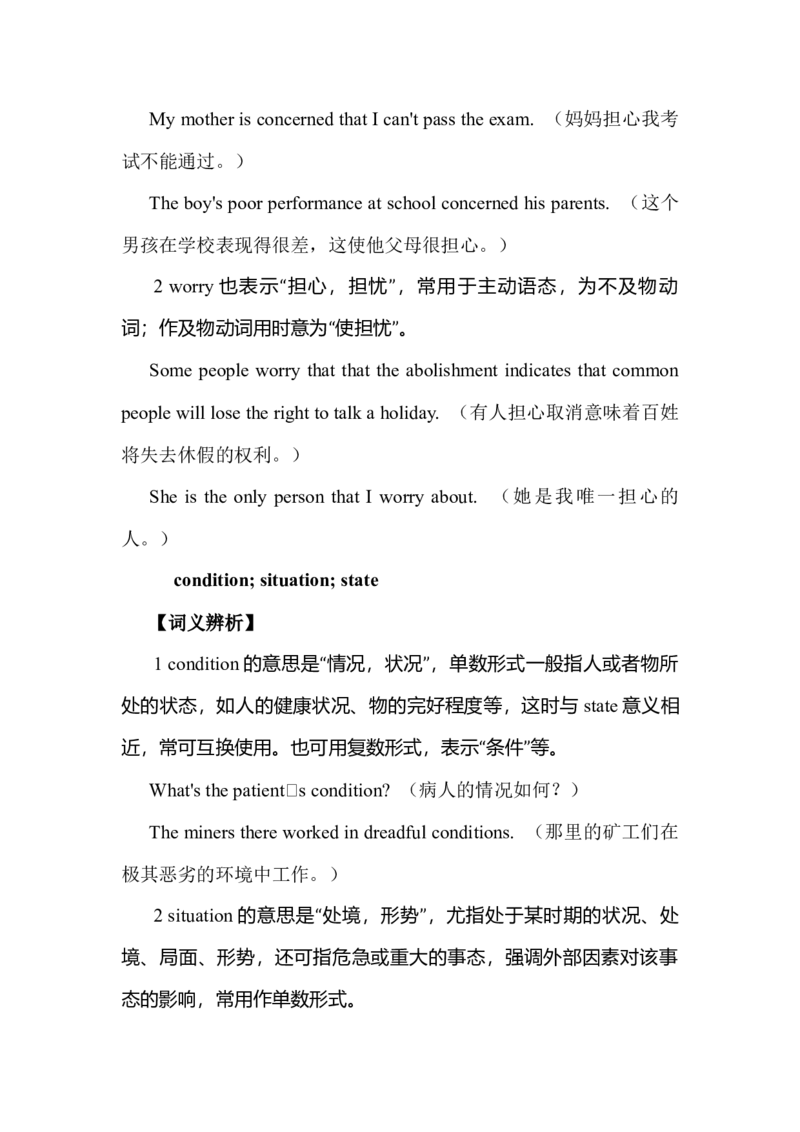
2 worry
“
”
也表示担心,担忧,常用于主动语态,为不及物动
“
”
词;作及物动词用时意为使担忧。
Some people worry that that the abolishment indicates that common
people will lose the right to talk a holiday. (有人担心取消意味着百姓
将失去休假的权利。)
She is the only person that I worry about. (她是我唯一担心的
人。)
condition; situation; state
【词义辨析】
1 condition
“
”
的意思是情况,状况,单数形式一般指人或者物所
处的状态,如人的健康状况、物的完好程度等,这时与state 意义相
“
”
近,常可互换使用。也可用复数形式,表示条件等。
What's the patients condition? (病人的情况如何?)
The miners there worked in dreadful conditions. (那里的矿工们在
极其恶劣的环境中工作。)
2 situation
“
”
的意思是处境,形势,尤指处于某时期的状况、处
境、局面、形势,还可指危急或重大的事态,强调外部因素对该事
态的影响,常用作单数形式。
She is in a difficult situation. (她处境艰难。)
The international situation now is not good for business. (现在的国
际形势不适合经商。)
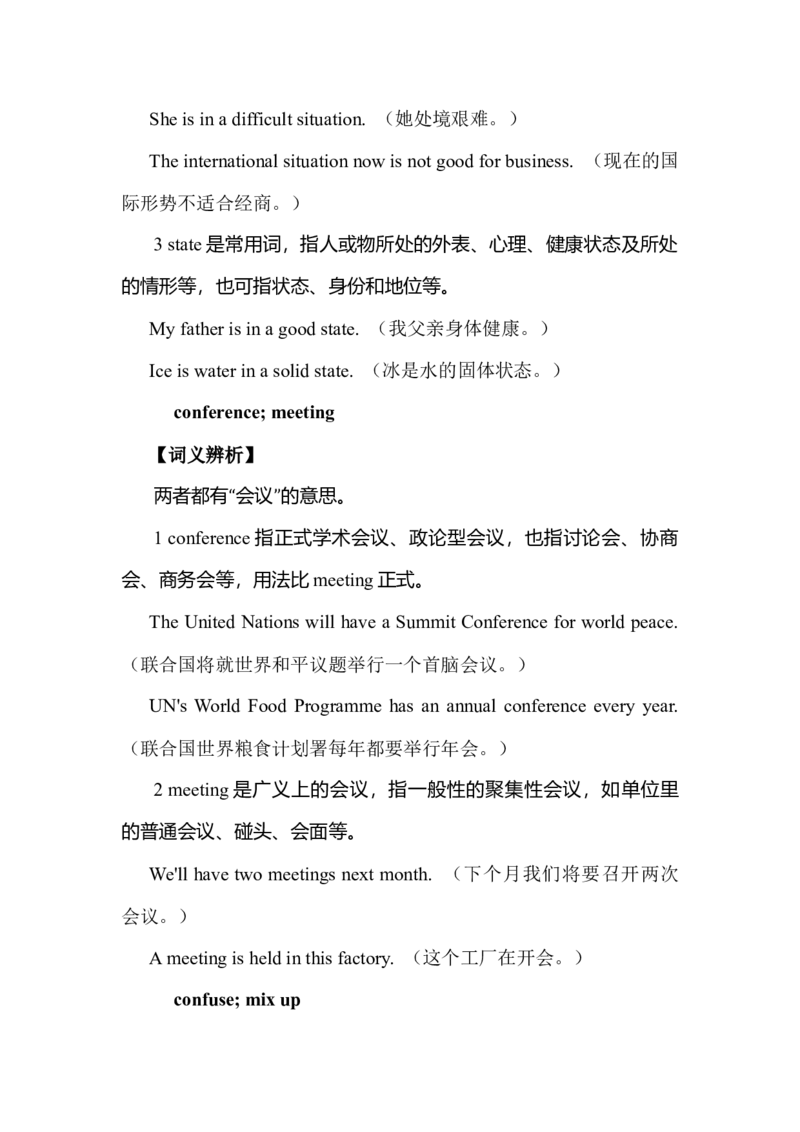
3 state 是常用词,指人或物所处的外表、心理、健康状态及所处
的情形等,也可指状态、身份和地位等。
My father is in a good state. (我父亲身体健康。)
Ice is water in a solid state. (冰是水的固体状态。)
conference; meeting
【词义辨析】
“
”
两者都有会议的意思。
1 conference 指正式学术会议、政论型会议,也指讨论会、协商
会、商务会等,用法比meeting 正式。
The United Nations will have a Summit Conference for world peace.
(联合国将就世界和平议题举行一个首脑会议。)
UN's World Food Programme has an annual conference every year.
(联合国世界粮食计划署每年都要举行年会。)
2 meeting 是广义上的会议,指一般性的聚集性会议,如单位里
的普通会议、碰头、会面等。
We'll have two meetings next month. (下个月我们将要召开两次
会议。)
A meeting is held in this factory. (这个工厂在开会。)
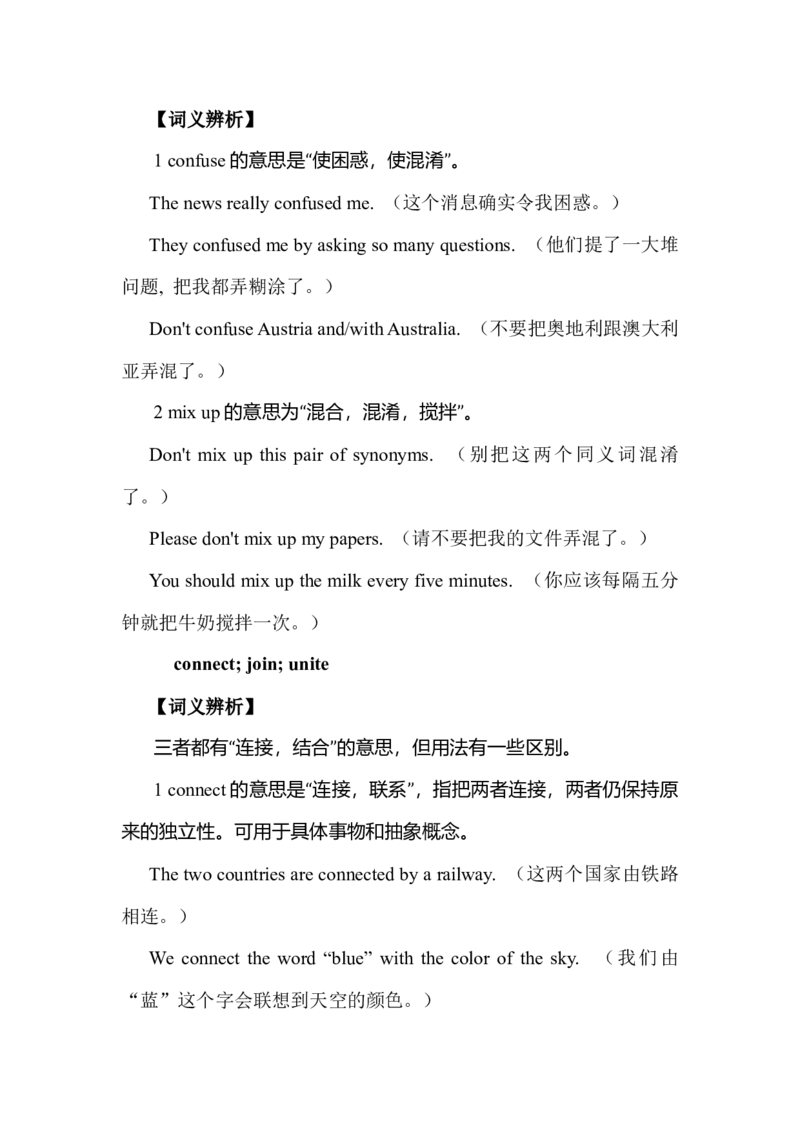
confuse; mix up
【词义辨析】
1 confuse
“
”
的意思是使困惑,使混淆。
The news really confused me. (这个消息确实令我困惑。)
They confused me by asking so many questions. (他们提了一大堆
问题, 把我都弄糊涂了。)
Don't confuse Austria and/with Australia. (不要把奥地利跟澳大利
亚弄混了。)
2 mix up
“
”
的意思为混合,混淆,搅拌。
Don't mix up this pair of synonyms. (别把这两个同义词混淆
了。)
Please don't mix up my papers. (请不要把我的文件弄混了。)
You should mix up the milk every five minutes. (你应该每隔五分
钟就把牛奶搅拌一次。)
connect; join; unite
【词义辨析】
“
”
三者都有连接,结合的意思,但用法有一些区别。
1 connect
“
”
的意思是连接,联系,指把两者连接,两者仍保持原
来的独立性。可用于具体事物和抽象概念。
The two countries are connected by a railway. (这两个国家由铁路
相连。)
We connect the word “blue” with the color of the sky. (我们由
“蓝”这个字会联想到天空的颜色。)
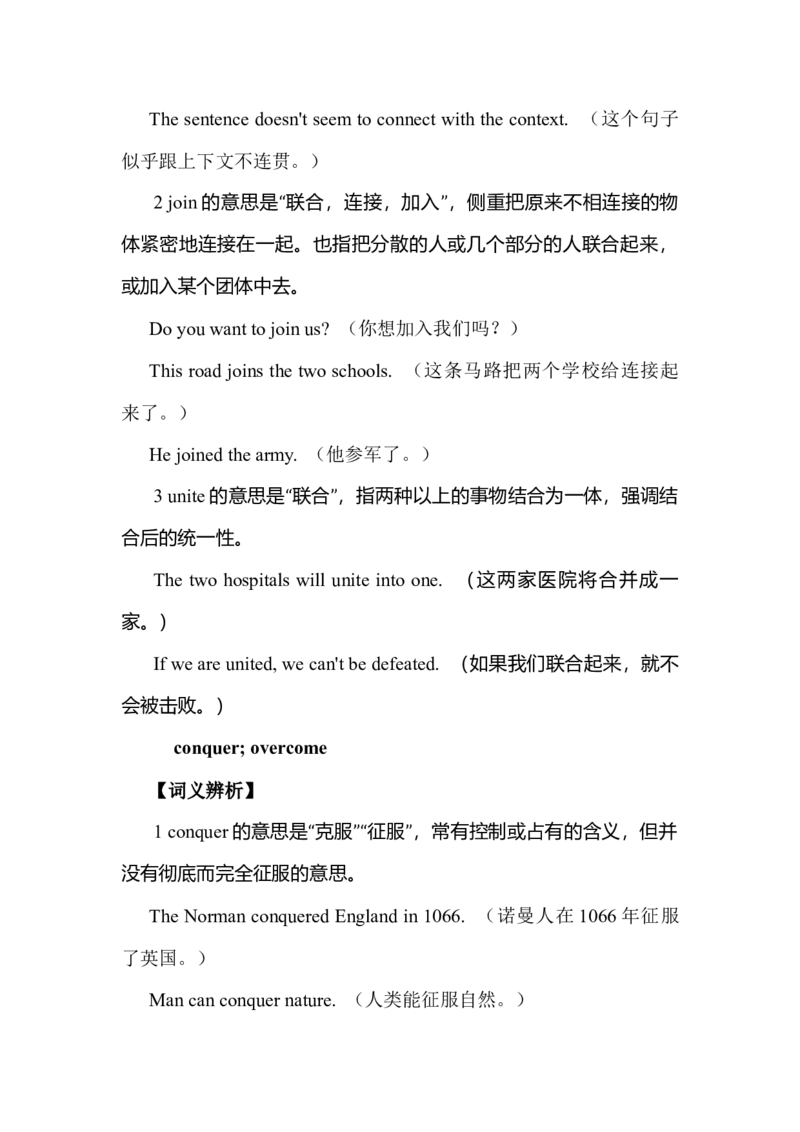
The sentence doesn't seem to connect with the context. (这个句子
似乎跟上下文不连贯。)
2 join
“
”
的意思是联合,连接,加入,侧重把原来不相连接的物
体紧密地连接在一起。也指把分散的人或几个部分的人联合起来,
或加入某个团体中去。
Do you want to join us? (你想加入我们吗?)
This road joins the two schools. (这条马路把两个学校给连接起
来了。)
He joined the army. (他参军了。)
3 unite
“
”
的意思是联合,指两种以上的事物结合为一体,强调结
合后的统一性。
The two hospitals will unite into one. (这两家医院将合并成一
家。)
If we are united, we can't be defeated. (如果我们联合起来,就不
会被击败。)
conquer; overcome
【词义辨析】
1 conquer
“
”“
”
的意思是克服征服,常有控制或占有的含义,但并
没有彻底而完全征服的意思。
The Norman conquered England in 1066. (诺曼人在1066 年征服
了英国。)
Man can conquer nature. (人类能征服自然。)
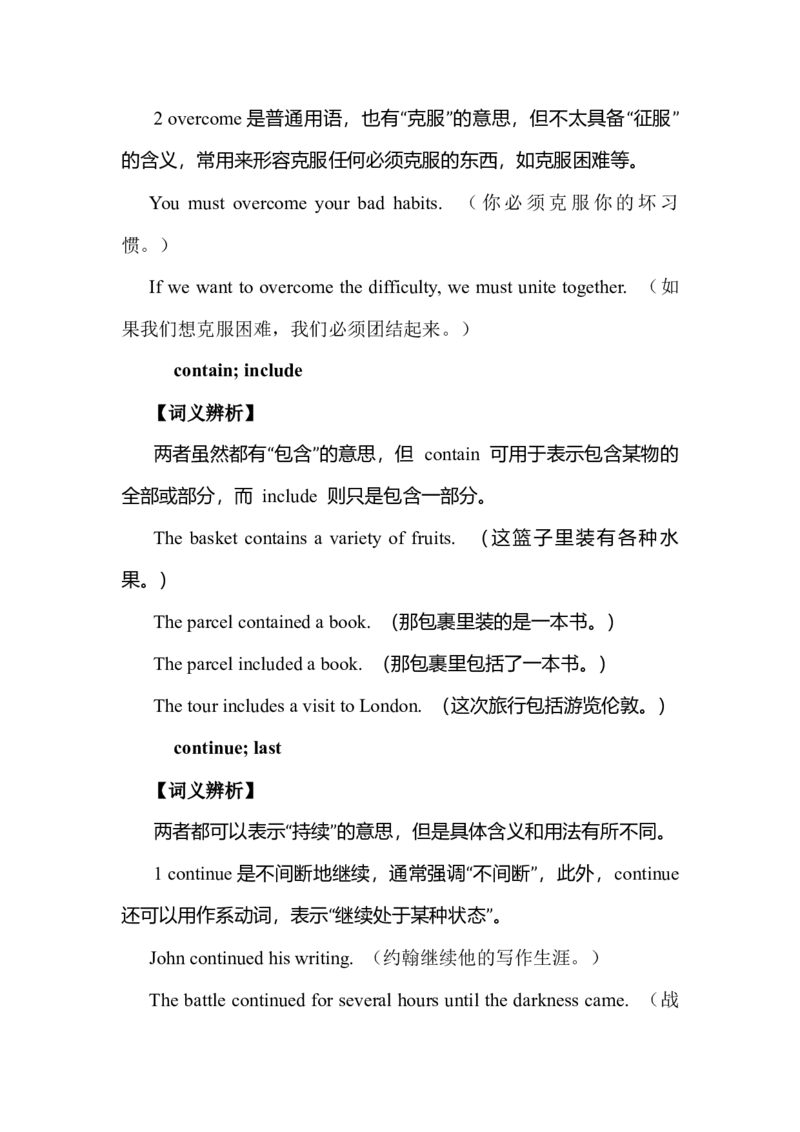
2 overcome
“
”
“
”
是普通用语,也有克服的意思,但不太具备征服
的含义,常用来形容克服任何必须克服的东西,如克服困难等。
You must overcome your bad habits. (你必须克服你的坏习
惯。)
If we want to overcome the difficulty, we must unite together. (如
果我们想克服困难,我们必须团结起来。)
contain; include
【词义辨析】
“
”
两者虽然都有包含的意思,但contain 可用于表示包含某物的
全部或部分,而include 则只是包含一部分。
The basket contains a variety of fruits. (这篮子里装有各种水
果。)
The parcel contained a book. (那包裹里装的是一本书。)
The parcel included a book. (那包裹里包括了一本书。)
The tour includes a visit to London. (这次旅行包括游览伦敦。)
continue; last
【词义辨析】
“
”
两者都可以表示持续的意思,但是具体含义和用法有所不同。
1 continue
“
”
是不间断地继续,通常强调不间断,此外,continue
“
”
还可以用作系动词,表示继续处于某种状态。
John continued his writing. (约翰继续他的写作生涯。)
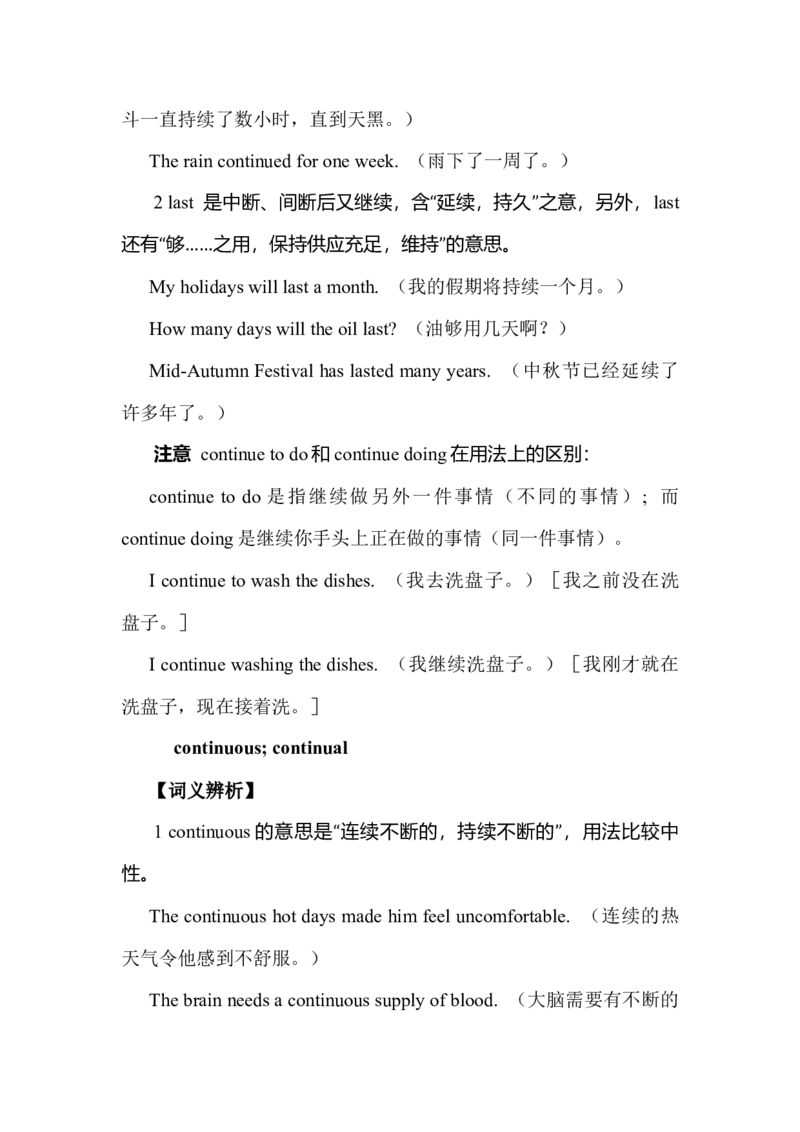
The battle continued for several hours until the darkness came. (战
斗一直持续了数小时,直到天黑。)
The rain continued for one week. (雨下了一周了。)
2 last
“
”
是中断、间断后又继续,含延续,持久之意,另外,last
“
……
”
还有够
之用,保持供应充足,维持的意思。
My holidays will last a month. (我的假期将持续一个月。)
How many days will the oil last? (油够用几天啊?)
Mid-Autumn Festival has lasted many years. (中秋节已经延续了
许多年了。)
注意 continue to do 和continue doing 在用法上的区别:
continue to do 是指继续做另外一件事情(不同的事情); 而
continue doing 是继续你手头上正在做的事情(同一件事情)。
I continue to wash the dishes. (我去洗盘子。)[我之前没在洗
盘子。]
I continue washing the dishes. (我继续洗盘子。)[我刚才就在
洗盘子,现在接着洗。]
continuous; continual
【词义辨析】
1 continuous
“
”
的意思是连续不断的,持续不断的,用法比较中
性。
The continuous hot days made him feel uncomfortable. (连续的热
天气令他感到不舒服。)
The brain needs a continuous supply of blood. (大脑需要有不断的
血液供给。)
2 continual
“
……
”
“
的意思是经久不息的,老是
,反复的,有点没
”
完没了的意思。
A continual applause was given after he finished his performance.
(他演完后响起了经久不息的掌声。)
She is tired of continual trips to the school, office and home. (她对
从家到学校,再到办公室三点一线的生活感到厌倦。)
contrary; opposite
【词义辨析】
“
”
两者可以用作形容词,都表示完全相反的意思。
1 contrary 一般用于表示相反的意见、计划、目的等抽象意义,
有时带有矛盾或敌对的意味。
Wet is contrary to dry. (湿的反义词是干燥。)
What you are doing now is contrary to the doctor's advice. (你正在
做违反医嘱的事。)
2 opposite 是常用词,常指相反的位置、方向、性质、结果等,
不一定有敌对的含义。opposite
“
也可作形容词,意为对立面,反
”
面。
Have you seen the house opposite to the railway station? (你看到
火车站对面的房子了吗?)
Black is the opposite of white. (黑和白相反。)
correct; right
【词义辨析】
1
“
”
两者都有正确的意思,区别不是很大,常可互换。
Your opinion is correct/ right. (你的意见是正确的。)
2
“
”
两者均可表示恰当的,但correct 侧重指行为、礼貌、衣着
等方面符合公认标准或得体;
而right 则指同类中的最佳者,即最恰
当的、最适宜的、最切合实际的。
Such cheap dress would not be correct for a formal occasion. (这样
的廉价衣服不宜在正式场合穿。)
He is the right man for the chairman. (他是最适合做主席的
人。)
3
“
”
指道德行为方面的正确,或指人的身体或精神处于正常状
态,均用right。
It is not right to tell lies. (说谎是不对的。)
The old man is not right in his head. (这个老人头脑不正常。)
cost; pay; spend; take
【词义辨析】
“
”
这几个词都可以表示花费。
1 cost
“
”
“
”
的主语一般是物或事,多指花金钱、时间、劳力等,
“
”
表示费用,耗费。cost 的过去式及过去分词都是cost,并且不能用
于被动句。
It will cost you a lot of money if you want to live in America. (如果
你想住在美国,你必须花费很多钱。)
The new house cost me one million yuan. (新房子花费了我一百万
元。)
How much will the operation cost? (这台手术要花费多少钱?)
2 pay
“
”
“
”
其主语通常是人,只能用于表示花钱,不能用于表示
“
”
花时间。
How much rent do you pay for the house? (你付多少钱租这个房
子?)
I have to pay for the lost bike. (我不得不赔丢失的自行车款。)
Here is not allowed to pay by check. (这里不准用支票付费。)
3 spend 的主语必须是人,可指花时间、金钱、精力等,常用结
构是:spend sth. (money, time) on sth.和spend sth. (money, time) (in)
doing sth.。
He doesn't spend much time on his homework. (他没有在做作业
上花费很多时间。)
My mother spent a whole afternoon (in) washing clothes. (我妈妈
花了整整一下午洗衣服。)
The boy spent all his money yesterday. (那个男孩昨天把所有的钱
都花光了。)
4 take 常用于表示花时间,主语常为形式主语it,后面常跟双宾
语。常见结构是:It takes sb.+时间+to do sth. (做某事花了某人多少
时间); doing sth. takes sb.+时间(做某事花了某人多少时间)。
Washing the windows and floors took him the whole day. (他花了
一整天擦洗窗户和地板。)
It took me five years to finish the novel. (我用了五年时间才写完
这部小说。)
crazy; mad
【词义辨析】
“
”
两者都是形容词,都有疯狂,着迷的意思,但用法不同。
1 crazy
“
”
的意思是疯狂的,狂热的。
It is crazy of you to drive at such high speed. (以这么快的速度开
车你真是疯了。)
Many children are learning Crazy English. (许多孩子都在学《疯
狂英语》。)
It was crazy to publish this kind of novel in that time. (在那个年代
发表这样的小说简直就是疯狂之举。)
2 mad
“
”
的意思是发疯的,疯狂的,常带贬义。
She was mad after the death of her daughter. (她女儿死后她就疯
了。)
The noise is enough to make a man mad. (这种噪声足够让一个人
变疯。)
cross; crossing
【词义辨析】
1 cross
“
”
可作名词,意思为十字,十字架,crossing 也可作名
“
”
词,意思为横渡,渡口。
Jesus died on the cross. (耶稣死在十字架上。)
You should be careful for the railway crossing when driving. (开车
时,你要小心铁路道口。)
2 cross
“
”
还可作动词,意思为跨越,穿过,而crossing 则不能用
作动词。
The policeman crossed the road and saluted to the passers-by. (警察
穿过路口,向行人敬礼。)
The man spent two months crossing the ocean. (那人花了两个月
跨越了大洋。)
cry; sob; weep
【词义辨析】
“
”
这三个动词都表示哭。
1 cry 是普通用语,指因悲伤、恐惧、绝望甚至高兴而哭,一般
“
”
多强调哭出声来。此外,cry
“
”
还有喊叫,呼叫的意思。
He cried over his mother's death. (他为母亲的去世而哭泣。)
The baby cried. (婴儿哭了。)
A girl cried for help at midnight. (一个女孩在深夜大声呼救。)
2 sob 指痛苦、悲伤时,伴随着喘气、又近似叹息的声音,多指
“
”
抽噎,啜泣。
The baby sobbed himself to sleep. (那个婴儿抽噎着睡着了。)
The wind sobbed in the trees. (风在树林中凄鸣。)
A sob welled up in his throat. (他喉咙里发出一声呜咽。)
3 weep 是书面用语,强调小声地哭或无声地流泪。
Mother wept for joy. (母亲高兴得流出了眼泪。)
We all wept in silence for the deceased. (我们都默默为死者哀
悼。)
cure; heal; treat
【词义辨析】
1 cure
“
”
的意思是治疗,治愈,指治愈、治好病人或者疾病,达
到康复的结果。
The medicine can cure you of a fever. (这种药可以治好你的发
烧。)
When I left the hospital I was completely cured. (出院时,我已经
痊愈了。)
The doctor has cured me completely. (医生把我的病彻底治好
了。)
2 heal 常指治愈伤口或创伤、烧伤等,也可指精神创伤或者环境
破坏后的复原。
Time heals most troubles. (时间会治愈一切痛苦。)
The cut is no longer weeping and is starting to heal. (伤口已经不
再流脓,并开始愈合。)
3 treat 指接受某人为病人,并为其进行诊断病情,帮助其解除痛
“
”
“
”
苦等治疗或医治工作,不一定治愈。
The doctors were not able to treat this disease. (医生治不了这种
病。)
This old man is being treated for a heart condition. (这位老人正在
接受心脏病治疗。)
Cancers are difficult to treat. (癌症很难治愈。)
custom; habit; practice; convention
【词义辨析】
1 custom 指一个国家、一个民族、一个地区或一个社会的习惯、
行为方式或风俗习惯。也可指个人的习惯。
The celebration of Christmas is a custom. (庆祝圣诞节是一种风
俗。)
Social customs vary greatly from country to country. (每个国家的
社会风俗都不一样。)
He makes it a custom to go to bed late and get up early. (他养成了
晚睡早起的习惯。)
2 habit 指生活习惯,个人的习惯,有好有坏。
A good eating habit makes you healthy and strong. (一个好的饮食
习惯使你健康、强壮。)
Smoking after meal is not a good habit. (饭后吸烟不是一个好习
惯。)
3 practice 常指个人的或社会的习惯做法或行为。
It's my practice always to rise early. (早起是我的习惯。)
It is a dangerous practice to get off a bus before it stops. (在公交车
没停稳之前下车是一个危险的习惯。)
4 convention 多指约定俗成的行为方式、规则或公认的标准,或
指艺术上公认的技巧。
It is silly to be a slave to social conventions. (对社会习俗盲从是愚
蠢的。)
Using the right hand to shake hands with the guests is a convention.
(用右手同客人握手是约定俗成的行为。)