2026 年高考一轮复习收官卷(广东卷02)
 英语·全解全析
第一部分 听力(共两节,满分30 分)
注意,听力部分答题时请先将答案标在试卷上,听力部分结束前你将有两分钟的时间将答案转涂到答题
上。
第一节(共5 小题; 每小题1.5 分, 满分7.5 分)
听下面 5 段对话,每段对话仅读一遍。
1.  What is wrong with the man’s computer?
A.The space bar doesn’t work well.
B.The memory needs to be changed.
C.The keyboard can’t be connected.
2.What does Robert think of the musical?
A.It’s rather amusing.
B.It’s far from satisfactory.
C.It’s very disappointing.
3.Where does the conversation probably take place?
A.In the man’s house.
B.In a restaurant.
C.In the woman’s office.
4.What is the probable relationship between the speakers?
A.Friends.
B.Boss and secretary.
C.Strangers.
5. What is the woman mainly talking about?
A.Cindy’s appearance.
B.Cindy’s personality.
C.Cindy’s hobby.
第二节 (共15 小题;每小题1. 5 分,满分 22. 5 分)
听下面5 段对话或独白。每段对话或独白后有几个小题 ,从题中所给的A、B、C 项中选出最佳选项。听
每段对话或独白前,你将有时间阅读各个小题,听完后,各小题将给出5 秒钟的作答时间。每段对话或独
白读两遍。
听下面一段较长对话,回答以下小题。
6.What is the probable relationship between the speakers?
A.Old friends.
B.Business partners.
C.Boss and clerk.
7.What does the man want the woman to do?
A.Recommend a worker.
B.Work on a project.
C.Meet some customers.
听下面一段对话,回答以下小题。
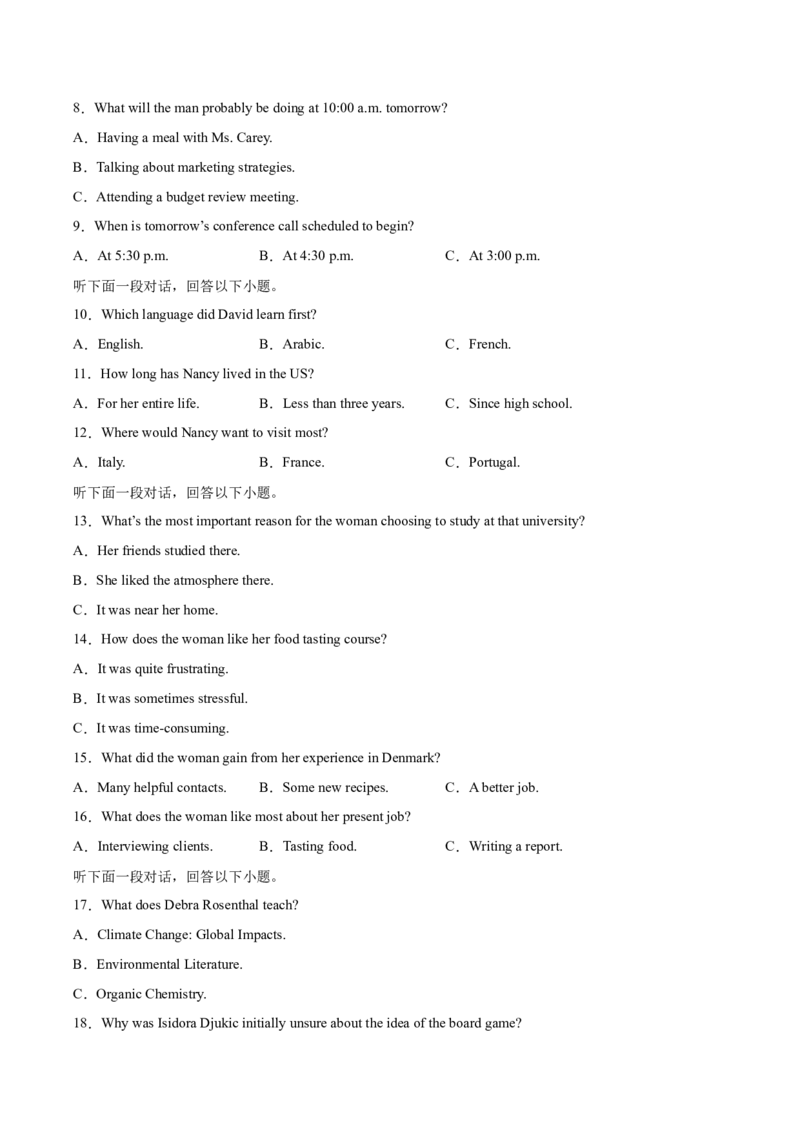
8.What will the man probably be doing at 10:00 a.m. tomorrow?
A.Having a meal with Ms. Carey.
B.Talking about marketing strategies.
C.Attending a budget review meeting.
9.When is tomorrow’s conference call scheduled to begin?
A.At 5:30 p.m.
B.At 4:30 p.m.
C.At 3:00 p.m.
听下面一段对话,回答以下小题。
10.Which language did David learn first?
A.English.
B.Arabic.
C.French.
11.How long has Nancy lived in the US?
A.For her entire life.
B.Less than three years.
C.Since high school.
12.Where would Nancy want to visit most?
A.Italy.
B.France.
C.Portugal.
听下面一段对话,回答以下小题。
13.What’s the most important reason for the woman choosing to study at that university?
A.Her friends studied there.
B.She liked the atmosphere there.
C.It was near her home.
14.How does the woman like her food tasting course?
A.It was quite frustrating.
B.It was sometimes stressful.
C.It was time-consuming.
15.What did the woman gain from her experience in Denmark?
A.Many helpful contacts.
B.Some new recipes.
C.A better job.
16.What does the woman like most about her present job?
A.Interviewing clients.
B.Tasting food.
C.Writing a report.
听下面一段对话,回答以下小题。
17.What does Debra Rosenthal teach?
A.Climate Change: Global Impacts.
B.Environmental Literature.
C.Organic Chemistry.
18.Why was Isidora Djukic initially unsure about the idea of the board game?
A.She didn’t enjoy playing board games.
B.She doubted its effectiveness in learning.
C.She preferred traditional classroom discussions.
19.How does the board game “Solutions” differ from “Monopoly”?
A.The players of “Solutions” work towards a common goal.
B.The aim of “Solutions” is to make players compete with each other.
C.“Solutions” includes collecting recyclable materials.
20.What do we know about the board game “Solutions”?
A.It needs to be played with six copies at the same time.
B.It often involves votes to make a decision.
C.It requires the players to measure the temperature.
第二部分 阅读(共两节,满分 50 分)
第一节 (共 15 小题;每小题 2.5 分,满分 37.5 分) 阅读下列短文,从每题所给的 A、B、C、D 四
个选项中选出最佳选项。
A
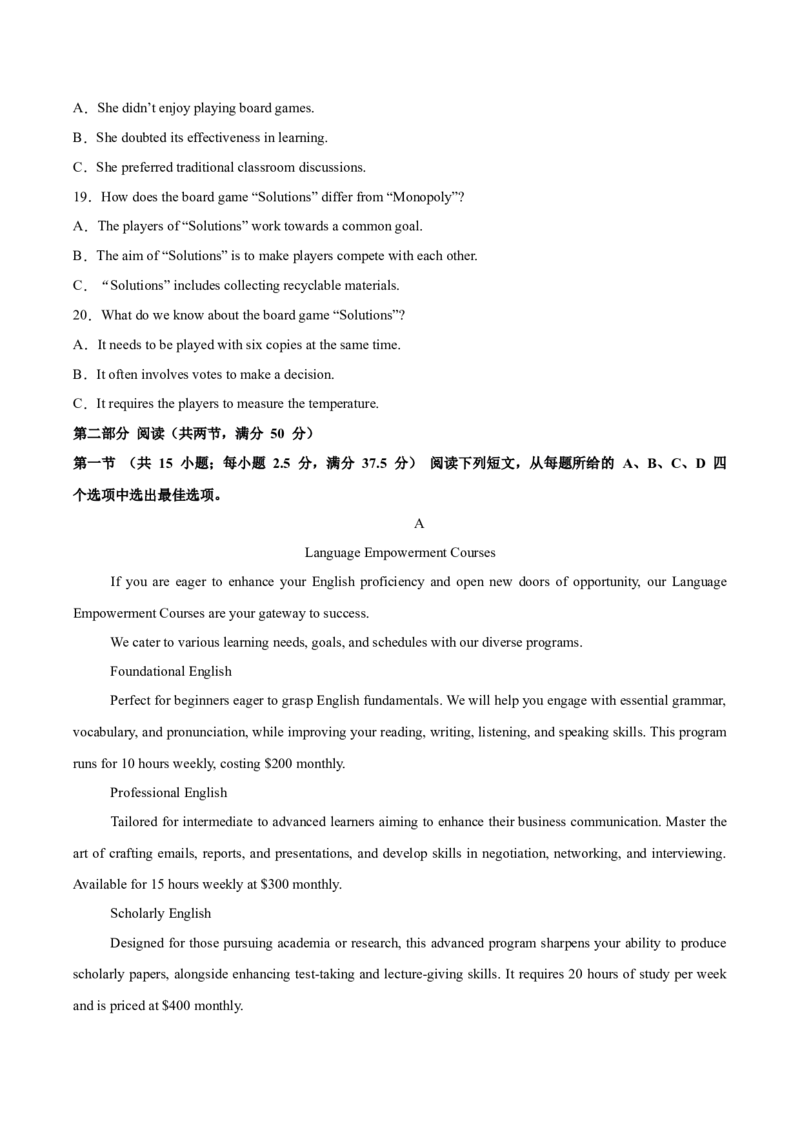
Language Empowerment Courses
If you are eager to enhance your English proficiency and open new doors of opportunity, our Language
Empowerment Courses are your gateway to success.
We cater to various learning needs, goals, and schedules with our diverse programs.
Foundational English
Perfect for beginners eager to grasp English fundamentals. We will help you engage with essential grammar,
vocabulary, and pronunciation, while improving your reading, writing, listening, and speaking skills. This program
runs for 10 hours weekly, costing $200 monthly.
Professional English
Tailored for intermediate to advanced learners aiming to enhance their business communication. Master the
art of crafting emails, reports, and presentations, and develop skills in negotiation, networking, and interviewing.
Available for 15 hours weekly at $300 monthly.
Scholarly English
Designed for those pursuing academia or research, this advanced program sharpens your ability to produce
scholarly papers, alongside enhancing test-taking and lecture-giving skills. It requires 20 hours of study per week
and is priced at $400 monthly.
Technical English: Science Focus
Ideal for beginners focused on English in science, particularly those interested in developing language skills
related to scientific discussions and texts. This program offers 10 hours of study per week for $200 monthly.
Visit our website or reach out for more details. Benefit from our free placement assessment and trial session
to find the perfect fit for your language journey.
21.Which would likely attract someone interested in pursuing a career in research?
A.Foundational English.
B.Professional English.
C.Scholarly English.
D.Technical English.
22.In what aspect does the Technical English program help the learner?
A.Developing business communication.
B.Mastering scientific terms.
C.Improving general English skills.
D.Understanding cultural notes.
23.What additional service is provided?
A.Advanced placement in courses.
B.Customized learning materials.
C.A free placement test and a trial session.
D.Guaranteed proficiency upon course completion.
B
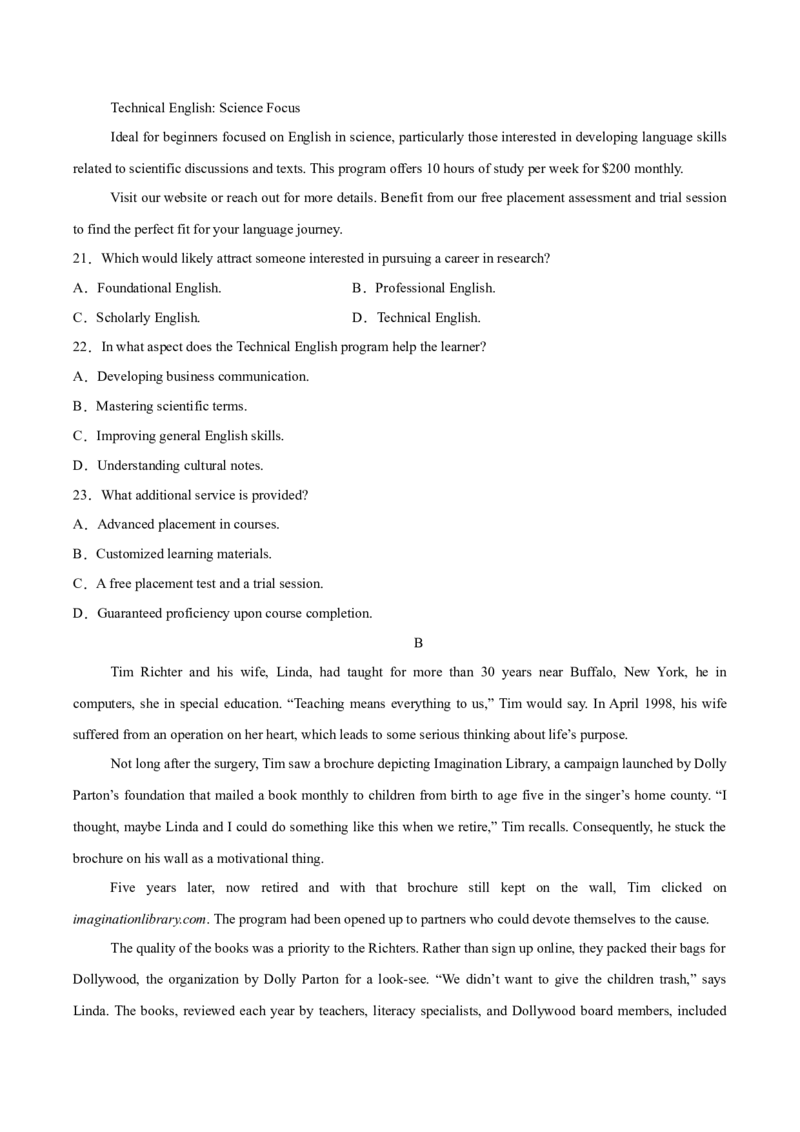
Tim Richter and his wife, Linda, had taught for more than 30 years near Buffalo, New York, he in
computers, she in special education. “Teaching means everything to us,” Tim would say. In April 1998, his wife
suffered from an operation on her heart, which leads to some serious thinking about life’s purpose.
Not long after the surgery, Tim saw a brochure depicting Imagination Library, a campaign launched by Dolly
Parton’s foundation that mailed a book monthly to children from birth to age five in the singer’s home county. “I
thought, maybe Linda and I could do something like this when we retire,” Tim recalls. Consequently, he stuck the
brochure on his wall as a motivational thing.
Five years later, now retired and with that brochure still kept on the wall, Tim clicked on
imaginationlibrary.com. The program had been opened up to partners who could devote themselves to the cause.
The quality of the books was a priority to the Richters. Rather than sign up online, they packed their bags for
Dollywood, the organization by Dolly Parton for a look-see. “We didn’t want to give the children trash,” says
Linda. The books, reviewed each year by teachers, literacy specialists, and Dollywood board members, included
classics such as Ezra Jack Keats’s The Snowy Day and newer titles like Anna Dewdney’s Llama Llama series.
Satisfied, the couple set up the Richter Family Foundation and work on. Since 2004, they have shipped more
than 12,200 books to preschoolers in their area. Megan Williams, a mother of four, is more than appreciative: “This
program introduces us to titles I’ve never heard of.”
The Richters spend about $400 a month sending books to 200 children. “Some people sit on their bottom and
wait to die,” says Tim. “Others get as busy as they can in the time they have left.”
24.What inspired Tim’s action to do something for children?
A.Tim’s teaching.
B.Linda’s operation.
C.Megan’s encouragement.
D.Patron’s foundation.
25.Why did the Richters select the books carefully?
A.To become Imagination Library’s partner.
B.To meet the children’s requirement.
C.To guarantee the quality of books.
D.To win the praise of board members.
26.What is the attitude of Megan towards the program?
A.Critical.
B.Doubtful.
C.Supportive.
D.Contradictory.
27.Which of the following best describes Tim?
A.Changeable and creative.
B.Generous and reliable.
C.Imaginative and respectable.
D.Traditional and helpful.
C
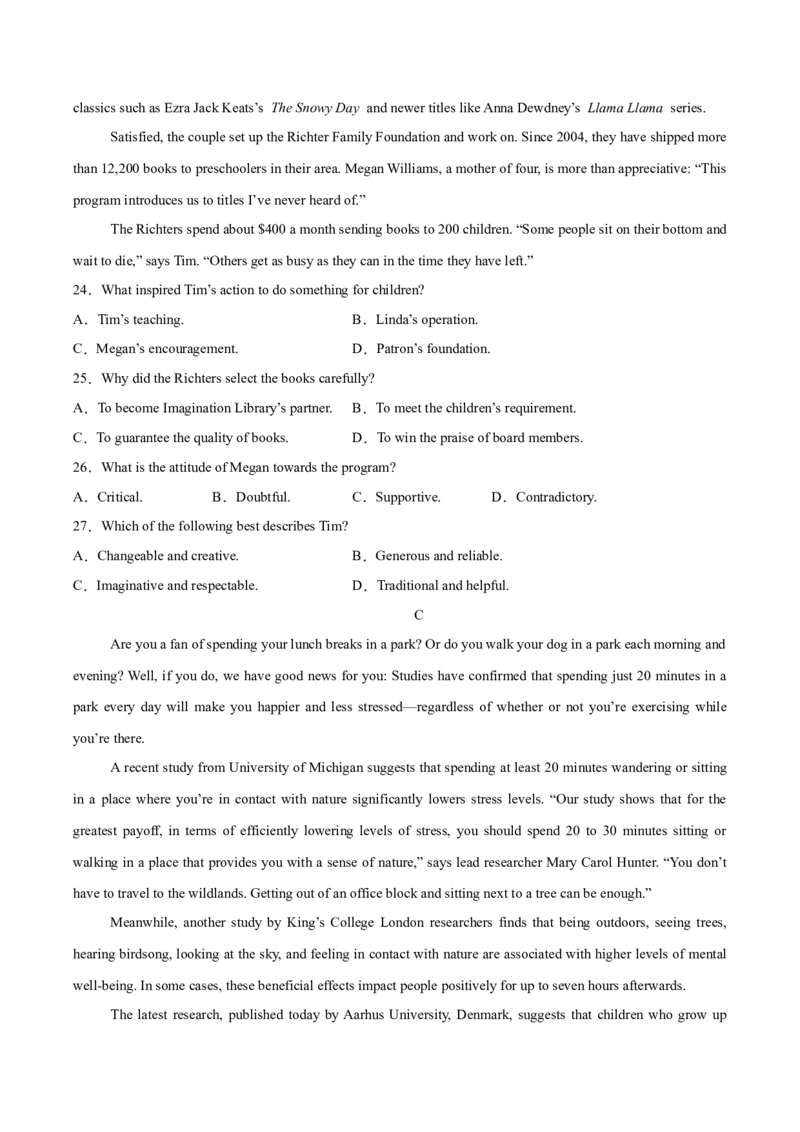
Are you a fan of spending your lunch breaks in a park? Or do you walk your dog in a park each morning and
evening? Well, if you do, we have good news for you: Studies have confirmed that spending just 20 minutes in a
park every day will make you happier and less stressed—regardless of whether or not you’re exercising while
you’re there.
A recent study from University of Michigan suggests that spending at least 20 minutes wandering or sitting
in a place where you’re in contact with nature significantly lowers stress levels. “Our study shows that for the
greatest payoff, in terms of efficiently lowering levels of stress, you should spend 20 to 30 minutes sitting or
walking in a place that provides you with a sense of nature,” says lead researcher Mary Carol Hunter. “You don’t
have to travel to the wildlands. Getting out of an office block and sitting next to a tree can be enough.”
Meanwhile, another study by King’s College London researchers finds that being outdoors, seeing trees,
hearing birdsong, looking at the sky, and feeling in contact with nature are associated with higher levels of mental
well-being. In some cases, these beneficial effects impact people positively for up to seven hours afterwards.
The latest research, published today by Aarhus University, Denmark, suggests that children who grow up
with greener surroundings have up to 55% less risk of developing various mental disorders later in life.
The results are perhaps unsurprising. Multiple studies have previously highlighted the benefits of nature on a
person’s mental health and emphasized the need for designing greener cities for the future and protecting our
existing parks. However, the challenge facing cities is that planners and developers are eager to replace green space
with residential and commercial buildings.
28.What will Mary Carol Hunter most probably advise us to do to reduce stress?
A.Put some flowers in the office.
B.Spend 25 minutes in nature each day.
C.Go to wildlands once a week.
D.Do exercise each morning at home.
29.What is paragraph 4 mainly about?
A.The challenge facing cities.
B.The healing effects of trees.
C.Nature’s impact on efficiency.
D.The lasting influence of green space.
30.What message does the author seem to convey in the last paragraph?
A.The conclusion of the studies is not reliable.
B.The studies have ground-breaking significance.
C.The urban planning is going in a wrong direction.
D.Cities will become greener and healthier in the future.
31.How is the text mainly developed?
A.By listing examples.
B.By analyzing data.
C.By conducting surveys.
D.By making comparisons.
D
Soy is found in almost everything we eat, from the vegetable oil to store-bought chocolate. While it may
seem like humans chose the soybean, it was arguably the soybean that chose people.
Soybeans have an innate ability to grow almost anywhere and survive almost anything. They can grow
anywhere from three to five feet tall and produce around 100 beans per plant. Soy can be grown everywhere from
the extremely harsh four seasons of Manitoba, Canada, to the grassland of Mpumalanga, South Africa.
Soy was likely domesticated in China approximately 6,000 to 9,000 years ago when ancient Chinese medical
healers used all parts of the plant as medicine. People also turned soy into noodles, tofu, and soy sauce. Soybeans
were initially sent to England to meet rising demands for soy sauce, which was becoming a staple in British
cuisine.
It would not be long, though, before Americans found another use for the bean. During the Civil War, roasted
soybeans were used as coffee substitutes ( 替代) for economy and health considerations. And soon, soybeans
became the staple feed in the diets of non-human creatures, too, with one cup of raw soybeans containing 67.9
grams of protein and 17.3 grams of fiber. In the US, chickens eat the most soy, followed by pigs, cows, and fish.
These animals eat over 70 percent of all soybeans grown in the US.
Nowadays, genetic modification contributes to massive quantities of soybeans all over the world, including
the Amazon rainforest, where they are replacing the trees that once stood there. Brazil now exports more soybeans
than any other country. Now some advocacy groups are calling for better land-use practices to safeguard the
rainforest and the soil. In 2023, policies brought on by new governments in South America began slowing rates of
deforestation in the Amazon.
Now many growers have expanded their soy operations to the Cerrado, a savannah-like region of Brazil.
Despite changing policies and practices around deforestation, this year is expected to be a record year for soybean
production.
32.What does the underlined word “innate” probably mean in the second Paragraph?
A.Important.
B.Inborn.
C.Immediate.
D.Initial.
33.What did the Americans use soy to do?
A.Treat the patients as medicine.
B.Enrich the kinds of cuisine.
C.Produce a wide range of food.
D.Offer staple food to livestock.
34.What affects the planting of soy now?
A.The communication across the globe.
B.The change of environment.
C.The updated government policies.
D.The deforestation in the Amazon.
35.In which section of a magazine is the text taken from?
A.Society.
B.Agriculture.
C.History.
D.Communication.
第二节 (共5 小题;每小题2.5 分,满分12.5 分)
根据短文内容,从短文后的选项中选出能填入空白处的最佳选项。选项中有两项为多余选项。
Do you remember when someone would be cruel to you at school and you would come home crying? Your
parents probably told you that “what they think doesn’t matter — it’s what you think that counts.”     36

How can you be happy if you don’t like who you are? Here are some ways to change your self-perception and
boost your happiness.
Identify what matters to you.
First, ask yourself what’s important to you. We all have traits (特点) we value and talents we pride ourselves
on.     37     If creativity and art are your strengths, emphasize them. It shouldn’t matter if you lack confidence
or are overweight as long as you have something to be proud of. Finding your purpose makes minor issues seem
less significant.
    38
Your current self is a stepping stone to becoming who you want to be. For instance, if you’re unhappy with
your career, think about a job that would make you happy and how to achieve it. Remember, many successful
people didn’t achieve greatness until later in life; it’s never too late to pursue your dreams.     39
List your positive traits and achievements.
Before aiming for self-improvement, recognize your virtues. Sit down and write ten things you like about
yourself and ten achievements you’re proud of. Everyone can come up with at least ten items.
Find role models.
    40     To overcome this, find role models who share similar traits but succeed despite challenges.
Seeing how others maximize their strengths can inspire you to do the same, boosting your self-respect.
By focusing on what truly matters, you can improve your self-respect and overall happiness.
A.Focus on these positive aspects.
B.Acknowledge you can change and grow.
C.But what if the criticism comes from within?
D.The journey itself matters more than the destination.
E.How do you go about changing the way you feel about others?
F.Reflect on your friends and family members who love you for who you are.
G.We often compare ourselves unfavourably to others, especially those in the media.
第三部分:语言运用(共两节,满分 30 分)
第一节:(共15 小题;每小题 1 分,满分15 分)
阅读下面短文,从短文后各题所给的 A、B、C 和 D 四个选项中,选出可以填入空白处的最佳选项。
The mark of a good fantasy story is that it inspires those who encounter it. Carlo Collodi’s The Adventures
of Pinocchio certainly     41     this test. Since it first appeared in Italy in 1883, it has     42

generations of children and young people. It is about a naughty wooden boy whose nose grows when he lies. It
enjoys lasting     43     among all ages.
Pinocchio comes into being when a man discovers a talking piece of wood. The man gives it to Geppetto,
who carves it into a wooden boy. The puppet becomes a(n)     44     for the childless old man, who treats him
like his son.     45    , Pinocchio is the opposite of an angel. The puppet can do many things,     46

when it comes to doing bad things. On his way to school for the first time, he     47     his promise to Geppetto
to be a good student and sells his school book to go see a show.
This is only the     48     of a series of adventures that find the boy in the belly of a shark and falling
into hell. Events like these are     49     in modern fantasies. They are common story points in old stories, too.
The shark chapter may     50     readers of Jonah, who is eaten by a whale in the Bible.
Some fantasies     51     adults. They think that stories with violence will have a bad     52     on
children. But generally, fantasy stories have moral lessons in them. Certainly this story has one. Pinocchio     53
to become a real child, but he must survive many adventures before achieving his     54     wish. Finally he
becomes one, but to achieve humanity he must learn how to     55     well.
41.A.skips
B.fails
C.stands
D.misses
42.A.puzzled
B.frightened
C.concerned
D.fascinated
43.A.happiness
B.popularity
C.expectation
D.power
44.A.representative B.decoration
C.experiment
D.companion
45.A.However
B.Therefore
C.Instead
D.Otherwise
46.A.exactly
B.especially
C.apparently
D.definitely
47.A.fulfills
B.recalls
C.breaks
D.keeps
48.A.consequence
B.origin
C.beginning
D.cause
49.A.common
B.rare
C.strange
D.unique
50.A.inform
B.remind
C.convince
D.warn
51.A.worry
B.excite
C.engage
D.inspire
52.A.conclusion
B.impression
C.motivation
D.impact
53.A.hates
B.rejects
C.longs
D.seems
54.A.worst
B.fittest
C.darkest
D.fondest
55.A.function
B.reform
C.behave
D.operate
第二节:(10 个小题;每小题1.5 分,满分15 分)
(原创试题)阅读下列短文,根据短文内容或括号内所给词的恰当形式填空。
Common water plant could provide a green energy source. Scientists have figured out how to get large
amounts of oil from duckweed, one of nature’s fastest-growing water plants. _____56_____(transfer) such plant
oil into biodiesel (生物柴油) for transportation and heating could be a big part of a more sustainable future.
For a new study, researchers genetically engineered duckweed plants to produce seven times more oil per
acre than soybeans. John Shanklin, a biochemist says further research could double the     57     (engineer)
duckweed’s oil output in the next few years.
Biofuels, which are distinct from fossil fuels     58     form underground, possess renewability whereas
their consumption rate is exceeded by regeneration speed. Lower carbon footprints compared to those produced
by fossil fuels can    59     (achieve)by fuels sourced from both unused and recycled vegetable oils, animal fat,
alongside seaweed sources. Nevertheless, negative perceptions have been increasingly directed toward them
recently. This     60     (criticize) is partly attributed to the reality that substantial crop     61     (volume)
are now diverted toward energy production instead of food supplies, while over 100 million acres of global
agricultural land are occupied by biofuel cultivation.
Duckweed, common on every continent but Antarctica, is among the world’s most productive plants and the
researchers suggest it could be a game-changing renewable energy source for three key reasons. First, it grows
62     (ready) in water, so it wouldn’t compete with food crops for agricultural land. Second, duckweed can grow
fast in agricultural pollution released into the water. Third, Shanklin and his team found a way to avoid a major
biotechnological barrier. For the new study, Shanklin says, the researchers added     63     oil-producing gene,
“turning it on like a light switch”     64     introducing a particular molecule only when the plant had finished
growing.
To expand production to industrial levels, scientists will need to design ,     65     produce large-scale
bases for growing engineered plants and obtaining oil is a challenge. Shanklin says, because duckweed is a non-
mainstream crop without much existing infrastructure.
第四部分  写作(共两节,满分40 分)
第一节(满分 15 分)
(原创试题)假如你是李华,为提升学生对健康生活方式的认识,培养科学的体重管理习惯,你校于上周
五开展了主题为“科学管理体重”(Scientific weight management)的活动,请你给校英文报写一篇报道。
内容包括:1.活动内容;2.活动反响。
注意:
1.写作词数应为80 左右;
2.可适当根据需要增加细节。
____________________________________________________________________________________________
____________________________________________________________________________________________
____________________________________________________________________________________________
____________________________________________________________________________________________
________________________________________________________________________________________
第二节  (满分 25 分)
阅读下面材料,根据其内容和所给段落开头语续写两段,使之构成一篇完整的短文。
In the small town of Millfield, at Cedarwood Middle School, Jake, a lanky and soft-spoken boy with thick
glasses, was an easy target for bullies. His passion for astronomy set him apart from his peers. Instead of playing
football or video games, he spent his free time stargazing and reading books about galaxies and constellations.
Every day at lunch, as Jake sat alone at a corner table, devouring a homemade sandwich and scribbling notes about
the latest celestial event he’d read about, a group led by Mark, the school’s self- proclaimed “cool kid,” would pass
by.
Mark, tall with a confident swagger, loved the attention he got from his friends. With a smile on his face,
he’d lean over Jake’s table and pick up his astronomy notebook. “What’s this? More of your space nonsense?” he’d
sneer, waving the notebook in the air. His friends would snicker, and Jake would blush, reaching out timidly to get
his notebook back. “Leave me alone,” Jake would mumble, his voice barely above a whisper. “Or what? You’ll call
your alien friends to attack me?” Mark would laugh, and the group would walk away, leaving Jake feeling
humiliated.
Ms. Thompson, Jake’s science teacher, noticed the situation but could only do so much to stop it during
class. “Boys, be respectful,” she’d say whenever she caught Mark teasing Jake. But once out of her sight, the
bullying continued.
One day, the school announced a science fair with the theme “Innovation s for the Future.” Students were
encouraged to create projects that could change the world. Mark, seeing it as a chance to show off, immediately
started planning a project with his friends. Jake, on the other hand, decided to combine his love for astronomy with
his dream of making a difference. He began working on a model of a sustainable space colony, spending hours after
school in the science lab, building and perfecting his creation.
When the day of the science fair arrived, students and parents crowded into the gymnasium to view the
projects. Mark’s group presented a flashy but rather simplistic model of a self- driving car. Jake, nervous but
determined, set up his space colony model, complete with detailed explanations of how it would generate energy
and recycle resources.
As the judges walked around to evaluate the projects, Mark and his friends watched with smug expressions,
convinced they would win. But when the results were about to be announced, everyone held their breath in
anticipation.
注意:
1.续写词数应为150 左右;
2.请按如下格式在答题卡的相应位置作答。
Paragraph 1: The principal stepped onto the stage and cleared his throat. “And the winner of the science fair is...”
____________________________________________________________________________________________
____________________________________________________________________________________________
____________________________________________________________________________________________
____________________________________________________________________________________________
____________________________________________________________________________________________
Paragraph 2: That night, as Jake lay in bed, looking out at the stars, he heardknock on his front door.
____________________________________________________________________________________________
____________________________________________________________________________________________
____________________________________________________________________________________________
____________________________________________________________________________________________
____________________________________________________________________________________________