1
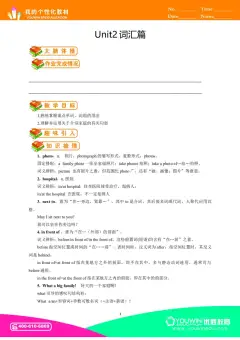
Unit 2 词汇篇
__________________________________________________________________________________
__________________________________________________________________________________
1. 理解并灵活运用重点单词、词组
2. 理解、掌握并灵活运用重点句型
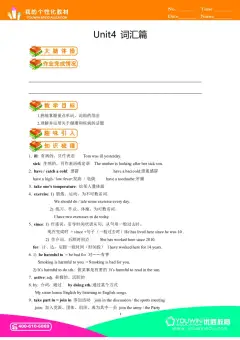
1. return v. 还回;回来  n. 返回
return 用作及物动词,意为“归还;拿回”。return sb. sth.相当于return sth. to sb. 意为“将
某物归还给某人”。例如:
Don’t forget to return

   my
    book

 .  不要忘了还我的书。
return 用作不及物动词,意为“返回,回来”,常与介词from 或to 连用。例如:
When did you return

   from

   the
    trip

 ?  你什么时候旅行回来的?
2. bring, take 与get
  bring 指从某处将某物或某人“带来”,后面常接双宾语。例如:
  Remember to bring me the pictures.  记得把照片给我带来。
  take 指将某人或某物从说话人处“带到”另一处。例如:
  I won’t take you there.  我不会带你去那的。
  get 指从某处经某人或某物带到说话人处。例如:
  Please get some paper for me. 请帮我拿点纸。
3. alone 与lonely
    alone 用作副词,意为“独自地,单独地”,在句中作状语;alone 也可作形容词,意为“独自
2
的,单独的”,在句中作表语。
    lonely 用作形容词,意为“孤独的,寂寞的”,带有一定的感情色彩。例如:
    The old man is alone in the room. He feels lonely.
    这个老人独自在房间里,他感到孤单。
4. share v. 分享;共有
share sth. with sb. 意为“与某人分享/共用某物”。例如:
I share the bedroom with my sister.  我和妹妹共用这间卧室。
5. mind v. 介意
    mind 用作及物动词,意为“介意”。mind doing sth. 意为“介意做某事”,常用于否定句或
疑问句中。例如:
    Would you mind

   closing

  the window? I feel cold.  你介意关上窗户吗?我感觉有点冷。
6. stand 站立;忍受
stand 用作不及物动词时意为“站立”;用作及物动词时,意为“忍受;容忍”。
can’t stand 意为“不能忍受”,例如:
I really

  can
  ’ t  stand

  the noise. 我真的不能忍受那噪音了。
7. divide…into… 把…分成…
    divide 指把整体分成几份,例如:
    The teacher divides the class into three groups.  老师把学生分成三个组。
8. encourage sb. to do sth.  鼓励某人做某事,例如:
  My uncle encouraged me to work hard.  我叔叔鼓励我努力学习。
    encourage v. 鼓励; encouragement n. 鼓励
9. decide to do sth.  决定做某事。例如:
We decided

   to   tell Tom about it.  我决定把此事告诉Tom。
decide v. 决定 decision n. 决定
make a decision 做决定,例如:
At last, they made

   a    decision

 . 最后,他们做出了一个决定。
10. have fun 玩得高兴
   have fun 与have a good/ great/wonderful time 或enjoy oneself 意思相近。
   have fun doing sth. 做某事很开心。例如:
   The boys had

   fun

   drawing

  the pictures.   那些男孩画画画得很开心。
11. It + be + adj (for sb.)+ to do sth.   对于某人来说,做某事是...
     It 作形式主语用来代替形容词后面的动词不定式。例如:
     It is important for us to speak English.   对于我们来说,说英语是重要的。
  12. It takes (took) sb. some time to do sth. “花费某人多少时间做某事”。例如:
It took me one hour to do my homework last night.   昨天晚上我做作业花了一个小时。
【关于“花费”的知识拓展】
 spend, cost, take, pay
 spend (spent, spent)  主语是人
3
spend some time /some money on sth.     花时间/钱在某事上
spend some time /some money (in) doing sth. 花时间/钱做某事
例如:I spent 10 dollars on
    the
    book

 . / I spent 10 dollars (in)
    buying

   the
    book

 .
      我花10 美元买了这本书。
cost (cost, cost) 主语是物,例如:
The book cost me 10 dollars.   这本书花了我10 美元。
take (took, taken)
固定搭配“It takes/took sb. some time /some money to do sth.”做某事花费某人…时间/钱,
例如:
It took me 1 hour to do my homework.  做家庭作业花了我1 个小时的时间。
pay (paid, paid),主语是人 pay some money for sth. 为某物支付…钱,例如:
I paid 10 dollars for the book.   我花10 美元买了这本书。
1. His father lives_________in a small house, but he doesn’t feel__________.
  A. lonely; alone     B. lonely; lonely     C. alone; lonely
  D. alone; alone
2. ---Can’t you stop making so much noise? I really can’t ________it.
  ---I am terribly sorry for it.
  A. keep
    B. stand     C. hear    D. make
3. He decides __________to New York city next summer vacation.
  A. to go
    B. going
 C. go
D. is going
4. Mr. Zhang encourages the poor students________study.
  A. not giving up    B. to not give up
 C. not to giving up
D. not to give up
5. We went to Hainan Island on May Day and had great fun__________in the sea.
  A. surf
        B. surfs     C. surfing
    D. to surf
6. It ________ 30 minutes to finish reading the book.
  A. cost
        B. paid             C. spent
        D. took
7. Marry, you’d better not have too much ice cream. It’s bad for you ________too much junk
food.
  A. eat        B. to eat         C. eating
        D. ate
8. You can________the cake ________ten pieces.
  A. divided; into  B. be divided; into  C. divide; into    D. be divided; to
9. It was very kind of him to________his umbrella with me.
  A. share   B. take   C. bring   D. use
10. ---Would you mind_______here?
   ---I’m sorry about that. I’ll go somewhere else.
   A. no smoking   B. not smoking  C. no smoke   D. not smoke
4
基础演练
一、翻译下列短语
1. 寻找_______________    2. 在一起________________     3. 表演戏剧_________________
4. 目前_______________    5. 讨论问题______________     6. 发表演讲_________________
7. 散步_______________    8. 在度假________________     9. 我所有的朋友_____________
10. 一起玩得高兴_______________________
11. 引起某人的注意_____________________
12. 赢得比赛_______________________
二、根据句意及汉语提示填写单词或词组
1. She didn’t say anything for several_____________ (秒).
2. He____________(返回) to his hometown last year.
3. Please get to the bus station ___________(准时).
4. The model plane is made of ___________(木头).
5. When did you start to c __________stamps?
6. ---How about your j _________to Mount Emei?  ---Wonderful.
7. Parents should e__________their children to take exercise.
8. He kindly s __________hands with me as usual.
9. The shop sells all kinds of musical __________(乐器).
10. The rain will_____________(持续) five days.
巩固提高
根据中文提示完成句子。(每空一词)
1. 我们将要在这里建一座大桥。
  We will________ _______ ________here.
2. 请给我5 张纸。
  Please give me_________ _________ ________ _________.
3. 他从图书馆接了一本字典。
  He ________ a _________ ________the library.
4. 她什么时候从聚会回来的?
  When did she _______ ________ the party?
5. 我们必须准时赶到车站。
  We _______ _________ arrive at the station_______ ________.
6. —我能问你个问题吗?  —不,你不能。
  ---May I _______ you a _______?  ---No, you ________.
5
7. 他有礼貌地向我们道别。
  He said goodbye _______ us ________.
8. 她去书店买了一些书。
  She went to the bookstore________ ________ ________ ________.
9. 我们的老师不让我们星期天做作业。
  Our teachers don’t make_______ ______ ________on Sunday.
10. 中国的母亲们总是尝试为她们的孩子做任何事情。
  Chinese mothers always ______ _______ _______ everything for their children.
一、单项选择
1. They must be working ________because they have a lot of work to do yesterday.
  A. any moment        B. at the moment     C. just a moment
    D. the moment
2. Pollution is a serious problem. Scientists have______ some good ways to solve it.
  A. come up with
       B. come on
         C. come out        D. come up
3. The earthquake hurt _______people and more than 35,000 got badly hurt.
  A. thousands
       B. two thousands
     C. thousands of    D. thousand of
4. Everyone_______ here now. Let’s_______.
  A. are; begin
       B. are; to begin
     C. is; to start
        D. is; start
5. The snow made them________cold, so they decided to make a fire________warm.
  A. feel; to keep       B. to feel; keep
         C. feel; keep
        D. to feel; to
keep
6. Nancy spent half an hour_________the piano every day.
  A. to practice playing
   B. practicing playing
 C. practicing to play D. to practice to
play
7. I feel _________because my job is too_________.
  A. bored; boring
       B. bored; bored
          C. boring; boring
     D. boring;
bored
8. Lily doesn’t buy this book because she doesn’t have________.
  A. money much        B. enough money      C. money many     D. many money
9. Would you mind ________ me how_______this physics problem?
  A. telling; to solve
   B. telling; solve
          C. to tell; to solve
 D. to tell; solve
10. I _________some money from him yesterday, but ________it to him already.
  A. borrowed; returned    B. lend; borrow          C. borrow; keep
     D. lend; keep
二、完形填空
Many parents buy everything their children want. If they go on doing so, the children won’t
know that money
  1
  from hard work. When they
  2
  up, they will waste money but not save
it.
6
Some parents like holding birthday parties
  3
  their children. If they go on doing so, the
children will think they

 4

 enjoy birthday parties every year. They may
  5
  their parents’
birthdays and only remember theirs.
Many parents don’t let their children do chores. They think children have
  6
  one thing to
do. They should study hard and be
  7
  at their subjects. If parents go on doing so, children
will think their parents should do
  8
  and won’t like cleaning the room after they find a job.
9

 doing chores can help children start good habits, parents should
  10

  children to do some
chores.
1. A. comes    B. keeps         C. leaves
      D. makes
2. A.
open        B. turn
         C. grow          D. get
3. A.
with        B. for
         C. as
          D. of
4. A.
should
    B. needn’t
     C. mustn’t
      D. would
5. A.
hold        B. have         C. forget
      D. think
6. A. hardly    B. almost
         C. always
      D. only
7. A. well
        B. good         C. kind          D. nice
8. A.
homework
B. shopping
     C. reading
      D. chores
9. A. Why
    B. Until         C. Because      D. While
10. A. let
        B. learn         C. make
          D. teach
_________________________________________________________________________________
_________________________________________________________________________________
 一、单项选择
1. You were________; you didn’t hurt yourself.
   A. luck
          B.luckily
           C. lucky
       D. lucks
 2. ---I am going to Sanya for my holiday tomorrow.  ---_______________.
   A. Have a good time
  B. You’re right       C. It’s good
   D. Goodbye
 3. Look at the smog. _______bad weather it is!
   A. How             B. How a             C. What
       D. What a
4. ---It’s too late. I have to go now.
---Oh, it’s raining outside. Don’t leave _________it stops.
A. since             B. until               C. while         D. as
 5. Li Lei is good_______ English, but he doesn’t do well ________Chinese.
   A. at; with
           B. at; in
            C. on; in       D. with; of
7
6. ---Would you like to share joy or sadness______ us?  ---Yes, I’d love to.
A. with
           B. to
        C. at
   D. on
7. ---Can I have ______ bread? I’m still hungry.  ---Sure, here you are.
A. any more
       B. some more
    C. much
   D. any
8. He will not forget that ______ earthquake(地震). Many people lost their lives in it.
A. beautiful
       B. terrible
    C. interesting    D. exciting
9. ---        does Mary usually go to the Bubby Club?  ---Once a week.
A. How often
   B. How long
C. How far      D. How much
10. Chinese students have      weeks      in the summertime than American students.
A. more; on             B. fewer; on
C. more; off     D. less; off
 (附:6-10,2013-2014 年学年度第一学期期中学业质量测试八年级上英语试卷)
二、用括号内所给词的正确形式填空
11. I have fun ________(work) with my friends and________(meet) new people.
12. We join teams for several______________ (reason).
13. Can you see the old photo of ___________(I)?
14. He can play the drums very____________(good).
15. We are trying our best ____________(solve) the problems.
三、根据汉语提示完成英语句子
16. 这对老夫妇在一个大山旅游胜地度假。
The_____ _______was ______ ______at a mountain resort.
17. 他们一个接一个地离开了房间。
They left the room ________ _______ _______.
18. 天开始下起了大雨。
It started to_______ _______.
19. 我们直到明天才能下山。
We _______ _______ go down the mountain ________tomorrow.
20. 这里没有足够的食物给每个人。
There isn’t______ ________for everyone.
四、完形填空
One day two brothers went fishing. They had a
  21

  with them. When they came
  22

the river, they threw down their hats on the ground and went to the river to look
  23

  fish. It
was so
  24

  that day, and soon they wanted their
  25

  . They told the dog to go
  26

  for
them.
When the dog got there, he tried to take
  27

  hats together in his
  28

  at the same time.
It was not very easy. Then the dog found that
  29

  of the hats was smaller
  30

  the other.
He put the smaller one in the larger one, then he could carry both hats.
21. A. child     B. boat        C. duck     D. dog
22. A. out
         B. near        C. from     D. into
8
23. A. after
     B. at
        C. like
     D. for
24. A. cold
     B. cooler
    C. hot        D. warm
25. A. shoes     B. hats        C. trousers
 D. clothes
26. A. over
     B. by
        C. back     D. out
27. A. all
         B. some
        C. both
     D. many
28. A. arms
     B. hands
        C. foot
     D. mouth
29. A. each
     B. one        C. few
     D. any
30. A. than
     B. as
        C. like
     D. with
五、阅读理解
A
You may hear about earthquakes ,but do you know what to do before , during and after an
Earthquake? Here is some advice for you:
Before an earthquake: It's necessary to prepare yourself and your family. All family members
should know how to turn off gas, water and electricity and know useful telephone numbers(doctor,
hospital, police, 119, etc. ). Never put heavy things over beds.
During an earthquake: It's important for each of you to stay calm( 冷静). If you are indoors,
quickly move to a safe place in the room such as under a strong desk or a strong table. The purpose is to
protect  yourself from falling objects. Stay away from windows,large mirrors,heavy furniture and so
on. If you are cooking, turn off the gas.
If you are outdoors, move to an open area like a playground. Move away from buildings, bridges and
trees. If you are driving, stop the car as soon as possible, staying away from bridges and tall
buildings. Stay in your car.
After an earthquake: Once the shaking has stopped, DO NOT run out of the building at once.  It's
better to wait and leave when it is safe.
Check around you and help the people who are in  trouble. If your building is badly  broken you
should leave it. If you smell or hear a gas,get everyone outside and open windows and doors. If you can
do it safely, turn off the gas. Report it to the gas company.
31. Which of the following is mentioned in the second paragraph?
A. People should know how to turn on gas.
B. People should know how to save water.
C. People shouldn't put heavy boxes over beds.
D. People shouldn't forget the phone numbers of others.
32. When an earthquake happens, _________can help you deal with it.
   A. standing still
       B. staying calm       C. looking outside      D. moving indoors
33. During an earthquake, if you are driving in an open area, you should_______.
   A. speed up your car
                           B. stop your car and stay in
C. slow down your car
                       D. stop your car and run out
9
34. When the earth stops shaking, you should________.
   A. check around you first                        B. run out of the building at once
C. break the windows and doors                   D. write a report to your company
35. You can learn ________alter reading the passage.
   A. what an earthquake is like                     B. what to do to avoid an earthquake


C. how an earthquake happens                   D. how to protect yourse1f in an earthquake
B
    There was a famous French writer. He was a man of great achievements(成就).He said that one of his
main(主要的) achievements was his study of hand-writing. He had spent much time on it and he often told
his friend s that he could tell a person’s character(性格) from that person’s handwriting.
One day, a woman brought him a page of a boy’s handwriting. She said that she wanted to know
what he thought of the boy’s character.
He studied the handwriting carefully for a few minutes. Then he looked at the woman strangely(奇怪
地).The woman told him that the boy was not in her family and that be did not have to worry.
“Good!” said the write, “Then I can tell you.” He went to say that he thought the boy was stupid(愚蠢)
and lazy(懒惰).He added that the boy should be watched carefully, if not, he would bring harm(害处) to his
family when he grew up.
“Isn’t that strange?” said the woman, smiling.“Because this page from your own exercise book. You
wrote it yourself when you were a boy.”
36. It look the writer a lot of time____________.
   A. to read books
 B. to make handwriting     C. to write book     D. to study handwriting
37. From a person’s ________,the writer could tell a persons character.
A. pronunciation     B. handwriting             C. smiling face       D. Speech
38. The woman wanted to _____________.
   A. know the writer   B. help the writer           C. visit the writer      D. test the writer
39. The writer was sure that the boy____________.
   A. was not worth teaching
                  B. would do good deeds for his family
C. would do wrong to his family
              D. would work hard
40. From the story we know_____________.
   A. the woman knew the writer very well
B. the writer knew the woman well
C. neither of them knew each other
D. both of them knew each other well


10
课程顾问签字:                        教学主管签字: