文档文本内容
主题群三 地球与宇宙
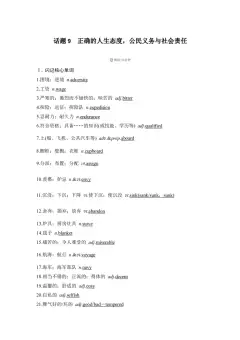
话题 36 宇宙奥秘探索
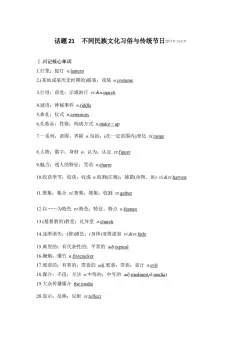
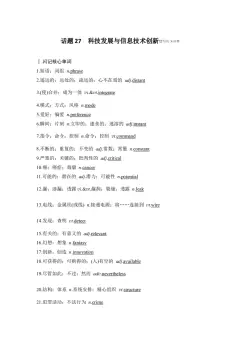
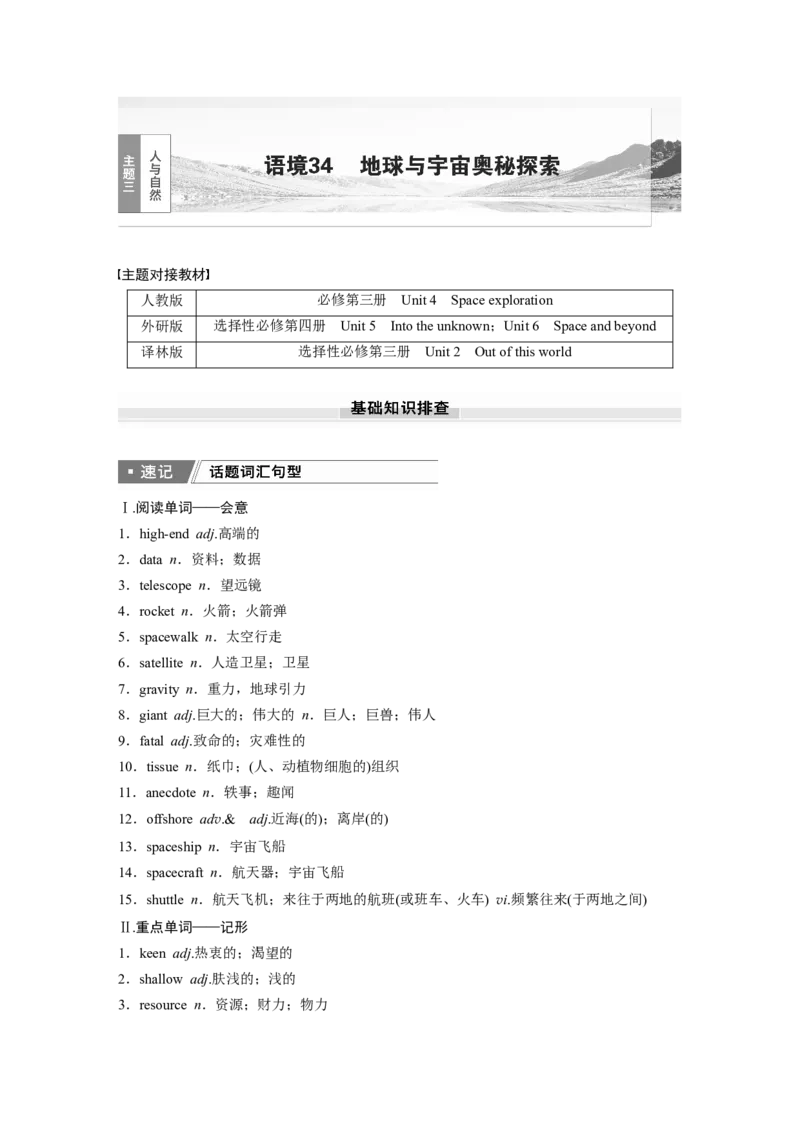
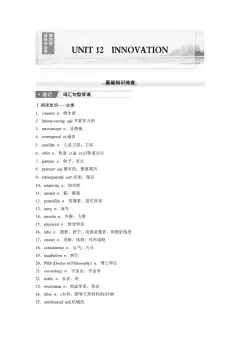
Ⅰ.闪记核心单词
1.宇航员;太空人 n.astronaut
2.程序;步骤;手续 n.procedure
3.火箭;火箭弹 n.rocket
4.重力;引力 n.gravity
5.边境;国界;边远地区 n.frontier
6.交通工具;车辆 n.vehicle
7.人造卫星;卫星 n.satellite
8.发射;发起;上市 vt.&n.launch
9.(环绕地球、太阳等运行的)轨道;势力范围 n.沿轨道运行;环绕……运行
vt.&vi.orbit
10.巨大的;伟大的 adj.巨人;巨兽;伟人 n.giant
11.跳跃;剧增;剧变 n.跳过;跃过 vi.&vt.leap
12.人类 n.mankind
13.(政府的)专门机构;服务机构;代理处 n.agency
14.传输;发送 vt.&vi.transmit
15.[pl.]资料;数据 n.data
16.航天器;宇宙飞船 n.spacecraft
17.渴望;欲望 n.渴望;期望 vt.desire
18.太空行走;太空行走的时间 n.spacewalk
19.玉;翡翠;玉器 n.jade20.标志着;标明;发信号 vt.&vi.信号;标志 n.signal
21.回收利用;再利用 vt.recycle
22.肌肉;实力;影响力 n.muscle
23.缺乏;短缺 n.没有;缺乏 vt.lack
24.浮动;漂流;漂浮 vi.使浮动;使漂流 vt.float
25.否则;要不然 adv.otherwise
26.在更远处;超出 prep.beyond
27.当前的;现在的 adj.水流;电流;思潮 n.current
28.纸巾;(人、动植物细胞的) 组织 n.tissue
29.设施;设备 n.facility
30.热衷的;渴望的 adj.keen
31.致命的;灾难性的 adj.fatal
32.肤浅的;浅的 adj.shallow
33.模式;图案;模范 n.pattern
34.监视器;监测仪 n.监视;监测;监控 vt.monitor
35.枕头 n.pillow
36.智能手机 n.smartphone
37.资源;财力;物力 n.resource
38.氧;氧气 n.oxygen
39.精神的;思想的 adj.mental→精神上;心理上 adv.mentally
40.有智慧的;聪明的;有智力的 adj.intelligent→聪明;智慧 n.intelligence
41.查明;确定;决定 vt.determine→有决心的;意志坚定的 adj.determined→决
心;果断 n.determination
42.失望;沮丧 n.disappointment→使失望 vt.disappoint→失望的;沮丧的adj.disappointed→令人失望的 adj.disappointing
43.宇宙;天地万物 n.universe→普遍的 adj.universal→普遍地 adv.universally
44.独立的;自立的 adj.independent→独立地;自立地 adv.independently→依靠;
依赖 v.depend→独立 n.independence
45.足够的;充足的 adj.sufficient→足够地;充足地 adv.sufficiently→不够的;
不足的 adj.insufficient
46.地球;世界;地球仪 n.globe→全球的;全面的 adj.global→全局地;全球地
adv.globally
47.论证;争辩;争论 vt.&vi.argue→争论;争吵;论点 n.argument→可论证的
adj.arguable
48.(对事物的)分析;分析结果 n.analysis(pl.analyses)→分析 vt.analyze/analyse→
分析家 n.analyst
49.定期的;经常的;正常的 adj.常客 n.regular→经常;定期地 adv.regularly→
不规则的;不规律的adj.irregular
50.有限的 adj.limited→限制 vt.&n.limit→无限的 adj.limitless→限制;限度
n.limitation
51.神秘事物;谜 n.mystery→神秘的 adj.mysterious
52.系;绑;贴 vt.attach→附加的;附属的;依恋的 adj.attached
Ⅱ.速记重点短语
1.迫切要做某事 have a strong desire to do sth
2.成功做某事 succeed in doing sth
3.宇宙的秘密 the secrets of the universe
4.在宇宙飞船上;在船上;在飞机上 on board5.抱着……的希望 in the hope of doing sth
6.为了;以便 so as to (do sth)
7.继续做,坚持干某事 carry on doing sth
8.取得巨大的进步 make great progress
9.实现梦想 realize one’s dream
10.难以描述 beyond description
11.弄懂;弄清楚;弄明白 figure out
12.热衷于做某事 be keen on doing/to do sth
13.据理反对 argue against
14.导致;造成 result in
15.所以;结果(是) as a result
16.为某人提供某物 provide sth for sb
17.最后 in closing
18.用完;耗尽 run out
19.认为……很重要 attach great importance to
Ⅲ.快记经典句式
1.Astronauts not only had to learn how to use space equipment, but also had to do a
lot of mental and physical training.(not only... but also...)
宇航员不仅要学习如何使用太空设备,还要进行大量的心理和身体训练。
2.Afterwards,the USSR focused on sending people into space,and on 12 April
1961,Yuri Gagarin became the first person in the world to enter space.[the+序数
词(+n.)+动词不定式]
后来,苏联专注于把人送入太空,1961年4月12日,尤里·加加林成为世界上
第一个进入太空的人。
3.Sending people to other planets or even beyond the solar system is not an easy goal
to achieve.(be+adj./n.+to do)
把人送到其他星球甚至太阳系以外不是一个容易达到的目标。
4.Countries around the globe are spending billions of dollars and lots of time onvarious space missions, whether to Mars or other planets much further away.
(whether...or...)
全球各国正在花费数十亿美元和大量的时间来完成各种太空任务,无论是去火
星还是去更远的其他行星。
5.Firstly,exploring space has already made a difference in the fight against world
hunger.(动名词短语作主语)
首先,探索太空已经在与世界饥饿的斗争中发挥了作用。
6.After having succeeded in sending satellites into space, people wanted to know if it
was safe for a human to go into space.[it is+adj.(+for sb)+to do sth]
在成功地将卫星送往太空后,人们想知道人类进入太空是否安全。
7.While sleeping,they must attach themselves to something so as to prevent floating
around.(状语从句的省略)
睡觉的时候,他们必须把自己固定在某物上,以防止四处飘荡。
Ⅳ.话题语篇填空
Humans have always looked up at the stars and wanted to learn more about
space.1.Determined (determine) to find out the secrets of the universe, scientists work
hard to make vehicles to carry people into space. In the mid-20th century, rockets
that were powerful enough to overcome Earth’s gravity 2.were developed (develop),
making space exploration 3.a reality. On 4 October, 1957, the USSR
4.successfully(success) launched the first artificial satellite, Sputnik 1, into space.
Four years later. Yuri Gagarin became the first human 5.to travel (travel) into space.
20 July, 1969 was a 6.historic (history) day for space travel: astronaut Neil Armstrong
walked on the surface of the Moon.
Although China’s space programme started later than those of Russia and the US, it
has made great progress in a short time. In 2003, Yang Liwei successfully 7.orbited
(orbit)Earth in the Shenzhou 5 spacecraft, 8.which made China the third country in
the world to independently send humans into space. More recently,the launch of the
Mengtian module signaled the basic 9.completion(complete) of the Tiangong SpaceStation. Now the desire to explore space never 10.fades (fade)away. The future of
space exploration remains bright.