7 选5+阅读理解组合练(02)
考试时间:50 分钟  满分:50  每小题2.5 分 得分:
1.阅读理解
A
体裁:应用文  字数:381 话题:志愿者网站介绍
Last August, city officials interviewed about 500 residents to find out people’s attitudes to protecting the
environment and what actions they had taken. Here are the results:
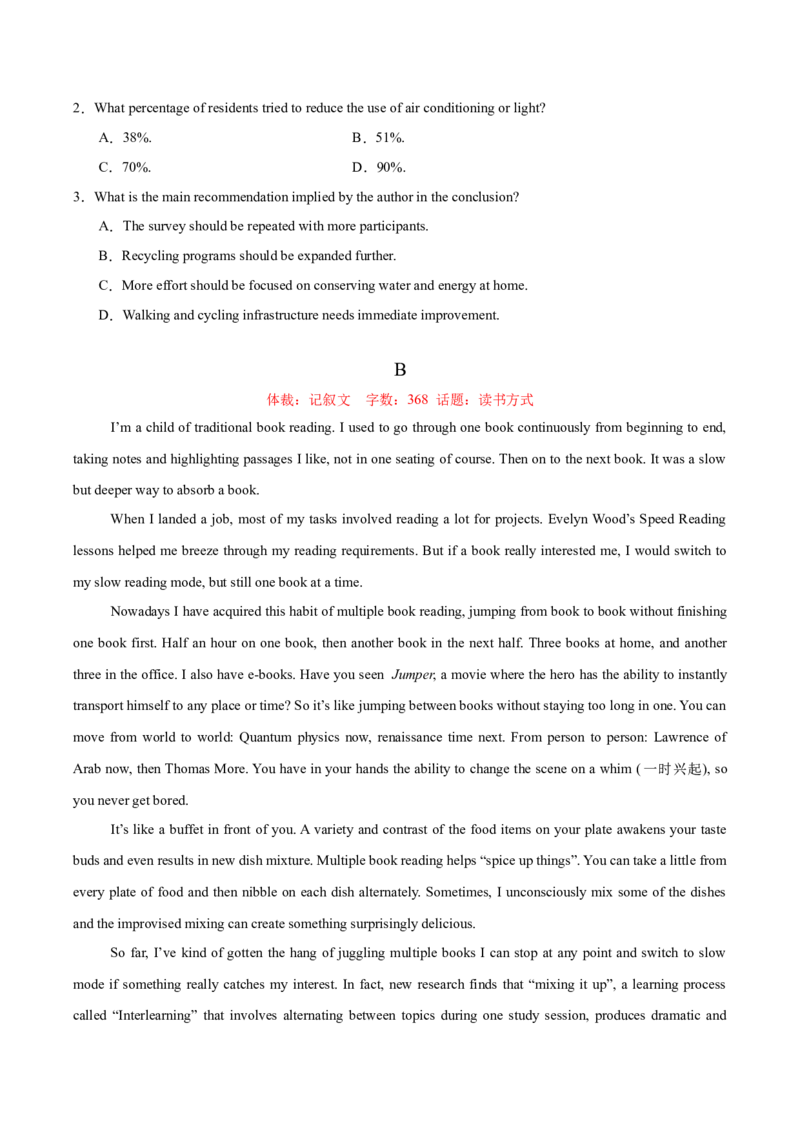
As the diagram showed, the percentage of those who felt that they needed to help protect the environment is
as high as 96%. Very few (4%) felt it was not necessary to help protect the necessary. More than half of those who
took part in the survey had done four of the five activities in the past month. Around 90% had tried to recycle waste
such as glass, metal and paper, and more than two thirds (70%) had tried to cut back on the use of disposable
packaging, such as plastic honey bottles, and butter and yogurt containers. Also, the majority of residents had
cycled or walked.
Unfortunately, not as many who took part had taken action to save water and energy in their homes. Just
under 40% (38%) tried to save water when they were washing dishes or taking showers. Just over half (51%) tried
to save energy by reducing the use of air conditioning or turning off lights.
To sum up, it seems that almost all who took part understood the need to help take care of the environment.
Most of them tried to recycle waste, ride bikes or walk, and reduce the use of disposable packaging. However, not
as many were saving water and energy. This indicates that the residents needed to pay more attention to these two
activities.
1.The residents interviewed in the survey were ________ .
A.15 years of age and older
B.from the countryside
C.important city officials
D.less than 15 years old
2.What percentage of residents tried to reduce the use of air conditioning or light?
A.38%.
B.51%.
C.70%.
D.90%.
3.What is the main recommendation implied by the author in the conclusion?
A.The survey should be repeated with more participants.
B.Recycling programs should be expanded further.
C.More effort should be focused on conserving water and energy at home.
D.Walking and cycling infrastructure needs immediate improvement.
B
体裁:记叙文  字数:368 话题:读书方式
I’m a child of traditional book reading. I used to go through one book continuously from beginning to end,
taking notes and highlighting passages I like, not in one seating of course. Then on to the next book. It was a slow
but deeper way to absorb a book.
When I landed a job, most of my tasks involved reading a lot for projects. Evelyn Wood’s Speed Reading
lessons helped me breeze through my reading requirements. But if a book really interested me, I would switch to
my slow reading mode, but still one book at a time.
Nowadays I have acquired this habit of multiple book reading, jumping from book to book without finishing
one book first. Half an hour on one book, then another book in the next half. Three books at home, and another
three in the office. I also have e-books. Have you seen Jumper, a movie where the hero has the ability to instantly
transport himself to any place or time? So it’s like jumping between books without staying too long in one. You can
move from world to world: Quantum physics now, renaissance time next. From person to person: Lawrence of
Arab now, then Thomas More. You have in your hands the ability to change the scene on a whim (一时兴起), so
you never get bored.
It’s like a buffet in front of you. A variety and contrast of the food items on your plate awakens your taste
buds and even results in new dish mixture. Multiple book reading helps “spice up things”. You can take a little from
every plate of food and then nibble on each dish alternately. Sometimes, I unconsciously mix some of the dishes
and the improvised mixing can create something surprisingly delicious.
So far, I’ve kind of gotten the hang of juggling multiple books I can stop at any point and switch to slow
mode if something really catches my interest. In fact, new research finds that “mixing it up”, a learning process
called “Interlearning” that involves alternating between topics during one study session, produces dramatic and
long-lasting learning benefits. If this is true, then my reading evolution has been in the right direction all along.
4.What was the author’s way of reading books in the past?
A.skipping through books randomly.
B.Reading one book straight through.
C.Reading several books in one seating.
D.Using speed-reading methods constantly.
5.Why does the author enjoy multiple book reading?
A.It offers the author variety and new insights.
B.It meets the author’s job requirements better.
C.It allows the author to change his ability at will.D.It enables in-depth understanding of each book.
6.Why is the new research mentioned in the last paragraph?
A.To prove the benefits of multiple-book reading.
B.To question the value of slow-reading practices.
C.To show the academic advantages of “interlearning”.
D.To persuade readers to adopt multiple-book reading.
7.What can be the best title for this passage?
A.My Experience of Speed Reading.
B.My Evolution As a Book Reader.
C.Single vs Multiple: A Reader’s Dilemma. D.Depth vs Variety: A Reader’s Crossroads.
C
体裁:说明文  字数:331 话题:被监视对人们行为和认知等方面的影响
In 1785, English philosopher Jeremy Bentham designed a perfect castle where rooms circle a tower, from
which an unseen guard can observe any people at will. People have to assume they’re constantly observed and
behave accordingly. The secret of the castle control: the people have internalized the surveillance ( 监控)
mechanism themselves. Bentham’s design feels so relevant in our digital age of algorithms ( 算法) and social
media, when we frequently feel watched, with no way to escape.
How being watched affects us is the first topic that has been studied in psychology. Decades of studies have
shown that we behave differently when we are watched. On a conscious level, we become more prosocial, meaning
we’re more likely to give and less likely to cheat or litter. Even theft or littering could be reduced merely by posting
pictures of eyes. Seymour, a psychologist from the University of Technology Sydney, puts this down to our concern
with reputation and social consequences. This led to the idea that surveillance could be used for social good,
echoing Bentham’s methods.
Being watched also affects cognitive ( 认知) functions, but negatively. One study found that participants
performed worse on a working memory task with people looking at them — a direct gaze grabs participants’
attention and distracts them from a given task. A series of experiments have demonstrated that bringing more
surveillance into workplaces or educational settings — usually an attempt to boost productivity — could actually
be counterproductive.
Surveillance profoundly impacts our brain’s unconscious processing. Seymour says it makes our social
thinking and survival instincts work too hard. This makes us worry about everyone’s mental health. Always being
watched makes us more aware of people around us, keeping us on edge and ready to act. “We didn’t have as much
surveillance and social connection 50 years ago, so it’s a new societal context we’re adapting to. We need to find
ways to balance the benefits of connectivity with the drawbacks of constant surveillance,” Seymour remarks.
8.Why does the author mention the castle in the first paragraph?
A.To express his respect to Bentham.
B.To explain a concept of psychology.
C.To illustrate its working mechanism.
D.To present a picture of surveillance.
9.What urges people to become more prosocial?
A.Their desire to keep a good image.
B.Their trust from the family.
C.Their attachment to the community.
D.Their concern with education.
10.The word “counterproductive” in paragraph 3 most likely means ________.
A.highly efficient
B.producing the opposite of the desired result
C.difficult to implement
D.increasing in popularity
11.What does Seymour suggest about the society full of surveillance?
A.Cut interactions to ease stress.
B.Boost surveillance for connections.
C.Weigh connectivity against surveillance.D.Ignore the impact of surveillance.
D
体裁:说明文  字数:341 话题:大脑与身体之间密切的相互联系
For decades, scientists thought of the brain as the most valuable and consequently most closely guarded part
of the body. Locked safely behind the blood-brain barrier, it was broadly free of the harm of viruses and the battles
started by the immune system (免疫系统). Then, about 20 years ago, some researchers began to wonder: Is the
brain really so separated from the body? The answer, according to a growing body of evidence, is no.
The list of brain conditions that have been associated with changes elsewhere in the body is long and
growing. Changes in the make-up of the microorganisms in the digestive system have been linked to disorders such
as Parkinson’s disease. There is also a theory that infection during pregnancy (孕期) could lead to brain diseases in
babies.
The effect is two-way. There is a lengthening list of symptoms (症状) not typically viewed as disorders of
the nervous system, but the brain plays a large part in them. For instance, the development of a fever is influenced
by a population of nerve cells that control body temperature and appetite. Evidence is mounting that cancers use
nerves to grow and spread.
The interconnection between brain and body has promising implications for our ability to both understand
and treat illnesses. If some brain disorders start outside the brain, then perhaps treatments for them could also reach
in from outside. Treatments that take effect through the digestive system, the heart or other organs, would be much
easier and less risky than those that must cross the blood-brain barrier.
It also works in the opposite direction. Study shows mice have healthier hearts after receiving stimulation to
a brain area involved in positive emotion and motivation. Activation of the brain reward centre — called the ventral
tegmental area (VTA) — seems to cause immune changes that contribute to it. Working out how this happens could
help to destroy cancers, enhance responses to vaccines ( 疫苗) and even re-evaluate physical diseases that, for
centuries, have not been considered as being psychologically driven.
12.What is linked to disorders like Parkinson’s disease?
A.Infection during pregnancy.
B.Nerve cells controlling appetite.
C.Activation of the brain reward centre.
D.Variations in digestive microorganisms.
13.How does the author mainly support the argument in paragraph 3?
A.By quoting expert opinions.
B.By stating a personal opinion.
C.By providing specific examples.
D.By using a theoretical framework.
14.Which of the following best describes the structure of the text?
A.Theory → Proof → Example.
B.Question → Analysis → Definition.
C.Problem → Solution → Conclusion.
D.Old View → New Evidence → Implications.
15.What is the text mainly about?
A.The symptoms of various brain diseases.
B.The process of fighting viruses effectively.
C.The protective role of the blood-brain barrier.
D.The new understanding of brain-body interactions.
2.阅读7 选5
体裁:说明文  字数:250 话题:自然灾害——如何防止洪水进入室内
Any home may be at risk of flooding, even from a heavy rain, but some homes are much easier than others.
16   ? Actually not, but keep in mind that you may be able to make some changes outside that will help keep
water from coming inside.
Improve site drainage (排水). This can be very helpful, if you have a basement that tends to flood after a
heavy rain. Building gutters (排水沟) to keep water flowing away from the house is also important. You may face a
really complex problem.    17   . They can assess your yard, design a drainage plan, and set up various systems.
Plant trees. It may not sound like a flood-proofing strategy, but you could plant native trees around your
property to help absorb excess water. Native plants, not a plant that doesn’t grow in the area naturally, are
important.    18   . Native plants also tend to be better for the environment.
   19   . You may want to design a new road surface that absorbs water more easily. If you’re considering
replacing a sidewalk, it’s certainly worth considering setting up a material that may reduce your risk of flooding.
These new road surface options can also help filter (过滤) out pollutants that ultimately end up in the water supply.
Clean gutters regularly. Everyone knows this, but it’s got to be said. Those gutters are there for a reason, to
make rain away from your home. You must keep your gutters clean.    20   .
A.Take a look at your sidewalk
B.Choose proper water-absorbing material
C.You can turn to the drainage specialists for help
D.Otherwise, the gutters blocked with leaves become useless
E.How can we make the flood prevention home improvements
F.Do we need to make lots of flood prevention home improvements
G.This is because their roots can go deeper and grab more groundwater