2026 年高考一轮复习验收卷(江苏卷02)
 英语·全解全析
注意事项:
1. 答题前,考生先将自己的姓名、准考证号码填写清楚,将条形码准确粘贴在条形码区域内。
2. 选择题必须使用2B 铅笔填涂;非选择题必须使用0. 5 毫米黑色字迹的签字笔书写,字体工整,笔记清楚。
3. 请按照题号顺序在答题卡各题目的答题区域内作答,超出答题区域书写的答案无效;在草稿纸、试卷上
答题无效。
4. 作图可先使用铅笔画出,确定后必须用黑色字迹的签字笔描黑。
5. 保持卡面清洁,不要折叠、不要弄破、弄皱,不准使用涂改液、修正带、刮纸刀。
第一部分  听力(共两节,满分30 分)
做题时,先将答案标在试卷上。录音内容结束后,你将有两分钟的时间将试卷上的答案转涂到答题卡上。
第一节(共5 小题;每小题1. 5 分,满分7. 5 分)
听下面5 段对话。每段对话后有一个小题,从题中所给的 A、B、C 三个选项中选出最佳选项。听完每段
对话后,你都有10 秒钟的时间来回答有关小题和阅读下一小题。每段对话仅读一遍。
例: How much is the shirt?
A. £19. 15.         B. £9. 18.         C. £9. 15.
答案是C.
1.What will the woman do next?
A.Cook dinner.
B.Water the plants.
C.Answer the phone.
2.What does Tom want to do this weekend?
A.Finish his homework.
B.Visit his grandparents.
C.Go hiking with friends.
3.What are the speakers discussing?
A.A park.
B.A restaurant.
C.A speciality.
4.What’s the problem with the yoga studio according to the woman?
A.Its functional room is hot.
B.Its instructor is strict.
C.Its lesson is demanding.
5.What are the speakers looking for?
A.A bakery.
B.A bookstore.
C.A flower shop.
第二节(共15 小题;每小题1. 5 分,满分22. 5 分)
听下面5 段对话或独白。每段对话或独白后有几个小题,从题中所给的 A、B、C 三个选项中选出最佳选
项。听每段对话或独白前,你将有时间阅读各个小题,每小题5 秒钟;听完后,各小题将给出5 秒钟的作答
时间。每段对话或独白读两遍。
听第6 段材料,回答第6 和7 题。
6.What mistake did the man make?
A.He went to the wrong gate.
B.He took the wrong luggage.
C.He booked the wrong flight.
7.When will the man’s flight take off?
A.At 9:15.
B.At 9:30.
C.At 9:45.
听第7 段材料,回答第8 至10 题。
8.Where are the speakers?
A.In a library.
B.In a classroom.
C.At a supermarket.
9.Who was Anna’s high school chemistry teacher?
A.Lucy.
B.Mrs. Lee.
C.Paul’s mom.
10.What will Anna do next?
A.Attend a reunion.
B.Pick up her daughter.
C.Move to the apartment.
听第8 段材料,回答第11 至13 题。
11.What does the man say about online shopping?
A.It saves time.
B.It’s unreliable.
C.It’s more expensive.
12.What is the woman’s attitude toward online shopping?
A.Opposed.
B.Skeptical.
C.Favorable.
13.What does the man suggest the woman do?
A.Shop in a random store.B.Shop in physical stores.
C.Shop on famous websites.
听第9 段材料,回答第14 至17 题。
14.What does Lisa do?
A.A radio host.
B.A garden designer.
C.A community volunteer.
15.What can residents do on weekends?
A.Plant in the garden.
B.Attend cooking classes.
C.Sell vegetables at markets.
16.What can be developed in the “Little Gardeners” club?
A.A skill of independence.
B.A sense of responsibility.
C.A spirit of teamwork.
17.What is the goal of the community garden project?
A.To teach farming skills.
B.To encourage healthy eating.
C.To build up community bonds.
听第10 段材料,回答第18 至20 题。
18.Where are the old stone cottages located?
A.By the river.
B.Around the town.
C.Next to the apartments.
19.Who are the main participants of the project?
A.Local kids.
B.Developers.
C.Historians.
20.Why did the speaker start the project?
A.To honor great figures.
B.To forget past memories.
C.To preserve old homes.
第二部分 阅读(共两节,满分 50 分)
第一节 (共 15 小题;每小题 2.5 分,满分 37.5 分) 阅读下列短文,从每题所给的 A、B、C、D 四
个选项中选出最佳选项。
A
The World Cup has come to an end. Let’s review some facts about the hi-tech turf ( 草皮) that Qatar had
spent much of its energy on.
Qatar, a desert nation, has three main challenges: water, air, and light. Almost every natural factor is against
it. The water used to irrigate the grass is of low quality, mainly treated seawater. Because of the desert sun, Qatar’s
stadiums were built for maximum shade — great for preventing heatstroke, but less ideal for photosynthesis (光合
作用). Inside the nearly-closed stadiums, there’s very little air movement.
Qatar identified pitch (球场) quality as a particular issue and set up the Aspire Sports Turf Research and
Development Centre to find the best types of grass for use in the harsh climate, testing 24 different varieties.
Eventually, Atlas Turf’s grass was chosen as much for its appearance as for its tolerance of the tough conditions
Qatar faces.
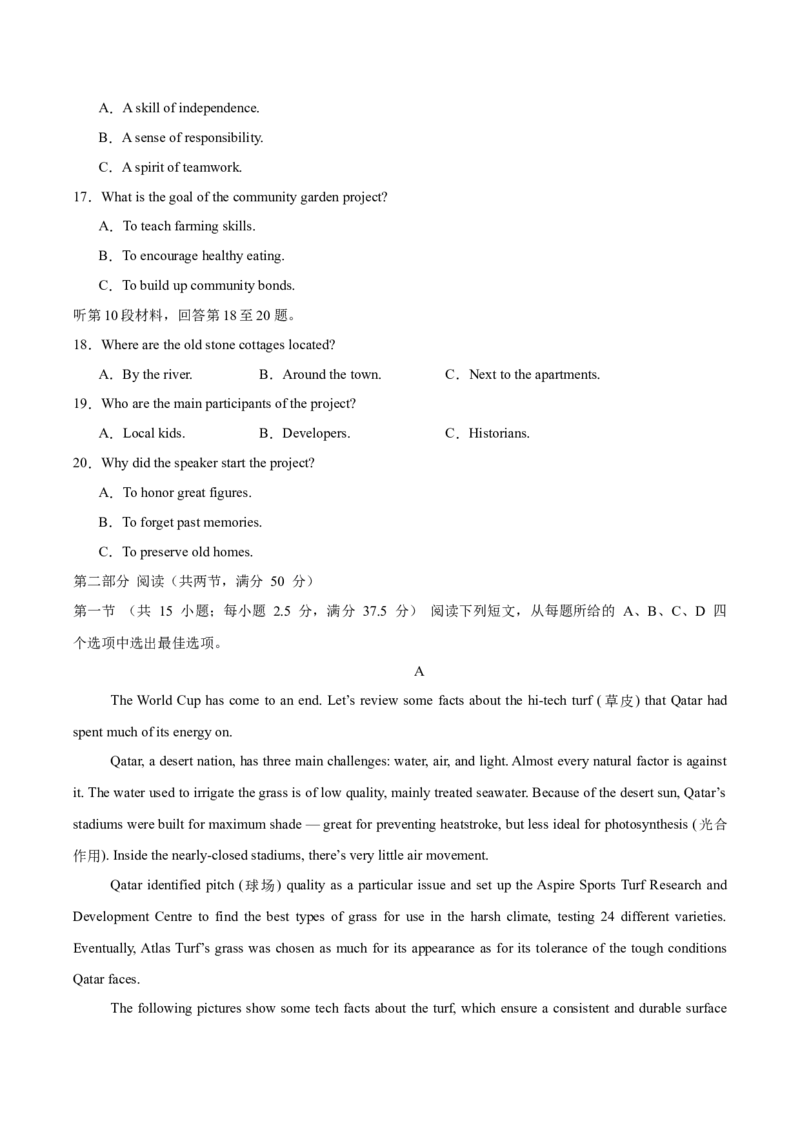
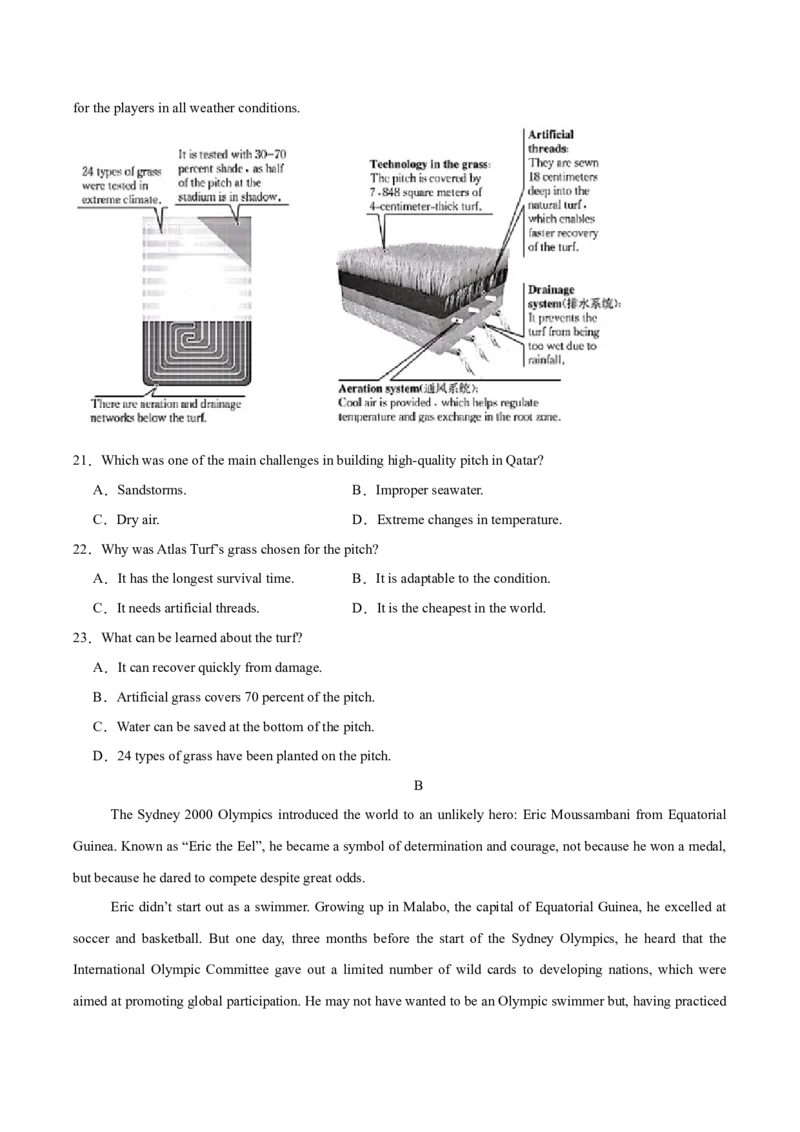
The following pictures show some tech facts about the turf, which ensure a consistent and durable surface
for the players in all weather conditions.
21.Which was one of the main challenges in building high-quality pitch in Qatar?
A.Sandstorms.
B.Improper seawater.
C.Dry air.
D.Extreme changes in temperature.
22.Why was Atlas Turf’s grass chosen for the pitch?
A.It has the longest survival time.
B.It is adaptable to the condition.
C.It needs artificial threads.
D.It is the cheapest in the world.
23.What can be learned about the turf?
A.It can recover quickly from damage.
B.Artificial grass covers 70 percent of the pitch.
C.Water can be saved at the bottom of the pitch.
D.24 types of grass have been planted on the pitch.
B
The Sydney 2000 Olympics introduced the world to an unlikely hero: Eric Moussambani from Equatorial
Guinea. Known as “Eric the Eel”, he became a symbol of determination and courage, not because he won a medal,
but because he dared to compete despite great odds.
Eric didn’t start out as a swimmer. Growing up in Malabo, the capital of Equatorial Guinea, he excelled at
soccer and basketball. But one day, three months before the start of the Sydney Olympics, he heard that the
International Olympic Committee gave out a limited number of wild cards to developing nations, which were
aimed at promoting global participation. He may not have wanted to be an Olympic swimmer but, having practiced
in a local river, Eric decided to give it a shot. With no proper swimming facilities in his country, he trained in a
hotel pool that was just 20 meters long and often practiced alone. Before he arrived at the Games, he had never
even seen an Olympic-sized pool, let alone swum in one.
On the day of his race, Eric was up against a tough challenge. His two competitors in the 100-meter freestyle
heat were disqualified for false starts, leaving him to swim alone. As he dived into the water, it quickly became
clear that he was struggling. His strokes (划水动作) were awkward, his pace slow, and by the final 50 meters, he
was completely worn out. The crowd held its breath, unsure if he would make it to the finish line. But Eric didn’t
give up. Step by step, or rather stroke by stroke, he pushed forward. When he finally touched the wall, the audience
erupted in cheers, celebrating his determination and courage.
His swim made him an instant star of the Sydney Olympics for posting the worst time in the history of the
sport. But it also reminded the world that there’s far more to the Olympic spirit than just victory.
24.What challenge did Eric face during his training?
A.Shortage of qualified instructors.
B.No opportunity for real competitions.
C.No access to proper swimming venues.
D.Unfamiliarity with the rules of the Olympics.
25.What happened during Eric’s race?
A.He failed to reach the finish line.
B.He swam the entire race alone.
C.He was disqualified for a false start.
D.He finished ahead of his competitors.
26.Which words can best describe Eric?
A.Devoted and humble.
B.Courageous and honest.
C.Optimistic and outgoing.
D.Determined and inspiring.
27.What is the passage mainly about?
A.A swimmer’s Olympic medal victory.
B.A man’s courage motivating the world.
C.A nation’s efforts in sports development.
D.A sportsman’s dream to win the Olympics.
C
Self-confidence is trusting in our abilities or qualities. It’s usually seen as a good thing. But is it possible that
we might benefit from a little less confidence in our beliefs?
For many years, Dr. Mark Leary, a neuroscientist at Duke University in Durham, N.C . , has studied the
role of people’s beliefs in their behavior. He found overconfidence is very common, especially when it comes to
what people believe to be true, and can lead us to disastrous decisions. In 1986, NASA believed that the risk of loss
for any space flight was roughly 1 in 100,000. It was an overconfident belief and might have led to the explosion of
the Challenger. The good news is that there’s a “vaccine (疫苗)” for overconfidence, and that’s what scientists call
“intellectual humility”— recognizing that your beliefs could be wrong.
A survey of 144 college students to measure their intellectual humility found that students who saw their
thinking could be wrong tended to be more curious and more likely to seek out new knowledge. They ended up
knowing more at the end of the day. But does it actually help you beyond that?
To find out more, Dr. Tenelle Porter at Ball State University conducted a series of studies with high school
students. She found that students with intellectual humility were much more likely to test themselves to see whether
they really understood the material and seek out potential holes in their understanding. When they got test scores,
they’d change their study strategics to improve their performance and master the material for the next test.
Students who didn’t see their knowledge could be wrong might instead just sail through their studying and
wouldn’t stop to ask themselves if they truly understood what they read, heard, or did. Such students thought they
got a subject down pat, but when asked to explain it on a test, they found they didn’t actually understand as much
as they had thought.
Although it might be good for you, researchers recognize that questioning your beliefs can be truly hard.
Still, it’s important to remember that questioning beliefs isn’t always about replacing old ones with new ones. If
you find it hard to question a belief, try taking “baby steps.”
28.Why does the author mention the explosion of the Challenger?
A.To express his sorrow for the loss.
B.To stress the high risk of space flights.
C.To show the result of wrong operation.
D.To give an example of overconfidence.
29.What do we know about intellectual humility according to Porter’s research?
A.It urged students to gain recognition.
B.It encouraged students to take exams.
C.It helped students to adjust learning methods.
D.It motivated students to memorize knowledge.
30.What do the underlined words “got a subject down pat” mean in paragraph 5?
A.Fully mastered a subject.
B.Put great effort into a subject
C.Really enjoyed a subject.
D.Benefited a lot from a subject.
31.What will probably be discussed in the following paragraphs?
A.Why questioning our belief is hard.
B.Why intellectual humility is helpful.
C.How to become a confident person.
D.How to practice intellectual humility.
D
Unlike traditional rigid robots, soft robotics are built from flexible materials that copy the natural movements
of living creatures. This design enables them to move through narrow spaces like disaster debris or complex paths
inside the human body. However, adding sensors has been difficult. “The key was making them smart,” explains
researcher Larry Cheng from Penn State University, “We needed robots that sense and act independently.”
The solution lies in electronic parts designed to bend. Traditional hard electronics limit robot movement, but
Cheng’s team used bendable electronics spread across the body. They added magnetic materials inside. By
adjusting magnetic fields, robots crawl, roll and twist wirelessly and battery-free.
Developing this technology faced two main obstacles. First, even bendable electronics are much stiffer than
the robot’s soft material. “We arranged electronics like puzzle pieces to fit flexibly,” Cheng explained. Second,
magnetic fields used for control can disturb electronic signals. The team redesigned circuits (电路) to prevent this
interference, keeping sensors accurate near strong magnets.
These improvements allow robots to work with less human guidance. In rescue missions, they could find
trapped people by detecting body heat. Medical versions might sense chemical changes to deliver drugs exactly
where needed. Researchers are developing a pill-sized robot that patients could swallow. “It could examine the
digestive system, collect samples, or treat diseases without surgery,” said Korean scientist Suk-Won Hwang,
Cheng’s partner.
Future plans include creating tiny robots for blood vessel treatments. “Injected into veins, they could repair
heart problems or target cancer cells,” Cheng described. Though unnamed yet, these robots might get public-
suggested names. “That’s a fun idea,” Cheng laughed when asked about naming possibilities.
32.What is a major advantage of soft robotics?
A.Rigid electronic control.
B.Stiffer structural components
C.Strong built-in power supplies.
D.Flexible movements in narrow spaces
33.What problems did researchers face in developing the soft robots?
A.High cost and material scarcity.
B.Sensor accuracy and medical risks.
C.Stiff electronics and signal interference.
D.Limited movement and power shortage.
34.What can be inferred about future medical treatments in paragraph 4?
A.Doctors will be replaced by robots.
B.Robots can only assist in diagnoses.
C.Treatment costs will significantly decrease.
D.Certain surgeries may become unnecessary.
35.How did Cheng feel about letting the public name the robots?
A.Deeply moved.
B.Lightly amused.
C.Slightly doubtful.
D.Completely uninterested.
第二节 (共5 小题;每小题2.5 分,满分12.5 分)
根据短文内容,从短文后的选项中选出能填入空白处的最佳选项。选项中有两项为多余选项。
I am a child of traditional book reading. I used to go through one book continuously from beginning to end,
taking notes or highlighting lines before going on to the next book. It was a slow but deeper way to absorb a book.
3  6

  My struggle with Dostoevsky’ s The Brothers Karamazov early on is a good example.
After college, my job involved reading a lot of background materials for projects. Many nights I stayed
awake till past midnight leafing through pages.

 3  7

  It helped me breeze through my reading requirements.
However, for books I was genuinely passionate about, I switched to a slower pace, and still read one book at a time.


 3  8

  I no longer stick to one book, but jump between them, spending about half an hour on each.
Currently, I’m reading six books in various stages, with more lined up to start soon. My speed reading skills help
me scan quickly without losing comprehension. I can easily switch to slow reading mode whenever needed.
Recently, I learnt from a journal that my previous reading method is known as “Blocked Practice”, which
involves studying one topic thoroughly before moving on to another.

 3  9

  However, it tends to restrict how
you apply knowledge in new and varied situations.
On the other hand, the “mixing it up” approach, also referred to as “Interleaved Practice”, could produce
dramatic, long-lasting learning benefits. By switching between topics, readers can make connections between ideas
and skills.

 4  0

  Over time, readers could be more capable of solving problems critically. If this is true, then
my evolution as a reader of books has been in the right direction all along.
A.It helps widen perspectives.
B.This method has its limitations.
C.That was when I took up speed reading.
D.I’m not great at trying out different reading styles.
E.That’s why it took me months to finish heavy books.
F.Nowadays I’ ve acquired the habit of multiple book reading.
G.This approach can be effective for mastering individual concepts.
第三部分:语言运用(共两节,满分 30 分)
第一节:(共15 小题;每小题 1 分,满分15 分)
阅读下面短文,从短文后各题所给的 A、B、C 和 D 四个选项中,选出可以填入空白处的最佳选项。
I love needles. They have a variety of uses, from creating vivid designs out of wool to providing medical
41    . Each needle I own represents a different     42     in my life.
When I was 6, I was given small pink knitting ( 针织) needles. “I am knitting. Do you want me to teach
you?” My grandmother     43     my hands in hers and showed me how to knit. While she was cooking, I
would sit on her seat, knitting just like her. When I was first learning, I would frequently ask for     44    , and
constantly be scared of ruining our     45    . After my grandmother left America, I missed the     46     of
sticks clicking against each other and the smell of her Peruvian cornbread. No matter the     47    , I know my
grandmother and I will always be connected through the needles she     48    .
Hypodermic ( 注射) needles are currently my most     49     needles. While many people hated
hypodermic needles, to me they represent curing and my      50      in the medical field. This simple yet
51      needle is employed every day to protect lives. Suture (缝合) needles are the needles that I aim to use in
the future. Only specially trained      52      can properly handle them. They      53      put people back
together using incredible      54     .
Needless to say, needles have always been a part of my life. They have been a physical      55      of
how I’ve developed as a person.
41.A.advice
B.information
C.research
D.treatment
42.A.secret
B.phase
C.opinion
D.challenge
43.A.pressed
B.shook
C.held
D.lifted
44.A.guidance
B.praise
C.admission
D.introduction
45.A.cooperation
B.creation
C.fame
D.opportunity
46.A.type
B.move
C.shadow
D.sound
47.A.age
B.change
C.distance
D.ability
48.A.showed off
B.passed down
C.put aside
D.took up
49.A.feared
B.remembered
C.trusted
D.used
50.A.career
B.collection
C.preference
D.practice
51.A.powerful
B.rare
C.long
D.sharp
52.A.patients
B.tailors
C.professionals
D.officials
53.A.formally
B.literally
C.nearly
D.curiously
54.A.courage
B.strength
C.imagination
D.technique
55.A.test
B.copy
C.reminder
D.product
第二节:(10 个小题;每小题1.5 分,满分15 分)
阅读下面短文,在空白处填入1 个适当的单词或括号内单词的正确形式。
The vocabulary of tea tasting can seem abstract to the point of poetry. When     56     (season) tea lovers
comment on a cup of tea, they might comment on its qi and yun. In a 2021 paper, Zhang Jinghong notes that in
Chinese culture, food and drink are not judged only by taste or smell. When     57     (cite) the ancient saying,
“Medicine and food have the same origin”, she says that the impact of food and drink on the body remains     58
important factor in how Chinese perceive taste and quality. Just to name one example, common food descriptors
like “hot” and “cold” do not describe specific temperatures,     59     how a dish is perceived to affect a
person’s inner temperature.
Keeping that     60     mind, what exactly do tea lovers mean when they talk about qi and yun? Deng
Shihai, an early expert on Pu’er tea, praised its “flavorless flavor” as the highest level Pu’er can attain. If that
sounds needlessly contradictory, you’re not alone, but to Deng, it was a way to distinguish beginners at tea,     61
focus on taste, from experts who see tea more     62     (whole).
Qi and yun are thought to be more advanced than any simple description of taste, in part because they imply
an indescribable sense of connection between people and things, and even to the far     63     (expand) natural
world. As Zhang notes, “Qi and yun     64     (consider) to more accurately and thoroughly express what
people feel when they are touched by things, and to better reflect the     65     (unit) of people and things, and
people and nature.”
第四部分  写作(共两节,满分40 分)
第一节(满分 15 分) 学校英文报正在开展以“Weight Management”为主题的讨论。请你根据下列调查结果
写一篇短文投稿,内容包括:
(1) 描述调查结果;
(2) 简单评论;
(3) 你的建议。
Student Weight Distribution by Gender in a Middle School
Gender
Weight Category
Percentage of Gender
Male
Normal Weight
60%
Overweight
30%
Severely Overweight
10%
Female
Normal Weight
70%
Overweight
25%
Severely Overweight
5%
注意:
(1) 写作词数应为80 个左右;
(2) 请按如下格式在相应位置作答。
____________________________________________________________________________________________
____________________________________________________________________________________________
____________________________________________________________________________________________
____________________________________________________________________________________________
____________________________________________________________________________________
第二节  (满分 25 分)
阅读下面材料,根据其内容和所给段落开头语续写两段,使之构成一篇完整的短文。
It was a rainy Saturday afternoon, and 16-year-old Mia sat on the porch (门廊), staring at the rain forming
puddles in the driveway. Her dad, a single parent, had lost his job last month, and their car had broken down that
morning. “We need to get to the hospital,” Dad had said, his voice tight — Mia’s little brother, Leo, had a high
fever and was struggling to breathe. But with no car and no money for a taxi, they were stuck.
Mia wrapped her arms around herself, listening to Leo’s weak coughs from inside. She’d checked their
savings jar earlier — only $12. Not nearly enough for even a short taxi ride, let alone the hospital bills she knew
would come. The rain tapped harder on the roof, as if adding to their worry. Just then, Mr. Carter, their elderly
neighbor, appeared at the gate, holding an umbrella. He’d lived next door for years, always sitting on his porch
reading newspapers, sometimes waving slightly if they passed by, but they’d rarely spoken beyond a quick “hello.”
“Heard the little one’ s sick?” he asked, rain dripping from the brim of his old canvas hat. Mia nodded, biting her
lip to hold back tears — she hated feeling so helpless.
Mr. Carter stepped closer. “My car is in the garage. It’s old, but it runs. Let’s get him to the doctor.” Mia’s
eyes widened. “Really? But the rain?” “Rain never stopped a Carter from helping a neighbor,” he said. Without
another word, he turned and hurried toward the garage. Moments later, the old car rumbled to life and pulled up to
the curb in front of the house. Dad hurried out with Leo in his arms, and Mr. Carter helped tuck the boy into the
back seat.
By the time they reached the hospital, Leo’s fever had gone down a little. Nurses rushed him to a small
examination room, asking Dad to stay by his side to answer questions. Mia waited in the lobby, her hands shaking
as she thought about the money they didn’t have. She decided to get a cup of water to calm herself, stepping toward
the water dispenser (饮水机) near the reception desk.
注意:1.续写词数应为150 左右;
2.请按如下格式在答题卡的相应位置作答。
Getting water, she saw Mr. Carter, who was with the receptionist, pulling out his wallet.
____________________________________________________________________________________________
____________________________________________________________________________________________
____________________________________________________________________________________________
____________________________________________________________________________________________
____________________________________________________________________________________________
________________________________________
Later that night, Leo recovered from his illness.
____________________________________________________________________________________________
____________________________________________________________________________________________
____________________________________________________________________________________________
____________________________________________________________________________________________
____________________________________________________________________________________________
________________________________________