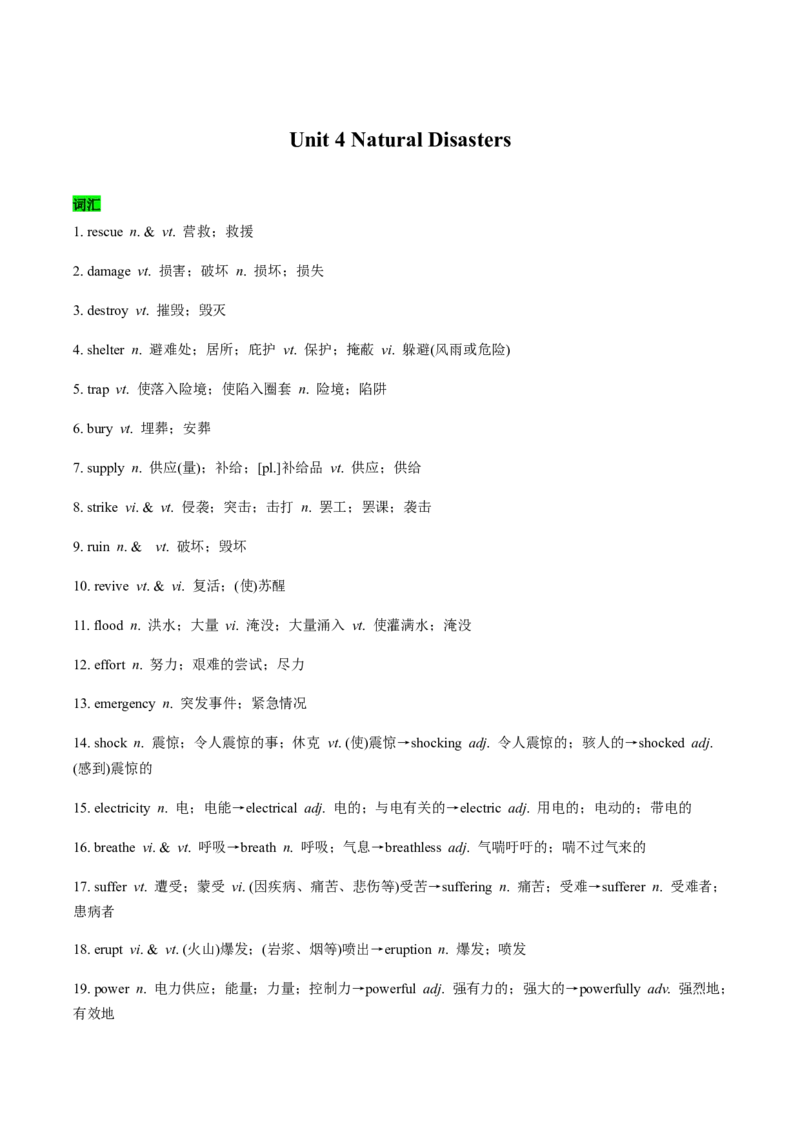
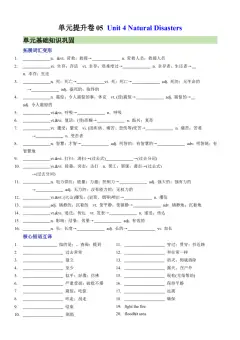
Unit 4 Natural Disasters
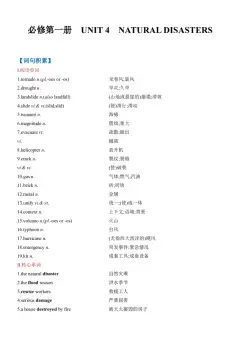
词汇
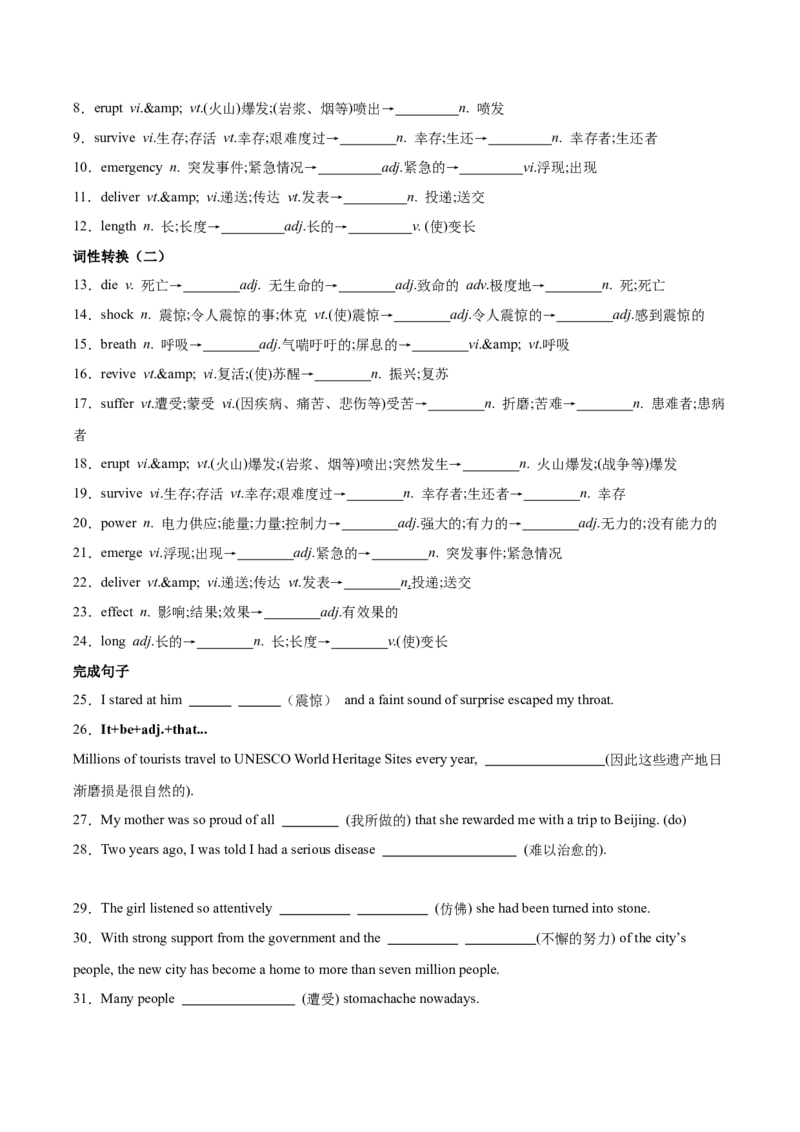
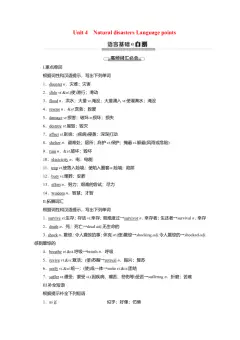
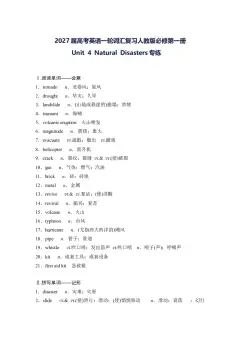
1. rescue n. & vt. 营救;救援
2. damage vt. 损害;破坏 n. 损坏;损失
3. destroy vt. 摧毁;毁灭
4. shelter n. 避难处;居所;庇护 vt. 保护;掩蔽 vi. 躲避(风雨或危险)
5. trap vt. 使落入险境;使陷入圈套 n. 险境;陷阱
6. bury vt. 埋葬;安葬
7. supply n. 供应(量);补给;[pl.]补给品 vt. 供应;供给
8. strike vi. & vt. 侵袭;突击;击打 n. 罢工;罢课;袭击
9. ruin n. & vt. 破坏;毁坏
10. revive vt. & vi. 复活;(使)苏醒
11. flood n. 洪水;大量 vi. 淹没;大量涌入 vt. 使灌满水;淹没
12. effort n. 努力;艰难的尝试;尽力
13. emergency n. 突发事件;紧急情况
14. shock n. 震惊;令人震惊的事;休克 vt. (使)震惊→shocking adj. 令人震惊的;骇人的→shocked adj.
(感到)震惊的
15. electricity n. 电;电能→electrical adj. 电的;与电有关的→electric adj. 用电的;电动的;带电的
16. breathe vi. & vt. 呼吸→breath n. 呼吸;气息→breathless adj. 气喘吁吁的;喘不过气来的
17. suffer vt. 遭受;蒙受 vi. (因疾病、痛苦、悲伤等)受苦→suffering n. 痛苦;受难→sufferer n. 受难者;
患病者
18. erupt vi. & vt. (火山)爆发;(岩浆、烟等)喷出→eruption n. 爆发;喷发
19. power n. 电力供应;能量;力量;控制力→powerful adj. 强有力的;强大的→powerfully adv. 强烈地;
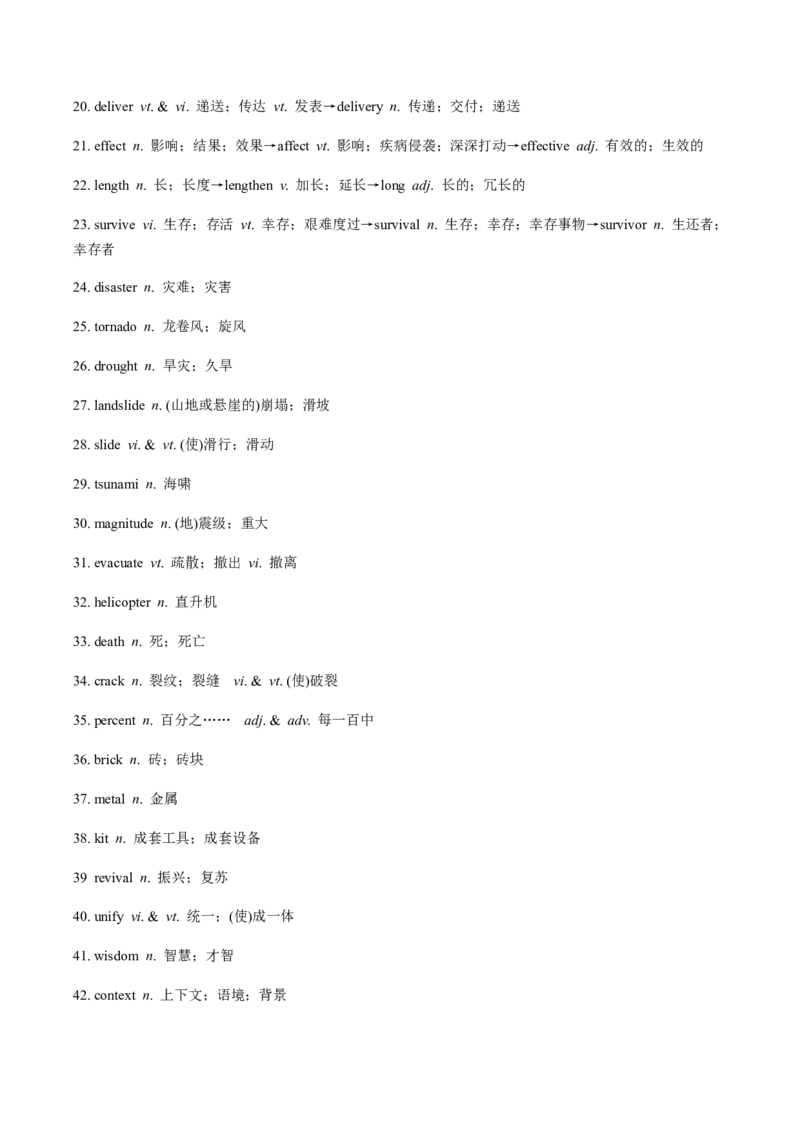
有效地20. deliver vt. & vi. 递送;传达 vt. 发表→delivery n. 传递;交付;递送
21. effect n. 影响;结果;效果→affect vt. 影响;疾病侵袭;深深打动→effective adj. 有效的;生效的
22. length n. 长;长度→lengthen v. 加长;延长→long adj. 长的;冗长的
23. survive vi. 生存;存活 vt. 幸存;艰难度过→survival n. 生存;幸存;幸存事物→survivor n. 生还者;
幸存者
24. disaster n. 灾难;灾害
25. tornado n. 龙卷风;旋风
26. drought n. 旱灾;久旱
27. landslide n. (山地或悬崖的)崩塌;滑坡
28. slide vi. & vt. (使)滑行;滑动
29. tsunami n. 海啸
30. magnitude n. (地)震级;重大
31. evacuate vt. 疏散;撤出 vi. 撤离
32. helicopter n. 直升机
33. death n. 死;死亡
34. crack n. 裂纹;裂缝 vi. & vt. (使)破裂
35. percent n. 百分之…… adj. & adv. 每一百中
36. brick n. 砖;砖块
37. metal n. 金属
38. kit n. 成套工具;成套设备
39 revival n. 振兴;复苏
40. unify vi. & vt. 统一;(使)成一体
41. wisdom n. 智慧;才智
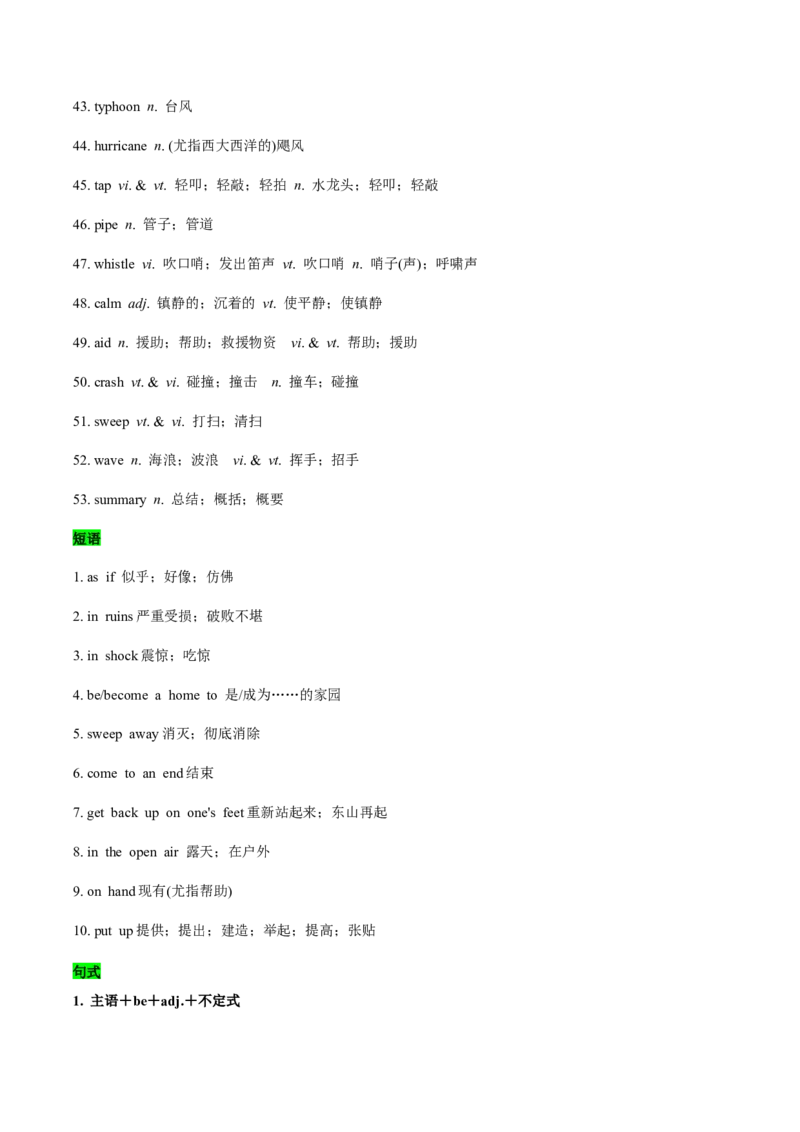
42. context n. 上下文;语境;背景43. typhoon n. 台风
44. hurricane n. (尤指西大西洋的)飓风
45. tap vi. & vt. 轻叩;轻敲;轻拍 n. 水龙头;轻叩;轻敲
46. pipe n. 管子;管道
47. whistle vi. 吹口哨;发出笛声 vt. 吹口哨 n. 哨子(声);呼啸声
48. calm adj. 镇静的;沉着的 vt. 使平静;使镇静
49. aid n. 援助;帮助;救援物资 vi. & vt. 帮助;援助
50. crash vt. & vi. 碰撞;撞击 n. 撞车;碰撞
51. sweep vt. & vi. 打扫;清扫
52. wave n. 海浪;波浪 vi. & vt. 挥手;招手
53. summary n. 总结;概括;概要
短语
1. as if 似乎;好像;仿佛
2. in ruins严重受损;破败不堪
3. in shock震惊;吃惊
4. be/become a home to 是/成为……的家园
5. sweep away消灭;彻底消除
6. come to an end结束
7. get back up on one's feet重新站起来;东山再起
8. in the open air 露天;在户外
9. on hand现有(尤指帮助)
10. put up提供;提出;建造;举起;提高;张贴
句式
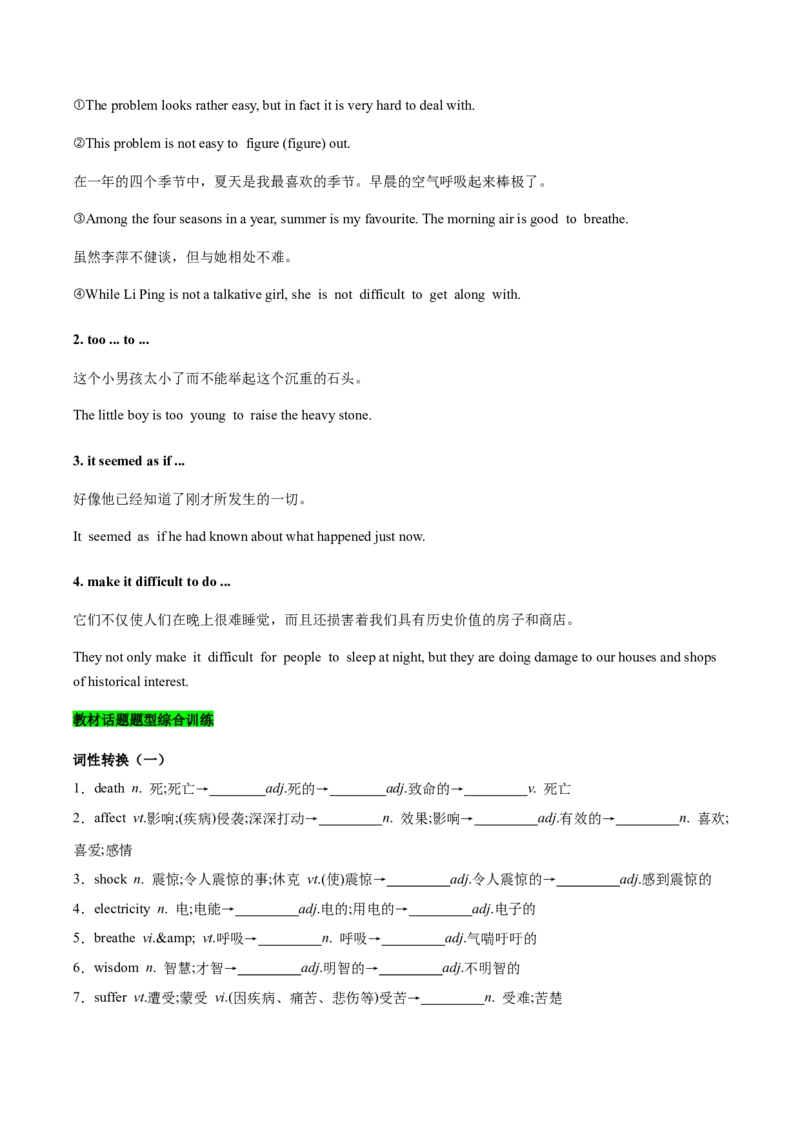
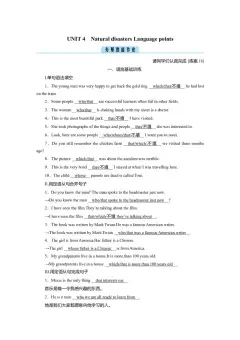
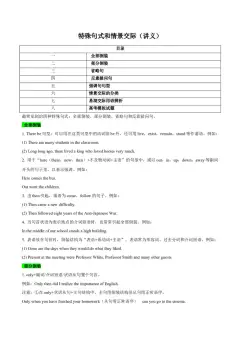
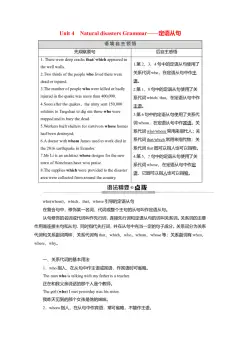
1. 主语+be+adj.+不定式①The problem looks rather easy, but in fact it is very hard to deal with.
②This problem is not easy to figure (figure) out.
在一年的四个季节中,夏天是我最喜欢的季节。早晨的空气呼吸起来棒极了。
③Among the four seasons in a year, summer is my favourite. The morning air is good to breathe.
虽然李萍不健谈,但与她相处不难。
④While Li Ping is not a talkative girl, she is not difficult to get along with.
2. too ... to ...
这个小男孩太小了而不能举起这个沉重的石头。
The little boy is too young to raise the heavy stone.
3. it seemed as if ...
好像他已经知道了刚才所发生的一切。
It seemed as if he had known about what happened just now.
4. make it difficult to do ...
它们不仅使人们在晚上很难睡觉,而且还损害着我们具有历史价值的房子和商店。
They not only make it difficult for people to sleep at night, but they are doing damage to our houses and shops
of historical interest.
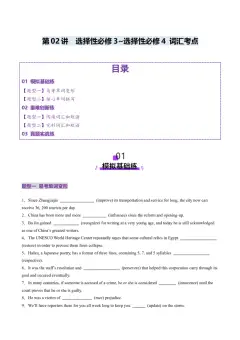
教材话题题型综合训练
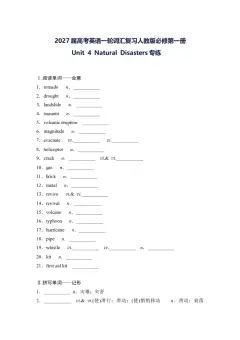
词性转换(一)
1.death n. 死;死亡→ adj.死的→ adj.致命的→ v. 死亡
2.affect vt.影响;(疾病)侵袭;深深打动→ n. 效果;影响→ adj.有效的→ n. 喜欢;
喜爱;感情
3.shock n. 震惊;令人震惊的事;休克 vt.(使)震惊→ adj.令人震惊的→ adj.感到震惊的
4.electricity n. 电;电能→ adj.电的;用电的→ adj.电子的
5.breathe vi.& vt.呼吸→ n. 呼吸→ adj.气喘吁吁的
6.wisdom n. 智慧;才智→ adj.明智的→ adj.不明智的
7.suffer vt.遭受;蒙受 vi.(因疾病、痛苦、悲伤等)受苦→ n. 受难;苦楚8.erupt vi.& vt.(火山)爆发;(岩浆、烟等)喷出→ n. 喷发
9.survive vi.生存;存活 vt.幸存;艰难度过→ n. 幸存;生还→ n. 幸存者;生还者
10.emergency n. 突发事件;紧急情况→ adj.紧急的→ vi.浮现;出现
11.deliver vt.& vi.递送;传达 vt.发表→ n. 投递;送交
12.length n. 长;长度→ adj.长的→ v. (使)变长
词性转换(二)
13.die v. 死亡→ adj. 无生命的→ adj.致命的 adv.极度地→ n. 死;死亡
14.shock n. 震惊;令人震惊的事;休克 vt.(使)震惊→ adj.令人震惊的→ adj.感到震惊的
15.breath n. 呼吸→ adj.气喘吁吁的;屏息的→ vi.& vt.呼吸
16.revive vt.& vi.复活;(使)苏醒→ n. 振兴;复苏
17.suffer vt.遭受;蒙受 vi.(因疾病、痛苦、悲伤等)受苦→ n. 折磨;苦难→ n. 患难者;患病
者
18.erupt vi.& vt.(火山)爆发;(岩浆、烟等)喷出;突然发生→ n. 火山爆发;(战争等)爆发
19.survive vi.生存;存活 vt.幸存;艰难度过→ n. 幸存者;生还者→ n. 幸存
20.power n. 电力供应;能量;力量;控制力→ adj.强大的;有力的→ adj.无力的;没有能力的
21.emerge vi.浮现;出现→ adj.紧急的→ n. 突发事件;紧急情况
22.deliver vt.& vi.递送;传达 vt.发表→ n.投递;送交
23.effect n. 影响;结果;效果→ adj.有效果的
24.long adj.长的→ n. 长;长度→ v.(使)变长
完成句子
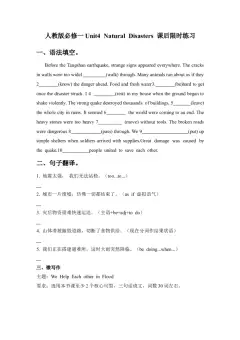
25.I stared at him (震惊) and a faint sound of surprise escaped my throat.
26.It+be+adj.+that...
Millions of tourists travel to UNESCO World Heritage Sites every year, (因此这些遗产地日
渐磨损是很自然的).
27.My mother was so proud of all (我所做的) that she rewarded me with a trip to Beijing. (do)
28.Two years ago, I was told I had a serious disease (难以治愈的).
29.The girl listened so attentively (仿佛) she had been turned into stone.
30.With strong support from the government and the (不懈的努力) of the city’s
people, the new city has become a home to more than seven million people.
31.Many people (遭受) stomachache nowadays.32.Suddenly, a large wave (彻底消除) half the sandcastle, which made the little girl cry loudly.
33.After the earthquake, the city was (严重受损), with buildings collapsed and streets
destroyed.
34.I told myself that (我得从这些负面情绪中走出来) and that I had to win Wimbledon, which had
always been the main goal of my whole life.
阅读理解
It is well-known that earthquake is one of the most serious natural disasters. Because of its sudden nature,
the traditional earthquake prediction method is often difficult to predict it accurately, and has always been a
difficult problem in the field of earth science. Recently, artificial intelligence is showing promise in earthquake
prediction, challenging the long-held belief that it is impossible. Researchers at the University of Texas, Austin,
have developed an AI algorithm (算法) that correctly predicted 70% of earthquakes a week in advance during a
trial in China and provided accurate strength calculations (强度计算) for the predicted earthquakes.
The research team believes their method succeeded because they used a relatively simple machine learning
approach. The AI was provided with a set of statistical features based on the team’s knowledge of earthquake
physics (地震物理学), and then instructed to train itself using a five-year database of earthquake recordings. Once
trained, the Al provided its prediction by listening for signs of incoming earthquakes within the background sounds
in the Earth.
This work is clearly a milestone in research for AI-driven earthquake prediction. “You don’t see earthquakes
coming,” explains Alexandros Savvaidis, a senior research scientist who leads the Texas Seismological Network
Program (TexNet). “It’s a matter of milliseconds, and the only thing you can control is how prepared you are. Even
with the 70% accuracy, that’s a huge result and could help minimize economic and human losses and possibly
improve earthquake preparation worldwide.”
While it is unknown whether the same approach will work at other locations, the researchers are confident
that their AI algorithm could produce more accurate predictions if used in areas with reliable earthquake tracking
networks. The next step is to test artificial intelligence in Texas, since UT’s Bureau TexNet has locations and over
six years worth of continuous records, making it an ideal location in 300 earthquakes for these purposes.
Eventually, the authors hope to combine the system with physics-based models. This strategy could prove
especially important where data is poor or lacking. “That may be a long way off, but many advances such as this
one, are what moves science forward,” says Scott Tinker, the bureau’s director.
35.What can we infer from the passage?A.AI can predict earthquakes accurately.
B.AI is provided with accurate strength calculations.
C.AI can prevent the potential earthquakes from coming.
D.AI forecasts earthquakes by analyzing background sounds.
36.What makes Texas a better place to do the follow-up tests?
A.Building many earthquake stations. B.Over ten years of continuous records.
C.Reliable earthquake tracing networks. D.Researcher’s confidence in the technology.
37.What is the author’s attitude to the AI algorithm?
A.Indifferent. B.Supportive. C.Disapproving. D.Doubtful.
38.What’s the main idea of the text?
A.AI helps reduce possible earthquakes by 70%.
B.AI predicts earthquakes with a certain accuracy.
C.AI algorithm improves earthquake preparation worldwide.
D.AI algorithm produces accurate predictions about earthquakes.
七选五
Natural disasters can cause people’s fears at any age. 39 , but you do have lots of influence on how
your children may face the possible disasters. Let’s see how to talk to your children about natural disasters
correctly.
● Be honest
When there is information about natural disasters, try not to hide it. 40 . They may want to know
more about where the natural disaster is and the path that it is on. Give proper explanations or even check books out
from the library.
● 41
Ask your children what they are nervous about so that you can solve their concerns. Deal with any of their
fears, big or small, and provide some kind of comfort. Whether these disasters are happening far away or close to
home, they need to know that you will keep them safe.
● Make a plan for your family
There is no place on Earth that is free from possibly suffering some type of natural disaster. All families
should have a disaster plan and emergency supplies at home. Create a family safety plan, and share it with your
children. 42 .
● Talk about the helpers43 . The idea that firefighters, paramedics (护理人员), and other disaster service workers will be
there to help in case of an emergency helps children take away some of the anxiety.
A.Answer questions
B.Take away your children’s fears
C.It is completely natural to be afraid
D.They just have to wait with nothing to do
E.It can prepare them for what to do if a disaster happens
F.Instead, offering detailed information and explanation can help calm your children
G.Teach your children about the different types of helpers that show up in a disaster
完形填空
Throughout history, many lives have been lost at the hands of severe weather. Meteorologists (气象学家)
and scientists alike are always investigating new ways to increase the warning time for storms, with the hope of
reducing the 44 of lives. In the past few decades, local weather radar advancements have been made, which
allow for better accuracy in 45 the paths of storms.
Meteorologists and scientists have been able to successfully track severe thunderstorms and possible
tornadoes by using an advanced tracking system called NEXRAD (Next-Generation Radar). NEXRAD is a
tracking network 46 158 Doppler weather radars. And during a storm this high-resolution computerized
47 takes readings on the amount of precipitation (降水) in the air, the movements in the clouds, and the wind
speeds.
These 48 are bounced back to a local weather computer, and a colorful image appears on the
screen,giving meteorologists a clear picture of what kind of weather is on the horizon. This final image is what you
see when the meteorologist breaks in with severe weather reports and warnings. 49 , on your television
screen you will see a computer animated image of the approaching storm.
If the storm is severe enough, then the National Weather Service (NWS) will 50 severe weather
reports of severe thunderstorm warnings for your area. 51 , the storm captured on the radar will have
produced strong readable winds, detectable lightning, and some hail (冰雹). Paying attention to the weather map is
52 when severe weather is around.
On the television screen you will see several colors on the precipitation map, 53 from blue (the
lightest) to black (the heaviest). If the colors for your 54 area are yellow, take caution. If the colors range
between orange and red, take cover immediately, as damaging winds and dangerous lightning have been reported.
When local weather radar in Atlanta, Georgia reported high winds, circular wind patterns and large hailearlier this year, the National Weather Service issued a tornado 55 . Meteorologists in the area used the
collected data to predict what path the storm would take, 56 which areas needed to be warned.
Thanks to this technology, most residents received the severe weather reports early enough to seek 57
before the storm hit. Paying attention to your 58 weather source during severe weather plays a vital role in
your safety.
44.A.loss B.increase C.protection D.value
45.A.changing B.controlling C.predicting D.guiding
46.A.faced with B.exposed to C.involved in D.made up of
47.A.structure B.system C.mode D.style
48.A.figures B.data C.readings D.statistics
49.A.Most likely B.Most evidently C.Most interestingly D.Most importantly
50.A.decide B.estimate C.handle D.issue
51.A.By the way B.In that case C.To some extent D.On the contrary
52.A.vital B.reasonable C.normal D.available
53.A.expanding B.spreading C.ranging D.extending
54.A.proper B.specific C.typical D.regular
55.A.process B.threat C.warning D.sign
56.A.indicating B.recognizing C.covering D.recommending
57.A.rescue B.residence C.support D.shelter
58.A.local B.international C.nationwide D.neighborhood
单句语法填空
59.Nowadays, consumers prefer to shop online and have their goods (deliver) to their door.
60. (deliver) the package to the customer, the deliveryman stopped to have lunch.
61.All we have to do for our students is (aid) them in learning English with a comparative
method.
62.Other little New Year activities include cleaning the houses (sweep)away bad luck and hanging
spring couples to bring wealth.
63.Finally, drug users find themselves (trap) in a prison form which they can’t escape.
64.With her face (bury) in her hands, the hopeless mother couldn’t help crying at the scene of her
injured son.
65.When I arrived there, I (strike) by the beauty of the snow-covered rural landscape.66.They have been working to prevent the environment here from (destroy).
67.I wasn’t sure whether the postman (deliver) me the package on time.
68.The earthquake in Tangshan caused great damage, leaving the city in (ruin).
语法填空
This story took place about seven years ago. But images of that week are still clear in my mind. During that
week, we had to face up to a 69 (power) hurricane. The fact that I was still out seemed to increase 70
(it) force. And I could hear the noise of the wind blowing on the windows, 71 were shaking. Outside,
everything was flying or moving.
In fact, the hurricane did not cross the island only once, but three times, 72 (cause) more and more
damage at each crossing. During the entire week following that event, we were unable 73 (go) out of the
house. All 74 (road) were cut off, and we did not have running water.
Under those conditions, 75 hardest part was having no contact 76 the rest of my family
living around the island. The fear of losing my close friends and relatives was 77 (extreme) hard to stand.
We stayed like that for one unpleasant week before everything 78 (fix). For me, those seven days were
a real nightmare.
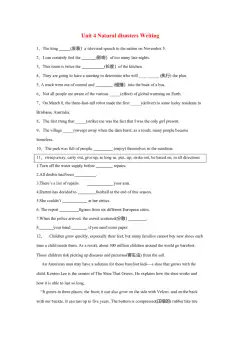
应用文写作
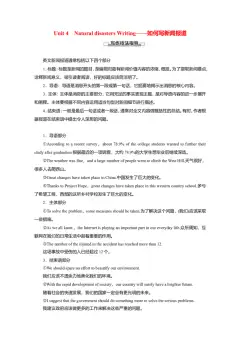
假定你是李华,上周你参加了学校组织的消防安全演习,请你在校英文论坛发表一篇帖子,分享此次经历,
内容包括:
1.活动过程;
2.个人感悟。
注意:
1.词数80左右;
2.可适当增加细节,以使行文连贯。
参考词汇:消防安全演习fire safety drill
____________________________________________________________________________________________
____________________________________________________________________________________________
____________________________________________________________________________________________
____________________________________________________________________________________________
____________________________________________________________________________________________
_______________