综合训练17
第一部分:听力(共两节,满分30 分)
做题时,先将答案标在试卷上,录音内容结束后,有两分钟时间将试卷上的答案转涂到答题卡上。
第一节(共5 小题;每小题1.5 分,满分7.5 分)
听下面5 段对话。每段对话后有一个小题,从题中所给的A、B、C 三个选项中选出最佳选项,并标在
试卷的相应位置。听完每段对话后,你都有 10 秒钟的时间来回答有关小题和阅读下一小题。每段对话仅
读一遍。
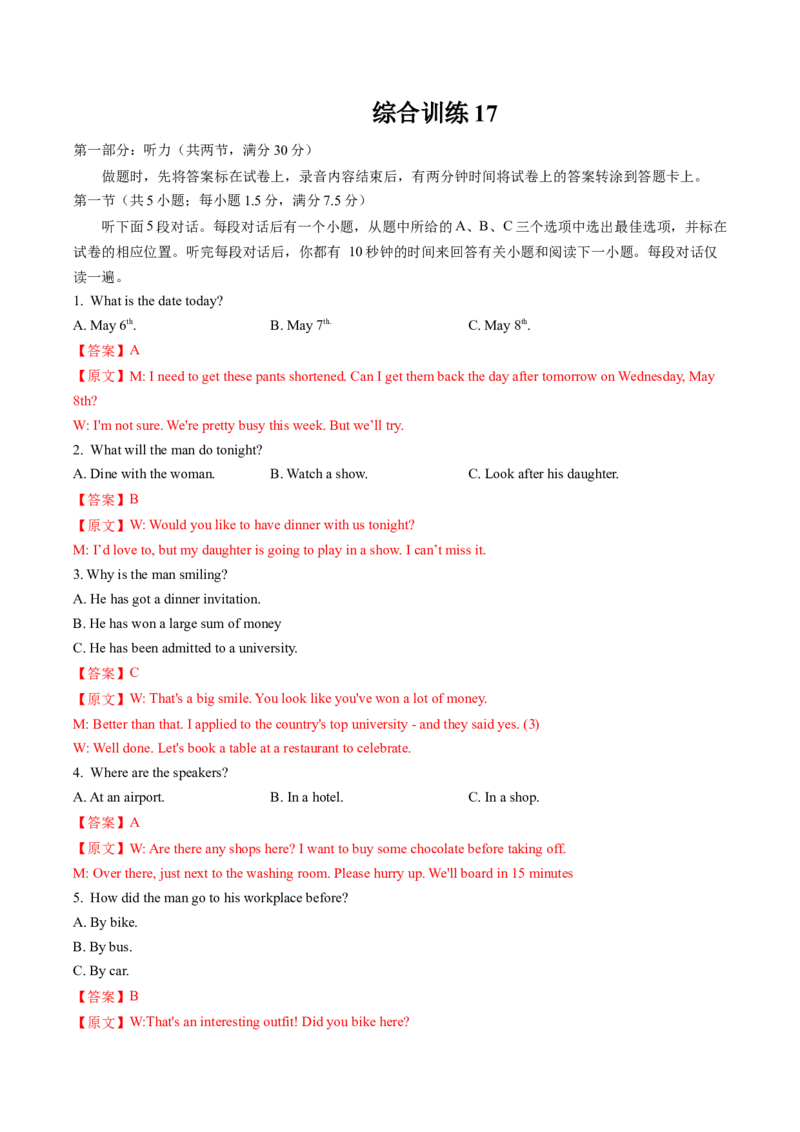
1. What is the date today?
A. May 6th.
B. May 7th.
C. May 8th.
【答案】A
【原文】M: I need to get these pants shortened. Can I get them back the day after tomorrow on Wednesday, May
8th?
W: I'm not sure. We're pretty busy this week. But we’ll try.
2. What will the man do tonight?
A. Dine with the woman.
B. Watch a show.
C. Look after his daughter.
【答案】B
【原文】W: Would you like to have dinner with us tonight?
M: I’d love to, but my daughter is going to play in a show. I can’t miss it.
3. Why is the man smiling?
A. He has got a dinner invitation.
B. He has won a large sum of money
C. He has been admitted to a university.
【答案】C
【原文】W: That's a big smile. You look like you've won a lot of money.
M: Better than that. I applied to the country's top university - and they said yes. (3)
W: Well done. Let's book a table at a restaurant to celebrate.
4. Where are the speakers?
A. At an airport.
B. In a hotel.
C. In a shop.
【答案】A
【原文】W: Are there any shops here? I want to buy some chocolate before taking off.
M: Over there, just next to the washing room. Please hurry up. We'll board in 15 minutes
5. How did the man go to his workplace before?
A. By bike.
B. By bus.
C. By car.
【答案】B
【原文】W:That's an interesting outfit! Did you bike here?
M: Yes, I got my bike last week. Now I don't have to worry about missing the bus anymore.
W: Sounds great! I still drive, but the traffic can be terrible.
第二节(共15 小题;每小题1.5 分,满分22.5 分)
听下面 5 段对话或独白。每段对话或独白后有几个小题,从题中所给的 A、B、C 三个选项中选出最佳
选项,并标在试卷的相应位置。听每段对话或独白前,你将有时间阅读各小题,每小题 5 秒钟;听完后,
各小题将给出 5 秒钟的作答时间。每段对话或独白读两遍。
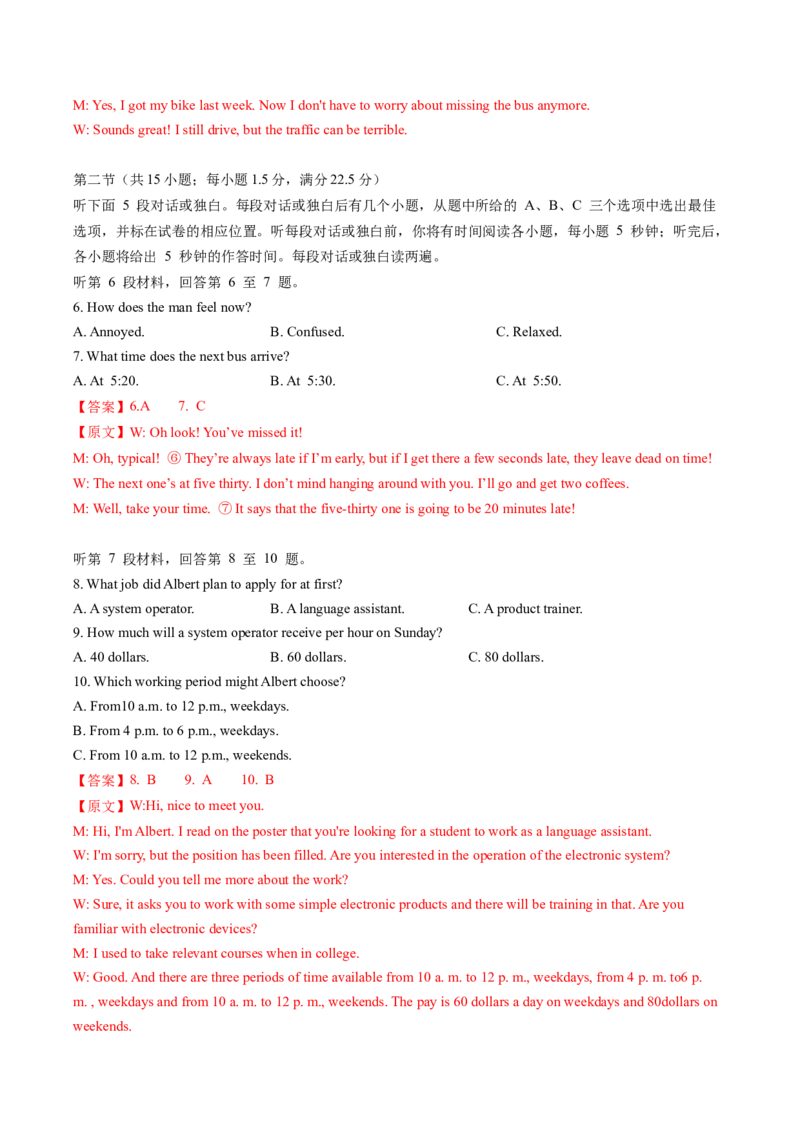
听第 6 段材料,回答第 6 至 7 题。
6. How does the man feel now?
A. Annoyed.
B. Confused.
C. Relaxed.
7. What time does the next bus arrive?
A. At 5:20.
B. At 5:30.
C. At 5:50.
【答案】6.A    7. C
【原文】W: Oh look! You’ve missed it!
M: Oh, typical! ⑥They’re always late if I’m early, but if I get there a few seconds late, they leave dead on time!
W: The next one’s at five thirty. I don’t mind hanging around with you. I’ll go and get two coffees.
M: Well, take your time. ⑦It says that the five-thirty one is going to be 20 minutes late!
听第 7 段材料,回答第 8 至 10 题。
8. What job did Albert plan to apply for at first?
A. A system operator.
B. A language assistant.
C. A product trainer.
9. How much will a system operator receive per hour on Sunday?
A. 40 dollars.
B. 60 dollars.
C. 80 dollars.
10. Which working period might Albert choose?
A. From10 a.m. to 12 p.m., weekdays.
B. From 4 p.m. to 6 p.m., weekdays.
C. From 10 a.m. to 12 p.m., weekends.
【答案】8. B    9. A    10. B
【原文】W:Hi, nice to meet you.
M: Hi, I'm Albert. I read on the poster that you're looking for a student to work as a language assistant.
W: I'm sorry, but the position has been filled. Are you interested in the operation of the electronic system?
M: Yes. Could you tell me more about the work?
W: Sure, it asks you to work with some simple electronic products and there will be training in that. Are you
familiar with electronic devices?
M: I used to take relevant courses when in college.
W: Good. And there are three periods of time available from 10 a. m. to 12 p. m., weekdays, from 4 p. m. to6 p.
m. , weekdays and from 10 a. m. to 12 p. m., weekends. The pay is 60 dollars a day on weekdays and 80dollars on
weekends.
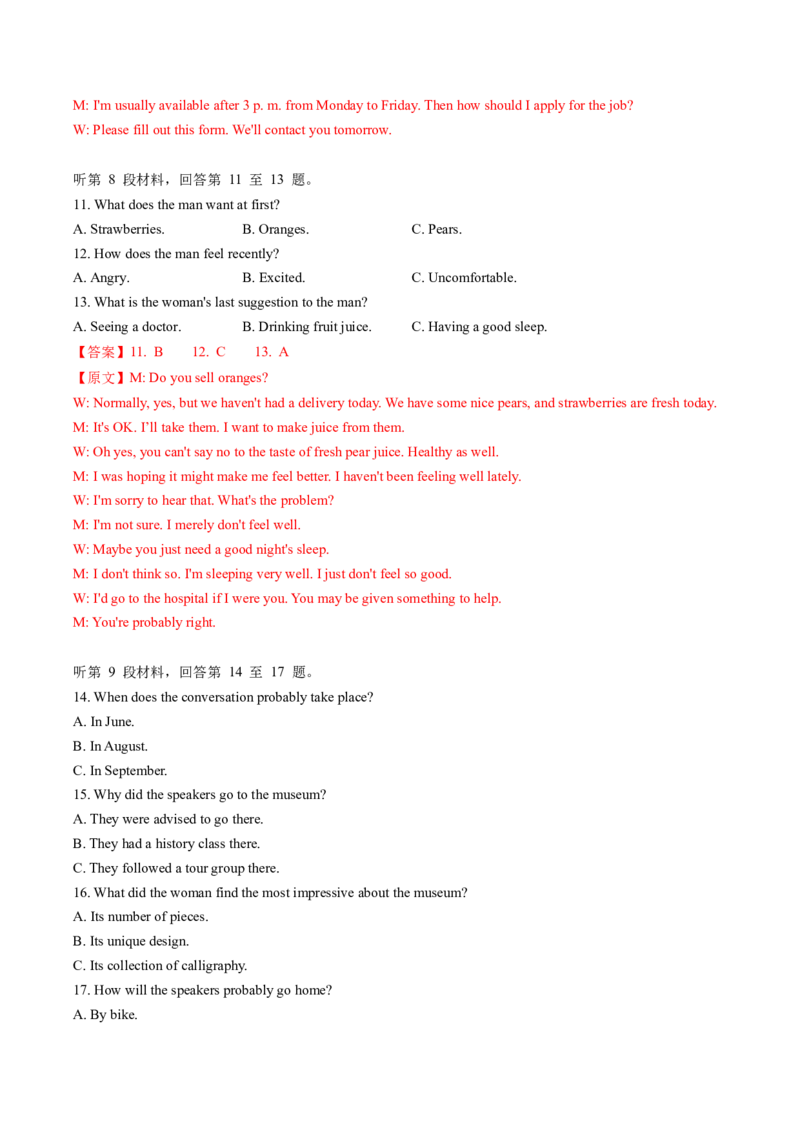
M: I'm usually available after 3 p. m. from Monday to Friday. Then how should I apply for the job?
W: Please fill out this form. We'll contact you tomorrow.
听第 8 段材料,回答第 11 至 13 题。
11. What does the man want at first?
A. Strawberries.
B. Oranges.
C. Pears.
12. How does the man feel recently?
A. Angry.
B. Excited.
C. Uncomfortable.
13. What is the woman's last suggestion to the man?
A. Seeing a doctor.
B. Drinking fruit juice.
C. Having a good sleep.
【答案】11. B    12. C    13. A
【原文】M: Do you sell oranges?
W: Normally, yes, but we haven't had a delivery today. We have some nice pears, and strawberries are fresh today.
M: It's OK. I’ll take them. I want to make juice from them.
W: Oh yes, you can't say no to the taste of fresh pear juice. Healthy as well.
M: I was hoping it might make me feel better. I haven't been feeling well lately.
W: I'm sorry to hear that. What's the problem?
M: I'm not sure. I merely don't feel well.
W: Maybe you just need a good night's sleep.
M: I don't think so. I'm sleeping very well. I just don't feel so good.
W: I'd go to the hospital if I were you. You may be given something to help.
M: You're probably right.
听第 9 段材料,回答第 14 至 17 题。
14. When does the conversation probably take place?
A. In June.
B. In August.
C. In September.
15. Why did the speakers go to the museum?
A. They were advised to go there.
B. They had a history class there.
C. They followed a tour group there.
16. What did the woman find the most impressive about the museum?
A. Its number of pieces.
B. Its unique design.
C. Its collection of calligraphy.
17. How will the speakers probably go home?
A. By bike.
B. By subway.
C. On foot.
【答案】14. B    15. A    16. A   17. C
【原文】W: Wow, it has been an incredible day. The National Art Museum of China was so inspiring! (15) I’m so
glad we visited.
M: Me too. We’ve been talking about visiting since the beginning of the summer. It will be September next week.
(14) I’m glad we finally went there.
W: Same! The historical pieces were mind-blowing.
M: Agreed. I’m so glad our Chinese teacher recommended us to visit. (15) We’ve seen a lot of great places while
touring around Beijing. But this was one of my favorites.
W: True. The calligraphy exhibition was amazing. I wish I could write like that. But I was most impressed by the
size of the museum's collections. (16)
M: I loved the mix of traditional and modern design in this building and its 21 different exhibition halls. It perfectly
represents Chinese historical significance and modern innovation.
W: Well, it’s too early to take the underground home, (17) and the weather is perfect. Should we ride bicycles
through the park instead?
M: I’d rather walk through these small streets. (17)
W: Yes. That’s a great idea! (17)
听第 10 段材料,回答第 18 至 20 题。
18. Why did the Chinese use chopsticks?
A. It was dirty to use hands.
B. It was considered more polite.
C. They liked the new invention.
19. What can we know about Confucius?
A. He had mercy on animals.
B. He sometimes used knives.
C. He liked meat more than vegetables.
20. When did people begin to use forks?
A. After the Northern Song Dynasty.
B. During the Spring and Autumn Period.
C. By the end of the Western Han Dynasty.
【答案】18. B    19. A    20. C
【原文】M: Before the invention of chopsticks, the Chinese used only their hands to eat. This might have allowed
some people to take more food than others, which was considered rude. By using chopsticks, people could control
how much food could be taken at one time, which was thought to be more polite. (18) There’s a story about the
great Chinese philosopher Confucius. He refused to use knives at the table because they reminded eaters of the
scenes where animals were killed. So he preferred the new eating tool. (19) At first, only high-level citizens used
chopsticks when dining. Later on, during the Western Han Dynasty, common people began to use them as well. At
that time, people used chopsticks only to eat side dishes; spoons were used for rice and soups. It was around the
end of the Western Han Dynasty that the fork came into use in Eastern Roman culture. (20) During the Northern
Song Dynasty, noodles became a popular dish. It was very difficult to eat noodles with a spoon, so chopsticks were
used more often.