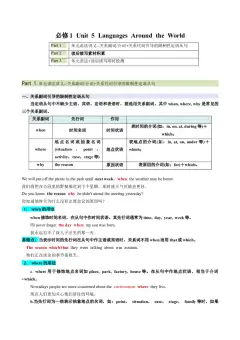
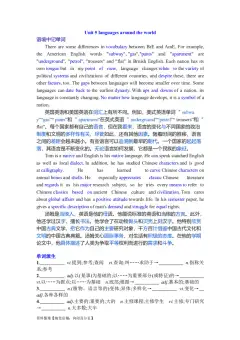
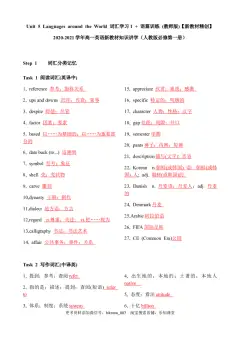
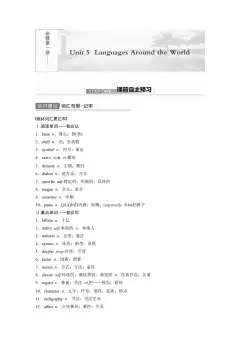
Unit 5 Languages around the World
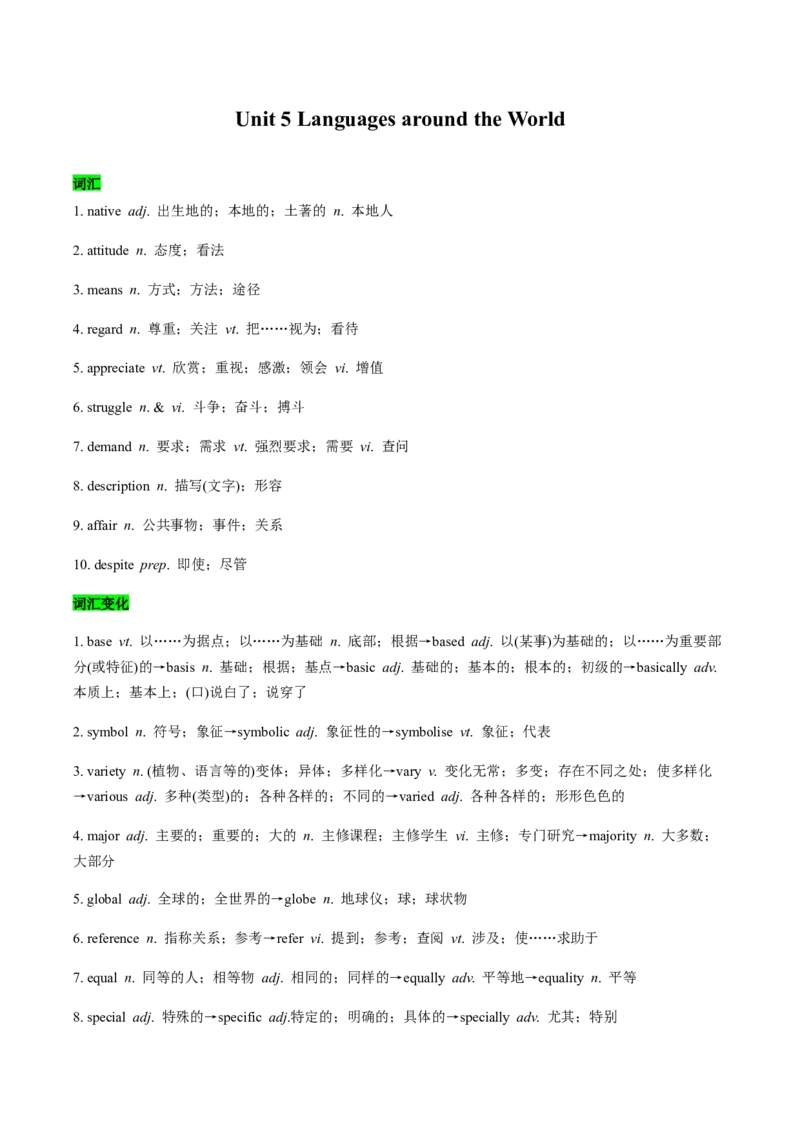
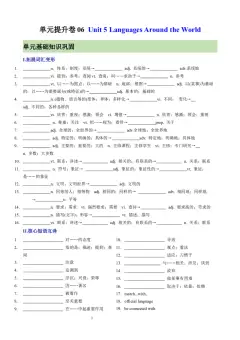
词汇
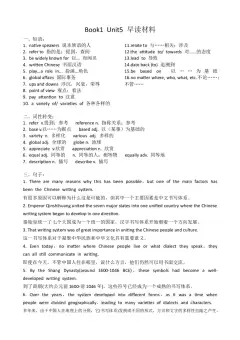
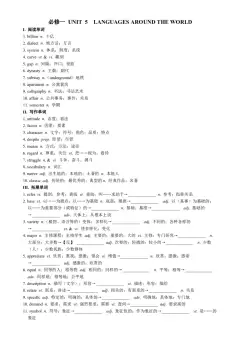
1. native adj. 出生地的;本地的;土著的 n. 本地人
2. attitude n. 态度;看法
3. means n. 方式;方法;途径
4. regard n. 尊重;关注 vt. 把……视为;看待
5. appreciate vt. 欣赏;重视;感激;领会 vi. 增值
6. struggle n. & vi. 斗争;奋斗;搏斗
7. demand n. 要求;需求 vt. 强烈要求;需要 vi. 查问
8. description n. 描写(文字);形容
9. affair n. 公共事物;事件;关系
10. despite prep. 即使;尽管
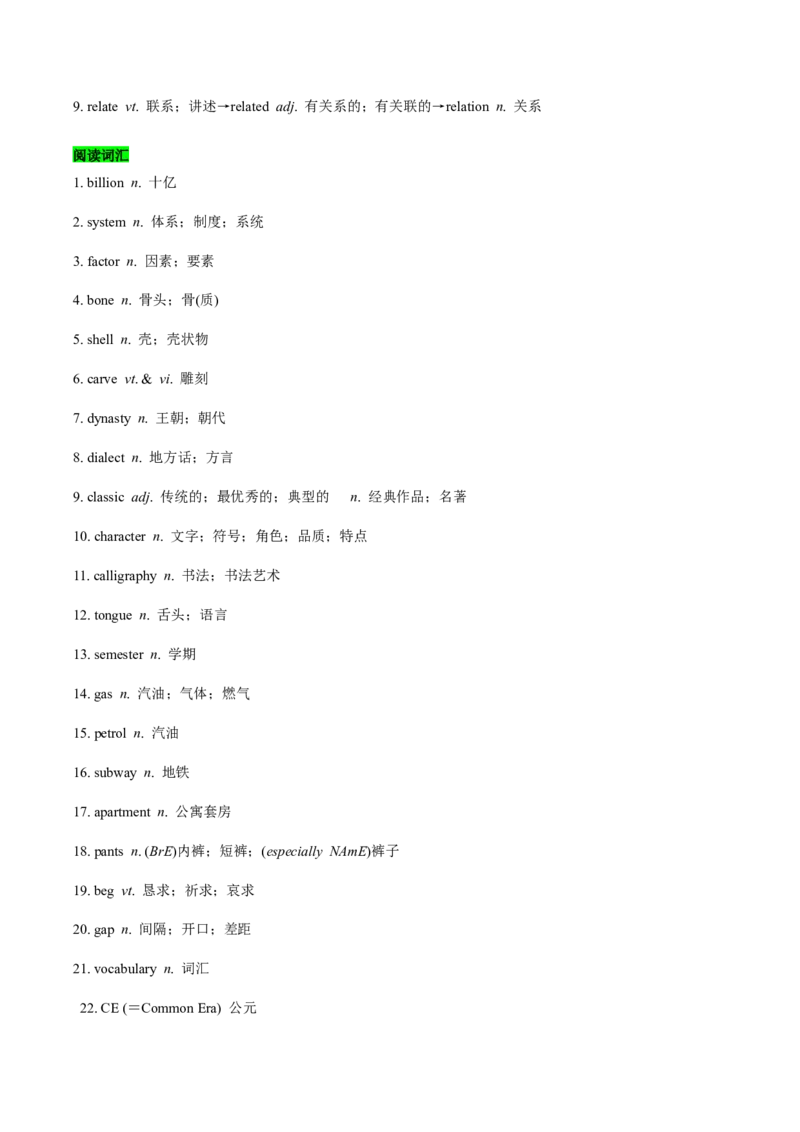
词汇变化
1. base vt. 以……为据点;以……为基础 n. 底部;根据→based adj. 以(某事)为基础的;以……为重要部
分(或特征)的→basis n. 基础;根据;基点→basic adj. 基础的;基本的;根本的;初级的→basically adv.
本质上;基本上;(口)说白了;说穿了
2. symbol n. 符号;象征→symbolic adj. 象征性的→symbolise vt. 象征;代表
3. variety n. (植物、语言等的)变体;异体;多样化→vary v. 变化无常;多变;存在不同之处;使多样化
→various adj. 多种(类型)的;各种各样的;不同的→varied adj. 各种各样的;形形色色的
4. major adj. 主要的;重要的;大的 n. 主修课程;主修学生 vi. 主修;专门研究→majority n. 大多数;
大部分
5. global adj. 全球的;全世界的→globe n. 地球仪;球;球状物
6. reference n. 指称关系;参考→refer vi. 提到;参考;查阅 vt. 涉及;使……求助于
7. equal n. 同等的人;相等物 adj. 相同的;同样的→equally adv. 平等地→equality n. 平等
8. special adj. 特殊的→specific adj.特定的;明确的;具体的→specially adv. 尤其;特别9. relate vt. 联系;讲述→related adj. 有关系的;有关联的→relation n. 关系
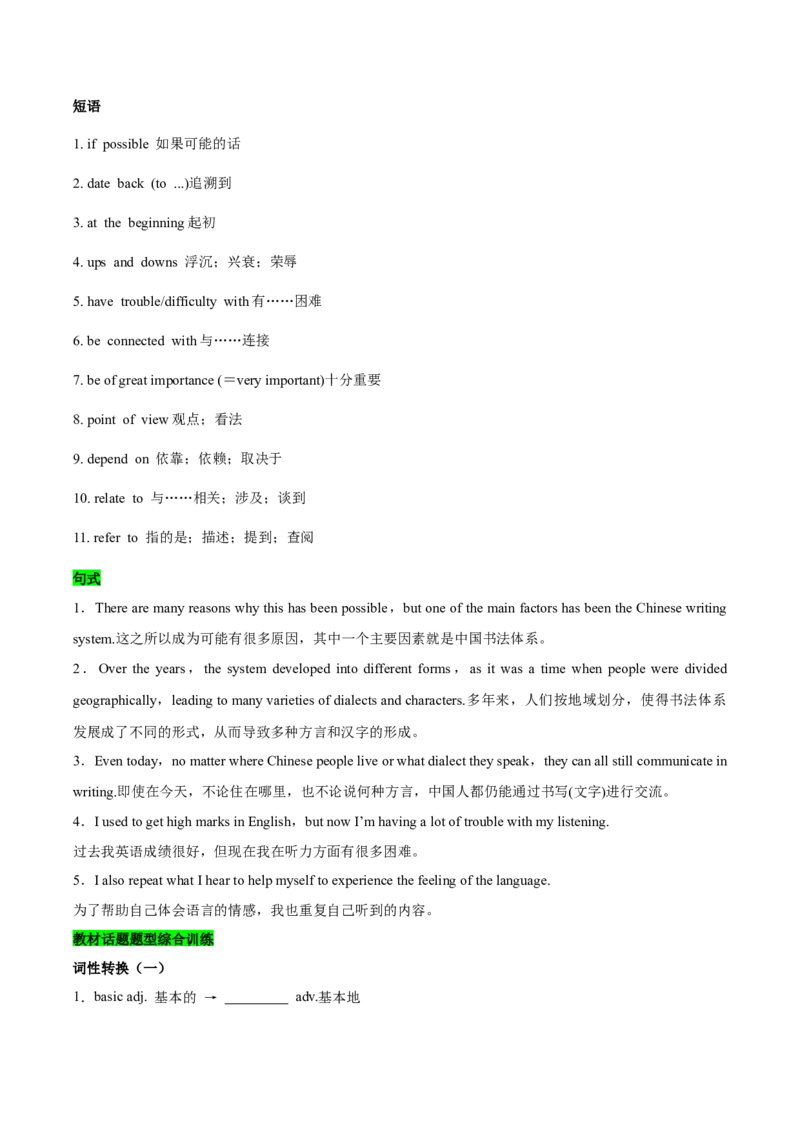
阅读词汇
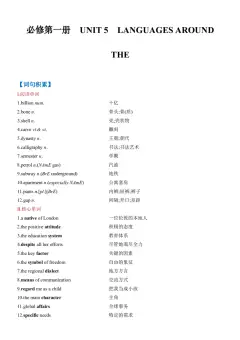
1. billion n. 十亿
2. system n. 体系;制度;系统
3. factor n. 因素;要素
4. bone n. 骨头;骨(质)
5. shell n. 壳;壳状物
6. carve vt. & vi. 雕刻
7. dynasty n. 王朝;朝代
8. dialect n. 地方话;方言
9. classic adj. 传统的;最优秀的;典型的 n. 经典作品;名著
10. character n. 文字;符号;角色;品质;特点
11. calligraphy n. 书法;书法艺术
12. tongue n. 舌头;语言
13. semester n. 学期
14. gas n. 汽油;气体;燃气
15. petrol n. 汽油
16. subway n. 地铁
17. apartment n. 公寓套房
18. pants n. (BrE)内裤;短裤;(especially NAmE)裤子
19. beg vt. 恳求;祈求;哀求
20. gap n. 间隔;开口;差距
21. vocabulary n. 词汇
22. CE (=Common Era) 公元短语
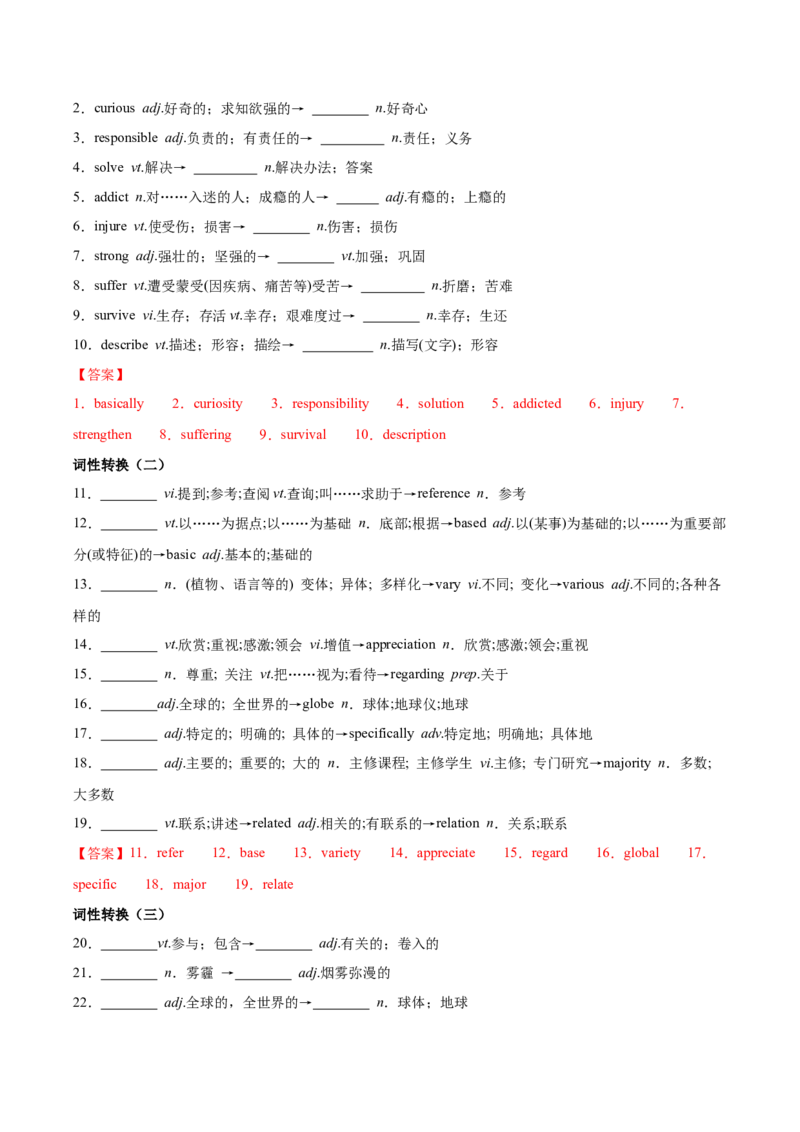
1. if possible 如果可能的话
2. date back (to ...)追溯到
3. at the beginning起初
4. ups and downs 浮沉;兴衰;荣辱
5. have trouble/difficulty with有……困难
6. be connected with与……连接
7. be of great importance (=very important)十分重要
8. point of view观点;看法
9. depend on 依靠;依赖;取决于
10. relate to 与……相关;涉及;谈到
11. refer to 指的是;描述;提到;查阅
句式
1.There are many reasons why this has been possible,but one of the main factors has been the Chinese writing
system.这之所以成为可能有很多原因,其中一个主要因素就是中国书法体系。
2.Over the years,the system developed into different forms,as it was a time when people were divided
geographically,leading to many varieties of dialects and characters.多年来,人们按地域划分,使得书法体系
发展成了不同的形式,从而导致多种方言和汉字的形成。
3.Even today,no matter where Chinese people live or what dialect they speak,they can all still communicate in
writing.即使在今天,不论住在哪里,也不论说何种方言,中国人都仍能通过书写(文字)进行交流。
4.I used to get high marks in English,but now I’m having a lot of trouble with my listening.
过去我英语成绩很好,但现在我在听力方面有很多困难。
5.I also repeat what I hear to help myself to experience the feeling of the language.
为了帮助自己体会语言的情感,我也重复自己听到的内容。
教材话题题型综合训练
词性转换(一)
1.basic adj. 基本的 → adv.基本地2.curious adj.好奇的;求知欲强的→ n.好奇心
3.responsible adj.负责的;有责任的→ n.责任;义务
4.solve vt.解决→ n.解决办法;答案
5.addict n.对……入迷的人;成瘾的人→ adj.有瘾的;上瘾的
6.injure vt.使受伤;损害→ n.伤害;损伤
7.strong adj.强壮的;坚强的→ vt.加强;巩固
8.suffer vt.遭受蒙受(因疾病、痛苦等)受苦→ n.折磨;苦难
9.survive vi.生存;存活vt.幸存;艰难度过→ n.幸存;生还
10.describe vt.描述;形容;描绘→ n.描写(文字);形容
【答案】
1.basically 2.curiosity 3.responsibility 4.solution 5.addicted 6.injury 7.
strengthen 8.suffering 9.survival 10.description
词性转换(二)
11. vi.提到;参考;查阅vt.查询;叫……求助于→reference n.参考
12. vt.以……为据点;以……为基础 n.底部;根据→based adj.以(某事)为基础的;以……为重要部
分(或特征)的→basic adj.基本的;基础的
13. n.(植物、语言等的) 变体; 异体; 多样化→vary vi.不同; 变化→various adj.不同的;各种各
样的
14. vt.欣赏;重视;感激;领会 vi.增值→appreciation n.欣赏;感激;领会;重视
15. n.尊重; 关注 vt.把……视为;看待→regarding prep.关于
16. adj.全球的; 全世界的→globe n.球体;地球仪;地球
17. adj.特定的; 明确的; 具体的→specifically adv.特定地; 明确地; 具体地
18. adj.主要的; 重要的; 大的 n.主修课程; 主修学生 vi.主修; 专门研究→majority n.多数;
大多数
19. vt.联系;讲述→related adj.相关的;有联系的→relation n.关系;联系
【答案】11.refer 12.base 13.variety 14.appreciate 15.regard 16.global 17.
specific 18.major 19.relate
词性转换(三)
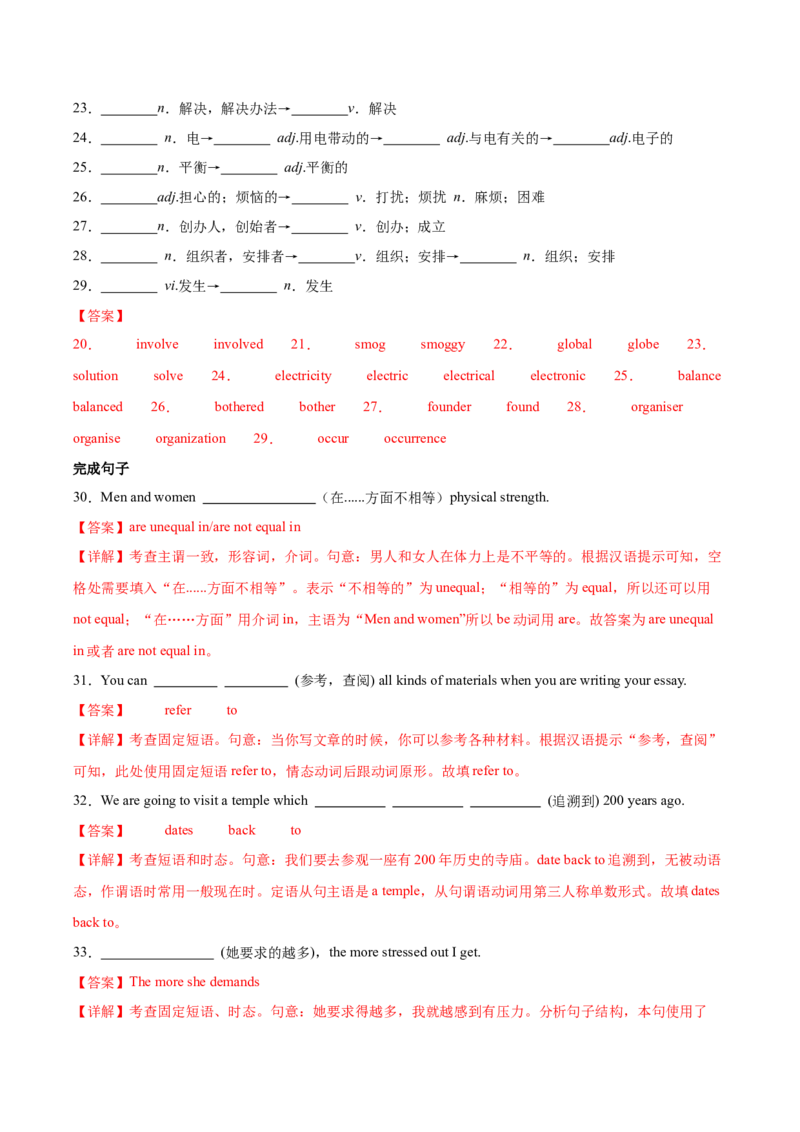
20. vt.参与;包含→ adj.有关的;卷入的
21. n.雾霾 → adj.烟雾弥漫的
22. adj.全球的,全世界的→ n.球体;地球23. n.解决,解决办法→ v.解决
24. n.电→ adj.用电带动的→ adj.与电有关的→ adj.电子的
25. n.平衡→ adj.平衡的
26. adj.担心的;烦恼的→ v.打扰;烦扰 n.麻烦;困难
27. n.创办人,创始者→ v.创办;成立
28. n.组织者,安排者→ v.组织;安排→ n.组织;安排
29. vi.发生→ n.发生
【答案】
20. involve involved 21. smog smoggy 22. global globe 23.
solution solve 24. electricity electric electrical electronic 25. balance
balanced 26. bothered bother 27. founder found 28. organiser
organise organization 29. occur occurrence
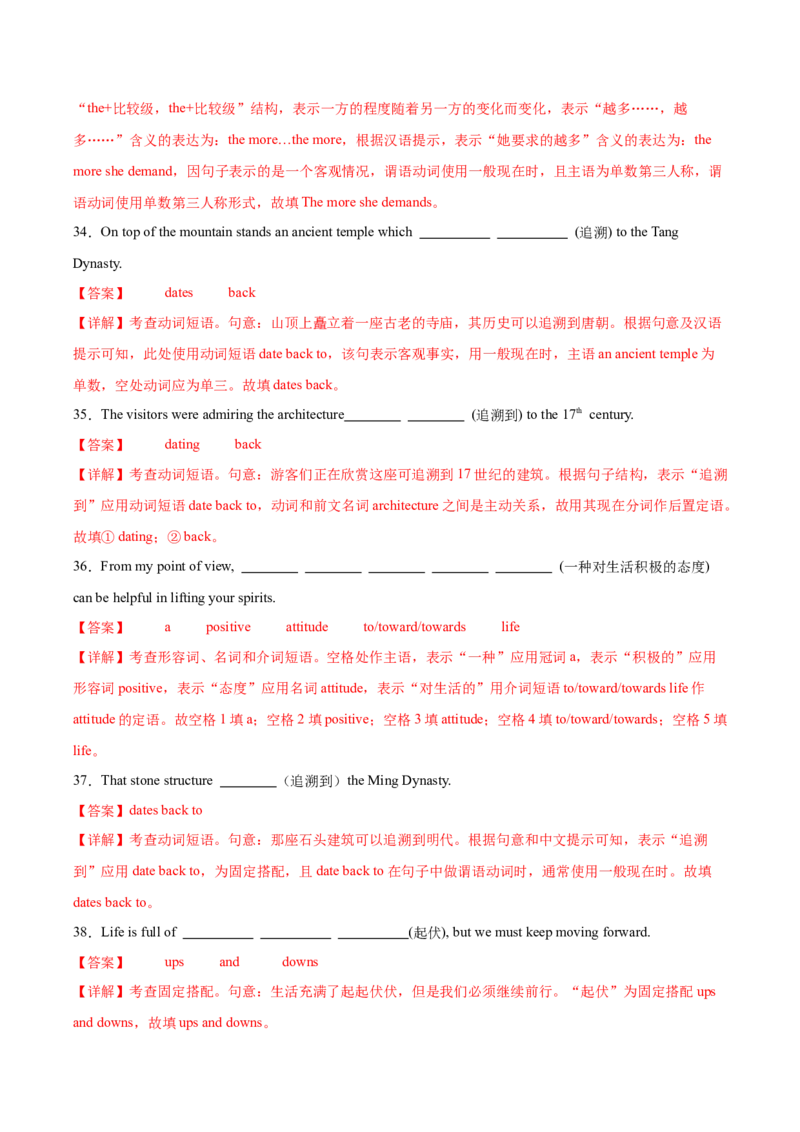
完成句子
30.Men and women (在......方面不相等)physical strength.
【答案】are unequal in/are not equal in
【详解】考查主谓一致,形容词,介词。句意:男人和女人在体力上是不平等的。根据汉语提示可知,空
格处需要填入“在......方面不相等”。表示“不相等的”为unequal;“相等的”为equal,所以还可以用
not equal;“在……方面”用介词in,主语为“Men and women”所以be动词用are。故答案为are unequal
in或者are not equal in。
31.You can (参考,查阅) all kinds of materials when you are writing your essay.
【答案】 refer to
【详解】考查固定短语。句意:当你写文章的时候,你可以参考各种材料。根据汉语提示“参考,查阅”
可知,此处使用固定短语refer to,情态动词后跟动词原形。故填refer to。
32.We are going to visit a temple which (追溯到) 200 years ago.
【答案】 dates back to
【详解】考查短语和时态。句意:我们要去参观一座有200年历史的寺庙。date back to追溯到,无被动语
态,作谓语时常用一般现在时。定语从句主语是a temple,从句谓语动词用第三人称单数形式。故填dates
back to。
33. (她要求的越多),the more stressed out I get.
【答案】The more she demands
【详解】考查固定短语、时态。句意:她要求得越多,我就越感到有压力。分析句子结构,本句使用了“the+比较级,the+比较级”结构,表示一方的程度随着另一方的变化而变化,表示“越多……,越
多……”含义的表达为:the more…the more,根据汉语提示,表示“她要求的越多”含义的表达为:the
more she demand,因句子表示的是一个客观情况,谓语动词使用一般现在时,且主语为单数第三人称,谓
语动词使用单数第三人称形式,故填The more she demands。
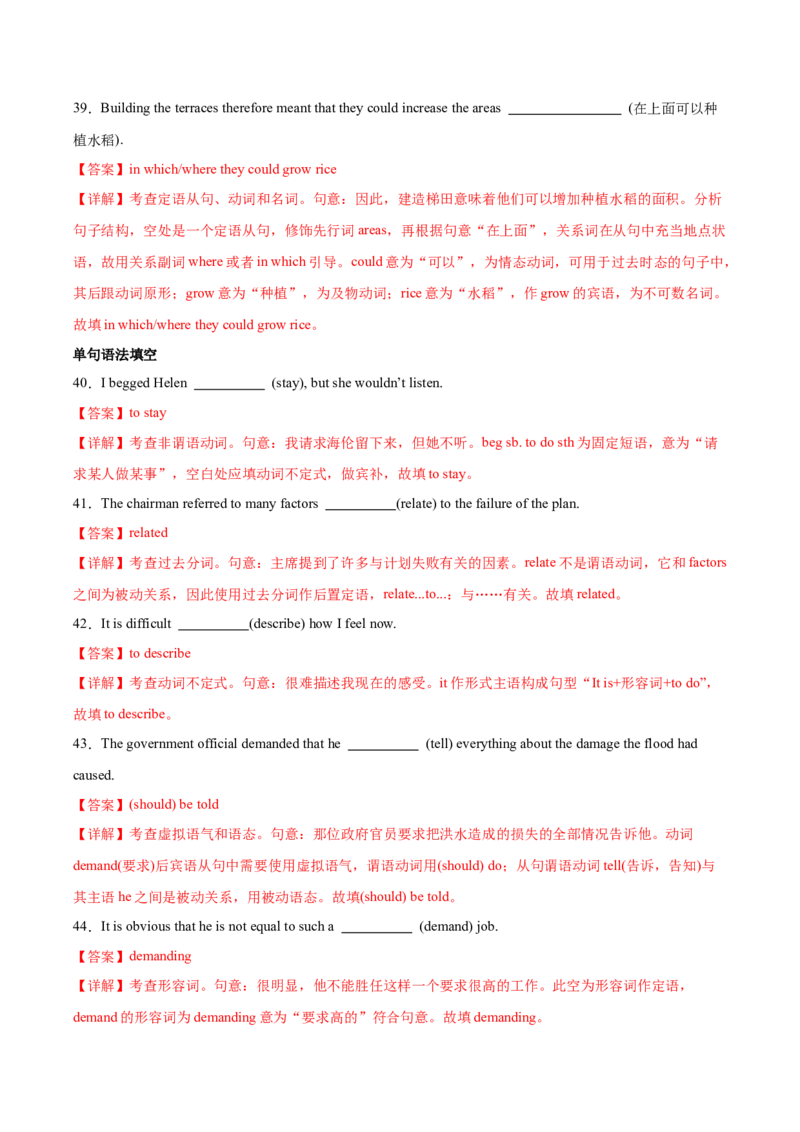
34.On top of the mountain stands an ancient temple which (追溯) to the Tang
Dynasty.
【答案】 dates back
【详解】考查动词短语。句意:山顶上矗立着一座古老的寺庙,其历史可以追溯到唐朝。根据句意及汉语
提示可知,此处使用动词短语date back to,该句表示客观事实,用一般现在时,主语an ancient temple为
单数,空处动词应为单三。故填dates back。
35.The visitors were admiring the architecture (追溯到) to the 17th century.
【答案】 dating back
【详解】考查动词短语。句意:游客们正在欣赏这座可追溯到17世纪的建筑。根据句子结构,表示“追溯
到”应用动词短语date back to,动词和前文名词architecture之间是主动关系,故用其现在分词作后置定语。
故填①dating;②back。
36.From my point of view, (一种对生活积极的态度)
can be helpful in lifting your spirits.
【答案】 a positive attitude to/toward/towards life
【详解】考查形容词、名词和介词短语。空格处作主语,表示“一种”应用冠词a,表示“积极的”应用
形容词positive,表示“态度”应用名词attitude,表示“对生活的”用介词短语to/toward/towards life作
attitude的定语。故空格1填a;空格2填positive;空格3填attitude;空格4填to/toward/towards;空格5填
life。
37.That stone structure (追溯到)the Ming Dynasty.
【答案】dates back to
【详解】考查动词短语。句意:那座石头建筑可以追溯到明代。根据句意和中文提示可知,表示“追溯
到”应用date back to,为固定搭配,且date back to在句子中做谓语动词时,通常使用一般现在时。故填
dates back to。
38.Life is full of (起伏), but we must keep moving forward.
【答案】 ups and downs
【详解】考查固定搭配。句意:生活充满了起起伏伏,但是我们必须继续前行。“起伏”为固定搭配ups
and downs,故填ups and downs。39.Building the terraces therefore meant that they could increase the areas (在上面可以种
植水稻).
【答案】in which/where they could grow rice
【详解】考查定语从句、动词和名词。句意:因此,建造梯田意味着他们可以增加种植水稻的面积。分析
句子结构,空处是一个定语从句,修饰先行词areas,再根据句意“在上面”,关系词在从句中充当地点状
语,故用关系副词where或者in which引导。could意为“可以”,为情态动词,可用于过去时态的句子中,
其后跟动词原形;grow意为“种植”,为及物动词;rice意为“水稻”,作grow的宾语,为不可数名词。
故填in which/where they could grow rice。
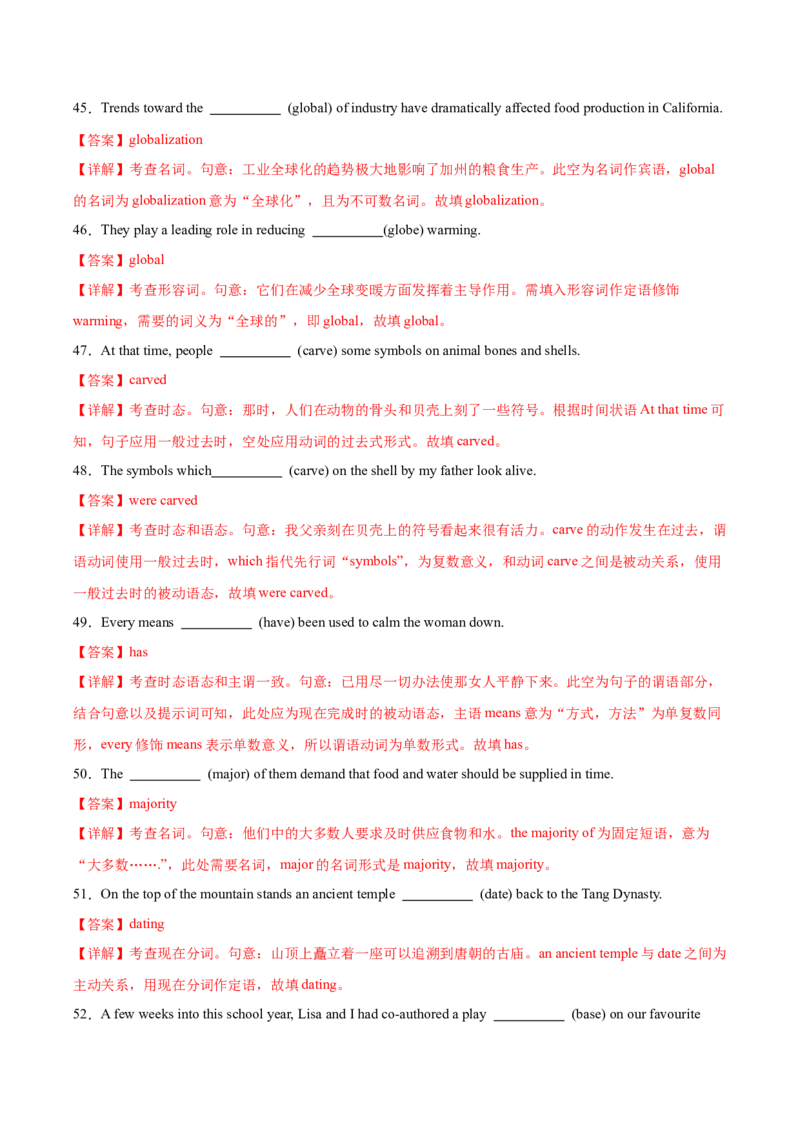
单句语法填空
40.I begged Helen (stay), but she wouldn’t listen.
【答案】to stay
【详解】考查非谓语动词。句意:我请求海伦留下来,但她不听。beg sb. to do sth为固定短语,意为“请
求某人做某事”,空白处应填动词不定式,做宾补,故填to stay。
41.The chairman referred to many factors (relate) to the failure of the plan.
【答案】related
【详解】考查过去分词。句意:主席提到了许多与计划失败有关的因素。relate不是谓语动词,它和factors
之间为被动关系,因此使用过去分词作后置定语,relate...to...:与……有关。故填related。
42.It is difficult (describe) how I feel now.
【答案】to describe
【详解】考查动词不定式。句意:很难描述我现在的感受。it作形式主语构成句型“It is+形容词+to do”,
故填to describe。
43.The government official demanded that he (tell) everything about the damage the flood had
caused.
【答案】(should) be told
【详解】考查虚拟语气和语态。句意:那位政府官员要求把洪水造成的损失的全部情况告诉他。动词
demand(要求)后宾语从句中需要使用虚拟语气,谓语动词用(should) do;从句谓语动词tell(告诉,告知)与
其主语he之间是被动关系,用被动语态。故填(should) be told。
44.It is obvious that he is not equal to such a (demand) job.
【答案】demanding
【详解】考查形容词。句意:很明显,他不能胜任这样一个要求很高的工作。此空为形容词作定语,
demand的形容词为demanding意为“要求高的”符合句意。故填demanding。45.Trends toward the (global) of industry have dramatically affected food production in California.
【答案】globalization
【详解】考查名词。句意:工业全球化的趋势极大地影响了加州的粮食生产。此空为名词作宾语,global
的名词为globalization意为“全球化”,且为不可数名词。故填globalization。
46.They play a leading role in reducing (globe) warming.
【答案】global
【详解】考查形容词。句意:它们在减少全球变暖方面发挥着主导作用。需填入形容词作定语修饰
warming,需要的词义为“全球的”,即global,故填global。
47.At that time, people (carve) some symbols on animal bones and shells.
【答案】carved
【详解】考查时态。句意:那时,人们在动物的骨头和贝壳上刻了一些符号。根据时间状语At that time可
知,句子应用一般过去时,空处应用动词的过去式形式。故填carved。
48.The symbols which (carve) on the shell by my father look alive.
【答案】were carved
【详解】考查时态和语态。句意:我父亲刻在贝壳上的符号看起来很有活力。carve的动作发生在过去,谓
语动词使用一般过去时,which指代先行词“symbols”,为复数意义,和动词carve之间是被动关系,使用
一般过去时的被动语态,故填were carved。
49.Every means (have) been used to calm the woman down.
【答案】has
【详解】考查时态语态和主谓一致。句意:已用尽一切办法使那女人平静下来。此空为句子的谓语部分,
结合句意以及提示词可知,此处应为现在完成时的被动语态,主语means意为“方式,方法”为单复数同
形,every修饰means表示单数意义,所以谓语动词为单数形式。故填has。
50.The (major) of them demand that food and water should be supplied in time.
【答案】majority
【详解】考查名词。句意:他们中的大多数人要求及时供应食物和水。the majority of为固定短语,意为
“大多数…….”,此处需要名词,major的名词形式是majority,故填majority。
51.On the top of the mountain stands an ancient temple (date) back to the Tang Dynasty.
【答案】dating
【详解】考查现在分词。句意:山顶上矗立着一座可以追溯到唐朝的古庙。an ancient temple与date之间为
主动关系,用现在分词作定语,故填dating。
52.A few weeks into this school year, Lisa and I had co-authored a play (base) on our favouritenovel, Little Women.
【答案】based
【详解】考查非谓语动词。句意:开学几周后,丽莎和我合写了一部以我们最喜欢的小说《小妇人》为基
础的剧本。根据句子的谓语动词“had co-authored”可知,空处应用非谓语形式作后置定语,修饰名词
“play”,play与base之间为逻辑上的被动关系,应用过去分词形式based,“based on”是一个常见短语,
表示“基于;以……为根据”。故填based。
53. (base) on their demands, the government has taken effective measures.
【答案】Based
【详解】考查非谓语动词。句意:根据他们的要求,政府采取了有效措施。be based on“以……为依据”,
为固定短语,使用过去分词作状语。故填Based。
语篇填空
“I wish you good health, happiness and longevity!” The allegro (快板) in the Chinese language resounded in
a hall at Prince Sultan University, during a cultural event to celebrate the Chinese New Year.
54 (crowd) with enthusiastic visitors, the event held on Monday afternoon showed the rich
traditions of the Chinese festival, 55 fell on February 10 this year.
Abdullah Hazmi, a student who is studying the Chinese Proficiency Test (HSK) Level 2, expressed his 56
(admire) for the experience of tasting traditional Chinese foods and learning about the art of Chinese tea. He said
that his encounter with the Spring Festival’s customs inspired a 57 (deep) interest in Chinese culture than
ever, 58 (lead) him to learn more about the Chinese language.
Faisal Islam, who 59 (recent) has began his Chinese learning journey, shared how brush writing
sparked his interest in the beauty of Chinese 60 (character) and the charm of Chinese culture. The event
also featured traditional Spring Festival scrolls (卷轴), penned by students from China’s Tsinghua University.
These volunteers presented plenty 61 cultural performances, including traditional Chinese dragon dances
and tai chi.
Zhang Xinying, the Chinese dean of the Confucius Institute at Prince Sultan University, said, “It is not only a
Spring Festival celebration, but a grand event to bring Chinese culture into the campus, fostering deeper Sino-Saudi
cultural exchanges.”
The Confucius Institute has witnessed 62 growing interest in Chinese language and culture since
its opening on June 4, 2023, with nearly 100 students 63 (include) in five classes to learn junior- and
medium-level Chinese language.
【答案】54.Crowded 55.which 56.admiration 57.deeper 58.leading 59.recently 60.
characters 61.of 62.a 63.included
【导语】本文是一篇说明文。文章主要介绍了中国文化在外国友人中开始流行。
54.考查非谓语动词。句意:周一下午举行的活动中挤满了热情的游客,展示了今年2月10日举行的中国
节日的丰富传统。这句话的主语是the event,谓语是showed,crowd在这里作非谓语,和主语之间是被动
关系,应用过去分词 crowded,放在句子开头,首字母要大写,故填Crowded。
55.考查非限制性定语从句。句意:周一下午举行的活动中挤满了热情的游客,展示了今年2月10日举行
的中国节日的丰富传统。设空处引导的是非限制性定语从句,先行词是the event,指物,关系词作从句的
主语,应用关系代词which引导,故填which。
56.考查名词。句意:Abdullah Hazmi,一名正在学习中国水平测试(HSK)二级的学生,表达了他对品
尝中国传统食物和学习中国茶艺术的经验的钦佩。根据空前的his可知,此处要用名词admiration“钦佩”,
不可数名词,作宾语。故填admiration。
57.考查形容词比较级。句意:他说,他与春节习俗的接触激发了他比以往更深的中国文化兴趣,使他了
解了更多的汉语。根据本句中的than ever可知,此处要用deep的比较级deeper。故填deeper。
58.考查非谓语动词。句意:他说,他与春节习俗的接触激发了他比以往更深的中国文化兴趣,使他了解
了更多的汉语。这句话的谓语动词是inspired,lead在这个句子中作非谓语,根据句意设空处作的是结果状
语,并且是意料之中的结果,应用现在分词,作结果状语。故填leading。
59.考查副词。句意:Faisal Islam最近开始了他的汉语学习之旅,他分享了毛笔写作是如何激发他对汉字
之美和中国文化魅力的兴趣的。此处修饰整个句子,应用副词recently“最近”,作状语。故填recently。
60.考查名词复数。句意:Faisal Islam最近开始了他的汉语学习之旅,他分享了毛笔写作是如何激发他对
汉字之美和中国文化魅力的兴趣的。根据空前的Chinese可知,此处要填名词character“文字”,且
character为可数名词,前无限定词,应用复数形式,表泛指。故填characters。
61.考查介词。句意:这些志愿者进行了大量的文化表演,包括中国传统龙舟和太极。根据空前的plenty
可知,此处填介词of,plenty of“大量的”。故填of。
62.考查冠词。句意:自2023年6月4日孔子学院开课以来,人们对汉语和中国文化的兴趣日益浓厚,近
100名学生被分在5个班学习初、中级汉语。根据空后的名词interest可知,此处泛指“一种兴趣”,应用
不定冠词,且growing是辅音音素开头,应用不定冠词a。故填a。
63.考查非谓语动词。句意:自2023年6月4日孔子学院开课以来,人们对汉语和中国文化的兴趣日益浓
厚,近100名学生被分在5个班学习初、中级汉语。此处用的是with+宾语+宾语补足语,宾语是students,
include和宾语之间是被动关系,应用过去分词,作宾语补足语。故填included。阅读理解
When I mentioned to some friends that we all have accents, most of them proudly replied, “Well, I speak
perfect English/Chinese/etc.” But this kind of answer misses the point.
More often than not, what we mean when we say someone “has an accent” is that their accent is different
from the local one, or that pronunciations are different from our own. But this definition of accents is limiting and
could give rise to prejudice (偏见). Funnily enough, in terms of the language study, every person speaks with an
accent. It is the regular differences in how we produce sounds that define our accents. Even if you don’t hear it
yourself, you speak with some sort of accent. In this sense, it’s pointless to point out that someone “has an accent”.
We all do!
Every person speaks a dialect, too. In the field of language study, a dialect is a version of a language that is
characterized by its variations of structure, phrases and words. For instance, “You got eat or not?” (meaning “Have
you eaten?”) is an acceptable and understood question in Singapore Oral English. The fact that this expression
would cause a standard American English speaker to take pause doesn’t mean that Singapore Oral English is
“wrong” or “ungrammatical”. The sentence is well-formed and clearly communicative, according to native
Singapore English speakers’ solid system of grammar. Why should it be wrong just because it’s different?
We need to move beyond a narrow conception of accent s and dialects — for the benefit of everyone.
Language differences like these provide insights into people’s cultural experiences and backgrounds. In a global
age, the way one speaks is a distinct part of one’s identity. Most people would be happy to talk about the cultures
behind their speech. We’d learn more about the world we live in and make friends along the way.
64.What does the author think of his/her friends’ response in paragraph 1?
A.It misses the real meaning of accents. B.It reflects their language levels.
C.It misses the point of communication. D.It reflects their self confidence.
65.Why does the author use the example of Singapore Oral English?
A.To correct a grammatical mistake. B.To show the diversity of dialects.
C.To show the use of dialects is reasonable. D.To bring in a traditional approach.
66.What does the author recommend us to do in the last paragraph?
A.Learn to speak with your local dialect. B.Seek for an official definition of accents.
C.Appreciate the value of accents and dialects. D.Tell our local languages from others’.
67.What can be a suitable title for this passage?
A.Accents Represent Our Identities B.Everyone Has an Accent
C.Dialects Lead to Misunderstanding D.Standard English Is at Risk【答案】64.A 65.C 66.C 67.B
【导语】本文是一篇议论文,主要论述了每个人都有口音。从这个意义上说,指出某人“有口音”是毫无
意义的。语言差异可以帮助人们洞察他人的文化经历和背景,因此我们要欣赏口音和方言的价值。
64.推理判断题。根据文章第一段“When I mentioned to some friends that we all have accents, most of them
proudly replied, “Well, I speak perfect English/Chinese/etc.” But this kind of answer misses the point.(当我向一些
朋友提到我们都有口音时,他们中的大多数人自豪地回答说:“嗯,我的英语/汉语/等等都说得很好。”
但这种回答没有抓住要点。)”可知,作者认为他/她的朋友忽略了口音的真正含义。故选A。
65.推理判断题。根据第三段“The sentence is well-formed and clearly communicative, according to native
Singapore English speakers’ solid system of grammar. Why should it be wrong just because it’s different?(根据新
加坡英语母语者扎实的语法体系,句子结构良好,交际清晰。为什么仅仅因为不同就应该是错的呢?)”可
知,作者认为不能因为它不同就认为它是错的。所以作者使用新加坡口语的例子是在说明方言的使用是合
理的。故选C。
66.细节理解题。根据最后一段“Language differences like these provide insights into people’s cultural
experiences and backgrounds. In a global age, the way one speaks is a distinct part of one’s identity. Most people
would be happy to talk about the cultures behind their speech. We’d learn more about the world we live in and
make friends along the way.(像这样的语言差异提供了对人们的文化经历和背景的见解。在全球化时代,一
个人说话的方式是一个人身份的一个独特部分。大多数人都乐于谈论他们讲话背后的文化。我们会更多地
了解我们生活的世界,并在此过程中结交朋友。)”可知,作者在最后一段中建议我们欣赏口音和方言的价
值,这样我们可以更好了解我们的世界,交更多的朋友。故选C。
67.主旨大意题。通读全文,尤其是第二段“Funnily enough, in terms of the language study, every person
speaks with an accent. It is the regular differences in how we produce sounds that define our accents. Even if you
don’t hear it yourself, you speak with some sort of accent. In this sense, it’s pointless to point out that someone “has
an accent”. We all do!(有趣的是,就语言学习而言,每个人说话都带有口音。我们发音的规律差异决定了我
们的口音。即使你自己没有听到,你说话也带有某种口音。从这个意义上说,指出某人“有口音”是没有
意义的。我们都有!)”可知,本段主要讲的是每个人都有口音。从这个意义上说,指出某人“有口音”是
毫无意义的,因此最恰当的题目是B选项“Everyone Has an Accent(每个人都有口音)”。故选B。
七选五
Social media, when approached the right way, can be just as valuable for practicing a new language as TV
shows, books or any other form of media. 68 .
Be a focused followerThe best way to get started in your language learning via social media adventure is by following a number of
accounts in your target language. But it would be helpful to have a clear goal in mind first. 69 . Whether
you’re interested in sports, travel or any other topics, there’s an account for that.
70
Once you’ve chosen some accounts to follow, you should not stop there. 71 . This means reading
posts, watching videos. You may set a target for yourself, like reading five posts every day. It’s important to make
this a habit if you really want to use social media for language learning effectively.
Be a positive contributor
When you’ve followed the accounts you want to follow and have made a habit of engaging with them, you
can consider taking your use of social media for language learning to the next level. For example, you can set up
your own account. 72 .
A.Be an active user
B.Be a patient helper
C.Then you can try to post in the target language
D.Instead, you have to make daily use of the accounts
E.Here are some accounts we’ve put together for you to follow
F.In this article, you’ll find a few tips on how to use social media for language study
G.For example, if you want to learn food vocabulary, you may follow a cooking account
【答案】68.F 69.G 70.A 71.D 72.C
【导语】本文是一篇说明文,介绍了如何通过社交媒体学习语言的几点建议。
68.根据上文“Social media, when approached the right way, can be just as valuable for practicing a new
language as TV shows, books or any other form of media. (当使用得当,社交媒体对于练习一门新语言来说,
和电视节目、书籍或任何其他形式的媒体一样有价值。)”以及下文具体的建议可知,此处需要一个承上启
下的过渡句,引出“如何通过社交媒体学习语言”这一话题,F 选项“In this article, you’ll find a few tips
on how to use social media for language study (在这篇文章中,你会发现一些关于如何使用社交媒体学习语言
的建议)”符合语境,故选 F。
69.根据上文“But it would be helpful to have a clear goal in mind first. (但首先有一个明确的目标会很有帮
助。)”以及下文“Whether you’re interested in sports, travel or any other topics, there’s an account for that. (无论
你对体育、旅游或其他任何话题感兴趣,都有一个账号可以关注。)”可知,此处举例说明如何设定目标,
G 选项“For example, if you want to learn food vocabulary, you may follow a cooking account (例如,如果你想
学习食物词汇,你可以关注一个烹饪账号)”符合语境,故选 G。70.根据下文“Once you’ve chosen some accounts to follow, you should not stop there. (一旦你选择了一些要
关注的账号,你就不应该就此打住。)”以及下文具体的做法可知,此处应该是说要积极使用社交媒体,A
选项“Be an active user (做一个积极的用户)”符合语境,故选 A。
71.根据上文“Once you’ve chosen some accounts to follow, you should not stop there. (一旦你选择了一些要
关注的账号,你就不应该就此打住。)”以及下文“You may set a target for yourself, like reading five posts
every day. (你可以为自己设定一个目标,比如每天阅读五篇文章。)”可知,此处应该是说要经常使用社交
媒体,D 选项“Instead, you have to make daily use of the accounts (相反,你必须每天使用这些账号)”符合语
境,故选 D。
72.根据上文“For example, you can set up your own account. (例如,你可以建立自己的账号。)”可推理出,
下文应该是说建立自己的账户之后该怎么做,C 选项“Then you can try to post in the target language (然后你
可以试着用目标语言发帖)”符合语境,故选 C。
完形填空
I am often asked how I learned to speak Chinese fluently. 73 , as a native English speaker, learning to
speak in tones was the 74 part about learning Chinese for me. To 75 the tones, I lived in Shanghai
for 6 months. Once I wanted to buy a 76 for my mother. Unluckily, the words for “horse” and “mother” are
only differentiated by a 77 tone. When I told the store clerk I wanted to buy a gift for my“horse”, she
looked at me like I had lost my 78 . In the end, she 79 what I was trying to say, but it was a bit of a
struggle. After that, I learned the 80 between the two tones.
After returning to England, I bought a web camera and found myself a language 81 by going to
ichinese.com, where I met a native speaker willing to help me learn Chinese. Together, we 82 speaking
Chinese for a few hours per week. 83 , I not only mastered my tones but learned to speak more 84 ,
just like a native speaker.
In my 85 , when studying Chinese in an English-speaking environment, my classmates and I often
made a 86 of the tones when speaking to one another. In fact, in a Chinese-speaking environment, the 87
interaction is of great importance for fluency, and it separates the amateurs (业余爱好者) from the experts.
73.A.Hopefully B.Actually C.Surprisingly D.Similarly
74.A.main B.best C.basic D.hardest
75.A.learn B.match C.lower D.record
76.A.horse B.camera C.gift D.dictionary
77.A.soft B.formal C.single D.pleasant78.A.mind B.balance C.interest D.confidence
79.A.agreed with B.worked out C.focused on D.brought up
80.A.clue B.difference C.issue D.importance
81.A.test B.learner C.magazine D.partner
82.A.suggested B.considered C.practiced D.avoided
83.A.As a rule B.At times C.As a result D.At first
84.A.fluently B.openly C.meaningfully D.slowly
85.A.heart B.dream C.power D.experience
86.A.list B.mess C.habit D.collection
87.A.back-to-back B.eye-to-eye C.knee-to-knee D.face-to-face
【答案】
73.B 74.D 75.A 76.C 77.C 78.A 79.B 80.B 81.D 82.C
83.C 84.A 85.D 86.B 87.D
【导语】这是一篇记叙文。文章主要讲述了作者学习中文的经历,作者认为学习中文最难的部分是区分音
调,为此还发生了一个小误会。
73.考查副词词义辨析。句意:事实上,作为一个以英语为母语的人,对我来说学习汉语最难的部分是学
会说话的声调。A. Hopefully有希望地;B. Actually实际上;C. Surprisingly惊人地;D. Similarly类似地。
根据上文“I am often asked how I learned to speak Chinese fluently.”以及后文“about learning Chinese for me”
可知,作者虽然如今汉语说得很流利了,但是实际上也遇到过困难。故选B。
74.考查形容词词义辨析。句意:事实上,作为一个以英语为母语的人,对我来说学习汉语最难的部分是
学会说话的声调。A. main主要的;B. best最好的;C. basic基本的;D. hardest最难的。根据后文“part
about learning Chinese for me”以及作者去商店买礼物,因为音调不同导致了误解,可知作者学习汉语最难
的部分是学会说话的声调。故选D。
75.考查动词词义辨析。句意:为了学习这些声调,我在上海住了6个月。A. learn学习;B. match匹配;
C. lower降低;D. record记录。根据后文“the tones, I lived in Shanghai for 6 months”可知,作者去上海是为
了学习声调。故选A。
76.考查名词词义辨析。句意:有一次,我想给妈妈买一件礼物。A. horse马;B. camera照相机;C. gift
礼物;D. dictionary字典。根据后文“I wanted to buy a gift for my “horse””可知,作者想要母亲买礼物。故
选C。
77.考查形容词词义辨析。句意:不幸的是,“马”和“妈”这两个词只有一个音调的区别。A. soft柔软
的;B. formal正式的;C. single单个的;D. pleasant愉快的。根据上文““horse” and “mother””以及常识,这两个词只有一个音调的区别。故选C。
78.考查名词词义辨析。句意:当我告诉店员我想给我的“马”买礼物时,她看着我,好像我疯了一样。
A. mind思维;B. balance平衡;C. interest兴趣;D. confidence自信。根据上文“I wanted to buy a gift for
my “horse””可知,店员听到作者要给“马”买礼物,以为作者疯了,此处为短语lose one’s mind表示“失
去理智”。故选A。
79.考查动词短语辨析。句意:最后,她明白了我想说的话,但这有点困难。A. agreed with同意;B.
worked out理解,想出;C. focused on集中;D. brought up抚养。根据后文“what I was trying to say, but it
was a bit of a struggle”可知,店员最后理解了作者的话,故选B。
80.考查名词词义辨析。句意:在那之后,我学会了这两种音调的区别。A. clue线索;B. difference不同,
区别;C. issue问题;D. importance重要性。根据上文““horse” and “mother” are only differentiated by a”可
知,经过这件事,作者学会了这两种音调的区别。故选B。
81.考查名词词义辨析。句意:回到英国后,我买了一个网络摄像头,并在icchinese.com上找到了一个语
言伙伴,在那里我遇到了一个愿意帮助我学习汉语的母语人士。A. test测试;B. learner学习者;C.
magazine杂志;D. partner伙伴。根据后文“where I met a native speaker willing to help me learn Chinese”指
作者在网上找到了一个语言伙伴,故选D。
82.考查动词词义辨析。句意:我们每周一起练习说几个小时的中文。A. suggested建议;B. considered考
虑;C. practiced练习;D. avoided避免。根据上文“where I met a native speaker willing to help me learn
Chinese”可知,找语言伙伴的目的就是练习中文,他们每周一起练习说几个小时的中文。故选C。
83.考查介词短语辨析。句意:结果,我不仅掌握了我的音调,而且学会了更流利地说话,就像一个母语
人士一样。A. As a rule通常;B. At times有时候;C. As a result因此,结果;D. At first首先。上文提到他
们每周一起练习说几个小时的中文,结果就是作者的中文说得流利起来。故选C。
84.考查副词词义辨析。句意:结果,我不仅掌握了我的音调,而且学会了更流利地说话,就像一个母语
人士一样。A. fluently流利地;B. openly公开地;C. meaningfully有意义地;D. slowly缓慢地。根据后文
“just like a native speaker”可知,作者的中文说得流利了,像一个母语人士一样。故选A。
85.考查名词词义辨析。句意:根据我的经验,当我在一个说英语的环境中学习中文时,我和我的同学在
彼此说话时经常弄混音调。A. heart心;B. dream梦想;C. power力量;D. experience经验。后文提到“当
我在一个说英语的环境中学习中文时,我和我的同学在彼此说话时经常弄混音调”,这是作者学习中文以
后得出的经验之谈。故选D。
86.考查名词词义辨析。句意:根据我的经验,当我在一个说英语的环境中学习中文时,我和我的同学在
彼此说话时经常弄混音调。A. list清单;B. mess混乱;C. habit习惯;D. collection收集。根据上文“in anEnglish-speaking environment”可知,在一个说英语的环境中学习中文,因为大家的母语都是英语,所以作
者和同学在彼此说话时经常弄混音调。故选B。
87.考查形容词词义辨析。句意:事实上,在说中文的环境中,面对面的交流对流利来说是非常重要的,
它把业余爱好者和专家区分开来。A. back-to-back背靠背的;B. eye-to-eye对视的;C. knee-to-knee跪坐的;
D. face-to-face面对面的。根据上文“in a Chinese-speaking environment”可知,在说中文的环境中,都是说
中文的人,因此是面对面的交流,对比上文提到的说英语的环境中学习中文,身边都是说英语的人。故选
D。
读后续写
阅读下面材料,根据其内容和所给段落开头语续写两段,使之构成一个完整的短文。
I'm an English self-learner. English is not my first language. Today I’m an English teacher. I like to voice
that failures are not disasters. Have faith, keep moving on and never give up. You will see your hard work pay off.
I was a slow learner when I was little. Before five, I couldn't even speak in full sentences like most other
children. I sound interacted with others. I neither cry nor go, nor got angry. My extreme quietness made my parents
wonder if I was mentally slow. But they were not sure. Actually, I have to admit that my memories of my early
childhood are quite uncertain.
When I was in elementary school, I learned very slowly and was as quiet as a doll. While my teacher was
teaching, my mind often would wander outside of the classroom to the playground. The learning problems and
inactive personality remained with me until I was in Grade 5. As a fifth grader, I finally started interacting with my
classmates. That was the first time in my memory that I had some friends. Most amazingly, from that time on, I
became talkative, laughing and playing like any normal child.
After heading full speed for my junior education, my learning situation got stuck in the mud again. In my
country, students were arranged into different levels of classes based on their IQ test scores. For example, students
with higher IQ scores were placed in the “outstanding class”; average ones joined the “intermediate class”, and
slower students were destined for the “bottom class”. I was placed in the “bottom class” as a result of my below
average IQ score. Most of my teachers taught us using easy and slow methods because they considered us unable to
learn much. Despite that, I never lost faith that I might one day succeed. As if to prove that when God closes a door,
he will definitely open up a big window, a miracle occurred. That's when I discovered a strong passion for English.
注意:1.续写词数应为 150 左右;
2.请按如下格式在答题卡的相应位置作答,
Paragraph 1: At the age of 13, I found myself deeply interested in English.____________________________________________________________________________________________
____________________________________________________________________________________________
____________________________________________________________________________________________
____________________________________________________________________________________________
____________________________________________________________________________________________
Paragraph 2: That way, I could further expand my vocabulary.
____________________________________________________________________________________________
____________________________________________________________________________________________
____________________________________________________________________________________________
____________________________________________________________________________________________
____________________________________________________________________________________________
【答案】At the age of 13, I found myself deeply interested in English. It was the movie called Roman Holiday
that attracted my attention. From then on, I watched English movies from time to time. While watching, I followed
the pronunciation, stress and intonation of speakers, which was my great pleasure. I also tried to communicate with
my teachers and classmates in English. Even if they would make fun of me, I didn’t mind. To my surprise, I was
transferred from the bottom class to the top due to my progress, which was a miracle. To enlarge my vocabulary, I
read as many stories and articles as possible.
That way, I could further expand my vocabulary. I continued to self-learn English step by step. I even
tried to write English diaries and rewrite some famous stories, one of which was published in our school
newspaper. With these achievements, I had more faith in myself. Therefore, English was given priority when I
chose my major at university. Wandering in the ocean of English, appreciating different cultures, I couldn’t be
happier more. After graduating from college, I was determined to be an English teacher to share my experience in
learning English to help more students. My story proves that everyone has the ability to learn English. Success has
less to do with IQ, but more to do with hard work and strong passion.
【导语】本文以时间发展为线索展开,讲述了作者是一个自学英语者,现在是英语老师,但是作者从小就
有语言学习上的问题,原因是母亲在怀自己的时候吃了一些药,对作者早期的智力发育有影响,在中学的
入学智力测试时,作者被分到了底层的班级,学习的东西也比较浅显,但是作者没有丧失学习的信息,作
者发现自己对学习英语有很大的热情。
【详解】1.段落续写:
①由第一段首句内容“13岁时,我发现自己对英语产生了浓厚的兴趣。”可知,第一段可描写作者如何学习英语,除了学习英语课本外,作者还额外利用英语杂志、英语节目和写英语日记来学习英语,作者最终
成为了一位英语老师。
②由第二段首句内容“这样,我可以进一步扩大我的词汇量。”可知,第二段可描写作者对学习的感悟,
成功和努力和坚持有关,和智商无关,作者鼓励人们在学习的时候不要丧失信心,只有这样才能赢。
2.续写线索:讲述学习过程——付出得到回报——继续学习——取得成就——成为英语老师——经验分享
3.词汇激活
行为类
①吸引注意力:attract my attention/draw attention to/catch my attention
②努力去做:try to do/try one’s best to do/make every effort to do
③取笑:make fun of/laugh at
情绪类
①惊奇:to my surprise/to my astonishment
②有信心:have faith in/be confident in
③非常高兴:couldn’t be happier/on cloud nine
【点睛】[高分句型1] It was the movie called Roman Holiday that attracted my attention. (运用了强调句型)
[高分句型2] While watching, I followed the pronunciation, stress and intonation of speakers, which was my great
pleasure. (运用了状语从句的省略和which引导定语从句)
[高分句型3] Wandering in the ocean of English, appreciating different cultures, I couldn’t be happier more. (运用
了现在分词作状语)