专题 01 生活与学习(原卷版)
【材料来源:BBC Apr. 15, 2023】
Illeism:The ancient trick to help you think more wisely
As a writer specialising in psychology, I've come across hundreds of evidence-based tips for better
thinking. Few have proven as useful to me as the ancient strategy of illeism.
Put simply, illeism is the practice of talking about oneself in the third person, rather than the first
person. The rhetorical device is often used by politicians to try to give their words an air of objectivity.
In his account of the Gallic War,for example, the emperor Julius Caesar wrote "Caesar avenged the
public" rather than "I avenged the public".
To the modern ear, illeism can sound a little silly or pompous.Yet recent psychological research
suggests that illeism can bring some real cognitive benefits. If we are trying to make a difficult decision,
speaking about ourselves in the third person can help to neutralise the emotions that could lead our
thinking astray, allowing us to find a wiser solution to our problem.
When making personal choices, we become too immersed in our emotions, which cloud our thinking
and prevent us from putting our issues in perspective. If I have received negative feedback from a
colleague, for example, my feeling of embarrassment might lead me to become overly self-defensive. I
might therefore dismiss their opinions without considering whether their advice could be helpful in the
long-term.
By switching to the third person, our descriptions of the situation will start to sound as if we are
talking about someone else rather than ourselves. This sense of detachment would allow us to see the
bigger picture, rather than getting caught up in our own feelings. By encouraging us to put our problems
in perspective, the use of illeism may also help us to have a more balanced response to daily stresses.
【译文欣赏】
第三人称叙述法:帮助你更明智地思考的古老技巧
作为一名专攻心理学的作家,我接触过上百种提高思维能力的实证技巧。但对我来说,很少有策略能
像古老的“第三人称叙述法”(illeism)一样有用。
简单来说,“illeism”就是用第三人称而不是第一人称来谈论自己。政治家为了给自己的话语增添一
种客观的感觉,经常使用这种修辞手法。例如,凯撒大帝(Julius Caesar)在叙述高卢战争(Gallic War)
时,写的是“凯撒为公众报了仇”,而不是“我为公众报了仇”。
在现代人听来,用第三人称来谈论自己可能有些愚蠢或者自负。然而,最近的心理学研究表明,这种
方式能给人带来一些认知方面的切实好处。如果我们在做某个决定时十分艰难,那么用第三人称谈论自己,
就可以中和那些可能导致我们误入歧途的情绪,从而让我们找到解决问题更明智的办法。
在做个人选择时,我们往往会过于沉浸在自己的情绪当中,这会妨碍我们思考,使我们无法更全面地
看清问题。比方说,如果我收到了一个同事的负面反馈,这种尴尬感就可能导致我过度自我防卫。因此,我可能会无视他们的意见,而不去考虑这些建议从长远来看是否对自己有帮助。
切换成第三人称后,我们对情况的描述听起来就像是在谈论别人,而不再是我们自己。这种疏离感能
够让我们“格局打开”,而不是陷在自己的感受当中。通过鼓励自己用全局视角看问题,使用“第三人称
叙述法”也可以帮助我们更加冷静平和地应对日常压力。
【词汇积累】
1.illeism /ˈɪliˌɪzəm/ n. 自称其名(用第三人称称呼 6.cognitive /ˈkɑːɡnɪtɪv/ adj. 认知的
自己) 7.neutralise /ˈnjuːtrəˌlaɪz/ v. 中和,使无效
2.specialising /ˈspɛʃəlaɪzɪŋ/ v. 专注于 8.emotions /ɪˈmoʊʃənz/ n. 情绪
3.evidence-based /ˈɛvɪdəns beɪst/ adj. 基于证据的 9.detachment /dɪˈtætʃmənt/ n. 超然,客观
4.rhetorical /rɪˈtɔːrɪkəl/ adj. 修辞的 10.perspective /pərˈspɛktɪv/ n. 视角,观点
5.objectivity /ˌɑːbdʒɛkˈtɪvɪti/ n. 客观性
【长难句分析】
原句:
"If we are trying to make a difficult decision, speaking about ourselves in the third person can help to
neutralise the emotions that could lead our thinking astray, allowing us to find a wiser solution to our
problem."
译文:
如果我们试图做出一个困难的决定,用第三人称谈论自己可以帮助中和那些可能使我们的思维偏离正轨的
情绪,从而让我们找到一个更明智的解决方案。
分析:
主句: speaking about ourselves in the third person can help to neutralise the emotions that could lead our
thinking astray,
|
+--[主语: speaking about ourselves in the third person]
+--[谓语: can help]
+--[补语: to neutralise the emotions that could lead our thinking astray]
分词短语: allowing us to find a wiser solution to our problem.
|
+--[动词: allowing]
+--[宾语: us]
+--[不定式短语: to find a wiser solution to our problem](一)
(2024·广东广州·二模)Train the important skills modern editors use to evaluate and enhance writing for
clarity, precision and accuracy.
In this course, students will learn how an editor approaches a submitted piece, going beyond sentence-level
error and looking at the big picture around accuracy, style and organization. Understanding the different challenges
in an editor’s job, students will get a behind-the-scenes look at this sometimes busy and often exciting career.
Meanwhile, students will grow their own technical editing skills and return home a more competent editor.
Using Gen Z Era as their case study, students will meet and study under the people who decide what topics
are relevant and valuable to the audience and who determine the overall editorial strategy, ensuring that the content
meets the standards and tone of the publication.
Course Highlights
● Visit the media city and attend lectures by award-winning guest speakers.
● Assess articles as well as question and coach the authors to get the best piece possible.
● Connect with professionals who manage the development and publication of accurate and worthy content.
● Edit one piece into a well-written and fact-checked article in the style of Gen Z Era.
Price
● Residential Program (Students live on campus):$6,600
● Day Program(Students commute to class every day): $5,500
(Graduating seniors can have a $400 discount if applying before May 2,2024.)
Term Date: July 9-July 21,2024
Application Deadline: Friday, May 31,2024
Contact Admission:info@gzeeditor.net
1.Which is the probable name of the course?
A.Career Development in Media. B.Editorial Decision-making.
C.Fundamentals of Editing. D.Introduction to Publication.
2.What will students do in the course?
A.Interview award-winning guests. B.Help authors improve their articles.
C.Connect with professional publishers. D.Edit one article for Gen Z Era.
3.A graduating senior applying for a Day Program on April 30, 2024 should pay _______.
A.$5,100 B.$5,500 C.$6,200 D.$6,600原句
"In this course, students will learn how an editor approaches a submitted piece, going beyond sentence-level
error and looking at the big picture around accuracy, style and organization."
译文
在这门课程中,学生将学习编辑如何处理提交的文章,超越句子层面的错误,关注准确性、风格和组织
等大局。
分析
这是一个由逗号连接的复合句。
主句: students will learn how an editor approaches a submitted piece,
|
+--[主语: students]
+--[谓语: will learn]
+--[宾语从句: how an editor approaches a submitted piece]
补充说明: going beyond sentence-level error and looking at the big picture around accuracy, style and
organization.
|
+--[现在分词短语: going beyond sentence-level error and looking at the big picture around accuracy,
style and organization]
|
+--[并列结构: going beyond sentence-level error and looking at the big picture around accuracy,
style and organization]
1.evaluate /ɪˈvæljueɪt/ v. 评估 2.enhance /ɪnˈhæns/ v. 提高
3.accuracy /ˈækjərəsi/ n. 准确性 4.insights /ˈɪnˌsaɪts/ n. 洞察力
5.dynamic /daɪˈnæmɪk/ adj. 动态的 6.proficient /prəˈfɪʃnt/ adj. 熟练的
7.curating /ˈkjʊreɪtɪŋ/ v. 策划 8.relevant /ˈreləvənt/ adj. 相关的
9.optimal /ˈɑːptɪməl/ adj. 最优的 10.publication /ˌpʌblɪˈkeɪʃn/ n. 出版物
(二)
(2024·重庆·模拟预测)At Countryside High School in Clearwater, Fla. , 16-year-old Sage Waite is
already taking a class in cybersecurity, and she’d welcome one that’s in the works on cyber disinformation.
“For the longest time, I didn’t actually know what disinformation was,” said Waite, who’s in the 11th grade.
“There was always the idea that things could be wrong in what you’re hearing and what you’re being told. But theidea of misinformation and disinformation wasn’t in my day-to-day.” This past year, she says, has been an eye-
opener. “My friends and I definitely started looking into stuff more and doing more research after that,” she said.
A new program on “digital literacy,” with a focus on topics like disinformation, is in the pipeline, thanks in
part to Mike McConnell, who is now working to fight false information aimed at young people. “We need to
understand this so we can appreciate what's happening to us, and be able to not only understand it, but also to
navigate through it,” McConnell said. “That’s what I call digital literacy.”
McConnell is executive director of Cyber Florida, which is based at the University of South Florida in
Tampa. The group works with kids throughout the state at universities, high schools, and even those in younger
grades. Cyber Florida helped set up the cybersecurity program now being taught at many Florida schools. The new
project, Cyber Citizenship, is even more ambitious. “We think if we can do this for Florida, we can spread it across
the nation,” he said.
The expanded program now in the works aims to make digital literacy something all Florida students get, at
several grade levels, before they finish high school.
There’s no date yet for the cyber disinformation classes in Florida, but computer teacher Jason Felt says it
can’t come soon enough and he is ready to embrace it.
“The Internet is a wonderful tool. It’s connected us in a way that’s never really been seen before. But it’s a
blessing and it’s also a curse.”
Teaching students the difference, he says, is a huge challenge.
4.What can we learn about the class that Sage Waite is taking from the first two paragraphs?
A.It receives a cold welcome. B.It aims to form a bond.
C.It focuses on technologies. D.It has a positive impact.
5.What is digital literacy according to MeConnell?
A.The specific strategies for protecting privacy. B.The inborn capacity to track fake information.
C.The general skills of maintaining cybersecurity. D.The overall ability to handle online information.
6.What is the vision of Cyber Citizenship?
A.To outperform Cybersecuritiy. B.To take the lead in the world.
C.To reach a wider range of students. D.To make a substantial profit.
7.What is Jason Felt’s attitude towards the cyber disinformation classes?
A.Welcoming. B.Unclear. C.Opposed. D.Prejudiced.原句
"There’s no date yet for the cyber disinformation classes in Florida, but computer teacher Jason Felt says it
can’t come soon enough and he is ready to embrace it."
译文
佛罗里达州的网络虚假信息课程尚未确定日期,但计算机教师杰森·费尔特说,他希望课程尽快开始,
并且他已经准备好接受这项课程。
分析
主句1: There’s no date yet for the cyber disinformation classes in Florida,
连接词: but
主句2: computer teacher Jason Felt says it can’t come soon enough and he is ready to embrace it.
|
+--[主句: computer teacher Jason Felt says]
|
+--[主语: computer teacher Jason Felt]
+--[谓语: says]
宾语从句1: it can’t come soon enough
宾语从句2: and he is ready to embrace it
1.cybersecurity /ˌsaɪbərsɪˈkjʊrɪti/ n. 网络安全 2.disinformation /ˌdɪsɪnfərˈmeɪʃən/ n. 虚假信息
3.misinformation /ˌmɪsɪnfərˈmeɪʃən/ n. 错误信息 4.eye-opener /ˈaɪˌoʊpənər/ n. 使人大开眼界的事物
5.digital literacy /ˈdɪdʒɪtəl ˈlɪtərəsi/ n. 数字素养 6.pipeline /ˈpaɪpˌlaɪn/ n. 管道;筹划中
7.ambitious /æmˈbɪʃəs/ adj. 雄心勃勃的 8.navigate /ˈnævɪˌɡeɪt/ v. 导航;应对
9.embrace /ɪmˈbreɪs/ v. 拥抱;接受 10.curse /kɜːrs/ n. 诅咒;祸害
(三)
(2024·辽宁·模拟预测)What is a barrier? It usually refers to an obstacle or a difficulty that prevents you
from achieving something. Whether it was in your past, or you’ re presently facing one, you have to resolve it.
While many people avoid barriers, deny their existence or let barriers control themselves, what stand you take on
barriers will define the outcome of whether you rise from the challenge, or remain stuck in it. Here are some more
great things to love about barriers.First of all, barriers give you motivations. Sometimes barriers can reset your goals. You might be faced with
setbacks or difficulties, you’ re forced to re-think, and re-examine your path. You may end up focusing on
something new and exciting. Or, you may concentrate on something that you otherwise wouldn’t have if not for the
particular setback. By having to overcome an obstacle, you’ll be fulfilling a purpose, rather than just going through
the motions.
Also, barriers prepare you for the unexpected. They serve as guides for where to go next. Even though
barriers can bring out many negative emotions in us, such as frustration, anger, or sadness, it’s important to realize
that they don’t stop you from reaching your intended goals. Instead, they, in a way, give you time to stop and think
if perhaps there is a new and better path to take and what you can prepare for what will happen along the way.
Barriers shift your perspective.
Barriers, more often than not, are unavoidable. Life will never stop throwing you new barriers. So, the best
thing to do is know how to better see and approach these obstacles, and transform them into opportunities for self-
improvement. The more you’re able to see barriers as being an advantage to your life, the better you’ll be at
managing them.
It will be rewarding to accept barriers, which will make you constantly change and adapt to new situations,
thus allowing you to grow into a better version of yourself.
8.What is the determining factor of the outcome when facing barriers?
A.Your specific goals. B.Your own attitude.
C.Your diverse preparations. D.Your strong will power.
9.Which of the following is true about barriers?
A.They bring you positive emotions.
B.They prevent you from realizing your goals.
C.They are avoidable if you prepare for them well.
D.They enable you to view things in a different way.
10.What does the underlined word “approach” in paragraph 4 mean?
A.To cope with. B.To go over.
C.To come near to sb. D.To speak to sb about sth.
11.What’s the main idea of the passage?
A.Life is always throwing us barriers. B.Barriers are double-edged swords.
C.Embracing barriers benefits a lot. D.Meeting barriers is actually avoidable.原句
"It will be rewarding to accept barriers, which will make you constantly change and adapt to new situations,
thus allowing you to grow into a better version of yourself."
译文
接受障碍将是有益的,这将使你不断地改变和适应新的情况,从而让你成长为更好的自己。
分析
这是一个复杂句,由主句、定语从句和分词短语组成。
主句: It will be rewarding to accept barriers,
定语从句: which will make you constantly change and adapt to new situations,
|
+--[先行词: barriers]
+--[谓语: will make]
+--[宾语: you]
+--[宾语补足语: constantly change and adapt to new situations]
|
+--[并列结构: change and adapt]
+--[状语: constantly]
+--[状语: to new situations]
分词短语: thus allowing you to grow into a better version of yourself.
1.barrier /ˈbæriər/ n. 障碍 2.obstacle /ˈɑːbstəkl/ n. 障碍
3.resolve /rɪˈzɑːlv/ v. 解决 4.deny /dɪˈnaɪ/ v. 否认
5.outcome /ˈaʊtkʌm/ n. 结果 6.motivation /ˌmoʊtɪˈveɪʃn/ n. 动力
7.setback /ˈsɛtbæk/ n. 挫折 8.fulfilling /fʊlˈfɪlɪŋ/ adj. 令人满足的
9.perspective /pərˈspektɪv/ n. 观点 10.transform /trænsˈfɔːrm/ v. 转变
(四)
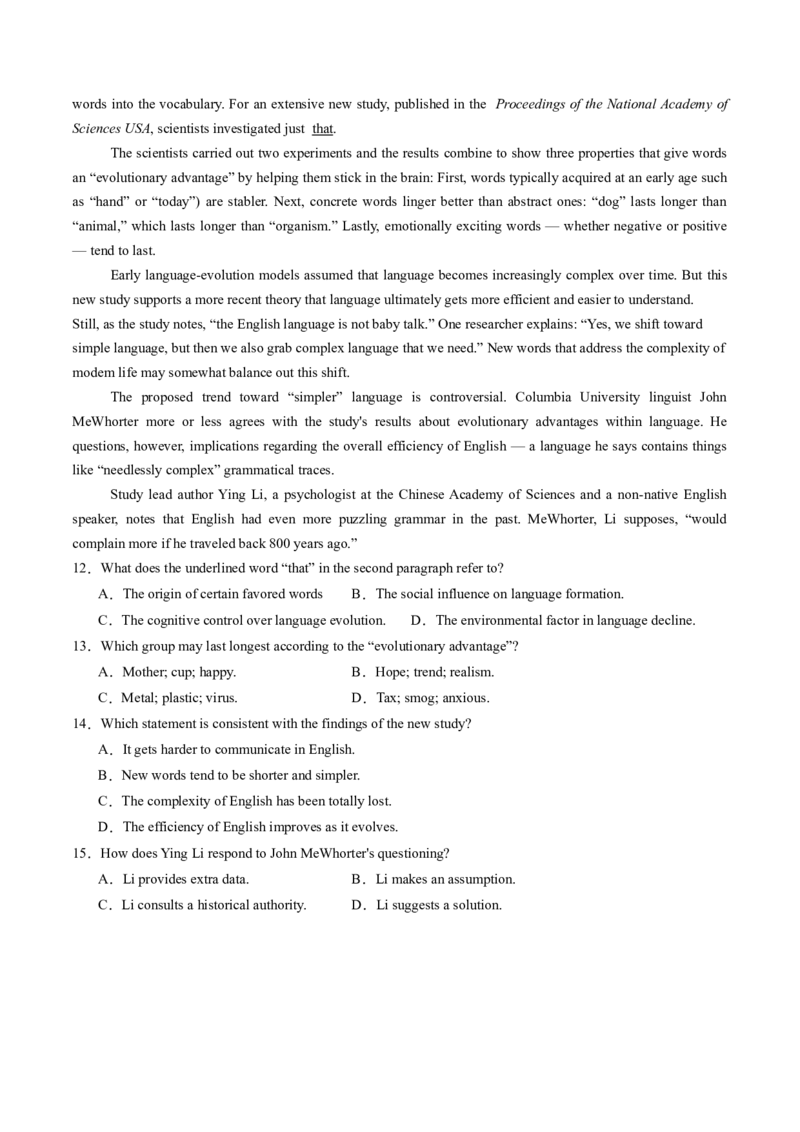
(2024·重庆·模拟预测)Charles Darwin found inspiration for his theory of evolution in birds' beaks, giant
tortoise shells — and language. “The survival or preservation of certain favored words in the struggle for existence
is natural selection, he wrote in The Descent of Man in 1871.
Language gradually shifts over time. Much research examines how social and environmental factors
influence language change, but very little wrestles with the forces of human cognitive (selection that fix certainwords into the vocabulary. For an extensive new study, published in the Proceedings of the National Academy of
Sciences USA, scientists investigated just that.
The scientists carried out two experiments and the results combine to show three properties that give words
an “evolutionary advantage” by helping them stick in the brain: First, words typically acquired at an early age such
as “hand” or “today”) are stabler. Next, concrete words linger better than abstract ones: “dog” lasts longer than
“animal,” which lasts longer than “organism.” Lastly, emotionally exciting words — whether negative or positive
— tend to last.
Early language-evolution models assumed that language becomes increasingly complex over time. But this
new study supports a more recent theory that language ultimately gets more efficient and easier to understand.
Still, as the study notes, “the English language is not baby talk.” One researcher explains: “Yes, we shift toward
simple language, but then we also grab complex language that we need.” New words that address the complexity of
modem life may somewhat balance out this shift.
The proposed trend toward “simpler” language is controversial. Columbia University linguist John
MeWhorter more or less agrees with the study's results about evolutionary advantages within language. He
questions, however, implications regarding the overall efficiency of English — a language he says contains things
like “needlessly complex” grammatical traces.
Study lead author Ying Li, a psychologist at the Chinese Academy of Sciences and a non-native English
speaker, notes that English had even more puzzling grammar in the past. MeWhorter, Li supposes, “would
complain more if he traveled back 800 years ago.”
12.What does the underlined word “that” in the second paragraph refer to?
A.The origin of certain favored words B.The social influence on language formation.
C.The cognitive control over language evolution. D.The environmental factor in language decline.
13.Which group may last longest according to the “evolutionary advantage”?
A.Mother; cup; happy. B.Hope; trend; realism.
C.Metal; plastic; virus. D.Tax; smog; anxious.
14.Which statement is consistent with the findings of the new study?
A.It gets harder to communicate in English.
B.New words tend to be shorter and simpler.
C.The complexity of English has been totally lost.
D.The efficiency of English improves as it evolves.
15.How does Ying Li respond to John MeWhorter's questioning?
A.Li provides extra data. B.Li makes an assumption.
C.Li consults a historical authority. D.Li suggests a solution.原句
"But this new study supports a more recent theory that language ultimately gets more efficient and easier to
understand. Still, as the study notes, ‘the English language is not baby talk’."
译文
但这项新的研究支持了一个更近期的理论,即语言最终变得更有效率,更容易理解。尽管如此,正如
研究所指出的,“英语并不是幼儿语言”。
分析
But [主句: this new study supports a more recent theory that language ultimately gets more efficient and easier
to understand]
|
+--[宾语从句: that language ultimately gets more efficient and easier to understand]
|
+-- [补充说明: ultimately] (副词,意为“最终”)
Still, [过渡句: as the study notes, ‘the English language is not baby talk’]
|
+--[引用内容: ‘the English language is not baby talk’]
1.inspiration /ˌɪnspəˈreɪʃn/ n. 灵感 2.evolution /ˌiːvəˈluːʃn/ n. 进化
3.preservation /ˌprɛzərˈveɪʃn/ n. 保存 4.selection /sɪˈlɛkʃn/ n. 选择
5.influence /ˈɪnfluəns/ v. 影响 6.cognitive /ˈkɒɡnɪtɪv/ adj. 认知的
7.extensive /ɪkˈstɛnsɪv/ adj. 广泛的 8.concrete /ˈkɒŋkriːt/ adj. 具体的
9.efficiency /ɪˈfɪʃənsi/ n. 效率 10.controversial /ˌkɒntrəˈvɜːʃəl/ adj. 有争议的
(五)
(2024·四川成都·模拟预测)In order to better survive in the world filled with challenges, we ourselves
need to be wise. 16 Let me tell you this. Wisdom provides us with perspectives and calms us down in
terrible situations. Here are some effective strategies that we can use to get wiser.
17 This will open up new pathways for us. Never base your perspective on the most popular
opinion or which is the most comfortable for you. Instead, train your mind to be a judgment-free space for ideas. If
you are humble enough, you will always get to experience something new.
Meanwhile, you’re supposed to be the kind of person who learns something new every day. Take new
classes, read books and the list goes on and on. 18 All of these activities will help you to tackle problems
from different angles, making everything easier.What if you lack self-discipline or need timely guidance? Maybe the best way is to have wise people as your
mentors (导师), like teachers, colleagues and even special friends. Prior to making them a mentor, find out what
makes them wiser, and then engage in useful dialogue with them. 19
If you have accumulated a lot of knowledge, then why not share it with others too? 20 In today’s
world, it is very easy to become wise but it isn’t easy to help others. So keep things balanced and never let go of
your passions and values. This will pave the path to success.
A.Why is wisdom crucial in this modern world?
B.Change your routine and see where life takes you.
C.Therefore, you can ask them to supervise you or imitate their mindset.
D.Try surfing the Internet and clear out your problems that confuse you.
E.Sometimes we can benefit a lot from being open to diverse perspectives.
F.By spending more time with them, there will be more transfer of knowledge to you.
G.Communicating with others and helping them out will also increase your wisdom.
原句
"Never base your perspective on the most popular opinion or which is the most comfortable for you. Instead,
train your mind to be a judgment-free space for ideas. If you are humble enough, you will always get to
experience something new."
译文
永远不要根据最流行的观点或最让你舒适的观点来建立你的看法。相反,要训练你的头脑,使其成为
一个对各种想法不加评判的空间。如果你足够谦逊,你将总是能够体验到新事物。
分析
句子1: Never base your perspective on the most popular opinion or which is the most comfortable for you.
|
+--[否定命令句: Never base your perspective on the most popular opinion or which is the most
comfortable for you]
句子2: Instead, train your mind to be a judgment-free space for ideas.
|
+--[命令句: train your mind to be a judgment-free space for ideas]
句子3: If you are humble enough, you will always get to experience something new.
|
+--[条件状语从句: If you are humble enough]
+--[主句: you will always get to experience something new]1.survive /sərˈvaɪv/ v. 生存 2.challenges /ˈtʃælɪndʒɪz/ n. 挑战
3.perspectives /pərˈspɛktɪvz/ n. 观点 4.strategies /ˈstrætədʒiz/ n. 策略
5.pathways /ˈpæθˌweɪz/ n. 路径 6.discipline /ˈdɪsəplɪn/ n. 纪律
7.guidance /ˈɡaɪdəns/ n. 指导 8.mentors /ˈmɛntɔrz/ n. 导师
9.accumulated /əˈkjuːmjəˌleɪtɪd/ adj. 积累的 10.supervise /ˈsuːpərˌvaɪz/ v. 监督
(六)
(2024·四川成都·模拟预测)Spanish class scared me in the freshman year. I knew little Spanish before
starting the class, and I thought it would be 21 for me. However, Mary, our honored Spanish teacher, who
was full of creativity, made her class fun from the beginning. I knew what to expect with a schedule for each week,
but there was always some slight 22 .
Before the exam, Mary often asked us to 23 our lessons by ourselves. But I could remember one day
she said, “This time, let’s play a game before going over what you’ve learned.” The game was so interesting that
we all 24 ourselves. After the exam, Mary gave us opportunities to make up for our 25 . After each
error correction, she would check again. She took things so 26 that she wouldn’t overlook any detail. No
wonder she was 27 by us.
Mary was 28 and willing to help, within reason, on everything. We could ask her questions at any
time. She encouraged everyone to speak Spanish in class. Because of that, I was 29 enough, and then I
could communicate with Spanish speakers outside of class. When she knew our problems, she would give advice.
When someone was struggling, she would 30 .
Mary’s 31 teaching eventually transformed my 32 into fascination. She infused (灌输)
foreign culture into lessons, using music and dance to 33 our language skills. Her personalized attention to
each student’s needs fostered a(n) 34 environment. At the end of the term, my Spanish improved, and my
confidence soared. Mary left a lasting impact on my 35 for new challenges.
21.A.exciting B.easy C.boring D.beneficial
22.A.variation B.disturbance C.annoyance D.inconvenience
23.A.explain B.describe C.prepare D.review
24.A.challenged B.enjoyed C.trusted D.developed
25.A.experience B.time C.losses D.mistakes
26.A.seriously B.roughly C.modestly D.curiously
27.A.amused B.respected C.judged D.spotted
28.A.understanding B.humble C.athletic D.courageous
29.A.discouraged B.suspected C.heartened D.comforted
30.A.set out B.reach out C.get out D.make out
31.A.passive B.conventional C.voluntary D.innovative
32.A.fear B.sorrow C.anger D.confusion33.A.know B.match C.enhance D.assess
34.A.secure B.supportive C.economic D.competitive
35.A.pity B.profit C.debate D.desire
原句
"I knew what to expect with a schedule for each week, but there was always some slight variation."
译文
我知道每周的时间表是什么样的,但总会有一些细微的变化。
主句1: I knew what to expect with a schedule for each week,
|
+--[宾语: what to expect with a schedule for each week]
|
+--[宾语从句: what to expect with a schedule for each week]
连接词: but
主句2: there was always some slight variation.
1.variation /ˌvɛriˈeɪʃən/ n. 变化 2.creativity /ˌkriːeɪˈtɪvɪti/ n. 创造力
3.opportunities /ˌɑːpərˈtuːnɪtiz/ n. 机会 4.mistakes /mɪˈsteɪks/ n. 错误
5.seriously /ˈsɪriəsli/ adv. 认真地 6.respected /rɪˈspɛktɪd/ adj. 受尊敬的
7.understanding /ˌʌndərˈstændɪŋ/ adj. 体谅的 8.heartened /ˈhɑːrtənd/ adj. 受到鼓舞的
9.accumulated /əˈkjuːmjəˌleɪtɪd/ adj. 积累的 10transformed /trænsˈfɔːrmd/ v. 转变
(一)
(2024·北京·高考真题)When I was a little girl, I liked drawing, freely and joyously making marks on the
walls at home. In primary school, I learned to write using chalks. Writing seemed to be another form of drawing. I
shaped individual letters into repeating lines, which were abstract forms, delightful but meaningless patterns.
In secondary school, art was my favourite subject. Since I loved it so much I thought I was good at it. For the
art O-level exam I had to present an oil painting. I found it difficult, but still hoped to pass. I failed, with a low
grade. I’d been over-confident. Now I’d been declared talentless.
But other channels of creativity stayed open: I went on writing poems and stories. Still, I went to exhibitionsoften. I continued my habitual drawing, which I now characterised as childish doodling (乱画). In my 30s, I made
painter friends and learned new ways of looking at art. However, I couldn’t let myself have a go at actually doing it.
Though these new friends were abstract painters using oil paints, or were printmakers or sculptors, I took oil
painting as the taboo (禁忌) high form I wasn’t allowed to practice.
One night, in my early 40s, I dreamed that a big woman in red approached me, handed me a bag of paints, and
told me to start painting. The dream felt so authoritative that it shook me. It was a form of energy, giving me back
something I’d lost. Accordingly, I started by experimenting with water colours. Finally, I bought some oil paints.
Although I have enjoyed breaking my decades-long taboo about working with oil paints, I have discovered I
now prefer chalks and ink. I let my line drawings turn into cartoons I send to friends. It all feels free and easy. Un-
anxious. This time around, I can accept my limitations but keep going.
Becoming a successful painter calls for being resolute. I realised I was always afraid of wanting too much.
That dream reminded me that those fears and desires could encourage me to take risks and make experiments.
1.How did the author feel about the result of the art exam?
A.Scared. B.Worried. C.Discouraged. D.Wronged.
2.In her 30s, the author _________.
A.avoided oil painting practice B.sought for a painting career
C.fancied abstract painting D.exhibited child paintings
3.Which word would best describe the author’s dream?
A.Confusing. B.Empowering.
C.Disturbing. D.Entertaining.
4.What can we learn from this passage?
A.Actions speak louder than words. B.Hard work is the mother of success.
C.Dreams are the reflections of realities. D.Creative activities involve being confident.
(二)
(2024·新课标Ⅰ卷C篇·高考真题)Is comprehension the same whether a person reads a text onscreen or
on paper? And are listening to and viewing content as effective as reading the written word when covering the same
material? The answers to both questions are often “no”. The reasons relate to a variety of factors, including reduced
concentration, an entertainment mindset (心态) and a tendency to multitask while consuming digital content.
When reading texts of several hundred words or more, learning is generally more successful when it’s on
paper than onscreen. A large amount of research confirms this finding. The benefits of print reading particularly
shine through when experimenters move from posing simple tasks — like identifying the main idea in a reading
passage — to ones that require mental abstraction — such as drawing inferences from a text.
The differences between print and digital reading results are partly related to paper’s physical properties.
With paper, there is a literal laying on of hands, along with the visual geography of distinct pages. People often link
their memory of what they’ve read to how far into the book it was or where it was on the page.
But equally important is the mental aspect. Reading researchers have proposed a theory called “shallowing
hypothesis (假说)”. According to this theory, people approach digital texts with a mindset suited to social media,
which are often not so serious, and devote less mental effort than when they are reading print.Audio (音频) and video can feel more engaging than text, and so university teachers increasingly turn to
these technologies — say, assigning an online talk instead of an article by the same person. However, psychologists
have demonstrated that when adults read news stories, they remember more of the content than if they listen to or
view identical pieces.
Digital texts, audio and video all have educational roles, especially when providing resources not available in
print. However, for maximizing learning where mental focus and reflection are called for, educators shouldn’t
assume all media are the same, even when they contain identical words.
5.What does the underlined phrase “shine through” in paragraph 2 mean?
A.Seem unlikely to last. B.Seem hard to explain.
C.Become ready to use. D.Become easy to notice.
6.What does the shallowing hypothesis assume?
A.Readers treat digital texts lightly. B.Digital texts are simpler to understand.
C.People select digital texts randomly. D.Digital texts are suitable for social media.
7.Why are audio and video increasingly used by university teachers?
A.They can hold students' attention. B.They are more convenient to prepare.
C.They help develop advanced skills. D.They are more informative than text.
8.What does the author imply in the last paragraph?
A.Students should apply multiple learning techniques.
B.Teachers should produce their own teaching material.
C.Print texts cannot be entirely replaced in education.
D.Education outside the classroom cannot be ignored.
(三)
(2024·浙江·高考真题)In the past few years, online learning has become a significant part of the
university and college experience. 9 But are all online courses created equal? How can you be sure that
digital learning is right for you? 10
We interviewed students and professors to get their advice about online courses, The most obvious advantage
of online learning is that you can study anywhere and anytime. 11 “I think a point that many people lose
sight of is how easy it can be to fall behind schedule,” says graduate student Amanda Bindman. Before choosing to
study online, consider whether you’re a self-motivated learner and if the material seems interesting enough to keep
you going.
The tip that comes up most often is simple: build online courses into your weekly schedule, just like what
you would do with in person courses. 12 He noted that his online students usually end up with lower
grades. It is so easy to let an online course slide, but your grades will suffer as a result. Be sure to schedule set
times to watch your lectures, read materials and contribute to online discussion boards.
13 A social connection is often a big part of learning. There are things you can do to ease this
problem. Jessica Pink, an undergraduate student, suggests taking online courses with a friend, so you can motivate
each other to stay on track. You can also find students on the class discussion board to organize a study group, orschedule in-person meeting s with your professor to discuss course concepts.
A.But that doesn’t mean there aren’t deadlines.
B.Your motivation should be your main concern.
C.Do you know that online courses are also part of your education?
D.Professor Alex Davidson teaches the same course in person and online.
E.The chief complain t about online courses is that they lack human interaction.
F.If you take an online course, what can you do to ensure the best possible grade?
G.A survey found that 29 percent of college students registered for online courses.
(四)
(2024·新课标Ⅰ卷完形填空·高考真题)I’ve been motivated — and demotivated — by other folks’
achievements all my life.
When I was a teenager, a neighborhood friend 14 a marathon race. Feeling motivated, I started
running 15 , but then two things happened. First, a girl I met one day told me she was 16 for a
“super,” referring to a 52.4-mile double marathon. Then, the next day I went on my longest run — 15 miles. To be
honest, I 17 it! Between the girl making my 18 seem small and the pure boredom of jogging, I
decided that the only 19 I’d ever run again is if a big dog was running after me!
So I 20 cycling. I got a good bike and rode a lot. I 21 of entering cycle races until I
flew to San Diego to visit my sister. While she was at work one day, I 22 her bike and went for a ride.
The 23 : the roads there went through large valleys where I’d be riding uphill for miles at a time. I’d
never faced such 24 . That day, I got 25 by about 100 “local” bikers who were used to such
roads. When I got back home, suddenly riding my bike didn’t seem quite as 26 .
I’ve 27 a lot since then. I’ve come to accept that whatever 28 I set for myself, they just
have to be my own.
14.A.knew B.held C.won D.quit
15.A.regularly B.silently C.proudly D.recently
16.A.asking B.looking C.waiting D.training
17.A.made B.believed C.hated D.deserved
18.A.advantage B.achievement C.contribution D.influence
19.A.way B.risk C.place D.reason
20.A.gave up B.went on C.turned to D.dealt with
21.A.heard B.dreamed C.complained D.approved
22.A.painted B.borrowed C.bought D.parked
23.A.problem B.secret C.principle D.advice
24.A.dangers B.events C.opponents D.challenges
25.A.passed B.convinced C.admired D.stopped
26.A.reliable B.convenient C.familiar D.appealing
27.A.traveled B.matured C.missed D.worried28.A.limits B.dates C.goals D.tests
Task 1
本专题的主题语境是“人与自我”,话题是“生活与学习”,与学生们的日常生活和学习密切相关,
旨在帮助学生们认识自我、丰富自我、完善自我。请选择一篇你感兴趣的阅读语篇,尝试用思维导图绘制
出文章脉络吧!
Task 2
(2024·山东·二模)阅读下面材料,根据其内容和所给段落开头语续写两段,使之构成一篇完整的短文。
On a sunny Friday morning, Mr. Stone, the Grade 4 head teacher, walked into the classroom with a new
student following him. She was a lively girl from Mexico, and her red mushroom hair cut immediately drew
everyone’s eyes. With a welcoming smile, Mr. Stone gestured for her to sit beside Mike, a student known for
teasing others.
During break time, Mike couldn’t help but laugh when he caught sight of his new deskmate. Sara’s
distinctive hairstyle seemed like an open invitation for him to make fun of her. Leaning in towards Sara, he
playfully suggested, “Hey, Sara. Ever thought about changing your name to Dora? You look just like Dora the
Explorer!” His words caused laughter and cheers from the others in the classroom.
Sara’s eyes filled with tears, her cheeks turning red with embarrassment. Feeling hurt and upset, she stood up
suddenly, rushing to the teacher’s office to seek support from Mr. Stone. After hearing her story, Mr. Stone offered
her gentle comfort, saying, “Sara, your hairstyle is truly pretty. Remember, everyone has their own sense of
beauty.”
Mr. Stone then directed his attention to Mike, expressing his disappointment and urging Mike to apologize to
Sara. “Mike,” he continued, “your actions were unkind. We must treat everyone with empathy(同情). Laughing at
Sara’s hair has deeply hurt her.”
This conflict was temporarily settled, but Mr. Stone found himself lost in thought. Reflecting on his own
childhood, Mr. Stone recalled how he had been teased for being overweight. The pain caused by hurtful words was
like wrinkles on a crumpled(压皱的)ball of paper. Even if you smoothed them out, the wrinkles stayed.
He wanted to teach an important lesson to Mike, the troublemaker. Then, a unique strategy came to mind. He
contacted Mike’s mother, explaining the situation and discussing a plan with her to develop empathy in her son.
They agreed that over the weekend, Mike’s mother would arrange for Mike to have his hair cut extremely short.
注意:
1.续写词数应为150左右;
2.请按如下格式在答题卡的相应位置作答。
On Monday morning, Mike unwillingly approached the classroom.______________________________________________________________________________________________________________________________
____________________________________________________________________________________________
____________________________________________________________________________________________
____________________________________________________________________________________________
____________________________________________________________________________________________
____________________________________________________________________________________________
____________________________________________________________________________________________
____________________________________________________________________________________________
At that moment, Mr. Stone walked into the classroom with a ball of paper._____________________________
____________________________________________________________________________________________
____________________________________________________________________________________________
____________________________________________________________________________________________
____________________________________________________________________________________________
____________________________________________________________________________________________
____________________________________________________________________________________________
____________________________________________________________________________________________
____________________________________________________________________________________________