试题 第1 页(共12 页)
试题 第2 页(共12 页)
………………○………………内………………○………………装………………○………………订………………○………………线………………○………………
………………○………………外………………○………………装………………○………………订………………○………………线………………○………………
…             学校:______________姓名:_____________班级:_______________考号:______________________
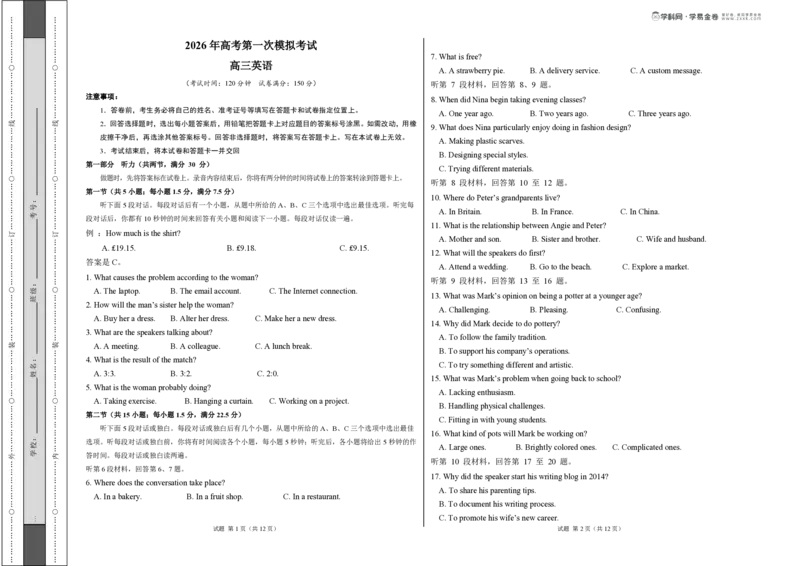
2026 年高考第一次模拟考试
高三英语
(考试时间:120 分钟  试卷满分:150 分)
注意事项:
1.答卷前,考生务必将自己的姓名、准考证号等填写在答题卡和试卷指定位置上。
2.回答选择题时,选出每小题答案后,用铅笔把答题卡上对应题目的答案标号涂黑。如需改动,用橡
皮擦干净后,再选涂其他答案标号。回答非选择题时,将答案写在答题卡上。写在本试卷上无效。
3.考试结束后,将本试卷和答题卡一并交回
第一部分  听力(共两节,满分 30 分)
做题时,先将答案标在试卷上。录音内容结束后,你将有两分钟的时间将试卷上的答案转涂到答题卡上。
第一节(共5 小题;每小题1.5 分,满分7.5 分)
听下面5 段对话。每段对话后有一个小题,从题中所给的A、B、C 三个选项中选出最佳选项。听完每
段对话后,你都有10 秒钟的时间来回答有关小题和阅读下一小题。每段对话仅读一遍。
例 :How much is the shirt?
A. ₤19.15.


B. ₤9.18.
 C. ₤9.15.
答案是C。
1. What causes the problem according to the woman?
A. The laptop.

B. The email account.

C. The Internet connection.
2. How will the man’s sister help the woman?
A. Buy her a dress.
B. Alter her dress.

C. Make her a new dress.
3. What are the speakers talking about?
A. A meeting.

B. A colleague.

C. A lunch break.
4. What is the result of the match?
A. 3:3.


B. 3:2.


C. 2:0.
5. What is the woman probably doing?
A. Taking exercise.

B. Hanging a curtain.
C. Working on a project.
第二节(共15 小题;每小题1.5 分,满分22.5 分)
听下面5 段对话或独白。每段对话或独白后有几个小题,从题中所给的A、B、C 三个选项中选出最佳
选项。听每段对话或独白前,你将有时间阅读各个小题,每小题5 秒钟;听完后,各小题将给出5 秒钟的作
答时间。每段对话或独白读两遍。
听第6 段材料,回答第6、7 题。
6. Where does the conversation take place?
A. In a bakery.


B. In a fruit shop.


C. In a restaurant.


7. What is free?
A. A strawberry pie.

B. A delivery service.

C. A custom message.
听第 7 段材料,回答第 8、9 题。
8. When did Nina begin taking evening classes?
A. One year ago.

B. Two years ago.


C. Three years ago.
9. What does Nina particularly enjoy doing in fashion design?
A. Making plastic scarves.
B. Designing special styles.
C. Trying different materials.
听第 8 段材料,回答第 10 至 12 题。
10. Where do Peter’s grandparents live?
A. In Britain.


B. In France.


C. In China.
11. What is the relationship between Angie and Peter?
A. Mother and son.

B. Sister and brother.

  C. Wife and husband.
12. What will the speakers do first?
A. Attend a wedding.
B. Go to the beach.
  C. Explore a market.
听第 9 段材料,回答第 13 至 16 题。
13. What was Mark’s opinion on being a potter at a younger age?
A. Challenging.


B. Pleasing.


 C. Confusing.
14. Why did Mark decide to do pottery?
A. To follow the family tradition.
B. To support his company’s operations.
C. To try something different and artistic.
15. What was Mark’s problem when going back to school?
A. Lacking enthusiasm.
B. Handling physical challenges.

C. Fitting in with young students.
16. What kind of pots will Mark be working on?
A. Large ones.

B. Brightly colored ones.    C. Complicated ones.
听第 10 段材料,回答第 17 至 20 题。
17. Why did the speaker start his writing blog in 2014?
A. To share his parenting tips.
B. To document his writing process.
C. To promote his wife’s new career.
{#{QQABRQiQggigQIJAARgCEwHgCgIYkAGAAIgORBAQMAABQQFABAA=}#}
试题 第3 页(共12 页)
试题 第4 页(共12 页)
………………○………………外………………○………………装………………○………………订………………○………………线………………○………………
………………○………………内………………○………………装………………○………………订………………○………………线………………○………………
             此
卷
只
装
订
不
密
封
18. What motivated the speaker to join book blogging?
A. A desire to sell his novels.
B. An inspiring blog tour experience.

C. Pressure from writing communities.
19. How does the speaker write book reviews on his blog?
A. By offering honest reviews.
B. By comparing different books.

C. By focusing on questions about the books.
20. What effect has book blogging had on the speaker?
A. It helps him write more books.
B. It allows him to meet more readers.

C. It increases his understanding of literature.
第二部分  阅读(共两节, 满分50 分)
第一节(共15 小题;每小题2.5 分, 满分37.5 分)
阅读下列短文, 从每题所给的A、B、C 和D 四个选项中选出最佳选项。
A(原创题)
Community Youth Center Spring Programs 2026
Are you looking for meaningful activities for teenagers? The Community Youth Center is
offering the following programs for students aged 13-18:
Environmental Protection Volunteer Program
Time: Every Saturday, 9:00-11:30 AM (March 16 - May 25)
Activities: Tree planting, community cleaning, waste sorting workshops
Requirements: No experience needed; sign up in advance (limit 30 people)
Registration: Visit the center’s office or call 555-7890
Public Speaking Training Course
Time: Every Sunday, 2:00-4:30 PM (March 17 - June 2)
Activities: Speech practice, debate competitions, expert lectures
Requirements: Basic English or Chinese communication skills
Fee: $80 per person (includes materials)
Traditional Handicraft Workshop
Time: Every Friday evening, 6:30-8:30 PM (March 15 - May 10)
Activities: Learn paper-cutting, bamboo weaving, and Chinese knot making
Requirements: Interest in traditional culture; bring your own scissors (basic tools provided)
Registration deadline: March 10th
For more information, visit www.communityyouthcenter.org.
21. How long will the Environmental Protection Volunteer Program last?
A. 2 months
B. 2.5 months
C. 3 months
 D. 3.5 months
22. What do participants need to bring to the Traditional Handicraft Workshop?
A. Paper
B. Bamboo
C. Scissors
D. Knots
23. Which program requires a fee?
A. None of the above
B. Public Speaking Training Course
C. Traditional Handicraft Workshop
D. Environmental Protection Volunteer Program
B(原创题)
When 14-year-old Mia Anderson was walking her dog Max in the neighborhood park last
Saturday afternoon, she noticed a small, trembling figure hiding behind a bush. As she approached
carefully, she found it was a 3-year-old boy wearing only a thin T-shirt, crying silently. The boy
couldn’t tell Mia his name or where he lived, so she decided to stay with him and alert the authorities
right away.
Mia sat on the grass with the boy, using her jacket to keep him warm and letting Max play with
him to cheer him up. Meanwhile, she called the local police station. Ten minutes later, two officers
arrived. They asked Mia for details about how she found the boy, and then used the boy’s description
to search the nearby area.
While the police were working, Mia thought of a way to help. She remembered that there was a
community noticeboard at the park entrance. She quickly made a simple poster with the boy’s
appearance—curly brown hair, blue eyes, and a red toy car in his hand—and stuck it on the board.
She also asked some passers-by if they had seen a worried parent looking for a child.
Luckily, within 20 minutes, a woman rushed to the park, shouting the boy’s name—Liam. It
turned out that Liam had wandered off while his mother was busy preparing lunch at home. The
mother was so grateful that she hugged Mia tightly and wanted to give her some money as a reward,
but Mia politely refused. “I just did what anyone would do,” she said with a smile.
The local newspaper later reported the story, praising Mia for her quick thinking and kindness.
Mia’s teacher also mentioned her in class, saying that Mia was always a responsible and caring
student. When asked about the experience, Mia said, “It feels good to help others. I hope everyone
will pay more attention to their surroundings and lend a hand when needed.”
24. How did Mia cheer the little boy up while waiting for the police?
A. By buying him a toy car
{#{QQABRQiQggigQIJAARgCEwHgCgIYkAGAAIgORBAQMAABQQFABAA=}#}
试题 第5 页(共12 页)
试题 第6 页(共12 页)
………………○………………内………………○………………装………………○………………订………………○………………线………………○………………
………………○………………外………………○………………装………………○………………订………………○………………线………………○………………
…             学校:______________姓名:_____________班级:_______________考号:______________________
B. By singing songs for him
C. By letting her dog play with him
D. By taking him to the community noticeboard
25. Why did Liam get lost in the park?
A. Because Mia’s dog Max led him away from home
B. Because he wanted to play with passers-by in the park
C. Because he wandered off when his mother was cooking
D. Because Mia took him there without his mother’s permission
26. We can infer from the passage that ________.
A. Mia’s act of kindness was widely praised
B. Liam’s mother punished him for wandering off
C. the police found Liam’s home by using the poster
D. Mia received a reward from Liam’s mother finally
27. What is the best title for the passage?
A. How to Find a Lost Child
B. Mia’s Kindness Saves the Day
C. A Lost Boy’s Adventure in the Park
D. The Story of a Community Noticeboard
C 篇(原创)
Exams are coming, and many students are worried about remembering all the knowledge they’ve
learned. Fortunately, there are simple and effective ways to improve your memory.
First, practice active recall. Instead of just reading your notes repeatedly, try to remember and
write down what you’ve learned without looking. For example, after studying a chapter, close the
book and list the key points. This forces your brain to retrieve information, which strengthens
memory.
Second, use spaced repetition. Our brains forget information quickly, so it’s important to review
regularly. Study a topic for the first time, then review it after 1 day, 3 days, and 7 days. This method
helps move information from short-term memory to long-term memory.
Third, connect new information to what you already know. If you’re learning a new English
word, link it to a familiar word or a personal experience. For example, if you’re learning “delicious”,
think of your favorite food. This makes the new information easier to remember.
Fourth, get enough sleep. Sleep is crucial for memory consolidation. When you sleep, your brain
organizes and stores the information you’ve learned during the day. Aim for 7-9 hours of sleep every
night, especially before exams.
Finally, stay relaxed. Stress and anxiety can affect your memory. Try deep breathing, meditation,
or taking short walks to reduce stress. A calm mind is better at remembering information.
By following these methods, you can improve your memory and perform better in exams. Remember,
consistency is key—start practicing these techniques early and stick to them.
28.  What does the underlined word “retrieve” in Paragraph 2 probably mean?
A. Forget
B. Store
C. Recall
D. Analyze
29. Which method involves reviewing information at different time intervals?
A. Active recall
B. Spaced repetition
C. Connecting new information     D. Staying relaxed
30. What is the function of the example in Paragraph 3?
A. To compare familiar words with new words
B. To show the difficulty of learning new English words
C. To prove that personal experiences are more important
D. To explain how to connect new information with existing knowledge
31. How is the passage organized?
A. By presenting methods in order.
B. By telling a story and giving advice.
C. By listing problems and solving them.
D. By comparing different memory techniques.
D 篇(原创)
With the development of technology, more and more smart tools are helping high school students
study more efficiently. These tools are designed to solve common study problems, such as time
management and difficult subjects.
{#{QQABRQiQggigQIJAARgCEwHgCgIYkAGAAIgORBAQMAABQQFABAA=}#}
试题 第7 页(共12 页)
试题 第8 页(共12 页)
………………○………………外………………○………………装………………○………………订………………○………………线………………○………………
………………○………………内………………○………………装………………○………………订………………○………………线………………○………………
             此
卷
只
装
订
不
密
封
One popular tool is the digital planner app. Unlike traditional paper planners, digital planners
allow students to set reminders for homework, exams, and deadlines. They can also track their study
time and set goals. For example, a student can set a goal to study math for 2 hours a day, and the app
will send a reminder when it’s time to start. Some apps even have a calendar function that shows
upcoming tests and assignments.
Another useful tool is the language learning app. For students struggling with English, these apps
offer interactive lessons, vocabulary practice, and pronunciation exercises. Many apps use
gamification(游戏化)—students earn points or badges when they complete tasks, which makes
learning more fun. Some apps also have a speech recognition feature that helps students improve their
speaking skills by comparing their pronunciation to native speakers.
For science and math subjects, there are problem-solving apps. These apps can solve complex
equations, explain scientific concepts, and provide step-by-step solutions. Students can take a photo of
a problem, and the app will show the answer and explain how to get there. This helps students
understand difficult topics and learn from their mistakes.
However, it’s important to use these tools wisely. They should be used as aids, not replacements
for hard work. Students should still attend classes, do homework independently, and practice
regularly. With the right balance, smart study tools can be valuable helpers for high school students.
28. What is a feature of digital planner apps?
A. They solve math problems
B. They send study reminders
C. They provide vocabulary practice
D. They offer pronunciation exercises
29. How do language learning apps make learning fun?
A. By using gamification
B. By sending reminders
C. By tracking study time
D. By showing step-by-step solutions
34. What is the author’s attitude towards smart study tools?
A. Critical
B. Supportive
C. Doubtful
 D. Neutral
35. What does the author want to tell students in the last paragraph?
A. Smart tools can replace hard work
B. Students should rely on smart tools fully
C. Balance is key when using smart tools    D. Smart tools are useless for daily study
第二节(共5 小题;每小题2. 5 分, 满分12. 5 分)
阅读下面短文, 从短文后的选项中选出可以填入空白处的最佳选项。选项中有两项为多余
选项。
The Campus Locker of KindnessIn the corner of our school’s cafeteria, a wooden locker painted
in warm yellow has become a beloved spot for students.      36     What started as a small
initiative has grown into a heartwarming tradition that connects the whole school.
It all began with three Grade 11 students—Luna, Jake, and Mia. They noticed that some
classmates often forgot essential items like umbrellas, stationery, or even snacks for after-school
activities.     37    They cleaned and repaired an old unused locker, then put up a sign that read:
“Take what you need, leave what you can—kindness is free.”
At first, only a few students dared to participate. Some left extra pens and notebooks, while
others took a raincoat or a pack of tissues.    38    Soon, the locker was filled with all sorts of
useful things: from textbooks and sports water bottles to handmade cookies and encouraging notes.
The three students also added small labels to help organize the items, making it easier for everyone to
find what they needed.

39     Once, a student accidentally took a borrowed novel without leaving a replacement,
which made some donors feel disappointed. Instead of giving up, Luna and her friends posted a gentle
reminder on the locker: “Let’s keep the cycle of kindness going—every item matters.” This small
adjustment worked, and the locker soon returned to its harmonious state.
Today, the Locker of Kindness is more than just a storage space.    40     It reminds us that even
the smallest acts of generosity can make a big difference. As Jake said, “We never expected it to grow
so much. It’s amazing to see how kindness spreads when we give it a chance.”
A. The locker is open 24 hours a day for all students.
B. Many students donated their new textbooks to the locker.
C. Like any other project, it faced a small challenge at one point.
D. Teachers soon joined the project and offered financial support.
E. They wanted to do something to help without drawing attention.
F. However, as more people heard about it, participation grew rapidly.
G. It not only provides practical help but also spreads warmth among peers.


{#{QQABRQiQggigQIJAARgCEwHgCgIYkAGAAIgORBAQMAABQQFABAA=}#}
试题 第9 页(共12 页)
试题 第10 页(共12 页)
………………○………………内………………○………………装………………○………………订………………○………………线………………○………………
………………○………………外………………○………………装………………○………………订………………○………………线………………○………………
…             学校:______________姓名:_____________班级:_______________考号:______________________

第三部分 语言运用(共两节,满分30 分)
第一节(共15 小题,每小题1 分,满分15 分)
阅读下面短文, 从每题所给的A、B、C 和D 四个选项中选出可以填入空白处的最佳选项。
Our school launched a "Low-Carbon Campus" initiative last year, inspired by the national call
for ecological protection. As a member of the student volunteer team, I witnessed how small changes
can     41     a big difference to the environment.
The project began with a     42    : our campus consumed too much electricity and produced
a lot of waste. We first conducted a survey to   43    the main sources of energy waste—old
lighting systems, improper garbage sorting, and excessive use of disposable products. Based on the
results, we    44   practical solutions: installing solar-powered lights, setting up classified waste
bins, and promoting reusable tableware in the cafeteria.
At first, some students were    45   to change their habits. They thought the new rules were
inconvenient and unnecessary. However, we didn’t give up. We created posters to explain the   46
of low-carbon life, held lectures with environmental experts, and shared interesting facts about
sustainability on the school website. Gradually, more and more students    47    the initiative.
They started bringing their own water bottles, sorting garbage carefully, and turning off lights when
leaving classrooms.
We also faced technical   48   . The solar lights sometimes failed to work on cloudy days, and
some waste bins were often misused. With the help of our physics teacher, we adjusted the light
sensors to improve their    49   . We also added clear labels and student volunteers to guide
everyone in proper waste sorting. These small   50    made the project run more smoothly.
After one year, the   51    were remarkable. Our campus electricity consumption dropped by
23%, and waste recycling rate increased to 45%. More importantly, the concept of low-carbon living
has deeply   52    into every student’s mind. Many families even joined our efforts, reducing
plastic use and saving energy at home.
This experience taught me that environmental protection is not a solo journey but a collective
53   . It requires patience, creativity, and teamwork to turn ideas into reality. As young people, we
have the   54    to take action and contribute to a greener future. Every small step we take today
will    55   to a more sustainable world tomorrow.

41 A. make
B. take
C. have
D. keep
42 A. problem
B. plan
C. dream
D. goal
43 A. hide
B. identify
C. prove
D. ignore
44 A. rejected
B. borrowed
C. proposed
D. copied
45 A. ready
B. reluctant
C. eager
D. afraid
46 A. importance
B. difficulty
C. possibility
D. happiness
47 A. criticized
B. abandoned
C. joined
D. doubted
48 A. chances
B. challenges
C. benefits
D. rewards
49 A. appearance
B. safety
C. performance
D. popularity
50 A. changes
B. mistakes
C. promises
D. gifts
51 A. reasons
B. results
C. causes
D. troubles
52 A. divided
B. translated
C. entered
D. settled
53 A. duty
B. task
C. effort
D. hobby
54 A. right
B. responsibility
C. freedom
D. ability
55 A. lead
B. stick
C. turn
D. object


第二节(共10 小题;每小题1.5 分 ,满分15 分)
阅读下面短文,在空白处填入1 个适当的单词或括号内单词的正确形式。
Youth Volunteer Teaching Team, a program advocating educational equity, has been connecting
urban students with rural schools for five years. Last summer, I joined the team and spent a
meaningful month in a mountain village.
The village school lacked basic teaching resources, and many students had never seen a
computer before. Our first task was   61   (set) up a digital classroom with donated equipment.
With the help of local teachers, we spent three days   62   (install) software and testing devices.
Though tired, we were motivated by the students’ eager eyes — they would gather around the
classroom window,    63
 (attract) by our work with curiosity.
On the first day of class, I taught English to Grade 8 students. I prepared interactive games to
make the lessons lively,    64     proved effective in attracting their attention. One student, Li
Hua, was particularly shy at first. I encouraged him to speak up and praised his small progress.
Gradually, he became more      65    (confidence) and even volunteered to lead group
discussions.
To enrich their after-school life, we organized a reading club. We brought over 200 books,
including storybooks, science books and biographies. The students were thrilled to read these books,
which opened a window  66  the outside world for them. A girl told me, "I want to study hard and
visit the cities you talked about one day."
{#{QQABRQiQggigQIJAARgCEwHgCgIYkAGAAIgORBAQMAABQQFABAA=}#}
试题 第11 页(共12 页)
试题 第12 页(共12 页)
………………○………………外………………○………………装………………○………………订………………○………………线………………○………………
………………○………………内………………○………………装………………○………………订………………○………………线………………○………………
             此
卷
只
装
订
不
密
封
During our stay, the local    67    (villager) treated us warmly. They invited us to their homes
for meals and shared stories of the village’s development. We learned that a new road 68  (build) the
year before, making it easier for goods to be transported out of the mountains.
As our volunteer service came to an end, we promised to keep in touch with the students. So far,
we  69  (exchange) dozens of letters. This experience taught me that education is not just about
knowledge, but about building  70   bridge between different worlds. It also made me realize that
young people can contribute to society in their own ways, no matter how small the effort.
第四部分 写作(共两节, 满分40 分)
第一节(满分15 分)
假设你是李华,你校将举办“校园文化节”(Campus Culture Festival),请你给外教Smith
先生写一封邮件,邀请他参加。内容包括:
1. 活动时间:4 月10 日(星期三)下午2:00-5:00
2. 活动地点:学校操场
3. 活动内容:传统舞蹈、手工展示、美食分享等
4. 邀请他参与美食分享环节,带来他国家的特色美食
注意:1. 词数80 左右;
2. 可适当增加细节,使行文连贯;
3. 开头和结尾已给出,不计入总词数。
Dear Mr. Smith,
I hope this email finds you well.


Looking forward to your reply.
Yours sincerely,
Li hua
第二节(满分25 分)
阅读下面材料,根据其内容和所给段落开头语续写两段,使之构成一篇完整的短文。
注意:1.续写词数应为150 个左右;
2.请按如下格式在答题纸的相应位置作答。
 It was a rainy Saturday morning. Lily was on her way to the library to return some books. She
had promised her friend Lucy to meet at the library at 10:00 AM to study for the upcoming exam.
When Lily got to the bus stop, she realized she had forgotten her umbrella. The rain was pouring
down, and there was no shelter at the bus stop. She looked around, hoping to find a store where she
could buy an umbrella, but there was nothing nearby. Just as she was about to give up and run to the
library in the rain, a young woman walked up to her.
“Excuse me, do you need an umbrella?” the woman asked with a smile. Lily nodded shyly. “I
have an extra one. You can use it,” the woman said, handing her a pink umbrella. Lily thanked her
repeatedly. “What’s your name? I want to return it to you,” Lily said. “My name is Emma. You can
return it to the café on Main Street. I work there,” the woman replied.
Lily took the umbrella and got on the bus. When she arrived at the library, she saw Lucy waiting
for her. They studied together until noon. After that, Lily decided to return the umbrella to Emma.
However, when she got to the café on Main Street, she found that it was closed. She asked a nearby
shop owner, who told her that Emma had quit her job and moved to another city.
Lily felt disappointed. She really wanted to thank Emma properly. She looked at the pink
umbrella and had an idea.
注意:1. 所续写短文的词数应为150 左右;
2. 续写部分分为两段,每段的开头语已为你写好;
Paragraph 1:
Lily took the pink umbrella and went back to the library.


Paragraph 2:
A month later, Lily received a surprise email.


{#{QQABRQiQggigQIJAARgCEwHgCgIYkAGAAIgORBAQMAABQQFABAA=}#}