Unit 1 How can we become good learners ? 单元整体教学设计
本单元的主题属于“人与自我 ”范畴,教材内容围绕学习本身,讲述了学习
障碍及对应的解决方法,对学生有重要的意义。它贴近学生学习生活,所有学
单元主
生有话可说,表达的欲望强烈,学习兴趣浓厚。本单元以 “学会如何学习”
题意义
为话题,以谈论如何学习为功能,以紧扣话题的四个对话和两个篇章为载体,
在具体情境中谈论学习方法并学会评价他人的学习方法。
通过本单元的学习,学生能够:
目标a:理解重点句子,掌握学习英语的方法。介词 by引导的方式状语
的合理运用。
目标b:正确运用动名词谈论学习中的问题。
目标c:通过开展角色表演等活动,培养学生阅读兴趣。
单 元 教 目标d:通过本单元的阅读,培养学生的文化意识,陶冶思想情操,让学
学目标 生树立终身学习的道德素养。
与核心素养的关系:
学完本单元后,学生能够运用读懂并讨论学习方法的对话,培养学生语言知识
的掌握能力和思考能力,还对学生学习兴趣的激发和学习方法的改进进行引
导,学习能力作为核心素养,不仅要求学生具备良好的自主学习能力,同时也
需要学生有正确的学习态度。 通过分享活动,解决自身存在的学习问题,提高
学习的自信心,形成良好的学习态度。
1.来源& 内容:
本单元是《新目标英语》系列教材之一 Go for it !九年级上册的
第一单元。本单元主要通过介绍不同的英语学习方法引出 “学会怎样
去学习”这一话题,围绕“如何进行学习”展开各种教学活动,谈论学
生对不同学习方法的感受及其带来的效果。然后通过列举一些英语学习
中存在的问题,有针对性地提出解决问题的办法。本单元教学内容由浅
入深,逐步引导学生用英语表述学习英语的方法和学习中存在的问题以
及应对方法,正确理解学习目的,了解不同的学习方法,学会借鉴他人
的长处以提高自己的学习效率和解决问题的能力。
2.纵向知识关联:
功能: 谈论如何学习。
整 体 教
话题: 学会如何学习
学 思 路
语言知识:
及 教 学
a. 正确运用 how 引导的方式状语从句。如:How do you study/learn?
结构图
How can I ..?
b. 正确运用于学习主题相关的单词和各种表达学习方法,如 learn/
study...by.. You can ...by...
c. 学会用 “by+v.-ing”结构来表达方式方法。
3.横向知识关联:
(1 )复习七年级上册Unit 9学科学习及学习方法;
(2 )本单元出现的一般现在时,现在完成及过去时多次,巩固已学时
态。
(3 )本单元也反复强调了by+v.ing结构用法。
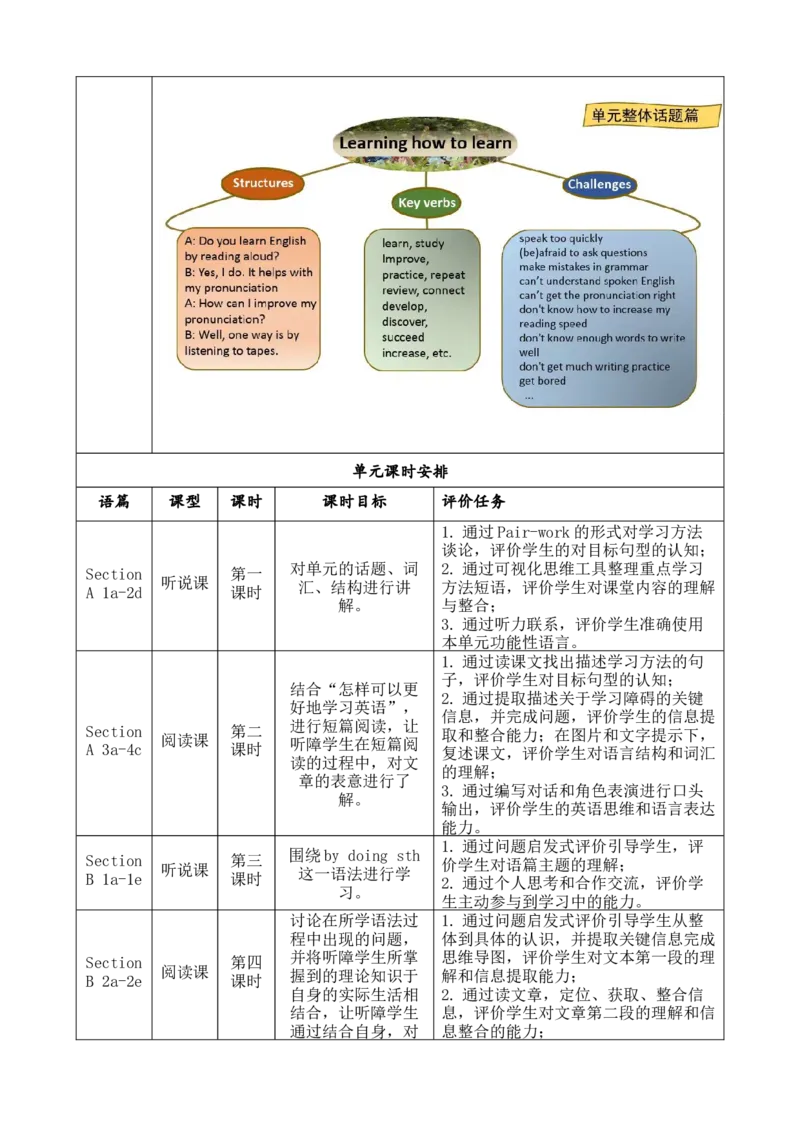
教学结构图:单元课时安排
语篇 课型 课时 课时目标 评价任务
1. 通过Pair-work的形式对学习方法
谈论,评价学生的对目标句型的认知;
对单元的话题、词 2. 通过可视化思维工具整理重点学习
Section 第一
听说课 汇、结构进行讲 方法短语,评价学生对课堂内容的理解
A 1a-2d 课时
解。 与整合;
3. 通过听力联系,评价学生准确使用
本单元功能性语言。
1. 通过读课文找出描述学习方法的句
子,评价学生对目标句型的认知;
结合“怎样可以更
2. 通过提取描述关于学习障碍的关键
好地学习英语”,
信息,并完成问题,评价学生的信息提
进行短篇阅读,让
Section 第二 取和整合能力;在图片和文字提示下,
阅读课 听障学生在短篇阅
A 3a-4c 课时 复述课文,评价学生对语言结构和词汇
读的过程中,对文
的理解;
章的表意进行了
3. 通过编写对话和角色表演进行口头
解。
输出,评价学生的英语思维和语言表达
能力。
1. 通过问题启发式评价引导学生,评
围绕by doing sth
Section 第三 价学生对语篇主题的理解;
听说课 这一语法进行学
B 1a-1e 课时 2. 通过个人思考和合作交流,评价学
习。
生主动参与到学习中的能力。
讨论在所学语法过 1. 通过问题启发式评价引导学生从整
程中出现的问题, 体到具体的认识,并提取关键信息完成
并将听障学生所掌 思维导图,评价学生对文本第一段的理
Section 第四
阅读课 握到的理论知识于 解和信息提取能力;
B 2a-2e 课时
自身的实际生活相 2. 通过读文章,定位、获取、整合信
结合,让听障学生 息,评价学生对文章第二段的理解和信
通过结合自身,对 息整合的能力;学习英语时自身存 3. 通过对话编写和角色表演进行口头
在的问题与解决方 输出,并通过书面表达的形式,评价学
法有清晰的认识。 生对句型的掌握
带领听障学生对学
习优秀学习者的学
习习惯进行了解。
Section
巩固听障学生所学
B 3a- 第五 通过书面表达的形式介绍如何学习,,
写作课 习到的知识,丰富
Self 课时 评价学生写作的能力。
学听障生的词汇量
check
积累,对听障学生
的看、听、读、写
能力进行练习。
第4课时 教学设计
课题 Unit 1 How can we become good learners? Section B 2a-2e阅读课
教材(语篇)分析:
【what】
本节课是一节阅读课。活动2a-2e是一系列与阅读相关的任务链。这一部分内容以
How can you become a successful learner ?为核心展开阅读训练。
【why】
2a 为读前活动,要求学生列出自己所知的好的学习方法并与同伴讨论,旨在导
入话题为阅读做好准备。2b 侧重训练阅读的训读策略,需要学生快速阅读语篇,并
找出成功学习者通常具备的四种学习习惯。2c 提出了关于文章各个细节的问题,需
要学生细读文章找出答案。2d-2e 为读后活动,2d 结合本单元提出的使用词典的策
略,需要学生利用词典抓出所列举的多义词在阅读语篇中的词义并造句。这个活动
需要学生能根据上下文从词典中判断,选择恰当词义。2e 是阅读后延申型口语交流
活动,旨在训练学生口头表达能力的同时,引导学生养成积极的学习态度。
【how】
通过2a-2e一系列的活动,训练学生能通过阅读获取所需要的信息, 训练阅读的寻
读策略,使用词典的学习策略。
学情分析:
(一)自然情况
经过了本单元的前面你内容的学习后,学生已应该由了一些储备。
(二)已有基础
初步接触了语言目标,基本掌握了 “by+动词v-ing形式“,能够用这个结构进行简
单的表达。
(三)存在问题
需要学生利用所学内容并结合自身学习情况,反思自己是否具备优秀学习者应具备
的学习习惯和方法。
(四)解决措施
训练学生应能有意识地结合自身实际选择有效的学习方式,以获取学业上的成功。
教学目标:
通过本课学习,学生能够:
1. 学生能学会重点词汇及目标语言 (学习理解)
重点单词及短语:be born with , ability , create, brain , active , pay attention to ,connect ..with.., overnight , review , knowledge , lifelong , wisely
目标语言:How can you become a successful learner? Creating an interest in what they
learn /Practicing and learning from mistakes /Developing their study skills /Asking questions
2. 能通过阅读提取所需要的必要信息。 (应用实践)
3. 训练阅读的寻读策略,使用词典的学习策略。 (迁移创新)
教学重难点
重点:学生能学会重点词汇及目标语言。
难点:Use target languages to describe your learning methods 。
学习活动设计
教师活动 学生活动
环节一:Activity 1
教师活动1 Lead-in 学生活动1
Ask students to brainstorm and say the
difficulties in learning English and the Answer the questions and discuss
good ways of learning English , and
discuss them with their partners.
活动意图说明:
读前活动旨在为阅读铺垫,激活学生对阅读话题或者内容的相关知识。
环节二:Activity 2
教师活动2 Presentation 学生活动2
Walk around in the classroom , and
collect their words . While doing this ,
present the new words and write them
on the blackboard.
always read English aloud , both in
and out of school ; do a bit reading in Learn the new words and phrases
English every day ; study with a group
sometimes instead of working on my Ask and answers
own ; memorize new words and
review them as often as possible ; be
active in thinking ; pay too much Review what they have learned
attention to the knowledge of grammar
; connect something new with
knowledge and experience I already
have ; review well what I have learned
活动意图说明:
导入阅读课,激发学生继续阅读的兴趣和动机,同时谈论的问题与阅读的信息相关,为学
生顺利月u的提供相关信息支持。
环节三:Activity 3
教的活动3 Reading 学的活动31. Before reading According to the title , students predict what
Ask students to predict what they will they will read .
read in this passage with the help of
the title . Make sure not to read the
words in the passage .
活动意图说明:
通过指导学生捕捉视觉信息中由助于阅读预测的“线索”。如:利用标题等来提供必要的
背景,预测课文的内容,传授阅读预测的方法和技巧,培养学生的预测能力。)
环节四:Activity 4
教的活动4 While reading 学的活动4
1. Let students scan the passage and check
their predictions . 速读文章,检查预测
2. Get students to read the passage quickly
and try to find out the answers to the 回答问题
questions :
How many habits are mentioned in the
passage ? And what are they ?
活动意图说明:
让学生初次阅读文章,按照2b要求完成活动,阅读策略渗透,意识到利用字体的视觉差
异-粗体加黑及条约寻读是阅读中经常使用的一种策略方法。
环节五:Activity 5
教的活动5 After reading 学的活动5
Get students to make sentences with the Ask and answer :
language points , an English movie called make sentences
Toy Story , fall in love with .. the secret
to ... ,, a piece of cake and son on .
活动意图说明:
读后语言学习及操练,鼓励学生运用所学语言现象遣词造句,在阅读的基础上训练写作的
能力。
环节六:Activity 6 Grammar Focus
教的活动6 学的活动6
回答问题
1. According to the writer , what kind of
ability is everyone born with ?
2. Why is it a good idea to connect something
you need to learn with something you’re
interested in ?
3. What’s the Chinese translation for “Use it or
Ask students to read the passage more carefully lose it” and “Practice makes perfect”
again , and focus on the details . Try to find out 4. Are good learners afraid of making
the answers to the questions. mistakes ?What do they do with the mistakes
5. What study skills does the writer talk
about ?List them out
6. Why do many people say learning is a
lifelong journey?活动意图说明:
要求学生再次阅读文本,训练学生关注细节的能力。
环节七:Activity 7
教的活动7 学的活动7
Get students to have a discussion while Answer questions
checking the answers. The first is after 1. Besides the ability to learn , what other
Question 1 , and the second is after Question 6. abilities do you think everyone is born
with ?
2. When people say “You are never too
late to learn”,what do they mean ?
活动意图说明:
通过discussion的形式,将问题视角侧重于学生自身观点的表述,训练学生表达自己观点
的能力。
环节八:activity 8
教的活动8 学的活动7
Work on 2d. Get students to look up the
words from the passage in the dictionary .
Practice looking up in the dictionary .
Then write a sentence of each word .
活动意图说明:
读后语言学习能力训练,词典运用。培养学生运用词典、自主学习的能力。
环节九:activity 9
教的活动8 work on 2e 教的活动8
Do you think you are a good learner ? Work in pairs
What learning habits do you think are
useful ? Discuss with your group and make a report
share your ideas with the class.
重点突破
在学生熟读及透彻理解课文的基础上,进行小组讨论,让每个学生都有机会参与交流。
板书设计
Unit 1 How can we become good learners ?
Period 4 Section B 2a-2e
Words : brain , attention, ability , connect , review , active , overnight , knowledge ,
wisely
Good habits : Creating an interest in what they learn / Practicing and learning from
mistakes /Developing their study skills /Asking questions
分层作业设计
1. 基础巩固:
短语翻译
1. 注意;关注________ 2.把...和...联系起来____________
设计意图:熟记本课重点单词和短语。
2. 能力提升:单项选择
1. John is a _____ learner , he passed the exam ____ .
A. successful ; successful
B. successfully ; successfully
C. successful ; successfully
D. successfully ; successful
2. He never tries because he ______ making mistakes
A. is interested in
B. is afraid of
C. pays attention to
D. is worried
设计意图:复习巩固重点单词及短语。
3. 拓展延伸:
完成句子
1. Jack does poor in English , he _______ _______ ____ (寻找)some good ways to
learn English these days.
2. Whether or not you can learn English well ______ ____ (取决于)your learning
methods and habits .
设计意图:在语境中填写单词,提高学生对目标语言的运用能力。
教学反思与改进
本节课的设计体现了任务型教学的设计理念,如何围绕阅读提取必要信息。整个阅
读教学过程中由易至难,逐层递进, 逐步完成各个任务,使学生初步学会如何读前预
测、利用视觉差异跳跃寻读以及运用词典等阅读策略;为培养学生良好的阅读习惯作了铺
垫。
本节课也存在以下几个由待改进的地方:
学生参与读不够广;
部分学生提取信息不全面。