专题19 情态动词
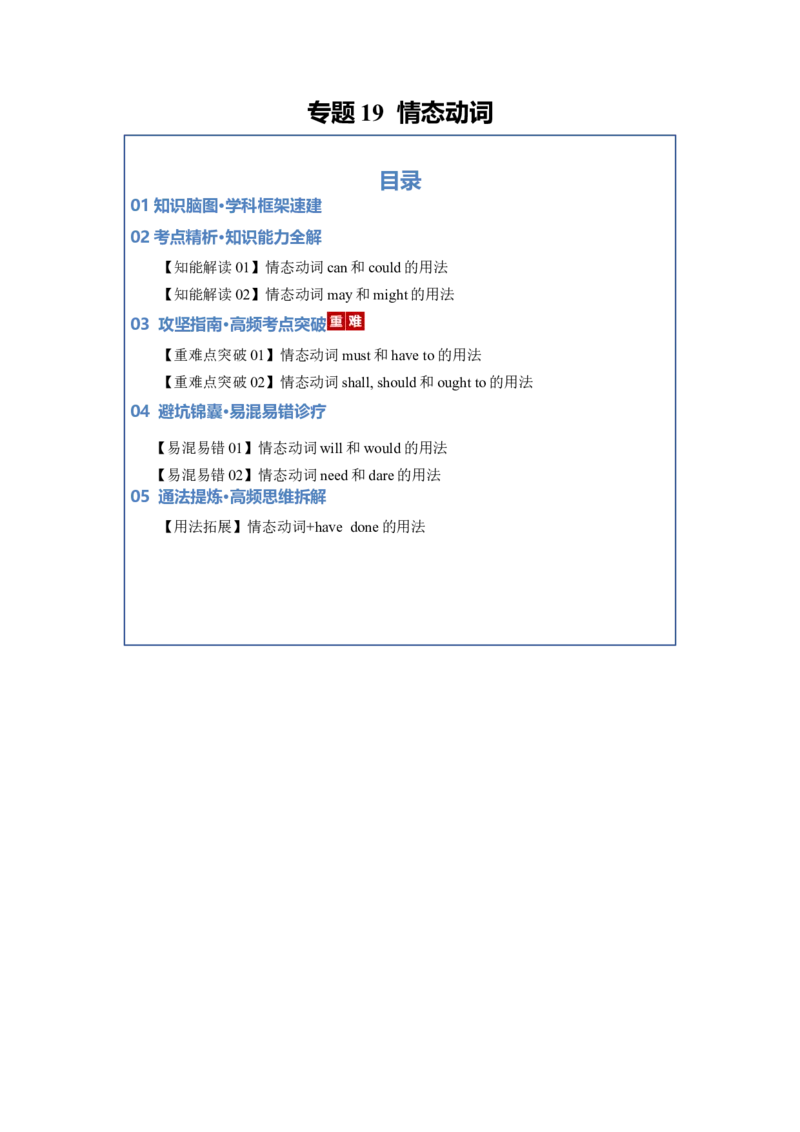
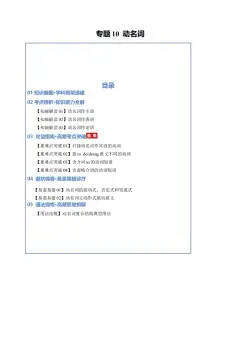
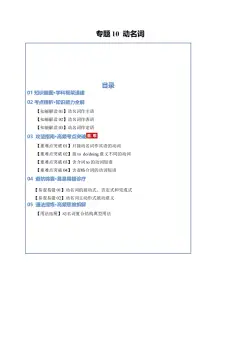
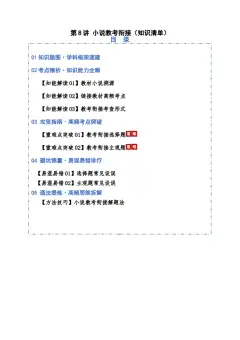
目录
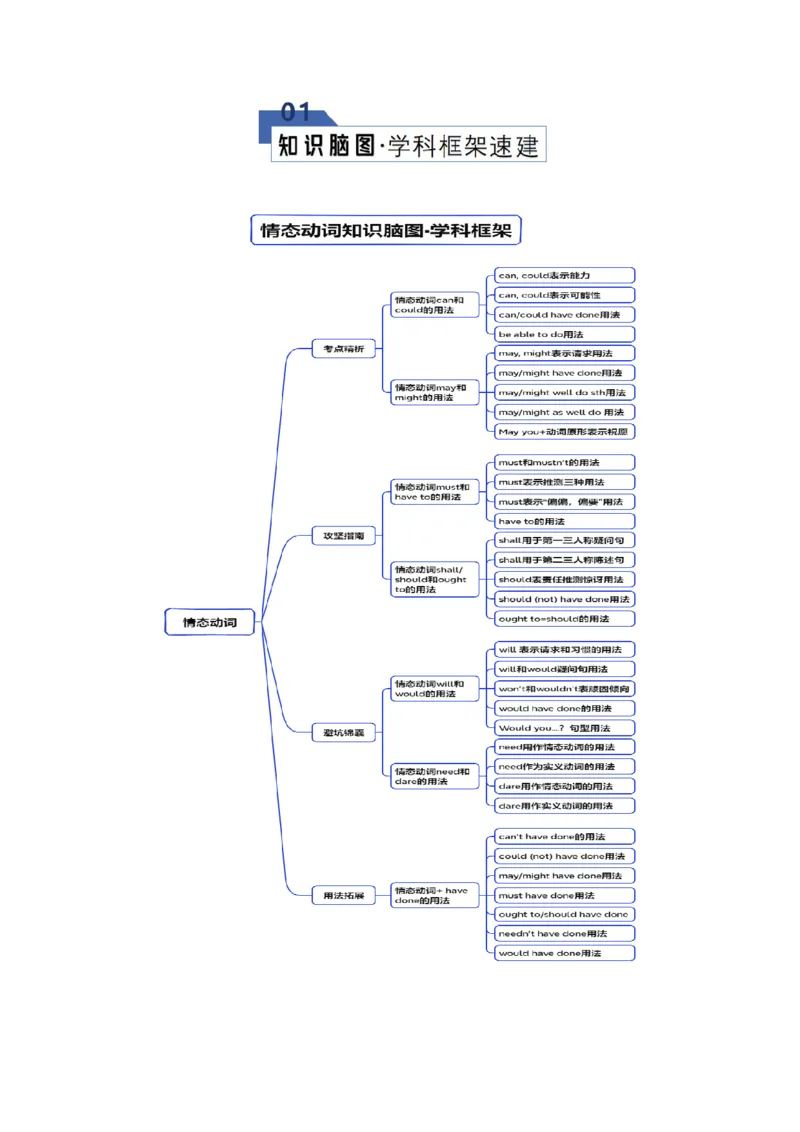
01 知识脑图·学科框架速建
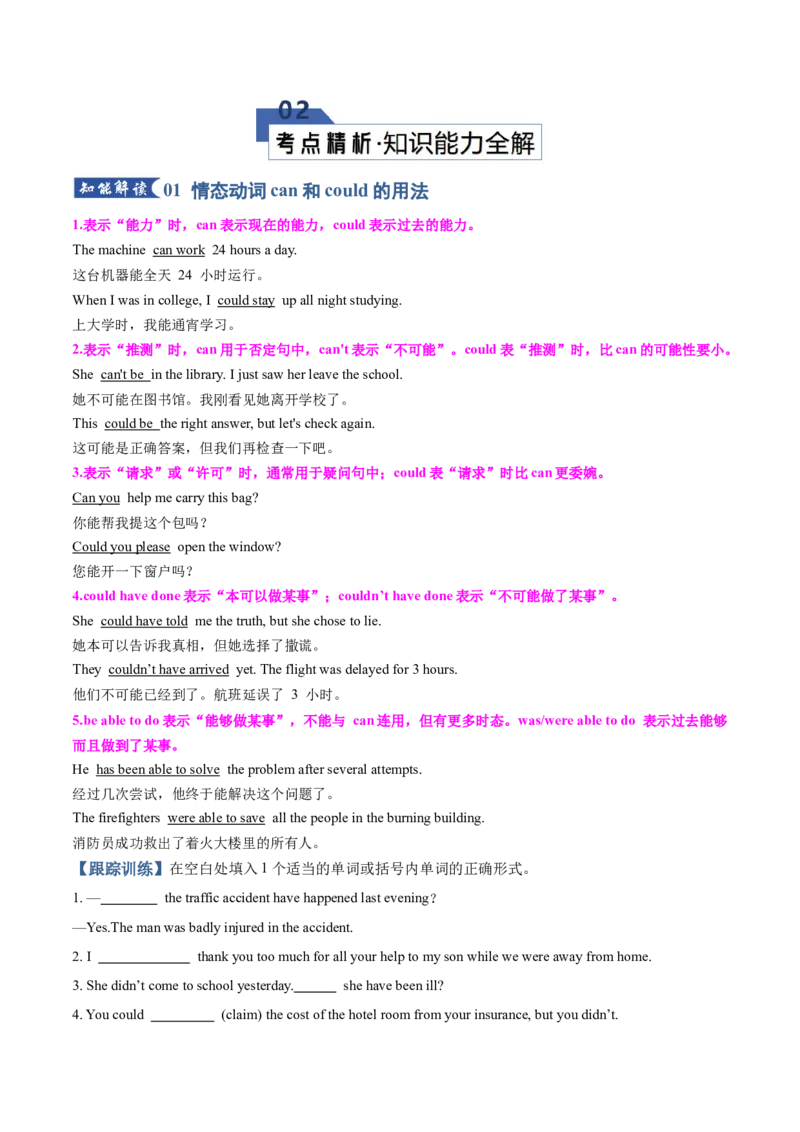
02 考点精析·知识能力全解
【知能解读01】情态动词can 和could 的用法
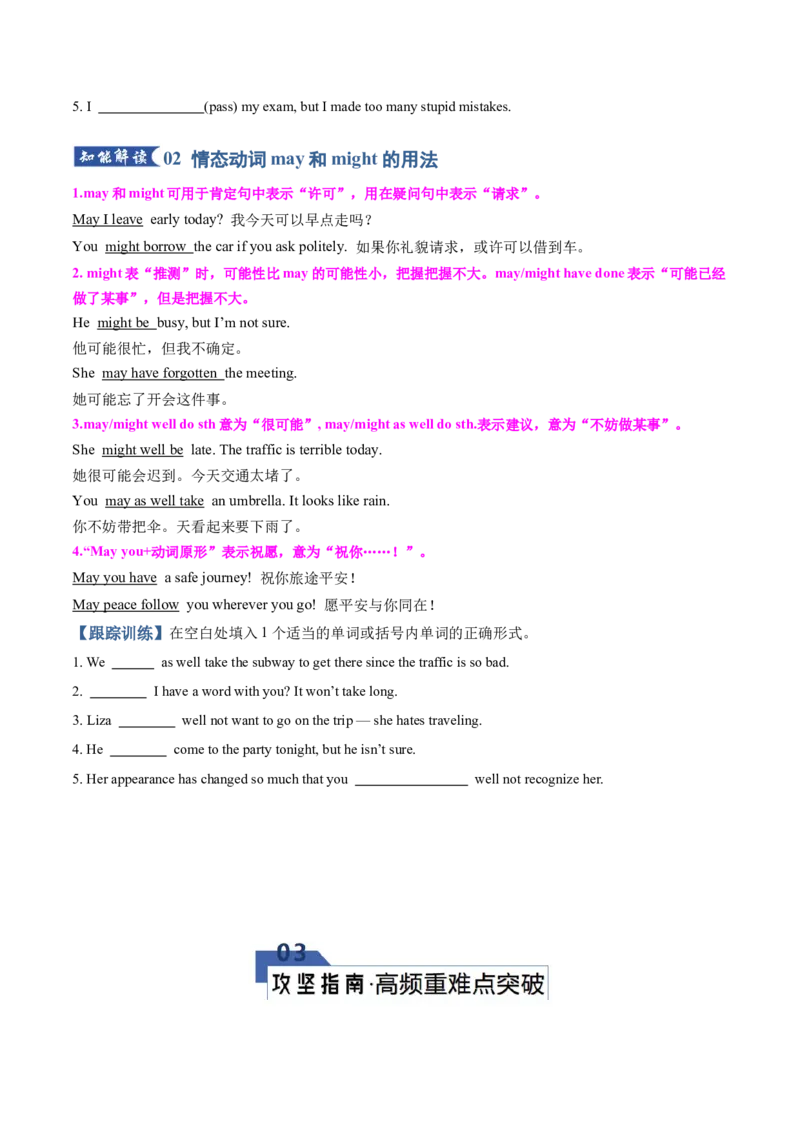
【知能解读02】情态动词may 和might 的用法
03 攻坚指南·高频考点突破
【重难点突破01】情态动词must 和have to 的用法
【重难点突破02】情态动词shall, should 和ought to 的用法
04 避坑锦囊·易混易错诊疗
【易混易错01】情态动词will 和would 的用法
【易混易错02】情态动词need 和dare 的用法
05 通法提炼·高频思维拆解
【用法拓展】情态动词+have done 的用法
01 情态动词can 和could 的用法
1.表示“能力”时,can 表示现在的能力,could 表示过去的能力。
The machine can work 24 hours a day.
这台机器能全天 24 小时运行。
When I was in college, I could stay up all night studying.
上大学时,我能通宵学习。
2.表示“推测”时,can 用于否定句中,can't 表示“不可能”。could 表“推测”时,比can 的可能性要小。
She can't be in the library. I just saw her leave the school.
她不可能在图书馆。我刚看见她离开学校了。
This could be the right answer, but let's check again.
这可能是正确答案,但我们再检查一下吧。
3.表示“请求”或“许可”时,通常用于疑问句中;could 表“请求”时比can 更委婉。
Can you help me carry this bag?
你能帮我提这个包吗?
Could you please open the window?
您能开一下窗户吗?
4.could have done 表示“本可以做某事”;couldn’t have done 表示“不可能做了某事”。
She could have told me the truth, but she chose to lie.
她本可以告诉我真相,但她选择了撒谎。
They couldn’t have arrived yet. The flight was delayed for 3 hours.
他们不可能已经到了。航班延误了 3 小时。
5.be able to do 表示“能够做某事”,不能与 can 连用,但有更多时态。was/were able to do 表示过去能够
而且做到了某事。
He has been able to solve the problem after several attempts.
经过几次尝试,他终于能解决这个问题了。
The firefighters were able to save all the people in the burning building.
消防员成功救出了着火大楼里的所有人。
【跟踪训练】在空白处填入1 个适当的单词或括号内单词的正确形式。
1. —         the traffic accident have happened last evening?
—Yes.The man was badly injured in the accident.
2. I               thank you too much for all your help to my son while we were away from home.
3. She didn’t come to school yesterday.       she have been ill?
4. You could           (claim) the cost of the hotel room from your insurance, but you didn’t.
5. I                (pass) my exam, but I made too many stupid mistakes.
02 情态动词may 和might 的用法
1.may 和might 可用于肯定句中表示“许可”,用在疑问句中表示“请求”。
May I leave early today? 我今天可以早点走吗?
You might borrow the car if you ask politely. 如果你礼貌请求,或许可以借到车。
2. might 表“推测”时,可能性比may 的可能性小,把握把握不大。may/might have done 表示“可能已经
做了某事”,但是把握不大。
He might be busy, but I’m not sure.
他可能很忙,但我不确定。
She may have forgotten the meeting.
她可能忘了开会这件事。
3.may/might well do sth 意为“很可能”, may/might as well do sth.表示建议,意为“不妨做某事”。
She might well be late. The traffic is terrible today.
她很可能会迟到。今天交通太堵了。
You may as well take an umbrella. It looks like rain.
你不妨带把伞。天看起来要下雨了。
4.“May you+动词原形”表示祝愿,意为“祝你……!”。
May you have a safe journey! 祝你旅途平安!
May peace follow you wherever you go! 愿平安与你同在!
【跟踪训练】在空白处填入1 个适当的单词或括号内单词的正确形式。
1. We        as well take the subway to get there since the traffic is so bad.
2.          I have a word with you? It won’t take long.
3. Liza          well not want to go on the trip — she hates traveling.
4. He          come to the party tonight, but he isn’t sure.
5. Her appearance has changed so much that you                  well not recognize her.
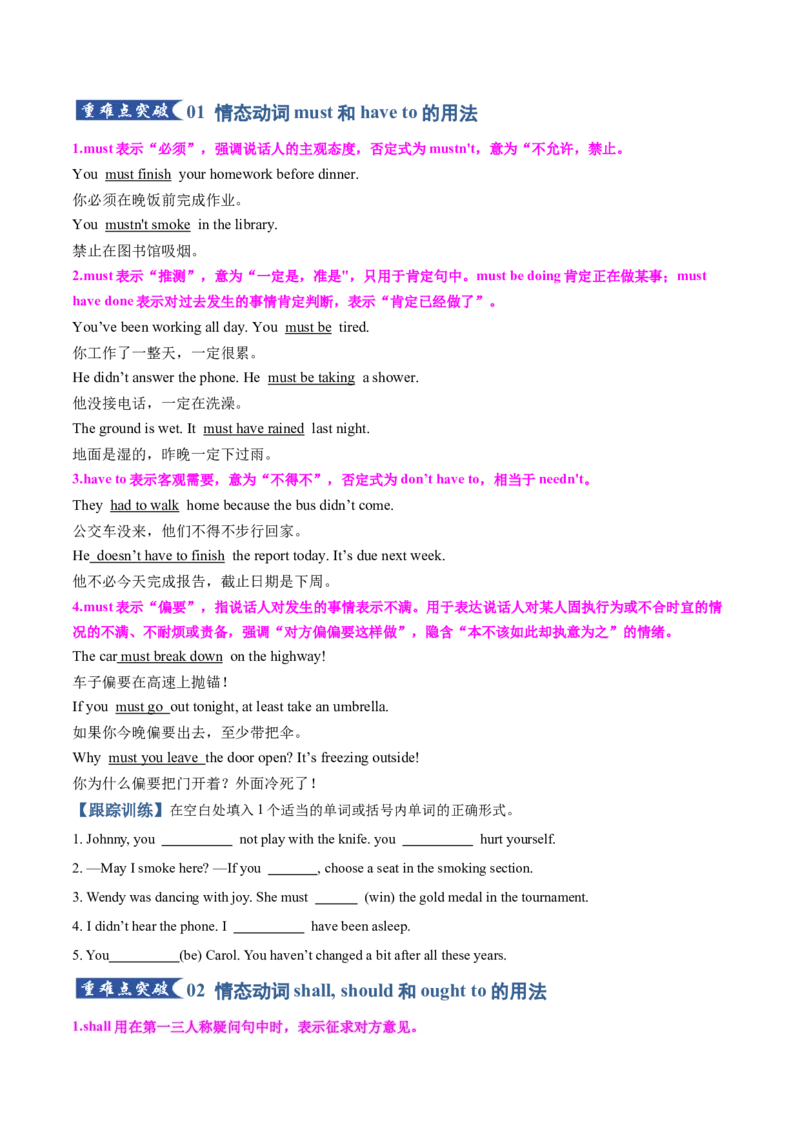
01 情态动词must 和have to 的用法
1.must 表示“必须”,强调说话人的主观态度,否定式为mustn't,意为“不允许,禁止。
You must finish your homework before dinner.
你必须在晚饭前完成作业。
You mustn't smoke in the library.
禁止在图书馆吸烟。
2.must 表示“推测”,意为“一定是,准是",只用于肯定句中。must be doing 肯定正在做某事;must
have done 表示对过去发生的事情肯定判断,表示“肯定已经做了”。
You’ve been working all day. You must be tired.
你工作了一整天,一定很累。
He didn’t answer the phone. He must be taking a shower.
他没接电话,一定在洗澡。
The ground is wet. It must have rained last night.
地面是湿的,昨晚一定下过雨。
3.have to 表示客观需要,意为“不得不”,否定式为don’t have to,相当于needn't。
They had to walk home because the bus didn’t come.
公交车没来,他们不得不步行回家。
He doesn’t have to finish the report today. It’s due next week.
他不必今天完成报告,截止日期是下周。
4.must 表示“偏要”,指说话人对发生的事情表示不满。用于表达说话人对某人固执行为或不合时宜的情
况的不满、不耐烦或责备,强调“对方偏偏要这样做”,隐含“本不该如此却执意为之”的情绪。
The car  must

   break down

  on the highway!
车子偏要在高速上抛锚!
If you must go out tonight, at least take an umbrella.
如果你今晚偏要出去,至少带把伞。
Why must you leave the door open? It’s freezing outside!
你为什么偏要把门开着?外面冷死了!
【跟踪训练】在空白处填入1 个适当的单词或括号内单词的正确形式。
1. Johnny, you            not play with the knife. you            hurt yourself.
2. —May I smoke here? —If you        , choose a seat in the smoking section.
3. Wendy was dancing with joy. She must        (win) the gold medal in the tournament.
4. I didn’t hear the phone. I            have been asleep.
5. You          (be) Carol. You haven’t changed a bit after all these years.
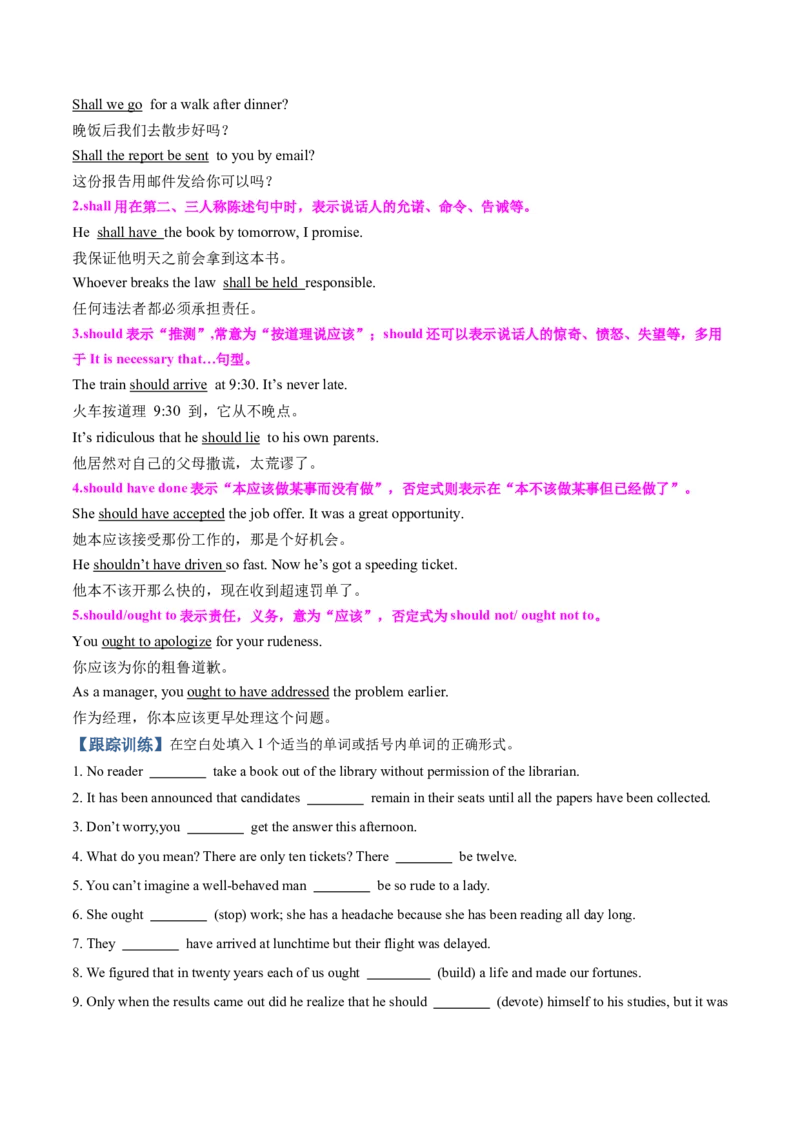
02 情态动词shall, should 和ought to 的用法
1.shall 用在第一三人称疑问句中时,表示征求对方意见。
Shall we go for a walk after dinner?
晚饭后我们去散步好吗?
Shall the report be sent to you by email?
这份报告用邮件发给你可以吗?
2.shall 用在第二、三人称陈述句中时,表示说话人的允诺、命令、告诫等。
He shall have the book by tomorrow, I promise.
我保证他明天之前会拿到这本书。
Whoever breaks the law shall be held responsible.
任何违法者都必须承担责任。
3.should 表示“推测”,常意为“按道理说应该”;should 还可以表示说话人的惊奇、愤怒、失望等,多用
于It is necessary that…句型。
The train should

   arrive

  at 9:30. It’s never late.
火车按道理 9:30 到,它从不晚点。
It’s ridiculous that he should

   lie
   to his own parents.
他居然对自己的父母撒谎,太荒谬了。
4.should have done 表示“本应该做某事而没有做”,否定式则表示在“本不该做某事但已经做了”。
She should have accepted the job offer. It was a great opportunity.
她本应该接受那份工作的,那是个好机会。
He shouldn’t have driven

   so fast. Now he’s got a speeding ticket.
他本不该开那么快的,现在收到超速罚单了。
5.should/ought to 表示责任,义务,意为“应该”,否定式为should not/ ought not to。
You ought to apologize for your rudeness.
你应该为你的粗鲁道歉。
As a manager, you ought to have addressed the problem earlier.
作为经理,你本应该更早处理这个问题。
【跟踪训练】在空白处填入1 个适当的单词或括号内单词的正确形式。
1. No reader          take a book out of the library without permission of the librarian.
2. It has been announced that candidates          remain in their seats until all the papers have been collected.
3. Don’t worry,you          get the answer this afternoon.
4. What do you mean? There are only ten tickets? There          be twelve.
5. You can’t imagine a well-behaved man          be so rude to a lady.
6. She ought          (stop) work; she has a headache because she has been reading all day long.
7. They          have arrived at lunchtime but their flight was delayed.
8. We figured that in twenty years each of us ought           (build) a life and made our fortunes.
9. Only when the results came out did he realize that he should          (devote) himself to his studies, but it was
too late.
10. I shouldn’t          (stay) up last night, or I wouldn’t be so sleepy now.
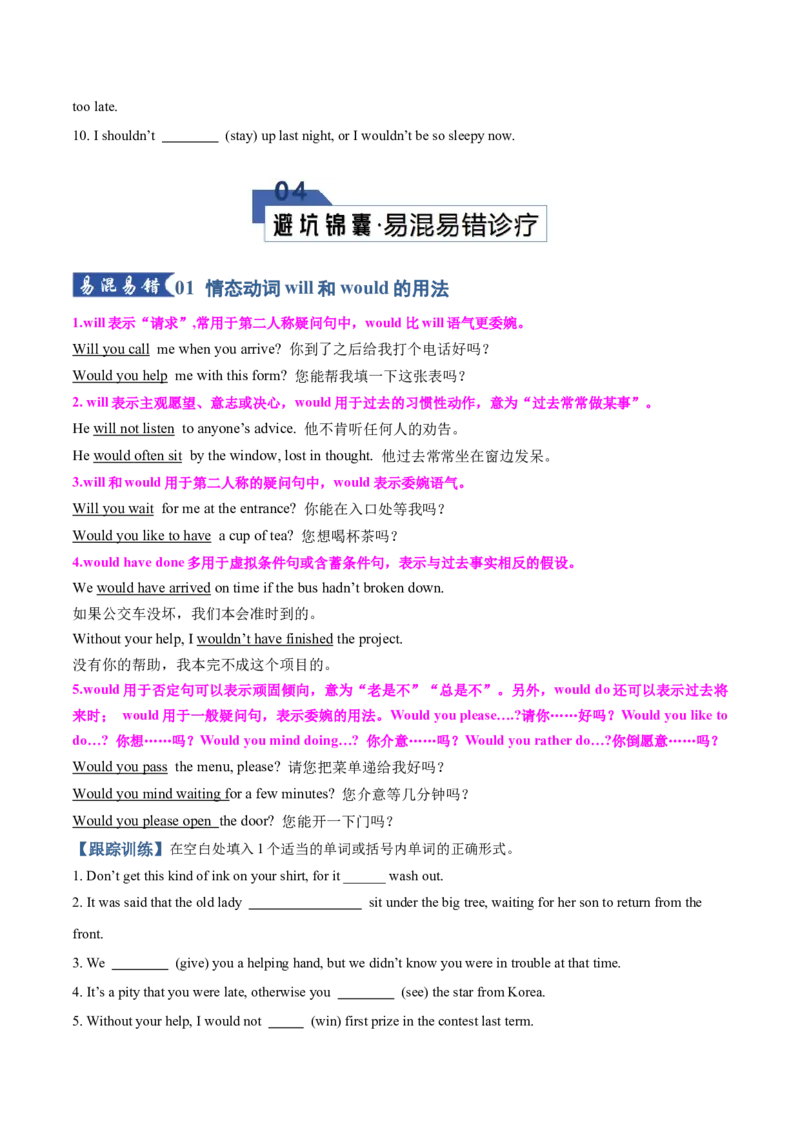
01 情态动词will 和would 的用法
1.will 表示“请求”,常用于第二人称疑问句中,would 比will 语气更委婉。
Will you call me when you arrive? 你到了之后给我打个电话好吗?
Would you help me with this form? 您能帮我填一下这张表吗?
2. will 表示主观愿望、意志或决心,would 用于过去的习惯性动作,意为“过去常常做某事”。
He will

   not listen

  to anyone’s advice. 他不肯听任何人的劝告。
He would

   often sit

  by the window, lost in thought. 他过去常常坐在窗边发呆。
3.will 和would 用于第二人称的疑问句中,would 表示委婉语气。
Will you wait for me at the entrance? 你能在入口处等我吗?
Would you like to have a cup of tea? 您想喝杯茶吗?
4.would have done 多用于虚拟条件句或含蓄条件句,表示与过去事实相反的假设。
We would have arrived on time if the bus hadn’t broken down.
如果公交车没坏,我们本会准时到的。
Without your help, I wouldn’t have finished the project.
没有你的帮助,我本完不成这个项目的。
5.would 用于否定句可以表示顽固倾向,意为“老是不”“总是不”。另外,would do 还可以表示过去将
来时; would 用于一般疑问句,表示委婉的用法。Would you please….?请你……好吗?Would you like to
do…? 你想……吗?Would you mind doing…? 你介意……吗?Would you rather do…?你倒愿意……吗?
Would you pass the menu, please? 请您把菜单递给我好吗?
Would you mind waiting for a few minutes? 您介意等几分钟吗?
Would you please open the door? 您能开一下门吗?
【跟踪训练】在空白处填入1 个适当的单词或括号内单词的正确形式。
1. Don’t get this kind of ink on your shirt, for it ______ wash out.
2. It was said that the old lady                  sit under the big tree, waiting for her son to return from the
front.
3. We          (give) you a helping hand, but we didn’t know you were in trouble at that time.
4. It’s a pity that you were late, otherwise you          (see) the star from Korea.
5. Without your help, I would not       (win) first prize in the contest last term.
02 情态动词need 和dare 的用法
1.need 用作情态动词,多用于否定句、疑问句,后接动词原形。needn’t have done 表示“本没必要做某事
但实际上做了”。
She needn’t worry about the exam—she’s well-prepared.
她没必要担心考试,她准备得很充分。
She needn’t have hurried to the airport. The flight was delayed for 2 hours.
她本没必要急着去机场,航班延误了 2 小时。
2.need 用作实意动词,接名词、代词、不定式作宾语。need doing=need to be done 表示需要做。
Do they need to book a hotel in advance?
他们需要提前预订酒店吗?
The broken window needs to be repaired.
这扇破窗户需要被修理。
3.dare 用作情态动词,多用于否定句、疑问句,只有dare 和dared 两种形式。I dare say...意为“我想,大概,
可能,或许……”。
She dare not go out alone at night.
她晚上不敢独自外出。
Dare he speak in front of the whole class?
他敢在全班面前发言吗?
She dared not go out alone when she was a child.
她小时候不敢独自外出。
4.dare 用作实意动词,接名不定式作宾语。
She didn’t dare (to) tell him the bad news.
她不敢告诉他这个坏消息。
Did they dare (to) argue with the teacher?
他们敢和老师争论吗?
【跟踪训练】在空白处填入1 个适当的单词或括号内单词的正确形式。
1. I          worry about my weekend — I always have my plans ready before it comes.
2. We suggest the data need            (update) every month.
3. He needn’t          (take) so much cash with him, you know — that shop accepted checks.
4. But there are still some dishes that Dad                not try even after many years of marriage to my
mother.
5. You            not return the book now. You can keep it till next week if you like.
 情态动词+have done 的用法
1.can’t have done 表示“不可能做了某事”。
The baby can’t have eaten a whole cake. She’s only one year old.
宝宝不可能吃掉一整块蛋糕,她才一岁。
He can’t have finished the work in an hour. It’s too complicated.
他不可能一小时内完成这项工作,太复杂了。
2.could have done 用于肯定句,表示“本可以做某事”。couldn’t have done 表示“不可能做了某事”。
He could have become a doctor, but he gave up the opportunity.
他本可以成为一名医生,但他放弃了这个机会。
She couldn’t have forgotten your birthday. You reminded her twice.
她不可能忘记你的生日,你提醒过她两次了。
3.may/might have done 用于肯定或否定句中,表示对过去的推测,意思是“也许已经┅,可能已经…”。
She may have forgotten our appointment. She’s been really busy lately.
她也许已经忘了我们的约会,她最近太忙了。
He might have made a mistake in the report, but I’m not sure.
他可能在报告里犯了个错,但我不确定。
4. must have done 只用于肯定句,表示对过去的推测,意思是“一定已经,想必已经,准是已经….”。
The door is locked. They must have left already.
门锁着,他们一定已经走了。
He didn’t answer the phone. He must have been busy at that moment.
他没接电话,那时候准是在忙。
5. should/ought to have done 表示“本应该做某事而没有做”; shouldn’t have done 表示在“本不该做某事
但已经做了”。
You shouldn’t have lied to your parents. They trust you.
你本不该对父母撒谎的,他们信任你。
She shouldn’t have opened

   your letter without permission.
她本不该未经允许就拆你的信。
6.needn’t have done 表示“作了不必做或不需要做的事”。
We needn’t have prepared so much food. Only five guests came.
我们本没必要准备这么多食物,只来了五位客人。
I needn’t have bought a new umbrella—the old one still works.
我本没必要买新伞的,旧的还能用。
【跟踪训练】下列各题均有一个最佳答案。
1. The spokesman did not regret what he had said at the conference but felt that he could          (express) it
indirectly.
2. You          have seen Mary at the meeting this morning, because she left for Beijing yesterday.
3. Tom was absent from the meeting. You         have informed him of the time.
4. You shouldn’t                (go) without telling us. We were really concerned about you.
5. Since nobody gave him any help, he must          (fix) the door on his own. It looks good though.
6. He          have completed his work; otherwise, he wouldn't be enjoying himself by the seaside.
7. I needn’t                (buy)so much wine—only five people came.
8. Xiao Ming was absent yesterday. He might            (catch) a cold, but I’m not sure.
9. Suddenly it occurred to me that I          have left my suitcase in the taxi. But I was not sure.
10. I couldn’t        (go)through that bitter period without your generous help.
一、单项选择
1.(2023·天津卷)We _________bother with details, for our teammates will do everything in their power to help
us.
A. mustn’t
B. daren’t
C. needn’t
D. can’t
2.(2021·天津卷)---I honestly don't think I'm going to be admitted.
---Well, you never know! You________ a better impression than you think.
A. may have made                        B. should have made
C. couldn't have made                     D. needn't have made
3.(2021·天津卷)It used to be that you __________drive for miles here without seeing another person, but now
情态动词综合能力提升
there are houses and people everywhere.
A. need
B. should
C. could
D. must
4.(2020·江苏卷)If I hadn’t been faced with so many barriers, I _____where I am.
A. won’t be
B. wouldn’t have been
C. wouldn’t be
D. shouldn’t have been
5.(2018·天津·高考卷)I can't find my purse. I___________ it in the supermarket yesterday, but I'm not sure.
A. should leave        B. must have left      C. might leave      D. could have left
6.(2020·天津卷)You ____________ have scolded him for his poor performance. After all, he had done his best.
A. must
B. should
C. mustn’t
D. shouldn't
7.(2018·天津卷)—What’s wrong with the door?
—The key has got stuck in it and ______ come out.
A. shouldn’t
B. mustn’t
C. needn’t
D. won’t
8.(2019·天津卷)Paul did a great job in the speech contest. He _________ many times last week.
A. need have practised
B. might practise
C. must have practised
D. could practise
9.(2015·天津卷)I ______ have worried before I came to the new school, for my classmates here are very
friendly to me.
A. mightn’t           B. mustn’t             C. needn’t
        D. couldn’t
10.(2015·重庆卷)You ________ be Carol. You haven’t changed a bit after all these years.
A. must
B. can
C. will
D. shall
11.(2015·福建卷)—Sorry, Mum! I failed the job interview again.
—Oh, it's too bad. You________ have made full preparations.
A. must
B. can
C. would
D. should
12.(2014·重庆卷)I’ve ordered some pizza, so we _______ worry about cooking when we get home tired.
A. can’t
B. dare not
C. needn’t
D. may not
13.(2017·天津·高考卷)My room is a mess, but I __________clean it before I go out tonight. I can do it in the
morning.
A. daren’t            B. shouldn’t          C. needn’t          D. mustn’t
14.(2011·重庆卷)—Why didn’t you come to Simon’s party last night?
—I wanted to, but my mom simply ________ not let me out so late at night.
A. could              B. might             C. would          D. should
15.(2011·北京卷)—I don’t really like James. Why did you invite him?
—Don’t worry. He ______________come. He said he wasn’t certain what his plans were.
A. must not
B. need not
C. would not
D. might not
二、单句填空。
1.Even worse, I had unthinkingly bought way too much;  I ________ have made six salads with what I threw out.
2. In college I had been taught that a successful educator ________ ignore bad behavior.
3. There were times when we ________ get lunch together and be in the library, working silently sidebyside.
4. It had the soldier's name and army number, so he supposed that the message ________ be real.
5. When you introduce me to the businessman, ________ you please say something for me?
6. Officials say they are not sure exactly what persuaded the elephants to make their long trip; some experts say the
elephants ________ have left because their leader ________ have gotten lost.
7. However, it may be not easy to cheer up your friends when you ________ be by their side.
8. A geneticist (遗传学家) says that individuals who are effortlessly thin ________ hold the key to understanding
obesity.
9. ________ you make so much noise?
10. With our school's annual Sports Day approaching, I ________ help thinking of my sports experience.
11. I can't find Charlie anywhere; I think the mailman ________ have forgotten to close the gate.
12. Darling, our son has grown up and is quite independent now; you ________ be too concerned about him.
13. I can't understand why he ________ have been so angry; I meant no offence.
14. You ________ not have success right away, but that doesn't mean you ________ have it at all.
15. According to the school rule, no child ________ be allowed out of the school, unless accompanied by his or her
own parents.